Physics 9702/23 — October/November 2013
Cambridge AS Level · AS Level Structured Questions · worked solutions for every part, with the mark scheme
Topics Dynamics · Forces, Density and Pressure · Kinematics · Work, Energy and Power · Physical Quantities and Units · Deformation of Solids · +4 more
A cylindrical disc is shown in Fig. 1.1.
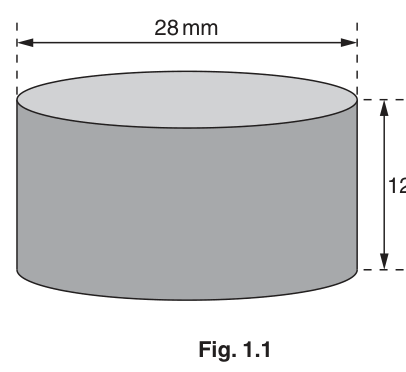
The disc has diameter and thickness .
The material of the disc has density .
Calculate, to two significant figures, the weight of the disc.
weight = ______
Working
Diameter so radius
Thickness
Answer
(2 s.f.)
0.49 N
Background Concept
For an object of uniform density , its mass is found from its volume using
Weight is the gravitational force on the mass in a gravitational field of strength :
Here, is in , so must be in to keep units consistent.
A cylindrical disc is a cylinder, so its volume is
where is the radius and is the thickness (height).
Understanding the Question
You are given:
- diameter (so you must halve it to get radius),
- thickness ,
- density .
You must calculate the weight in newtons, to two significant figures. So the path is:
- convert mm to m,
- find of the cylinder,
- find ,
- find .
Approach
- Convert all lengths to metres because the density is in SI units.
- Use the cylinder formula .
- Multiply by density to get mass.
- Multiply by (take unless otherwise stated) to get weight.
- Round the final value to 2 s.f.
Step-by-Step Reasoning
- Convert dimensions:
- Radius is half the diameter:
- Thickness:
- Volume of cylinder:
Compute:
- Mass from density:
- Weight:
To two significant figures:
Key Takeaways
- Always convert to SI units before using formulas involving in .
- For a disc-shaped cylinder, use with diameter.
- Weight is a force: and is measured in newtons.
Common Mistakes
- Using diameter instead of radius in (this makes the volume 4 times too big).
- Forgetting to convert mm to m, leading to a volume error of .
- Giving the final answer in kg (mass) instead of N (weight).
- Rounding too early (can shift the final 2 s.f. answer).
Things to Be Careful About
- Unit consistency: is essential because is required.
- Significant figures: only the final answer needs to be to 2 s.f.; keep extra digits during intermediate steps.
- Use the value of expected by the exam (typically unless told otherwise).
The rest of this paper
6 more questions- Q2Physical Quantities and Units6M
- Q3Kinematics · Dynamics10M
- Q4Work, Energy and Power · Deformation of Solids · Kinematics · Dynamics10M
- Q5Waves9M
- Q6D.C. Circuits · Electricity · Work, Energy and Power10M
- Q7Electric Fields · Forces, Density and Pressure11M