Physics 9702/21 — October/November 2013
Cambridge AS Level · AS Level Structured Questions · worked solutions for every part, with the mark scheme
Topics Physical Quantities and Units · Waves · Work, Energy and Power · Dynamics · Forces, Density and Pressure · Electricity · +3 more
Answer all the questions in the spaces provided.
State two SI base units other than the kilogram, metre and second.
- ______
- ______
Answer
- (ampere)
- (kelvin)
A and K (any two of A, K, mol, cd)
Background Concept
The SI system has seven base quantities, each with a base unit:
- length (metre, )
- mass (kilogram, )
- time (second, )
- electric current (ampere, )
- temperature (kelvin, )
- amount of substance (mole, )
- luminous intensity (candela, )
All other units (newton, joule, volt, etc.) are derived from these.
Understanding the Question
You are asked to state two SI base units, but you are not allowed to use , , or . So you must choose from the remaining four base units.
Approach
List the remaining SI base units and state any two.
Step-by-Step Reasoning
- The seven base units are , , , , , , .
- Excluding , , leaves , , , .
- Any two of these are acceptable, e.g. ampere and kelvin.
Key Takeaways
- Know the seven SI base units.
- Be able to distinguish base units from derived units.
Common Mistakes
- Giving a derived unit such as or (not base units).
- Writing a base quantity name (e.g. “temperature”) instead of the unit (kelvin, ).
- Using one of the excluded units (, , ).
Things to Be Careful About
- Use correct unit symbols and capitalisation: and are capital letters; is lower case.
A metal wire has original length . It is then suspended and hangs vertically as shown in Fig. 1.1.
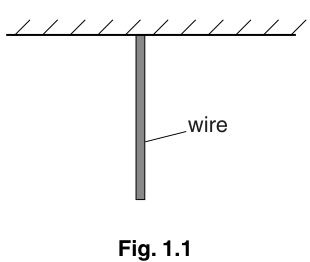
The weight of the wire causes it to stretch. The elastic potential energy stored in the wire is .
Show that the SI base units of are .
Working
Energy has units of work:
So
Answer
kg m^2 s^-2
Background Concept
Energy is measured in joules (). A joule can be defined from mechanical work:
where is force and is distance moved in the direction of the force.
The unit of force is the newton (), and from Newton’s second law:
so
Understanding the Question
You are asked to show the SI base units of the elastic potential energy . Even though the context is an elastic wire, the unit of energy is the same for all forms of energy.
Approach
Convert energy to base units by:
- using so
- writing in base units using
- multiplying by .
Step-by-Step Reasoning
- Start from work/energy:
- Write force in base units:
- Multiply by distance (unit ):
This matches the expected base units of the joule.
Key Takeaways
- Energy (joule) in base units is .
- A reliable route is with .
Common Mistakes
- Stopping at without converting to base units.
- Writing (missing a power of ).
- Confusing mass () with weight ().
Things to Be Careful About
- Keep track of indices carefully when multiplying units: .
- Use negative indices for seconds: , not “per second squared”.
The elastic potential energy is given by
where is the density of the metal,
is the acceleration of free fall,
is the cross-sectional area of the wire
and is a constant.
Determine the SI base units of .
SI base units of = ______
Working
Given
Base units:
So
Hence
Answer
kg^-1 m s^2
Background Concept
Dimensional (unit) analysis uses the fact that an equation must be homogeneous: both sides must have the same dimensions/units.
If
then the units of must “fix” the units of the product so that the final units match those of energy .
Key base-unit expressions:
- density:
- acceleration:
- area:
- length:
- energy:
Understanding the Question
You are given a formula for elastic potential energy in terms of density , gravitational field strength , cross-sectional area , original length , and a constant .
The task is not to calculate a number but to determine what SI base units must have for the equation to be dimensionally consistent.
Approach
- Write each quantity () in SI base units.
- Find the combined units of by applying powers and multiplying.
- Rearrange unit-wise:
Step-by-Step Reasoning
- List base units:
- Multiply the units on the right-hand side excluding :
- kilograms: only from , so
- metres: add powers: , so
- seconds: only from , so
Therefore:
- Solve for :
Divide by subtracting indices:
So:
Key Takeaways
- Dimensional homogeneity lets you find the units of an unknown constant.
- When multiplying quantities, add indices; when dividing, subtract indices.
- Writing everything in base units avoids mistakes.
Common Mistakes
- Using (forgetting density is per volume, ).
- Forgetting to square and .
- Adding indices incorrectly for the metre powers (this is the most common arithmetic slip).
- Giving the unit as (missing the negative power on ).
Things to Be Careful About
- Check each quantity’s physical meaning before writing units: is area (), not .
- Keep the base-unit form consistent (use , , only).
- A quick sanity check: since has but only has , must include , which matches the result.
The rest of this paper
6 more questions- Q2Waves7M
- Q3Work, Energy and Power · Dynamics8M
- Q4Forces, Density and Pressure8M
- Q5Waves9M
- Q6Electricity · Physical Quantities and Units · D.C. Circuits12M
- Q7Electric Fields · Particle Physics9M