Physics 9702/35 — October/November 2011
Cambridge AS Level · Advanced Practical Skills · worked solutions for every part, with the mark scheme
Topics Manipulation, Measurement and Observation · Presentation of Data and Observations · Analysis, Conclusions and Evaluation
In this experiment you will investigate how the depth to which a beaker is submerged in water depends on the mass added to the beaker.
Measure and record the height of the beaker as shown in Fig. 1.1.
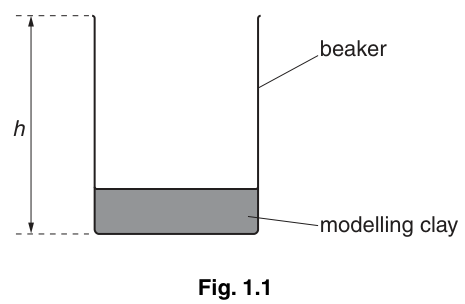
= ______
Place the beaker from (a) inside the larger container, which contains water.
The beaker will float in the water and may tilt to one side.
Measure and record the distance between the lowest point of the bottom of the beaker and the water surface as shown in Fig. 1.2.
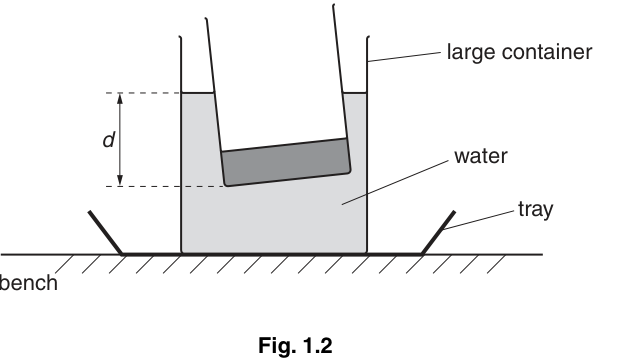
This measurement should be taken from outside the large container.
= ______
Carefully place the mass on top of the modelling clay in the beaker.
For this added mass of , measure and record the new distance .
= ______
Change the added mass in the small beaker and measure .
Repeat this until you have six sets of readings of and .
Include values of and in your table.
Plot a graph of on the -axis against on the -axis.
Draw the straight line of best fit.
Determine the gradient and -intercept of this line.
gradient = ______
-intercept = ______
It is suggested that the quantities and are related by the equation
where and are constants.
Use your answers in (a) and (e)(iii) to determine the least value of that would be needed to completely submerge the beaker.
Give an appropriate unit.
= ______
The rest of this paper
1 more questions- Q2Manipulation, Measurement and Observation · Analysis, Conclusions and Evaluation · Presentation of Data and Observations20M