Physics 9702/23 — October/November 2011
Cambridge AS Level · AS Level Structured Questions · worked solutions for every part, with the mark scheme
Topics Dynamics · Physical Quantities and Units · Forces, Density and Pressure · Kinematics · Work, Energy and Power · Deformation of Solids · +4 more
Answer all the questions in the spaces provided.
Distinguish between scalars and vectors.
Answer
A scalar has magnitude only.
A vector has magnitude and direction.
Scalar: magnitude only. Vector: magnitude and direction.
Background Concept
Physical quantities can be classified by whether they require direction information.
- A scalar quantity is fully described by a magnitude (a single number with a unit).
- A vector quantity requires both magnitude and direction to be fully described.
Understanding the Question
You are asked to distinguish (i.e. clearly state the difference between) scalars and vectors.
Approach
Give the defining feature of each type:
- scalar: magnitude only
- vector: magnitude and direction
Step-by-Step Reasoning
- Write what information is needed to specify a scalar: only size (with units).
- Write what extra information is needed for a vector: a direction as well as size.
Key Takeaways
- Scalars: one value (with unit).
- Vectors: value (with unit) plus direction.
Common Mistakes
- Saying “vectors have direction” but forgetting to mention they also have magnitude.
- Giving examples only, without stating the defining difference (often loses the mark if the question asks to distinguish).
Things to Be Careful About
- Words like “speed” vs “velocity” can be confusing: speed is scalar, velocity is vector because velocity includes direction.
Underline all the vector quantities in the list below.
acceleration kinetic energy momentum power weight
Answer
Vector quantities: acceleration, momentum, weight.
acceleration, momentum, weight
Background Concept
A vector requires direction; a scalar does not.
Typical examples:
- Vectors: displacement, velocity, acceleration, force, momentum, weight.
- Scalars: mass, time, energy, power, temperature.
Understanding the Question
From the list
- acceleration
- kinetic energy
- momentum
- power
- weight
you must select only those that need direction as well as magnitude.
Approach
Go through each quantity and decide: does it need direction?
Step-by-Step Reasoning
- Acceleration: change of velocity per unit time, so it has direction (vector).
- Kinetic energy: energy depends on speed, not direction (scalar).
- Momentum: , so it has the same direction as velocity (vector).
- Power: rate of energy transfer, no direction (scalar).
- Weight: a force (gravitational force), acts vertically downward (vector).
Key Takeaways
- If a quantity is a type of force or depends on a vector like velocity, it is usually a vector.
- Energies and rates like power are typically scalars.
Common Mistakes
- Choosing kinetic energy as a vector because it relates to velocity (it depends on , so direction cancels).
- Forgetting weight is a force and therefore a vector.
Things to Be Careful About
- “Momentum” is a vector even though you may often only calculate its magnitude in 1D problems.
A force of acts at to the horizontal, as shown in Fig. 1.1.
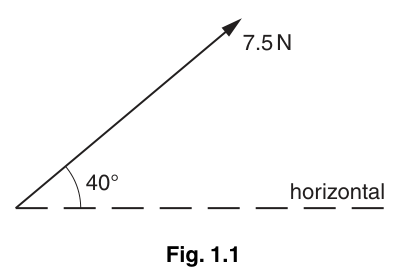
Calculate the component of the force that acts
horizontally,
horizontal component = ______
Working
Horizontal component
Answer
5.7 N
Background Concept
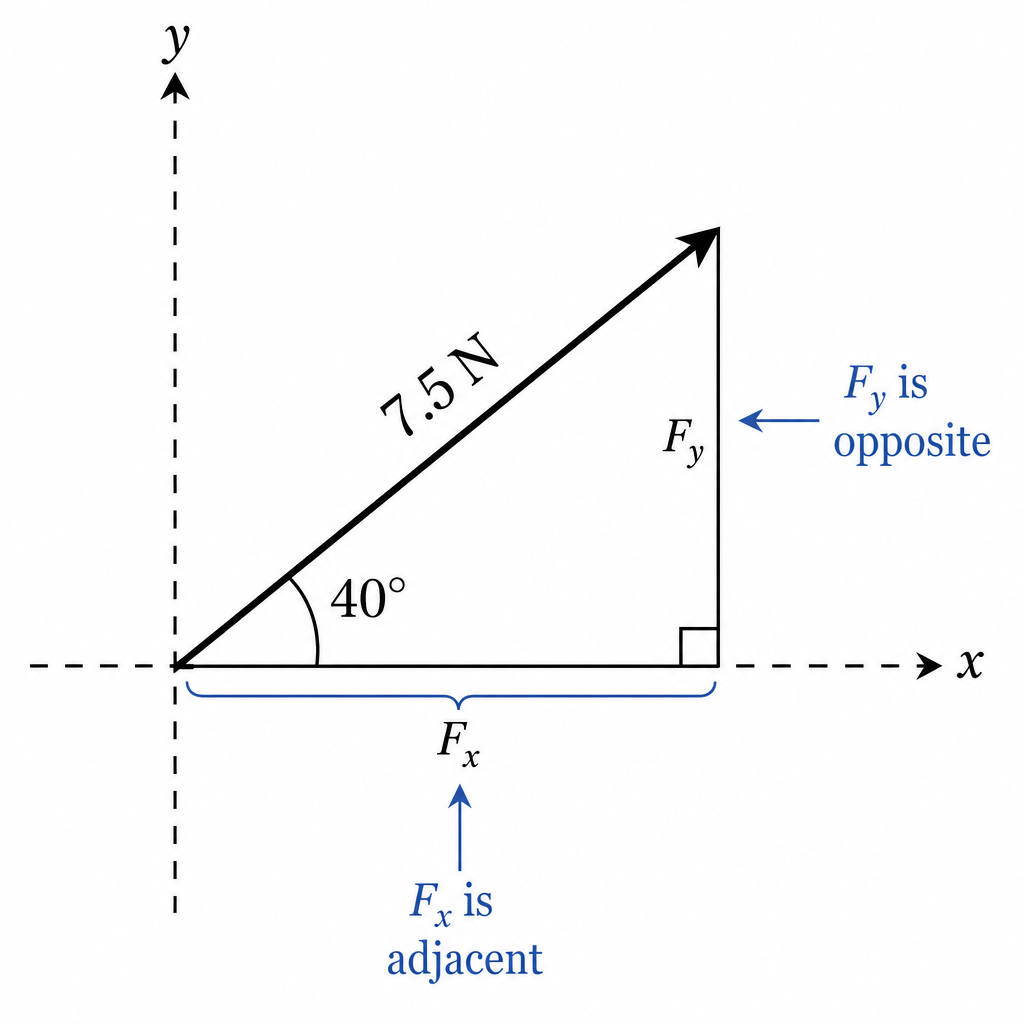
Any vector can be split into perpendicular components (usually horizontal and vertical). If a force makes an angle to the horizontal, then:
The cosine corresponds to the adjacent side to the angle, and sine to the opposite side.
Understanding the Question
A force of acts at above the horizontal. You are asked only for the horizontal component (the part acting along the horizontal direction).
Approach
Use the component formula with cosine because the given angle is from the horizontal.
Step-by-Step Reasoning
- Identify and measured from the horizontal.
- Horizontal component:
- Calculate:
Key Takeaways
- Angle to the horizontal: horizontal uses , vertical uses .
- Components are always smaller than the original vector (unless angle is or ).
Common Mistakes
- Swapping sine and cosine (giving for the horizontal component).
- Forgetting the unit N.
Things to Be Careful About
- Check what the angle is measured from. If the angle were to the vertical, the trig functions would swap.
- Rounding: give a sensible number of significant figures (typically 2 s.f. here).
vertically.
vertical component = ______
Working
Vertical component
Answer
4.8 N
Background Concept
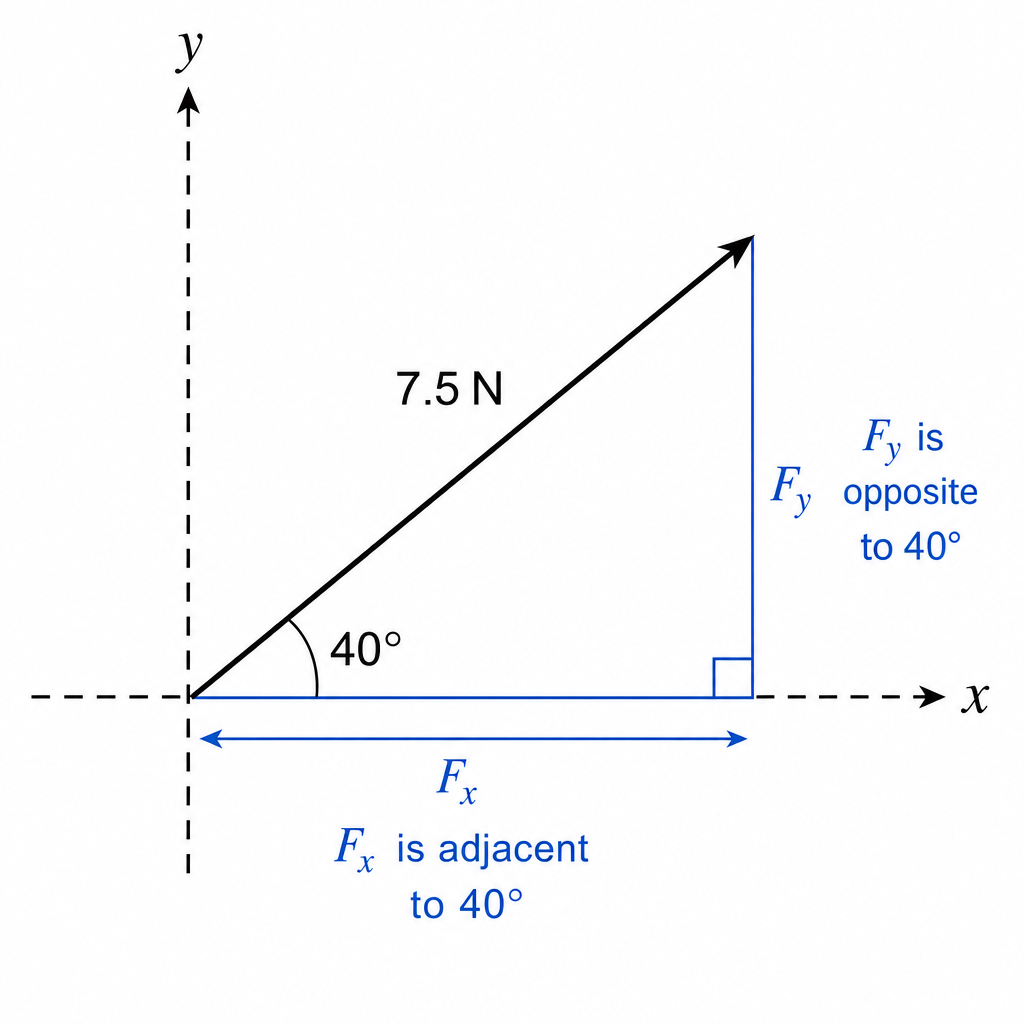
When a force is at an angle to the horizontal, the vertical component is the side opposite in the right triangle, so it is given by sine:
Understanding the Question
The same force of acts at above the horizontal, and now you need the vertical component.
Approach
Use because the given angle is to the horizontal.
Step-by-Step Reasoning
- Take , .
- Vertical component:
- Evaluate:
Key Takeaways
- With angle to the horizontal, vertical component uses sine.
- Components depend on the choice of axes; here axes are horizontal/vertical.
Common Mistakes
- Using cosine for the vertical component when the angle is given to the horizontal.
- Giving the correct number but with wrong unit or missing unit.
Things to Be Careful About
- Ensure the angle used in the calculator is in degrees, not radians.
- Do not round too early if you are using the value in later calculations.
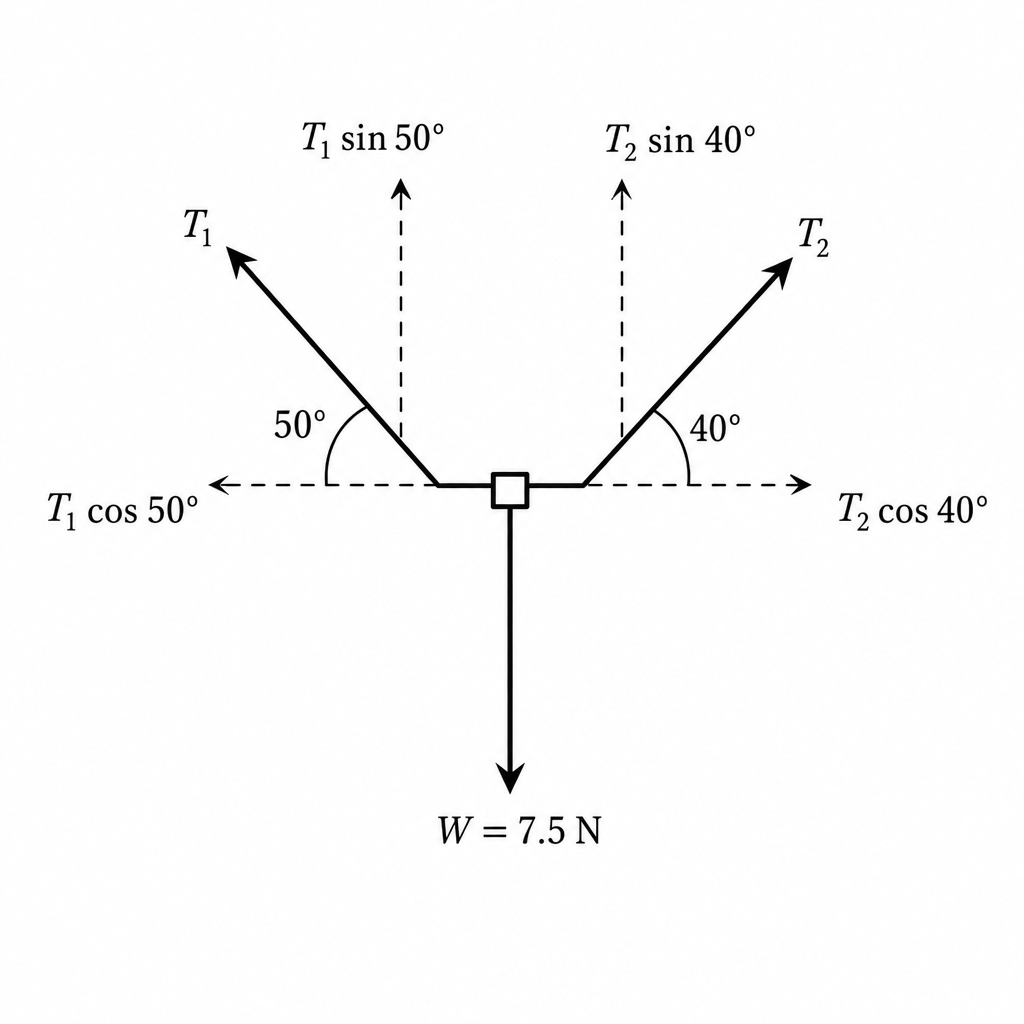
Two strings support a load of weight , as shown in Fig. 1.2.
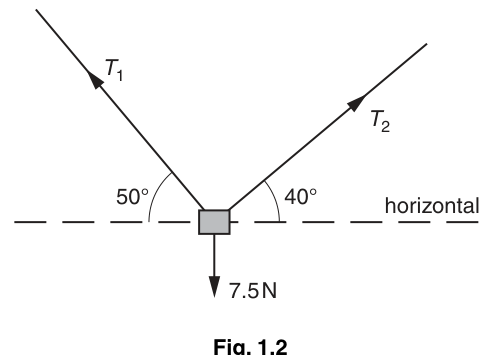
One string has a tension and is at an angle to the horizontal. The other string has a tension and is at an angle to the horizontal. The object is in equilibrium.
Determine the values of and by using a vector triangle or by resolving forces.
= ______
= ______
Working
In equilibrium, take rightward and upward as positive.
Horizontal:
Vertical:
From horizontal,
Substitute into vertical:
Answer
T1 = 5.7 N, T2 = 4.8 N
Background Concept
For a body in equilibrium, the resultant force is zero. In 2D this means the sum of components in each perpendicular direction is zero:
When forces are at angles, we resolve each force into horizontal and vertical components using sine and cosine with the angle given.
Understanding the Question
A load of weight is supported by two strings:
- tension at to the horizontal
- tension at to the horizontal
The load is at rest, so forces balance. You must determine and .
Approach
- Draw a free-body diagram of the load showing three forces: , , and weight downward.
- Resolve the tensions into horizontal and vertical components.
- Apply equilibrium:
- horizontal components cancel
- vertical components add to
- Solve the two simultaneous equations for and .
Step-by-Step Reasoning
- Resolve horizontally (take right as positive). One tension pulls left, the other pulls right, so their horizontal components must be equal in magnitude:
- Resolve vertically (up positive). Both tensions have upward components, balancing the weight:
- Use the horizontal equation to express in terms of :
- Substitute into the vertical equation:
-
Solve for (numerically this gives ), then substitute back to get .
-
Quote to appropriate significant figures:
Key Takeaways
- In equilibrium, resolve forces and apply and .
- Always relate sine/cosine to the angle given (here angles are to the horizontal).
Common Mistakes
- Using and the wrong way round (common when unsure what the angle is measured from).
- Setting vertical components equal (they do not cancel; they add to balance the weight).
- Forgetting there are two independent equations needed to find two unknown tensions.
Things to Be Careful About
- Keep a consistent sign convention (e.g. right/up positive) before writing equations.
- Ensure calculator is in degrees.
- Quote units (N) and sensible significant figures.
The rest of this paper
5 more questions- Q2Kinematics · Dynamics10M
- Q3Work, Energy and Power · Deformation of Solids · Dynamics13M
- Q4D.C. Circuits10M
- Q5Waves8M
- Q6Electric Fields · Particle Physics · Dynamics10M