Physics 9702/34 — May/June 2011
Cambridge AS Level · Advanced Practical Skills · worked solutions for every part, with the mark scheme
Topics Manipulation, Measurement and Observation · Analysis, Conclusions and Evaluation · Presentation of Data and Observations
In this experiment, you will investigate the angle through which a loaded beaker rolls as a turning force is applied.
The apparatus has been assembled as shown in Fig. 1.1.
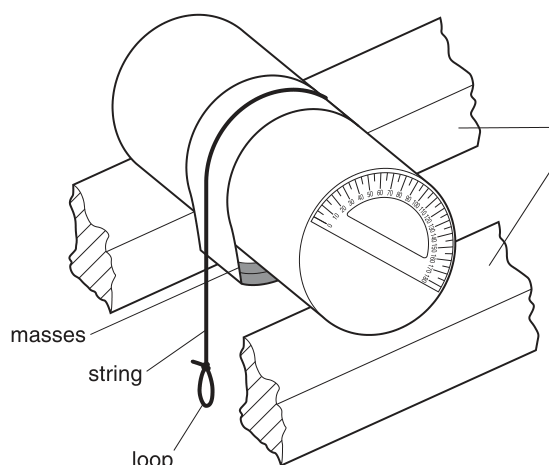
Make sure that the beaker is positioned so that the masses do not touch the rails.
Using the set square, measure and record the angle , as shown in Fig. 1.2.
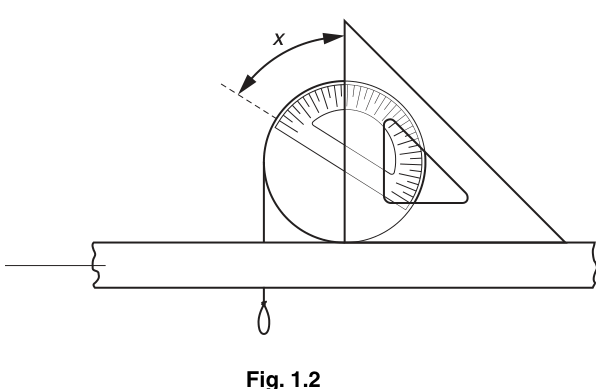
= ______
Hook the mass hanger on the string loop. Record the mass that is suspended from the loop.
= ______
Wait for the beaker to stop moving, making sure that the beaker is positioned so that the masses do not touch the rails.
Using the set square, measure and record the angle , as shown in Fig. 1.3.
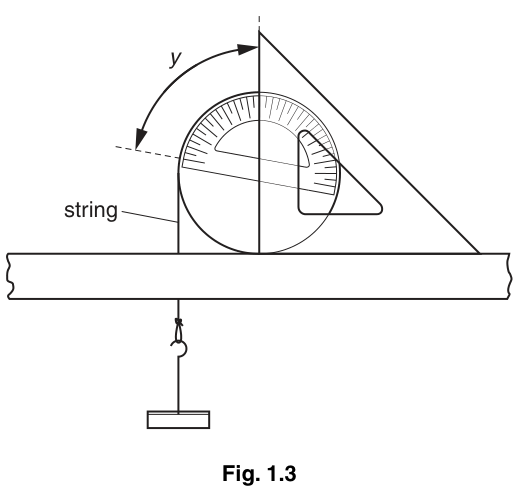
= ______
Calculate , where .
= ______
Change by adding masses to the hanger and repeat (d)(ii), (d)(iii) and (d)(iv).
Repeat this procedure until you have six sets of values for (the total suspended mass) and angle .
Include in your table values for (using your answer from (c)) and .
Plot a graph of on the -axis against on the -axis.
Draw the straight line of best fit.
Determine the gradient and -intercept of this line.
gradient = ______
-intercept = ______
Unhook the masses from the string loop and remove the beaker from the rails.
Take measurements to determine the radius of the beaker.
= ______
It is suggested that the relationship between and is
where and are constants.
Using your answers from (f)(iii) and (g)(ii), determine the value of . Give an appropriate unit.
= ______
The rest of this paper
1 more questions- Q2Manipulation, Measurement and Observation · Analysis, Conclusions and Evaluation20M