Physics 9702/23 — May/June 2011
Cambridge AS Level · AS Level Structured Questions · worked solutions for every part, with the mark scheme
Topics Physical Quantities and Units · Forces, Density and Pressure · Dynamics · Kinematics · Deformation of Solids · Work, Energy and Power · +4 more
For each of the following, tick [✓] one box to indicate whether the experimental technique
would reduce random error, systematic error or neither. The first row has been completed
as an example.
| random error | systematic error | neither | |
|---|---|---|---|
| keeping your eye in line with the scale and the liquid level for a single reading of a thermometer | ✓ | ||
| averaging many readings of the time taken for a ball to roll down a slope | |||
| using a linear scale on an ammeter | |||
| correcting for a non-zero reading when a micrometer screw gauge is closed |
The measurement of a particular time interval is repeated many times. The readings are
found to vary. The results are shown in Fig. 1.1.
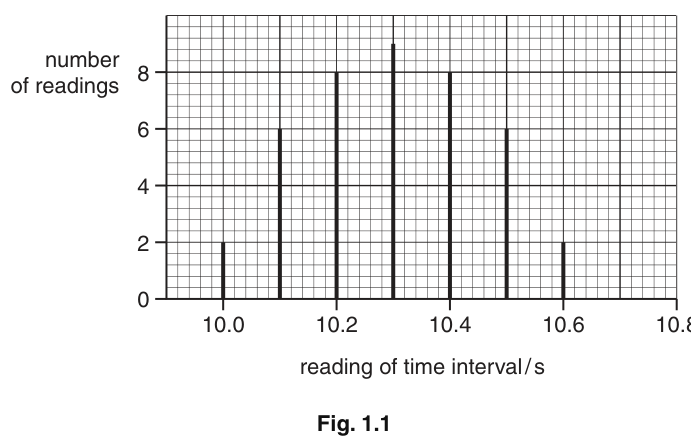
The true value of the time interval is .
State how the readings on Fig. 1.1 show the presence of
-
a systematic error,
-
a random error.
State the expected changes to Fig. 1.1 for experimental measurements that are
-
more accurate,
-
more precise.
The rest of this paper
6 more questions- Q2Forces, Density and Pressure · Physical Quantities and Units8M
- Q3Dynamics · Kinematics10M
- Q4Deformation of Solids · Work, Energy and Power10M
- Q5Electricity · D.C. Circuits9M
- Q6Waves · Superposition10M
- Q7Forces, Density and Pressure · Physical Quantities and Units7M