Physics 9702/22 — May/June 2011
Cambridge AS Level · AS Level Structured Questions · worked solutions for every part, with the mark scheme
Topics Kinematics · Physical Quantities and Units · Dynamics · Forces, Density and Pressure · Work, Energy and Power · Deformation of Solids · +4 more
Distinguish between scalar quantities and vector quantities.
Answer
A scalar quantity has magnitude only.
A vector quantity has magnitude and direction.
Scalar: magnitude only; Vector: magnitude and direction.
Background Concept
A physical quantity is something that can be measured and expressed with a number and a unit. Quantities fall into two key types:
- Scalar: completely described by magnitude only (size).
- Vector: needs magnitude and direction to be fully described.
Vectors also follow vector addition rules (e.g. adding two velocities depends on their directions).
Understanding the Question
You are asked to distinguish (i.e. clearly tell the difference) between scalar and vector quantities. For full credit you must mention the defining property of each.
Approach
Give the definition of each type in one short sentence, focusing on whether direction is required.
Step-by-Step Reasoning
- For a scalar, if you change the direction you point, the quantity does not change because there is no direction attached to it. Example: mass .
- For a vector, the same magnitude in a different direction is a different vector. Example: velocity east is not the same as west.
Key Takeaways
- Scalars: magnitude only.
- Vectors: magnitude + direction.
Common Mistakes
- Saying “vector has direction only” (it must also have magnitude).
- Giving examples without stating the defining difference (the question asks to distinguish, not list examples).
Things to Be Careful About
- Words like “speed” vs “velocity”: speed is scalar, velocity is vector.
- Some quantities sound like they might be scalar but are vectors (e.g. acceleration, force, weight).
In the following list, underline all the scalar quantities.
acceleration force kinetic energy mass power weight
Answer
Scalar quantities: kinetic energy, mass, power.
kinetic energy, mass, power
Background Concept
A scalar has magnitude only; a vector has magnitude and direction. Many mechanics quantities are vectors because they relate to motion in a particular direction (e.g. acceleration) or are forces (forces are vectors).
Understanding the Question
From the list
- acceleration
- force
- kinetic energy
- mass
- power
- weight
you must select only the scalars.
Approach
For each quantity, ask: “Would I need to specify a direction for this to be complete?” If yes, it is a vector.
Step-by-Step Reasoning
- Acceleration: change of velocity per time, has direction (e.g. downwards) → vector.
- Force: must have direction to be fully described → vector.
- Kinetic energy : depends on speed squared, no direction → scalar.
- Mass : no direction → scalar.
- Power : rate of energy transfer, no direction → scalar.
- Weight : a force due to gravity, acts downward → vector.
So the scalars are kinetic energy, mass, power.
Key Takeaways
- Forces (including weight) are vectors.
- Energies and power are scalars.
Common Mistakes
- Treating weight as a scalar because it is sometimes called “how heavy something is” (in physics, weight is a force).
- Treating acceleration as scalar (confusing it with “rate of change of speed” in 1D).
Things to Be Careful About
- In 1D problems, vectors may be represented by positive/negative signs; they are still vectors.
- “Magnitude of acceleration” would be scalar, but “acceleration” itself is a vector.
A stone is thrown with a horizontal velocity of from the top of a cliff high. The path of the stone is shown in Fig. 1.1.
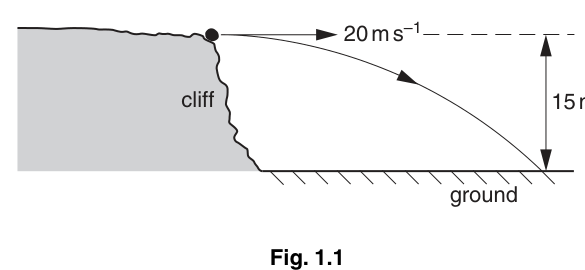
Air resistance is negligible.
For this stone,
calculate the time to fall ,
time = ______
Working
Vertical motion: , , .
Answer
1.75 s
Background Concept
Projectile motion can be split into two independent perpendicular motions:
- Horizontal: constant velocity (no horizontal acceleration when air resistance is negligible).
- Vertical: constant acceleration downward.
For vertical free fall starting with no vertical component of velocity, the displacement after time is
With and , this becomes .
Understanding the Question
The stone is thrown horizontally, so initially its vertical velocity is zero. It falls a vertical distance of under gravity, with air resistance negligible. You must find the time taken to fall that .
Approach
Use vertical motion only:
- Set .
- Use .
- Rearrange for .
Step-by-Step Reasoning
Take downward as positive for convenience.
Given:
Use
So
and
(The horizontal speed does not affect the fall time because horizontal and vertical motions are independent.)
Key Takeaways
- Horizontal projection means .
- Time to fall depends only on vertical distance and , not on horizontal speed.
Common Mistakes
- Using in the vertical equation (that is the horizontal component).
- Using (missing the factor ).
Things to Be Careful About
- Keep the vertical distance as (already in SI units).
- Use a consistent value of (commonly or depending on the paper).
calculate the magnitude of the resultant velocity after falling ,
resultant velocity = ______
Working
Horizontal component: .
Vertical component after time :
Resultant speed:
Answer
26.4 m s⁻¹
Background Concept
In projectile motion with negligible air resistance:
- Horizontal acceleration so horizontal velocity stays constant.
- Vertical acceleration so vertical velocity changes uniformly.
The actual velocity at any instant is a vector with components and . The magnitude (speed) is found by Pythagoras because the components are perpendicular:
Understanding the Question
After falling , the stone has gained a downward vertical velocity due to gravity but keeps the same horizontal velocity of . You must calculate the magnitude of the resultant velocity at that point.
Approach
- Keep (no horizontal acceleration).
- Find using (or ).
- Combine and using Pythagoras to get the resultant speed.
Step-by-Step Reasoning
Horizontal component:
Vertical component: initial vertical velocity . Using the time from part (i), ,
Now form the velocity triangle:
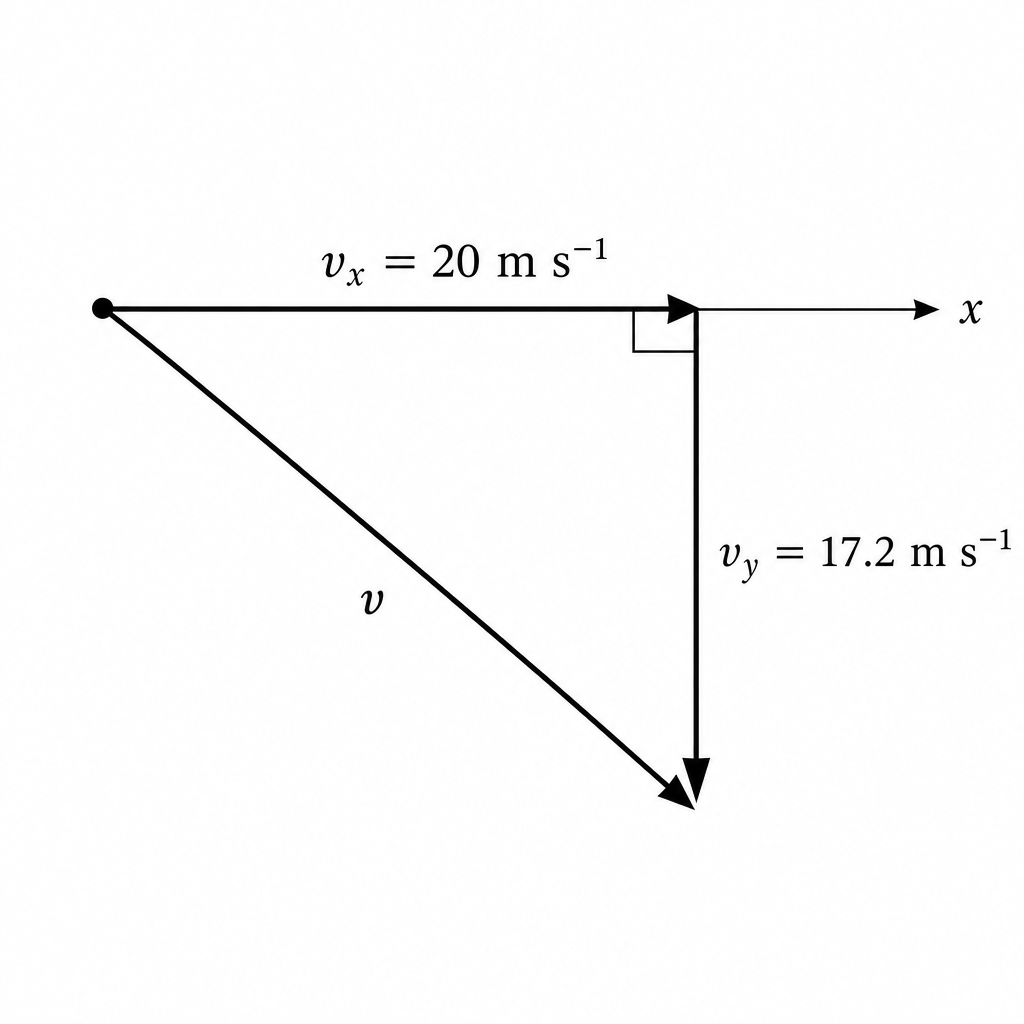
Magnitude:
Key Takeaways
- stays constant without air resistance.
- increases from due to gravity.
- Resultant speed comes from combining perpendicular components.
Common Mistakes
- Adding components directly: (wrong because velocities are perpendicular vectors).
- Using as the initial vertical velocity.
- Forgetting that the question asks for magnitude (so no direction is required in the final answer).
Things to Be Careful About
- Use consistent significant figures (typically 2–3 s.f.).
- If you use the alternative method , you should still combine with using Pythagoras.
- Keep units throughout: for velocities.
describe the difference between the displacement of the stone and the distance that it travels.
Answer
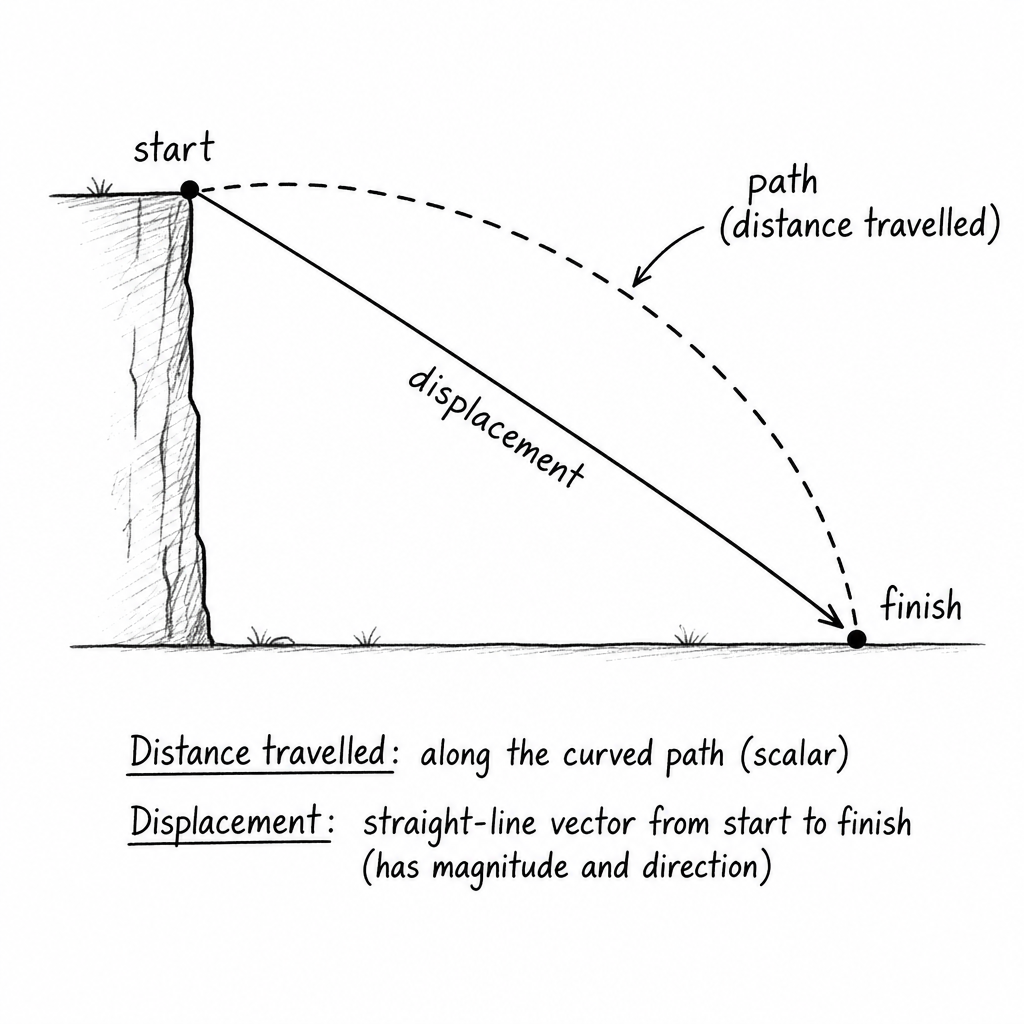
Displacement is the straight-line change in position from the launch point to the landing point (a vector, with direction).
Distance travelled is the length of the actual curved path followed (a scalar); it is greater than the magnitude of the displacement.
Displacement: straight-line change in position (vector). Distance: length of path travelled (scalar), larger than |displacement|.
Background Concept
- Displacement is a vector: it describes the change in position from start to finish. It is the straight-line vector joining the initial and final positions.
- Distance travelled is a scalar: it is the total length of the path actually taken.
For curved motion, distance and the magnitude of displacement are not the same.
Understanding the Question
The stone follows a curved (parabolic) path from the top of the cliff to the ground. The question asks you to describe how:
- the displacement (start-to-finish vector), and
- the distance travelled (length along the curve)
are different for this motion.
Approach
State:
- what displacement means here (straight line between initial and final points + direction),
- what distance means here (length along the trajectory),
- compare them (distance is larger than the magnitude of displacement for a non-straight path).
Step-by-Step Reasoning
- The displacement is drawn from the throw point at the top of the cliff directly to the landing point on the ground: it does not follow the curve. Because it is a vector, it has a direction (downwards and horizontally away from the cliff).
- The distance travelled is measured along the projectile’s parabolic trajectory, which is longer than the straight-line separation.
A sketch can help:
Key Takeaways
- Displacement: straight-line vector from start to end.
- Distance: total path length (scalar).
- For curved motion, .
Common Mistakes
- Saying displacement is “how far it moves” (that describes distance, not displacement).
- Forgetting to mention that displacement is a vector (direction matters).
- Claiming distance and displacement are the same because the object “moves from A to B” (only true if the path is a straight line).
Things to Be Careful About
- Displacement depends only on the initial and final positions, not on the route.
- The question asks for a description, not a calculation, so clear definitions earn the marks.
The rest of this paper
5 more questions- Q2Physical Quantities and Units · Dynamics · Forces, Density and Pressure · Kinematics12M
- Q3Work, Energy and Power · Kinematics10M
- Q4Deformation of Solids · Measurement Techniques10M
- Q5D.C. Circuits · Electricity9M
- Q6Superposition9M