Physics 9702/31 — October/November 2010
Cambridge AS Level · Advanced Practical Skills · worked solutions for every part, with the mark scheme
Topics Manipulation, Measurement and Observation · Presentation of Data and Observations · Analysis, Conclusions and Evaluation
In this experiment, you will determine the resistance of an unknown resistor.
You have been supplied with a chain of eight resistors, as shown in Fig. 1.1.

Connection to one or more of the resistors can be made by attaching a crocodile clip between individual resistors.
The resistance of each individual resistor is .
The formula for the total resistance of resistors in series is
Set up the circuit in Fig. 1.2, with resistor X in the position shown.
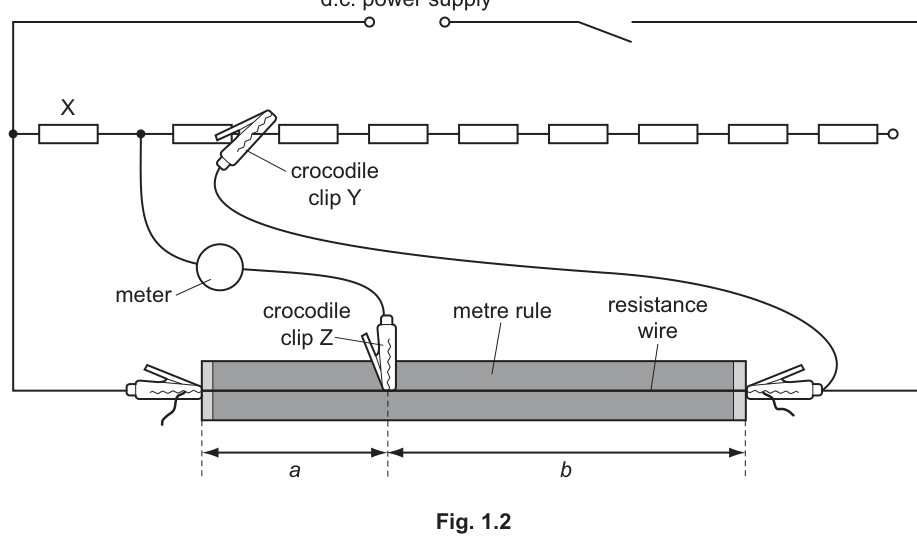
Only the first resistor in the chain is included in the circuit. This has resistance of .
Place Z on the resistance wire and move Z until the meter reading is zero.
Measure and record lengths and .
= ______
= ______
Vary by adjusting the position of Y on the chain of resistors.
Repeat (a)(ii) until you have six sets of readings of , and .
Include values of in your table of results.
Plot a graph of on the -axis against on the -axis.
Draw the straight line of best fit.
Determine the gradient of this line.
gradient = ______
The quantities , and are related by the equation
where is the resistance of resistor X.
Use your answer in (c)(iii) to determine the value of .
Give an appropriate unit.
= ______
Using your graph, determine the value of that would be needed for the lengths and to be equal to each other.
= ______
The rest of this paper
1 more questions- Q2Manipulation, Measurement and Observation · Presentation of Data and Observations · Analysis, Conclusions and Evaluation