Physics 9702/43 — May/June 2025
Cambridge A-Level · A Level Structured Questions · worked solutions for every part, with the mark scheme
Topics Electric Fields · Nuclear Physics · Gravitational Fields · Motion in a Circle · Temperature · Thermodynamics · +7 more
Answer
Gravitational potential at a point is the work done per unit mass by an external agent in bringing a small test mass from infinity to the point (with no change in kinetic energy).
Work done per unit mass to bring a test mass from infinity to the point (no change in KE).
Background Concept
Gravitational potential, (\phi), is a way of describing a gravitational field using energy ideas.
It is defined as the potential energy per unit mass at a point, taking zero potential at infinity:
Equivalently, it is the work done per unit mass by an external agent to move a small test mass from infinity to that point slowly (so that its kinetic energy does not change).
Understanding the Question
You are asked for a definition, not a calculation. For full marks you must:
- mention “per unit mass”,
- use “from infinity” as the reference,
- make clear it is work done (or potential energy) with no change in kinetic energy.
Approach
Write the standard definition used in Cambridge mark schemes: “work done per unit mass to bring a test mass from infinity to the point, without change in kinetic energy”.
Step-by-Step Reasoning
- “Potential” is an energy quantity, but it is defined per unit mass.
- The reference is chosen as infinity, where (\phi = 0).
- To make work done equal to the change in potential energy, the mass must be moved slowly so its kinetic energy stays the same.
Key Takeaways
- Gravitational potential is work done per unit mass.
- The standard reference is infinity.
- State the condition “no change in kinetic energy”.
Common Mistakes
- Defining (g) (field strength) instead of (\phi).
- Missing “per unit mass”.
- Using the surface of the planet as the reference instead of infinity.
- Forgetting to state “no change in kinetic energy”.
Things to Be Careful About
- Use “external agent does work” (not “work done by the field”, which would have the opposite sign).
- The potential is a scalar and is typically negative near a planet (because infinity is zero).
Mars is a planet that may be considered to be an isolated uniform sphere of radius .
A satellite of mass is in orbit around Mars at a constant height of above the surface of the planet.
The height of the orbit is increased to above the surface. This increases the gravitational potential energy of the satellite by .
Working
For a satellite of mass (m),
Increase in GPE when moving from (r_1) to (r_2):
(r_1 = 3.4\times10^6 + 1.7\times10^6 = 5.1\times10^6\ \text{m})
(r_2 = 3.4\times10^6 + 6.8\times10^6 = 1.02\times10^7\ \text{m})
Answer
(M = 6.4\times10^{23}\ \text{kg})
6.4 × 10^23 kg
Background Concept
For a point (or spherically symmetric) mass (M), the gravitational potential energy (U) of a mass (m) at distance (r) from the centre is
The negative sign occurs because we define (U=0) at infinity; at finite (r) the mass is bound, so (U) is negative.
A change in gravitational potential energy when moving between radii (r_1) and (r_2) is
Understanding the Question
You are told:
- Mars radius (R = 3.4\times10^6\ \text{m})
- satellite mass (m = 122\ \text{kg})
- initial height (h_1 = 1.7\times10^6\ \text{m})
- final height (h_2 = 6.8\times10^6\ \text{m})
- increase in GPE (\Delta U = 5.1\times10^8\ \text{J})
You must show that the mass of Mars is (6.4\times10^{23}\ \text{kg}).
Key point: heights are above the surface, but the formula needs (r) from the centre.
Approach
- Convert the two heights into orbital radii: (r_1 = R + h_1), (r_2 = R + h_2).
- Use (\Delta U = GMm\left(\frac{1}{r_1}-\frac{1}{r_2}\right)).
- Rearrange to solve for (M) and substitute values.
Step-by-Step Reasoning
- Find the radii:
- Use the change in potential energy:
Here (r_2 > r_1), so (\frac{1}{r_1}-\frac{1}{r_2}) is positive, giving a positive increase in (U), consistent with the statement.
- Substitute and solve for (M):
Evaluate the bracket:
Difference (\approx 9.80\times10^{-8}\ \text{m}^{-1}).
Then
Key Takeaways
- Use (U=-GMm/r) and work with (\Delta U) between two radii.
- Always convert “height above surface” into (r) from the centre.
- The increase in GPE for moving outward comes from becoming less negative.
Common Mistakes
- Using heights (h_1, h_2) directly as (r).
- Sign errors (e.g. writing (\Delta U = -GMm(1/r_1 - 1/r_2))).
- Forgetting that (\Delta U) is (U_2-U_1).
Things to Be Careful About
- Check that (r_2 > r_1) gives a positive (\Delta U) as stated.
- Keep powers of ten consistent; these calculations are sensitive to exponent errors.
- Use (G = 6.67\times10^{-11}\ \text{N m}^2\ \text{kg}^{-2}).
Calculate the gravitational potential at the surface of Mars. Give a unit with your answer.
= ______ unit ______
Working
At the surface, (r=R) and
Answer
(\phi = -1.3\times10^7\ \text{J kg}^{-1})
-1.3 × 10^7 J kg^-1
Background Concept
Gravitational potential (\phi) at distance (r) from the centre of a spherical mass (M) is
It is related to potential energy by (U = m\phi). The unit is
The potential is negative because we define (\phi=0) at infinity.
Understanding the Question
You must calculate (\phi) at the surface of Mars, so (r = R = 3.4\times10^6\ \text{m}). You can use the mass of Mars found in part (b)(i): (M = 6.4\times10^{23}\ \text{kg}). The question also asks you to give a unit.
Approach
Use
Substitute (G), (M), and (R), keeping the negative sign, then quote units (\text{J kg}^{-1}).
Step-by-Step Reasoning
- Write the expression at the surface:
- Substitute values:
- Calculate:
- Numerator: (6.67\times10^{-11}\times 6.4\times10^{23} = 4.27\times10^{13})
- Divide by (3.4\times10^6): (4.27\times10^{13} / 3.4\times10^6 \approx 1.26\times10^7)
So
Key Takeaways
- For a spherical planet, (\phi = -GM/r).
- At the surface, (r = R).
- The unit of potential is (\text{J kg}^{-1}).
Common Mistakes
- Missing the negative sign.
- Using height above surface instead of radius from centre.
- Giving unit as (\text{J}) instead of (\text{J kg}^{-1}).
Things to Be Careful About
- The potential is not the same as field strength: (g = GM/r^2), whereas (\phi = -GM/r).
- Quote sensible significant figures (usually 2 s.f. or 3 s.f. consistent with data).
The satellite in (b) is moved to an orbit in which the satellite remains at the same point above the surface of Mars.
The orbit has a period of 25 hours.
State what can be deduced from this about the rotation of Mars on its axis.
Answer
Mars must rotate once every (25\ \text{h}) about its axis (rotation period (= 25\ \text{h})).
Mars has a rotation period of 25 h.
Background Concept
A satellite that “remains at the same point above the surface” is in a synchronous (geostationary-type) orbit. For this to happen, the satellite’s angular speed must match the planet’s angular speed.
That means the orbital period (T) equals the rotation period of the planet.
Understanding the Question
You are told this special orbit has a period of (25\ \text{h}). The question asks what this tells you about Mars’s rotation.
Approach
Use the defining condition for a stationary (synchronous) orbit:
So whatever period the satellite has, Mars must rotate with the same period.
Step-by-Step Reasoning
- If the satellite always stays above the same surface point, Mars must rotate underneath it at the same rate that the satellite goes around Mars.
- Therefore Mars completes one rotation in (25\ \text{h}).
Key Takeaways
- Stationary/synchronous orbit (\Rightarrow) satellite period equals planet’s rotation period.
Common Mistakes
- Saying Mars rotates in 25 h but forgetting to say “once” (i.e. one full rotation).
- Confusing period with angular speed (both are linked, but the question gives period directly).
Things to Be Careful About
- The deduction is about rotation period, not the mass of Mars or orbital radius.
- The term “same point above the surface” implies a synchronous orbit by definition.
Answer
The orbit is in the equatorial plane of Mars.
Orbit lies in the equatorial plane.
Background Concept
For a satellite to stay above the same point on a rotating planet (a stationary/synchronous orbit), it must:
- have the same period as the planet’s rotation,
- orbit in the equatorial plane (inclination (=0)), otherwise it would move north–south in the sky,
- move in the same direction as the planet’s rotation (prograde),
- and the orbit is usually taken as circular for constant radius and constant angular speed.
Any one of these “extra features” (besides the period) typically gains the mark.
Understanding the Question
Part (c)(ii) asks for one other feature of the orbit apart from the 25 h period. A standard accepted statement is that it must be above the equator (equatorial orbit).
Approach
State a correct property that is required for stationarity. The most common is: “orbit is in the equatorial plane”.
Step-by-Step Reasoning
- If the orbital plane were tilted, the satellite would appear to move north and south relative to the surface point.
- Therefore, to remain above the same surface location, the orbit must lie in Mars’s equatorial plane.
Key Takeaways
- Stationary orbit conditions include: equatorial plane, same direction as rotation, and (typically) circular orbit.
Common Mistakes
- Saying only “circular orbit” without linking to stationarity (usually still acceptable, but equatorial is safer).
- Saying “polar orbit”: this is the opposite of what is needed.
Things to Be Careful About
- Do not repeat the period condition (already used in part (c)(i)).
- Ensure the feature you state is genuinely characteristic of a stationary orbit (equatorial/prograde/circular).
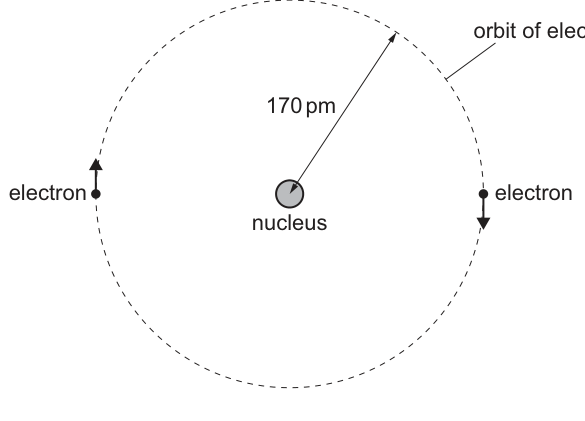
A helium atom may be modelled as a nucleus surrounded by two electrons in diametrically opposite circular orbits, each of radius , as shown in Fig. 2.1.
Answer
For two point charges and separated by distance , the magnitude of the electrostatic force is
The force acts along the line joining the charges; it is repulsive for like charges and attractive for unlike charges.
For two point charges Q1 and Q2 separated by r: F = (1/4πϵ0)|Q1Q2|/r^2 along the line joining them; repulsive for like charges and attractive for unlike.
Background Concept
Coulomb's law describes the electrostatic force between two point charges. It is an inverse-square law: doubling the separation makes the force four times smaller. The constant
is sometimes written as .
The force is a vector. Its line of action is the straight line joining the charges, and its direction depends on whether the charges are like (repel) or unlike (attract).
Understanding the Question
You are asked to state Coulomb's law, so you must give the relationship for the force between two point charges, including how it depends on charge, separation, and the direction/attraction-repulsion condition.
Approach
Write the standard formula for the magnitude and then add the key directional information: line of action and whether it attracts or repels.
Step-by-Step Reasoning
- Identify the variables: charges , and separation .
- State the inverse-square dependence on separation and proportionality to the product of charges:
- Include the constant of proportionality in SI units:
- Add direction: along the line joining the charges; attraction for opposite charges and repulsion for like charges.
Key Takeaways
- Coulomb's law: inverse-square in , proportional to .
- Direction is essential: along the line joining the charges.
- Like charges repel; unlike charges attract.
Common Mistakes
- Missing the (writing instead of ).
- Omitting the statement about attraction/repulsion.
- Forgetting that the force acts along the line joining the charges.
Things to Be Careful About
- Use point charges (or spherical charges) assumption.
- If you include signs in , then be clear you are giving a vector direction; otherwise use magnitude bars and state attraction/repulsion separately.
Answer
Helium has protons, so the nuclear charge is .
charge
+2e
Background Concept
The charge on a nucleus comes from its protons. Each proton has charge and neutrons have charge . Therefore, for atomic number (number of protons), the nuclear charge is .
Understanding the Question
Helium is being modelled as a nucleus plus two electrons. You are asked for the nucleus charge in terms of , so you just need the number of protons in helium.
Approach
Use helium's atomic number (), then multiply by .
Step-by-Step Reasoning
- Helium has protons.
- Each proton has charge .
So nuclear charge:
Key Takeaways
- Nuclear charge depends only on protons: .
Common Mistakes
- Writing by confusing nuclear charge with electron charge.
- Writing (forgetting helium has two protons).
Things to Be Careful About
- The question asks for the nucleus charge, not the charge of the atom (which would be for a neutral atom).
Working
For nucleus–electron separation .
with and :
Answer
1.6 × 10^-8 N
Background Concept
The magnitude of the electrostatic force between two point charges is given by Coulomb's law:
where .
The separation must be in metres and charge must be in coulombs.
Understanding the Question
You must show that the force between the helium nucleus () and one electron () at radius has magnitude . This is a direct Coulomb's law substitution.
Approach
- Convert to metres.
- Substitute , into Coulomb's law (magnitude).
- Evaluate and round to the stated value.
Step-by-Step Reasoning
- Convert the radius:
- Use magnitudes in Coulomb's law:
- Substitute numbers:
- Work through the powers of ten carefully.
So
Key Takeaways
- Always convert pm to m.
- For magnitudes, you can use and avoid negative signs.
- A quick sense-check: very small gives a relatively large force.
Common Mistakes
- Using (mixing up pm and angstroms).
- Forgetting the factor of from the nuclear charge .
- Squaring but not squaring .
Things to Be Careful About
- The question asks for the force between nucleus and one electron, not between the two electrons.
- Quote the final value to match the given answer (here ).
Assume that the force in (b)(ii) is the only force on the electrons.
Working
Assuming the only force is the electric attraction providing centripetal force:
with and :
Answer
1.7 × 10^6 m s^-1
Background Concept
For uniform circular motion of radius and speed , the required centripetal acceleration is
The net inward (radial) force must therefore be
In this model, the only force is the electrostatic attraction between the nucleus and the electron, so that force must be the centripetal force.
Understanding the Question
You are told to assume the force found in (b)(ii), , is the only force acting on each electron. That force acts towards the nucleus, so it provides the centripetal force needed for circular motion at radius . You must find the electron speed.
Approach
Set
and solve for using the given and and the electron mass.
Step-by-Step Reasoning
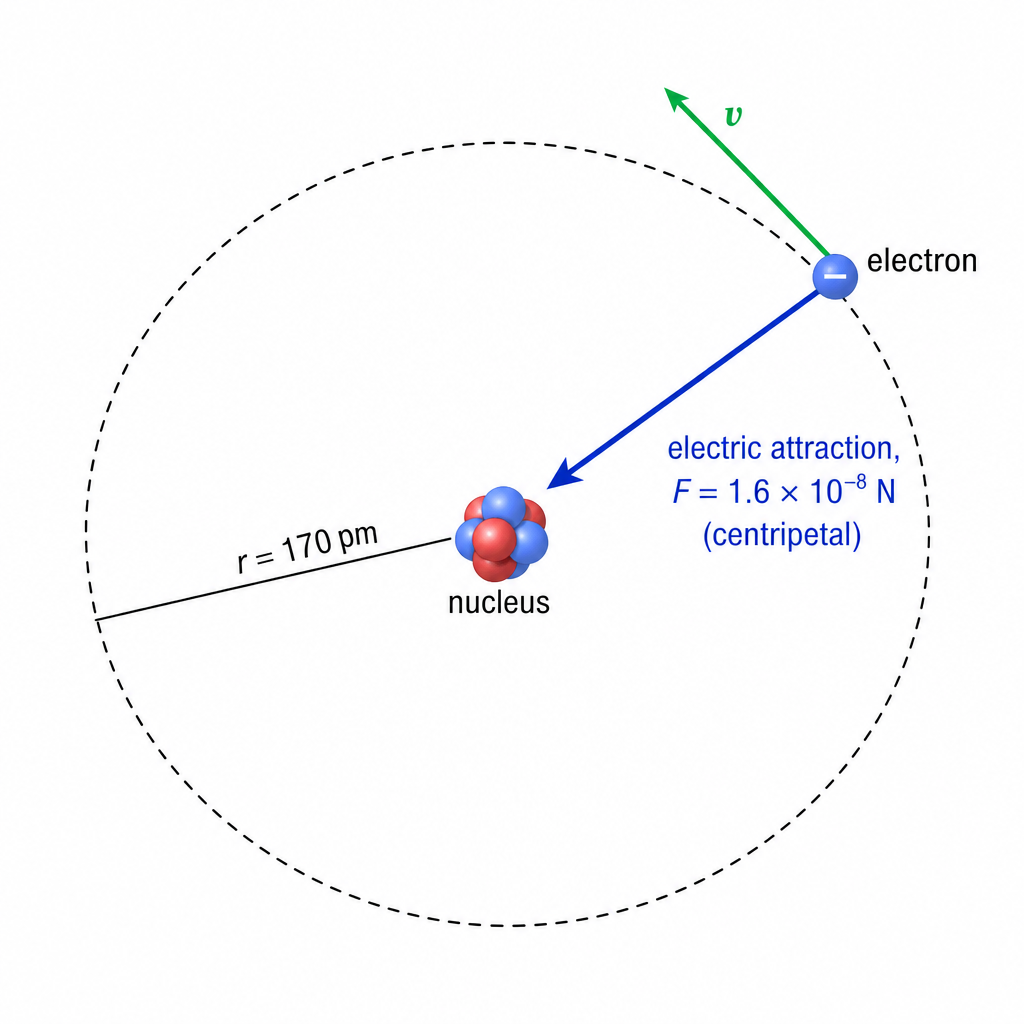
- Use the centripetal force equation:
- Rearrange for :
- Substitute values:
- Take the square root:
Key Takeaways
- For circular motion, a net inward force is required: .
- If a single force acts radially inward, it must equal the centripetal force.
- Rearranging to is a common step.
Common Mistakes
- Using or other incorrect centripetal expressions.
- Using diameter instead of the radius .
- Forgetting to use the electron mass (or using proton mass).
Things to Be Careful About
- The centripetal force is provided by the resultant radial force, not “an extra force”.
- Keep powers of ten consistent: , then dividing by gives , etc.
- Quote the speed to a sensible number of significant figures (typically 2 s.f. here).
Working
Answer
6.3 × 10^-16 s
Background Concept
For uniform circular motion:
- the distance travelled in one orbit is the circumference ,
- the time for one orbit is the period ,
- speed is distance/time.
So
Understanding the Question
You have already found the electron's speed (from part (c)(i)) and you know the orbit radius is . The question asks for the period (time for one complete orbit).
Approach
Use
with in metres and in .
Step-by-Step Reasoning
- Convert (or use) the radius in metres:
- Substitute into the period formula:
- Evaluate:
- dividing by gives
Key Takeaways
- Period is circumference divided by speed: .
- Very small orbits and high speeds produce extremely small periods.
Common Mistakes
- Using (inverting the relationship).
- Forgetting that pm must be converted to m.
- Using (diameter) instead of the radius.
Things to Be Careful About
- Use the speed from (c)(i) consistently (error carried forward would usually be allowed).
- Express the final time in standard form and include the unit .
In practice, the orbit of each electron is affected by the presence of the other electron.
Working
At one electron:
- distance to nucleus: , nucleus charge
- distance to other electron: , electron charge magnitude
Answer
0.125
Background Concept
The electric field strength due to a point charge at distance is
When comparing two fields at the same point, taking a ratio is powerful because the constant cancels.
Understanding the Question
You look at the position of one electron. Two sources produce electric field at that point:
- the nucleus at the centre (charge ) at distance ,
- the other electron (charge magnitude ) which is diametrically opposite, so it is a distance of one diameter, , away.
You must find
Approach
Write for each source at that point and divide, using the correct distances ( and ) and charges ( and ).
Step-by-Step Reasoning
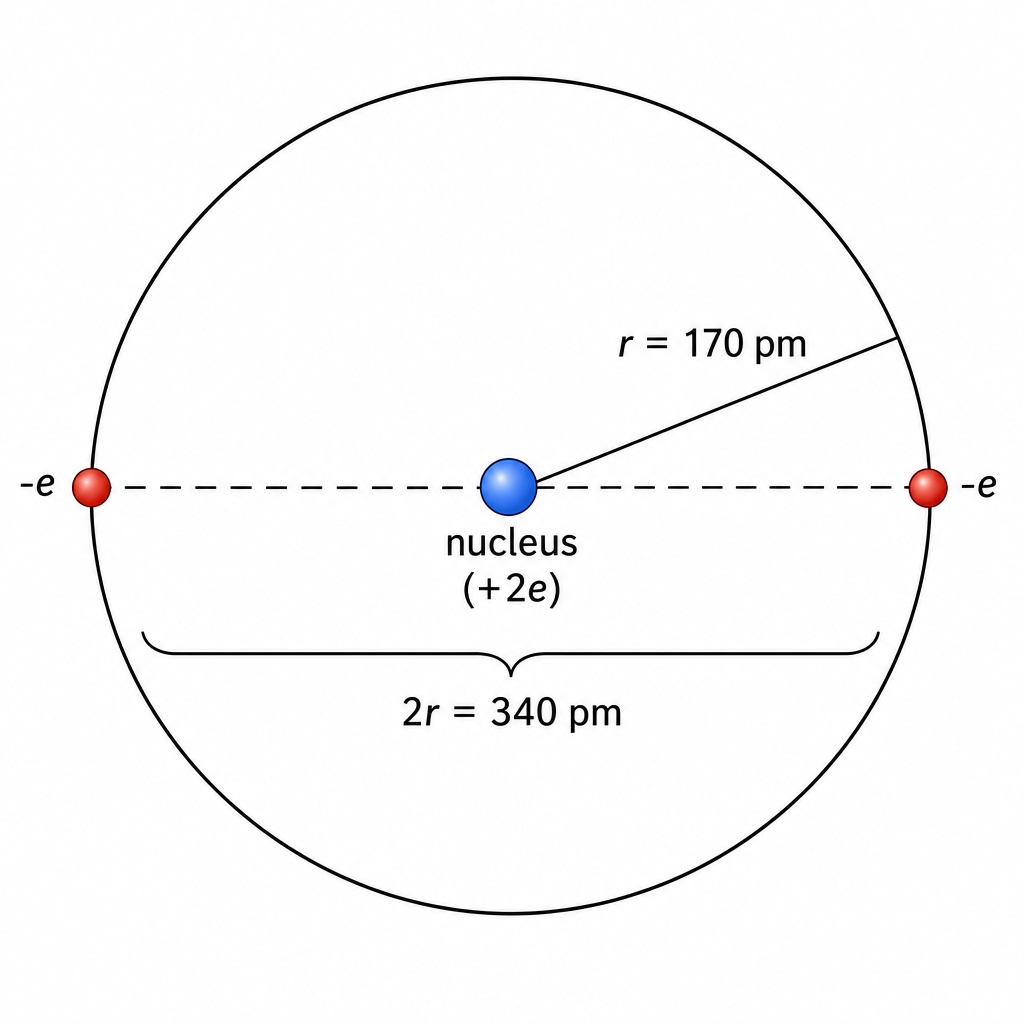
- Field due to the other electron at distance :
- Field due to nucleus at distance :
- Form the ratio:
- Cancel , cancel , and simplify:
Key Takeaways
- For point charges, .
- When charges and distances are multiples, ratios simplify quickly.
- Here the other electron is twice as far away and has half the charge magnitude of the nucleus (compared with ), giving a small ratio.
Common Mistakes
- Using for both distances (forgetting the electrons are opposite ends of the diameter).
- Using nucleus charge instead of .
- Squaring the distance incorrectly: .
Things to Be Careful About
- The question asks for electric field strength, not force. (They are related by , but the ratio of fields is independent of the test charge.)
- Use magnitudes for the ratio; direction is not needed until part (d)(ii).
Use your answer in (d)(i) to suggest and explain how the orbit of the electron is affected by the presence of the other electron.
Answer
The other electron repels the electron outwards, opposing the inward attraction to the nucleus. Since its field is about of the nucleus field, the resultant inward (centripetal) force is reduced, so the electron is less tightly bound and the orbit would be at a larger radius (or equivalently a smaller speed for the same radius).
Repulsion from the other electron opposes the inward nuclear attraction, reducing the resultant centripetal force, so the orbit is less tight (larger radius / lower speed).
Background Concept
For an electron in a circular orbit, the net inward (towards the centre) force must provide the centripetal force:
Electrostatic forces can be attractive or repulsive:
- nucleus () attracts the electron inward,
- the other electron () repels it, and because it is on the opposite side of the nucleus, that repulsion on the chosen electron points radially outward.
Understanding the Question
Part (d)(i) showed that at the position of one electron, the electric field magnitude from the other electron is times that from the nucleus. You must use this to decide what happens to the orbit when both interactions are present.
Approach
- Decide the direction of each force on the electron.
- Use the ratio to judge how much the outward effect reduces the inward attraction.
- Link reduced net inward force to the requirements for circular motion (it changes the speed and/or radius of the orbit).
Step-by-Step Reasoning
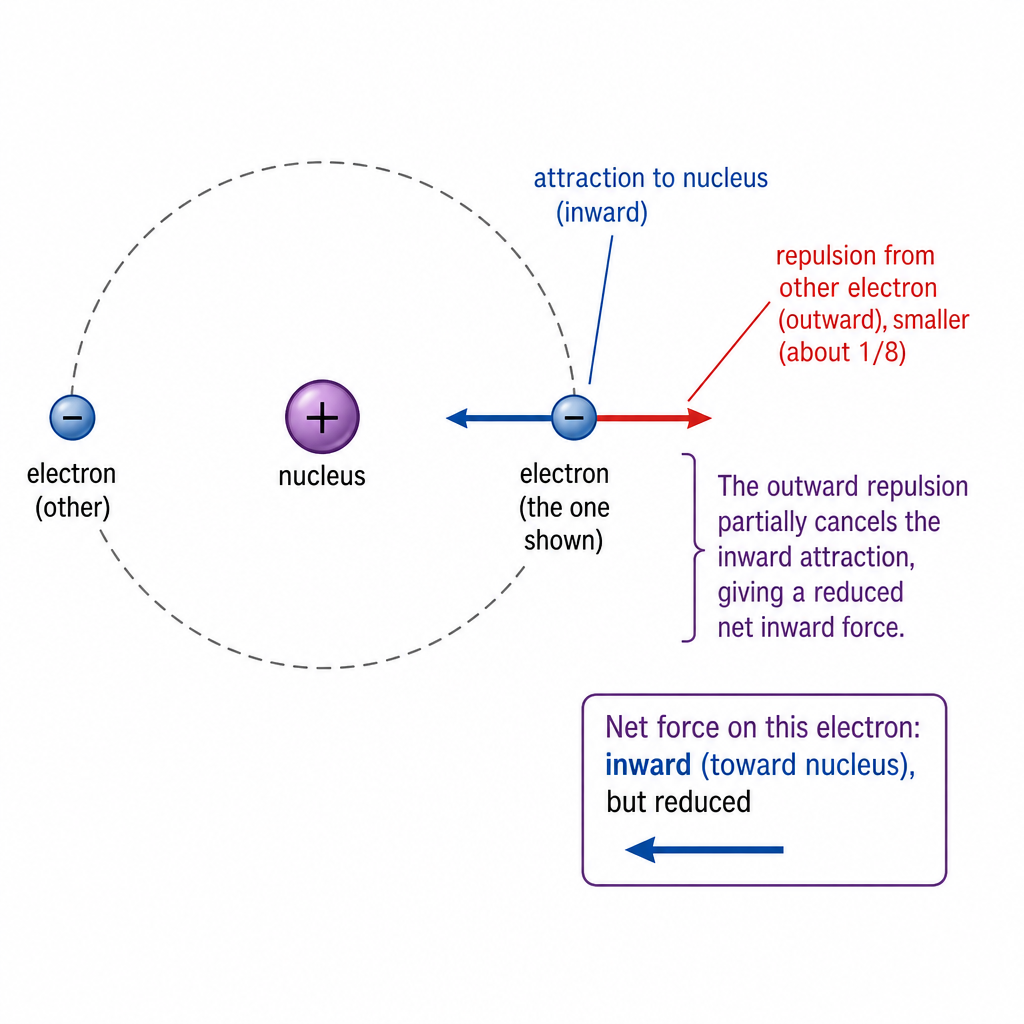
- Direction of forces on one electron:
- Force due to nucleus: attractive, towards nucleus (inward).
- Force due to other electron: repulsive, away from the other electron. Since the other electron is on the opposite side, this is outward from the nucleus.
-
Magnitude comparison:
From (d)(i), the other electron's field is of the nucleus field. Because for the same electron charge , the force magnitudes have the same ratio. So the outward repulsion is about of the inward attraction. -
Resultant radial force:
Net inward force is reduced compared with the nucleus-only model. -
Effect on orbit:
With a smaller inward force available, the electron cannot sustain the same circular motion at the same radius and speed as before. Physically it will be less tightly bound, so the orbit tends to be larger (or the speed would need to be smaller for the same radius).
Key Takeaways
- Forces from multiple charges add as vectors; directions matter.
- A repulsive force from the other electron acts outward and reduces the net centripetal force.
- Reduced net inward force implies a less tight orbit (larger radius / lower speed).
Common Mistakes
- Saying the other electron increases the inward force (wrong direction: electrons repel).
- Using the ratio to claim the effect is negligible without linking to centripetal force.
- Confusing electric field direction with force direction on an electron (force is opposite to field for a negative charge).
Things to Be Careful About
- Part (d)(i) was about field strength magnitudes; for (d)(ii) you must consider direction as well.
- Because the electron is negative, it is often clearer to think in terms of forces (attraction/repulsion) rather than field direction.
Answer
Specific latent heat is the thermal energy required to change the state of unit mass of a substance with no change in temperature.
Thermal energy required to change the state of unit mass of a substance with no change in temperature.
Background Concept
During a phase change (melting, boiling, condensing, freezing), energy can be transferred to or from a substance without changing its temperature. This energy goes into changing the arrangement/separation of molecules rather than increasing their average kinetic energy.
The specific latent heat of a particular phase change is defined using
where is the energy transferred, is the mass undergoing the change of state, and is the energy required per unit mass.
Understanding the Question
You are asked to define specific latent heat. For full credit you must include:
- it is energy per unit mass,
- it is for a change of state,
- the temperature does not change during the change.
Approach
Write a single sentence definition including the three points above.
Step-by-Step Reasoning
- “Latent heat” refers to energy transferred during a phase change.
- “Specific” means per unit mass.
- During a phase change for a pure substance at constant pressure, the temperature stays constant even though energy is being transferred.
So the definition must explicitly say “change of state” and “no change in temperature”.
Key Takeaways
- Specific latent heat is energy per unit mass for a phase change.
- Temperature remains constant during the phase change.
- The relation links the definition to calculations.
Common Mistakes
- Defining it as energy to raise temperature (that is specific heat capacity, not latent heat).
- Omitting “per unit mass”.
- Omitting the condition that temperature does not change.
Things to Be Careful About
- Use “change of state” (or “phase change”) explicitly.
- Do not mix up “latent heat” (total) with “specific latent heat” (per unit mass).
Explain why, for a substance, the specific latent heat of vaporisation is usually greater than the specific latent heat of fusion.
Answer
For fusion (solid to liquid), energy is mainly used to loosen bonds so molecules can move past each other, but they remain close together.
For vaporisation (liquid to gas), molecules must separate widely and overcome intermolecular attractions (and do work against external pressure), so more energy per unit mass is required. Hence is usually greater than .
Vaporisation requires separating molecules widely and overcoming intermolecular attraction (and doing work against pressure), whereas fusion mainly loosens bonds with molecules still close together, so more energy per unit mass is needed for vaporisation.
Background Concept
Latent heat is the energy associated with changing a substance’s internal energy during a phase change without changing temperature.
At constant temperature, the average kinetic energy of the molecules does not change. Therefore, the energy transferred goes mainly into changing molecular potential energy by overcoming intermolecular attractions and changing molecular separation.
Understanding the Question
You must explain why, for the same substance,
- the specific latent heat of vaporisation is usually larger than
- the specific latent heat of fusion .
This is asking for a molecular / energy argument, not a numerical one.
Approach
Compare what happens to molecular separation and intermolecular forces in:
- melting (solid (\to) liquid)
- boiling/evaporating (liquid (\to) gas)
Then relate “more separation / more overcoming forces” to “more energy per unit mass”, i.e. larger specific latent heat.
Step-by-Step Reasoning
-
Fusion (melting):
- In a solid, molecules are in fixed positions (vibrate about equilibrium positions).
- To melt, the molecules only need enough energy to break/loosen some of the bonds so they can move around.
- The molecules in a liquid are still close together, so not all attractive forces are fully overcome.
-
Vaporisation (boiling/evaporation):
- In a liquid, molecules are close together and strongly attracted.
- To become a gas, molecules must be separated to much larger distances.
- This requires overcoming intermolecular attractions much more completely, increasing molecular potential energy by a larger amount.
- In addition, at constant pressure the expanding gas does work on the surroundings (work done ), which also requires energy.
-
Therefore the energy required per unit mass is larger for vaporisation, so typically
Key Takeaways
- Latent heats are mainly about changing molecular potential energy at constant temperature.
- Liquid (\to) gas involves much greater separation than solid (\to) liquid.
- Vaporisation often includes work done in expansion, increasing the required energy.
Common Mistakes
- Saying “because boiling happens at a higher temperature”: latent heats are defined at the phase change temperature, but the reason is molecular separation/forces, not the numerical temperature.
- Talking about kinetic energy increase: temperature is constant during the phase change.
- Vague statements like “it needs more energy” without explaining what the energy is used for.
Things to Be Careful About
- Make it clear that molecules remain close in a liquid but are far apart in a gas.
- Mention overcoming intermolecular forces (and optionally work done against pressure) to fully justify the larger .
An ice cube of mass at temperature is placed in a beaker containing water of mass at temperature .
When all the ice has melted, and all the water in the beaker has reached thermal equilibrium, the final temperature of all the water is .
The specific heat capacity of water is .
The beaker has negligible specific heat capacity and is perfectly insulated from the surroundings.
Determine a value, to three significant figures, for the specific latent heat of fusion of water.
specific latent heat of fusion = ______
Working
Heat lost by warm water:
Heat gained by ice = heat to melt + heat to warm melted water from to :
Energy balance ():
Answer
335 J g^-1
Background Concept
In a perfectly insulated calorimetry problem, the total energy is conserved:
- energy lost by the warmer part of the system
= energy gained by the cooler part of the system.
Two kinds of thermal energy changes can occur:
- Sensible heating/cooling (temperature changes):
- Latent heating (phase change at constant temperature):
Here, ice at melts (latent heat of fusion) and then the meltwater warms up to the final equilibrium temperature.
Understanding the Question
Given:
- ice mass at
- water mass at
- final equilibrium temperature
- beaker negligible heat capacity and insulated
Unknown: specific latent heat of fusion of water in .
Key idea: the warm water cools down, providing energy to (i) melt the ice and (ii) warm the melted ice-water from to .
Approach
- Calculate heat lost by the original warm water as it cools from to using .
- Write heat gained by the ice as the sum:
- to melt at
- to warm the meltwater to the final temperature
- Equate heat lost = heat gained and solve for .
Step-by-Step Reasoning
- Heat lost by warm water
Temperature drop:
So
First multiply , then
- Heat gained by the ice
- Melting at needs latent heat:
- After melting, the meltwater warms from to :
Compute:
so
- Energy balance and solve for
Because the system is insulated and the beaker’s heat capacity is negligible:
So
Rearrange:
Divide by :
To three significant figures:
Key Takeaways
- In insulated mixing problems, set heat lost = heat gained.
- Ice at requires both latent heat to melt and then energy to warm the meltwater.
- Use consistent units: here is in so masses must be in grams.
Common Mistakes
- Forgetting to include the heating of the melted ice-water from to the final temperature.
- Using the total final mass in the cooling calculation instead of just the warm water mass.
- Using instead of for the warm water.
- Mixing units (using kg with in ).
Things to Be Careful About
- The ice starts at , so there is no warming of ice before melting.
- The final temperature is above , so all ice melts (consistent with the wording) and the meltwater must be warmed.
- Quote to three significant figures as requested, and include unit .
Answer
Internal energy is the total microscopic energy of a system, i.e. the sum of the random kinetic energies of its particles and the potential energies due to intermolecular forces (and separations).
Sum of random molecular kinetic energy and intermolecular potential energy.
Background Concept
Internal energy is an energy store associated with the microscopic motion and arrangement of particles in a substance.
For a gas, the particles have:
- random kinetic energy (translational, and possibly rotational/vibrational depending on the model), and
- potential energy due to intermolecular forces (important in real gases; negligible for an ideal gas).
Internal energy is not the macroscopic kinetic energy of the whole object moving, and not the macroscopic gravitational potential energy of the object in an external field.
Understanding the Question
You are asked to state what “internal energy of a system” means. For full credit you must mention that it is a microscopic total and include both kinetic and potential contributions.
Approach
Give the standard definition used at A Level:
- random kinetic energy of the particles
- plus potential energy associated with intermolecular forces.
Step-by-Step Reasoning
- A “system” contains many particles.
- Each particle has kinetic energy because it is moving randomly.
- Particles may also have potential energy because of their positions/separations in the intermolecular force field.
- Internal energy is the sum of these microscopic energies over all particles.
Key Takeaways
- Internal energy is a microscopic energy store.
- It is the sum of random kinetic energies plus intermolecular potential energies.
Common Mistakes
- Saying only “energy due to temperature” without stating what energies are included.
- Confusing internal energy with heat (thermal energy transfer) or with macroscopic kinetic energy of the whole gas.
Things to Be Careful About
- Use “random” or “microscopic” to make clear it is not bulk motion.
- Include both kinetic and potential terms to secure the 2 marks.
Explain why the internal energy of an ideal gas is directly proportional to the thermodynamic temperature of the gas.
Answer
For an ideal gas, intermolecular forces are negligible, so the internal energy is the total random kinetic energy of the molecules.
From kinetic theory, the mean translational kinetic energy per molecule is
Hence total internal energy (e.g. ), so is directly proportional to thermodynamic temperature.
In an ideal gas, internal energy is total random kinetic energy; mean kinetic energy per molecule is (3/2)kT, so total U ∝ T.
Background Concept
An ideal gas is modelled as:
- molecules that occupy negligible volume,
- molecules that exert no intermolecular forces except during collisions,
- perfectly elastic collisions.
Because intermolecular forces are neglected, there is (effectively) no intermolecular potential energy stored in the gas. Therefore, for an ideal gas:
- internal energy depends only on the random kinetic energy of the molecules.
Kinetic theory gives the key result:
where is the Boltzmann constant and is the thermodynamic temperature in kelvin.
Understanding the Question
You must explain (not just state) why the internal energy of an ideal gas is directly proportional to . The word “ideal” is the clue: it tells you potential energy due to intermolecular forces is negligible, so is purely kinetic.
Approach
- State that for an ideal gas, internal energy is the total random kinetic energy.
- Use kinetic theory to connect kinetic energy to temperature via .
- Multiply by the number of molecules to show a direct proportionality.
Step-by-Step Reasoning
- In general, internal energy is random kinetic + intermolecular potential.
- For an ideal gas, intermolecular potential energy can be taken as zero/constant because forces are negligible.
- So equals the total random kinetic energy of all molecules.
- Mean kinetic energy per molecule is .
- For molecules, total kinetic energy is
- Since and are constant for a fixed sample, .
Key Takeaways
- For an ideal gas, depends only on .
- The proportionality comes from the kinetic theory relation between temperature and mean molecular kinetic energy.
Common Mistakes
- Referring to only and trying to argue without linking to kinetic energy.
- Forgetting the “ideal” condition and talking about changes in potential energy due to intermolecular forces.
Things to Be Careful About
- Temperature must be thermodynamic temperature (kelvin).
- Use “mean kinetic energy per molecule is proportional to ” as the key link; that is what makes proportional to for an ideal gas.
A sample of an ideal gas at thermodynamic temperature has internal energy .
The gas is compressed so that its temperature increases to .
During this compression, work is done on the gas.
The gas is then cooled at constant volume so that its temperature decreases to .
Complete Table 4.1 to show, in terms of some or all of , and , the work done on the gas, the thermal energy supplied to the gas and the increase in internal energy of the gas for each of the two processes.
Table 4.1
| work done on gas | thermal energy supplied to gas | increase in internal energy of gas | |
|---|---|---|---|
| compression | |||
| cooling |
Working
For an ideal gas, .
Initial: at , internal energy .
After compression to : internal energy so
First law with = work done on gas:
Cooling at constant volume from to :
internal energy changes so
Constant volume .
So
Answer
| process | work done on gas | thermal energy supplied to gas | increase in internal energy |
|---|---|---|---|
| compression | |||
| cooling |
Compression: q = 2U − W, ΔU = +2U. Cooling: work = 0, q = −U, ΔU = −U.
Background Concept
Two ideas are being tested.
1) Internal energy of an ideal gas
For an ideal gas, internal energy depends only on temperature:
So if temperature is multiplied by a factor, internal energy is multiplied by the same factor.
2) First law of thermodynamics
Using the Cambridge convention stated in the syllabus:
where:
- is the change in internal energy of the gas,
- is the thermal energy supplied to the gas (negative if energy leaves the gas),
- is the work done on the gas (positive for compression, negative for expansion).
At constant volume, , so no work is done:
Understanding the Question
You are told:
- Initially: temperature , internal energy .
- Process 1 (compression): temperature rises to , and work is done on the gas.
- Process 2 (cooling at constant volume): temperature falls from to .
You must fill the table entries (work, thermal energy supplied, internal energy change) for each process in terms of , , and .
Approach
- Use to find the internal energy at and at .
- For each process, compute from final minus initial internal energy.
- Apply to find .
- Use the process conditions (compression, constant volume) to set correctly.
Step-by-Step Reasoning
Step 1: Internal energies at the three temperatures
Because :
- At : internal energy is given as .
- At : internal energy is .
- At : internal energy is .
Step 2: Compression process
Initial internal energy: .
Final internal energy: .
So:
You are told work done on the gas is .
Use first law:
Substitute:
So the thermal energy supplied could be positive or negative depending on the size of ; the expression correctly captures this.
Step 3: Cooling at constant volume
This starts at (so internal energy ) and ends at (internal energy ).
So:
Because the volume is constant, .
First law gives:
Negative means thermal energy leaves the gas (it is cooled).
Key Takeaways
- For an ideal gas, scales linearly with .
- Use the first law with a consistent sign convention: (work done on the gas).
- Constant volume implies zero work done.
Common Mistakes
- Using (the alternative sign convention) without adjusting the meaning of .
- Saying the cooling has “no heat transfer” just because volume is constant; constant volume only means no work, not no heating/cooling.
- Getting sign wrong for cooling (it must be negative because temperature decreases).
Things to Be Careful About
- Always compute as final minus initial.
- “Thermal energy supplied to the gas” can be negative; that represents thermal energy removed from the gas.
- Keep track of which temperature each process starts from: the cooling starts from , not from .
A cuboidal block floats in a liquid with its base horizontal, as shown in Fig. 5.1.
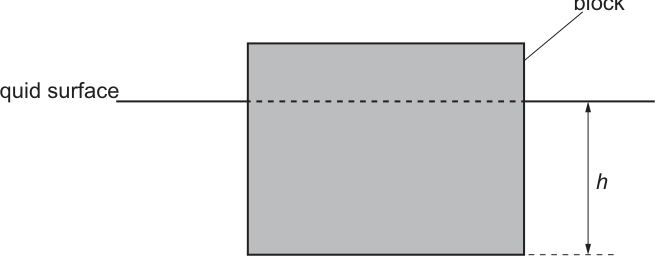
The base of the block is at a depth below the surface of the liquid.
The block is displaced downwards by a small distance and then released so that it oscillates.
Fig. 5.2 shows the variation with of the acceleration of the block.
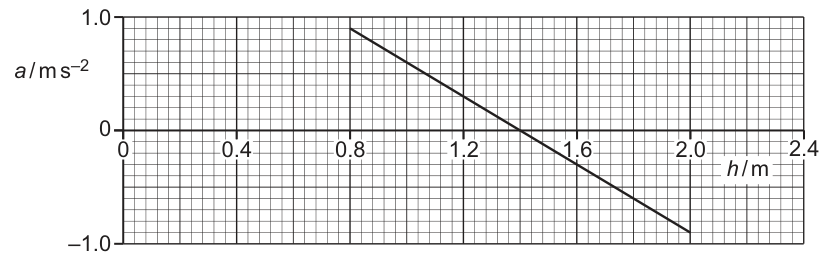
Fig. 5.3 shows the variation with of the kinetic energy of the block.
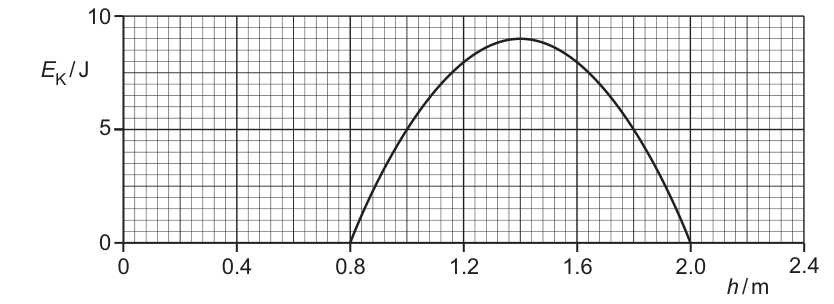
Turning points where are at and .
Equilibrium at maximum is .
Amplitude
Answer
0.60 m
Background Concept
For oscillations, the amplitude is the maximum displacement from the equilibrium position. In simple harmonic motion (SHM), the object oscillates between two turning points where the speed is zero, so the kinetic energy is zero.
Understanding the Question
You are given two graphs against depth :
- Fig. 5.2: acceleration vs (a straight line crossing at one value of ).
- Fig. 5.3: kinetic energy vs (a curve with a maximum and zeros at two values of ).
The block oscillates about an equilibrium depth. From the graphs we can identify:
- equilibrium depth (where and where is maximum)
- turning points (where )
Then amplitude is the distance from equilibrium to either turning point.
Approach
- Read the turning points from Fig. 5.3 where .
- Read the equilibrium position from Fig. 5.3 where is maximum (and it should match where on Fig. 5.2).
- Compute .
Step-by-Step Reasoning
- From Fig. 5.3, at and . These are the turning points.
- The peak of the curve is at , so this is the equilibrium depth .
- Amplitude is the maximum displacement from equilibrium:
(You could equally use .)
Key Takeaways
- Turning points occur where so .
- The equilibrium position is where speed (and hence ) is maximum.
- Amplitude is the distance from equilibrium to a turning point.
Common Mistakes
- Taking amplitude as the full peak-to-peak distance (): here is not the amplitude.
- Using the graph edges rather than the actual intercepts where .
Things to Be Careful About
- Ensure you identify equilibrium correctly: it should be consistent across both graphs (here at the same as maximum ).
- Quote the amplitude with a sensible number of significant figures from the graph (here ).
The straight line with negative gradient shows (acceleration proportional to displacement from equilibrium and opposite in direction), so the motion is simple harmonic.
Answer
Acceleration is proportional to displacement from equilibrium and directed towards equilibrium (SHM).
Acceleration is proportional to displacement from equilibrium and directed towards equilibrium (SHM).
Background Concept
A defining condition for simple harmonic motion is that the acceleration is proportional to the displacement from equilibrium and is always directed towards the equilibrium position:
where:
- is displacement from equilibrium (positive in a chosen direction),
- is angular frequency,
- the negative sign means the acceleration is a restoring acceleration (opposite to ).
So, if a graph of against displacement is a straight line through the equilibrium point with a negative gradient, the motion is SHM.
Understanding the Question
Fig. 5.2 is a graph of acceleration against depth . The block oscillates about some equilibrium depth (where ). You are asked what the line shows about the nature of the oscillations.
Approach
- Identify what variable represents displacement from equilibrium: here it is .
- Use the shape of the – graph: a straight line implies proportionality; negative gradient implies restoring direction.
Step-by-Step Reasoning
- The line is straight: this indicates
relative to some offset (equilibrium).
- The line crosses at , so equilibrium depth is .
- Rewriting in terms of displacement from equilibrium gives a relation of the form
because the gradient is negative.
- This matches the SHM condition .
Therefore, the oscillations are simple harmonic.
Key Takeaways
- SHM is identified by a linear acceleration–displacement relationship with negative gradient.
- The equilibrium position corresponds to where .
Common Mistakes
- Saying “acceleration is constant”: a straight line does not mean constant acceleration; it means acceleration changes linearly with .
- Missing the significance of the negative gradient (restoring direction).
Things to Be Careful About
- Displacement is not itself; it is measured from the equilibrium depth.
- The negative sign is essential: it distinguishes SHM from unstable motion (positive feedback).
State three other quantitative conclusions that can be drawn from Fig. 5.2 and Fig. 5.3 about the block and its oscillations. Use the space for any working.
From Fig. 5.2, equilibrium is at .
Gradient of Fig. 5.2:
For SHM, so gradient :
Hence period
Amplitude from (a)(i): , so
From Fig. 5.3, , and :
Answer
Examples of three quantitative conclusions:
- equilibrium depth
- so
- mass of block
h0 = 1.4 m; T = 6.3 s (ω = 1.0 rad s^-1); m ≈ 44 kg
Background Concept
For SHM:
So on a graph of against displacement , the gradient is .
The period is related to angular frequency by:
The speed is maximum at equilibrium and given by:
Energy in SHM is conserved (if no damping). At equilibrium, potential energy is minimum and kinetic energy is maximum. So the total energy equals :
Also:
Understanding the Question
You must extract three other numerical facts from Fig. 5.2 ( vs ) and Fig. 5.3 ( vs ) about the oscillation and/or the block.
The graphs show key SHM signatures:
- varies linearly with and changes sign at an equilibrium depth.
- is zero at two turning points and maximum at the equilibrium depth.
Approach
A good way to get quantitative conclusions is:
- Use Fig. 5.2 to find from the gradient (since gradient ).
- Convert to period .
- Use amplitude (from turning points) to find .
- Use Fig. 5.3 to read and then use to find .
Any three correct numerical conclusions earn the marks; the ones above are tightly linked and make full use of both graphs.
Step-by-Step Reasoning
1) Equilibrium depth
- In Fig. 5.2, at .
- In Fig. 5.3, is maximum at .
So the equilibrium depth is:
2) Find from the gradient
Pick two clear points on the straight line in Fig. 5.2, e.g.
Gradient:
For SHM, with :
So the gradient of vs is . Hence:
3) Period
4) Use graph to get total energy and find mass
- From Fig. 5.3, maximum kinetic energy is .
- The amplitude from the turning points is .
- Maximum speed:
- Use :
That gives a numerical property of the block (its mass) obtained by combining both graphs.
Key Takeaways
- The gradient of an –displacement graph gives .
- follows from via .
- The maximum kinetic energy equals the total energy in SHM (no damping).
- Combining with can determine the mass.
Common Mistakes
- Using the gradient as instead of .
- Forgetting that displacement is ; using measured from zero depth gives the wrong interpretation.
- Using (incorrect); it must be .
Things to Be Careful About
- Units of gradient: is in and is in , so gradient has units , consistent with .
- Read values accurately from the graph (intercepts and the labelled peak).
- Keep in ; then comes out in seconds without extra conversion.
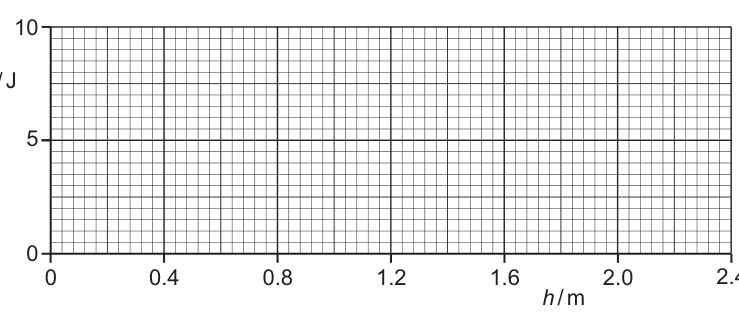
Total energy (from Fig. 5.3).
So
Hence at and at and .
Sketch: upward-opening parabola, symmetric about , passing through and and .
Answer
See sketch: minimum at with , maxima at and .
Upward parabola: Ep = 0 at h = 1.4 m; Ep = 8.0 J at h = 0.8 m and 2.0 m.
Background Concept
In undamped SHM, the total mechanical energy is constant:
At the equilibrium position:
- speed is maximum, so is maximum
- potential energy is minimum (often taken as zero for oscillation energy), so is minimum
At the turning points:
- speed is zero, so
- displacement is maximum, so is maximum and equals the total energy
Therefore, if you are given as a function of position, you can get:
Understanding the Question
You are given Fig. 5.3 (a downward-opening curve for vs depth ) and asked to sketch vs on the blank axes (Fig. 5.4).
Key read-offs from Fig. 5.3:
- at
- at and
Approach
- Identify the constant total energy from the maximum kinetic energy.
- Use .
- Mark the three crucial points for the sketch:
- equilibrium: where is maximum, must be minimum
- turning points: where , must equal
- Draw the correct shape: since is a downward parabola in , is an upward parabola in , symmetric about the equilibrium depth.
Step-by-Step Reasoning
- From Fig. 5.3, the highest point of the curve is . With no damping, this equals the total energy:
- Use the energy relation:
- At equilibrium , , so
- At turning points and , , so
So the curve passes through , has a minimum at , and passes through , with a smooth upward-opening parabolic shape.
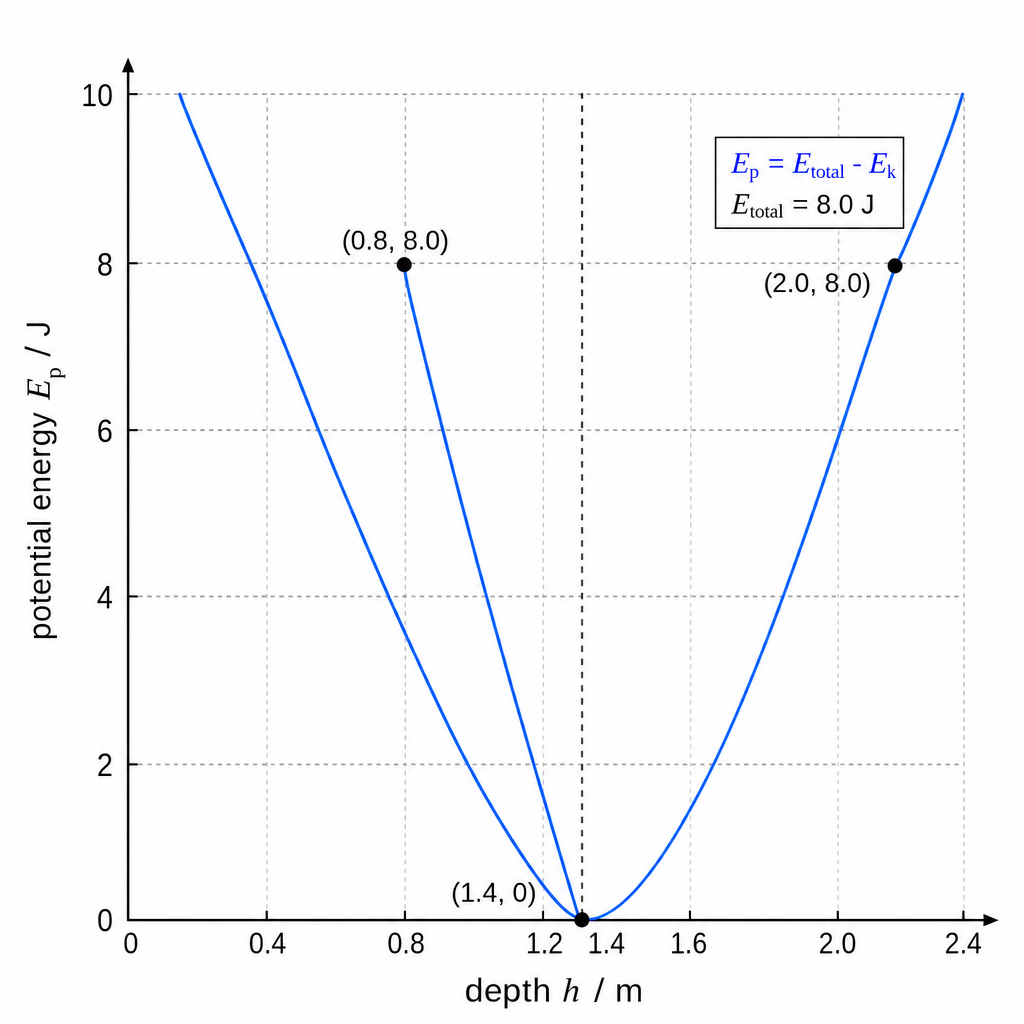
Key Takeaways
- In SHM (no damping), is constant.
- is maximum at equilibrium; is maximum at turning points.
- The graph is the “mirror” of the graph about the horizontal line .
Common Mistakes
- Drawing as the same shape as (it must be inverted relative to the constant total energy).
- Putting at the turning points (it is that is zero there).
- Choosing the wrong total energy (it is the maximum of , not some other y-value).
Things to Be Careful About
- Make sure your sketch uses the same values as the kinetic energy graph: , , .
- The minimum should touch exactly at .
- The curve should be smooth and symmetric about (same as the curve).
Fig. 6.1 shows a circuit that rectifies an alternating input voltage and produces an output voltage across a resistor .
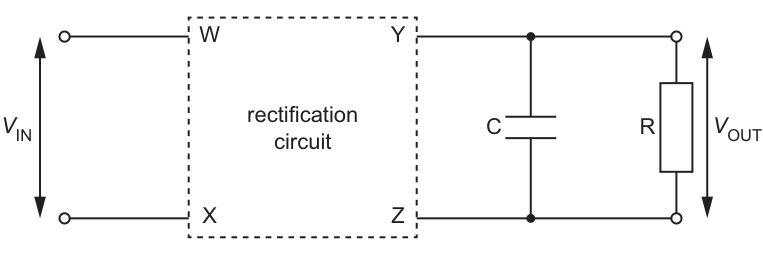
The four terminals of the rectification circuit are labelled W, X, Y and Z.
A capacitor is connected in parallel with resistor .
Answer
Rectification is the conversion of an alternating p.d./current into a p.d./current that is in one direction only (a unidirectional / d.c. output).
Conversion of a.c. to a unidirectional (d.c.) output.
Background Concept
Rectification is a process carried out using diodes (or diode bridges) where current is allowed to pass more easily in one direction than the other. An alternating supply reverses polarity every half-cycle, so the current would normally reverse direction as well.
A rectifier changes the output so that it does not reverse direction: the output becomes unidirectional (it may still vary in size with time).
Understanding the Question
You are shown a circuit with an a.c. input voltage and an output voltage across a resistor. The question asks for the meaning of “rectification”, i.e. what a rectifier does to the a.c. signal.
Approach
Give a clear definition in terms of converting a.c. to d.c. / unidirectional current or p.d. Mention “one direction only” to distinguish it from simply “changing the size”.
Step-by-Step Reasoning
- In a.c., the p.d. alternates between positive and negative values, so current would reverse.
- A rectifier uses diodes to make the output p.d. have only one polarity at the load.
- Therefore the output current through the load is in one direction only (unidirectional).
Key Takeaways
- Rectification means making an a.c. signal into a unidirectional output.
- The output may be pulsating; smoothing is a separate process.
Common Mistakes
- Saying “rectification makes the voltage constant”: that describes smoothing/regulation, not rectification.
- Saying only “changes a.c. to d.c.” without indicating “one direction only” can be too vague.
Things to Be Careful About
- “d.c.” in this context can mean pulsating d.c. (always same sign), not necessarily perfectly steady.
Answer
Capacitor smooths the rectified output by reducing the ripple in (it charges near peaks and discharges between them).
To smooth by reducing ripple.
Background Concept
After rectification, the output is often a series of peaks (pulsating d.c.). A capacitor connected in parallel with the load acts as an energy store:
- it charges up when the rectified voltage rises,
- it discharges through the load when the rectified voltage falls.
This makes the load voltage vary less, so the “ripple” (peak-to-trough variation) is reduced.
Understanding the Question
In Fig. 6.1, capacitor is connected in parallel with the resistor , and is measured across . The question asks what the capacitor is doing in that arrangement.
Approach
State that it smooths the output, and (to be precise) mention charging on peaks and discharging between peaks to keep the p.d. from falling too much.
Step-by-Step Reasoning
- When the rectified output rises, the capacitor charges quickly up to (approximately) the peak voltage.
- When the rectified output begins to fall, the capacitor cannot instantly lose charge; it discharges through .
- This discharge provides current to the resistor, so stays closer to the peak value, reducing ripple.
Key Takeaways
- A smoothing capacitor reduces ripple by providing current between peaks.
- The larger the time constant, the slower the discharge and the smoother the output.
Common Mistakes
- Saying “it increases the voltage”: it does not increase the peak; it reduces the fall between peaks.
- Confusing “smoothing” with “rectification”: rectification makes the output one polarity; smoothing reduces ripple.
Things to Be Careful About
- The capacitor is in parallel with the load, not in series; in parallel it directly holds up the load p.d.
Fig. 6.2 shows the variations with time of the potential differences (p.d.s) and .
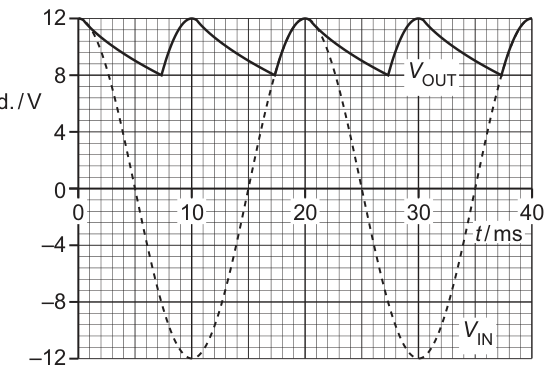
The variation of with can be represented by
where and are constants.
Determine the values of and . Give a unit with your answer for .
= ______ unit ______
= ______
Working
From Fig. 6.2, peak value of is , so
Period , so
Answer
A = 12 V, B = 3.14 × 10^2 rad s^-1
Background Concept
A sinusoidal voltage can be written in the form
where:
- is the peak (maximum) voltage (amplitude),
- is the angular frequency in ,
- the period is the time for one complete cycle.
The link between and is:
Understanding the Question
You are given a graph of against time.
- You must identify in as the peak voltage.
- You must identify as the angular frequency by reading the period from the graph.
Approach
- Read the peak value (highest point) of the curve to get .
- Read the period (time between successive peaks) and convert ms to s.
- Calculate .
Step-by-Step Reasoning
- From the vertical axis, reaches at its peaks, so .
- From the horizontal axis, one full cycle takes .
Convert:
Then:
Key Takeaways
- Amplitude comes from the peak value on the graph.
- Angular frequency is found from the period using .
Common Mistakes
- Using but forgetting to convert to .
- Leaving in ms (gives too small by a factor of ).
- Quoting in instead of .
Things to Be Careful About
- For , at the waveform should start at a maximum if there is no phase constant; the graph shown is consistent with this.
- Ensure is given with a unit (volts).
Answer
Full-wave rectification.
Full-wave rectification.
Background Concept
- Half-wave rectification: only one half-cycle of the a.c. appears at the output; the output pulses once per input cycle (same frequency as input).
- Full-wave rectification: both half-cycles are inverted so the output is always the same polarity; the output pulses twice per input cycle (double the input frequency).
With a smoothing capacitor, you do not see sharp pulses; instead you see a voltage that repeatedly charges near the peaks and then decays between peaks. The key clue is how often the capacitor is “topped up”.
Understanding the Question
From Fig. 6.2, has period . The trace stays positive and shows repeated peaks (with ripple). The question asks which rectification (half-wave or full-wave) produced that.
Approach
Check whether the output is refreshed every half-cycle (every ) or every full cycle (every ). A circuit with four terminals and a typical rectifier block strongly suggests a bridge rectifier, which gives full-wave rectification.
Step-by-Step Reasoning
- The output does not go negative (it is unidirectional).
- The ripple peaks occur more frequently than once per cycle; the capacitor is recharged every half-cycle, indicating full-wave rectification.
Key Takeaways
- Full-wave rectification gives a unidirectional output with ripple at twice the input frequency.
- A bridge rectifier uses four diodes and has four terminals (two input, two output).
Common Mistakes
- Saying “d.c.” without specifying half-wave or full-wave.
- Confusing smoothing (capacitor effect) with the type of rectification.
Things to Be Careful About
- With smoothing, the output is not a set of neat ‘humps’; you must infer the underlying pulse frequency from the recharge intervals.
On Fig. 6.3, draw the circuit diagram for the components inside the rectification circuit.
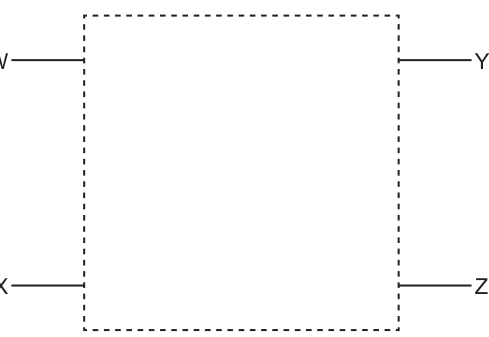
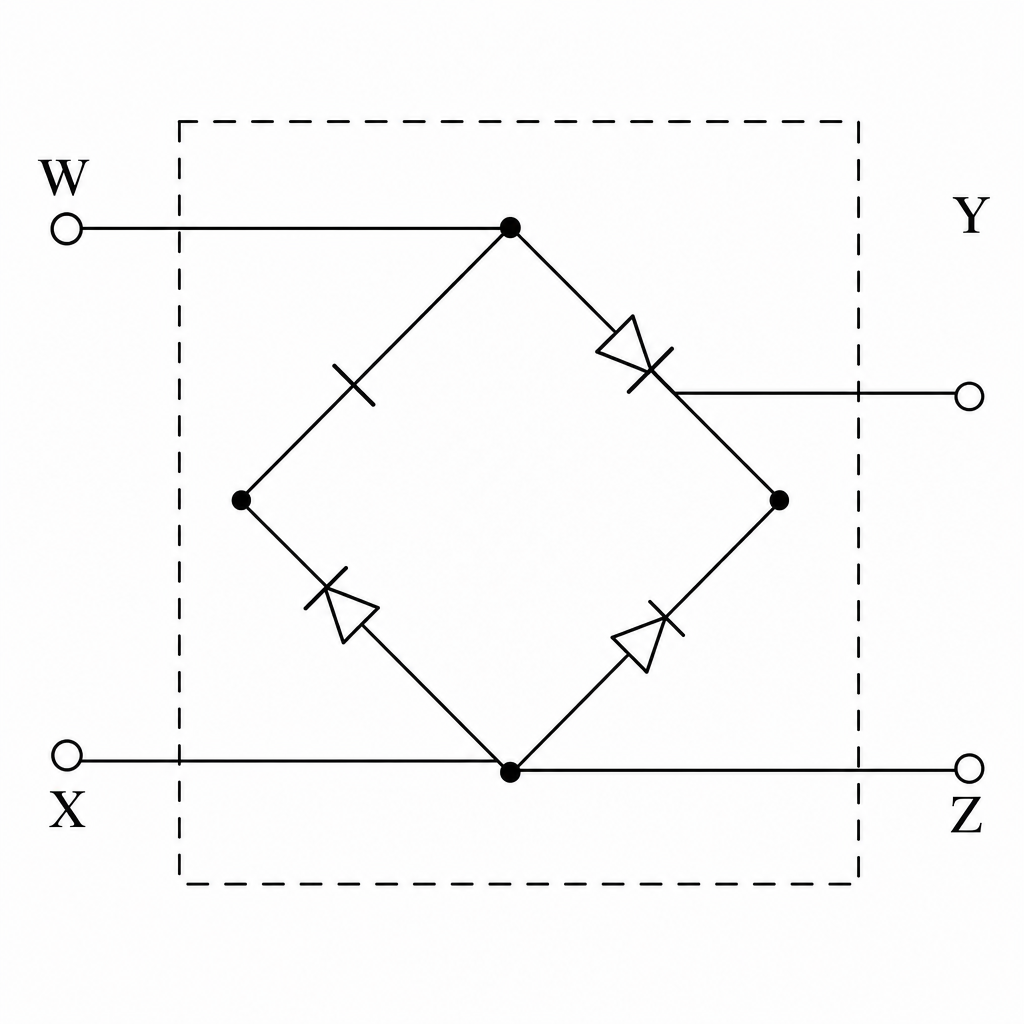
Answer
A four-diode bridge rectifier between (a.c. input) and (d.c. output), with as the positive output and as the negative output.
Bridge rectifier (4 diodes) with W,X as a.c. input and Y positive, Z negative output.
Background Concept
A bridge rectifier uses four diodes arranged so that, regardless of the polarity of the a.c. input, current through the load flows in the same direction.
In each half-cycle, a different pair of diodes conducts:
- On one half-cycle, two diodes conduct to send current through the load one way.
- On the next half-cycle, the other two diodes conduct, but the load current direction is unchanged.
Understanding the Question
Fig. 6.1 shows an unknown “rectification circuit” with terminals on the input side and on the output side. You are asked to draw what is inside that box. From the context (four terminals and full-wave output), the intended circuit is a bridge rectifier (four diodes).
Approach
Draw a standard diode bridge:
- Connect the a.c. input to two opposite corners of the bridge.
- Take the d.c. output from the other two corners.
- Orient diodes so that the output terminal is always at higher potential than .
Step-by-Step Reasoning
To check it works:
- If is positive relative to , current flows from through a diode into , through the load (external ) from to , then through another diode back to .
- If is positive relative to , current flows from through a different diode into , through the load , then through a different diode back to .
In both cases, the load current is in the same direction, so the output is full-wave rectified.
Key Takeaways
- A bridge rectifier uses four diodes to make the output unidirectional for both half-cycles.
- The diode orientation is the critical detail: must always be fed via a forward-biased diode from whichever input is positive.
Common Mistakes
- Drawing only one diode (half-wave rectifier) despite four terminals and full-wave behaviour.
- Reversing a diode so that one half-cycle gives no output or makes negative.
- Connecting output across the same pair of nodes as the input.
Things to Be Careful About
- Diode symbols must have correct direction (anode to cathode). In circuit diagrams, the diode’s bar is the cathode; current (conventional) flows from anode to cathode when forward biased.
- Keep the terminal labels exactly as given in the question when placing the bridge.
Determine a value for the time constant for the discharge of the capacitor through the resistor in Fig. 6.1.
time constant = ______
Working
From Fig. 6.2, falls from about to about between charging peaks.
For full-wave rectification, peaks are separated by .
Use capacitor discharge:
Answer
Time constant .
2.5 × 10^-2 s
Background Concept
When a capacitor discharges through a resistor, the p.d. across it decreases exponentially:
The product is called the time constant:
A larger means the voltage falls more slowly (better smoothing).
Understanding the Question
is the p.d. across and also across the capacitor (they are in parallel). From the graph, the capacitor charges to near the peak and then discharges through between peaks, causing the ripple.
You are asked to find a value of the time constant from the way falls between two successive recharging peaks.
Approach
- Read the maximum and minimum values of the ripple (approximate is acceptable from a graph).
- Decide the time interval between peaks (depends on half-wave vs full-wave). For full-wave, the capacitor is topped up every half-cycle.
- Apply and solve for using logarithms.
Step-by-Step Reasoning
- From the plotted , take (just after charging) and (just before the next charge).
- The input period is , so for full-wave rectification the ripple period is half of this:
Now use the discharge law:
Substitute:
Take natural logs:
So:
Rounded suitably from graph readings, .
Key Takeaways
- Ripple is caused by exponential discharge of the capacitor between peaks.
- Use the time between recharging events (set by rectification type) in the exponential equation.
Common Mistakes
- Using instead of for full-wave ripple spacing.
- Using a linear drop model instead of exponential decay.
- Swapping and in the logarithm (sign error).
Things to Be Careful About
- Read values from the graph sensibly (do not claim unrealistic precision).
- Convert ms to s before substituting.
- Use (natural log) because the equation uses .
The capacitor has a capacitance of .
Use your answer in (b)(iv) to determine the resistance of resistor .
resistance = ______
Working
With and ,
Answer
.
44 Ω
Background Concept
The time constant for an circuit is
This applies to both charging and discharging exponentials. If you know and , you can find by rearranging:
Understanding the Question
You are told and you have already estimated the discharge time constant from part (b)(iv). The question asks for the resistance .
Approach
- Convert to .
- Substitute into .
Step-by-Step Reasoning
Convert capacitance:
Substitute:
So (to 2 s.f., appropriate given the graph-based ).
Key Takeaways
- sets the smoothing behaviour and is directly proportional to and .
- Unit conversion for capacitance is essential.
Common Mistakes
- Using as if it were in farads instead of microfarads.
- Rearranging incorrectly (e.g. ).
Things to Be Careful About
- Keep powers of ten explicit: .
- Quote the final answer to a sensible number of significant figures matching the uncertainty in .
Answer
Magnetic flux density is the force per unit current per unit length on a straight conductor placed perpendicular to the magnetic field.
(where is the force on length carrying current at to the field).
Magnetic flux density is the force per unit current per unit length on a straight conductor placed perpendicular to the field (B = F/IL).
Background Concept
Magnetic flux density describes the strength of a magnetic field. It is defined operationally (i.e. in terms of a measurable effect) using the force a magnetic field exerts on a current-carrying conductor.
For a straight conductor of length carrying current in a magnetic field,
where is the angle between the conductor (current direction) and the magnetic field. The definition uses the special case so that .
Understanding the Question
You are asked to define magnetic flux density. For full credit, the definition must be precise and include the key condition that the conductor is at right angles to the magnetic field.
Approach
Give the standard definition in words and/or the corresponding defining equation for the perpendicular case:
Step-by-Step Reasoning
- Start from the force on a current-carrying conductor:
- For the definition, take :
- Rearrange to make the subject:
- State in words: “force per unit current per unit length” for a conductor perpendicular to the field.
Key Takeaways
- is defined via the magnetic force on a current-carrying conductor.
- The perpendicular condition () is essential in the definition.
Common Mistakes
- Missing the condition “perpendicular to the field”.
- Defining using (this is a valid relationship, but the usual definition at A Level is via a current-carrying conductor).
- Writing (forgetting the length ).
Things to Be Careful About
- Use the phrase “per unit current per unit length” (not just “force per unit current”).
- If you quote an equation, it should be the perpendicular-case equation .
A particle of mass and charge moves at speed into a region where there is a uniform magnetic field, as shown in Fig. 7.1.
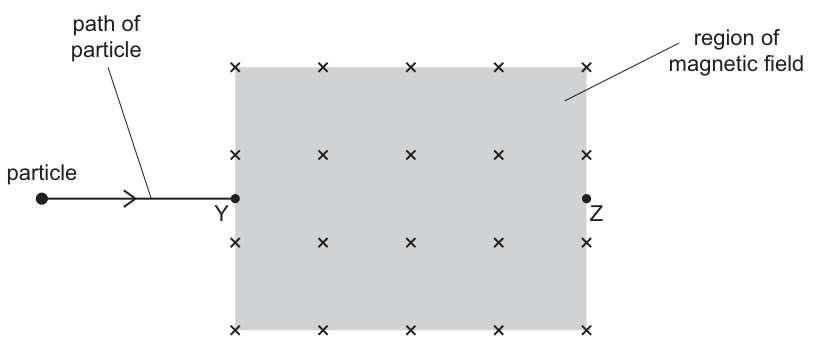
The uniform magnetic field is into the page and has flux density . The particle enters the region of the field at point Y.
State an expression, in terms of some or all of , , and , for the magnetic force that acts on the particle when it is at point Y.
= ______
Answer
At , so
F = BQv
Background Concept
A charge moving with velocity in a magnetic field experiences the magnetic (Lorentz) force
Its magnitude is
where is the angle between and . When the motion is perpendicular to the field (), the force is maximum and equals .
Understanding the Question
At point , the particle enters a region where the field is into the page. The particle’s velocity is in the plane of the page (to the right), so it is perpendicular to the field. You must state the expression for the magnitude of the magnetic force in terms of , , , and .
Approach
Use
and note .
Step-by-Step Reasoning
- Velocity is to the right in the plane of the page.
- Magnetic field is into the page, perpendicular to the plane.
- Therefore and .
So,
Key Takeaways
- Magnetic force on a moving charge depends on the component of velocity perpendicular to .
- For perpendicular entry, .
Common Mistakes
- Writing or .
- Including mass in the force expression (mass affects the radius of curvature later, not the force magnitude here).
Things to Be Careful About
- This is the magnetic force only; electric force is a different expression ().
On Fig. 7.1, draw an arrow at point Y to indicate the direction of the force in (b)(i).
Answer
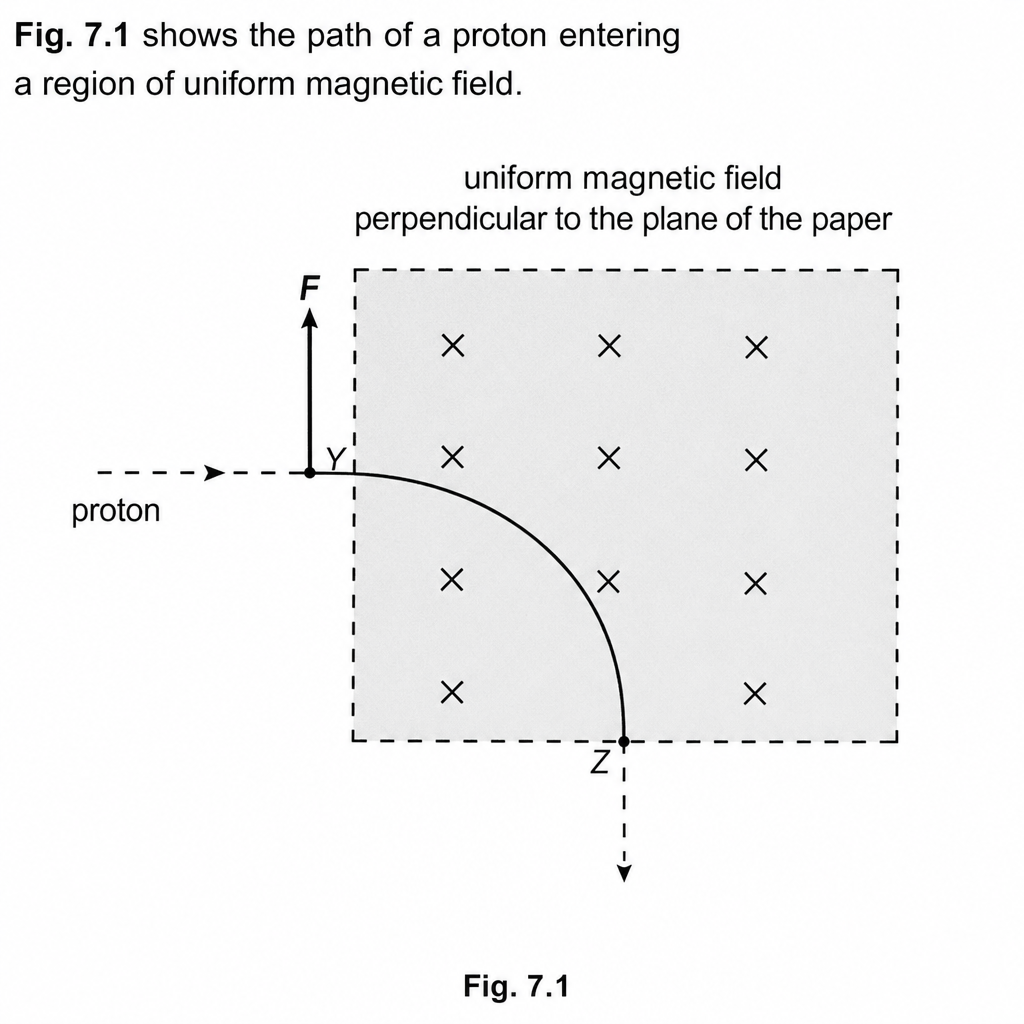
Force on the positive charge is upwards at .
Upwards
Background Concept
The direction of the magnetic force is given by the vector product
For a positive charge, the force direction is the same as . For a negative charge it would be opposite.
You can find the direction using:
- the right-hand rule for the cross product, or
- Fleming’s left-hand rule (conventional current direction is the direction of motion of a positive charge).
Understanding the Question
At :
- is to the right.
- is into the page.
You must draw the force direction arrow on the diagram.
Approach
Use :
- point fingers along (right)
- curl towards (into page)
- thumb gives (for positive charge).
Step-by-Step Reasoning
Take right as and out of the page as . Then:
- is in .
- Into the page is .
So
which is upwards on the page.
Key Takeaways
- Force is perpendicular to both and .
- For , direction follows .
Common Mistakes
- Reversing the direction because of confusing “into the page” with “out of the page”.
- Forgetting that the particle is positively charged (sign matters).
- Drawing force along the direction of motion (magnetic force is perpendicular to motion).
Things to Be Careful About
- Use the correct symbol convention: crosses mean into the page.
- If you use Fleming’s left-hand rule, be consistent: first finger = , second finger = conventional current (direction of positive charge), thumb = force.
On Fig. 7.1, draw a line to show a possible path for the particle through the region of the magnetic field.
Answer
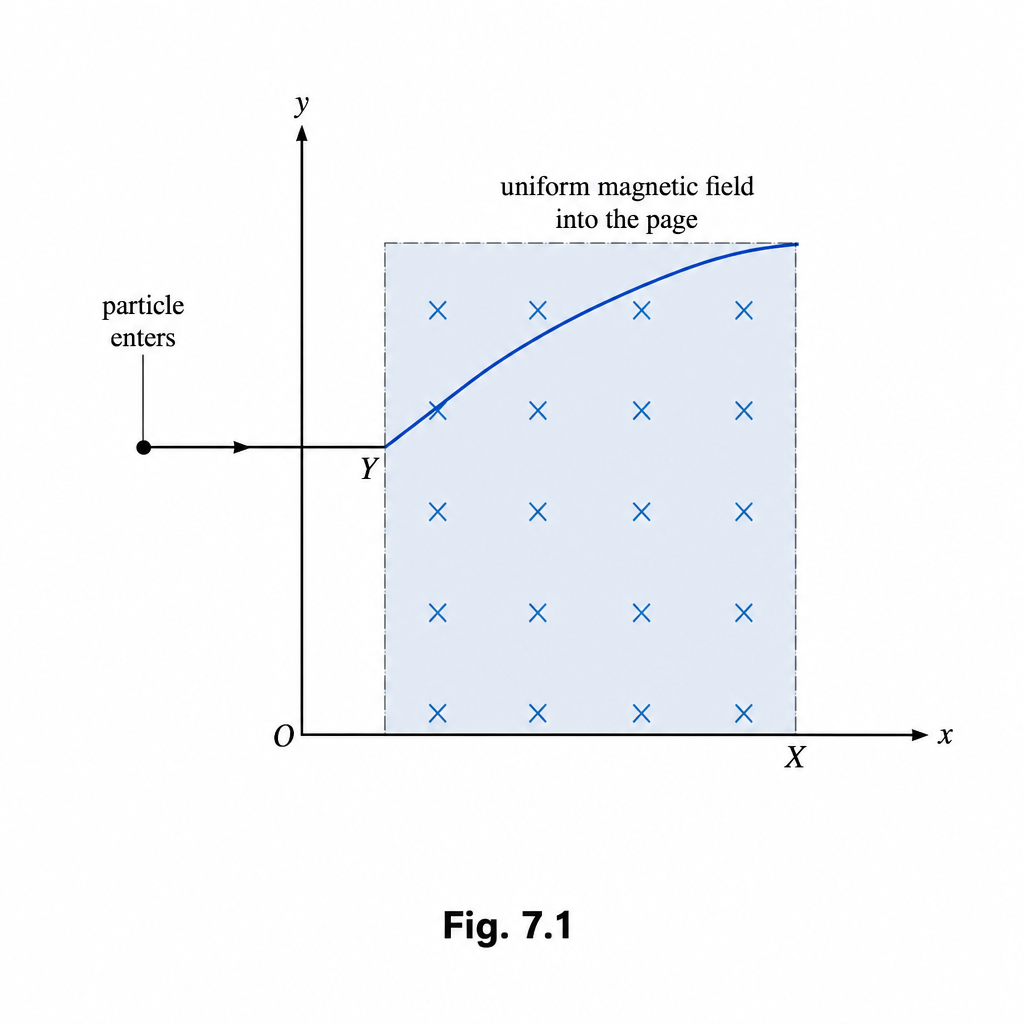
A circular arc through the field region, curving upwards from .
Circular arc curving upwards
Background Concept
In a uniform magnetic field, if a charged particle’s velocity is perpendicular to , the magnetic force is always perpendicular to the velocity. That means:
- the force does no work (speed stays constant),
- the force acts as a centripetal force,
so the motion is circular in the plane perpendicular to .
Magnitude:
and for circular motion,
so the radius is (not required to be found here).
Understanding the Question
You must sketch a possible path of the particle while it is in the shaded region where is uniform and into the page. From part (ii), the force at entry is upward, so the path must initially curve upward.
Approach
- Use the fact that a constant-magnitude force always perpendicular to velocity gives circular motion.
- Make the curve consistent with the initial force direction (upwards), so the centre of the circle is above the entry point.
Step-by-Step Reasoning
- At , velocity is to the right.
- Force is upwards, so acceleration is upwards.
- Acceleration points towards the centre of the circle, so the centre lies above the particle.
- Therefore the trajectory inside the field is an arc of a circle that bends upwards.
Key Takeaways
- Uniform + velocity perpendicular to circular motion.
- Curvature direction follows the magnetic force direction.
Common Mistakes
- Drawing a straight line (would require zero net force).
- Drawing the arc curving downward (wrong cross-product direction).
- Drawing a spiral (speed does not change because magnetic force does no work).
Things to Be Careful About
- The path is only circular while the particle is in the field region; once it leaves, it continues in a straight line tangential to the arc (if there are no other forces).
Explain how an electric field can be used with the magnetic field to ensure that the particle in (b) now passes through point Z.
Answer
Apply a uniform electric field across the magnetic-field region (e.g. using parallel plates) so that the electric force on the positive particle is opposite to the magnetic force.
Here the magnetic force is upwards, so make downwards so that the electric force is downwards.
Adjust so that
so the resultant force is zero and the particle is undeflected, passing through .
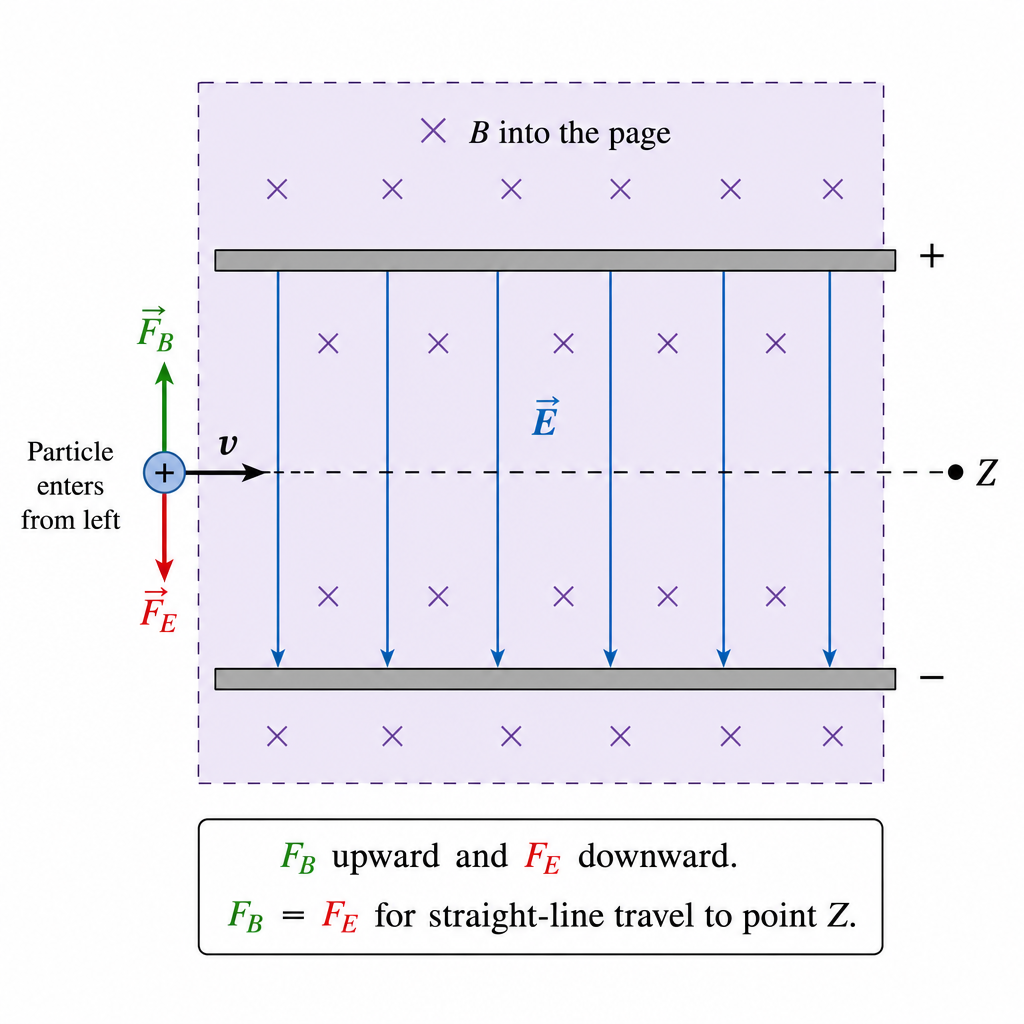
Use a uniform electric field (downwards) so that QE opposes the upward magnetic force; adjust E so QE = BQv and the particle goes straight through Z.
Background Concept
A charged particle in simultaneous electric and magnetic fields experiences two forces:
- Electric force:
- Magnetic force:
If these forces are equal in magnitude and opposite in direction, the net force is zero and the particle travels in a straight line at constant velocity. This arrangement is called a velocity selector.
Understanding the Question
In part (b), the particle curves because the magnetic force deflects it. Now you want it to pass through point (i.e. go straight through the region without being deflected). You must explain how to use an electric field together with the magnetic field to achieve this.
Approach
- Decide the direction of magnetic force from part (b): it is upward.
- Create an electric field that produces an electric force downward (since the charge is positive).
- Choose the electric field strength so that the forces balance:
so net force is zero and the particle is not deflected.
Step-by-Step Reasoning
- From (b)(ii), magnetic force at entry is upwards.
- To cancel it, we need a downward force.
- For a positive charge, the electric force is in the direction of , so must be downward.
To produce a uniform , place two parallel plates across the field region:
- top plate positive, bottom plate negative, giving downward.
Then adjust the potential difference so that
and the resultant force is zero, so the particle continues straight and reaches .
Key Takeaways
- Straight-line motion through crossed fields requires zero resultant force.
- Balance condition (for perpendicular and ): .
- Direction matters: choose to oppose the magnetic deflection.
Common Mistakes
- Choosing in the wrong direction (which would increase the deflection).
- Saying “electric field cancels magnetic field” (fields do not cancel; forces on the particle cancel).
- Forgetting that the magnetic force depends on speed .
Things to Be Careful About
- Because the charge is , the electric force is in the same direction as (opposite for electrons).
- The balance works only for one particular speed; particles with other speeds will be deflected.
Working
For no deflection,
Answer
v = E/B
Background Concept
In crossed electric and magnetic fields, a particle goes straight only if the net force is zero:
For perpendicular and ,
and the electric force magnitude is
Understanding the Question
You have already set up fields so the electric force cancels the magnetic force. You must now derive the formula for the speed in terms of the field strengths and .
Approach
Set the magnitudes equal for balance and rearrange for .
Step-by-Step Reasoning
Balance condition for straight-line motion:
Substitute the expressions:
Cancel (non-zero):
Rearrange for :
Key Takeaways
- A velocity selector selects the speed .
- The charge cancels, so the selected speed is independent of the particle’s mass and charge (as long as it is charged).
Common Mistakes
- Writing (inverting).
- Forgetting to cancel .
- Using instead of for a particle.
Things to Be Careful About
- This derivation assumes so that .
- must be in and in for to come out in .
Answer
The de Broglie wavelength is the wavelength associated with a moving particle, given by
The wavelength associated with a moving particle (matter wave), (\lambda = h/p).
Background Concept
Louis de Broglie proposed that particles can exhibit wave-like behaviour. The quantitative link between a particle and its associated matter wave is
where:
- is the de Broglie wavelength,
- is the Planck constant,
- is the momentum of the particle.
This relation is general: it applies to electrons, protons, atoms, etc. For slow (non-relativistic) motion, .
Understanding the Question
You are being asked to state what “de Broglie wavelength” means. For full credit, you should mention that it is a wavelength associated with a moving particle and ideally give the defining equation .
Approach
Give a clear definition (wavelength associated with a moving particle) and include the key formula connecting it to momentum.
Step-by-Step Reasoning
- A particle moving with momentum behaves as if it has an associated wave.
- The wavelength of this wave is defined by
This statement is exactly what the term “de Broglie wavelength” means.
Key Takeaways
- De Broglie wavelength links particle momentum to wave behaviour.
- The defining relation is .
Common Mistakes
- Writing as the definition (that is only after assuming ).
- Confusing de Broglie wavelength with photon wavelength or with the Compton wavelength.
Things to Be Careful About
- The definition must involve momentum (most general form).
- “Associated with a moving particle” is important: at , the relation would imply an infinite wavelength.
Calculate the de Broglie wavelength of an electron moving at a speed of .
wavelength = ______
Working
Answer
1.49 × 10^-11 m
Background Concept
For a particle, the de Broglie wavelength is
If the speed is not extremely close to , we usually take the momentum as
(At higher speeds you would need relativistic momentum, but here the question expects the non-relativistic expression.)
Understanding the Question
An electron has speed . You must calculate its de Broglie wavelength, so you need its momentum first.
Given:
Unknown: .
Approach
- Find momentum .
- Use .
- Quote the result in metres with sensible significant figures.
Step-by-Step Reasoning
- Momentum:
Multiply numbers and combine powers of ten:
and
So
- De Broglie wavelength:
Divide the decimal parts and subtract indices:
Key Takeaways
- Always go via momentum: is inversely proportional to .
- For typical exam electron speeds well below , is used.
Common Mistakes
- Forgetting to calculate momentum first and trying (wrong).
- Using (confusing kg with g).
- Power-of-ten error when dividing by .
Things to Be Careful About
- Units: in is consistent with momentum in , giving in metres.
- Significant figures: the speed is given to 2 s.f., so 2–3 s.f. is appropriate.
State one similarity and one difference between an electron and a positron.
similarity: ______
difference: ______
Answer
Similarity: same mass (and same magnitude of charge).
Difference: positron has charge whereas electron has charge .
Similarity: same mass. Difference: positron has +e charge, electron has −e charge.
Background Concept
An antiparticle has the same mass as its corresponding particle but opposite charge (and opposite quantum numbers such as lepton number). For the electron , the antiparticle is the positron .
Key properties:
- Electron: charge , mass .
- Positron: charge , mass .
Understanding the Question
You must give:
- one similarity (a property that is the same for both), and
- one difference (a property that is not the same).
Only one of each is required.
Approach
Pick a straightforward, unambiguous similarity (e.g. same mass) and a clear difference (opposite charge). Write them in short statements.
Step-by-Step Reasoning
- Similarity: electron and positron are both leptons and have equal rest mass .
- Difference: their charges are equal in magnitude but opposite in sign ( vs ).
Key Takeaways
- Particle–antiparticle pairs: same mass, opposite charge.
Common Mistakes
- Saying they have different masses (they do not).
- Giving two similarities but no difference, or vice versa.
- Saying “positron is positive and electron is negative” without explicitly linking to charge (usually fine, but better to state ).
Things to Be Careful About
- Keep to one similarity and one difference as requested.
- Avoid vague statements like “they are different particles” (no credit).
An electron moving at a speed of collides with a positron that is travelling at the same speed in the opposite direction. As a result of the collision, two gamma-ray photons are produced.
Answer
Annihilation (electron–positron annihilation).
Annihilation.
Background Concept
When a particle meets its antiparticle, they can annihilate: their rest mass (and any kinetic energy) is converted into other forms of energy, commonly high-energy photons (gamma rays).
Understanding the Question
An electron collides with a positron and produces two gamma-ray photons. You are asked to name this reaction.
Approach
Recognise “electron + positron producing gamma photons” as the standard signature of annihilation.
Step-by-Step Reasoning
- Electron is the antiparticle partner of the positron.
- Their collision producing photons indicates conversion of mass-energy into radiation.
- This is called annihilation.
Key Takeaways
- Electron + positron gamma photons is annihilation.
Common Mistakes
- Calling it “pair production” (that is the reverse process: gamma photon creating an pair).
Things to Be Careful About
- The term is “annihilation”, not “fusion” or “fission”.
Answer
The electron and the positron are annihilated (both cease to exist) and their mass-energy (and kinetic energy) is converted into the energy of the gamma-ray photons.
Both are annihilated; their mass/kinetic energy becomes the energy of the gamma photons.
Background Concept
In annihilation, the initial particles are not present after the interaction. Energy and momentum are conserved by converting the particles’ rest energy (and any kinetic energy) into the energy of the emitted products (here, photons).
Understanding the Question
You must state what happens to each of the original particles (electron and positron) after the collision.
Approach
Say explicitly that both particles are destroyed/annihilated and that their energy becomes gamma radiation.
Step-by-Step Reasoning
- The electron and positron are a particle–antiparticle pair.
- In annihilation, the pair disappears.
- The total energy they had (rest energy + kinetic) is carried away by the produced gamma photons.
Key Takeaways
- Annihilation: initial particles vanish; energy appears as radiation/other particles.
Common Mistakes
- Saying only one of the particles is destroyed.
- Saying they “combine” to form a heavier particle (not here; the products are photons).
Things to Be Careful About
- Mentioning energy conversion is usually needed for the second mark: not just “they disappear”.
Answer
Momentum must be conserved. A single photon would have non-zero momentum, but the total initial momentum is zero, so two photons are emitted in opposite directions so their momenta cancel.
To conserve momentum: one photon cannot have zero momentum, so two are emitted oppositely to give zero net momentum.
Background Concept
Momentum is always conserved in an isolated interaction. Photons have momentum even though they have no rest mass:
So any photon with energy has non-zero momentum.
Understanding the Question
The electron and positron have equal speeds in opposite directions, so the total momentum of the system before the collision is zero. The question asks why the products must be two photons rather than one.
Approach
Use conservation of momentum:
- initial total momentum ,
- one photon cannot have zero momentum,
- two photons can be emitted in opposite directions so net momentum is zero.
Step-by-Step Reasoning
- Electron momentum and positron momentum are equal in magnitude and opposite in direction, so they cancel.
- If only one photon were produced, it would have momentum , meaning the final total momentum would not be zero.
- With two photons emitted in opposite directions, their momenta can be equal and opposite, giving total final momentum , matching the initial momentum.
Key Takeaways
- A single photon cannot represent a zero-momentum final state.
- Two-photon emission is the standard way to conserve momentum in annihilation at zero net momentum.
Common Mistakes
- Explaining using energy conservation only (energy conservation does not force two photons).
- Saying “two photons because there are two particles” (not the correct physics reason).
Things to Be Careful About
- The crucial point is momentum: the initial total momentum is zero due to equal and opposite momenta.
Working
Answer
1.1 × 10^-15 J
Background Concept
For speeds that are not extremely close to , the kinetic energy of a particle of mass and speed is
(At relativistic speeds you would use , but the question clearly expects the classical expression.)
Understanding the Question
You are asked to show that an electron moving at has kinetic energy .
Given:
Approach
Substitute into and simplify carefully.
Step-by-Step Reasoning
- Square the speed:
- Multiply by the mass:
- Take half:
Key Takeaways
- Use and track indices carefully.
- “Show that” allows rounding to the stated value.
Common Mistakes
- Forgetting the factor .
- Squaring the power of ten incorrectly (e.g. using squared as instead of ).
Things to Be Careful About
- Keep the intermediate step in standard form to avoid index errors.
- The final answer should be consistent with the given speed (2 s.f. is fine).
Use the information in (d)(iv) to determine, to three significant figures, the wavelength associated with the gamma radiation emitted in the collision.
wavelength = ______
Working
Energy per photon (equal and opposite momenta) is
Using ,
Answer
2.39 × 10^-12 m
Background Concept
In electron–positron annihilation, energy is conserved. The initial total energy is the sum of rest energies and kinetic energies:
Two photons are produced. A photon’s energy is related to its wavelength by
If the electron and positron have equal and opposite momenta, the total momentum is zero. For the final momentum to be zero, the two photons must have equal and opposite momenta, which means they also have equal energies.
Understanding the Question
You are told (from part (iv)) that the kinetic energy of the electron is (and the positron has the same kinetic energy). You must find the wavelength of the gamma radiation emitted.
Because there are two photons and the initial net momentum is zero, each photon has the same energy. The question says to use the information in (d)(iv), so the kinetic energy must be included (not just ).
Approach
- Find the rest energy of one electron/positron: .
- Energy per photon equals the energy per particle: .
- Convert photon energy to wavelength using .
Step-by-Step Reasoning
- Rest energy of electron:
Since ,
- Energy accounting and energy per photon:
- Total initial energy:
- Two photons share this total energy equally (equal energies), so each photon has
Using :
- Convert to wavelength:
First evaluate :
Then
(to three significant figures).
Key Takeaways
- In annihilation with zero net momentum, the two photons have equal energies.
- Each photon carries energy (not just when particles are moving).
- Use for photon wavelength.
Common Mistakes
- Using total energy as the energy of one photon (forgetting there are two photons).
- Ignoring the kinetic energy even though the question explicitly references (iv).
- Using instead of .
Things to Be Careful About
- The “two photons” condition implies equal sharing here because the initial momenta cancel.
- Quote the final wavelength to three significant figures as requested.
- Keep consistent constants: use and (or consistent values).
Answer
Activity is the rate of decay of the sample (number of disintegrations per unit time).
Activity is the rate of decay (disintegrations per unit time).
Background Concept
Activity measures how quickly radioactive nuclei are decaying.
It is defined as the number of nuclear decays (disintegrations) occurring per unit time. The SI unit is the becquerel, where
Understanding the Question
You are asked to state what “activity” means for a radioactive sample. This is a definition question worth 1 mark, so it needs a precise phrase.
Approach
Give the definition in words: “rate of decay” or “number of disintegrations per unit time”. (You may optionally mention Bq corresponds to per second.)
Step-by-Step Reasoning
- A radioactive sample contains many unstable nuclei.
- Each time one nucleus decays, that counts as one disintegration.
- Activity tells you how many such disintegrations occur each second (or per unit time).
Key Takeaways
- Activity is a rate: decays per unit time.
- Unit: Bq ().
Common Mistakes
- Defining activity as “number of radioactive nuclei present” (that is , not ).
- Saying “energy released per second” (not the definition).
Things to Be Careful About
- Use the word “per unit time” (rate).
- Don’t confuse activity with count rate measured by a detector (count rate can differ due to efficiency/background).
Explain why the variation with time of the activity of a radioactive sample is exponential in nature.
Answer
Radioactive decay is random so each nucleus has a constant probability per unit time of decaying.
Hence the activity (rate of decay) is proportional to the number of undecayed nuclei :
As decreases, the rate decreases in the same proportion, giving an exponential decrease of (and therefore ) with time.
Because each nucleus has a constant probability per unit time of decay, the rate of decay is proportional to the number remaining (A = λN), so dN/dt = −λN and hence N and A fall exponentially with time.
Background Concept
Radioactive decay is a random and spontaneous process. For a given isotope, each nucleus has the same constant probability per unit time of decaying. This constant is the decay constant .
Two key relationships are:
where is the activity (decays per unit time) and is the number of undecayed nuclei, and the decay-rate equation
The solution to this differential equation is exponential:
Understanding the Question
The question asks for a reason why activity decreases exponentially with time. So you must explain the chain:
random decay with constant probability rate proportional to number remaining exponential law.
Approach
- State the physical assumption: constant probability of decay per nucleus per unit time.
- Convert that into a proportionality: total decays per second .
- State that because the rate is proportional to the amount remaining, the decrease is exponential.
Step-by-Step Reasoning
- Consider a short time interval . If the probability of decay for one nucleus in that time is proportional to , then the expected fraction that decays in is constant for that isotope.
- If there are nuclei present, the expected number that decay in is proportional to .
- That means the rate of decrease of is proportional to itself:
- Introducing the constant of proportionality gives
- A quantity whose rate of decrease is proportional to its current value must decrease exponentially. Therefore
- Since activity is proportional to via , activity also obeys
Key Takeaways
- Constant decay probability per nucleus constant fractional decrease per unit time.
- Rate law produces exponential decay.
- Activity follows the same exponential form because .
Common Mistakes
- Saying “activity decreases exponentially because half-life is constant” (this reverses cause and effect; constant half-life is a consequence of exponential decay).
- Not linking activity to number of nuclei (missing the crucial idea).
Things to Be Careful About
- Exponential does not mean “decreases quickly at first then slowly” unless you justify it via proportional rate.
- Make clear it is the probability per unit time that is constant, not the number decaying each second.
A sample contains a single radioactive isotope that decays to form a stable isotope.
The sample has an activity of at time .
At a time minutes later, the activity is .
Determine the decay constant, in , of the radioactive isotope.
decay constant = ______
Working
Answer
4.83 × 10^−2 min^−1
Background Concept
For a single radioactive isotope,
where:
- is activity at time ,
- is activity at ,
- is the decay constant (probability per unit time that a nucleus decays).
Because is proportional to the number of undecayed nuclei, it follows the same exponential form as .
Understanding the Question
You are told:
- at ,
- at ,
and asked to find in .
Approach
Use the exponential decay law for activity and rearrange:
Then substitute numbers and solve for .
Step-by-Step Reasoning
Start with
Substitute the two activity values and the time:
Divide both sides by to isolate the exponential:
Take natural logs:
So
Numerically, so
Key Takeaways
- Activity decays exponentially: .
- Solving for usually involves taking of an activity ratio.
Common Mistakes
- Using instead of without adjusting (Cambridge expects natural log for exponentials).
- Forgetting the negative sign: is negative because .
- Leaving in or mixing seconds and minutes.
Things to Be Careful About
- Time must match the unit of (here minutes ).
- Keep enough significant figures in intermediate steps (e.g. use ) to avoid rounding errors.
Use your answer in (c)(i) to determine the half-life, in min, of the radioactive isotope.
half-life = ______
Working
Answer
14.4 min
Background Concept
The half-life is the time for the activity (or number of undecayed nuclei) to fall to half its initial value.
From
define half-life by :
Understanding the Question
You have already found in (c)(i). This part asks you to use it to calculate the half-life in minutes.
Approach
Apply the standard relationship
and ensure the unit comes out in minutes because was in .
Step-by-Step Reasoning
Substitute :
Calculate:
(Units check: .)
Key Takeaways
- Half-life is linked to decay constant by .
- Units follow directly from the units of .
Common Mistakes
- Using (missing the factor).
- Mixing minutes and seconds between (c)(i) and (c)(ii).
Things to Be Careful About
- Use consistent significant figures (typically 3 s.f. for this data gives ).
- Ensure you quote the unit “min”.
On Fig. 9.1, sketch the variation of the activity of the sample with for values of between and .
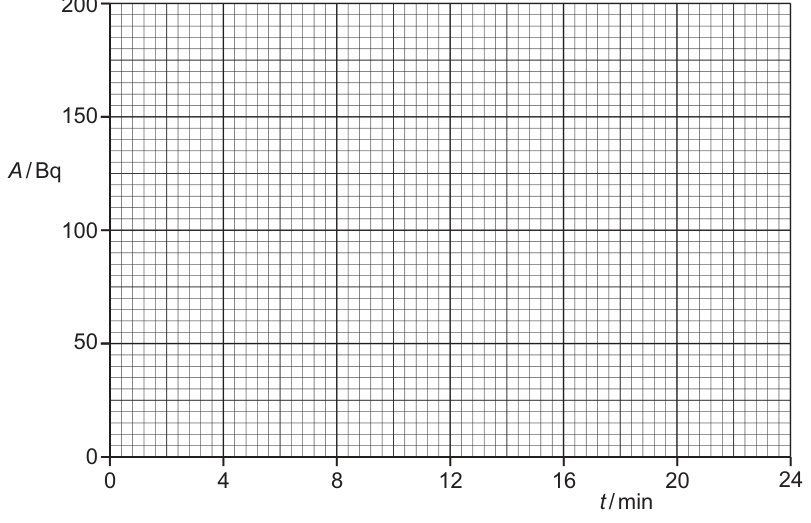
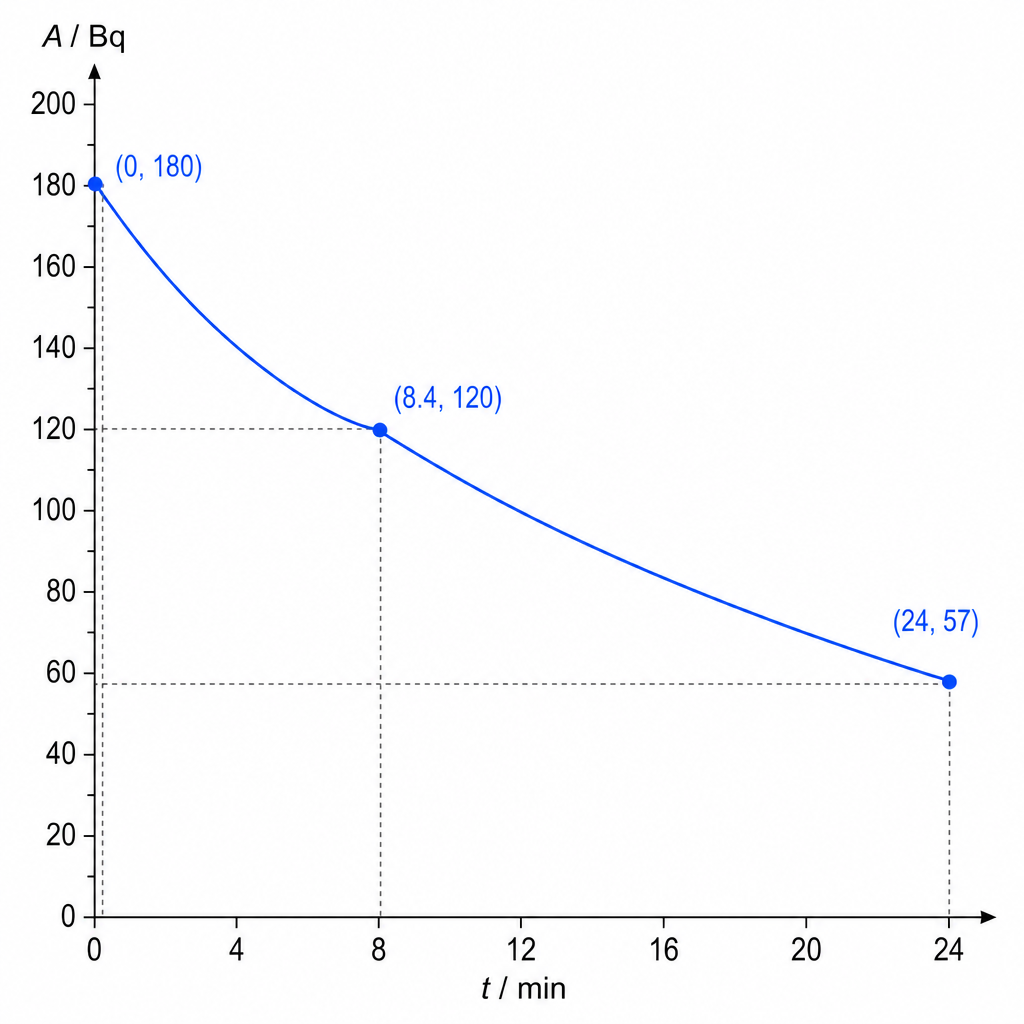
Answer
Sketch a smooth exponential decay curve starting at at , passing through at , and approaching asymptotically (e.g. at ).
Exponential decay curve from 180 Bq at t=0 through 120 Bq at t=8.4 min, tending to 0 (A ≈ 57 Bq at 24 min).
Background Concept
For radioactive decay,
The key graphical features of an exponential decay are:
- starts at when ,
- decreases rapidly at first then more slowly,
- never becomes negative and approaches as a horizontal asymptote.
Half-life gives helpful checkpoints: after each half-life, activity halves.
Understanding the Question
You must sketch against from to .
You are given two anchor points:
Your curve must pass through these and have the correct exponential shape.
Approach
- Plot the two given points accurately.
- Draw a smooth curve (not a straight line) that decreases and flattens out.
- Use your (or half-life) to estimate the value near to guide the tail of the curve.
Step-by-Step Reasoning
- Mark at on the vertical axis.
- Mark at .
- Use the decay law with to estimate the end value:
- So by the curve should be around and flattening.
- Draw a smooth exponential curve through the two given points, passing near , approaching but not touching .
Key Takeaways
- Exponential decay curves are smooth, decreasing, and asymptotic to zero.
- Use given points and one extra estimated point to get the correct shape over the full range.
Common Mistakes
- Drawing a straight line between the points.
- Making the curve reach at (exponential decay does not hit zero).
- Sketching a curve that goes below zero.
Things to Be Careful About
- Ensure the curve passes through the provided data point .
- Keep the curve concave upwards (slope magnitude decreases with time).
- Use the axes scales correctly; the -axis is in Bq and the -axis is in minutes.
Answer
Hubble’s law: the recessional speed of a galaxy is proportional to its distance from the observer:
Recessional speed is proportional to distance: v = H0 d.
Background Concept
Hubble’s law describes the expansion of the Universe. For sufficiently distant galaxies (and for speeds not too close to the speed of light), observations show that their recessional speed increases in proportion to their distance .
The constant of proportionality is the Hubble constant , so:
Understanding the Question
You are asked to state Hubble’s law, so you must give the relationship in words and/or in an equation. For 2 marks, it is usually necessary to include both the proportionality idea and the correct equation.
Approach
Write the law as a proportionality between and , then express it using .
Step-by-Step Reasoning
- “Recessional speed is proportional to distance” means .
- Introduce the constant of proportionality :
Key Takeaways
- Hubble’s law links cosmic expansion to a simple linear relation .
- has units of (or commonly ).
Common Mistakes
- Stating “redshift is proportional to distance” without mentioning recessional speed (often loses a mark).
- Writing (wrong rearrangement).
Things to Be Careful About
- Include the idea of recession (moving away) and the correct proportionality.
- If you give the equation, ensure the symbols are identified correctly: is recessional speed, is distance, is Hubble constant.
A star in a distant galaxy emits radiation that has a maximum intensity of emission at a wavelength of .
Observations of the galaxy made on the Earth detect the maximum intensity of emission from the star at a wavelength of .
Answer
The detected wavelength is larger than the emitted wavelength, so the radiation is redshifted.
This is because the star/galaxy is moving away from the Earth (recession due to the expansion of the Universe), so the waves are Doppler shifted to longer wavelength.
Because the galaxy is receding from Earth, the light is Doppler redshifted so the observed wavelength is longer.
Background Concept
Light (and all electromagnetic radiation) can exhibit a Doppler shift. If a source moves away from an observer, successive wavefronts are emitted from progressively further positions, so the spacing between arriving wavefronts increases. That means the observed wavelength is greater than the emitted wavelength (a redshift).
In cosmology, distant galaxies generally show redshift because space itself is expanding; this produces the same observed effect: wavelengths are stretched.
Understanding the Question
You are told the star emits maximum intensity at but Earth detects the maximum at . Since , the wavelength has increased.
The question asks you to explain why the values differ, so you must mention redshift and the physical reason (recession/expansion).
Approach
- Compare the two wavelengths to decide redshift vs blueshift.
- Connect redshift to the source moving away from the observer (in this context because of the expansion of the Universe).
Step-by-Step Reasoning
- Observed wavelength is longer:
- Longer wavelength corresponds to redshift.
- Redshift happens when the source is moving away, so the star/galaxy is receding from Earth (consistent with Hubble expansion).
Key Takeaways
- Increase in observed wavelength redshift.
- Redshift indicates recession (moving away), often due to expansion of the Universe for distant galaxies.
Common Mistakes
- Saying “the frequency increases” (it decreases when wavelength increases).
- Mentioning only “Doppler effect” but not stating that the source is moving away.
Things to Be Careful About
- Be explicit: moving away and longer wavelength are the key marking points.
- Don’t confuse cosmological redshift with gravitational redshift; here the context is a distant galaxy and Hubble expansion.
Working
Answer
1.9 × 10^7 m s^-1
Background Concept
Redshift is defined by
For speeds small compared with , the Doppler/redshift relation can be approximated by
where:
- is the speed of recession (positive when moving away),
- is the speed of light.
Understanding the Question
You are given an emitted wavelength (from the star) and an observed wavelength (measured on Earth) for the same peak in the spectrum. Because the observed wavelength is larger, the star is receding, and you can use the fractional change in wavelength to find the speed.
Given:
Find: .
Approach
- Calculate the wavelength shift .
- Compute the redshift fraction .
- Use .
Step-by-Step Reasoning
- Difference in wavelengths:
Compute the bracket first: .
- Fractional change:
- Multiply by :
To 2 s.f.:
Key Takeaways
- Use the fractional wavelength change to find recessional speed.
- For modest redshifts, is the standard A-level approximation.
Common Mistakes
- Using in the denominator instead of (usually the definition uses emitted/rest wavelength).
- Subtracting the wrong way round and getting a negative speed (sign error).
- Forgetting to multiply by or using with wrong power of ten.
Things to Be Careful About
- Keep track of powers of ten when subtracting: .
- Quote the speed in and to an appropriate number of significant figures.
The wavelength of maximum intensity of emission is used to determine a value for the surface temperature of the star.
Explain how the temperature determined using the observed wavelength compares with the true value of temperature determined using the emitted wavelength.
Answer
Using Wien’s law , the larger observed peak wavelength gives a smaller temperature.
So the temperature found using is lower than the true surface temperature found from .
It would be underestimated (observed λmax is larger so T is smaller).
Background Concept
Wien’s displacement law relates the wavelength at which a blackbody spectrum has maximum intensity, , to the absolute temperature :
where is Wien’s constant. The key relationship is that
So if the peak wavelength appears larger, the inferred temperature will be smaller.
Understanding the Question
The star’s true surface temperature corresponds to the peak wavelength it emits in its own rest frame (). However, Earth observes a redshifted peak at . The question asks how the temperature calculated from the observed wavelength compares with the true temperature.
Approach
Use the inverse proportionality from Wien’s law: compare values to decide whether the inferred increases or decreases.
Step-by-Step Reasoning
- From Wien’s law:
- Observed peak wavelength is larger:
- Because is inversely proportional to :
So the temperature calculated using the observed wavelength would be an underestimate.
Key Takeaways
- Wien’s law: bigger means lower inferred .
- Redshift pushes the spectrum peak to longer wavelength, biasing temperature measurements low if uncorrected.
Common Mistakes
- Claiming the temperature would be higher (getting the inverse relationship wrong).
- Mixing up “maximum intensity” wavelength with “maximum frequency” (they do not map one-to-one without care).
Things to Be Careful About
- Use kelvin temperature (absolute temperature) with Wien’s law.
- The comparison is qualitative here: you do not need to calculate the temperatures, only state the direction of the effect and link it to .
A value for the Hubble constant is .
Use your answer in (b)(ii) to determine the distance of the star in (b) from the Earth.
distance = ______
Working
Hubble’s law:
Answer
8.2 × 10^24 m
Background Concept
Hubble’s law relates recessional speed and distance :
Rearranging gives:
If is in and is in , then comes out in metres.
Understanding the Question
You are given and told to use the speed found in (b)(ii) to calculate the distance of the star’s galaxy from Earth.
So:
- Known: from (b)(ii),
- Unknown:
Approach
Use and substitute the numerical values carefully, especially the negative power of ten in .
Step-by-Step Reasoning
- Start with Hubble’s law and rearrange:
- Substitute and :
- Deal with powers of ten:
and the numerical part:
So:
To 2 s.f.:
Key Takeaways
- Hubble’s law can be used to estimate cosmic distances from recessional speeds.
- Dividing by a very small (about ) gives a very large distance (about to m).
Common Mistakes
- Using (inverting incorrectly).
- Mishandling powers of ten: dividing by should increase the power by 18.
- Forgetting to carry forward the answer from (b)(ii) consistently.
Things to Be Careful About
- Keep units consistent: in and in .
- Quote the final distance to sensible significant figures based on the data (here 2 s.f. is appropriate).