Physics 9702/42 — February/March 2025
Cambridge A-Level · A Level Structured Questions · worked solutions for every part, with the mark scheme
Topics Motion in a Circle · Electric Fields · Medical Physics · Magnetic Fields · Gravitational Fields · Temperature · +7 more
A steel ball is placed on the inside surface of a hollow circular cone. The ball moves in a horizontal circle at constant speed, as shown in Fig. 1.1.
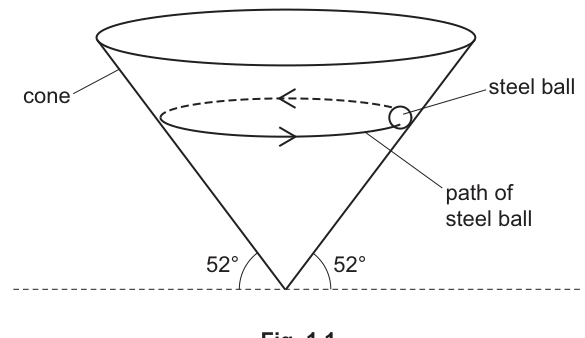
The angle of the side of the cone to the horizontal is . There is no friction between the ball and the cone.
Fig. 1.2 shows a cross-section through the cone and the steel ball.
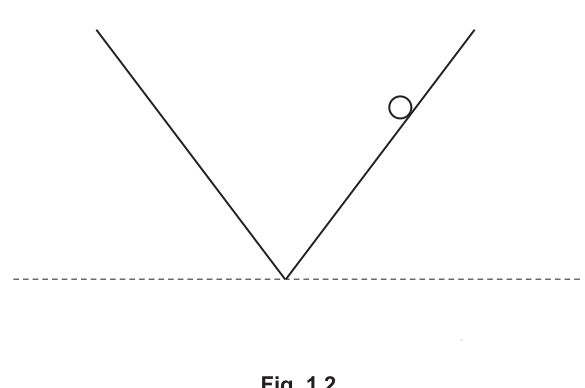
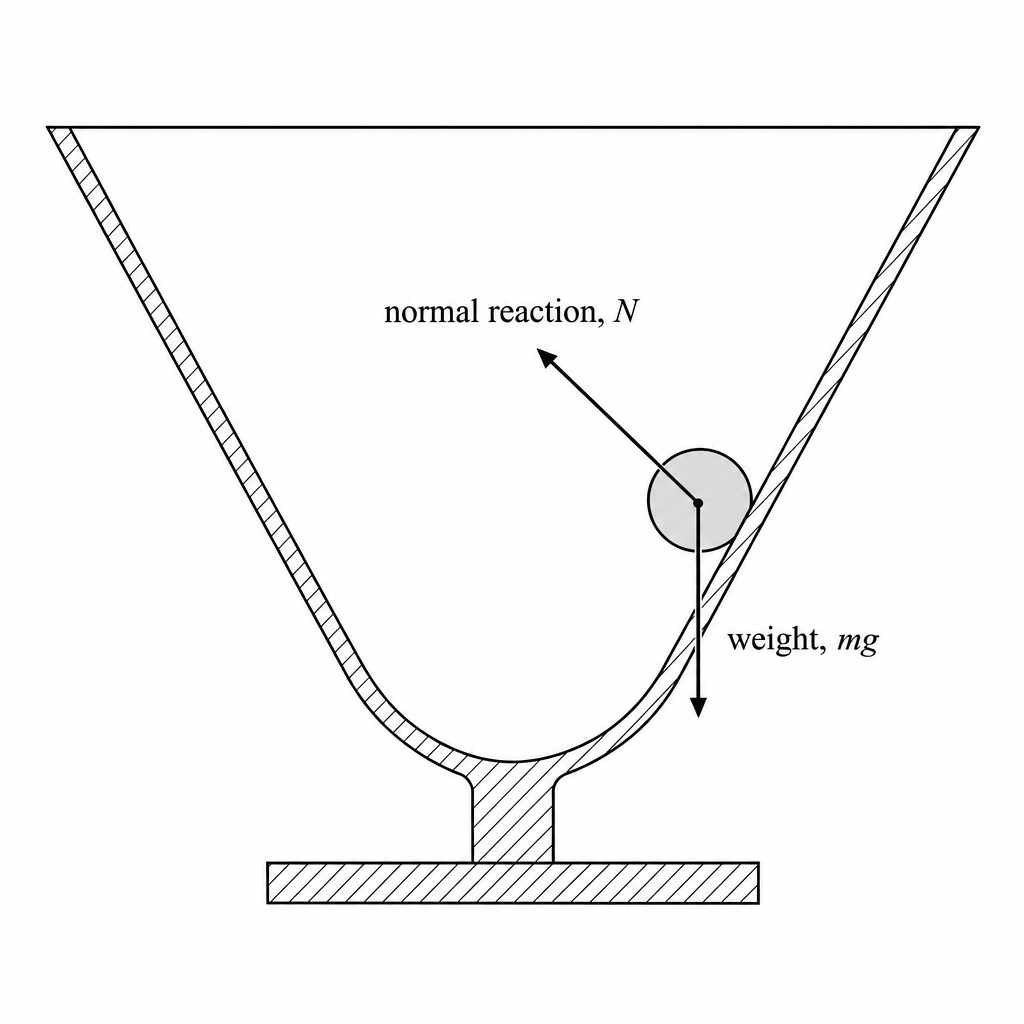
On Fig. 1.2, draw labelled arrows to show the two forces acting on the ball.
Answer
Forces on the ball:
- weight vertically downwards
- normal contact force from the cone, perpendicular to the cone surface
Weight mg downward; normal reaction N perpendicular to the cone surface.
Background Concept
A force diagram (free-body diagram) shows all the real forces acting on an object.
For a ball touching a surface:
- its weight acts vertically downwards (due to gravity)
- the surface exerts a normal contact force on the ball, perpendicular to the surface
- friction would act along the surface, but only if friction is present.
Understanding the Question
The ball is on the inside of a smooth (frictionless) conical surface and moves in a horizontal circle. The question asks for the two forces acting on the ball.
Because it is explicitly stated that there is no friction, there cannot be a frictional force along the surface.
Approach
List the forces:
- gravity on the ball
- contact force from the cone
Then draw them with correct directions from the ball.
Step-by-Step Reasoning
- Draw vertically downward from the centre of the ball.
- Draw the normal reaction perpendicular to the sloping cone surface, pointing away from the surface into the space inside the cone (this is the direction the surface pushes the ball).
- Do not draw any friction force because the surface is smooth.
Key Takeaways
- With no friction, the only contact force is the normal reaction.
- The normal reaction is always perpendicular to the surface.
Common Mistakes
- Drawing a friction force even though the question states there is no friction.
- Drawing vertically upwards instead of perpendicular to the cone surface.
- Drawing an extra “centripetal force” as a separate force (centripetal force is provided by components of real forces).
Things to Be Careful About
- The direction of is always vertical, not perpendicular to the surface.
- The normal force direction depends on the surface orientation; it must be exactly to the cone side in the cross-section.
Answer
The forces are (downwards) and the normal reaction (perpendicular to the surface).
Resolve :
- its vertical component balances so there is no vertical acceleration
- its horizontal component acts towards the axis of the cone and provides the centripetal force, so the acceleration is towards the centre of the circular path (centripetal).
Vertical component of N balances mg; horizontal component of N is towards the axis and provides the centripetal force so acceleration is centripetal.
Background Concept
For uniform circular motion at constant speed, the acceleration is not zero: it is a centripetal acceleration directed towards the centre of the circle.
Its magnitude is
This acceleration must be caused by a resultant force towards the centre (centripetal force):
Crucially, “centripetal force” is not an extra force; it is the inward resultant of the real forces.
Understanding the Question
The ball moves in a horizontal circle on the inside of a smooth cone. The only forces are and the normal reaction .
The question asks you to describe how these forces produce an acceleration that points towards the centre of the circular path.
Approach
Take the normal reaction and split it into:
- a vertical component (to balance so the ball stays at constant height)
- a horizontal inward component (to provide the required centripetal force)
Step-by-Step Reasoning
Consider the two forces:
- Weight acts vertically downward.
- Normal reaction is angled (perpendicular to the cone surface), so it has both vertical and horizontal components.
Because the ball stays at the same height (horizontal circle), its vertical acceleration is zero, so the net vertical force must be zero:
- the vertical component of balances .
That leaves an unbalanced horizontal component of . This component points towards the cone axis (towards the centre of the circular path). Therefore:
- the resultant force is horizontal and inward
- the ball’s acceleration is also horizontal and inward (Newton’s second law)
- hence the acceleration is centripetal.
Key Takeaways
- Constant speed in a circle still requires acceleration: direction changes.
- Vertical forces balance; the inward horizontal component provides centripetal acceleration.
Common Mistakes
- Saying “there is no acceleration because speed is constant”. Speed is constant but velocity changes direction.
- Treating centripetal force as a separate third force.
- Claiming provides the centripetal force (it is vertical, not horizontal).
Things to Be Careful About
- Use the word “component” clearly: it is a component of that acts inward.
- Mention vertical equilibrium explicitly to justify why the remaining resultant is horizontal and centripetal.
Working
Let be the normal reaction. The cone side is at to the horizontal, so is at to the vertical.
Vertical equilibrium:
Horizontal (centripetal):
Divide:
So
With and :
Answer
1.4 m s^-1
Background Concept
When an object moves in a horizontal circle at constant speed, the required centripetal force is
Here, the only forces are weight (vertical) and the normal reaction (perpendicular to the cone surface). Because the motion is at constant height, vertical forces must balance, while the horizontal resultant provides the centripetal force.
Understanding the Question
Given:
- cone side makes with the horizontal
- radius of horizontal circular path
- no friction, constant speed
We must show the speed is by using force components and centripetal force.
Approach
- Relate the direction of the normal force to the given angle.
- Resolve into vertical and horizontal components.
- Use vertical equilibrium () to relate to .
- Use horizontal component as centripetal force ().
- Eliminate to get .
Step-by-Step Reasoning
1) Geometry of the normal
The cone side is at to the horizontal. The normal is perpendicular to the side, so it is at to the horizontal, i.e. at to the vertical.
2) Resolve forces
- Vertical component of is (adjacent to the angle with vertical).
- Horizontal inward component of is .
3) Vertical equilibrium (constant height)
This tells you how large the normal reaction must be to support the weight.
4) Horizontal component provides centripetal force
5) Eliminate
Divide the centripetal equation by the vertical one:
so
Rearrange:
6) Substitute values
Using :
Key Takeaways
- For a frictionless conical surface, is balanced by the vertical component of .
- The inward (horizontal) component of supplies the centripetal force.
- The result is where is the cone side angle to the horizontal.
Common Mistakes
- Using (wrong component).
- Taking as the angle between and the horizontal instead of between the cone side and the horizontal.
- Forgetting centripetal force uses the radius of the horizontal circle ().
Things to Be Careful About
- Be consistent with the chosen angle: here it is simplest to note that is at to the vertical.
- Don’t drop units: must be in and in .
- Final rounding: showing then matches the “show that” style.
Working
Answer
9.3 rad s^-1
Background Concept
For motion in a circle of radius at speed , the angular speed is related by
This comes from the arc length relation and differentiating with respect to time.
Understanding the Question
You have already found the speed of the ball and you are given the radius of the circle . The question asks for the angular speed in .
Approach
Rearrange to and substitute the known values.
Step-by-Step Reasoning
Start with
Rearrange:
Substitute and :
Radians are dimensionless, so is equivalent to .
Rounded appropriately:
Key Takeaways
- Use for uniform circular motion.
- Units check: .
Common Mistakes
- Using (wrong rearrangement).
- Forgetting that must be in metres.
- Giving the unit as instead of .
Things to Be Careful About
- Significant figures: if was shown as (2 s.f.), then quoting to 2 s.f. (e.g. ) is appropriate.
- If you used an unrounded from part (c), your may be slightly different; this is usually allowed as error carried forward.
The speed of the ball is increased.
Explain why the radius of the circular path of the ball increases.
Answer
Since , the normal force (and hence ) is fixed.
But
so is constant and therefore increasing requires a larger .
With cone angle fixed, the available inward component of N is fixed; since mv^2/r must equal it, increasing v implies r must increase.
Background Concept
For an object on a frictionless conical surface moving in a horizontal circle:
- Vertical equilibrium requires the vertical component of the normal reaction to equal weight.
- The horizontal component of the normal reaction provides the centripetal force.
From earlier parts you can show
for fixed cone angle .
Understanding the Question
Only the speed is increased; the cone angle stays the same and there is still no friction. The question asks why the radius of the horizontal circular path must increase.
Approach
Use the fact that with no vertical acceleration,
so is determined by and the cone angle (both unchanged). Then the available inward force is fixed. Since the required centripetal force is , increasing means must increase to keep equal to the same available inward force.
Step-by-Step Reasoning
- Vertical balance (constant height):
Here and are constant, and the angle is fixed by the cone. Therefore does not change.
- The inward (horizontal) component is therefore also fixed:
- For circular motion, this must equal the centripetal force:
Since the left-hand side is fixed, the quantity must remain constant. Therefore if increases, must increase as well.
Equivalently, from
with constant, .
Key Takeaways
- With fixed cone angle and no vertical acceleration, the normal force is fixed by balancing weight.
- The available centripetal force is therefore fixed, forcing to be constant.
- Increasing speed leads to a larger radius.
Common Mistakes
- Saying “radius increases because centripetal force increases” without explaining where the extra force would come from (it cannot, because is fixed by vertical balance).
- Claiming the ball moves up the cone due to a frictional force (there is no friction).
Things to Be Careful About
- The key constraint is the absence of friction plus constant height: it makes the vertical component of force balance exactly, fixing .
- Use proportional reasoning carefully: it is , not .
The magnitude of the gravitational potential on the surface of a planet of radius is . The planet can be considered to be an isolated sphere.
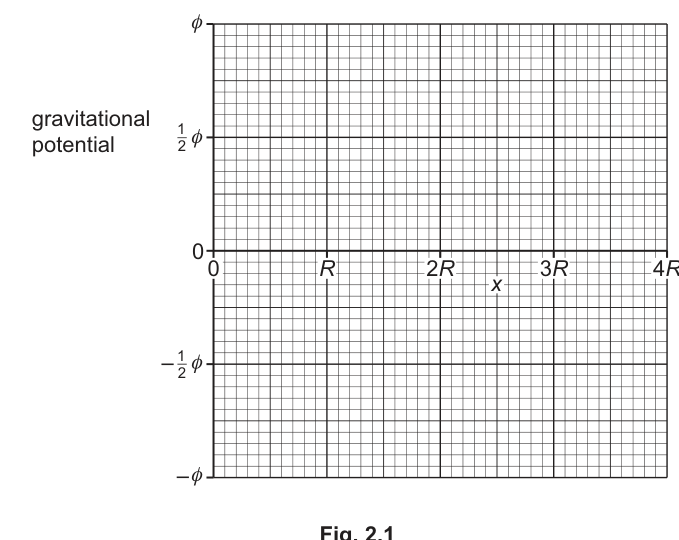
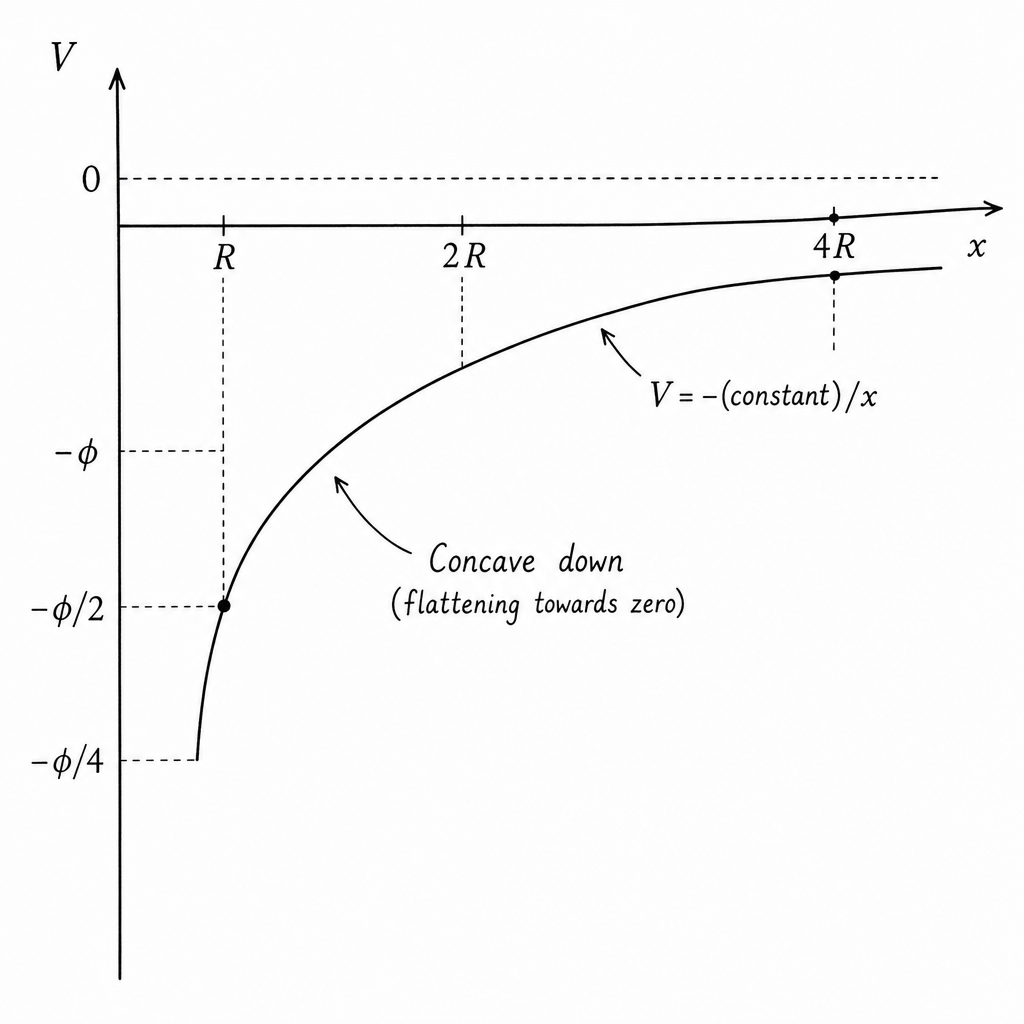
On Fig. 2.1, sketch the variation of the gravitational potential with distance from the centre of the planet for values of between and .
Answer
For an isolated sphere, for :
Given magnitude at is , so .
Mark and use these points:
- :
- :
- :
Draw a smooth curve that rises from at , is concave down (flattens), and approaches from below as increases.
Gravitational potential is negative and varies as -1/x: passes through (R, -φ), (2R, -φ/2), (4R, -φ/4) and approaches 0 from below.
Background Concept
Gravitational potential at a point is the work done per unit mass in bringing a small test mass from infinity to that point (with no change in kinetic energy). Taking , the potential due to a spherically symmetric mass at distance from its centre (for points outside the mass) is
It is negative because energy is released when a mass falls in from infinity; the field is attractive.
Understanding the Question
You are told that at the planet surface () the magnitude of the gravitational potential is . Since gravitational potential is negative, that means
You must sketch against for .
Approach
- Use the outside-sphere formula (the planet is an isolated sphere).
- Use the given surface value to relate to .
- Find a few easy points (e.g. , ) and use the known asymptotic behaviour as to shape the curve.
Step-by-Step Reasoning
From
so
Hence for :
Now evaluate at the marked -values:
- At :
- At :
- At :
As increases further, decreases towards 0, so increases towards 0 but stays negative. The curve is not a straight line: it rises quickly near and then flattens (approaches 0 asymptotically).
Key Takeaways
- For an isolated spherical mass, outside the sphere .
- “Magnitude is ” at the surface means the plotted value is .
- Correct sketches come from correct key points and correct end behaviour (approach to 0 from below).
Common Mistakes
- Plotting at (forgetting gravitational potential is negative).
- Drawing a straight line between points (confusing with a linear relationship).
- Making the graph cross within to (it should only approach 0).
Things to Be Careful About
- The horizontal axis is distance from the centre: the first point is at , not .
- The potential at infinity is defined as 0, so the curve must tend to 0, not to some other value.
A satellite is in a geostationary orbit above the Earth. At time , the magnitude of the gravitational potential due to the Earth at the location of the satellite is .
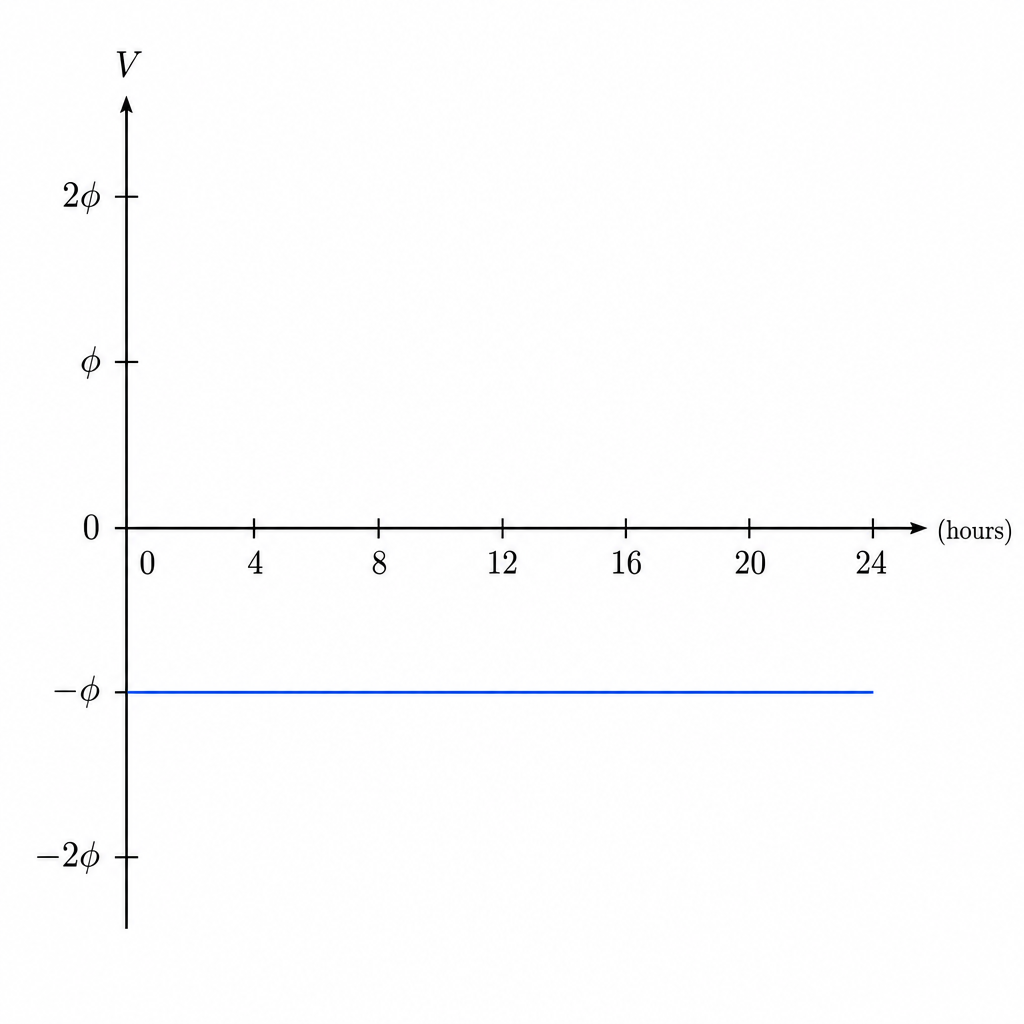
On Fig. 2.2, sketch the variation of the gravitational potential due to the Earth at the location of the satellite for values of between and hours.
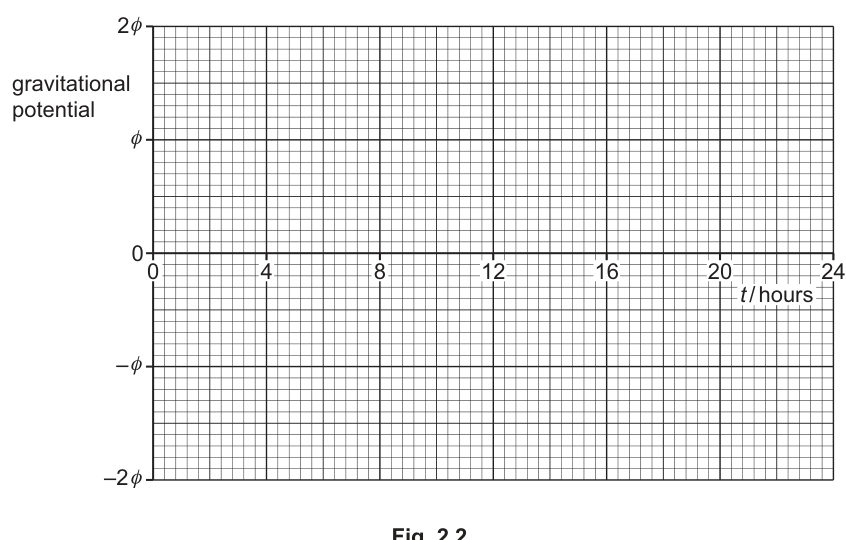
Answer
A geostationary satellite has constant orbital radius, so gravitational potential due to Earth at the satellite is constant.
Given its magnitude at is , the potential is for all .
Sketch a horizontal line at from to .
Constant: a horizontal line at gravitational potential -φ for 0 to 24 h.
Background Concept
For a point at distance from the centre of Earth (outside Earth), gravitational potential is
If does not change, does not change.
A geostationary satellite moves in a circular orbit with the same period as Earth’s rotation and stays above the same point on Earth. In a circular geostationary orbit, the orbital radius is constant.
Understanding the Question
You are told that at the magnitude of the gravitational potential at the satellite is . Since potential is negative,
You must sketch (due to Earth) as time goes from 0 to 24 h.
Approach
- Decide whether the satellite’s distance from Earth changes with time.
- Use : constant implies constant .
- Place the line at the correct signed value (negative).
Step-by-Step Reasoning
A geostationary orbit is (approximately) circular with fixed radius, so is constant.
Therefore
At , magnitude is , so the constant value must be .
So the graph is a horizontal line at from 0 to 24 h.
Key Takeaways
- In a circular orbit, the orbital radius is constant.
- Gravitational potential depends only on distance from the mass (for a spherically symmetric Earth).
- “Magnitude ” corresponds to potential .
Common Mistakes
- Drawing a sinusoidal variation (confusing potential with a quantity that depends on position around the orbit; here the distance is constant).
- Plotting instead of .
Things to Be Careful About
- The question asks for potential at the satellite due to Earth (not potential energy, which would be ).
- Time axis covers a full day; the line must extend unchanged across the entire range.
The electric potential difference (p.d.) between two parallel plates is , as shown in Fig. 2.3.
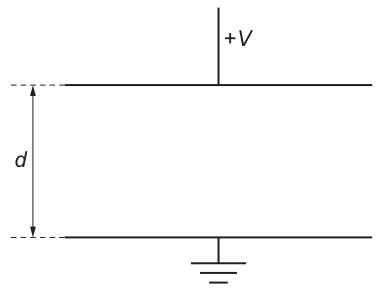
The distance between the plates is . The region between the plates is a vacuum.
On Fig. 2.4, sketch the variation of the electric potential with distance from the positive plate.
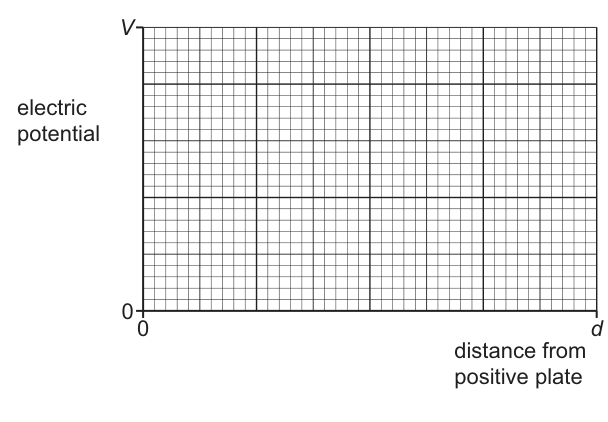
Answer
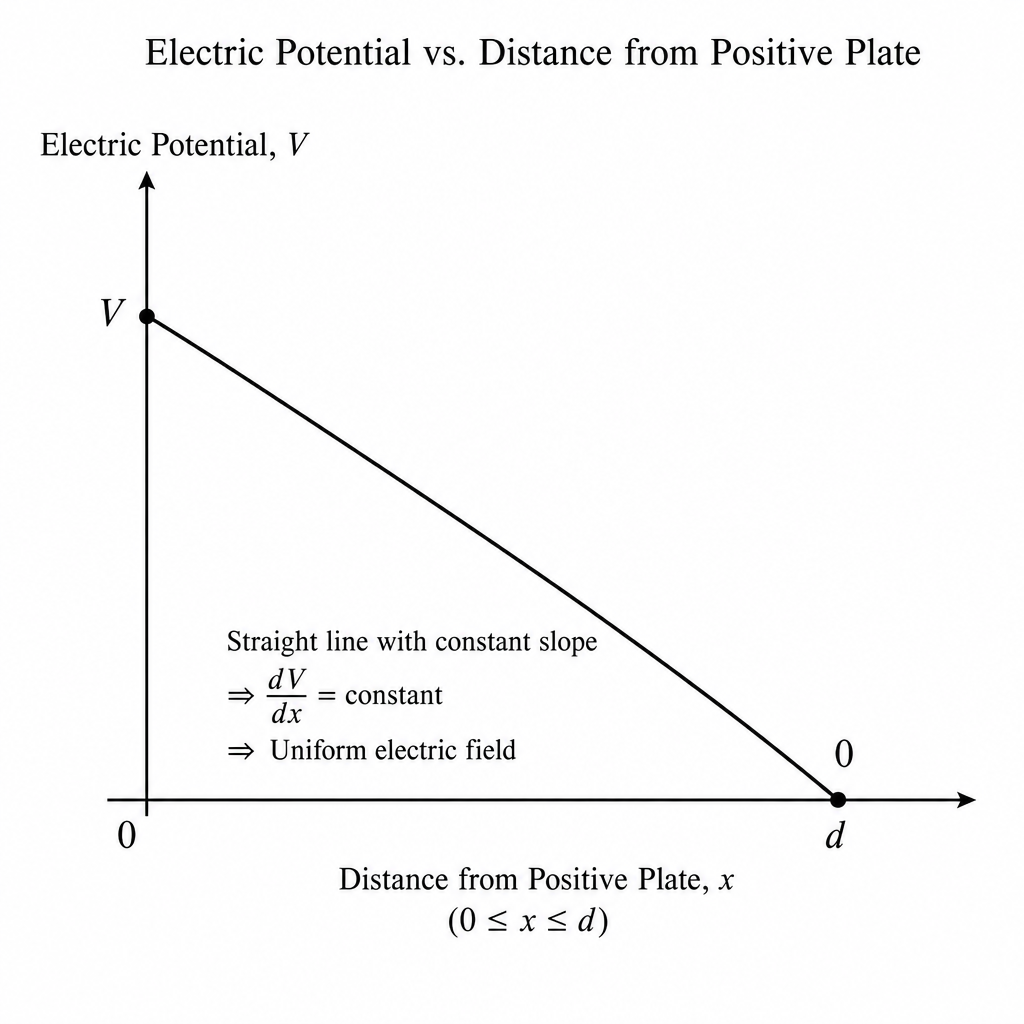
Between parallel plates in vacuum, the field is uniform so potential varies linearly with distance.
At distance from the positive plate: .
At distance (the other plate at 0 V): .
Sketch a straight line decreasing uniformly from to .
Electric potential decreases linearly from V at distance 0 to 0 at distance d.
Background Concept
Electric potential is related to electric field by the potential gradient. In one dimension,
Between large, parallel plates in vacuum (away from edges), the electric field is uniform:
in magnitude, where is the potential difference and is the plate separation. A constant means is constant, so changes linearly with distance.
Understanding the Question
The top plate is at potential and the bottom plate is at . The horizontal axis is “distance from the positive plate”, so:
- at distance : you are on the positive plate (potential )
- at distance : you are on the grounded plate (potential )
You must sketch how the potential varies in between.
Approach
- Use the idea that the field between parallel plates is uniform (in vacuum, ignoring edge effects).
- A uniform field means a constant slope on a vs distance graph.
- Apply the endpoint values at and and join them with a straight line.
Step-by-Step Reasoning
Let be the distance measured from the positive plate. Then:
Uniform field implies constant, hence is linear. The simplest linear function satisfying the endpoints is
So the graph is a straight line sloping down from at to at .
Key Takeaways
- In a uniform electric field, potential changes linearly with distance.
- Always anchor your sketch using the known potentials at the plates.
- The sign and direction are handled by the endpoints: here it must decrease from to .
Common Mistakes
- Drawing a curved line (that would imply a non-uniform field).
- Starting at at the positive plate (swapping the reference).
- Extending the line beyond as if the same uniform field continues inside the conductor; potential is constant inside each plate.
Things to Be Careful About
- The graph is of potential, not field strength: the field would be the (negative) gradient of this straight line.
- The question states vacuum: avoids complications of different permittivities; but the linear potential result still holds for a uniform field in a uniform medium.
Two metal cuboids P and Q are in thermal contact with each other.
P and Q are in thermal equilibrium.
State what is meant by the term thermal equilibrium.
Answer
Thermal equilibrium means that the two bodies are at the same temperature and there is no net transfer of thermal energy between them.
Same temperature; no net heat transfer between P and Q.
Background Concept
Thermal energy is transferred between objects only when there is a temperature difference. The transfer continues until there is no longer a driving temperature difference.
Thermal equilibrium is the condition reached when two systems in thermal contact have the same temperature. At that point, energy exchanges at the microscopic level may still occur, but there is no net flow of thermal energy from one to the other.
Understanding the Question
Two metal cuboids P and Q touch each other (thermal contact). The question asks for the meaning of “P and Q are in thermal equilibrium”. This is a definition question, so you need a precise statement in words.
Approach
State the two key mark points:
- their temperatures are equal,
- therefore there is no net heat flow between them.
Step-by-Step Reasoning
- When P and Q are in contact, heat flows from the hotter one to the cooler one.
- If they are in thermal equilibrium, neither is hotter than the other, so their temperatures must be the same.
- With no temperature difference, the net thermal energy transfer is zero.
Key Takeaways
- Thermal contact + same temperature means thermal equilibrium.
- “No net heat transfer” is essential wording.
Common Mistakes
- Saying only “same temperature” without mentioning no net heat transfer (often loses a mark).
- Saying “no heat transfer” (too absolute): better is “no net transfer”.
Things to Be Careful About
- Thermal equilibrium is about temperature equality, not about equal internal energies or equal heat capacities.
Data for P and Q are given in Table 3.1.
Table 3.1
| P | Q | |
|---|---|---|
| specific heat capacity / | 390 | 910 |
| mass / | 0.54 | 0.37 |
P and Q are initially both at the same temperature.
P is supplied with of thermal energy. After some time, P and Q are once again both at the same temperature as each other.
P and Q are perfectly insulated from the surroundings.
Determine the change in temperature of Q.
= ______
Working
Thermal energy supplied to P is shared between P and Q (perfect insulation), and final temperatures are equal, so both rise by the same .
Answer
44 K
Background Concept
The specific heat capacity links energy input to temperature rise:
where:
- is thermal energy transferred (J),
- is mass (kg),
- is specific heat capacity (),
- is the temperature change (K).
If objects are perfectly insulated from the surroundings, then any energy supplied stays within the system: total energy in equals total increase in internal energy of the objects.
Understanding the Question
- Two cuboids P and Q start at the same temperature and are in thermal contact.
- is supplied to P.
- They are insulated from the surroundings (so no energy escapes).
- After some time, P and Q are again at the same temperature (thermal equilibrium again).
The question asks for the temperature change of Q, .
Key implication: at the final equilibrium, both have the same final temperature, so they have undergone the same temperature rise .
Approach
Use energy conservation:
- energy supplied increase in internal energy of P increase in internal energy of Q.
- each increase is .
- factor out to solve.
Step-by-Step Reasoning
- Convert the energy input:
- Write the energy balance (no losses):
- Factor out :
- Calculate the “heat capacities” for each block:
- Add them and solve:
So Q’s temperature rises by about .
Key Takeaways
- With insulation, use conservation of energy.
- When two objects end at the same temperature, they share the same .
- Combine heat capacities: total .
Common Mistakes
- Using only Q’s (as if all went into Q).
- Forgetting to convert to .
- Assuming different temperature rises for P and Q even though they end at the same final temperature.
Things to Be Careful About
- Temperature changes in K and in have the same numerical size, but keep units as K for .
- Check that insulation is explicitly stated; otherwise you would have to consider losses to surroundings.
Nitrogen may be assumed to be an ideal gas. A fixed amount of nitrogen gas is contained at a constant pressure of .
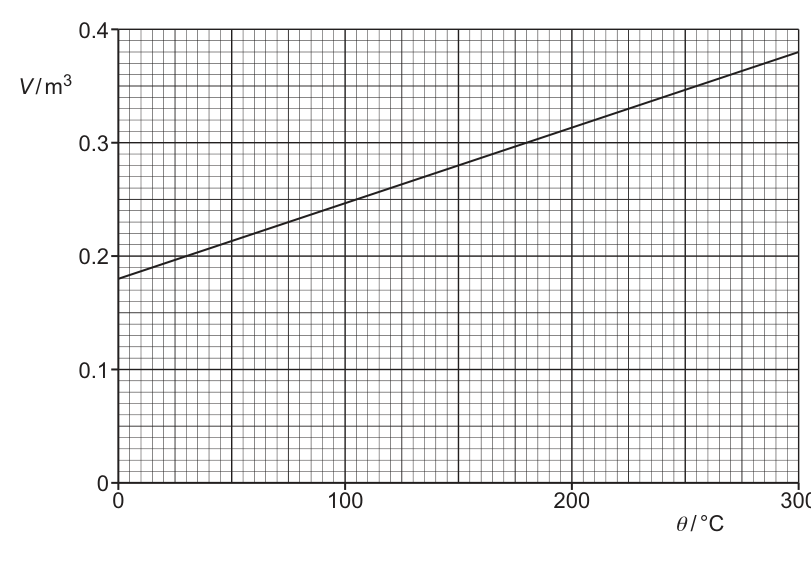
The variation of the volume of the gas with the temperature of the gas is shown in Fig. 3.1.
The temperature of the nitrogen gas is increased from to .
Determine the work done on the gas.
work done = ______
Working
From Fig. 3.1: at and at .
Linear variation:
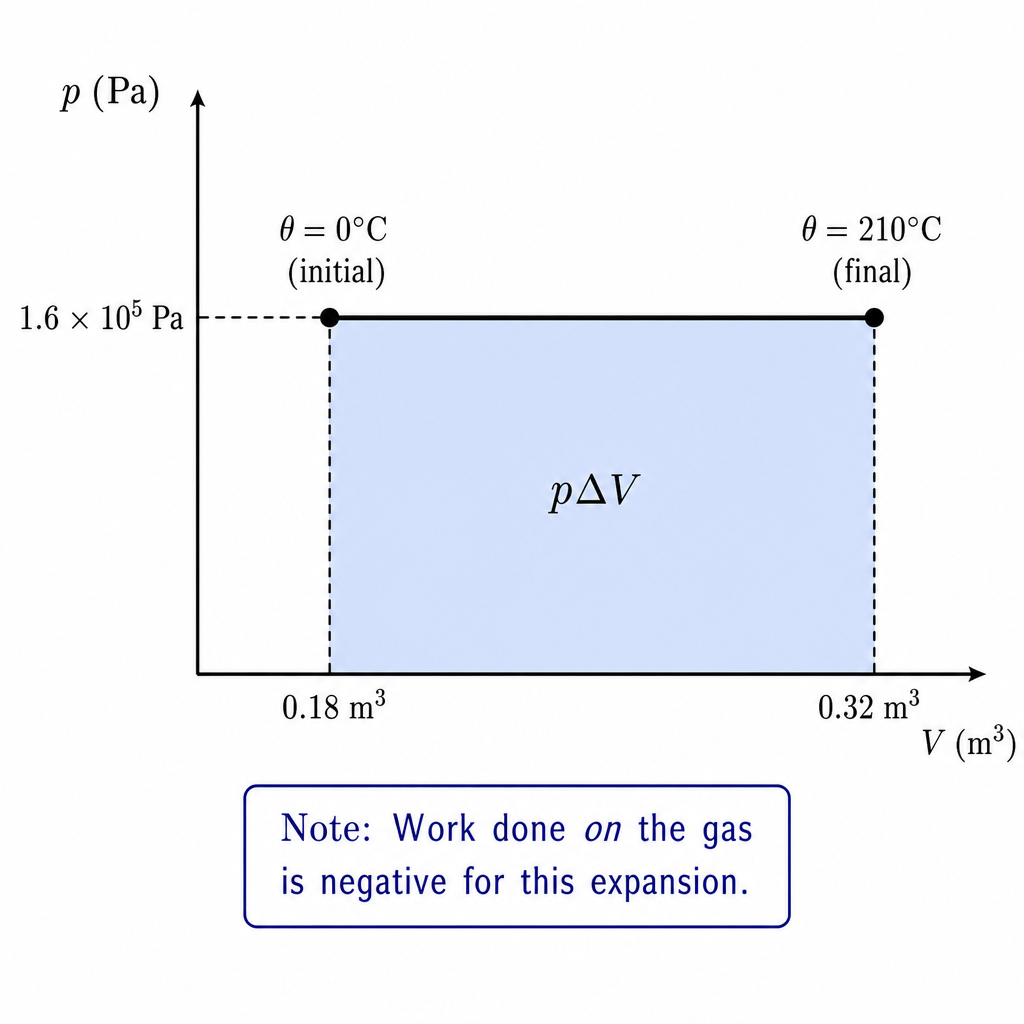
Work done by gas at constant pressure:
Work done on gas:
Answer
-2.2 × 10^4 J
Background Concept
When a gas expands against an external pressure , it does work. For a constant pressure process:
- is work done by the gas.
- If the gas expands, so .
- Work done on the gas is the negative of this:
because during expansion the surroundings do negative work on the gas.
Understanding the Question
- The gas pressure stays constant at .
- Temperature increases from to .
- From the given straight-line graph of vs , we must find the change in volume and hence the work.
- The question specifically asks for the work done on the gas, so the sign matters.
Approach
- Read (or interpolate) at and at from the straight line.
- Compute .
- Use .
Step-by-Step Reasoning
- Read two convenient points from the line. From the figure description, suitable readings are:
- at :
- at :
- Since the plot is a straight line, use linear interpolation to get the volume at :
- Change in volume:
- Work done by gas:
- Work done on gas is negative of this (because gas expands):
Key Takeaways
- For constant pressure, the work magnitude is .
- Expansion means work is done by the gas; hence work done on the gas is negative.
- Straight-line graphs allow interpolation using gradients.
Common Mistakes
- Giving when the question asks for work done on the gas.
- Using in the wrong direction (mixing up initial and final volume).
- Reading volumes inaccurately from the graph or not showing a clear interpolation method.
Things to Be Careful About
- Pressure is already in SI units (Pa) and volume in , so comes out directly in J.
- The numerical value depends slightly on graph reading; use consistent readings from the straight line.
Working
At , and from the graph .
Answer
7.6 × 10^24
Background Concept
For an ideal gas, the equation of state can be written using molecules:
where:
- is pressure (Pa),
- is volume (),
- is the number of molecules,
- is the Boltzmann constant (),
- is thermodynamic temperature (K).
This form is useful when the question asks for the number of molecules rather than moles.
Understanding the Question
You are told nitrogen behaves as an ideal gas, at constant pressure . From the vs graph you can read the volume at a stated temperature. Since the amount of gas is fixed, is constant and can be found from any single state.
Approach
- Choose a convenient point on the graph (e.g. ).
- Convert to kelvin.
- Rearrange to .
Step-by-Step Reasoning
- At , the absolute temperature is:
- Read the corresponding volume from the graph: .
- Substitute into the rearranged ideal gas equation:
Evaluating gives molecules.
(Using the point would give essentially the same result, allowing for graph reading.)
Key Takeaways
- Use when asked for number of molecules.
- Always convert to K by adding 273.
Common Mistakes
- Using for .
- Using but forgetting to convert from (moles) to number of molecules.
- Using an inconsistent volume reading from the graph.
Things to Be Careful About
- Make sure the volume you use corresponds to the same temperature you use.
- Quote to appropriate significant figures (usually 2\u20133 s.f. given graph-reading limits).
The mass of a nitrogen molecule is .
Calculate the root-mean-square (r.m.s.) speed of a nitrogen molecule at .
r.m.s. speed = ______
Working
At ,
Answer
6.5 × 10^2 m s^-1
Background Concept
For an ideal gas, the mean kinetic energy per molecule is
Rearranging gives the root-mean-square speed :
where is the mass of one molecule.
Understanding the Question
You are given the mass of a nitrogen molecule () and asked for the r.m.s. speed at . The key is to use absolute temperature in kelvin.
Approach
- Convert to kelvin.
- Substitute into .
- Calculate and give the answer with unit .
Step-by-Step Reasoning
- Convert temperature:
- Substitute values:
- Work inside the square root:
- Take the square root:
Key Takeaways
- Molecular speed depends on absolute temperature: .
- Always use kelvin in kinetic theory formulae.
Common Mistakes
- Using instead of .
- Forgetting the factor of 3 in .
- Mixing up molar mass with mass of one molecule.
Things to Be Careful About
- Keep powers of ten consistent: dividing by increases the power by 26.
- Quote to 2\u20133 significant figures, reflecting the given data (especially the molecular mass).
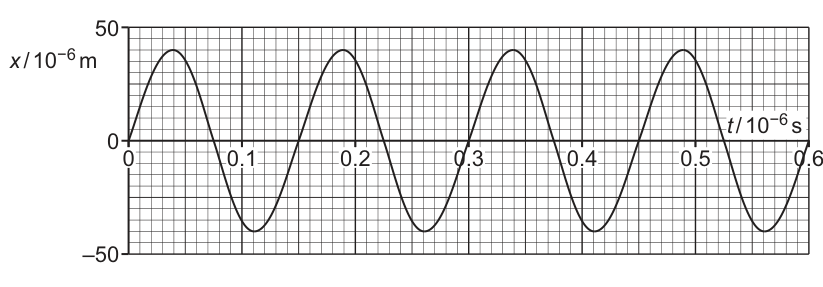
A small crystal is made to vibrate with simple harmonic motion. The variation with time of the displacement of one surface of the crystal from its equilibrium position is shown in Fig. 4.1.
Working
From the graph, one full cycle takes
Answer
4.2 × 10^7 rad s^-1
Background Concept
In simple harmonic motion (SHM), the motion repeats exactly after a time period . The angular frequency measures how fast the oscillation progresses in radians per second. The link between period and angular frequency is
because one full oscillation corresponds to an angular phase change of .
Understanding the Question
You are given a displacement–time graph for a vibrating crystal surface. The question asks you to use the graph to find and show it equals . The key step is identifying the period (time for one complete cycle) from the graph, and converting the microsecond scale to seconds.
Approach
- Read the period from the time axis by finding the time for one full cycle (e.g. from one zero crossing with the same direction of motion to the next such zero crossing).
- Convert from the graph units () into seconds.
- Substitute into .
Step-by-Step Reasoning
- The graph completes one cycle at on the axis scale, where the axis unit is .
- Use the definition of angular frequency:
- Rounding appropriately gives , as required.
Key Takeaways
- The period is read directly from the time between identical points in successive cycles.
- Convert axis multipliers (here ) into SI before substituting.
- Use .
Common Mistakes
- Using but then taking wrongly from the graph (e.g. using instead of ).
- Forgetting that the time axis is in , leading to an answer smaller by a factor of .
- Taking half a period (e.g. peak to trough) as .
Things to Be Careful About
- The period must be in seconds; here on the axis means .
- Quote in (not ).
Working
From the graph, amplitude
For SHM,
Using ,
Answer
7.1 × 10^10 m s^-2
Background Concept
For SHM,
This means the acceleration is proportional to displacement and always directed towards the equilibrium position. The maximum magnitude of acceleration occurs at the maximum displacement :
Understanding the Question
You are asked for the maximum acceleration of the vibrating surface. From the graph you can read the amplitude , and from part (a) you have . Then apply .
Approach
- Read amplitude (peak displacement) from the displacement axis and convert using the scale.
- Use .
- Ensure units end up as .
Step-by-Step Reasoning
- The graph peak is at on a scale of :
- Substitute into the SHM maximum acceleration formula:
- Evaluate:
so
Key Takeaways
- In SHM, is largest at the extremes and zero at equilibrium.
- Max acceleration magnitude is .
Common Mistakes
- Using (that is for maximum speed ).
- Forgetting the axis multiplier and using or without units.
- Using but treating it as Hz (missing factor ).
Things to Be Careful About
- is in but radians are dimensionless, so correctly gives .
- Significant figures should match the data: typically 2 s.f. here.
The crystal may be modelled as a single mass of that vibrates as shown in Fig. 4.1.
Calculate the total energy of the vibrations.
= ______
Working
Total energy in SHM:
With , , ,
Answer
3.4 × 10^2 J
Background Concept
In SHM, energy continuously transfers between kinetic energy and potential energy, but the total energy stays constant (if there is no damping). The total energy can be written as
This comes from noting that the maximum speed is , so the maximum kinetic energy is
Understanding the Question
You are told to model the crystal as a single mass vibrating with the displacement shown. That means you can treat it exactly like a particle in SHM with mass , angular frequency (from part a), and amplitude (from the graph). The question asks for the total energy of the vibration.
Approach
- Read/recall amplitude from the graph.
- Use from part (a).
- Substitute into and evaluate carefully in standard form.
Step-by-Step Reasoning
- Amplitude from the graph: peak displacement is in units of :
- Substitute the given mass and the angular frequency:
- Work through the powers:
So
Combine the last two factors first:
Then
Rounded:
Key Takeaways
- Total energy in SHM depends on , , and through .
- Using provides a useful check: .
Common Mistakes
- Using without relating to .
- Squaring incorrectly (common error: instead of ).
- Forgetting the factor .
Things to Be Careful About
- Keep amplitude in metres before squaring.
- Because is very large, is extremely large; errors in powers of ten change the result dramatically.
- Quote the final answer to 2–3 significant figures, consistent with the given data.
The crystal generates ultrasound waves that are used to obtain diagnostic information about internal structures.
The crystal is made from piezoelectric material.
Explain how the crystal is made to vibrate.
Answer
An alternating potential difference is applied across the piezoelectric crystal.
The alternating electric field makes the crystal alternately expand and contract (inverse piezoelectric effect), so it vibrates at the frequency of the applied a.c. (large amplitude if driven near resonance).
Apply an a.c. pd so the piezoelectric crystal alternately expands and contracts, making it vibrate (at the driving frequency, maximum near resonance).
Background Concept
Piezoelectric materials couple electrical and mechanical effects:
- Direct piezoelectric effect: mechanical stress produces a potential difference.
- Inverse piezoelectric effect: an applied electric field produces a change in dimensions (strain).
Ultrasound transducers use the inverse effect to generate vibrations, which launch sound waves into a medium.
Understanding the Question
The question asks how the crystal is made to vibrate. This is about the method of driving a piezoelectric transducer: what you apply electrically, and what mechanical response it causes.
Approach
State that you apply an alternating potential difference across the crystal. Explain that the alternating electric field causes repeated expansion and contraction, producing oscillations at the same frequency (often chosen to match a resonant frequency for efficiency).
Step-by-Step Reasoning
- Put electrodes on opposite faces of the piezoelectric crystal and connect to an a.c. supply.
- The a.c. supply produces an electric field whose direction (and magnitude) changes sinusoidally.
- Because of the inverse piezoelectric effect, the crystal changes thickness/length in response to the field: when the field reverses, the strain reverses.
- This alternating strain is a mechanical vibration. If the driving frequency matches (or is close to) the natural frequency of the crystal, resonance gives a larger vibration amplitude.
Key Takeaways
- Ultrasound is generated by driving a piezoelectric crystal with an a.c. voltage.
- The inverse piezoelectric effect converts electrical oscillations into mechanical oscillations.
Common Mistakes
- Describing only the direct effect (pressure producing a voltage) when the question is about generating vibration.
- Saying “apply a voltage” without specifying it must be alternating to cause continuous vibration.
Things to Be Careful About
- Use the correct language: alternating electric field causes alternating expansion and contraction.
- If mentioning resonance, keep it as an additional efficiency point, not the main mechanism.
A parallel beam of ultrasound waves is incident on a muscle-bone boundary. Data for muscle and bone are given in Table 4.1.
Table 4.1
| material | density / | speed of sound / |
|---|---|---|
| muscle | 1100 | 1600 |
| bone | 1900 | 4100 |
Calculate the percentage of the intensity of the ultrasound beam that is transmitted at this boundary.
percentage transmitted = ______
Working
Acoustic impedance .
For normal incidence, transmitted intensity fraction
Percentage transmitted:
Answer
60%
Background Concept
When an ultrasound wave reaches a boundary between two materials, some intensity is reflected and some is transmitted. How much is reflected depends on the acoustic impedance
where is the density and is the speed of sound in the material.
For a plane wave at normal incidence (beam perpendicular to the boundary), the intensity reflection coefficient is
and the transmitted fraction is
Understanding the Question
A parallel ultrasound beam hits a muscle–bone boundary. You are given and for each medium. You must find the percentage of intensity transmitted into the bone. This is a boundary-impedance problem: compute for each side, then compute .
Approach
- Calculate and using .
- Use the transmission fraction formula .
- Convert into a percentage.
Step-by-Step Reasoning
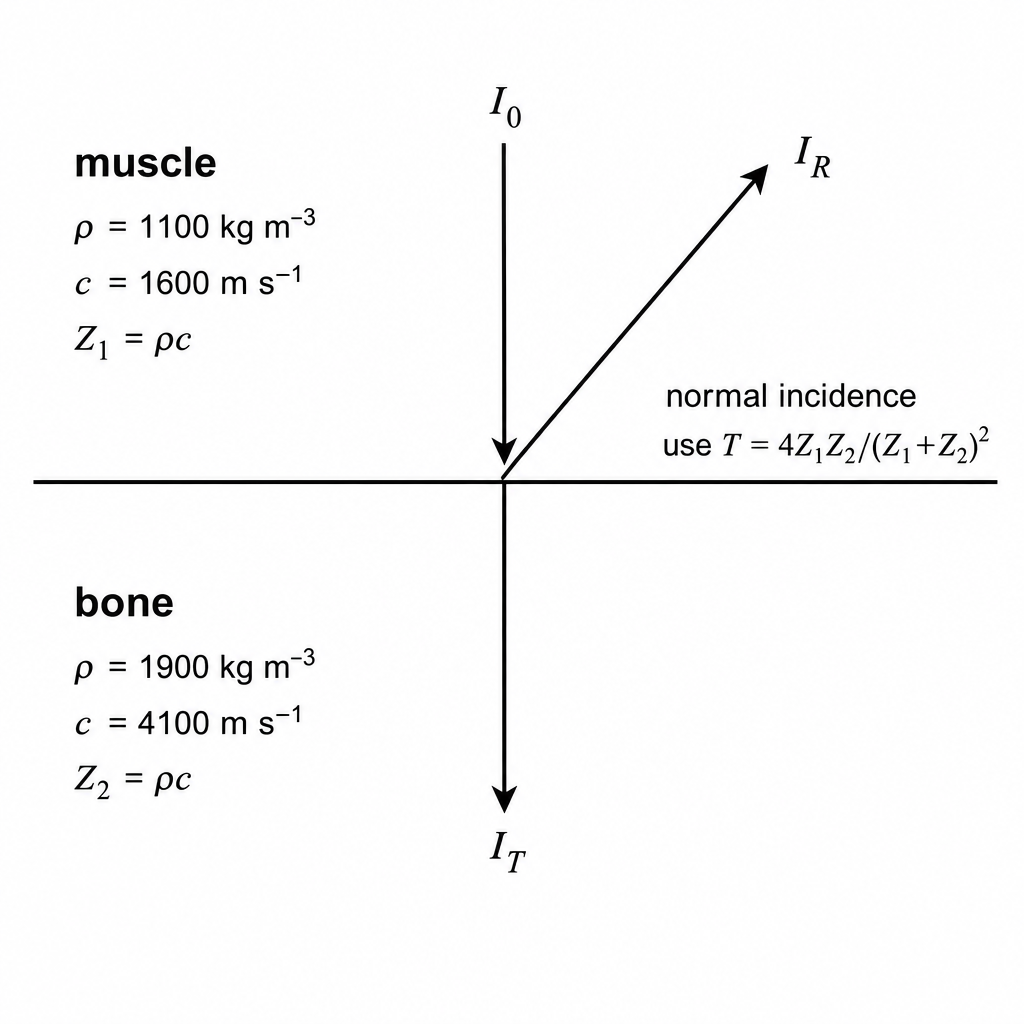
- Compute impedances:
- Apply the transmission coefficient at normal incidence (take , ):
Using values in units of (the cancels):
Calculate:
so
- Convert to a percentage:
Key Takeaways
- Use acoustic impedance to quantify mismatch between media.
- For normal incidence, intensity transmission is .
- Large impedance mismatch (bone vs muscle) causes significant reflection.
Common Mistakes
- Using densities alone (forgetting to multiply by sound speed).
- Using the amplitude coefficient formula instead of the intensity coefficient (intensity depends on the square).
- Mixing up transmitted and reflected fractions (reporting instead of ).
- Not converting the fraction into a percentage.
Things to Be Careful About
- Ensure normal incidence is assumed (the standard formula above); at oblique incidence it becomes more complicated.
- Keep enough significant figures in intermediate steps; round only at the end.
- Use consistent units when calculating (here SI throughout).
A capacitor of capacitance is connected in series with a second capacitor of capacitance .
Show that the combined capacitance of the two capacitors is given by
Working
For capacitors in series, the charge on each is the same, .
Total p.d.
Using so :
But , so and hence
Cancel :
Answer
1/C = 1/C1 + 1/C2
Background Concept
Capacitance is defined by
where is the charge stored and is the potential difference (p.d.) across the capacitor.
For capacitors:
- In series, the same charge must appear on each capacitor because charge cannot “pile up” at the junction: whatever charge arrives at one plate induces an equal and opposite charge on the facing plate of the next capacitor.
- The total p.d. across components in series is the sum of the individual p.d.s.
Understanding the Question
Two capacitors with capacitances and are connected in series. The question asks you to show (derive) a formula for the single equivalent capacitance of the series combination.
Approach
- Use the fact that series capacitors carry the same charge .
- Add the potential differences: .
- Replace each using .
- Use the definition of equivalent capacitance and rearrange.
Step-by-Step Reasoning
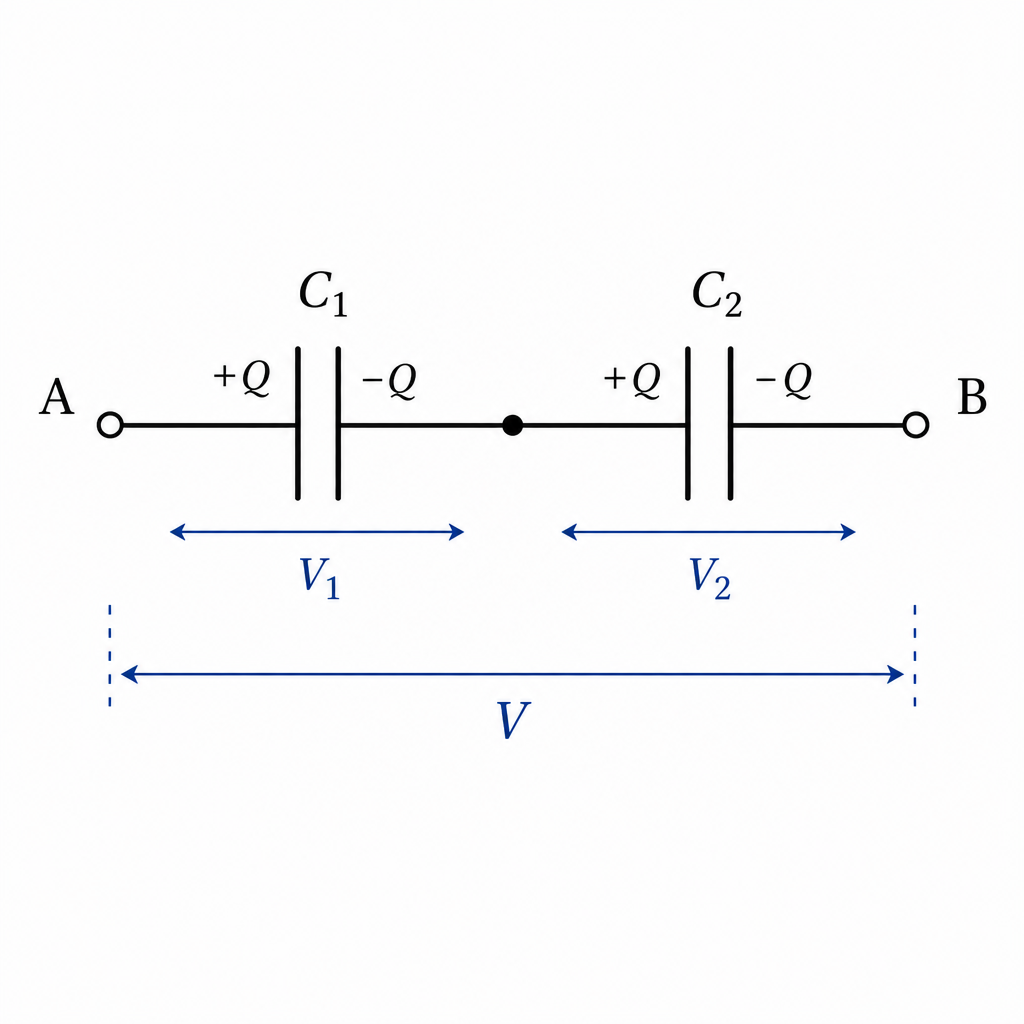
Take the charge on each capacitor to be .
The total p.d. between the ends of the series pair is
Using for each capacitor:
So
But the equivalent capacitor is defined by the same total charge at total p.d. :
Equate the two expressions for :
and cancel (non-zero during charging), giving
Key Takeaways
- In series: same charge, voltages add.
- Combine with to get the series capacitance rule.
Common Mistakes
- Assuming the p.d. is the same across series capacitors (that is only true for parallel).
- Writing (that is the parallel rule).
- Forgetting to use and trying to manipulate inconsistently.
Things to Be Careful About
- Be explicit that the charge is the same on series capacitors; that is the key physical step.
- When cancelling , ensure you have as a common factor on both sides first.
Three identical capacitors, each of capacitance , are connected in a network as shown in Fig. 5.1.
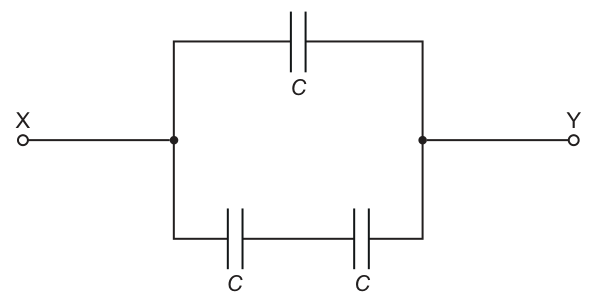
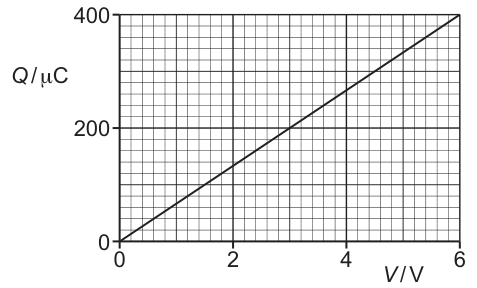
The variation of the charge with the potential difference (p.d.) between the terminals X and Y is shown in Fig. 5.2.
Show that is equal to .
Working
From Fig. 5.2, gradient .
Using point :
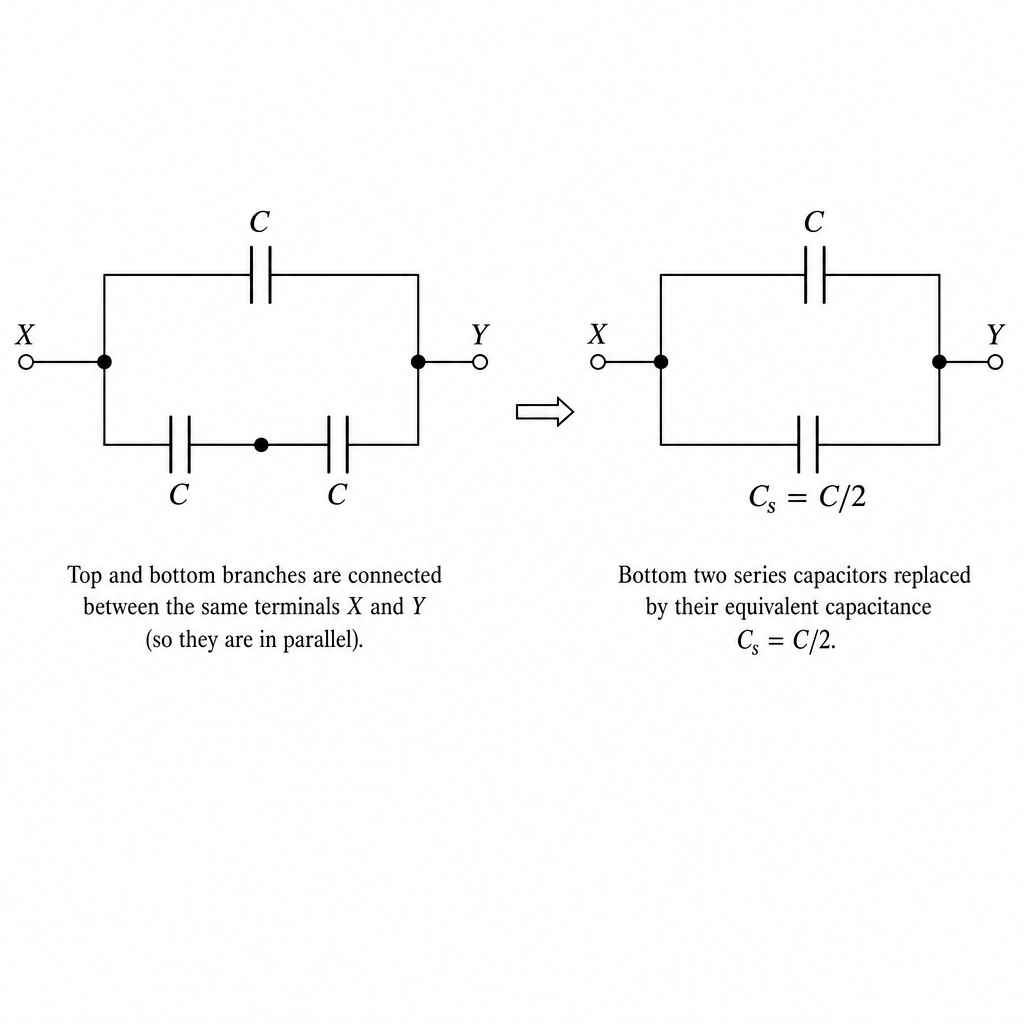
In Fig. 5.1: one capacitor in parallel with two capacitors in series.
Series pair:
Parallel total:
So
Answer
44 µF
Background Concept
For a capacitor (or a capacitor network behaving like a single capacitor),
So a graph of against is a straight line through the origin with gradient .
For combinations:
- Parallel: same p.d. across each branch, charges add, so
- Series: same charge on each, p.d.s add, so
Understanding the Question
Three identical capacitors (each capacitance ) are arranged so that:
- the top branch is a single capacitor ,
- the bottom branch is two capacitors in series,
and these two branches are connected in parallel between terminals X and Y.
The – graph for the whole network is given, so we can find the network’s equivalent capacitance , then relate it to .
Approach
- Use the graph to calculate .
- Reduce the circuit: find the series equivalent of the two lower capacitors.
- Add in parallel with the top capacitor.
- Set this equal to the value from the graph and solve for .
Step-by-Step Reasoning
1) Equivalent capacitance from the graph
Since , the gradient of the – line is .
Using the point :
2) Equivalent capacitance of the network in terms of
Bottom branch has two identical capacitors in series:
This series combination is in parallel with the top capacitor , so
3) Solve for
Key Takeaways
- A – graph gives capacitance directly: gradient .
- Reduce mixed networks by doing series first, then parallel (or vice versa depending on layout).
Common Mistakes
- Using instead of for the gradient.
- Forgetting to convert to C when calculating in SI units.
- Treating the bottom two capacitors as parallel (they are in series).
Things to Be Careful About
- The line passes through the origin, consistent with ; if you used two arbitrary points, ensure you still compute .
- Keep track of units: and , which cancel cleanly when using .
The capacitor network in Fig. 5.1 is charged and then connected to a resistor of resistance . The capacitor network discharges through the resistor.
Determine the time constant of the circuit. Give a unit with your answer.
= ______ unit ______
Working
Equivalent capacitance of the network (from part (b)):
Time constant:
Answer
3.6 s
Background Concept
For a capacitor (or capacitor network treated as an equivalent capacitance ) discharging through a resistor , the time constant is
The time constant is the characteristic time over which current, voltage, and charge fall exponentially.
Understanding the Question
The capacitor network from Fig. 5.1 is first charged, then connected across a resistor of resistance and allowed to discharge. We must find the circuit time constant .
We need the equivalent capacitance between X and Y. From part (b) (or from the – graph),
Approach
- Convert to ohms and to farads.
- Multiply using .
- Quote the unit (seconds).
Step-by-Step Reasoning
Convert units:
Now apply
Combine powers of ten: .
Numerically, (approximately), so
Key Takeaways
- Use the equivalent capacitance of the whole network when finding the discharge time constant.
- always has units of seconds.
Common Mistakes
- Using (capacitance of one capacitor) instead of the network’s .
- Forgetting to convert to or to .
Things to Be Careful About
- Time constant uses in farads; if you keep in and in , remember that .
- Quote a sensible number of significant figures consistent with the data given (here or are both reasonable).
Determine the time taken for the discharge current to reduce to of the initial discharge current.
time = ______
Working
For discharge,
Given :
Take ln:
So
With :
Answer
6.8 s
Background Concept
During discharge of a capacitor through a resistor, the current (and voltage and charge) decreases exponentially:
where is the initial current at and is the time constant.
To find the time for a quantity to fall to a certain fraction, you usually rearrange by taking natural logs.
Understanding the Question
The discharge current starts at and we want the time when it has fallen to of , i.e.
From part (c)(i), .
Approach
- Substitute the fraction into the exponential decay equation: .
- Take of both sides to bring down the exponent.
- Solve for and substitute .
Step-by-Step Reasoning
Start with
Divide by :
Given :
Take natural logarithms:
So
Now substitute :
Since ,
Key Takeaways
- Discharge current follows the same exponential form as voltage and charge.
- Fractions like lead naturally to logarithms when solving for time.
Common Mistakes
- Using (wrong sign in exponent).
- Using instead of without converting (the formula uses so use ).
- Using from a single capacitor rather than the network time constant.
Things to Be Careful About
- is negative; the minus sign in ensures is positive.
- Keep enough significant figures in and in the logarithm to avoid rounding too early; round only at the end.
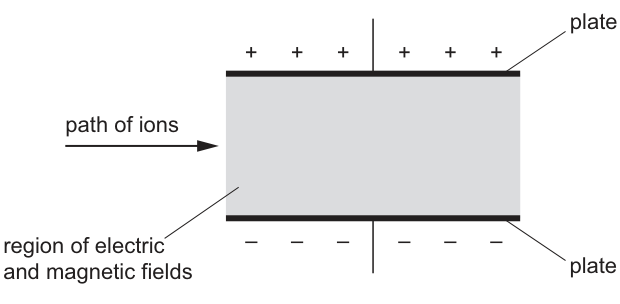
An electric field and a magnetic field are used to form a velocity selector. Charged particles, called ions, pass into a region of uniform electric and magnetic fields that is between parallel plates, as shown in Fig. 6.1.
The potential difference (p.d.) between the plates of the velocity selector is . The separation of the plates is and the magnetic flux density is .
Show that the speed of ions that pass undeviated through the velocity selector is given by
Working
Uniform electric field between parallel plates:
For undeviated motion, electric and magnetic forces balance:
So
Answer
ν = V/(Bd)
Background Concept
In a velocity selector, a charged particle moves through crossed uniform electric and magnetic fields. It experiences:
- Electric force:
where is the charge and is the electric field strength.
- Magnetic force (for motion perpendicular to ):
where is the particle speed and is the magnetic flux density.
A uniform electric field between parallel plates is related to the potential difference by:
where is the p.d. and is the plate separation.
Understanding the Question
The ions pass through the region between parallel plates where both and are uniform. “Pass undeviated” means the net sideways force is zero, so the magnetic force must exactly balance the electric force.
You are asked to show that the speed of ions that go straight through is
Approach
- Write the electric field between the plates as .
- For an undeviated path, set the magnitudes of the electric and magnetic forces equal: .
- Substitute and rearrange for .
Step-by-Step Reasoning
Start with the uniform field between the plates:
For a straight (undeviated) path, sideways forces cancel, so:
Using the expressions for the forces:
Cancel (this is important: the selected speed does not depend on the particle’s charge):
Hence:
Substitute :
Key Takeaways
- In a velocity selector, the condition for no deflection is .
- The selected speed depends only on the fields and plate separation: .
- The particle’s charge cancels out.
Common Mistakes
- Using (that is for a current-carrying conductor, not a single charged particle).
- Forgetting for parallel plates.
- Missing the fact that here because the velocity is perpendicular to in a velocity selector.
Things to Be Careful About
- The formula requires the velocity to be perpendicular to the magnetic field. Velocity selectors are designed so this is the case.
- Keep symbols consistent: the question uses (speed) but the shown result uses ; they represent the same speed here.
Positive ions with kinetic energy and mass pass undeviated through the velocity selector when is equal to and is equal to .
Determine .
= ______
Working
From kinetic energy,
Using ,
Answer
0.17 T
Background Concept
For a particle to pass straight through a velocity selector, the electric and magnetic forces must balance:
With parallel plates,
so the selected speed is
If the particle’s kinetic energy and mass are known, its speed can be found from:
Understanding the Question
You are told that the ions pass undeviated when and . Their kinetic energy and mass are also given, so you can calculate their speed . Then you use the velocity selector condition to find the magnetic flux density .
Approach
- Calculate from .
- Rearrange to .
- Substitute and compute, keeping units consistent.
Step-by-Step Reasoning
Calculate the speed from kinetic energy:
Substitute values:
Now use the selector condition:
Substitute:
Compute the denominator:
Hence:
Key Takeaways
- Convert kinetic energy to speed via .
- Use from the velocity selector equation.
- Maintain consistent SI units throughout.
Common Mistakes
- Forgetting the square root when rearranging .
- Substituting in cm instead of m.
- Rounding too early, causing noticeable error in .
Things to Be Careful About
- The selected speed formula assumes perpendicular and .
- Quote with a sensible number of significant figures (typically 2–3 here).
A proton passes undeviated through the velocity selector.
An alpha particle enters the velocity selector at the same speed as the proton.
State how the expression in (a) predicts that the alpha particle also passes undeviated through the velocity selector.
Answer
From (a),
so the speed for no deflection depends only on , and (not on mass or charge). Therefore any particle (including an particle) entering with the same speed as the proton will also pass undeviated.
Same speed ⇒ also undeviated because ν = V/(Bd) is independent of particle mass and charge.
Background Concept
In a velocity selector, the condition for straight-line motion is the balance of forces:
Using gives:
Notice cancels, and there is no anywhere in the final expression.
Understanding the Question
A proton passes undeviated, so its speed must equal the selector speed . An alpha particle enters with the same speed as the proton. The question asks you to use the expression from (a) to justify what happens to the alpha particle.
Approach
Read the expression in (a) as a “required speed” set by the apparatus. If another particle has that same speed, it will also satisfy the force-balance condition.
Step-by-Step Reasoning
From (a):
The required speed depends only on the electric and magnetic field settings (through , , and ). It does not depend on the particle’s mass or charge .
Therefore, if the alpha particle enters with the same speed as the proton, then the forces still balance:
so the alpha particle also experiences zero net transverse force and passes undeviated.
Key Takeaways
- A velocity selector selects a speed, not a particular type of particle.
- Because cancels, particles with different charges are still selected if their speed matches.
Common Mistakes
- Saying the alpha passes straight because it has the “same charge” (it does not: has charge ).
- Bringing in mass or kinetic energy unnecessarily; the question only needs the dependence shown in (a).
Things to Be Careful About
- The correct statement is: same speed in the same and gives the same force balance, regardless of charge magnitude (as long as it is non-zero).
By reference to Fig. 6.1 and to the forces acting on a positive ion, determine the direction of the magnetic field. Explain your reasoning.
Answer
Electric field is from the plate to the plate, so is downward and the electric force on a positive ion is downward.
For the ion to be undeviated, the magnetic force must be upward to balance this.
With ion velocity to the right, must be upward, so is into the page.
Magnetic field is into the page.
Background Concept
A charged particle in electric and magnetic fields experiences the Lorentz force:
- The electric force is in the same direction as for a positive charge.
- The magnetic force is perpendicular to both and , with direction given by the right-hand rule for (for a positive charge).
For an undeviated path, the net transverse force must be zero, so the electric and magnetic forces must be equal and opposite in direction.
Understanding the Question
From Fig. 6.1, the top plate is positive and the bottom plate is negative, so the electric field points from top to bottom. The ions move horizontally to the right. You must determine the direction of the magnetic field that makes the magnetic force oppose the electric force for a positive ion.
Approach
- Use plate polarities to find the direction of .
- For a positive ion, is in the direction of .
- Undeviated means must be opposite to .
- Use to infer the direction of .
Step-by-Step Reasoning
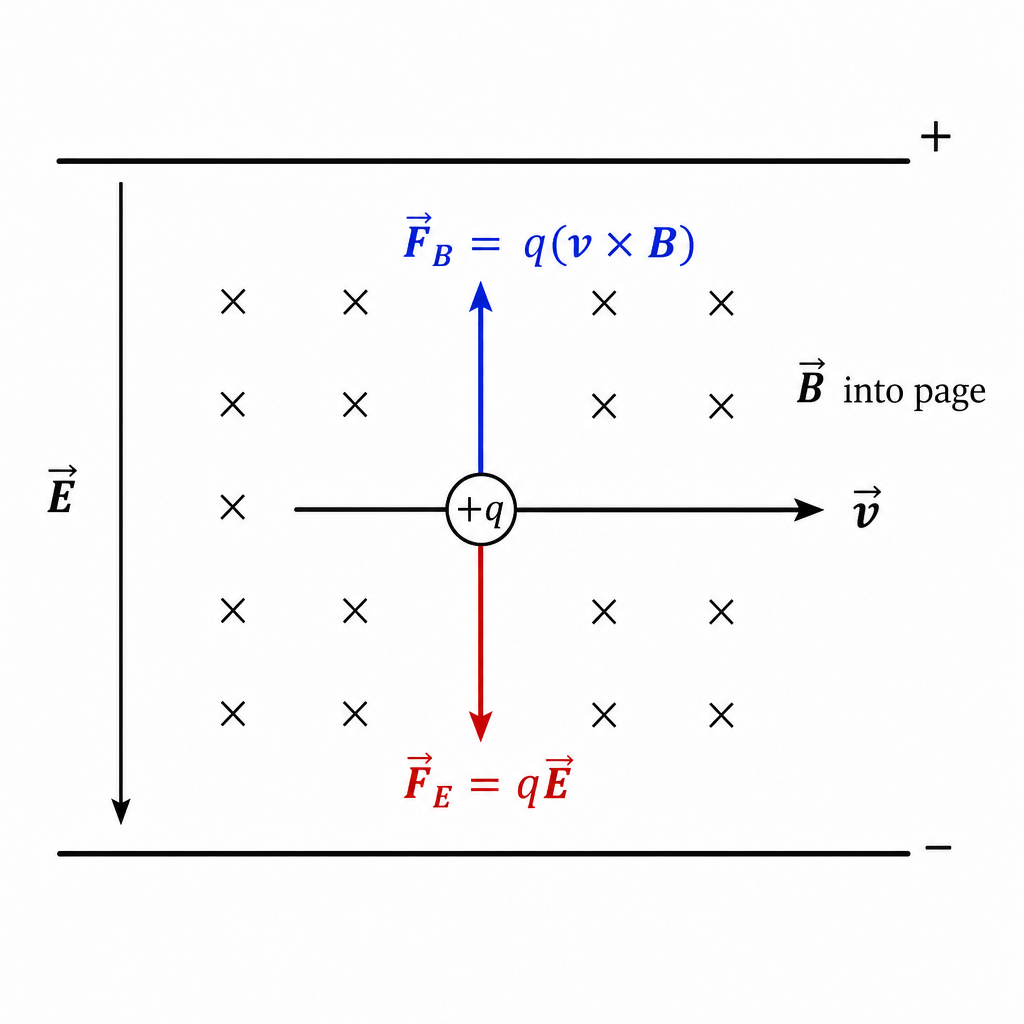
- The electric field points from the positive plate to the negative plate, so it is downward.
- A positive ion feels an electric force downward.
- For the ion to travel straight, the magnetic force must be upward.
Now use the cross product direction:
- Velocity is to the right.
- We need to be upward.
Using the right-hand rule, with fingers pointing to the right (direction of ) and thumb needing to point up (direction of ), the magnetic field must point into the page.
Therefore, is directed into the plane of the paper.
Key Takeaways
- goes from to .
- For a positive charge, is along .
- Magnetic force direction is found from (and reverses for a negative charge).
Common Mistakes
- Reversing the electric field direction (it is from to , not the other way).
- Using Fleming’s left-hand rule incorrectly for moving charges (it applies to conventional current; for a single positive charge, use ).
- Forgetting the magnetic force must oppose the electric force for undeviated motion.
Things to Be Careful About
- The conclusion “into/out of page” depends on the ion being positive; for a negative ion, the magnetic force direction would reverse.
- Keep consistent directions: if you choose upward as positive, check that your force balance matches it.
The positive ions in (b) enter the velocity selector with greater kinetic energy.
On Fig. 6.1, sketch the path of these ions.
Answer
For greater kinetic energy, the ions have greater speed , so increases while is unchanged.
Thus and the resultant force is upward (towards the plate), so the path curves upward through the field.
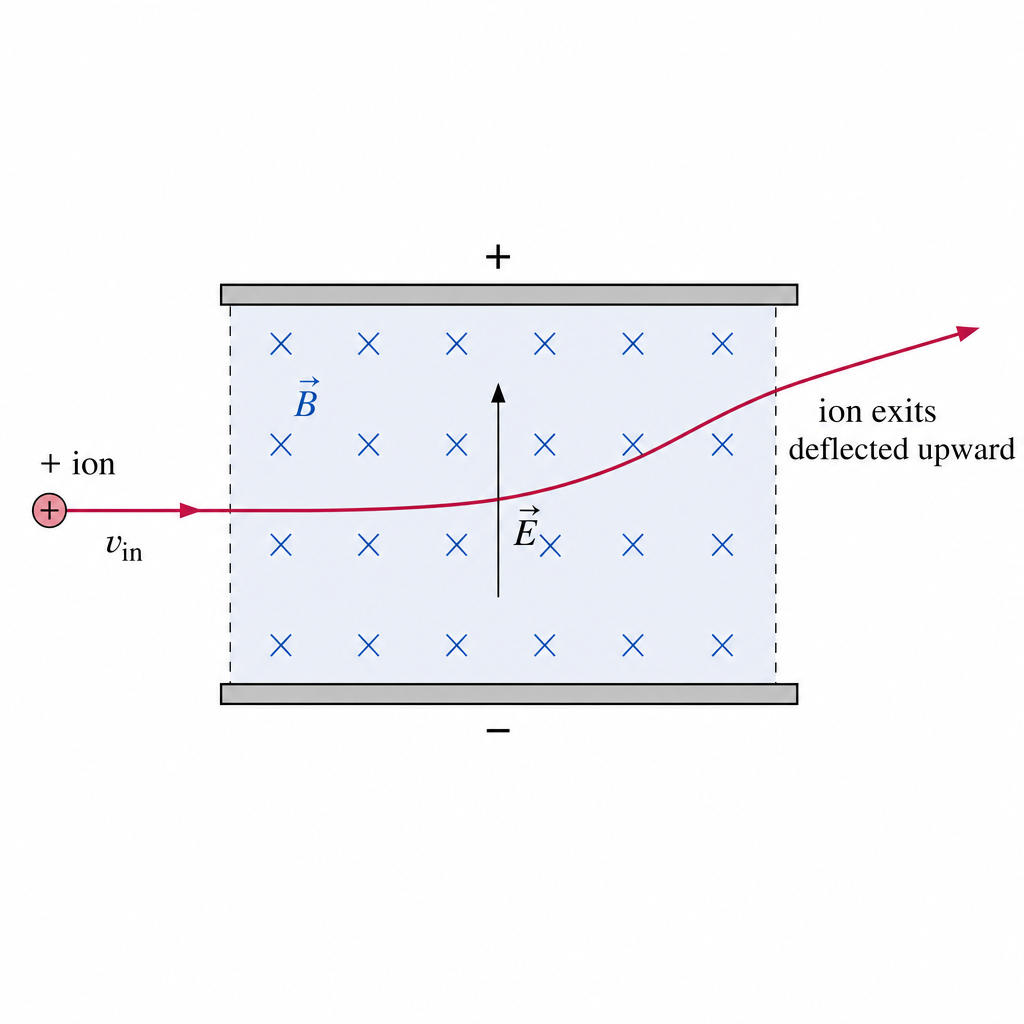
Path curves upward toward the positive (top) plate.
Background Concept
In the selector region:
- Electric force magnitude:
(and is fixed by the plates).
- Magnetic force magnitude (with ):
The velocity selector condition for no deflection is . If the speed changes while and stay the same, the balance is lost and the particle deflects in the direction of the larger force.
Understanding the Question
The ions in (b) were undeviated for a particular speed. Now they enter with greater kinetic energy, so their speed is higher than the selected speed. You must sketch their path on Fig. 6.1.
From part (d), for a positive ion with motion to the right, the electric force is downward and the magnetic force is upward (because is into the page).
Approach
- Higher kinetic energy implies higher speed.
- Decide how and change when increases.
- Identify the direction of the resultant force.
- Sketch a curved path bending in that direction within the field region.
Step-by-Step Reasoning
If kinetic energy increases, then speed increases because:
Electric force: stays the same (same plates, same and so same ).
Magnetic force: increases because it is proportional to .
So for the faster ions:
From (d), is upward and is downward, so the resultant transverse force is upward. A particle experiencing an upward transverse force while moving to the right follows a trajectory that curves upward toward the top plate.
Key Takeaways
- In a velocity selector, only one speed gives .
- If increases, increases but does not, so deflection is toward the magnetic-force direction.
Common Mistakes
- Drawing the path curving downward (would correspond to , i.e. slower ions).
- Drawing a straight line despite stating the ions have higher kinetic energy.
- Drawing a sharp kink rather than a smooth curve; a constant transverse force produces a smooth curvature.
Things to Be Careful About
- The direction of curvature depends on the sign of charge and the direction of . Here ions are positive and was deduced to be into the page.
- The question asks for a sketch “on Fig. 6.1”: show the curve mainly within the field region, then continuing out with an upward displacement.
Answer
Faraday’s law: the induced e.m.f. is proportional to the rate of change of magnetic flux linkage.
Induced e.m.f. equals the negative rate of change of magnetic flux linkage: E = -d(NΦ)/dt.
Background Concept
Faraday’s law links induction to changing magnetic flux. The magnetic flux through a circuit is
and the flux linkage is for a coil of turns. If the flux linkage changes (because , , or changes, or because a conductor moves in a field), an e.m.f. is induced.
Faraday’s law states that the induced e.m.f. is proportional to how fast the flux linkage changes. The minus sign is Lenz’s law: the induced e.m.f. acts in such a direction as to oppose the change causing it.
Understanding the Question
You are asked to state Faraday’s law. For full credit you should give the clear verbal statement and/or the standard equation involving flux linkage and a time rate of change.
Approach
Write Faraday’s law in its most general form using , including the negative sign.
Step-by-Step Reasoning
- Identify the relevant quantity that changes: magnetic flux linkage .
- State that induced e.m.f. depends on the rate of change:
- Give the full equation including Lenz’s-law sign:
Key Takeaways
- Induction requires change of flux linkage.
- The induced e.m.f. depends on the rate of that change.
- The negative sign indicates opposition to the change (Lenz’s law).
Common Mistakes
- Writing but forgetting the flux linkage factor when the law is asked generally.
- Stating Lenz’s law only (direction opposes change) without mentioning rate of change of flux linkage.
- Forgetting that Faraday’s law is about change, not just “presence of a magnetic field”.
Things to Be Careful About
- Use for flux and for flux linkage.
- Include the minus sign if giving the equation form.
- Use “rate of change” wording (not just “change”).
A metal rod is accelerated uniformly from rest in a uniform magnetic field as shown in Fig. 7.1.
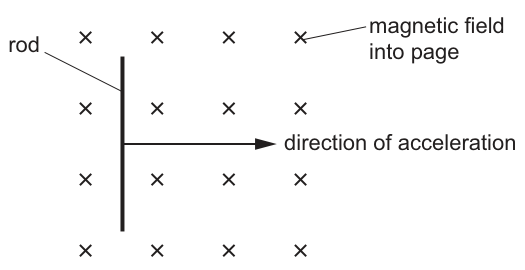
The rod has length and the flux density of the magnetic field is .
An electromotive force (e.m.f.) is induced in the rod. The variation with time of the induced e.m.f. is shown in Fig. 7.2.
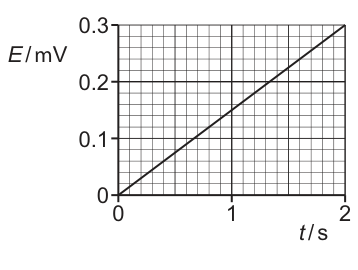
Answer
Fig. 7.2 is a straight line through the origin, so .
For uniform acceleration from rest, so .
Hence .
Since E ∝ t and v = at so v ∝ t, E is proportional to v.
Background Concept
If a quantity plotted against another gives a straight line through the origin, the relationship is proportional:
Also, for motion with uniform acceleration from rest,
so velocity increases linearly with time.
Understanding the Question
You are given a graph of induced e.m.f. against time . The rod is said to be accelerated uniformly from rest. You must use these two facts to argue that is proportional to the rod’s velocity .
Approach
- Read the shape of the – graph to infer how depends on .
- Use the kinematics for uniform acceleration from rest to express in terms of .
- Combine the two proportionalities.
Step-by-Step Reasoning
- The graph is a straight line passing through . That means
- Uniform acceleration from rest means initial velocity and
- If and , then both are proportional to the same variable, so
Key Takeaways
- Straight line through origin on a graph indicates direct proportionality.
- For uniform acceleration from rest, increases linearly with .
- Combining proportionalities is a quick way to relate two quantities.
Common Mistakes
- Saying “the graph is linear so is constant” (a linear graph does not mean constant; a horizontal line would).
- Forgetting “from rest” and using without setting .
- Claiming by confusing displacement () with velocity ().
Things to Be Careful About
- Proportionality () is only justified here because the line passes through the origin.
- Use the correct kinematics variable: velocity, not displacement.
Use Faraday’s law to show that the variation of with time is given by
where is the acceleration of the rod.
Working
As the rod moves a distance , area swept out
Flux linkage ():
Faraday’s law (magnitude):
With uniform acceleration from rest, so
Answer
E = Blat
Background Concept
Faraday’s law for a single conductor can be derived from the general statement
Here . If a straight rod of length moves sideways through a uniform magnetic field , it “cuts” magnetic field lines. One way to see the induced e.m.f. is to consider the area swept out by the rod: as the rod moves, the magnetic flux through that swept area changes.
Understanding the Question
A rod of length accelerates uniformly from rest in a uniform field of flux density . You must use Faraday’s law to show that the induced e.m.f. varies with time as
So you need to connect to rate of change of flux, and then connect that to motion ().
Approach
- Write the magnetic flux through the relevant area as .
- Express the area in terms of the rod length and the distance moved .
- Differentiate with respect to time to get .
- Replace with , and then use .
Step-by-Step Reasoning
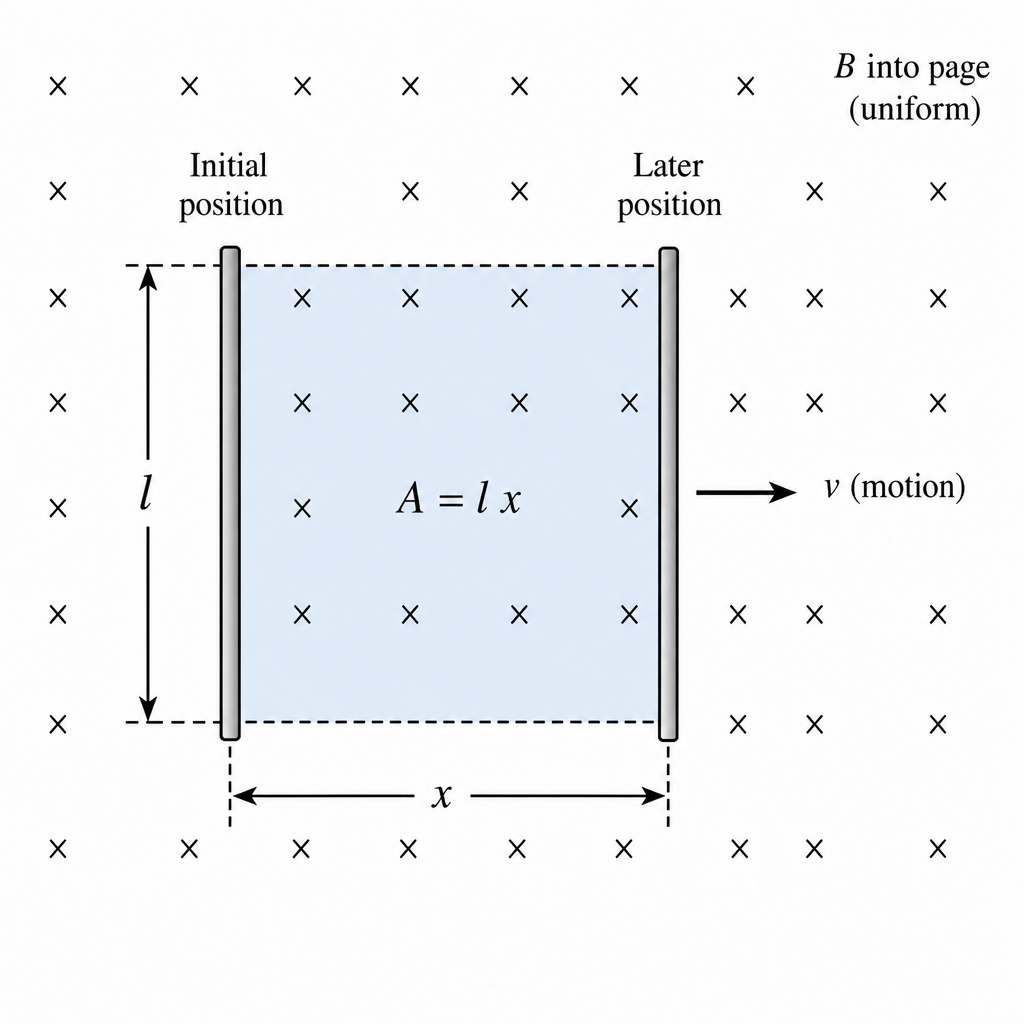
- As the rod moves a distance , it sweeps out a rectangular area
- In a uniform field perpendicular to the area, the magnetic flux is
- Using Faraday’s law for magnitude (the question is about the variation, so the sign is not essential here):
So
- Recognise that :
- The rod starts from rest and accelerates uniformly, so
Substitute into the expression for :
Key Takeaways
- Flux changes because the area linked with the field changes as the rod moves.
- Differentiate to get induced e.m.f.
- For uniform acceleration from rest, makes increase linearly with time.
Common Mistakes
- Using or other incorrect expressions for the swept area; it must be .
- Forgetting to differentiate: writing instead of .
- Mixing up and (displacement vs velocity).
- Including the minus sign and then treating as negative without discussing direction; usually the magnitude is enough unless asked for polarity.
Things to Be Careful About
- Ensure the field is perpendicular to the swept area so (i.e. ).
- Keep symbols consistent: is displacement, is velocity.
- State (single rod) if flux linkage form is used.
The length of the rod is . The acceleration of the rod is .
Determine the value of .
= ______
Working
From Fig. 7.2, at , .
Using ,
Answer
4.3 × 10^-5 T
Background Concept
Once you have an expression of the form
you can determine the magnetic flux density if you know the e.m.f. at a particular time , along with and . The key practical point is to keep everything in SI units: metres, seconds, volts.
Understanding the Question
You are given and . From the graph of against , you must obtain a corresponding pair and use
to calculate .
Approach
- Read a clear point from the straight line (the end point is easiest).
- Convert from to .
- Rearrange for and substitute.
Step-by-Step Reasoning
- From the graph, at ,
- Rearrange :
- Substitute values:
Calculate the denominator:
So
(Equivalently, you could use the gradient since for a straight line.)
Key Takeaways
- Convert graph readings to SI units before substituting.
- Rearranging a proportionality like is straightforward once one point is read.
- A straight-line – graph allows using either a single point or the gradient.
Common Mistakes
- Forgetting to convert to volts (leading to an answer too large).
- Using but reading in volts directly as .
- Rearranging incorrectly (e.g. multiplying instead of dividing by , , or ).
Things to Be Careful About
- Use in seconds, in metres, in , and in volts.
- Quote in tesla and to an appropriate number of significant figures consistent with the graph reading (typically 2 s.f. here).
Answer
A photon is a quantum (packet) of electromagnetic radiation.
Its energy is discrete and given by
(where is the radiation frequency).
A photon is a quantum (packet) of electromagnetic radiation with energy E = hf.
Background Concept
In quantum physics, electromagnetic (EM) radiation can be described as being made up of particles called photons. This is the “particle” side of wave–particle duality.
A photon carries:
- Energy given by
where is the Planck constant and is the frequency.
- (Later, you also use that a photon has momentum even though it has no rest mass.)
Understanding the Question
The question asks for what “a photon” means. For 2 marks, Cambridge typically wants two distinct pieces of information: (1) it is a packet/quantum of EM radiation, and (2) its energy is quantised and related to frequency.
Approach
Give a definition-style sentence (what it is), then add the key quantitative property that characterises a photon in A-level work: .
Step-by-Step Reasoning
- Identify what kind of thing a photon is: a single “particle” of EM radiation (light, X-rays, etc.).
- State the key quantised energy relationship used throughout the topic:
This distinguishes the photon model from a purely classical wave model.
Key Takeaways
- A photon is a quantum (packet) of EM radiation.
- Photon energy is proportional to frequency: .
Common Mistakes
- Saying only “a particle of light” without mentioning quantisation/energy–frequency link (often loses the second mark).
- Confusing photon with electron or other material particle.
- Writing only; this is true but the core definition point is usually .
Things to Be Careful About
- Use the wording “packet” or “quantum” to indicate discreteness.
- If you include an equation, ensure symbols are correct: is Planck constant, not , and is frequency.
A laser emits red light of a single wavelength. The light is produced when electrons move from a higher energy level to a lower energy level. The difference in energy between the two levels is .
Working
Energy difference:
Using :
Answer
6.34 × 10^-7 m
Background Concept
When an electron drops from a higher energy level to a lower one, it can emit a photon whose energy equals the energy difference between the levels.
Photon energy can be written as:
and because , we can also write
This is often the quickest route from photon energy to wavelength.
Also, energy is sometimes given in electronvolts:
Understanding the Question
You are told the energy difference between the two electron levels is . The laser light has a single wavelength, meaning each emitted photon has the same energy . The task is to find the wavelength in metres.
Approach
- Convert the photon energy from eV to J.
- Use and rearrange to .
- Substitute constants and compute.
Step-by-Step Reasoning
- Convert eV to J:
- Use the energy–wavelength form:
Rearrange:
- Substitute and :
This is in the red region of the visible spectrum (hundreds of nm), which is a good sense-check.
Key Takeaways
- Emitted photon energy equals the energy level difference.
- Convert before using SI constants.
- Use for direct wavelength calculations.
Common Mistakes
- Forgetting to convert eV to J (gives an answer wrong by a factor of ).
- Using but not connecting to wavelength via .
- Giving wavelength in nm when the answer space requests metres.
Things to Be Careful About
- Keep powers of ten consistent; this calculation is sensitive to exponent errors.
- Quote the final wavelength to a sensible number of significant figures (typically 3 s.f. here).
- Ensure and values are in SI units so that comes out in metres.
The power of the beam emitted by the laser is .
Calculate the number of photons emitted per unit time by the laser.
number per unit time = ______
Working
Energy per photon:
Power , so
Answer
3.2 × 10^16 s^-1
Background Concept
Power is the rate of energy transfer:
If a laser emits photons all of the same energy , then in time the energy emitted is
So the emission rate is
Understanding the Question
The laser beam has power , meaning it emits of energy each second. Each photon has energy equal to the level difference from part (i): (which is ). You must find how many photons per second are needed to carry that power.
Approach
- Use (or recalculate) the photon energy in joules.
- Apply .
Step-by-Step Reasoning
- Photon energy:
- Photon rate:
- Round appropriately (often 2 s.f. is acceptable for a 1-mark answer):
Key Takeaways
- Laser power tells you energy emitted each second.
- Divide by energy per photon to get photons per second.
Common Mistakes
- Using directly as if it were joules (forgetting eV conversion).
- Using wavelength directly without first getting photon energy.
- Writing the unit incorrectly; it should be .
Things to Be Careful About
- Use consistent units: in watts () and in joules.
- Significant figures: power is given to 2 s.f., so the rate should not be over-precise.
The photons are incident normally on a surface. Half of the number of photons are absorbed by the surface, and half are reflected.
Determine the average force exerted by the beam of photons on the surface.
average force = ______
Working
Photon momentum:
Photons per second:
Half absorbed: momentum change per photon .
Half reflected: momentum change per photon .
Total momentum change per second:
Substitute and :
With and :
Answer
5.0 × 10^-11 N
Background Concept
Although photons have no rest mass, they carry momentum. For a photon:
When light hits a surface, the surface experiences a force because the photons’ momentum changes.
Force is rate of change of momentum:
For a beam incident normally:
- Absorption: photon goes from momentum (towards the surface) to (no photon after absorption), so
- Reflection: photon reverses direction, from to , so
Understanding the Question
A laser beam (power ) hits a surface at right angles. Half the photons are absorbed and half are reflected.
You must find the average force on the surface due to the photons’ momentum transfer.
Approach
- Express the momentum change per photon for each case (absorbed vs reflected).
- Multiply each momentum change by the number of photons per second in that category.
- Add the two contributions to get total momentum change per second, which equals the force.
- Use and to simplify so you only need and .
Step-by-Step Reasoning
-
Let the total photon emission/arrival rate be .
-
Split into two equal groups:
- absorbed rate
- reflected rate
- Momentum change rates:
- Absorbed: each photon transfers momentum to the surface, so contribution to force:
- Reflected: each photon transfers momentum , so
- Total force:
- Replace and :
So
Notice the photon energy cancels: for a given power, the force depends only on what fraction is reflected/absorbed.
- Substitute values:
Key Takeaways
- Photon momentum: .
- Force from light is due to momentum change per unit time.
- Absorption gives ; reflection gives .
- For a beam of power :
- all absorbed:
- all reflected:
- half absorbed & half reflected: .
Common Mistakes
- Treating reflected photons as having momentum change instead of .
- Forgetting that only half the photons are in each category.
- Using without consistent units or without linking to power.
- Confusing energy with momentum and writing (wrong dimensions).
Things to Be Careful About
- The direction is normal to the surface; since the question asks for magnitude (average force), a positive value is fine.
- Use and quote the unit of force as newtons.
- Avoid double-counting: the factor comes from half at plus half at .
Polonium-193 () is an unstable nuclide. A nucleus of polonium-193 decays to a nucleus of lead-189 () by emitting an alpha-particle.
Radioactive decay is both random and spontaneous.
State what is meant by:
Answer
Random means it is impossible to predict which nucleus will decay, or when a particular nucleus will decay.
It is impossible to predict which nucleus will decay or when a particular nucleus will decay.
Background Concept
Radioactive decay is described statistically. Although a large sample follows a clear exponential law, the decay of an individual nucleus is not predictable.
Understanding the Question
You are asked to state what “random” means in the context of radioactive decay of a nucleus.
Approach
Give a statement about unpredictability of individual decay events (which nucleus / exact time), not about the overall trend for many nuclei.
Step-by-Step Reasoning
- In a sample, many nuclei are identical, but you cannot say which specific nucleus will decay next.
- You also cannot predict the exact time at which a particular chosen nucleus will decay.
- What you can predict is the probability per unit time (related to the decay constant) and therefore the behaviour of a large population.
Key Takeaways
- “Random” refers to unpredictability of individual decay events.
- Predictable behaviour applies only to large numbers of nuclei.
Common Mistakes
- Saying “random means it happens without a cause” (that is closer to spontaneous).
- Describing the activity decreasing with time (that is the exponential law, not the meaning of random).
Things to Be Careful About
- Mentioning either “which nucleus” or “when” may be enough for some mark schemes, but stating both is safest.
Answer
Spontaneous means the decay occurs by itself (without any external trigger) and is unaffected by external physical conditions such as temperature or pressure.
Decay occurs without an external trigger and is unaffected by external physical conditions.
Background Concept
A nucleus decays because of processes within the nucleus. External factors that affect chemical reactions (temperature, pressure, chemical state) do not control the nuclear decay.
Understanding the Question
You must state what “spontaneous” means for radioactive decay.
Approach
State two linked ideas: no external trigger is needed, and external conditions do not affect whether/when decay occurs.
Step-by-Step Reasoning
- “Spontaneous” means the nucleus decays on its own: it does not require a collision, heating, shining light, or applying an electric field.
- The probability of decay per unit time (decay constant) is a nuclear property, so changing temperature/pressure/chemical bonding does not change the decay rate in normal circumstances.
Key Takeaways
- Spontaneous: self-initiated decay.
- Not controllable by ordinary environmental changes.
Common Mistakes
- Confusing spontaneous with random (random is about unpredictability; spontaneous is about no external cause/trigger).
- Saying “it happens suddenly” (not the physics meaning).
Things to Be Careful About
- Do not claim the decay is caused by external radiation; that would be induced nuclear reactions, not normal spontaneous decay.
Answer
Half-life is the time taken for the number of undecayed nuclei (or the activity) in a sample to fall to half its initial value.
Time for number of undecayed nuclei (or activity) to halve.
Background Concept
For radioactive decay,
where is the number of undecayed nuclei after time , is the initial number, and is the decay constant. Activity is proportional to :
So also falls exponentially.
Understanding the Question
You are asked to define half-life, so you should express it as a time for a quantity to halve.
Approach
State: “time for (or ) to become half of its initial value”.
Step-by-Step Reasoning
- By definition, at the half-life ,
(and equivalently ).
- This definition does not require calculation; it is a statement of what half-life means.
Key Takeaways
- Half-life is a time interval linked to halving of or .
Common Mistakes
- Defining it as “time for all nuclei to decay” (wrong: exponential decay never reaches exactly zero).
- Saying “time for half the mass to disappear” without specifying undecayed nuclei/activity.
Things to Be Careful About
- Always refer to “undecayed nuclei” or “activity”, not “number of decays”.
Data for the binding energy per nucleon of the particles involved in the decay of a nucleus of polonium-193 are given in Table 9.1.
Table 9.1
| particle | binding energy per nucleon / |
|---|---|
| 7.774 | |
| 7.826 | |
| 7.074 |
Determine the energy, in , released when a nucleus of polonium-193 decays into a nucleus of lead-189.
energy = ______
Working
Total binding energy of :
Total binding energy of products:
Answer
7.03 × 10^6 eV
Background Concept
Binding energy is the energy required to separate a nucleus into free nucleons. The binding energy per nucleon allows you to find the total binding energy:
where is the nucleon (mass) number.
In nuclear decays and reactions, the energy released (the -value) is related to the change in total binding energy:
- If the products are more tightly bound (higher total binding energy), energy is released.
Understanding the Question
The decay is:
You are given binding energy per nucleon values for the parent nucleus and the two products. You must determine the energy released in .
Approach
- Convert each “binding energy per nucleon” into total binding energy by multiplying by nucleon number.
- Add total binding energies for the products.
- Subtract the reactant total binding energy.
- Express the result in (here, multiplying by converts from MeV to eV, matching the expected nuclear energy scale).
Step-by-Step Reasoning
- Parent nucleus total binding energy:
- Daughter nucleus total binding energy:
- Alpha particle total binding energy:
- Total binding energy of products:
- Increase in binding energy (released energy):
So about is released, i.e. .
Key Takeaways
- Multiply binding energy per nucleon by to get total binding energy.
- Energy released corresponds to an increase in total binding energy of the products.
Common Mistakes
- Using proton number instead of nucleon number .
- Subtracting in the wrong order (giving a negative released energy).
- Forgetting the alpha particle contributes to the products.
- Reporting the answer without converting to when requested.
Things to Be Careful About
- Nuclear binding energies are typically in MeV per nucleon; check that your final magnitude is around a few MeV (i.e. ), not a few eV.
- Keep consistent significant figures (typically 3 s.f.).
A pure sample of polonium-193 contains nuclei. After a time the sample contains nuclei of polonium-193. The variation of with is shown in Fig. 9.1.
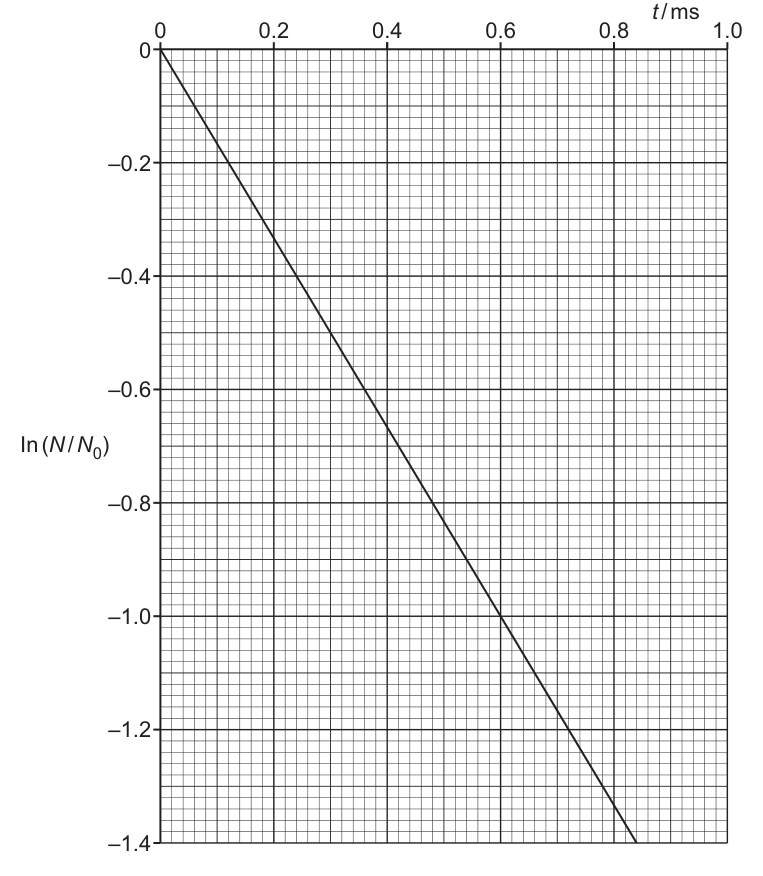
State the name of the quantity that is represented by the magnitude of the gradient of the line in Fig. 9.1.
Answer
For ,
So the magnitude of the gradient is the decay constant .
Decay constant, \lambda
Background Concept
Radioactive decay follows
Taking natural logs gives a straight-line form:
This matches with , , gradient , and intercept .
Understanding the Question
A graph of against is shown as a straight line. You are asked what quantity is given by the magnitude of its gradient.
Approach
Compare the plotted relationship to the linearised equation and read off what the gradient represents.
Step-by-Step Reasoning
- Since the graph is vs , the governing equation is
- Therefore the gradient is .
- The magnitude (absolute value) of the gradient is , the decay constant.
Key Takeaways
- Straight-line graph after logging is a classic test for exponential decay.
- Gradient magnitude gives the decay constant.
Common Mistakes
- Saying the gradient is the half-life.
- Forgetting the negative sign and stating gradient equals (the question avoids this by asking for magnitude).
Things to Be Careful About
- Use natural log , not , unless explicitly stated; the gradient meaning depends on the log base.
Working
From the line, using :
So
Half-life:
Answer
0.50 ms
Background Concept
For exponential decay,
so
A plot of against is a straight line with gradient .
Half-life is related to by setting :
and since ,
Understanding the Question
You are given a straight-line graph of vs time (in ms). You must use the graph to find the half-life in ms.
Approach
- Find the gradient of the line using two well-separated points.
- Use to get .
- Use .
Step-by-Step Reasoning
- Choose two points on the line. The graph passes through and approximately .
- Gradient:
- Hence .
- Now calculate the half-life:
- Rounding appropriately gives .
Key Takeaways
- Log plots turn exponentials into straight lines.
- Gradient gives decay constant, then half-life follows from .
Common Mistakes
- Using (incorrect; must include ).
- Forgetting units and giving in while is in ms.
- Calculating gradient as .
Things to Be Careful About
- Use two far-apart points on the best-fit line, not two noisy plotted points.
- Keep time units consistent: if gradient is in , then comes out in ms.
Positron emission tomography (PET scanning) uses a radioactive tracer.
Answer
The positrons quickly collide with electrons and annihilate, producing two -ray photons (in opposite directions).
They annihilate with electrons, producing two gamma photons (opposite directions).
Background Concept
In PET, the tracer emits positrons (). A positron is the antimatter particle of the electron. When a positron meets an electron, they annihilate, converting their mass into electromagnetic energy (gamma photons).
Understanding the Question
You are asked what happens to the positrons emitted by a PET tracer after they are produced in the body.
Approach
Describe the physical fate of positrons in tissue: they slow down, then annihilate with electrons, producing gamma rays.
Step-by-Step Reasoning
- After emission, a positron travels only a short distance in tissue, losing kinetic energy through ionisation/collisions.
- Once slow enough, it encounters an electron.
- Positron + electron annihilation occurs, producing two gamma photons (commonly of energy each) emitted in nearly opposite directions. These coincident photons are what the PET detectors register.
Key Takeaways
- PET relies on positron-electron annihilation.
- The detectable signal is a pair of gamma rays.
Common Mistakes
- Saying the positron becomes an electron (wrong: it annihilates with one).
- Mentioning alpha particles or beta-minus emission.
Things to Be Careful About
- The key mark-worthy idea is annihilation with electrons and gamma emission; extra details (like 511 keV) are usually not required.
Explain why a tracer with a half-life of approximately 2 hours is a suitable tracer to use.
Answer
A half-life of about is long enough for the tracer to be prepared and for the scan to be carried out, but short enough that it decays away soon after, reducing the radiation dose to the patient.
Long enough for preparation/scan, short enough to reduce patient dose afterwards.
Background Concept
Half-life controls how quickly the activity falls:
A suitable medical tracer must have:
- sufficient activity for detection during the measurement time,
- minimal time remaining radioactive in the patient (dose reduction).
Understanding the Question
You must explain why a tracer with half-life about 2 hours is suitable for PET. This is about practicality and safety.
Approach
State the trade-off:
- not too short (otherwise activity drops too fast before/during the scan),
- not too long (otherwise the patient remains radioactive for an unnecessarily long time).
Step-by-Step Reasoning
- A PET scan and associated preparation/transport typically take on the order of minutes to a couple of hours.
- If the half-life were much shorter (minutes), the activity might fall significantly before the scan completes, reducing count rate and image quality.
- If the half-life were much longer (days), the tracer would remain in the body emitting radiation long after the scan, increasing dose without benefit.
- A half-life of about 2 hours is a good compromise: adequate activity during the scan but rapid decay afterwards.
Key Takeaways
- Suitable half-life balances usable signal with minimal dose.
Common Mistakes
- Saying only “it is safe” without linking to half-life.
- Claiming a longer half-life is always better (it increases dose).
Things to Be Careful About
- You only need one clear explanation for 1 mark, but including both “long enough” and “short enough” makes the argument complete.
Answer
Luminosity is the total energy emitted by a star per unit time (total power output), in all directions.
Total power (energy per unit time) emitted by the star in all directions.
Background Concept
Luminosity, , is an intrinsic property of a star: it is the total power it emits as electromagnetic radiation.
It does not depend on how far away the star is.
By contrast, what we measure at Earth is the radiant flux intensity (often just called flux), , which does depend on distance :
Understanding the Question
The question asks for what “luminosity of a star” means, so you must state a definition in words (power/energy per time), not a formula for .
Approach
State that luminosity is the star’s total power output (energy radiated each second), emitted in all directions.
Step-by-Step Reasoning
- “Energy emitted per unit time” is the definition of power.
- “In all directions” clarifies that it is the star’s total emission, not what arrives at an observer.
Key Takeaways
- Luminosity is intrinsic: total power output of the source.
- Flux is what an observer receives and varies with via an inverse-square law.
Common Mistakes
- Writing instead of defining .
- Saying “brightness” without clarifying it is total power (brightness is ambiguous and often means flux).
Things to Be Careful About
- Include “per unit time” or “power” explicitly.
- Do not make luminosity depend on distance or observer.
Answer
A standard candle has known luminosity .
Measure its apparent brightness / flux as observed from Earth.
Use
to calculate the distance to the galaxy.
Use an object of known luminosity, measure its flux, and apply F = L/(4πd²) to find the distance.
Background Concept
For a source radiating equally in all directions, its total power spreads out over the surface area of a sphere of radius .
Surface area of sphere:
So the power per unit area received (flux), , is:
A standard candle is an astronomical object whose luminosity (or absolute magnitude) is known reliably (e.g. Cepheid variables, Type Ia supernovae).
Understanding the Question
You must explain the method: identify a standard candle in the galaxy, use its known luminosity, measure how bright it appears (flux), and then compute the distance using the inverse-square relationship.
Approach
- Choose/identify a standard candle in the galaxy.
- Use its known luminosity .
- Measure observed flux from Earth (from its apparent brightness).
- Rearrange to solve for .
Step-by-Step Reasoning
From
rearrange:
So if is known (standard candle calibration) and is measured, can be calculated.
Key Takeaways
- Standard candles turn a brightness measurement into a distance measurement.
- The essential physics is the inverse-square spreading of radiation.
Common Mistakes
- Saying “compare brightness to get distance” without mentioning known luminosity.
- Mixing up (intrinsic) and (observed).
- Forgetting the factor, or not using a square root when rearranging.
Things to Be Careful About
- State clearly what is measured () and what is known ().
- The method assumes negligible absorption/extinction, or that it has been corrected for (not always required, but avoid claiming distance depends only on brightness with no caveats).
The Sun rotates on its axis. Points X, Y and Z are on the equator of the Sun as shown in Fig. 10.1.
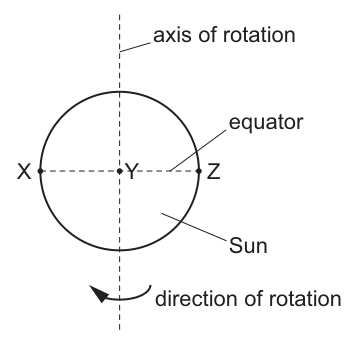
The wavelengths of light from points X and Y are observed and recorded in Table 10.1.
Table 10.1
| observed wavelength from X / | observed wavelength from Y / |
|---|---|
| 656.2877 | 656.2831 |
Working
For point , radial speed is , so emitted wavelength .
Difference:
Doppler shift:
Uniform circular motion:
Answer
6.93 × 10^8 m
Background Concept
When a source of light moves relative to an observer, the observed wavelength changes due to the Doppler effect. For speeds much less than (true for the Sun’s rotation), the fractional wavelength shift is approximately
where is the component of the source velocity along the line of sight.
For uniform circular motion, the tangential speed at the equator is
where is the rotation period.
Understanding the Question
You are given observed wavelengths from two points on the Sun’s equator, (at the limb, moving away from the observer) and (at the centre of the visible disc). You use the Doppler shift between them to find the equatorial speed , then use the period to find the radius .
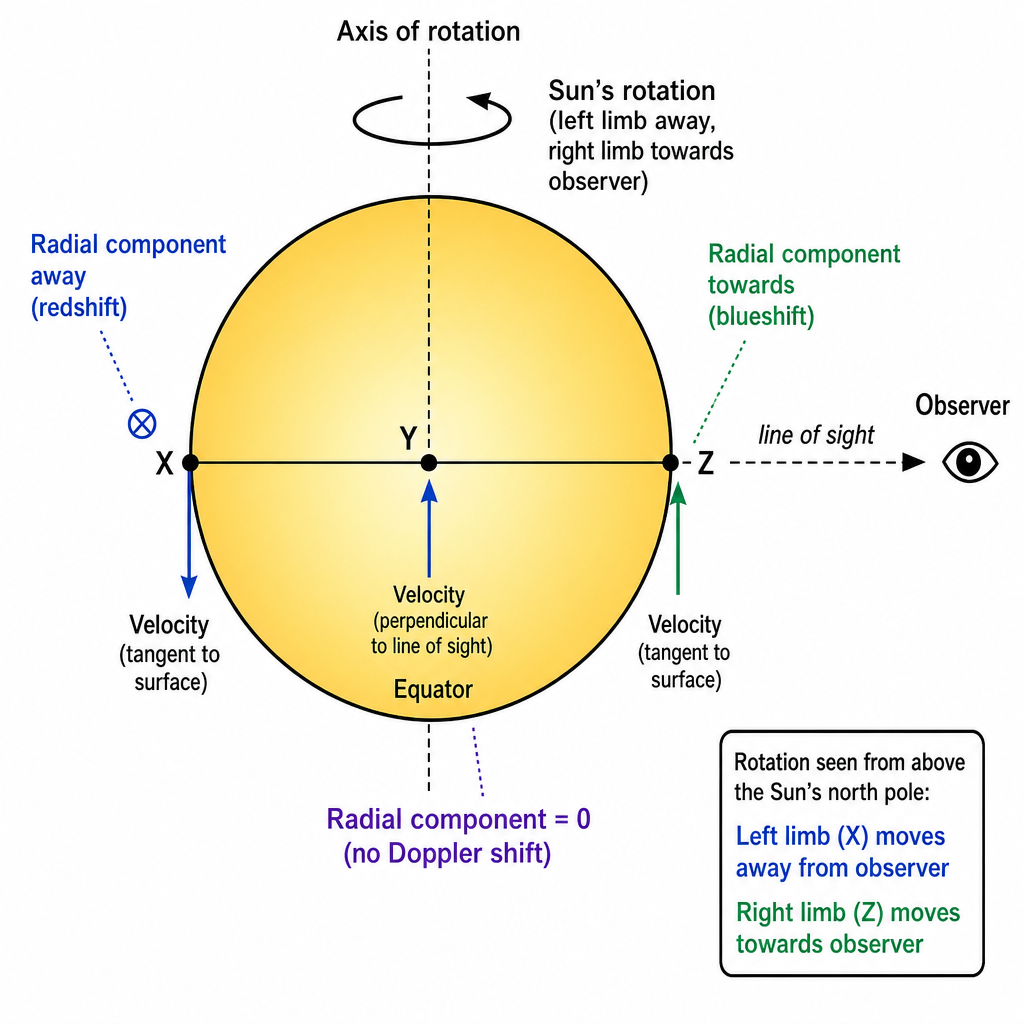
Approach
- Treat the wavelength from as (approximately) the emitted wavelength because the velocity component toward/away from us is zero at the disc centre.
- Find .
- Use to calculate for point .
- Use to solve for .
Step-by-Step Reasoning
- Identify the unshifted wavelength. At (centre of disc), the Sun’s rotation is sideways relative to the observer, so the radial component of velocity is zero. Hence the observed wavelength from is essentially the emitted wavelength:
- Find the wavelength difference.
It is larger at , consistent with moving away (redshift).
- Use Doppler relation to find speed at the equator.
So
- Relate equatorial speed to radius using the period.
Substitute :
This matches the required value.
Key Takeaways
- Doppler shift gives the radial component of velocity.
- The centre of the Sun’s disc has (approximately) zero radial velocity due to rotation.
- Combine Doppler speed with to obtain the radius.
Common Mistakes
- Using the wrong reference wavelength (e.g. averaging and without justification).
- Forgetting that Doppler shift uses the component of velocity along the line of sight.
- Using (missing the ).
- Converting incorrectly (it is ).
Things to Be Careful About
- Keep units consistent: ratios like are unitless, so nm can be used directly (no need to convert to m if both are in nm).
- Use and quote the final radius in standard form with appropriate significant figures.
State and explain how the expected wavelength of the light observed from Z compares with the emitted wavelength.
Answer
The observed wavelength from is less than the emitted wavelength (blueshift), because is moving towards the observer so successive wavefronts are received closer together.
Observed wavelength from Z is smaller than the emitted wavelength (blueshift) because Z is moving towards the observer.
Background Concept
Doppler effect for light:
- If the source moves away, wavefronts are stretched and the observed wavelength increases (redshift).
- If the source moves towards, wavefronts are compressed and the observed wavelength decreases (blueshift).
For small speeds compared with :
and the sign of (towards/away) determines whether increases or decreases.
Understanding the Question
Point is on the opposite limb to . From the rotation direction shown, has a velocity component towards the observer. You must state how the observed wavelength compares to the emitted wavelength and explain using Doppler shift.
Approach
Determine whether moves towards or away along the line of sight, then state blueshift or redshift accordingly.
Step-by-Step Reasoning
- Rotation means opposite limbs have opposite radial velocity components.
- Since is moving away (given by longer observed wavelength at than at ), the opposite point must be moving towards.
- Moving towards compresses wavefront spacing, so the observed wavelength is smaller than the emitted wavelength.
Key Takeaways
- Towards observer blueshift ().
- Away from observer redshift ().
Common Mistakes
- Reversing redshift/blueshift.
- Comparing with the wavelength from or instead of explicitly comparing with the emitted wavelength.
Things to Be Careful About
- Use the wording “observed wavelength is less than emitted wavelength” (or “blueshift”) and include the reason: motion towards the observer causing wavefronts to be closer together.
The luminosity of the Sun is .
Use the information in (b)(i) to calculate the surface temperature of the Sun.
temperature = ______
Working
Use Stefan–Boltzmann:
With , , :
Answer
5.8 × 10^3 K
Background Concept
If a star is approximated as a black body, the power radiated per unit area is given by the Stefan–Boltzmann law:
For a spherical star of radius , the surface area is , so its luminosity is
where:
- is luminosity (total power),
- ,
- is surface temperature.
Understanding the Question
You are given the Sun’s luminosity and (from part (b)(i)) its radius. You must use these to find the surface temperature by rearranging Stefan–Boltzmann.
Approach
- Start from .
- Rearrange for .
- Substitute and and evaluate the fourth root.
Step-by-Step Reasoning
Start with
Rearrange:
and hence
Substitute values:
Compute the denominator:
So
Taking the fourth root gives
(consistent with the known solar surface temperature about ).
Key Takeaways
- Use the whole surface area when connecting luminosity to temperature.
- Temperature comes from a fourth-root, so large changes in or produce smaller fractional changes in .
Common Mistakes
- Using (missing the area factor).
- Using diameter instead of radius.
- Arithmetic error with indices when squaring or handling .
Things to Be Careful About
- Keep in metres and use the correct value of with units.
- A fourth root is not the same as a square root; do it as two successive square roots if needed.
- Quote to appropriate significant figures (typically 2 s.f. or 3 s.f. depending on given data).