Physics 9702/42 — October/November 2023
Cambridge A-Level · A Level Structured Questions · worked solutions for every part, with the mark scheme
Topics Motion in a Circle · Gravitational Fields · Ideal Gases · Thermodynamics · Oscillations · Alternating Currents · +7 more
Define the radian.
Answer
One radian is the angle at the centre of a circle subtended by an arc of length equal to the radius.
Angle at centre subtended by an arc equal in length to the radius.
Background Concept
Angles can be measured in degrees or in radians. The radian is defined in a way that links angles directly to lengths on a circle.
For a circle of radius , an angle (in radians) subtends an arc length given by
This relationship is the reason radians are so convenient in circular motion.
Understanding the Question
The question asks for the definition of the radian (not a calculation). You must state it in terms of a circle, its radius, and the arc length it subtends.
Approach
Use the defining condition . Substitute this into to identify what radian corresponds to, and state it in words.
Step-by-Step Reasoning
If , then
So an angle of is the angle at the centre of a circle that subtends an arc length equal to the radius.
Key Takeaways
- Radian measure is defined by .
- corresponds to the special case .
Common Mistakes
- Defining it using degrees (e.g. saying ) rather than the arc/radius definition.
- Missing the phrase “at the centre” or not mentioning arc length.
Things to Be Careful About
- The definition must involve a circle, the radius, and an arc length equal to the radius.
- Do not confuse arc length with chord length.
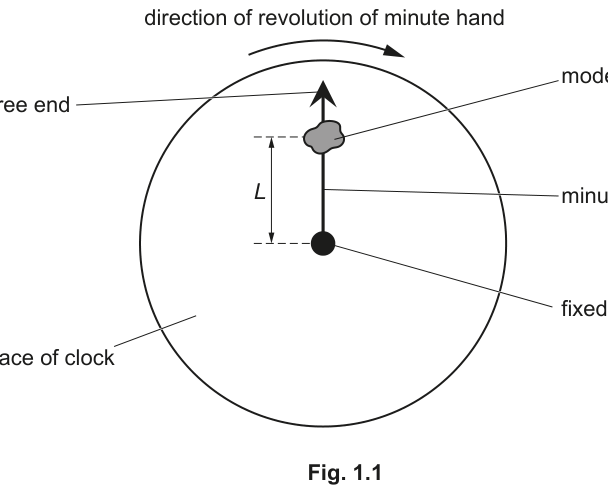
The minute hand of a clock revolves at constant angular speed around the face of the clock, completing one revolution every hour. A small piece of modelling clay is attached to the hand with its centre of gravity at a distance from the fixed end of the hand, as shown in Fig. 1.1.
Calculate the angular speed of the minute hand.
= ______
Working
Period
Answer
1.75 × 10^-3 rad s^-1
Background Concept
For uniform circular motion, angular speed is the rate of change of angular displacement:
One full revolution corresponds to an angular displacement of radians. If the time for one revolution is the period , then
Understanding the Question
The minute hand completes one full revolution every hour. That means its period is . The question asks for its angular speed in , so we must express in seconds.
Approach
- Convert to seconds.
- Use .
Step-by-Step Reasoning
1 hour is
Then
Key Takeaways
- One full revolution is always radians.
- For steady rotation, .
Common Mistakes
- Leaving in hours and producing in .
- Using instead of .
Things to Be Careful About
- The required unit is , so time must be in seconds.
- Quote a sensible number of significant figures (typically 2–3).
During a time interval of , the centre of gravity of the piece of modelling clay in Fig. 1.1 moves through a total distance of .
Calculate the angle through which the minute hand moves in this time interval.
angle = ______
Working
Answer
2.44 rad
Background Concept
For constant angular speed , angular displacement increases linearly with time:
This is the rotational analogue of for constant linear speed.
Understanding the Question
In the minute hand (and the clay fixed to it) rotates through some angle . You are given the time interval and (from part (b)) the constant angular speed of the minute hand.
Approach
Use the uniform rotation relation with .
Step-by-Step Reasoning
With and :
The seconds cancel, leaving radians.
Key Takeaways
- Uniform rotation: is found from .
Common Mistakes
- Using but mixing units for and .
- Forgetting that radians are dimensionless and still writing an incorrect unit.
Things to Be Careful About
- Ensure is in and in so the product is consistent.
Determine distance .
= ______
Working
Answer
0.18 m
Background Concept
Arc length on a circle is related to radius and angle (in radians) by
This formula is only valid when is in radians.
Understanding the Question
The clay’s centre of gravity moves along a circular arc of radius (distance from the centre of the clock to the clay). In it travels a distance along that arc. From part (c)(i) you have the angle moved through, .
You are asked to determine .
Approach
Use and rearrange to .
Step-by-Step Reasoning
Given and :
So .
Key Takeaways
- Use for circular motion distances.
- Always check is in radians.
Common Mistakes
- Using degrees in (would give a wrong value for ).
- Confusing with the full length of the minute hand to the edge of the clock.
Things to Be Careful About
- Use consistent significant figures; suggests should be quoted to about 2 s.f.
- is the radius of the circular path of the clay’s centre of gravity, not necessarily the hand’s full length.
Calculate the magnitude of the centripetal acceleration of the piece of modelling clay.
centripetal acceleration = ______
Working
Answer
5.5 × 10^-7 m s^-2
Background Concept
In uniform circular motion, the speed may be constant but the velocity changes direction, so there is an acceleration towards the centre called centripetal acceleration.
Its magnitude can be written as
or equivalently
where:
- is the radius of the circular path,
- is angular speed,
- is linear (tangential) speed.
Understanding the Question
The clay’s centre of gravity moves in a circle of radius about the clock’s centre. You have already found and you know the minute hand rotates at constant . The question asks for the magnitude of the centripetal acceleration of the clay.
Approach
Use because is known and is known. Substitute values and keep units consistent.
Step-by-Step Reasoning
From earlier parts:
Compute :
Then
This is extremely small because the rotation is very slow (one revolution per hour).
(Alternative check: , then gives the same result.)
Key Takeaways
- Centripetal acceleration depends on how fast the object goes around the circle: .
- Slow rotation gives very small centripetal acceleration.
Common Mistakes
- Using (missing the square).
- Using the distance travelled as the radius.
- Mixing up with the full minute-hand length.
Things to Be Careful About
- Radians are dimensionless, so has unit and ends up in .
- Because the answer is very small, standard form is usually clearest.
Use your answer in (c)(iii) to explain why the variation with time of the magnitude of the force exerted by the minute hand on the piece of modelling clay is negligible as the minute hand undergoes one full revolution.
Answer
From (c)(iii), is extremely small (), so the centripetal force needed is
and hence .
Therefore the force exerted by the hand on the clay is dominated by the (approximately constant) support of the clay’s weight, so any change in the magnitude during a revolution is negligible.
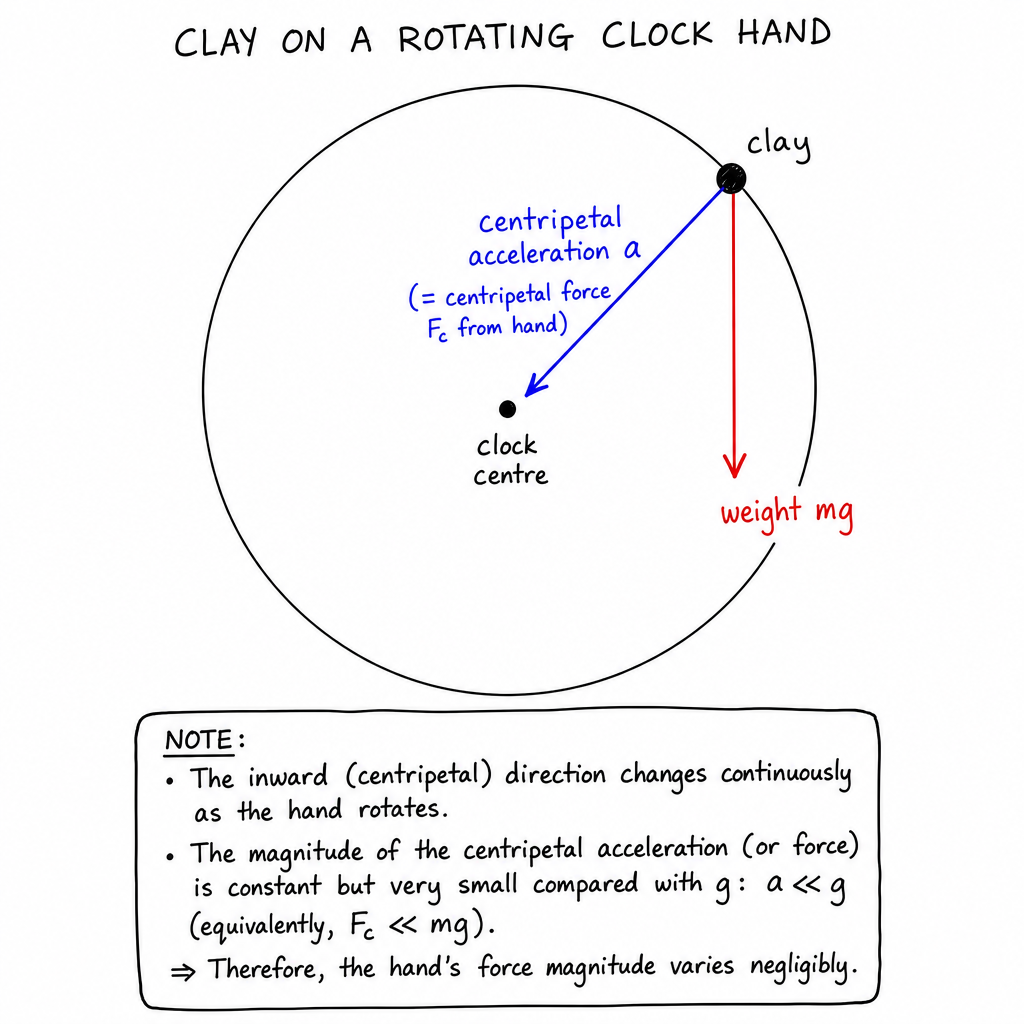
Because a is extremely small, Fc = ma is negligible compared with mg, so the hand’s force magnitude is essentially constant through a revolution.
Background Concept
If an object moves in a circle at constant speed, it needs a centripetal acceleration towards the centre.
The net inward (centripetal) force required is
In a real situation, the contact force provided by a support (here, the clock hand) may also have to balance other forces such as the weight .
The important idea for this question is comparing sizes of forces/accelerations:
- if the centripetal acceleration is tiny, then the additional force needed to provide it is also tiny.
Understanding the Question
You found in (c)(iii) that the centripetal acceleration of the clay is extremely small. The question asks you to use that fact to explain why, over a full revolution, the magnitude of the force that the minute hand exerts on the clay does not change appreciably with time.
In other words: does the required centripetal effect noticeably change the contact force the hand must provide as it rotates?
Approach
- Use to link your small value of to a small required centripetal force.
- Compare this with the weight (which is of order in acceleration terms).
- Conclude that the centripetal contribution is negligible, so the magnitude of the hand’s force is approximately constant.
Step-by-Step Reasoning
From (c)(iii),
The centripetal force needed is
Even without knowing , we can compare accelerations:
- centripetal acceleration is ,
- gravitational acceleration is .
So
That means the centripetal force is about times the weight:
So the force the hand must provide to cause the circular motion is utterly negligible compared with the force associated with the clay’s weight (which is essentially constant). Therefore, as the minute hand goes around, the magnitude of the force exerted by the hand changes by an amount that is far too small to matter.
Key Takeaways
- Use to convert “small acceleration” into “small force”.
- Comparing with is a powerful way to judge whether centripetal effects are significant.
Common Mistakes
- Saying “the force is constant because the acceleration is constant” without using the smallness of (the question specifically asks you to use the value from (c)(iii)).
- Forgetting that the direction of centripetal force changes, but the question is about the magnitude.
- Not making a comparison (e.g. with ) to justify “negligible”.
Things to Be Careful About
- “Negligible variation” needs a reason: here it is because (and thus ) is extremely small.
- If you choose to mention weight, be clear you are comparing magnitudes (using or ).
The rest of this paper
9 more questions- Q2Gravitational Fields · Ideal Gases12M
- Q3Thermodynamics8M
- Q4Oscillations · Alternating Currents11M
- Q5Electric Fields11M
- Q6Capacitance9M
- Q7Magnetic Fields11M
- Q8Quantum Physics8M
- Q9Medical Physics · Nuclear Physics12M
- Q10Astronomy and Cosmology8M