Physics 9702/42 — May/June 2022
Cambridge A-Level · A Level Structured Questions · worked solutions for every part, with the mark scheme
Topics Nuclear Physics · Magnetic Fields · Gravitational Fields · Electric Fields · Motion in a Circle · Medical Physics · +7 more
Define gravitational potential at a point.
Starting from the equation for the gravitational potential due to a point mass, show that the gravitational potential energy of a point mass at a distance from another point mass is given by
where is the gravitational constant.
Fig. 1.1 shows the path of a comet of mass as it passes around a star of mass .
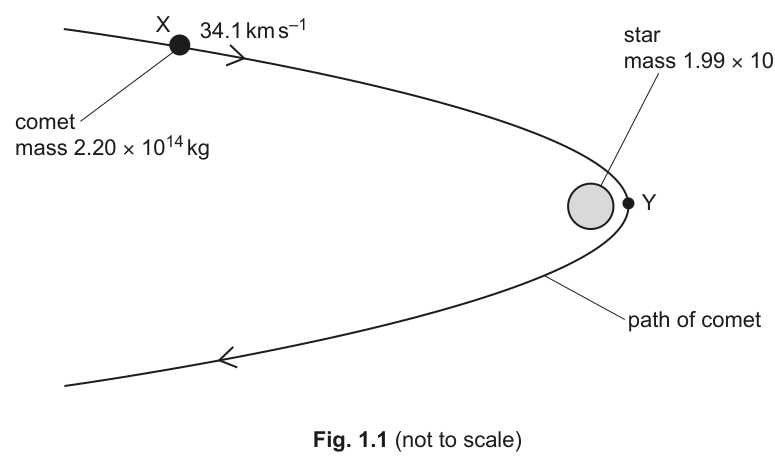
At point X, the comet is from the centre of the star and is moving at a speed of .
At point Y, the comet passes its point of closest approach to the star. At this point, the comet is a distance of from the centre of the star.
Both the comet and the star can be considered as point masses at their centres.
Calculate the magnitude of the change in the gravitational potential energy of the comet as it moves from position X to position Y.
= ______
State, with a reason, whether the change in gravitational potential energy in (b)(i) is an increase or a decrease.
Use your answer in (b)(i) to determine the speed, in , of the comet at point Y.
speed = ______
A second comet passes point X with the same speed as the comet in (b) and travelling in the same direction. This comet is gradually losing mass. The mass of this comet when it passes point X is the same as the mass of the comet in (b).
Suggest, with a reason, how the path of the second comet compares with the path shown in Fig. 1.1.
The rest of this paper
9 more questions- Q2Electric Fields · Motion in a Circle · Nuclear Physics · Medical Physics13M
- Q3Temperature · Ideal Gases · Thermodynamics12M
- Q4Oscillations8M
- Q5Capacitance11M
- Q6Magnetic Fields10M
- Q7Magnetic Fields10M
- Q8Quantum Physics8M
- Q9Astronomy and Cosmology7M
- Q10Nuclear Physics11M