Physics 9702/41 — May/June 2022
Cambridge A-Level · A Level Structured Questions · worked solutions for every part, with the mark scheme
Topics Magnetic Fields · Ideal Gases · Gravitational Fields · Motion in a Circle · Electric Fields · Thermodynamics · +6 more
State Newton’s law of gravitation.
Answer
Any two point masses attract each other with a force proportional to the product of their masses and inversely proportional to the square of their separation:
The force acts along the line joining the centres of the masses (attractive).
Any two point masses attract with force along the line joining their centres.
Background Concept
Newton’s law of gravitation describes the gravitational force between two isolated point masses (or spherically symmetric masses treated as if their mass is concentrated at their centres). It states that the magnitude of the force depends on:
- the product of the masses, and
- the inverse square of the distance between their centres.
The constant of proportionality is the gravitational constant .
Understanding the Question
You are asked to state Newton’s law of gravitation. For full credit, you must give both:
- the inverse-square relationship (or the equation), and
- the direction/nature of the force (along the line joining the masses, attractive).
Approach
Write the standard formula for the force between two point masses and add the key words about proportionality and direction.
Step-by-Step Reasoning
- Two point masses and separated by distance exert gravitational forces on each other.
- The force magnitude is:
- The forces are equal and opposite (Newton’s third law) and act along the line joining the centres; the interaction is always attractive.
Key Takeaways
- Gravity between point masses follows an inverse-square law.
- The force is along the line joining the centres and is attractive.
Common Mistakes
- Writing instead of .
- Omitting that the force acts along the line joining the masses.
- Forgetting that the force is attractive.
Things to Be Careful About
- Use as the centre-to-centre separation.
- State (or imply via the formula) that is a constant of proportionality.
Use Newton’s law of gravitation to show that the gravitational field strength at a distance away from a point mass is given by
Working
For a test mass at distance from point mass :
Gravitational field strength is force per unit mass:
Answer
Background Concept
The gravitational field strength at a point is defined as the force per unit mass experienced by a small test mass placed at that point:
For a point mass (or spherically symmetric mass) , Newton’s law of gravitation gives the force on a test mass a distance away:
Understanding the Question
You are asked to use Newton’s law to show the standard expression for field strength around a point mass:
So you must start with and use the definition .
Approach
- Write Newton’s gravitational force on a test mass due to .
- Divide by (because field strength is force per unit mass).
- Simplify to obtain the required expression.
Step-by-Step Reasoning
- Place a test mass at distance from mass . The gravitational attraction is:
- By definition,
- Substitute :
- Cancel :
This matches what you were asked to show.
Key Takeaways
- Field strength is derived directly from Newton’s force law by dividing by the test mass.
- The dependence is inherited from the inverse-square force.
Common Mistakes
- Writing (forgetting to divide by ).
- Using Earth’s surface formula without recognising is just a special case of .
Things to Be Careful About
- The test mass must be small enough not to affect the field significantly (so is treated as the source mass).
- is measured from the centre of the point mass (or centre of a sphere).
The Earth has a mass of and a radius of .
The Moon has a mass of and a radius of .
The Earth and the Moon can both be considered as point masses at their centres. Their centres are a distance of apart.
Show that the gravitational field strength at the surface of the Moon due to the mass of the Moon is .
Working
At the Moon’s surface, with and :
Answer
Background Concept
For a spherical body, the gravitational field outside (and at the surface) is the same as if all the mass were concentrated at its centre. The gravitational field strength at distance from the centre is:
At the surface, equals the radius of the body.
Understanding the Question
You are given the Moon’s:
- mass ,
- radius ,
and you must show that its surface gravitational field strength due to the Moon alone is .
Approach
Use
with taken as the Moon’s radius, substitute the numbers (including ), and evaluate.
Step-by-Step Reasoning
- Start with the field strength formula:
- Substitute the Moon’s values:
- Handle the powers of ten and the squared radius carefully:
- Numerator: and , so numerator .
- Denominator: and , so denominator .
- Divide:
So
Key Takeaways
- At a planet/moon surface, use in .
- Squaring the radius is where most numerical mistakes occur.
Common Mistakes
- Forgetting to square .
- Using but squaring only the and not the .
- Omitting the unit .
Things to Be Careful About
- Keep enough significant figures in intermediate steps to get .
- Remember is equivalent to , but quote what the question uses.
Explain why there is a point X on the line between the centres of the Earth and the Moon where the resultant gravitational field strength due to the Earth and the Moon is zero.
Answer
Along the line between Earth and Moon, the gravitational fields due to Earth and Moon act in opposite directions (each towards its own centre). The field strengths vary with distance as , so moving from Moon towards Earth the Moon’s field decreases while Earth’s increases. Therefore there is a position where the magnitudes are equal and opposite, giving resultant field strength zero.
Between Earth and Moon the fields are opposite; since each varies as , there is a point where their magnitudes are equal so the resultant is zero.
Background Concept
Gravitational field strength is a vector: it has magnitude and direction (direction is towards the attracting mass). When more than one mass produces a field, the resultant field is found by vector addition (principle of superposition).
On the straight line joining two masses, the two gravitational field vectors point in opposite directions between the masses, because each points towards its own centre.
Understanding the Question
You must explain (not calculate yet) why there must be a point on the line between Earth’s and Moon’s centres where the resultant gravitational field strength is zero. That means the field due to Earth at has the same magnitude as the field due to the Moon at , but opposite direction.
Approach
- Use the idea that fields add vectorially.
- Note that between the bodies the directions oppose.
- Use to argue that as you move along the line, one contribution increases while the other decreases, so equality must occur somewhere.
Step-by-Step Reasoning
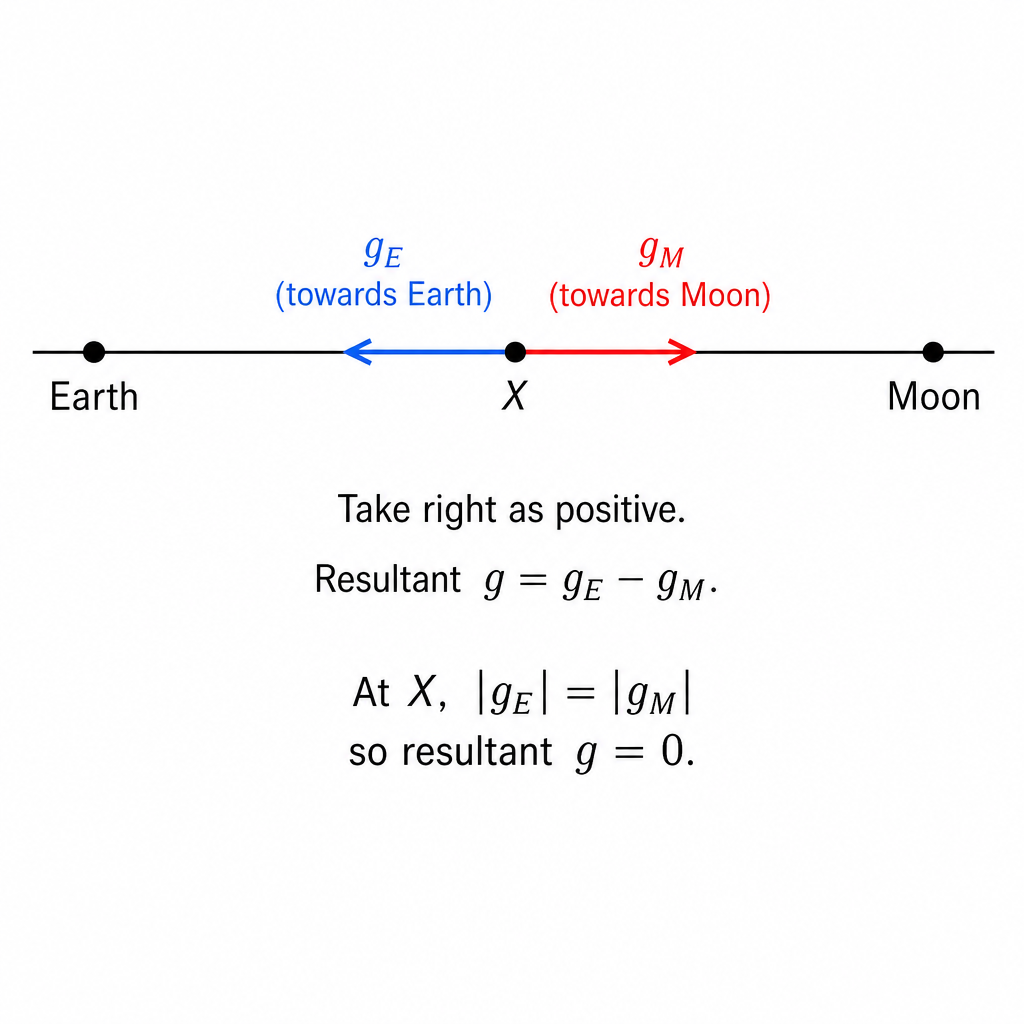
- Consider any point on the line between the centres.
- The Earth’s gravitational field at that point points towards the Earth.
- The Moon’s gravitational field at that point points towards the Moon.
- Therefore the two field vectors are opposite in direction.
- The magnitudes depend on distance via :
- closer to the Moon, the Moon’s field is large and the Earth’s is smaller (because you are far from Earth),
- closer to the Earth, the Earth’s field is large and the Moon’s is very small.
- Since one decreases while the other increases as you move from Moon to Earth, there must be an intermediate position where they are equal in magnitude; at that point the equal and opposite vectors cancel, giving resultant field strength .
Key Takeaways
- Gravitational fields superpose as vectors.
- Between two masses, the fields oppose in direction.
- Inverse-square dependence guarantees a crossover point where magnitudes match.
Common Mistakes
- Saying the fields “add to zero” without stating they are in opposite directions.
- Thinking the zero-field point must be halfway (it is not, unless masses are equal).
- Confusing field strength with force: the reasoning is for the field at a point, not for motion of the bodies.
Things to Be Careful About
- The point of zero resultant must lie between the masses; outside the interval, both fields point the same way (towards both masses), so they cannot cancel.
- Use the words “equal magnitude” and “opposite directions” for full credit.
Calculate the distance of point X from the centre of the Moon.
= ______
Working
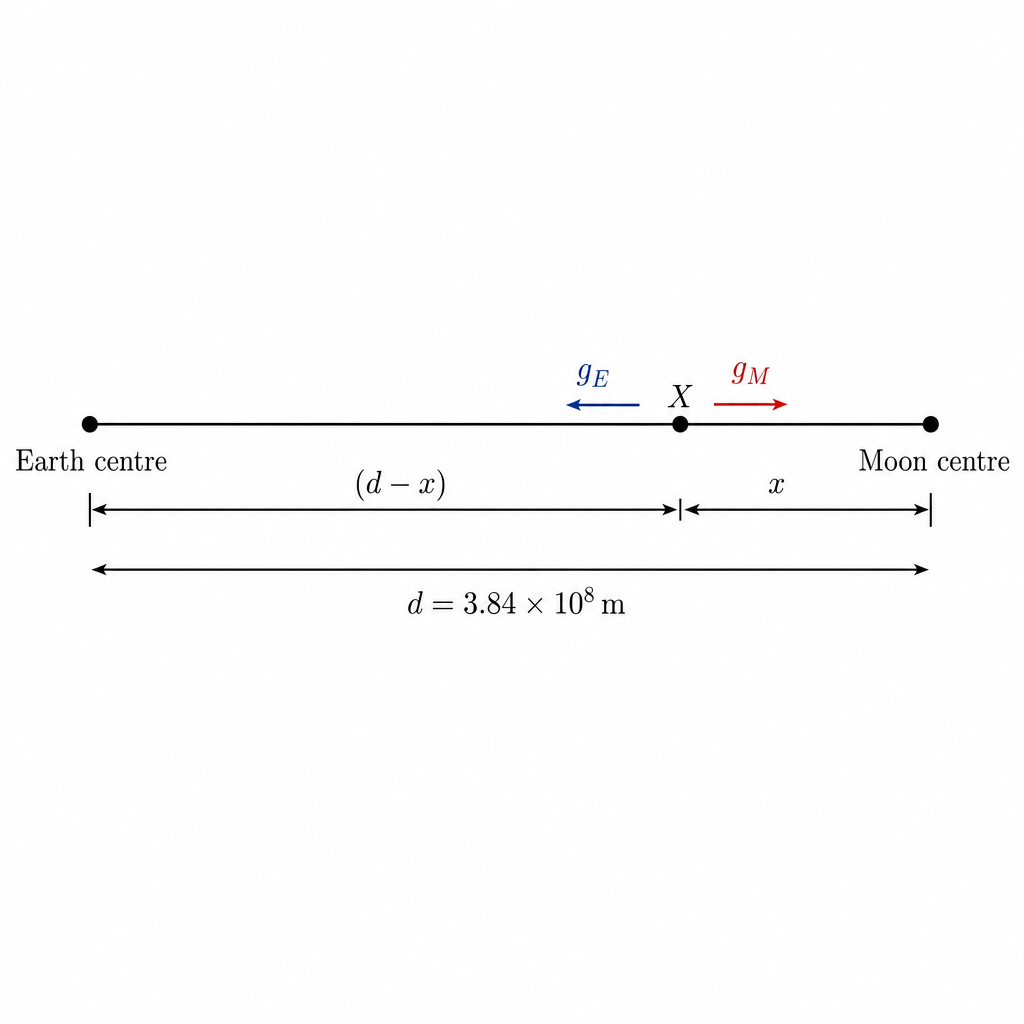
Let be the distance of from the Moon’s centre. Earth–Moon separation , so distance of from Earth’s centre is .
At , resultant field is zero so magnitudes are equal:
Cancel :
So :
Answer
Background Concept
At a point on the line between two masses, the gravitational field due to each mass has magnitude
and direction towards that mass. The resultant field is the vector sum. For the resultant to be zero, the two contributions must have:
- equal magnitudes, and
- opposite directions.
Between Earth and Moon the directions are opposite, so the zero point occurs where the magnitudes are equal.
Understanding the Question
Given:
- Earth mass
- Moon mass
- centre separation
We must find the distance from the Moon’s centre to point where the resultant gravitational field strength is zero.
Approach
- Let be the distance from the Moon to ; then the distance from the Earth to is .
- Set the magnitudes of the two fields equal:
- Cancel and solve for .
Step-by-Step Reasoning
-
Define distances:
- Moon to :
- Earth to : where
-
Write equality of field magnitudes at :
- Cancel (same constant on both sides):
- Rearrange to collect terms. A clean way is to take square roots:
- Compute the mass ratio inside the square root:
So
- Substitute back:
- Solve for :
This is closer to the Moon, as expected because the Moon is much less massive than Earth (so you need to be closer to the Moon for its field to match Earth’s field).
Key Takeaways
- Zero resultant field between two masses occurs where .
- The point lies closer to the smaller mass.
- Using square roots simplifies the algebra for inverse-square equalities.
Common Mistakes
- Using instead of for the Earth-to- distance.
- Forgetting to cancel (not wrong, just extra work).
- Assuming .
- Mixing up which mass goes with which distance (Moon mass must go with distance from Moon).
Things to Be Careful About
- is measured from the Moon’s centre, not from the Moon’s surface.
- Keep in metres and use consistent units throughout.
- When taking square roots, use the positive root because distances are positive.
The rest of this paper
9 more questions- Q2Magnetic Fields · Motion in a Circle · Electric Fields8M
- Q3Ideal Gases · Thermodynamics11M
- Q4Oscillations8M
- Q5Alternating Currents12M
- Q6Magnetic Fields11M
- Q7Quantum Physics10M
- Q8Nuclear Physics · Ideal Gases12M
- Q9Medical Physics9M
- Q10Astronomy and Cosmology9M