Physics 9702/42 — October/November 2021
Cambridge A-Level · A Level Structured Questions · worked solutions for every part, with the mark scheme
Topics Gravitational Fields · Motion in a Circle · Ideal Gases · Oscillations · Communication · Electric Fields · +7 more
State what is meant by centripetal acceleration.
Answer
Centripetal acceleration is the acceleration of an object moving in a circle that is directed towards the centre of the circular path (responsible for changing the direction of the velocity).
Acceleration directed towards the centre of the circular path.
Background Concept
For motion in a circle, the velocity is continually changing direction even if the speed is constant. Any change in velocity implies an acceleration.
The acceleration required to keep an object on a circular path is called centripetal acceleration. It always points towards the centre of the circle. Its magnitude is
where is speed, is radius and is angular speed.
Understanding the Question
You are asked to state what centripetal acceleration means (a definition), not to calculate it.
Approach
Give the key defining feature: direction towards the centre of the circle (and optionally that it causes the direction of the velocity to change).
Step-by-Step Reasoning
- In circular motion, the instantaneous direction of motion is tangential.
- To bend the path into a circle, the acceleration must be perpendicular to the velocity and point radially inward.
- That inward (centre-seeking) acceleration is called centripetal acceleration.
Key Takeaways
- Centripetal acceleration is always towards the centre.
- It is associated with changing direction of velocity, not necessarily changing speed.
Common Mistakes
- Saying the acceleration is “along the direction of motion” (that would be tangential acceleration).
- Giving only the formula without stating the direction.
Things to Be Careful About
- The word “centripetal” refers to direction, not a new type of force; it is the net inward force that produces this acceleration.
An unpowered toy car moves freely along a smooth track that is initially horizontal. The track contains a vertical circular loop around which the car travels, as shown in Fig. 1.1.
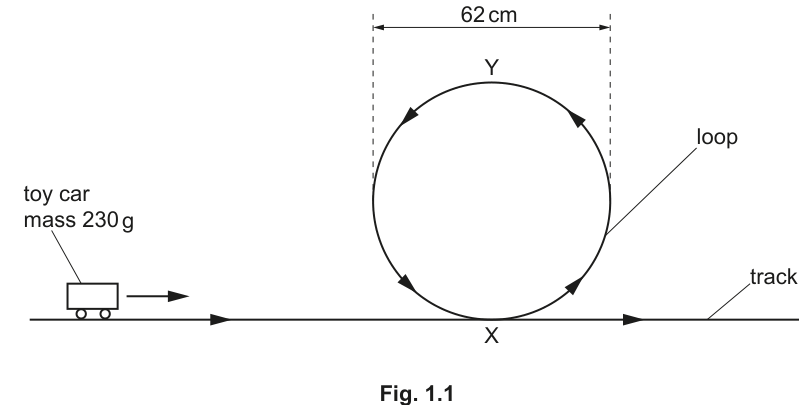
The mass of the car is and the diameter of the loop is . Assume that the resistive forces acting on the car are negligible.
State what happens to the magnitude of the centripetal acceleration of the car as it moves around the loop from X to Y.
Answer
From X (bottom) to Y (top) the car’s speed decreases, so decreases in magnitude.
It decreases.
Background Concept
The magnitude of centripetal acceleration for circular motion is
For a fixed loop, is constant, so depends only on .
Understanding the Question
The car moves freely around a vertical loop from the bottom point X to the top point Y, with negligible resistive forces. You must state how the magnitude of the centripetal acceleration changes from X to Y.
Approach
Decide how the speed changes as the car rises. Then use (since is constant) to infer how changes.
Step-by-Step Reasoning
- From X to Y the car gains gravitational potential energy .
- With negligible resistive forces, this gain comes from the car’s kinetic energy, so the speed decreases as it rises.
- Since is constant for the loop, decreases as decreases.
Key Takeaways
- For a given circle, changes in centripetal acceleration come from changes in speed.
- In a vertical loop, speed is generally greatest at the bottom and smallest at the top.
Common Mistakes
- Saying centripetal acceleration is constant because the radius is constant.
- Confusing centripetal acceleration (radial) with tangential acceleration (along the track).
Things to Be Careful About
- The question asks about magnitude (size), not direction. The direction is always towards the centre but rotates as the car goes round.
Explain, if the car remains in contact with the track, why the centripetal acceleration of the car at point Y must be greater than .
Answer
At Y (top), the required centripetal force is towards the centre (downwards):
If the car remains in contact then , so
Hence the centripetal acceleration at Y must be greater than .
Because at the top (mv^2/r = mg + N) and for contact (N>0), so (v^2/r > g = 9.8,\text{m s}^{-2}).
Background Concept
In circular motion, the resultant force towards the centre provides the centripetal acceleration:
For an object constrained to a track, the track exerts a normal reaction force on the object, perpendicular to the surface. If the object is in contact, (it cannot be negative because the track cannot "pull" the object).
Understanding the Question
At point Y (the top of the vertical loop), you must explain why, if the car stays in contact, its centripetal acceleration there must exceed . This is a force-balance argument at the top of the loop.
Approach
- Consider forces on the car at the top of the loop.
- Resolve (take) forces towards the centre.
- Use the condition for contact: .
Step-by-Step Reasoning
At the top of the loop, the centre is below the car, so “towards the centre” is downwards.
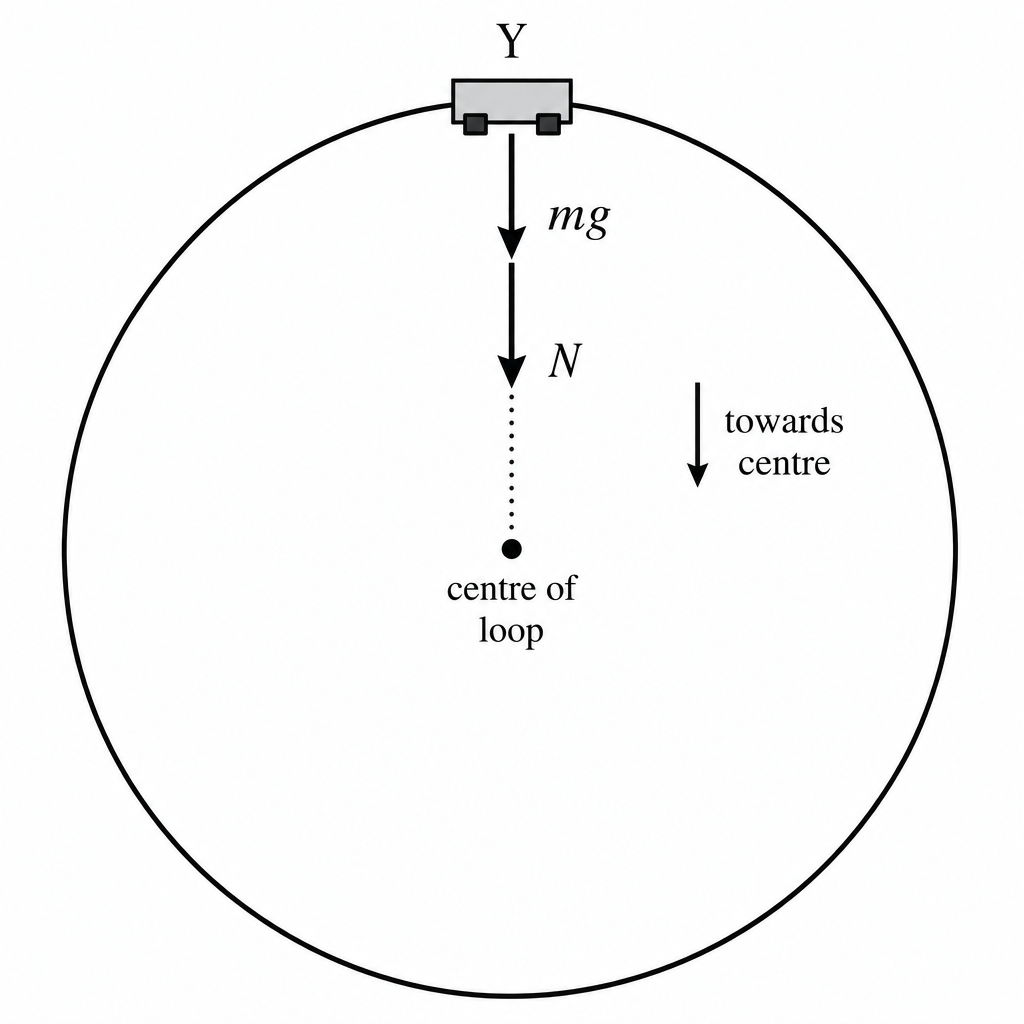
Forces on the car at Y:
- Weight acts downward (towards the centre).
- Normal reaction from the track also acts downward if the car is on the inside of the loop (it pushes the car towards the centre).
So the resultant inward force is , and Newton’s second law towards the centre gives
If the car remains in contact with the track, then , hence
Therefore
Divide by :
But , so at Y
Key Takeaways
- At the top of a loop, both and (if in contact) act towards the centre.
- Contact requires ; the limiting case is (just about to lose contact).
- The condition for contact at the top is (strictly if you insist on ).
Common Mistakes
- Using with the wrong sign.
- Saying always at the top; actually depends on speed, and is only the limiting case .
- Forgetting that the centripetal acceleration is towards the centre (downwards at the top).
Things to Be Careful About
- Be clear about the direction you choose as “towards the centre” at the top.
- The mark is usually earned by writing and using (or ) to conclude (or ).
The initial speed at which the car in (b) moves along the track is .
Determine whether the car is in contact with the track at point Y. Show your working.
Working
Radius of loop:
Energy from bottom X to top Y (height gain ):
Centripetal acceleration at Y:
For contact at Y, need . Since , the car is not in contact at Y.
Answer
Not in contact at Y.
Not in contact at Y.
Background Concept
Two physics ideas combine here:
- Energy conservation (negligible resistive forces):
From bottom to top of a loop, the height increases by .
- Condition to maintain contact at the top (point Y): the required inward (downward) centripetal acceleration is
At the top, the limiting case for contact is when the normal reaction , giving
So contact requires .
Understanding the Question
Given:
- initial speed on the track (at the bottom entry to the loop) ,
- loop diameter so radius ,
- resistive forces negligible.
You must decide whether, at the top point Y, the car is still pressed against the track (contact) or has lost contact.
Approach
- Use conservation of energy from X (bottom) to Y (top) to find the speed .
- Calculate at the top.
- Compare with : if then would have to be negative to supply enough inward force, which is impossible, so the car cannot be in contact.
Step-by-Step Reasoning
1) Find the radius
2) Use energy conservation from X to Y
Height gain from bottom to top is , so GPE increase is .
Mass cancels, giving
Substitute:
So
3) Calculate centripetal acceleration at Y
4) Check contact condition
For contact at the top, need .
So the car does not have enough speed to provide the required centripetal acceleration using weight plus a non-negative normal reaction. Therefore it loses contact before or at Y.
Key Takeaways
- In a vertical loop, speed at the top can be found using energy conservation if friction is negligible.
- At the top, maintaining contact requires .
- The limiting case corresponds to .
Common Mistakes
- Using height change as instead of (bottom to top).
- Forgetting to convert diameter to radius.
- Checking contact with instead of .
- Treating as constant around the loop.
Things to Be Careful About
- Keep the bottom point and top point clear: the car rises by a full diameter.
- The mass cancels in the energy equation and in the contact condition; do not let the given mass distract you.
- Use consistent units (metres, seconds) throughout.
Suggest, with a reason but without calculation, whether your conclusion in (c) would be different for a car of mass moving with the same initial speed.
Answer
No. The speed at Y from energy and the contact condition are independent of mass (the factor cancels), so doubling the mass does not change whether the car stays in contact.
No; the conclusion is unchanged because mass cancels in the energy and contact equations.
Background Concept
For this loop problem, two key relationships are used:
- Energy conservation from bottom to top:
- Contact condition at the top:
Both equations contain a factor of on every term, so mass often cancels.
Understanding the Question
You are asked (without calculation) whether changing the car mass from to , while keeping the same initial speed, would change the conclusion about contact at the top.
Approach
Decide whether the relevant conditions depend on :
- Does found from energy depend on ?
- Does the top contact condition depend on ?
If neither depends on , then the conclusion will not change.
Step-by-Step Reasoning
1) Speed at the top from energy
Every term has , so dividing through by gives
Thus depends on , , and , but not on .
2) Contact condition at the top
Again, the centripetal requirement involves on both sides. The limiting condition gives
So the requirement to remain in contact depends on , , and only, not on .
Therefore doubling the mass does not change whether the car maintains contact at Y.
Key Takeaways
- In many loop-the-loop problems with negligible resistive forces, the motion (speeds) is independent of mass.
- The contact condition at the top is also independent of mass.
Common Mistakes
- Assuming a heavier car “has more force” so it stays on: weight increases, but the required centripetal force increases in the same proportion.
- Thinking the given mass must be used because it is provided.
Things to Be Careful About
- This independence holds under the stated assumption of negligible resistive forces. If friction or air resistance were significant and depended on mass differently, then mass could matter.
The rest of this paper
11 more questions- Q2Gravitational Fields10M
- Q3Ideal Gases11M
- Q4Oscillations7M
- Q5Communication8M
- Q6Electric Fields · Capacitance7M
- Q7Electronics10M
- Q8Magnetic Fields5M
- Q9Quantum Physics9M
- Q10Alternating Currents10M
- Q11Medical Physics7M
- Q12Nuclear Physics8M