Physics 9702/41 — October/November 2021
Cambridge A-Level · A Level Structured Questions · worked solutions for every part, with the mark scheme
Topics Ideal Gases · Magnetic Fields · Motion in a Circle · Gravitational Fields · Temperature · Thermodynamics · +8 more
Answer all the questions in the spaces provided.
With reference to velocity and acceleration, describe uniform circular motion.
Two cars are moving around a horizontal circular track. One car follows path X and the other follows path Y, as shown in Fig. 1.1.
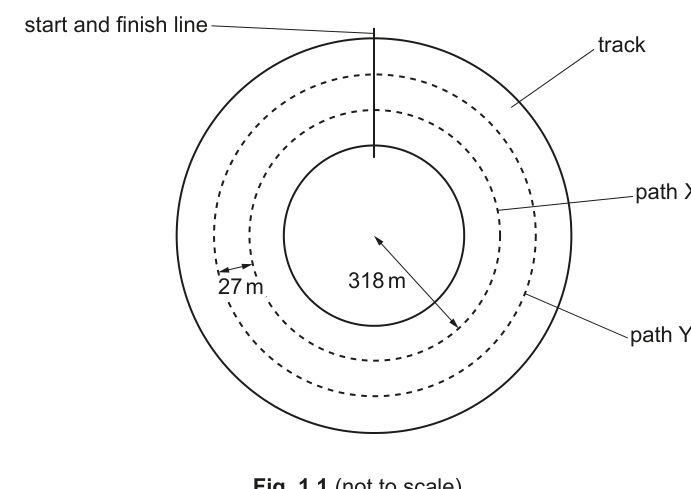
The radius of path X is . Path Y is parallel to, and outside, path X. Both cars have mass . The maximum lateral (sideways) friction force that the cars can experience without sliding is the same for both cars.
The maximum speed at which the car on path X can move around the track without sliding is .
Calculate .
= ______
Both cars move around the track. Each car has the maximum speed at which it can move without sliding.
Complete Table 1.1, by placing one tick in each row, to indicate how the quantities indicated for the car on path Y compare with the car on path X.
Table 1.1
| Y less than X | Y same as X | Y greater than X | |
|---|---|---|---|
| centripetal acceleration | |||
| maximum speed | |||
| time taken for one lap of the track |
The rest of this paper
11 more questions- Q2Gravitational Fields9M
- Q3Temperature · Ideal Gases · Thermodynamics13M
- Q4Oscillations11M
- Q5Communication8M
- Q6Capacitance5M
- Q7Electronics9M
- Q8Magnetic Fields6M
- Q9Alternating Currents · Magnetic Fields9M
- Q10Quantum Physics9M
- Q11Medical Physics7M
- Q12Nuclear Physics · Ideal Gases7M