Physics 9702/42 — May/June 2020
Cambridge A-Level · A Level Structured Questions · worked solutions for every part, with the mark scheme
Topics Electric Fields · Magnetic Fields · Gravitational Fields · Ideal Gases · Thermodynamics · Oscillations · +7 more
Answer all the questions in the spaces provided.
Define gravitational potential at a point.
Answer
Gravitational potential at a point is the work done per unit mass by an external agent in bringing a small test mass from infinity to that point (with no change in kinetic energy).
Work done per unit mass to bring a test mass from infinity to the point (no change in KE).
Background Concept
Gravitational potential (or ) is a scalar field quantity defined at a point. It is closely related to gravitational potential energy (GPE) :
A key idea is that we define the potential relative to a reference point, usually infinity. For isolated masses, we take at infinity.
Understanding the Question
You are asked to define gravitational potential at a point. For full credit you must include:
- it is work done per unit mass
- the mass is brought from infinity
- it is brought slowly / with no change in kinetic energy (so the work done is not “wasted” as kinetic energy)
Approach
Write the standard Cambridge definition using “work done per unit mass” and “from infinity”, and add the condition about no change in kinetic energy.
Step-by-Step Reasoning
- Gravitational potential energy change is the work done by (or against) gravity when moving a mass in a gravitational field.
- Dividing by the mass gives a definition that depends only on the field, not on the particular mass used.
- Choosing infinity as the reference gives a universal zero for isolated masses.
So the definition is: work done per unit mass by an external agent in bringing a test mass from infinity to the point, with no change in kinetic energy.
Key Takeaways
- Gravitational potential is energy per unit mass.
- For isolated masses, the reference is infinity where .
Common Mistakes
- Defining field strength (, force per unit mass) instead of potential.
- Missing “per unit mass”.
- Not stating the reference point “from infinity”.
- Not stating “no change in kinetic energy” / “moved slowly”.
Things to Be Careful About
- Potential is a scalar (no direction).
- In gravitational fields around a mass, potential values are typically negative (because at infinity).
An isolated solid sphere of radius may be assumed to have its mass concentrated at its centre. The magnitude of the gravitational potential at the surface of the sphere is .
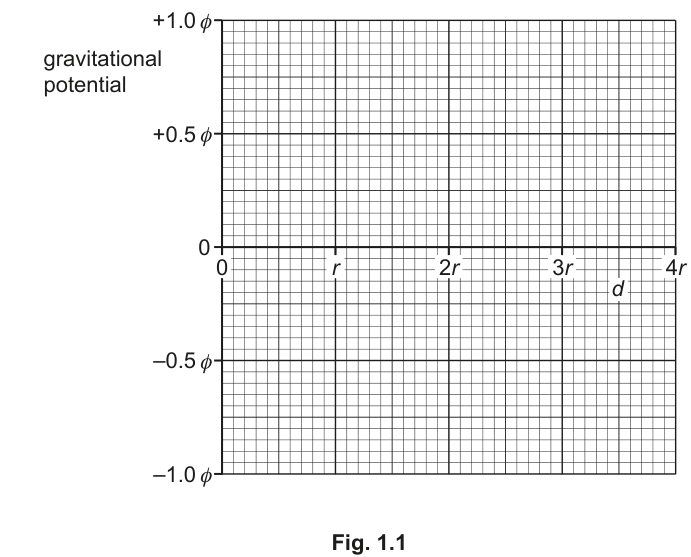
On Fig. 1.1, show the variation of the gravitational potential with distance from the centre of the sphere for values of from to .
Working
For ,
Given magnitude at surface is , so .
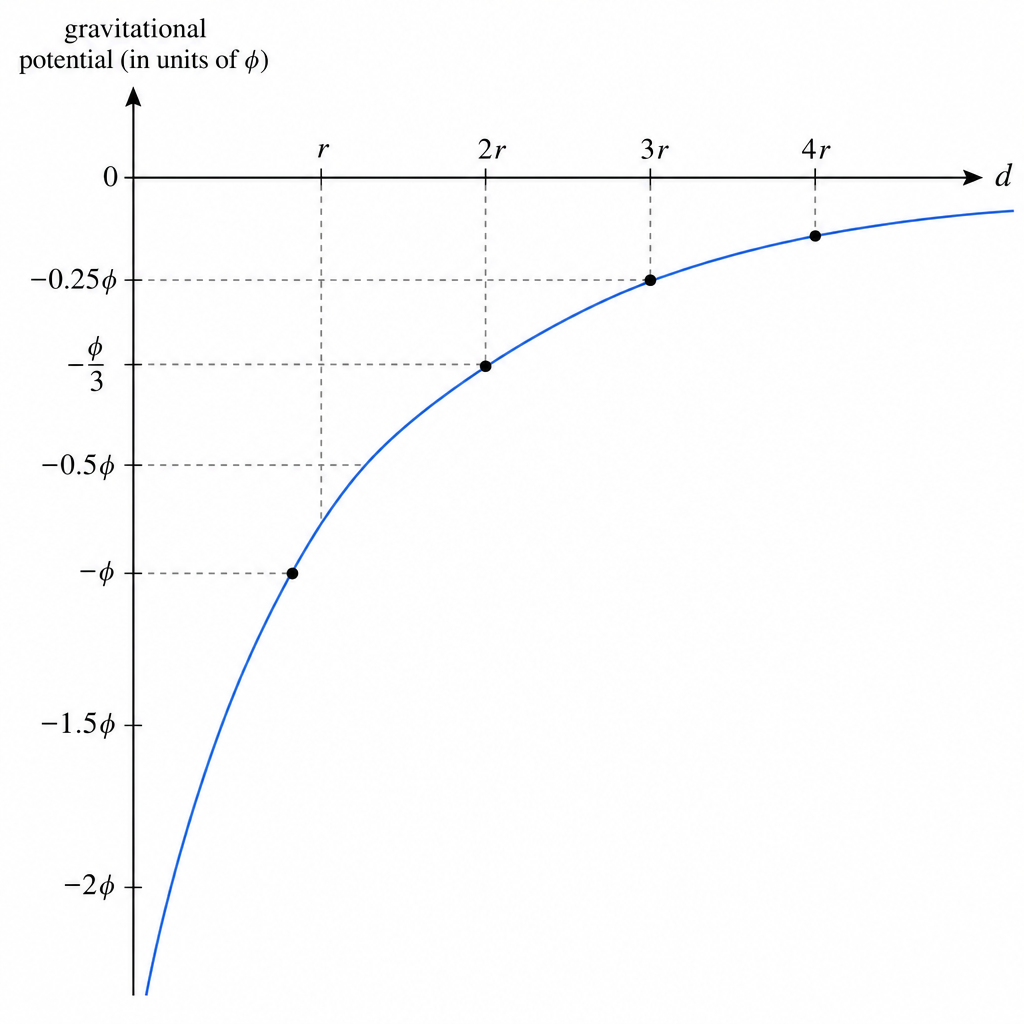
Hence points: , , , , with a smooth curve approaching from below.
Answer
Curve from to (negative, increasing towards ).
Graph of V = -φ r/d: at r is -φ, at 2r is -0.5φ, at 3r is -φ/3, at 4r is -0.25φ, smooth curve tending to 0.
Background Concept
Outside a spherically symmetric mass, the gravitational field is the same as if all the mass were concentrated at the centre. The gravitational potential (taking at infinity) is
This is an inverse relationship: as increases, becomes less negative and tends to .
Understanding the Question
You are told that at the surface () the magnitude of the potential is . Since gravitational potential is negative (with zero at infinity), this means
You must sketch against from to .
Approach
- Start from .
- Use the given surface value to rewrite the expression in terms of .
- Calculate the values at .
- Plot these points and draw a smooth curve approaching .
Step-by-Step Reasoning
From the formula,
At :
So .
Substitute back:
Now evaluate key points:
- :
- :
- :
- :
Plot these and join with a smooth curve that is always negative and flattens as increases (approaching asymptotically).
Key Takeaways
- For , gravitational potential varies as .
- The potential becomes less negative with distance and tends to at infinity.
Common Mistakes
- Drawing a straight line instead of a curved shape.
- Plotting positive values (forgetting potential is negative).
- Making the curve cross between and (it should not).
- Using (confusing potential with field strength ).
Things to Be Careful About
- The question says magnitude is ; you must use .
- Ensure correct fractional values at and a smooth curve through them.
The sphere in (b) is a planet with radius of and mass of . The planet has no atmosphere.
A rock of mass moves directly towards the planet. Its distance from the centre of the planet changes from to .
Calculate the change in gravitational potential energy of the rock.
change = ______
Working
With , , , :
Answer
-1.8 × 10^10 J
Background Concept
For a mass in the gravitational field of a spherical planet of mass , the gravitational potential energy (taking at infinity) is
where is the distance from the planet’s centre. The negative sign reflects that energy must be supplied to take the mass from near the planet out to infinity.
A change in GPE is always
Understanding the Question
A rock moves directly towards a planet, changing its distance from the centre from to . You are asked for the change in gravitational potential energy of the rock.
- initial distance
- final distance
Because it moves closer, you should expect to become more negative, so should be negative.
Approach
Use at and , then subtract:
- Write and .
- Compute .
- Substitute the numbers and keep the correct sign.
Step-by-Step Reasoning
Start with
So
Change in GPE:
Factor out :
Compute the bracket:
So
Substitute values:
This gives
To 2 s.f. (limited by given data),
Key Takeaways
- Use for gravitational potential energy relative to infinity.
- Always compute .
- Moving closer to the planet makes more negative, so .
Common Mistakes
- Getting the sign wrong (writing a positive change when moving closer).
- Using instead of or .
- Confusing (planet radius) with (distance from centre).
- Using and then incorrectly multiplying by distance without integrating.
Things to Be Careful About
- Distances must be measured from the centre of the planet.
- Keep powers of ten under control; using standard form helps.
- Quote an appropriate number of significant figures and include the unit .
Explain whether the rock’s speed increases, decreases or stays the same.
Answer
Speed increases.
As the rock moves closer, its gravitational potential energy decreases (becomes more negative). With no atmosphere, energy is conserved, so the lost GPE is converted to kinetic energy, increasing the speed.
Increases.
Background Concept
When only conservative forces act (such as gravity), the total mechanical energy is conserved:
Gravity does work on an incoming object, transferring energy from gravitational potential energy to kinetic energy .
If there is an atmosphere, drag would remove mechanical energy as thermal energy, but the question states there is no atmosphere.
Understanding the Question
The rock moves towards the planet (from to ). You must decide whether its speed increases, decreases, or stays the same, and explain why.
Key clues:
- Motion is directly towards the planet, so gravity acts along the motion.
- “No atmosphere” implies negligible resistive forces, so mechanical energy is conserved.
Approach
Use energy conservation:
- Moving closer makes gravitational potential energy more negative (decreases).
- With no losses, that decrease must appear as an increase in kinetic energy.
- Increasing kinetic energy implies increasing speed.
Step-by-Step Reasoning
- At a smaller distance ,
becomes more negative because is smaller.
- Therefore for motion inwards.
- With no atmosphere, there is no significant drag, so the decrease in becomes an increase in :
- Since
an increase in means increases.
Equivalently: the gravitational force is towards the planet, same direction as the motion, so the rock accelerates and its speed rises.
Key Takeaways
- In a vacuum, gravity converts GPE into KE.
- Moving towards a planet increases speed because the object accelerates towards the centre.
Common Mistakes
- Saying speed is constant because “gravity is constant” (it is not constant with distance, and anyway a non-zero force causes acceleration).
- Forgetting the significance of “no atmosphere” (drag would reduce speed gain).
- Confusing “potential increases” with “potential energy increases” (here, both and become more negative when closer).
Things to Be Careful About
- Use correct sign language: “GPE decreases / becomes more negative” when moving inward.
- Your explanation should mention either conservation of energy or the force/acceleration argument explicitly.
The rest of this paper
11 more questions- Q2Ideal Gases8M
- Q3Thermodynamics6M
- Q4Oscillations8M
- Q5Medical Physics7M
- Q6Communication7M
- Q7Electric Fields10M
- Q8Electronics11M
- Q9Magnetic Fields · Motion in a Circle · Electric Fields10M
- Q10Magnetic Fields · Alternating Currents7M
- Q11Quantum Physics8M
- Q12Nuclear Physics8M