Physics 9702/43 — May/June 2019
Cambridge A-Level · A Level Structured Questions · worked solutions for every part, with the mark scheme
Topics Magnetic Fields · Gravitational Fields · Motion in a Circle · Ideal Gases · Thermodynamics · Oscillations · +7 more
Two point masses are isolated in space and are separated by a distance .
State an expression relating the gravitational force between the two masses to the magnitudes and of the masses. State the name of any other symbol used.
Answer
where is the universal gravitational constant.
F = GMm/x^2; G is the universal gravitational constant.
Background Concept
Newton's law of gravitation gives the magnitude of the force between two point masses separated by a distance :
- is the magnitude of the gravitational force (always attractive).
- and are the masses.
- is the separation between their centres.
- is the universal gravitational constant.
Understanding the Question
You are told there are two isolated point masses, of magnitudes and , separated by a distance . You must state the relationship for the gravitational force between them and name any extra symbol used.
Approach
Use the inverse-square law for gravitation and replace with . Then identify .
Step-by-Step Reasoning
Start from Newton's law:
Substitute and :
The additional symbol is , called the universal gravitational constant.
Key Takeaways
- Gravitational force between point masses follows an inverse-square dependence on separation.
- Always name physical constants when asked.
Common Mistakes
- Writing (missing the square).
- Forgetting to mention what represents.
Things to Be Careful About
- is the distance between the centres of the masses.
- The question asks for an expression for the force magnitude, so no direction is needed here.
A spacecraft is to be put into a circular orbit about a spherical planet.
The planet may be considered to be isolated in space. The mass of the planet, assumed to be concentrated at its centre, is . The radius of the planet is .
The spacecraft is to orbit the planet at a height of above the surface of the planet. At this altitude, there is no atmosphere.
Show that the speed of the spacecraft in its orbit is .
Working
Orbital radius
For a circular orbit,
so
Answer
3.7 × 10^3 m s⁻1
Background Concept
For a spacecraft in a circular orbit, the inward (centripetal) force needed is provided by gravity.
- Gravitational force on mass at distance from planet centre:
- Centripetal force needed for speed in a circle of radius :
Setting gives the standard circular-orbit speed:
Understanding the Question
The planet has mass and radius . The spacecraft orbits at height above the surface, so the orbital radius from the centre is . You must show the orbital speed is .
Approach
- Calculate orbital radius .
- Use to derive .
- Substitute values (including ) and evaluate.
Step-by-Step Reasoning
- Radius from centre:
- Equate forces:
Cancel (spacecraft mass does not affect orbital speed) and rearrange:
- Substitute numbers:
Key Takeaways
- For circular orbit: gravity provides centripetal force.
- Orbital speed depends on and only: .
Common Mistakes
- Using instead of .
- Forgetting to cancel the spacecraft mass .
- Using in the final expression by algebra error.
Things to Be Careful About
- Always measure from the planet's centre.
- Check powers of ten when multiplying and .
- Final speed should be to 2 s.f. or consistent with the given value .
One possible path of the spacecraft as it approaches the planet is shown in Fig. 1.1.
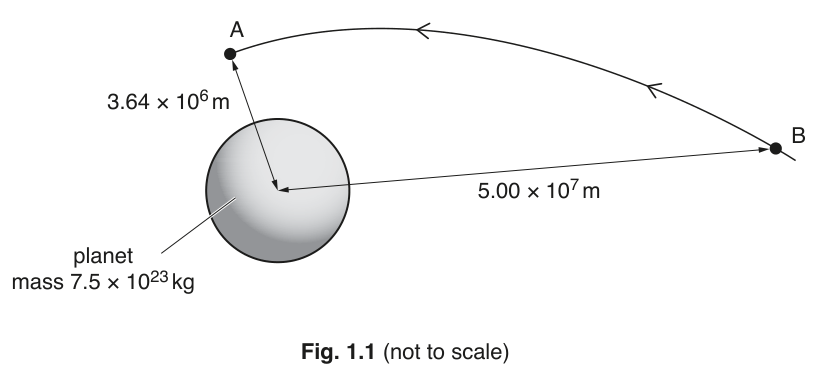
The spacecraft enters the orbit at point A with speed .
At point B, a distance of from the centre of the planet, the spacecraft has a speed of . The mass of the spacecraft is .
For the spacecraft moving from point B to point A, show that the change in gravitational potential energy of the spacecraft is .
Working
, .
Change in GPE from to :
Answer
Gravitational potential energy decreases by (i.e. ).
ΔGPE = −8.3 × 10^9 J (decrease of 8.3 × 10^9 J)
Background Concept
The gravitational potential energy (GPE) of a mass in the gravitational field of a spherical mass (with outside the sphere) is defined relative to zero at infinity:
where is the distance from the centre of the planet.
A change in GPE when moving from radius to is:
As you get closer to the planet ( decreases), becomes more negative, meaning GPE decreases.
Understanding the Question
Point is far from the planet centre: . Point is the circular orbit radius found earlier: . The spacecraft mass is . You must show that, moving from to , the change in GPE has magnitude .
Approach
- Use at the two positions.
- Compute .
- Expect a negative result (because the spacecraft moves closer), and report the magnitude consistent with the required value.
Step-by-Step Reasoning
Write the two GPE values:
So the change from to is
Substitute values (, , ):
Compute the bracket:
Then
The negative sign means GPE decreases; the magnitude of the change is .
Key Takeaways
- Use with measured from the centre.
- Moving closer to the planet makes more negative (a decrease in GPE).
Common Mistakes
- Using as height above the surface rather than distance from the centre.
- Dropping the minus sign and claiming GPE increases.
- Using without checking sign convention.
Things to Be Careful About
- The question wording may quote the magnitude; always state whether it is an increase or decrease.
- Keep enough significant figures during intermediate steps to obtain to 2 s.f.
By considering changes in gravitational potential energy and in kinetic energy of the spacecraft, determine whether the total energy of the spacecraft increases or decreases in moving from point B to point A. A numerical answer is not required.
Answer
From to , the spacecraft moves closer to the planet so its gravitational potential energy decreases (becomes more negative).
Also decreases from to , so kinetic energy decreases.
Therefore the total energy () decreases.
Decreases.
Background Concept
The total mechanical energy of the spacecraft in the planet's gravitational field is
where
- If speed decreases, kinetic energy decreases.
- If the spacecraft moves closer to the planet ( decreases), becomes more negative, so GPE decreases.
Understanding the Question
You are told the spacecraft moves from point (far away, , speed ) to point (orbit radius, speed ). You must decide whether the spacecraft's total energy increases or decreases, without calculating a numerical value.
Approach
- Determine the sign of the change in GPE from to (closer means GPE decreases).
- Compare speeds to decide the sign of the change in KE.
- Combine: if both and decrease, their sum decreases.
Step-by-Step Reasoning
- Gravitational potential energy:
Moving from to reduces , so
becomes more negative. Therefore is negative: GPE decreases.
- Kinetic energy:
Speed changes from to . Since
a smaller means smaller . Therefore kinetic energy decreases.
- Total energy:
Since both components decrease,
is negative, so the total energy decreases.
Key Takeaways
- Use signs: closer to a gravitating mass means GPE decreases.
- Comparing speeds is enough to decide the direction of KE change.
Common Mistakes
- Thinking GPE increases when the spacecraft falls inward (it actually decreases because it becomes more negative).
- Assuming KE must increase when moving closer; here the given speeds show the opposite.
Things to Be Careful About
- The question asks about the spacecraft's total energy, not just the magnitude of energy change.
- Always use the given speeds rather than assuming what “should” happen based on circular orbit ideas.
The rest of this paper
11 more questions- Q2Ideal Gases · Thermodynamics10M
- Q3Oscillations10M
- Q4Communication10M
- Q5Electric Fields8M
- Q6Capacitance7M
- Q7Electronics8M
- Q8Magnetic Fields10M
- Q9Magnetic Fields5M
- Q10Alternating Currents4M
- Q11Quantum Physics11M
- Q12Nuclear Physics9M