Physics 9702/42 — October/November 2018
Cambridge A-Level · A Level Structured Questions · worked solutions for every part, with the mark scheme
Topics Magnetic Fields · Gravitational Fields · Nuclear Physics · Temperature · Ideal Gases · Oscillations · +6 more
State what is meant by gravitational field strength.
Answer
Gravitational field strength at a point is the gravitational force per unit mass on a small test mass placed at that point:
Gravitational field strength is the gravitational force per unit mass at a point (g = F/m).
Background Concept
A gravitational field is a region where a mass experiences a gravitational force. The gravitational field strength at a point is defined by
where:
- is the gravitational force on a small test mass,
- is the test mass.
So tells you how many newtons of gravitational force act on each kilogram of mass at that point. Its units are , which is equivalent to .
Understanding the Question
You are asked to state what gravitational field strength means. For a 1-mark “state” question, the examiner expects the precise definition (force per unit mass) and/or the equation.
Approach
Recall the standard definition used throughout A-level gravitation: field strength equals force per unit mass on a small test mass.
Step-by-Step Reasoning
- Take a small test mass at the point in the field.
- It experiences a gravitational force .
- Define the field strength as the force per unit mass:
Key Takeaways
- is defined by force per unit mass.
- Units: (same as ).
Common Mistakes
- Defining as “force due to gravity” (missing “per unit mass”).
- Saying “acceleration due to gravity” as the definition without mentioning force per unit mass (that is an explanation/implication, not the definition).
Things to Be Careful About
- The test mass should be “small” so it does not significantly disturb the gravitational field you are measuring.
Explain why, at the surface of a planet, gravitational field strength is numerically equal to the acceleration of free fall.
Answer
At the surface, the gravitational force on mass is its weight .
By Newton’s second law, .
So (acceleration of free fall).
Because for a freely falling mass, F = mg and also F = ma, so mg = ma and hence g = a.
Background Concept
Two key ideas are being connected:
- Gravitational field strength definition:
- Newton’s second law for a net force on mass producing acceleration :
Near the surface of a planet, the gravitational force on an object is its weight:
Understanding the Question
The question asks why, at the planet’s surface, the value of (field strength) is numerically the same as the acceleration a freely falling object has (often called “acceleration of free fall”).
Approach
Use the fact that for free fall (ignoring air resistance) the only force is weight. Then apply Newton’s second law and compare with the expression .
Step-by-Step Reasoning
For an object of mass in free fall at the surface:
- The gravitational force on it is
- The same force causes an acceleration , so by Newton’s second law:
- Equate the two expressions for the same force:
- Cancel (non-zero):
So the gravitational field strength is numerically equal to the free-fall acceleration.
Key Takeaways
- is “force per unit mass”, but in free fall that force produces an acceleration.
- If gravity is the only force: and the free-fall acceleration are the same.
Common Mistakes
- Writing without any explanation.
- Forgetting to mention Newton’s second law (), which is the required link.
- Not specifying free fall / ignoring air resistance.
Things to Be Careful About
- If air resistance is significant, the resultant force is less than , so (e.g. at terminal velocity). The equality holds when gravity is the only significant force.
An isolated uniform spherical planet has radius .
The acceleration of free fall at the surface of the planet is .
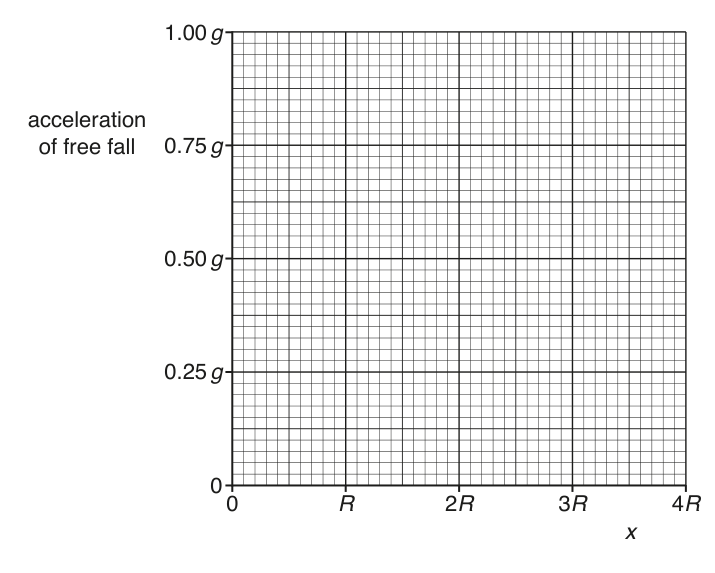
On Fig. 1.1, sketch a graph to show the variation of the acceleration of free fall with distance from the centre of the planet for values of in the range to .
Answer
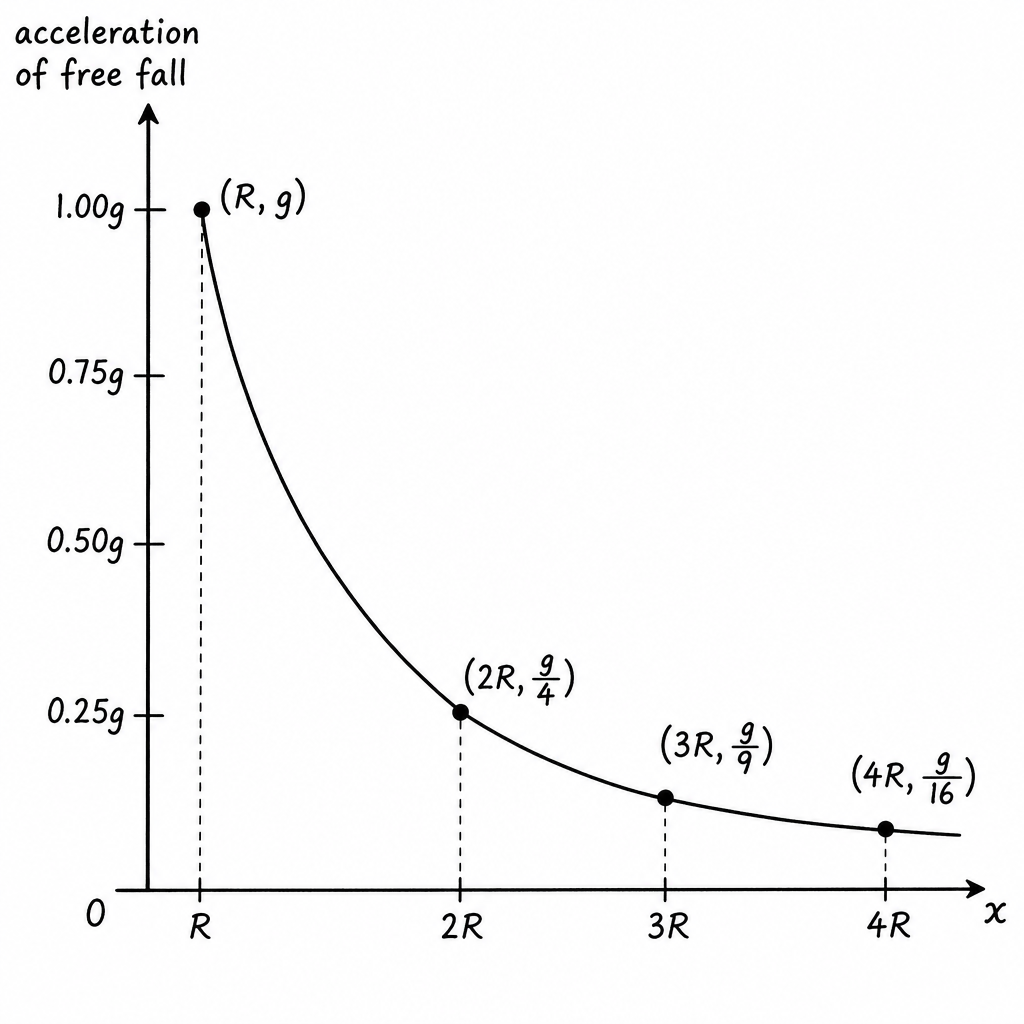
For ,
So the curve passes through and then falls as an inverse-square curve, e.g.
An inverse-square decrease from g at x = R: points (2R, g/4), (3R, g/9), (4R, g/16) joined by a smooth curve.
Background Concept
For a spherically symmetric planet, the gravitational field outside the planet behaves as if all its mass were concentrated at the centre. Hence for distance from the centre (with ), the gravitational field strength is
This is an inverse-square relationship: doubling makes four times smaller.
Understanding the Question
You are given that the acceleration of free fall (i.e. ) at the surface () equals . You must sketch how changes from out to .
Important clues:
- The planet is uniform spherical and isolated.
- The range begins at , so we are only considering points at and outside the surface.
Approach
- Use the inverse-square law for .
- Compute a few anchor points at in terms of .
- Sketch a smooth curve decreasing and flattening (since inverse-square gets less steep as increases).
Step-by-Step Reasoning
At the surface:
At :
At :
At :
Plot these points and draw a smooth inverse-square curve through them, decreasing and approaching zero as increases.
Key Takeaways
- Outside a spherical planet, follows .
- Use a few exact fractional points (, , ) to get the sketch correct.
Common Mistakes
- Drawing a straight line decrease (should be a curve).
- Making drop to zero by (it is small but not zero).
- Using instead of .
Things to Be Careful About
- The question starts at , not . (Inside the planet the relationship would be different, but that is not needed here.)
- Ensure the curve passes exactly through and is consistent with the scale (e.g. is at on the axis).
The planet in (b) has radius equal to and mean density .
Calculate the acceleration of free fall at a height above its surface.
acceleration of free fall = ______
Working
Radius:
Mass of planet:
At height above surface, distance from centre , so
Substitute:
Answer
0.95 m s^-2
Background Concept
For a spherical planet, the gravitational field strength at distance from its centre is
If the planet has mean density and radius , its mass is
Combining these allows to be found from and .
Understanding the Question
You are told:
- (so you must convert to metres),
- ,
- find the acceleration of free fall at a height above the surface.
A height above the surface means the distance from the centre is
Approach
- Convert to SI units.
- Find the planet’s mass using .
- Use with .
- Substitute values and give the answer in .
Step-by-Step Reasoning
- Convert radius to metres:
- Mass of the planet:
- Distance from centre at height :
- Field strength there:
- Substitute numbers:
(You can also note that outside the planet , so at the value is one quarter of the surface value.)
Key Takeaways
- Use to get mass from density.
- Use with measured from the centre.
- At , the field strength is a factor of of its value at .
Common Mistakes
- Using instead of (forgetting height is above the surface).
- Not converting to , leading to errors by a factor of .
- Forgetting the or in the sphere volume.
Things to Be Careful About
- Keep everything in SI units: in , in , in SI.
- Use a sensible number of significant figures (here typically 2 s.f. from given data).
The rest of this paper
11 more questions- Q2Ideal Gases · Nuclear Physics10M
- Q3Temperature7M
- Q4Oscillations8M
- Q5Communication · Gravitational Fields11M
- Q6Electric Fields8M
- Q7Electronics · Temperature8M
- Q8Magnetic Fields8M
- Q9Magnetic Fields5M
- Q10Alternating Currents · Magnetic Fields · Medical Physics9M
- Q11Quantum Physics10M
- Q12Nuclear Physics8M