Physics 9702/41 — May/June 2018
Cambridge A-Level · A Level Structured Questions · worked solutions for every part, with the mark scheme
13
questions
100
marks
120
minutes
Topics Gravitational Fields · Medical Physics · Magnetic Fields · Motion in a Circle · Oscillations · Thermodynamics · +8 more
Q1Gravitational FieldsMotion in a CircleFree sample
(a)2M
State Newton’s law of gravitation.
(b)
A distant star is orbited by several planets. Each planet has a circular orbit with a different radius.
(i)1M
Each planet orbits at constant speed.
Explain whether the planets are in equilibrium.
(ii)
6M
The radius of the orbit of a planet is and the orbital period is .
Data for some of the planets are given in Fig. 1.1.
| planet | ||
|---|---|---|
| c | ||
| e | ||
| g |
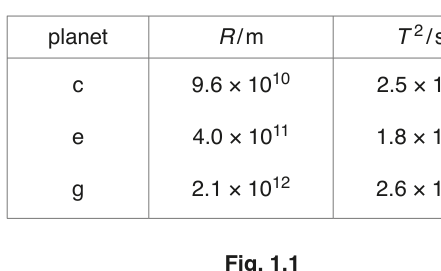
The relationship between and is given by the expression
- Show that the constant is given by the expression
where is the gravitational constant and is the mass of the star.
- Use data from Fig. 1.1 for the three planets and the expression for to calculate the mass of the star.
= ______
The rest of this paper
12 more questions- Q2Oscillations8M
- Q3Thermodynamics · Ideal Gases8M
- Q4Medical Physics7M
- Q5Gravitational Fields · Communication8M
- Q6Electric Fields5M
- Q7Capacitance9M
- Q8Electronics9M
- Q9Magnetic Fields · Alternating Currents8M
- Q10Magnetic Fields6M
- Q11Quantum Physics8M
- Q12Medical Physics7M
- Q13Nuclear Physics8M
Loading the full paper…