Physics 9702/43 — October/November 2017
Cambridge A-Level · A Level Structured Questions · worked solutions for every part, with the mark scheme
Topics Magnetic Fields · Nuclear Physics · Temperature · Oscillations · Gravitational Fields · Motion in a Circle · +7 more
Answer all the questions in the spaces provided.
State
what may be deduced from the difference in the temperatures of two objects,
the basic principle by which temperature is measured.
By reference to your answer in (a)(ii), explain why two thermometers may not give the same temperature reading for an object.
A block of aluminium of mass is heated at a constant rate of for .
The specific heat capacity of aluminium is .
The initial temperature of the block is .
Assuming that no thermal energy is lost to the surroundings, show that the final temperature of the block is .
In practice, there are energy losses to the surroundings.
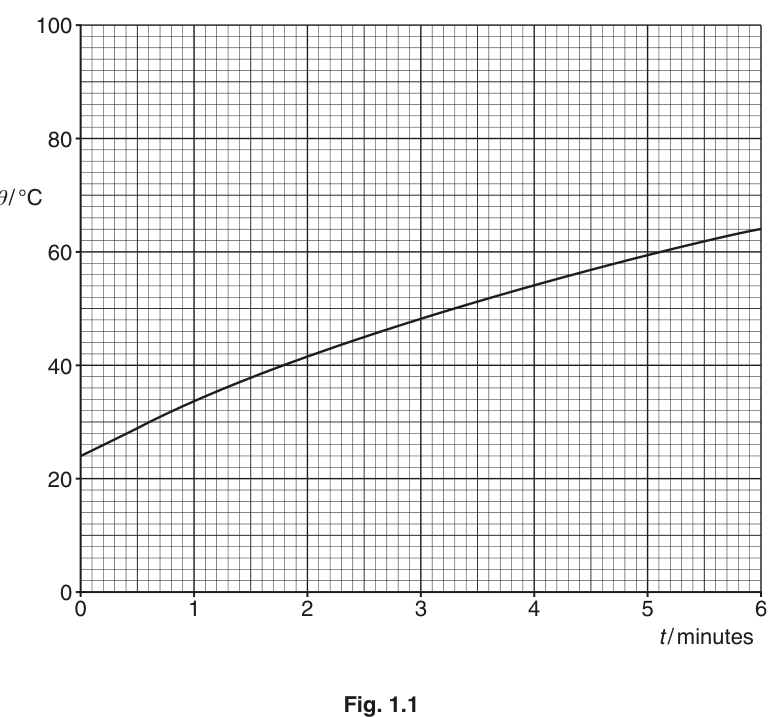
The actual variation with time of the temperature of the block is shown in Fig. 1.1.
-
Use the information in (i) to draw, on Fig. 1.1, a line to represent the temperature of the block, assuming no energy losses to the surroundings.
-
Using Fig. 1.1, calculate the total energy loss to the surroundings during the heating process.
energy loss = ______
The rest of this paper
11 more questions- Q2Oscillations7M
- Q3Gravitational Fields · Motion in a Circle8M
- Q4Communication8M
- Q5Electric Fields · Magnetic Fields8M
- Q6Capacitance8M
- Q7Electronics11M
- Q8Magnetic Fields8M
- Q9Medical Physics7M
- Q10Alternating Currents6M
- Q11Quantum Physics · Nuclear Physics7M
- Q12Nuclear Physics7M