Physics 9702/42 — October/November 2017
Cambridge A-Level · A Level Structured Questions · worked solutions for every part, with the mark scheme
Topics Motion in a Circle · Electric Fields · Magnetic Fields · Gravitational Fields · Temperature · Thermodynamics · +7 more
State Newton’s law of gravitation.
The planet Jupiter and one of its moons, Io, may be considered to be uniform spheres that are isolated in space.
Jupiter has radius and mean density .
Io has mass and is in a circular orbit about Jupiter with radius , as illustrated in Fig. 1.1.
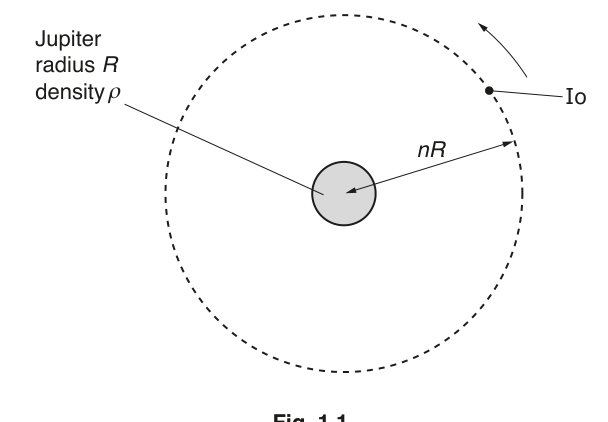
The time for Io to complete one orbit of Jupiter is .
Show that the time is related to the mean density of Jupiter by the expression
where is the gravitational constant.
The radius of Jupiter is and the distance between the centres of Jupiter and Io is .
The period of the orbit of Io is hours.
Calculate the mean density of Jupiter.
= ______
The Earth has a mean density of . It is said to be a planet made of rock.
By reference to your answer in (i), comment on the possible composition of Jupiter.
The rest of this paper
11 more questions- Q2Temperature · Thermodynamics8M
- Q3Motion in a Circle · Oscillations8M
- Q4Medical Physics6M
- Q5Communication8M
- Q6Electric Fields7M
- Q7Electronics10M
- Q8Magnetic Fields7M
- Q9Magnetic Fields · Electric Fields9M
- Q10Quantum Physics5M
- Q11Alternating Currents11M
- Q12Nuclear Physics11M