Physics 9702/53 — May/June 2017
Cambridge A-Level · Planning, Analysis and Evaluation · worked solutions for every part, with the mark scheme
Topics Analysis, Conclusions and Evaluation · Planning
A student is investigating the motion of a wooden block on an inclined plane, as shown in Fig. 1.1.
A falling body causes the wooden block to accelerate.
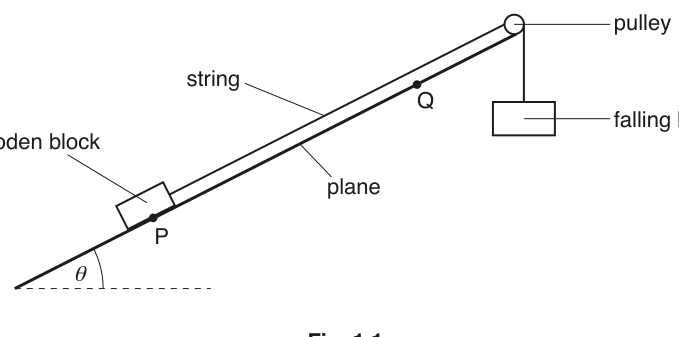
The wooden block is initially at rest at point P and has velocity at point Q.
It is suggested that the relationship between and the angle of the plane to the horizontal is
where is the mass of the falling body, is the mass of the wooden block, is the distance between P and Q and is the acceleration of free fall.
Design a laboratory experiment to test the relationship between and . Explain how your results could be used to determine a value for . You should draw a diagram, on page 3, showing the arrangement of your equipment. In your account you should pay particular attention to
• the procedure to be followed,
• the measurements to be taken,
• the control of variables,
• the analysis of the data,
• any safety precautions to be taken.
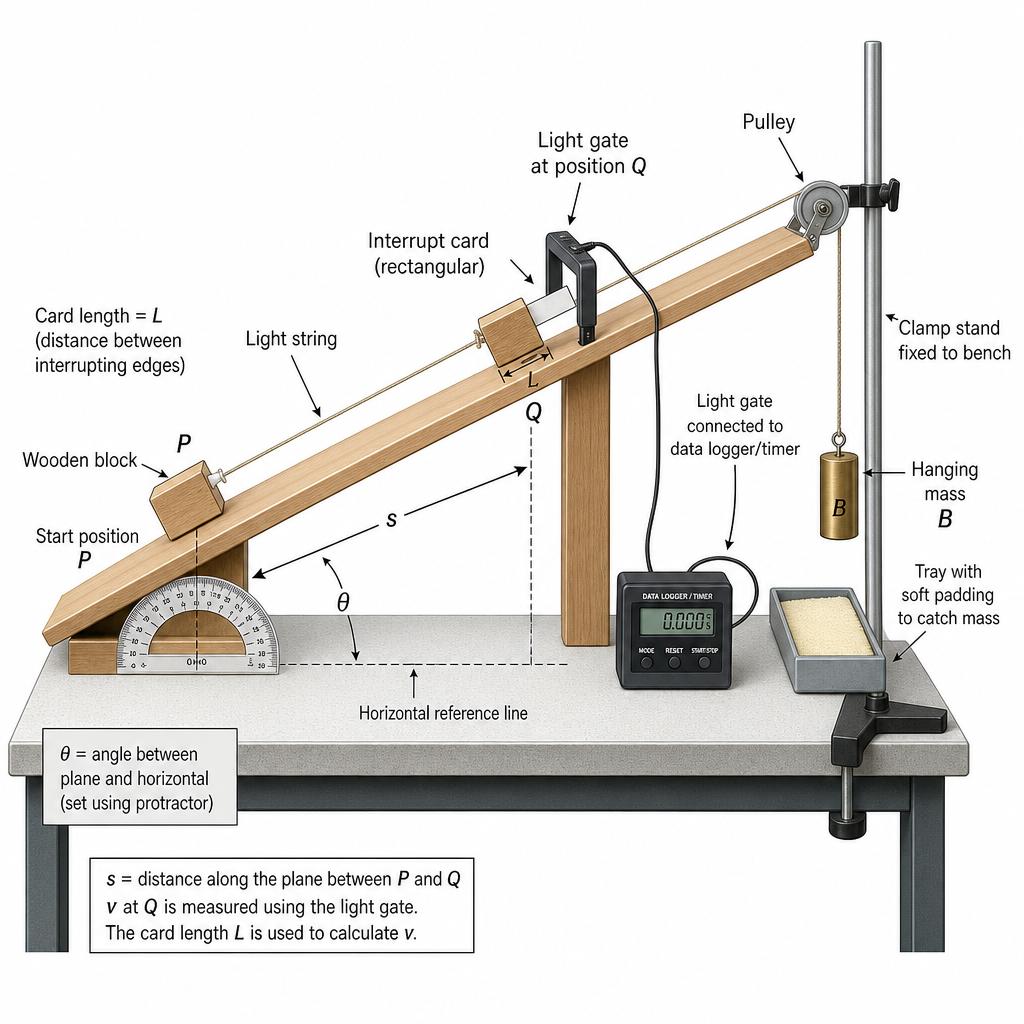
Apparatus
Inclined plane (board) with adjustable height, pulley clamped at top, wooden block (mass ) with card of known length , string, slotted masses for falling body (total mass ), light gate + data logger, metre rule/tape, protractor (or measure height and length), balance.
Variables
Independent: .
Dependent: speed of the block at point .
Controlled: , , distance between and , same board surface and block face, same string/pulley, same release method (from rest at ).
Procedure and measurements
- Measure and using a balance.
- Mark points and on the plane and measure with a metre rule. Keep constant for all runs.
- Fix the light gate at . Attach the card (length ) to the block so it passes through the light gate.
- Set the plane to a chosen angle (measure with a protractor, or calculate using ).
- Hold the block at with the string taut and the hanging mass at rest. Release without a push.
- Record the time for the card to pass through the light gate at and calculate
- Repeat at least 3 times for this and take the mean .
- Repeat for at least 6 different values of .
Analysis of data
For each run calculate and
The suggested relationship gives
where .
Plot a graph of (vertical axis) against (horizontal axis). A straight line supports the relationship.
Determination of
From :
- y-intercept .
- gradient .
(Use either method, or both and compare.)
Safety
Secure the board and pulley clamp; keep hands/feet clear of the falling mass; use a tray/soft landing to catch the mass; ensure the mass cannot fall off the bench; keep the runway area clear.
See working
Background Concept
The experiment involves an object accelerating from rest, so its speed after moving a known distance depends on the net force along the direction of motion.
The suggested model is
where:
- is the hanging (falling) mass,
- is the block mass,
- is the distance moved by the block from to along the plane,
- is the block speed at ,
- is the angle of the plane to the horizontal,
- is the gravitational field strength.
A key Paper 5 skill is to test a relationship by making a straight-line graph. To do that, we choose an independent variable we can vary (here ), measure the dependent variable (here ), and rearrange the equation into the form . Then the gradient/intercept allow determination of constants (here ).
Understanding the Question
You must design an experiment in which:
- you can set different values of the angle ,
- the block starts from rest at the same point each time,
- you can measure the block’s speed when it reaches a fixed point a known distance from ,
- you keep , , and constant,
- you use your results to find a value for .
The diagram in the stem shows a block on a plane connected by a string over a pulley to a hanging mass. That is the apparatus you should replicate.
Approach
- Choose variables: vary only; keep , , and fixed.
- Measure at a point: use a light gate at with an interrupt card on the block. This gives an instantaneous speed at (much better than using average speed over a long interval).
- Linearise the equation: define
so the model becomes a straight line:
- Plot and interpret: if the model is correct, the plot of against is a straight line. The intercept and gradient each contain , so you can compute .
- Reduce uncertainty and include safety: repeat runs, average values, and ensure the falling mass is safely caught.
Step-by-Step Reasoning
-
Set up the mechanics:
- Clamp the pulley firmly at the top of the board.
- Attach the string from the block over the pulley to the hanging mass.
- Ensure the string is taut and aligned so the block moves straight along the plane.
-
Fix , and (control variable):
- Mark (start) and (finish) on the plane.
- Measure the distance along the plane using a metre rule. Keep this distance constant throughout.
-
Choose a good method to measure at :
- Place a light gate at .
- Attach a card of known length to the block.
- The data logger measures the blocking time as the card passes; then
This gives the speed at point (not just an average between points).
-
Varying (independent variable):
- Adjust the height of one end of the board to set different angles.
- Measure directly using a protractor, or indirectly by measuring height and slope length and using .
-
Collecting data:
- For each angle, release the system from rest with the block at (no push).
- Record at the light gate and calculate .
- Repeat at least three times for the same and take the mean .
- Use at least 6 different angles to make a reliable graph.
-
Processing and linear graph:
- For each angle compute .
- Use the measured to compute
- Plot (vertical) against (horizontal).
- How the graph gives :
Since
the straight-line form has:
- intercept , so
- gradient , so
(You may calculate both ways and compare; agreement increases confidence.)
- Uncertainty ideas (what you would do in a real Paper 5 answer):
- Repeat readings to reduce random error in (and hence ).
- Use a larger card length to increase the blocking time, reducing percentage timing uncertainty.
- Add error bars: uncertainty in comes from uncertainty in and ; uncertainty in depends strongly on because .
Key Takeaways
- A planning question is scored by: sensible apparatus, clear variables, reliable measurements, good control of variables, and a correct graph-based analysis.
- Turning the given equation into a straight-line form is the cleanest way to test the model.
- The gradient and intercept are not just “numbers”: they let you calculate physical constants such as .
Common Mistakes
- Measuring only the time from to and using (that gives average speed, not the speed at required in the equation).
- Plotting the wrong graph (e.g. against without linearising, or using instead of ).
- Not controlling : moving between runs changes and invalidates the test.
- Forgetting to state how is obtained from the gradient/intercept.
- Too few angles/repeats to justify a straight-line conclusion.
Things to Be Careful About
- Ensure the block is released from rest at the same point each time; even a small push changes .
- Make sure the hanging mass falls freely and does not hit obstacles; stop it safely.
- Keep and constant (do not change the hanging mass when changing ).
- Use consistent SI units: and in , and in , giving in .
- When calculating from the gradient, remember the gradient is negative (because decreases as increases).
The rest of this paper
1 more questions- Q2Analysis, Conclusions and Evaluation15M