Physics 9702/41 — May/June 2017
Cambridge A-Level · A Level Structured Questions · worked solutions for every part, with the mark scheme
Topics Magnetic Fields · Motion in a Circle · Electric Fields · Medical Physics · Gravitational Fields · Oscillations · +6 more
Explain how a satellite may be in a circular orbit around a planet.
Answer
- The satellite has a tangential velocity.
- The gravitational attraction towards the planet provides the centripetal force (inward acceleration), so the satellite is in continuous free fall around the planet in a circular path.
Gravitational attraction provides the centripetal force for a satellite moving with tangential velocity, so it continuously falls towards the planet and remains in circular orbit.
Background Concept
For an object to move in a circle of radius at constant speed , it must have an inward (centripetal) acceleration
This acceleration is caused by a resultant inward force (centripetal force)
For a satellite orbiting a planet, the natural inward force available is the gravitational force,
where is the planet’s mass and is the satellite’s mass.
Understanding the Question
The question asks for a qualitative explanation of how a satellite can stay in a circular orbit. The key idea is that the satellite is not “supported”; instead it is constantly accelerating towards the planet due to gravity while moving sideways fast enough to keep missing the surface.
Approach
State (i) the direction of the satellite’s velocity (tangential to the orbit) and (ii) the direction and role of gravity (towards the centre providing centripetal force). A brief “continuous free fall” description completes the explanation.
Step-by-Step Reasoning
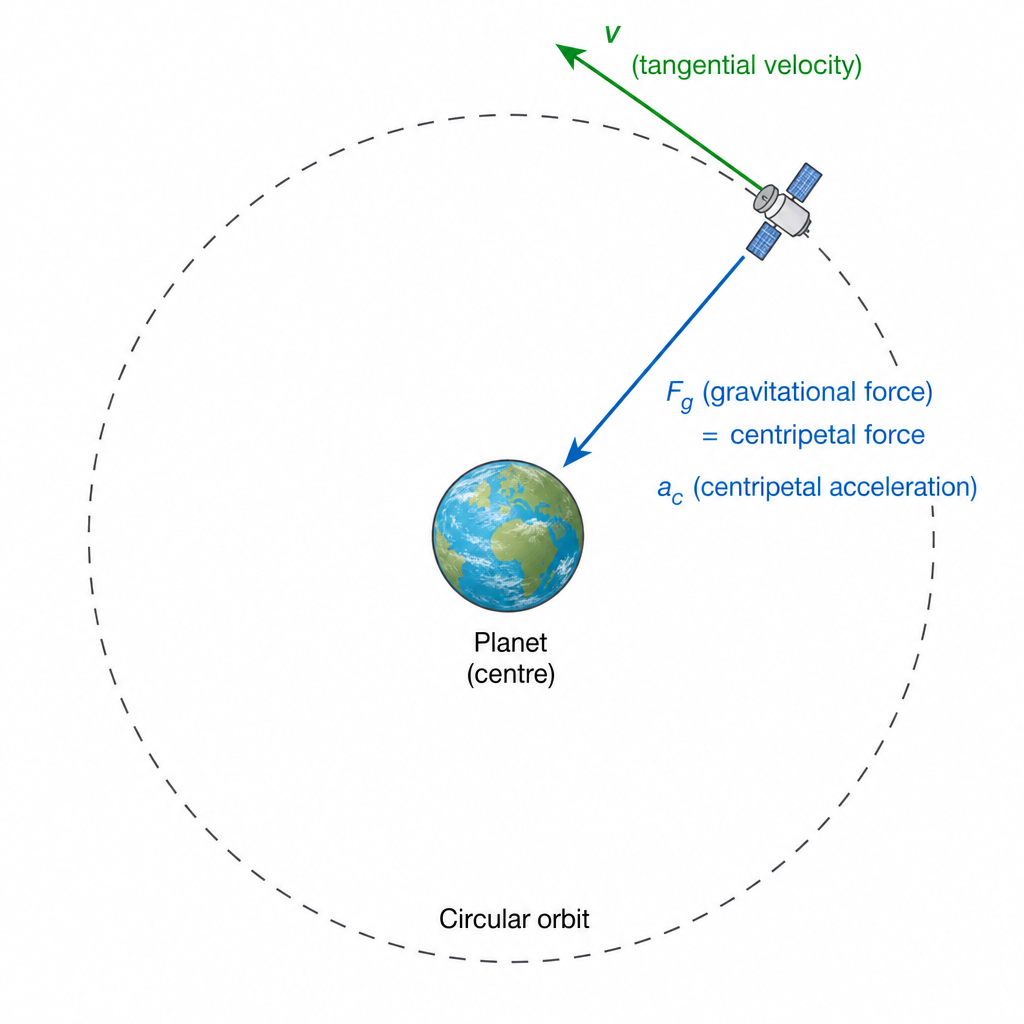
- In a circular orbit, the satellite’s instantaneous velocity is along the tangent to the circle.
- Gravity acts along the line joining satellite to the planet’s centre, i.e. radially inwards.
- This inward gravitational force provides the required centripetal force, so the satellite has inward centripetal acceleration while keeping (approximately) constant speed.
- Because it is continually accelerating towards the planet but also moving sideways, it continually “falls around” the planet rather than straight into it.
Key Takeaways
- Circular motion needs a resultant force towards the centre.
- In orbit, gravity is that centripetal force.
- The satellite’s velocity is tangential; its acceleration (and force) is radial.
Common Mistakes
- Saying “no forces act” on the satellite (gravity must act).
- Confusing tangential velocity with inward acceleration (they are perpendicular).
- Claiming the satellite is in equilibrium (it is not: resultant force is non-zero).
Things to Be Careful About
- Use the phrase “centripetal force” correctly: it is not an extra force, but the name for the resultant inward force.
- Make clear the direction: gravity acts towards the centre of the planet.
The Earth and the Moon may be considered to be uniform spheres that are isolated in space.
The Earth has radius and mean density . The Moon, mass , is in a circular orbit about
the Earth with radius , as illustrated in Fig. 1.1.
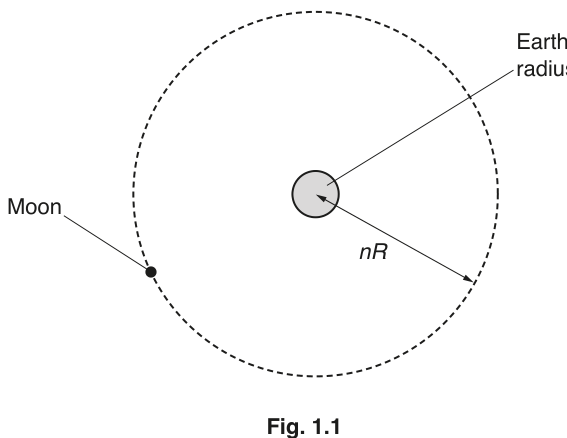
The Moon makes one complete orbit of the Earth in time .
Show that the mean density of the Earth is given by the expression
Working
For the Moon in circular orbit of radius :
Cancel :
With :
So
Earth mass and :
Cancel :
Hence
Answer
\rho = 3\pi n^3 / (G T^2)
Background Concept
For a body of mass moving in a circular orbit of radius with angular speed , the required centripetal acceleration is
So the required centripetal force is
For an orbit under gravity, the attractive gravitational force between the planet (mass ) and the orbiting body (mass ) is
In a stable circular orbit, gravity provides exactly the centripetal force:
Also, density relates to mass and volume. For a uniform sphere of radius and mean density ,
Understanding the Question
We are told:
- Earth radius is and mean density is (unknown).
- Moon orbits in a circle of radius from Earth’s centre.
- Period of orbit is .
We must show that can be written purely in terms of , and constants, ending with
This indicates that the Moon’s mass should cancel out, and the Earth’s mass should be replaced using .
Approach
- Set gravitational force equal to centripetal force for the Moon.
- Replace angular speed with .
- Replace Earth mass with .
- Use and rearrange to make the subject.
Step-by-Step Reasoning
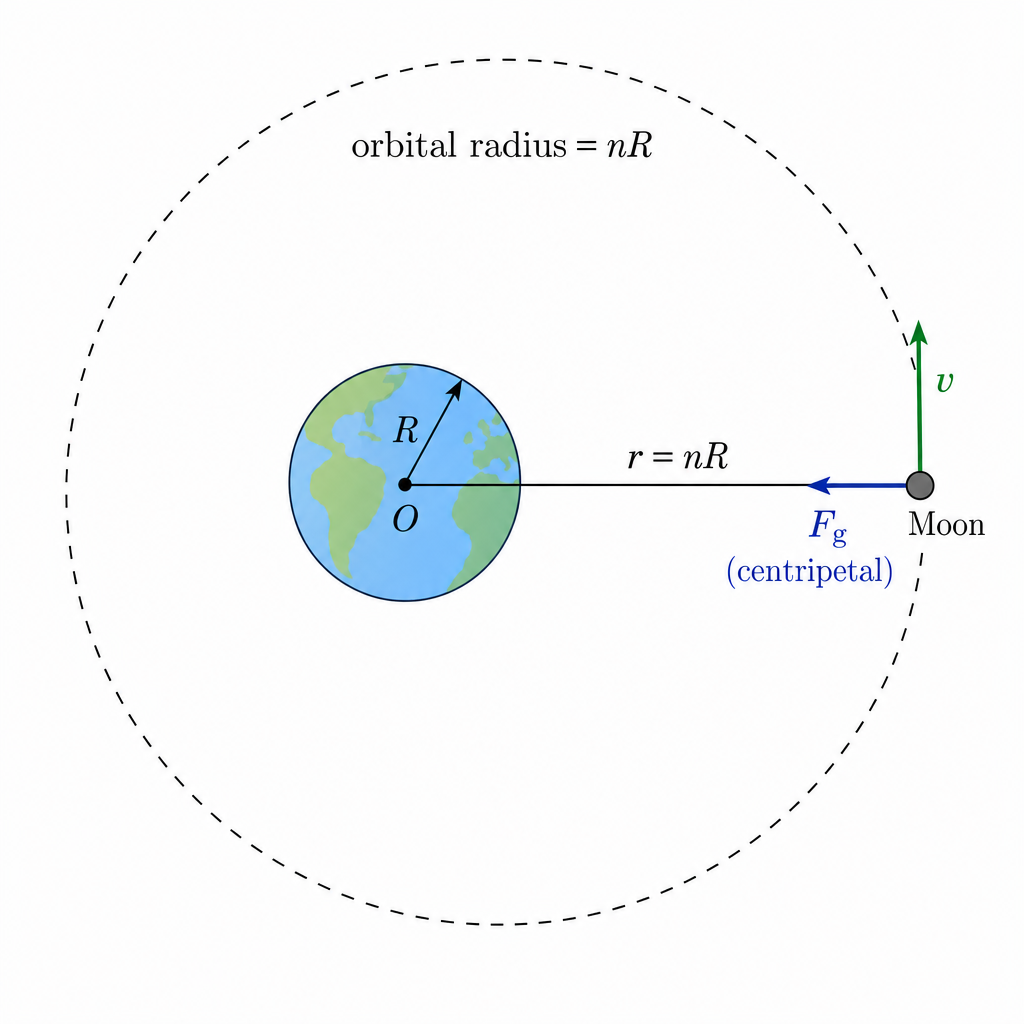
- For the Moon (mass ) in circular orbit of radius :
- Cancel (important: the orbital period does not depend on the Moon’s mass for this ideal model):
- Substitute :
- Multiply both sides by :
- Replace with the Earth’s mass in terms of density:
So
- Use , so :
- Cancel common factors :
- Rearrange:
Key Takeaways
- Circular orbit condition: gravitational force supplies centripetal force.
- Use to connect orbit period and dynamics.
- Replace mass of a uniform sphere with density (\times) volume.
Common Mistakes
- Using but forgetting to cube it when appears.
- Not cancelling the Moon’s mass .
- Mixing up with and making algebra errors.
- Using with the wrong radius (it must be Earth’s radius , not orbital radius ).
Things to Be Careful About
- must be in seconds if you later use SI units numerically.
- Keep track of what each radius represents: Earth’s radius vs orbital radius .
- The result is independent of the Moon’s mass only because we assumed an isolated two-body system and a circular orbit with (standard exam model).
The radius of the Earth is and the distance between the centre of the Earth
and the centre of the Moon is .
The period of the orbit of the Moon about the Earth is days.
Use the expression in (b) to calculate .
= ______
Working
Answer
5.55 × 10^3 kg m^-3
Background Concept
From part (b), the Earth’s mean density is related to the Moon’s orbital period and orbital radius by
where is the orbital radius in units of Earth radii (), is the gravitational constant, and must be in seconds for SI consistency.
Understanding the Question
You are given:
- Moon’s orbital radius
- Orbital period days
You must:
- Find .
- Convert into seconds.
- Substitute into and give in .
Approach
- Compute the ratio using the distances in the same units (km cancels).
- Convert days to seconds using .
- Evaluate the expression carefully, especially and .
Step-by-Step Reasoning
- Compute :
Using km for both is fine because the units cancel in the ratio.
- Convert the period to seconds:
- Substitute into the density formula:
- Handle powers and large numbers systematically:
So
Key Takeaways
- Ratios like are unit-independent as long as both distances use the same unit.
- Always convert periods to seconds before using formulas with .
- Be careful with powers: the formula involves and .
Common Mistakes
- Forgetting to convert days to seconds.
- Cubing incorrectly or using by accident.
- Using and in different units when finding .
- Rounding too early and losing accuracy.
Things to Be Careful About
- Use SI for (), so time must be in seconds.
- Quote the final answer to a sensible number of significant figures (typically 3 s.f. here, matching the given data).
The rest of this paper
11 more questions- Q2Oscillations · Magnetic Fields9M
- Q3Communication10M
- Q4Ideal Gases10M
- Q5Electric Fields7M
- Q6Electronics9M
- Q7Magnetic Fields · Motion in a Circle · Electric Fields10M
- Q8Medical Physics8M
- Q9Alternating Currents · Magnetic Fields6M
- Q10Medical Physics5M
- Q11Quantum Physics8M
- Q12Nuclear Physics9M