Physics 9702/42 — February/March 2017
Cambridge A-Level · A Level Structured Questions · worked solutions for every part, with the mark scheme
Topics Magnetic Fields · Gravitational Fields · Quantum Physics · Thermodynamics · Ideal Gases · Oscillations · +7 more
Define gravitational potential at a point.
A rocket is launched from the surface of a planet and moves along a radial path, as shown in Fig. 1.1.
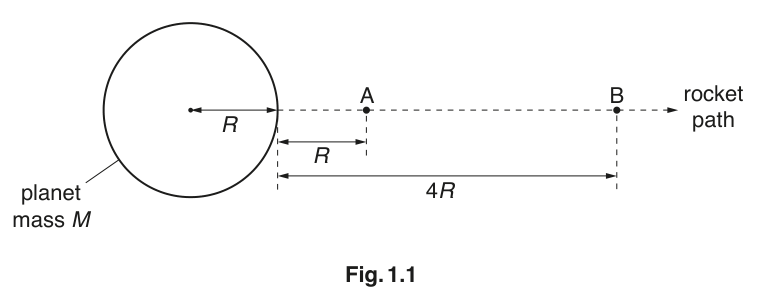
The planet may be considered to be an isolated sphere of radius with all of its mass concentrated at its centre. Point A is a distance from the surface of the planet. Point B is a distance from the surface.
Show that the difference in gravitational potential between points A and B is given by the expression
where is the gravitational constant.
The rocket motor is switched off at point A. During the journey from A to B, the rocket has a constant mass of and its kinetic energy changes from to .
For the planet, the product is . It may be assumed that resistive forces to the motion of the rocket are negligible.
Use the expression in (b)(i) to determine the distance from A to B.
distance = ______
The rest of this paper
11 more questions- Q2Thermodynamics · Ideal Gases10M
- Q3Oscillations · Magnetic Fields12M
- Q4Medical Physics4M
- Q5Communication8M
- Q6Electric Fields · Gravitational Fields9M
- Q7Electronics10M
- Q8Magnetic Fields · Motion in a Circle9M
- Q9Alternating Currents · Magnetic Fields11M
- Q10Quantum Physics8M
- Q11Quantum Physics5M
- Q12Nuclear Physics8M