Physics 9702/43 — May/June 2016
Cambridge A-Level · A Level Structured Questions · worked solutions for every part, with the mark scheme
Topics Magnetic Fields · Quantum Physics · Gravitational Fields · Ideal Gases · Oscillations · Medical Physics · +6 more
By reference to the definition of gravitational potential, explain why gravitational potential is a negative quantity.
Answer
Gravitational potential at a point is the work done per unit mass by an external agent in bringing a test mass from infinity to the point (taking at infinity).
Because the gravitational force is attractive, the field does positive work on the mass as it moves from infinity to the point, so the external work done per unit mass is negative. Hence is negative.
Gravitational potential is negative because, taking (\phi=0) at infinity, the attractive gravitational field does positive work bringing a mass in from infinity, so the external work done per unit mass is negative.
Background Concept
Gravitational potential at a point is defined as the work done per unit mass by an external agent in bringing a small test mass from infinity to that point, with no change in kinetic energy.
Mathematically,
A standard reference choice is at . Gravitational potential energy is then
Understanding the Question
You are asked to explain (not calculate) why comes out negative when we use the usual definition and reference point at infinity.
So you must connect:
- the attractive nature of gravity,
- the sign of work done by the field / external agent,
- the fact that is the chosen zero.
Approach
Start from the definition for a move from infinity to a point. Decide whether the external agent must do positive or negative work in this move.
Step-by-Step Reasoning
- A gravitational field attracts a mass toward the star/planet. That means the gravitational force is directed inward.
- Consider a test mass moving from infinity toward the mass creating the field. Its displacement is also inward.
- Since force and displacement are in the same direction, the gravitational field does positive work on the mass.
- If we bring the mass in slowly so that its kinetic energy does not increase, an external agent must remove energy (do negative work) to prevent the mass from speeding up.
- Therefore for moving from infinity to the point is negative, so is negative.
- With , any point in an attractive gravitational field has .
Key Takeaways
- is defined via work done per unit mass from infinity.
- Gravity is attractive, so the field does positive work bringing masses in.
- With , this makes negative everywhere finite.
Common Mistakes
- Saying “potential is negative because gravity is attractive” without linking to the work-done definition.
- Mixing up work done by the field (positive inward) with work done by the external agent (negative if speed is kept constant).
- Forgetting that the negativity depends on choosing at infinity.
Things to Be Careful About
- The sign depends on the reference: Cambridge assumes .
- Make clear it is work done per unit mass by an external agent (or equivalently the negative of work done by the field) that sets the sign.
Two stars A and B have their surfaces separated by a distance of , as illustrated in Fig. 1.1.
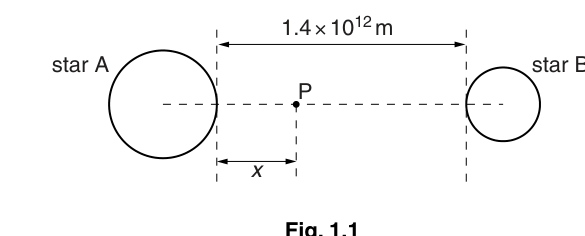
Point P lies on the line joining the centres of the two stars. The distance of point P from the surface of star A may be varied.
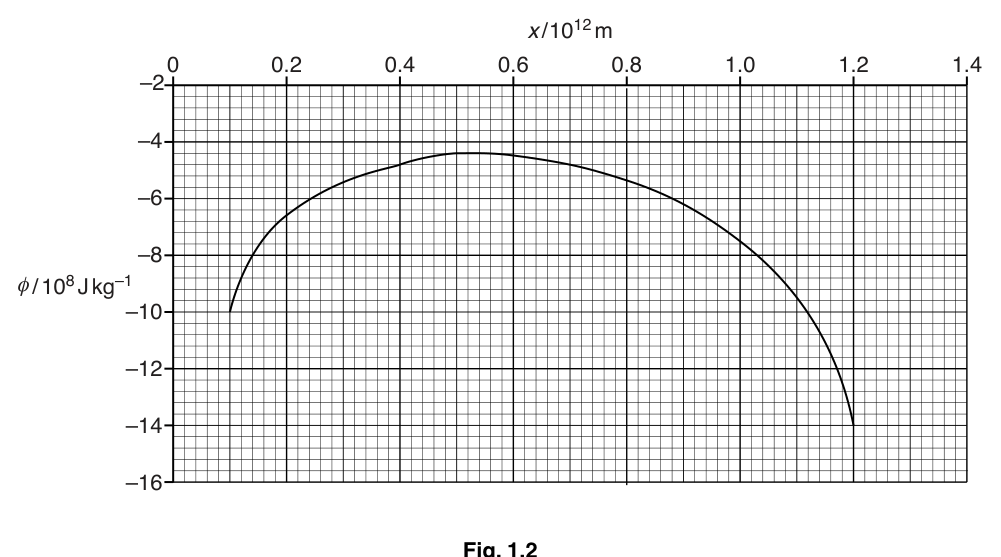
The variation with distance of the gravitational potential at point P is shown in Fig. 1.2.
A rock of mass moves along the line joining the centres of the two stars, from star A towards star B.
Use data from Fig. 1.2 to calculate the change in kinetic energy of the rock when it moves from the point where to the point where .
State whether this change is an increase or a decrease.
change = ______
Working
From Fig. 1.2:
Answer
Change in kinetic energy (increase).
7.2 × 10^10 J, increase
Background Concept
Gravitational potential is potential energy per unit mass:
So a change in potential corresponds to a change in gravitational potential energy:
If only gravitational forces do work (no engines, no friction), mechanical energy is conserved:
Understanding the Question
A rock moves from to . The graph gives at those points (in units of ). You must find how much the rock’s kinetic energy changes and state whether it increases or decreases.
Approach
- Read at the two values.
- Calculate .
- Convert to .
- Use .
Step-by-Step Reasoning
- From the graph, at , .
- At , .
- The potential becomes more negative, so
- Multiply by mass to get the change in potential energy:
The negative sign means gravitational potential energy decreases (the rock has moved to a “lower” potential).
- With conservation of mechanical energy (gravity only), the kinetic energy must increase by the same amount:
Key Takeaways
- is energy per unit mass, so multiply by to get .
- A decrease in corresponds to an increase in when only conservative forces act.
- Always track signs carefully with negative potentials.
Common Mistakes
- Using instead of .
- Forgetting the graph’s scale factor ().
- Stating “decrease” because decreases (more negative), without converting properly to energy changes.
Things to Be Careful About
- The graph values are approximate; sensible rounding (2–3 s.f.) is expected.
- Keep units consistent: in leads to in after multiplying by kg.
At a point where , the speed of the rock is .
Determine the minimum speed such that the rock reaches the point where .
minimum speed = ______
Working
From Fig. 1.2, maximum potential along the path is
At ,
Minimum speed occurs when the rock just reaches with zero kinetic energy:
Answer
Minimum speed .
3.3 × 10^4 m s^-1
Background Concept
In a conservative field (like gravity), total mechanical energy per unit mass is conserved:
So between two points 1 and 2,
A key idea here is a “potential barrier”: if the potential increases to a maximum somewhere along the path, the object must have enough initial kinetic energy to reach that maximum.
Understanding the Question
The rock starts at with speed . It must travel toward star B and reach . The graph shows that first rises (becomes less negative) to a maximum around , then falls.
The minimum starting speed is the one that just allows the rock to get over the highest point of ; once it has passed that point, it will then move to lower potential and speed up again.
Approach
- Read at the start.
- Find the maximum value on the graph between start and destination.
- Set the kinetic energy at the top of the barrier to zero (minimum condition).
- Use conservation of energy per unit mass to solve for .
Step-by-Step Reasoning
- Starting potential (from graph):
- The curve reaches a maximum (least negative) value of about
- To just reach this point, the rock arrives with there. Apply energy per unit mass conservation between start and the maximum point:
Rearrange:
- Substitute:
- Solve for :
(The mass cancels automatically because we used energy per unit mass.)
Key Takeaways
- Minimum launch speed is determined by the highest potential along the route, not the potential at the final point.
- Use energy per unit mass: pairs naturally with .
- Reading the correct feature (the maximum) from the graph is the main physics skill here.
Common Mistakes
- Using at instead of .
- Forgetting that values are negative and mishandling .
- Not including the factor of 2 when solving from .
Things to Be Careful About
- Ensure you pick the maximum of the curve (least negative value), not the minimum.
- Keep the scale factor from the axis.
- Quote to a sensible number of significant figures given the graph reading (typically 2 s.f. or 3 s.f.).
The rest of this paper
12 more questions- Q2Ideal Gases6M
- Q3Oscillations11M
- Q4Medical Physics9M
- Q5Communication10M
- Q6Electric Fields6M
- Q7Capacitance8M
- Q8Electronics9M
- Q9Magnetic Fields3M
- Q10Magnetic Fields9M
- Q11Alternating Currents7M
- Q12Quantum Physics8M
- Q13Nuclear Physics · Quantum Physics6M