Physics 9702/42 — May/June 2016
Cambridge A-Level · A Level Structured Questions · worked solutions for every part, with the mark scheme
Topics Gravitational Fields · Magnetic Fields · Motion in a Circle · Ideal Gases · Temperature · Oscillations · +8 more
A binary star consists of two stars A and B that orbit one another, as illustrated in Fig. 1.1.
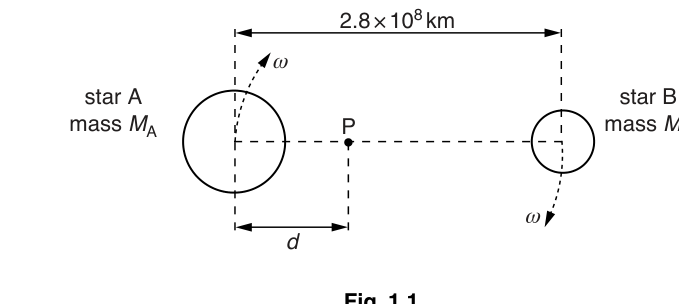
The stars are in circular orbits with the centres of both orbits at point P, a distance from the centre of star A.
Explain why the centripetal force acting on both stars has the same magnitude.
Answer
The centripetal force on each star is provided by the gravitational attraction between the two stars.
By Newton’s third law, the gravitational force exerted by A on B has the same magnitude as the force exerted by B on A (equal and opposite pair), so the centripetal forces on the two stars have the same magnitude.
The centripetal force is the mutual gravitational force, which has equal magnitude on each star by Newton’s third law.
Background Concept
In a binary system, each star is kept in circular motion by a centripetal force directed towards the centre of its circular path.
If the only significant interaction is gravity, the centripetal force is just the gravitational force of attraction between the two masses:
Newton’s third law says that forces in an interaction pair are equal in magnitude and opposite in direction: “force on A due to B” equals “force on B due to A” in magnitude.
Understanding the Question
We are told both stars move in circles about the same point P. The question asks why the centripetal forces on A and B are equal in magnitude.
Even though their masses and orbit radii may be different, the force responsible for both circular motions comes from the same two-body interaction.
Approach
- Identify what provides the centripetal force (gravity between the stars).
- Use Newton’s third law to compare the force on A with the force on B.
Step-by-Step Reasoning
- Star A attracts star B gravitationally; star B attracts star A gravitationally.
- These two forces form a Newton’s third law pair, so their magnitudes are equal.
- Each force acts towards the other star (along the line joining their centres), which is also the direction towards the centre of the circular motion about P at that instant.
- Therefore, the centripetal force on A and the centripetal force on B have the same magnitude (but act on different bodies, in opposite directions).
Key Takeaways
- In two-body gravity problems, the forces on the two bodies are always equal in magnitude (Newton’s third law).
- The centripetal force is not a new force; it is the name for the resultant inward force causing circular motion.
Common Mistakes
- Saying the centripetal forces are equal because the stars have the same angular speed (that alone does not force equal centripetal force because depends on and ).
- Mixing up “same magnitude” with “same direction” (directions are opposite).
Things to Be Careful About
- Be explicit that the centripetal force is the gravitational attraction.
- State Newton’s third law clearly: equal magnitude, opposite direction, acting on different bodies.
The period of the orbit of the stars about point P is 4.0 years.
Calculate the angular speed of the stars.
= ______
Working
Answer
5.0 × 10^-8 rad s^-1
Background Concept
For uniform circular motion, the angular speed is the rate of change of angular displacement (in radians) per second. One complete orbit corresponds to an angular displacement of radians, so
where is the period (time for one full orbit).
Understanding the Question
The stars complete one orbit about point P in years. We need the angular speed in , so the period must be converted into seconds before using .
Approach
- Convert years into seconds.
- Substitute into .
- Round appropriately (typically 2 s.f. because has 2 s.f.).
Step-by-Step Reasoning
- Convert years to seconds:
- Now calculate angular speed:
- Rounding to 2 significant figures gives:
Key Takeaways
- Always convert the period into SI units (seconds) when angular speed is required in .
- One full revolution is radians.
Common Mistakes
- Leaving the period in years and giving in .
- Using instead of .
- Rounding too early (carry at least 3 s.f. in intermediate steps).
Things to Be Careful About
- Use standard form correctly when dividing by a large number.
- The unit is (radian is dimensionless but the unit is still written).
The separation of the centres of the stars is .
The mass of star A is . The mass of star B is .
The ratio is 3.0.
Determine the distance .
= ______
Working
For orbit about the centre of mass at P:
Given :
Answer
7.0 × 10^7 km
Background Concept
If two objects orbit each other under mutual forces, they actually orbit about their common centre of mass. For two masses on a line,
where and are their distances from the centre of mass (here point P), measured along the line joining them.
Also, the total separation of their centres is
where is the distance between the stars.
Understanding the Question
The distance between the star centres is . Point P is the common centre of the circular orbits (centre of mass). The distance from A to P is , so and .
We are given and asked to find .
Approach
- Use the centre-of-mass condition .
- Substitute the mass ratio to get a single equation in .
- Solve for .
Step-by-Step Reasoning
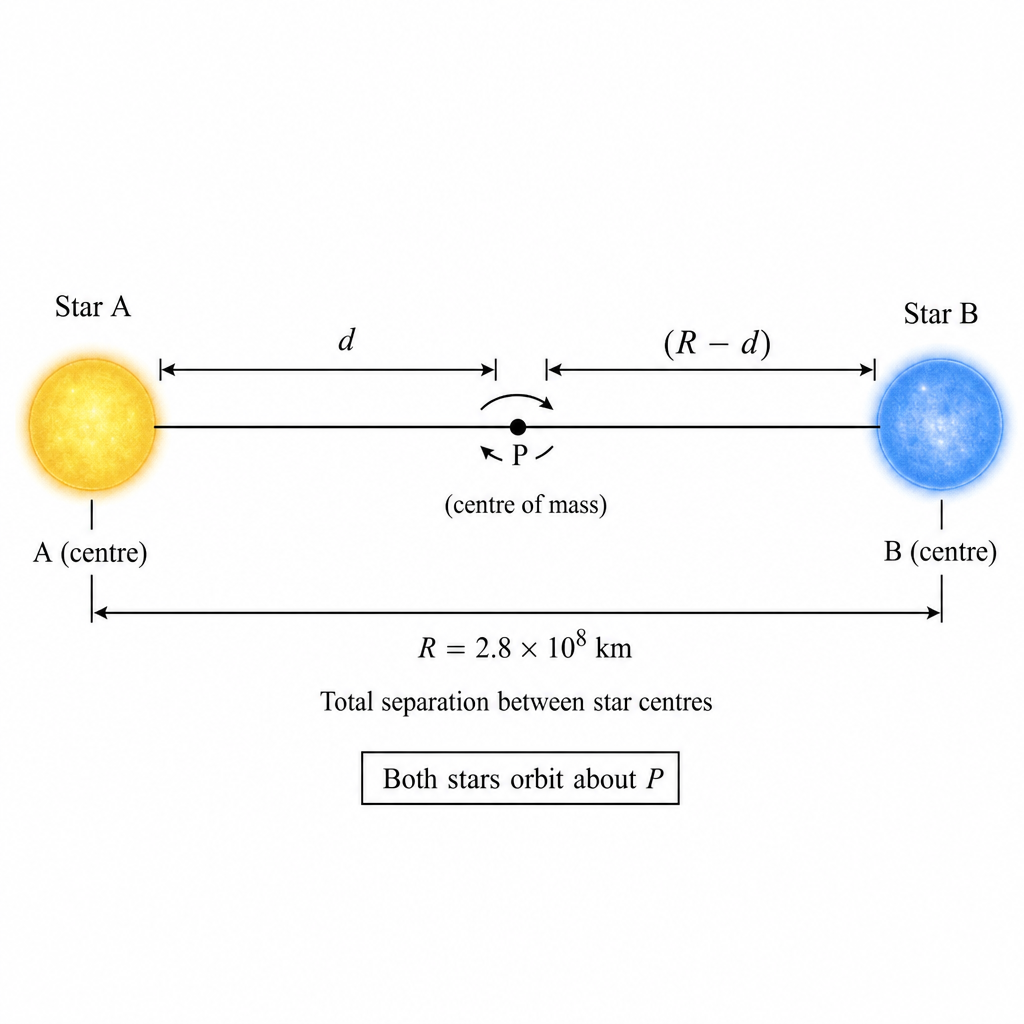
- Write the centre-of-mass relation about P:
- Use :
Cancel :
- Solve:
This makes sense: the more massive star A (three times heavier) is closer to P, so is smaller than .
Key Takeaways
- Two-body circular motion happens about the centre of mass.
- The condition is extremely useful with given mass ratios.
Common Mistakes
- Using instead of the correct inverted ratio (it should be ).
- Assuming P is midway between the stars (only true if masses are equal).
Things to Be Careful About
- Keep distances consistent: (not ).
- Units: here the question wants in km, so no conversion is needed in this part.
Use your answers in (a)(ii) and (b)(i) to determine the mass of star B.
Explain your working.
= ______
Working
From (b)(i):
For star B, gravitational force provides centripetal force:
Cancel and use :
Using from (a)(ii):
Answer
2.0 × 10^29 kg
Background Concept
For circular orbits, the required centripetal force is
where is the mass of the orbiting object, is its orbital radius about the centre of its circular path, and is the angular speed.
In a binary star system, the inward force causing the circular motion is the gravitational attraction between the stars:
where is the separation of their centres.
So we set for either star, using the correct radius about point P.
Understanding the Question
We know:
- Period years, so from (a)(ii) we have .
- Total separation of stars: .
- From (b)(i), distance from A to P: .
- Mass ratio: .
We must find in kg. This needs SI units: km to m, and use .
Approach
- Find star B’s orbital radius about P: .
- Write gravitational force between the stars and equate it to the centripetal force for star B.
- Cancel where possible and use to solve for .
Step-by-Step Reasoning
- Convert separation to metres:
- Find star B’s orbital radius (distance from B to point P):
- Equate forces for star B:
- Cancel (this is common in orbit problems):
- Substitute :
- Rearrange for :
- Substitute numbers (using ):
The result is of the order of a solar mass (), which is reasonable for a star.
Key Takeaways
- For circular gravitational orbits, set gravitational attraction equal to centripetal requirement.
- Use the separation in the gravitational force, but the orbital radius about the centre of mass ( or ) in the centripetal term.
- Mass ratios allow you to eliminate one mass.
Common Mistakes
- Using instead of .
- Mixing up the two different distances: (between stars) vs. (from star B to P).
- Forgetting to convert km to m, causing the mass to be wrong by a factor of or .
- Not cancelling correctly, leading to unnecessary algebra.
Things to Be Careful About
- Keep SI units throughout when using .
- Use the angular speed from (a)(ii) in .
- Square brackets and powers: is very large; handle standard form carefully to avoid exponent errors.
The rest of this paper
12 more questions- Q2Ideal Gases9M
- Q3Temperature5M
- Q4Oscillations9M
- Q5Communication8M
- Q6Electric Fields · Gravitational Fields6M
- Q7Capacitance8M
- Q8Electronics9M
- Q9Magnetic Fields7M
- Q10Magnetic Fields6M
- Q11Alternating Currents7M
- Q12Medical Physics · Quantum Physics8M
- Q13Nuclear Physics8M