Physics 9702/41 — May/June 2016
Cambridge A-Level · A Level Structured Questions · worked solutions for every part, with the mark scheme
Topics Magnetic Fields · Quantum Physics · Gravitational Fields · Ideal Gases · Oscillations · Medical Physics · +6 more
By reference to the definition of gravitational potential, explain why gravitational potential is a negative quantity.
Two stars A and B have their surfaces separated by a distance of , as illustrated in Fig. 1.1.
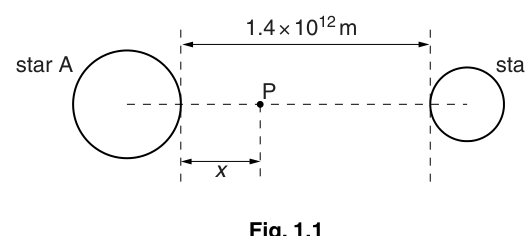
Point P lies on the line joining the centres of the two stars. The distance of point P from the surface of star A may be varied.
The variation with distance of the gravitational potential at point P is shown in Fig. 1.2.
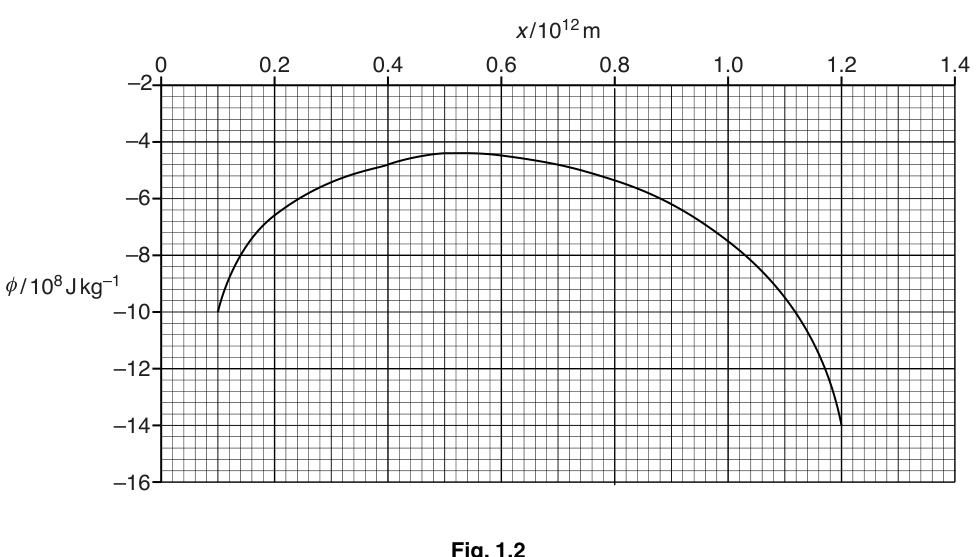
A rock of mass moves along the line joining the centres of the two stars, from star A towards star B.
Use data from Fig. 1.2 to calculate the change in kinetic energy of the rock when it moves from the point where to the point where .
State whether this change is an increase or a decrease.
change = ______
At a point where , the speed of the rock is .
Determine the minimum speed such that the rock reaches the point where .
minimum speed = ______
The rest of this paper
12 more questions- Q2Ideal Gases6M
- Q3Oscillations11M
- Q4Medical Physics9M
- Q5Communication10M
- Q6Electric Fields6M
- Q7Capacitance8M
- Q8Electronics9M
- Q9Magnetic Fields3M
- Q10Magnetic Fields9M
- Q11Alternating Currents7M
- Q12Quantum Physics8M
- Q13Nuclear Physics · Quantum Physics6M