Physics 9702/43 — October/November 2015
Cambridge A-Level · A Level Structured Questions · worked solutions for every part, with the mark scheme
Topics Ideal Gases · Communication · Gravitational Fields · Motion in a Circle · Temperature · Thermodynamics · +9 more
State Newton’s law of gravitation.
Answer
Any two point masses attract each other with a force proportional to the product of their masses and inversely proportional to the square of their separation, acting along the line joining their centres:
Any two point masses attract each other with force along the line joining them, proportional to product of masses and inversely proportional to square of separation: F = G m1 m2 / r^2.
Background Concept
Newton’s law of gravitation describes the gravitational force between two point masses (or spherically symmetric masses treated as if concentrated at their centres). The magnitude of the force depends on:
- the masses and (bigger masses give a bigger force), and
- the separation between their centres (greater separation gives a smaller force).
Mathematically,
where is the gravitational constant. The force is always attractive and acts along the line joining the centres of the two masses.
Understanding the Question
You are asked to state the law, so you must give the proportionalities (to and to ), the fact it is attractive, and the direction (along the line joining centres). Writing the formula is usually expected for full credit.
Approach
Provide a clear sentence (or two) describing the relationship and direction, and include the standard equation with correct symbols.
Step-by-Step Reasoning
- Identify the interaction: gravitational force between two masses.
- State the dependence on masses: .
- State the dependence on separation: .
- Combine these into one expression using the constant of proportionality :
- Add the directional statement: force acts along the line joining the masses and is attractive.
Key Takeaways
- Gravitational force follows an inverse-square law.
- It depends on the product of the two masses.
- It acts along the line joining the centres and is attractive.
Common Mistakes
- Writing (missing one of the masses).
- Forgetting to mention the line of action / that the force is attractive.
- Using as distance from a surface instead of centre-to-centre separation.
Things to Be Careful About
- Use centre-to-centre separation .
- State both proportionalities and the direction to secure full marks.
Some of the planets in the Solar System have several moons (satellites) that have circular orbits about the planet.
The planet and each of its moons may be considered to be point masses.
Show that the radius of a moon’s orbit is related to the period of the orbit by the expression
where is the gravitational constant and is the mass of the planet. Explain your working.
Working
For a moon of mass in a circular orbit of radius about a planet of mass :
Gravitational force provides centripetal force:
With ,
Cancel and rearrange:
Answer
GM = 4π^2 x^3 / T^2
Background Concept
A body in uniform circular motion needs a centripetal (centre-seeking) acceleration towards the centre:
So the resultant force towards the centre must be
In an orbit, the gravitational attraction between the planet (mass ) and the moon (mass ) provides this inward force:
For a circular orbit of radius , we set .
Understanding the Question
You are told moons move in circular orbits and both planet and moon can be treated as point masses. You must show the relationship between orbital radius and orbital period :
This is essentially a form of Kepler’s third law for circular orbits around the same central mass .
Approach
- Write the gravitational force on the moon due to the planet.
- Write the centripetal force needed for circular motion.
- Equate them (gravity provides the centripetal force).
- Replace using the period: .
- Rearrange to reach the required expression.
Step-by-Step Reasoning
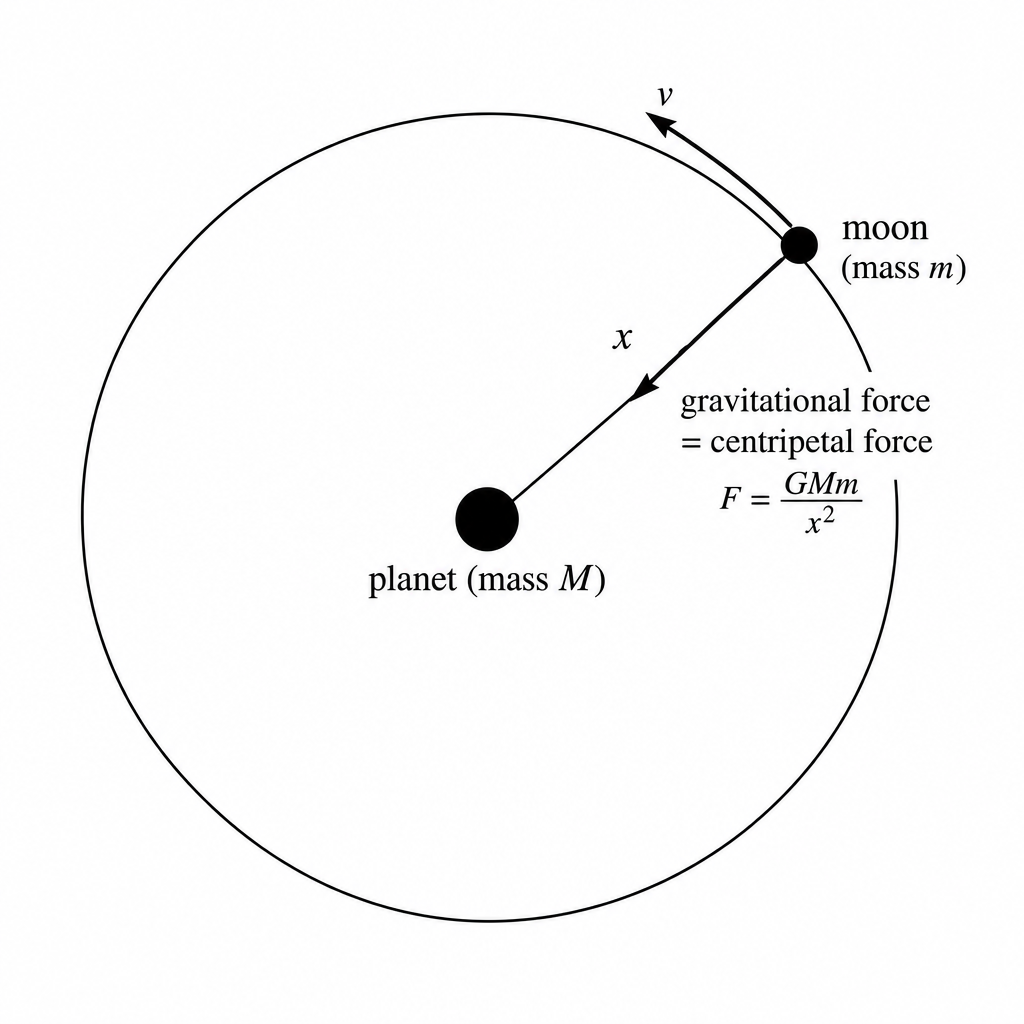
- Gravitational force magnitude between masses and separated by distance :
- Centripetal force needed for a mass moving at speed in a circle of radius :
- In a stable circular orbit, gravity supplies exactly the centripetal force:
- Express orbital speed using period. In one orbit the moon travels distance in time :
- Substitute for :
- Cancel (important: orbital radius/period do not depend on the moon’s mass for a given ), then rearrange:
Key Takeaways
- For circular orbits, set gravitational force equal to centripetal force.
- Use to connect period and radius.
- The orbit relationship depends on the central mass , not the orbiting mass .
Common Mistakes
- Using instead of .
- Using diameter instead of radius in .
- Forgetting to cancel or algebra mistakes when rearranging.
- Mixing and inconsistently.
Things to Be Careful About
- is the centre-to-centre orbital radius.
- The derivation assumes a circular orbit (constant ) and that gravity is the only significant force.
- Keep (not ) after squaring the speed expression.
The planet Neptune has eight moons, each in a circular orbit of radius and period . The variation with of for some of the moons is shown in Fig. 1.1.
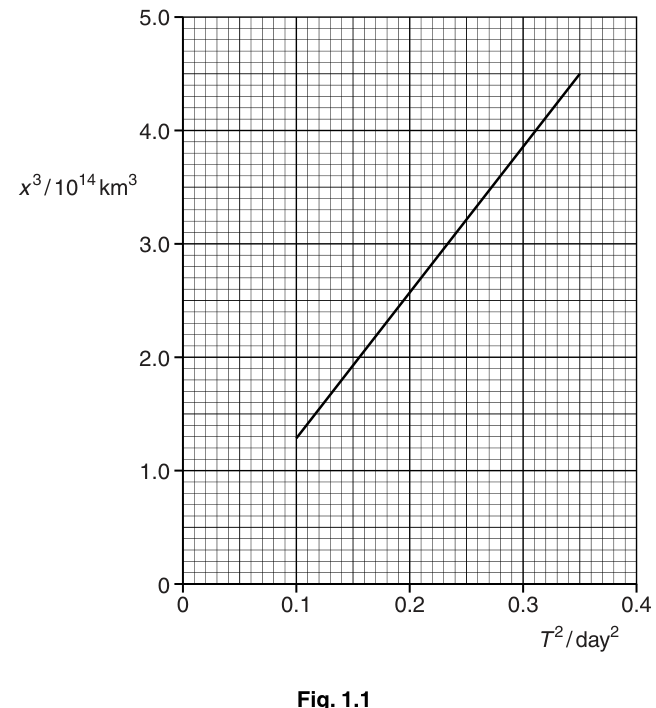
Use Fig. 1.1 and the expression in (b) to determine the mass of Neptune.
mass = ______
Working
From (b):
Graph is of against so gradient .
Using Fig. 1.1 (e.g. point in axis units):
So
Convert units:
and , so
Hence
Answer
1.0 × 10^26 kg
Background Concept
From part (b), the orbit relationship for a moon in a circular orbit around a planet of mass is
Rearranging into a straight-line form helps connect it to the graph:
This matches (a straight line through the origin) with:
- gradient (provided is plotted in SI and in SI).
If the axes are in non-SI units (km, day), you must convert the gradient into before using it in .
Understanding the Question
You are given a straight-line graph of (vertical axis) against (horizontal axis) for Neptune’s moons.
- You must read the gradient of the best-fit line from the graph.
- Use the relationship from (b) to find .
- Then divide by to obtain , the mass of Neptune.
The graph axes are scaled:
- vertical axis is
- horizontal axis is
So the gradient you read is in .
Approach
- Rewrite the equation as so the gradient corresponds to .
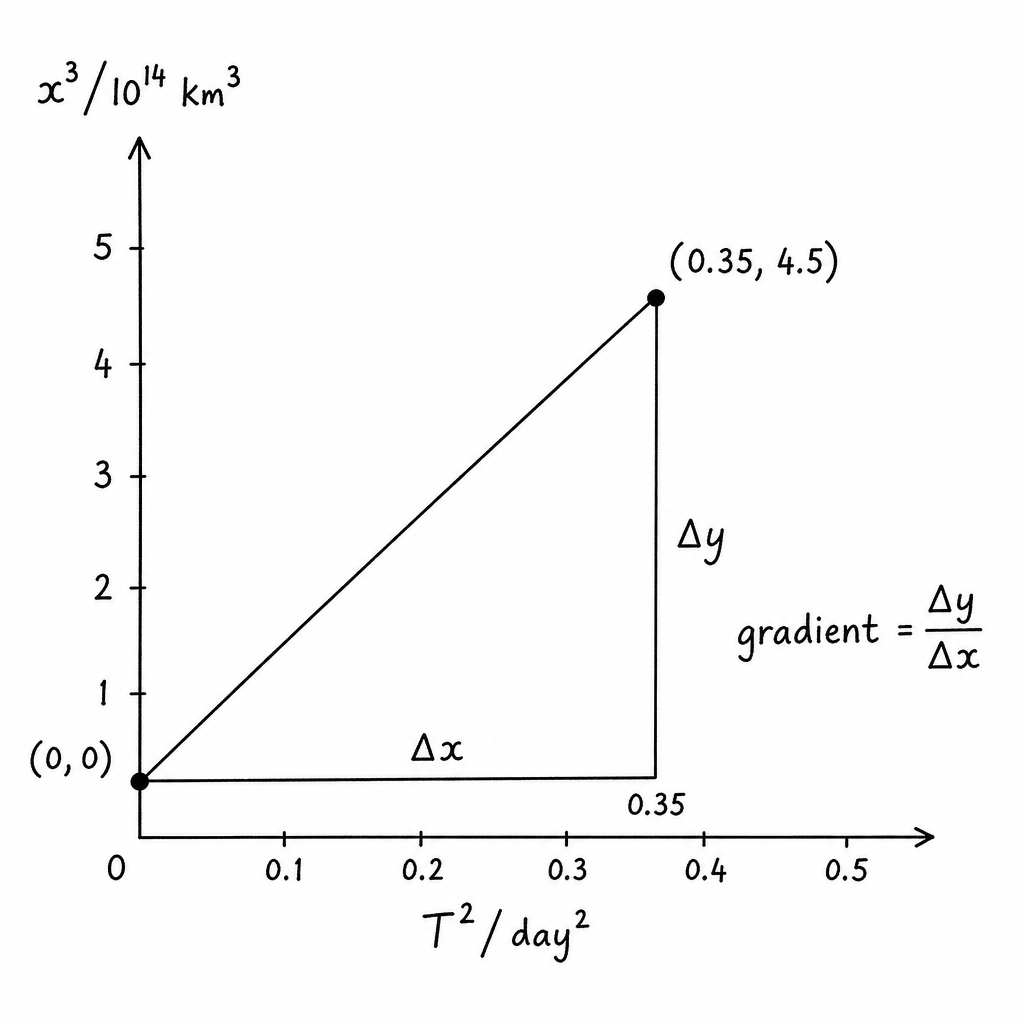
- Find the gradient from two well-separated points on the best-fit line.
- Convert the gradient into SI units ().
- Use (after consistent units) to calculate .
- Use .
Step-by-Step Reasoning
- Linear form:
So the (SI) gradient of a graph of vs would be .
- Read two points on the straight line (choose far apart to reduce percentage reading error). From the figure, a suitable estimate is approximately from the origin to about in the given axis units.
Hence the plotted-number gradient is
- Convert the plotted gradient to actual gradient in .
First convert the scale:
So
Now convert to .
Because ,
So to express the gradient per , divide by :
- Relate gradient to . Since with SI units
then
Numerically, , so
and thus
- Finally,
Key Takeaways
- A straight-line plot of vs for moons orbiting the same planet has gradient related to .
- The gradient must be in SI units before using it in gravitational equations.
- Reading far-apart points on the best-fit line improves the accuracy of the gradient.
Common Mistakes
- Using a single data point rather than the best-fit line to find the gradient.
- Forgetting that the y-axis is scaled by .
- Converting km to m incorrectly for volumes (must cube the conversion factor).
- Treating in day as if it were already in s.
- Using instead of .
Things to Be Careful About
- For volumes: .
- For time-squared: multiply or divide by consistently (here you divide the per-day gradient by to get per-s).
- Quote the mass to a sensible number of significant figures consistent with graph-reading uncertainty (typically 2–3 s.f.).
The rest of this paper
12 more questions- Q2Ideal Gases8M
- Q3Temperature · Thermodynamics · Ideal Gases8M
- Q4Oscillations11M
- Q5Electric Fields5M
- Q6Magnetic Fields7M
- Q7Alternating Currents · Capacitance5M
- Q8Quantum Physics7M
- Q9Nuclear Physics · Ideal Gases10M
- Q10Electronics7M
- Q11Medical Physics8M
- Q12Communication9M
- Q13Communication6M