Physics 9702/43 — October/November 2014
Cambridge A-Level · A Level Structured Questions · worked solutions for every part, with the mark scheme
Topics Magnetic Fields · Oscillations · Thermodynamics · Electric Fields · Capacitance · Quantum Physics · +8 more
A light spring is suspended from a fixed point. A bar magnet is attached to the end of the spring, as shown in Fig. 1.1.
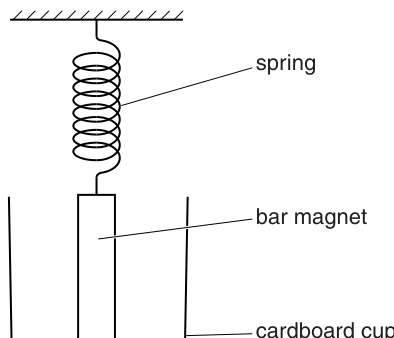
In order to shield the magnet from draughts, a cardboard cup is placed around the magnet but does not touch it.
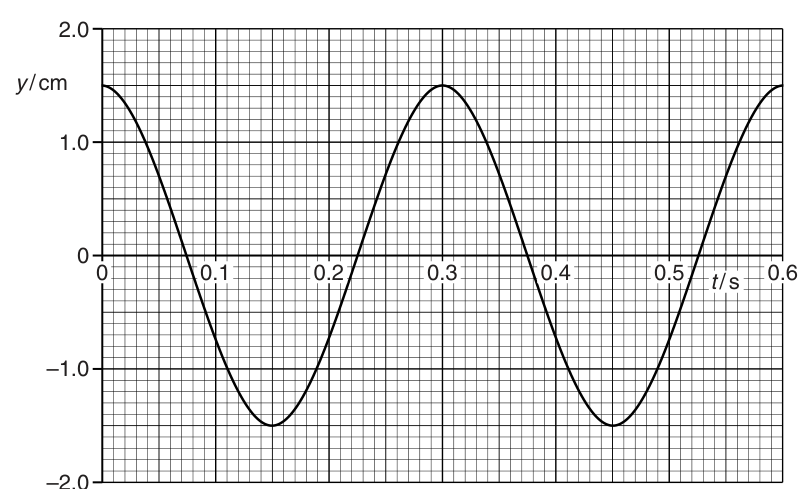
The magnet is displaced vertically and then released. The variation with time of the vertical displacement of the magnet is shown in Fig. 1.2.
The mass of the magnet is .
For the oscillations of the magnet, use Fig. 1.2 to
determine the angular frequency ,
= ______
Working
From Fig. 1.2, time between successive maxima:
Answer
21 rad s^-1
Background Concept
For simple harmonic motion (SHM), the displacement varies sinusoidally with time and repeats after one period . The angular frequency (in ) is related to the period by
Here, corresponds to one complete cycle.
Understanding the Question
You are given a displacement–time graph for the vertical oscillations of the magnet. The task is to use the graph to find the period and hence calculate .
Approach
- Identify two identical points one cycle apart (e.g. two successive maxima).
- Read the time difference to get .
- Substitute into .
Step-by-Step Reasoning
- From the graph description, there is a maximum at and the next maximum at . Hence
- Then
Key Takeaways
- The period is read from repeated points on the displacement–time graph.
- Angular frequency is found using .
Common Mistakes
- Using half a cycle (e.g. max to min) as the period.
- Forgetting the factor of and using .
Things to Be Careful About
- Choose clearly identifiable points (two maxima or two minima) to reduce reading error.
- Keep units consistent: in seconds gives in .
show that the maximum kinetic energy of the oscillating magnet is .
Working
From Fig. 1.2, amplitude
Mass of magnet .
Using ,
Answer
6.4 mJ
Background Concept
In SHM, the speed is greatest as the object passes through the equilibrium position (displacement ). The maximum speed is related to amplitude and angular frequency by
The maximum kinetic energy occurs at this point:
(Equivalently, the total energy in SHM is , which equals the maximum kinetic energy.)
Understanding the Question
From the displacement–time graph you read the amplitude. You already found in part (a)(i). With the given mass , you must show that the maximum kinetic energy is .
Approach
- Read amplitude from the graph and convert to metres.
- Use .
- Substitute into .
Step-by-Step Reasoning
- The graph shows peaks at about and , so
- With ,
- Then
Key Takeaways
- In SHM, maximum kinetic energy occurs at equilibrium where speed is maximum.
- Use and then .
Common Mistakes
- Using amplitude in cm without converting to m, giving an answer too large.
- Using the peak-to-peak displacement () instead of the amplitude ().
- Using instead of .
Things to Be Careful About
- Check units: in , in gives in .
- Significant figures: is appropriate given graph readings.
The cardboard cup is now replaced with a cup made of aluminium foil.
During 10 complete oscillations of the magnet, the amplitude of vibration is seen to decrease to from that shown in Fig. 1.2. The change in angular frequency is negligible.
Use Faraday’s law of electromagnetic induction to explain why the amplitude of the oscillations decreases.
Answer
As the magnet oscillates, the magnetic flux linkage through the aluminium cup changes, so an e.m.f. is induced (Faraday’s law).
This produces induced (eddy) currents in the aluminium. The magnetic field due to these currents opposes the change / motion of the magnet (Lenz’s law), giving a damping force.
Work is done against this force and the electrical energy is dissipated as thermal energy in the cup, so the oscillation energy decreases and the amplitude falls.
Induced eddy currents oppose the motion (Faraday + Lenz), dissipating energy as heat so amplitude decreases.
Background Concept
Faraday’s law states that an e.m.f. is induced when the magnetic flux linkage changes:
The negative sign is Lenz’s law: the induced effect opposes the change that produced it. In a bulk conductor (like an aluminium cup), induced currents circulate in closed loops; these are called eddy currents. Eddy currents cause heating because the conductor has resistance, so electrical energy is dissipated at a rate .
Understanding the Question
Replacing cardboard with aluminium introduces a conducting material near the oscillating magnet. The magnet’s motion changes the magnetic flux through the metal, so induction occurs. The question asks you to explain why this causes the amplitude to decrease (i.e. why the motion is damped).
Approach
- State that magnet motion causes changing flux linkage in the conductor.
- Use Faraday’s law to conclude an induced e.m.f. and current.
- Use Lenz’s law to explain the induced magnetic field opposes the magnet’s motion, creating a resistive (damping) force.
- Link the damping force to energy loss (work done) and heating in the cup.
Step-by-Step Reasoning
- When the magnet moves up and down, the magnetic field pattern relative to the aluminium changes. That means the magnetic flux through loops in the cup is changing with time.
- By Faraday’s law, a changing flux induces an e.m.f. around those loops. Since aluminium is conducting, this e.m.f. drives circulating eddy currents.
- By Lenz’s law, the magnetic field produced by the eddy currents acts so as to oppose the change in flux. In practice, this opposition manifests as a force opposing the magnet’s velocity (a “magnetic drag”).
- On the downward motion, the induced field acts to oppose the increase of flux (and so opposes the downward motion).
- On the upward motion, it opposes the decrease of flux (and again opposes the upward motion).
- Because there is a force opposite to the motion, the magnet does work against this force each cycle. That energy is transferred to the eddy currents and then dissipated as heat in the aluminium (resistive heating).
- As a result, the mechanical energy of the oscillation decreases, so the amplitude steadily falls (damped oscillation).
Key Takeaways
- Changing magnetic flux induces an e.m.f. (Faraday’s law).
- Induced currents create fields that oppose the motion/change (Lenz’s law).
- The opposition does negative work on the oscillator, reducing its energy and amplitude.
Common Mistakes
- Saying “the aluminium attracts the magnet” rather than opposing its motion.
- Describing induction but not linking it to energy dissipation (must mention loss as heat / ).
- Confusing the role of the cardboard cup: cardboard is an insulator so eddy currents cannot flow.
Things to Be Careful About
- The damping is strongest when the magnet moves fastest because is largest then.
- The question states the change in angular frequency is negligible: so you should focus on energy loss (amplitude reduction), not changing .
Show that the loss in energy of the oscillating magnet is .
Working
Total energy in SHM:
Initial amplitude from Fig. 1.2: .
After 10 oscillations: .
With ,
Energy lost:
Answer
4.8 mJ
Background Concept
For SHM with angular frequency and amplitude , the total mechanical energy is
So if and are constant (the question says the change in is negligible), then
This is why damping that reduces amplitude also reduces energy.
Understanding the Question
The magnet starts with the amplitude shown in Fig. 1.2 (about ). With an aluminium cup, after 10 complete oscillations the amplitude is . You must find how much energy has been lost over those 10 oscillations.
You can use the maximum kinetic energy from part (a)(ii) as the initial total energy .
Approach
- Use to find the fraction of energy remaining.
- Multiply that fraction by the initial energy to get final energy.
- Subtract to get the loss.
Step-by-Step Reasoning
- Initial amplitude , final amplitude .
- Energy ratio:
So the oscillation has of its original energy after 10 oscillations.
- With :
- Energy lost:
Key Takeaways
- In SHM (fixed and ), energy scales with .
- Halving the amplitude reduces the energy to one quarter.
Common Mistakes
- Assuming energy is proportional to amplitude rather than .
- Using (peak-to-peak) instead of amplitude.
- Treating as “energy lost” rather than initial energy.
Things to Be Careful About
- The result depends on being effectively constant (stated in the question).
- Keep consistent units: because you use an energy ratio, cm is acceptable for the amplitude ratio (the conversion cancels).
The mass of the aluminium cup in (b) is . The specific heat capacity of aluminium is .
The energy in (b)(ii) is transferred to the cup as thermal energy.
Calculate the mean rise in temperature of the cup.
temperature rise = ______
Working
Energy transferred to cup:
Mass of cup:
Specific heat capacity .
Answer
8.5×10^-4 K
Background Concept
The thermal energy required to raise the temperature of a mass by is
where is the specific heat capacity in . This relationship applies when there is no change of state and the temperature rise is small enough that can be treated as constant.
Understanding the Question
You are told that the energy lost from the oscillations (found in part (b)(ii) as ) is transferred as thermal energy to the aluminium cup of mass . With , you must find the mean temperature rise of the cup.
Approach
- Convert from mJ to J and mass from g to kg.
- Rearrange to .
- Substitute values and calculate.
Step-by-Step Reasoning
- Convert units:
- Rearrangement:
- Substitute:
Compute the denominator: .
So
Key Takeaways
- Use for heating with no phase change.
- Always convert g to kg and mJ to J before substituting.
Common Mistakes
- Using instead of (forgetting grams to kilograms).
- Using instead of (forgetting mJ to J).
- Quoting the answer without units.
Things to Be Careful About
- The temperature rise is very small; writing it in standard form avoids rounding to zero.
- Units check: .
The rest of this paper
12 more questions- Q2Gravitational Fields · Magnetic Fields · Alternating Currents7M
- Q3Ideal Gases · Thermodynamics7M
- Q4Oscillations10M
- Q5Electric Fields · Capacitance10M
- Q6Capacitance4M
- Q7Electric Fields · Magnetic Fields5M
- Q8Quantum Physics10M
- Q9Nuclear Physics · Quantum Physics · Thermodynamics6M
- Q10Electronics8M
- Q11Medical Physics9M
- Q12Communication7M
- Q13Communication6M