Physics 9702/42 — May/June 2014
Cambridge A-Level · A Level Structured Questions · worked solutions for every part, with the mark scheme
Topics Motion in a Circle · Gravitational Fields · Ideal Gases · Electric Fields · Nuclear Physics · Magnetic Fields · +8 more
The mass of a spherical planet may be assumed to be a point mass at the centre of the planet.
A stone, travelling at speed , is in a circular orbit of radius about the planet, as illustrated in Fig. 1.1.
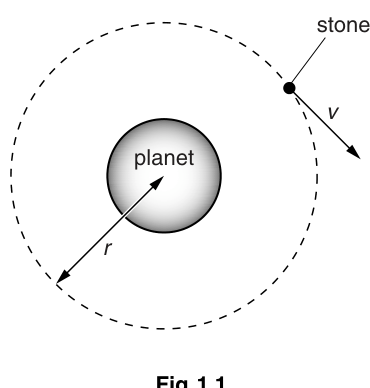
Show that the speed is given by the expression
where is the gravitational constant.
Explain your working.
A second stone, initially at rest at infinity, travels towards the planet, as illustrated in Fig. 1.2.
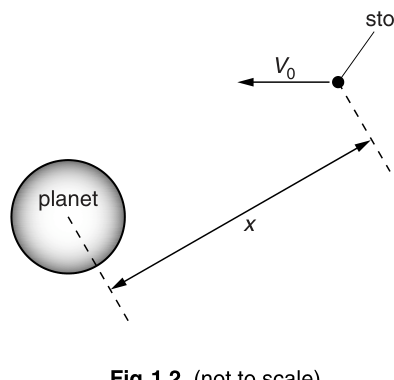
The stone does not hit the surface of the planet.
Determine, in terms of the gravitational constant and the mass of the planet, the speed of the stone at a distance from the centre of the planet. Explain your working.
You may assume that the gravitational attraction on the stone is due only to the planet.
Use your answer in (i) and the expression in (a) to explain whether this stone could enter a circular orbit about the planet.
The rest of this paper
11 more questions- Q2Ideal Gases · Thermodynamics9M
- Q3Oscillations · Temperature5M
- Q4Electric Fields · Gravitational Fields · Nuclear Physics9M
- Q5Magnetic Fields · Alternating Currents7M
- Q6Electric Fields · Magnetic Fields · Motion in a Circle10M
- Q7Motion in a Circle6M
- Q8Quantum Physics7M
- Q9Nuclear Physics · Ideal Gases10M
- Q10Electronics10M
- Q11Medical Physics · Communication12M
- Q12Gravitational Fields · Communication8M