Physics 9702/53 — May/June 2013
Cambridge A-Level · Planning, Analysis and Evaluation · worked solutions for every part, with the mark scheme
Topics Analysis, Conclusions and Evaluation · Planning
A student is investigating the flow of water through a horizontal tube.
The rate (volume per unit time) at which water flows through a tube depends on the pressure difference per unit length across the tube.
The student has the use of a metal can with two holes. A narrow horizontal tube goes through the hole in the side of the can. The can is continuously supplied with water from a tap. The level of water in the can is kept constant by the position of a wide vertical tube which passes through the hole in the bottom of the can as shown in Fig. 1.1. Both tubes may be moved along the holes.
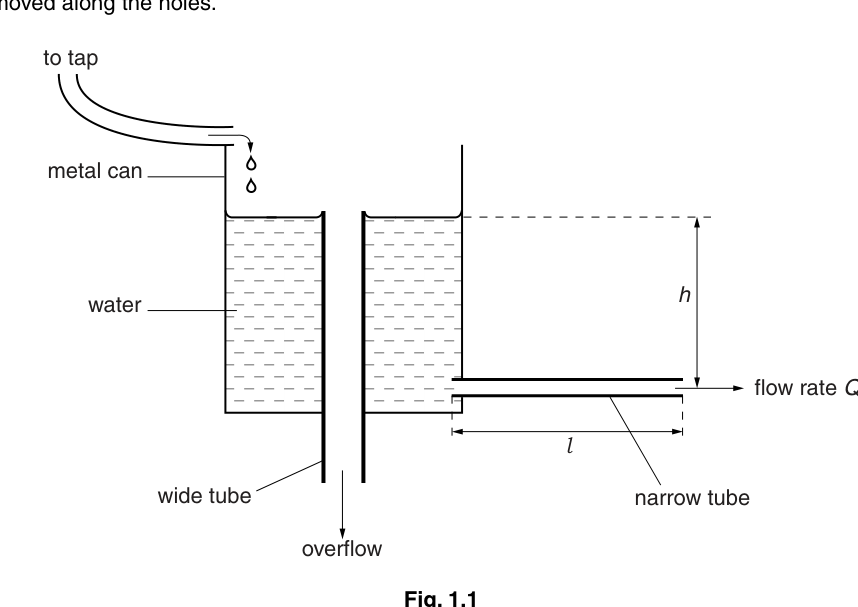
It is suggested that the relationship between the flow rate of water through the narrow horizontal tube and the vertical height is
where is the density of water, is the acceleration of free fall, is the internal diameter of the tube, is the length of the tube and is a constant.
Design a laboratory experiment to test the relationship between and and determine a value for . You should draw a diagram, on page 3, showing the arrangement of your equipment. In your account you should pay particular attention to
(a) the procedure to be followed,
(b) the measurements to be taken,
(c) the control of variables,
(d) the analysis of the data,
(e) the safety precautions to be taken.
The rest of this paper
1 more questions- Q2Analysis, Conclusions and Evaluation15M