Physics 9702/41 — May/June 2013
Cambridge A-Level · A Level Structured Questions · worked solutions for every part, with the mark scheme
Topics Communication · Gravitational Fields · Motion in a Circle · Ideal Gases · Thermodynamics · Oscillations · +7 more
Section A
Answer all the questions in the spaces provided.
State what is meant by a gravitational field.
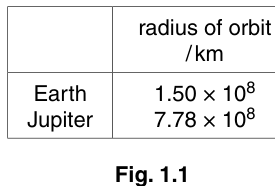
In the Solar System, the planets may be assumed to be in circular orbits about the Sun. Data for the radii of the orbits of the Earth and Jupiter about the Sun are given in Fig. 1.1.
State Newton’s law of gravitation.
Use Newton’s law to determine the ratio
ratio = ______
The orbital period of the Earth about the Sun is .
Use ideas about circular motion to show that the mass of the Sun is given by
where is the radius of the Earth’s orbit about the Sun and is the gravitational constant.
Explain your working.
The orbital period of the Earth about the Sun is .
The radius of the Earth’s orbit is given in Fig. 1.1.
Use the expression in (i) to determine the mass of the Sun.
mass = ______
The rest of this paper
11 more questions- Q2Ideal Gases · Thermodynamics9M
- Q3Oscillations10M
- Q4Electric Fields7M
- Q5Magnetic Fields10M
- Q6Alternating Currents5M
- Q7Quantum Physics9M
- Q8Nuclear Physics7M
- Q9Electronics8M
- Q10Medical Physics9M
- Q11Communication8M
- Q12Communication5M