Physics 9702/42 — October/November 2012
Cambridge A-Level · A Level Structured Questions · worked solutions for every part, with the mark scheme
Topics Magnetic Fields · Communication · Gravitational Fields · Motion in a Circle · Thermodynamics · Ideal Gases · +8 more
State Newton’s law of gravitation.
A satellite of mass is in a circular orbit of radius about a planet of mass .
For this planet, the product is , where is the gravitational constant.
The planet may be assumed to be isolated in space.
By considering the gravitational force on the satellite and the centripetal force, show that the kinetic energy of the satellite is given by the expression
The satellite has mass and is initially in a circular orbit of radius , as illustrated in Fig. 1.1.
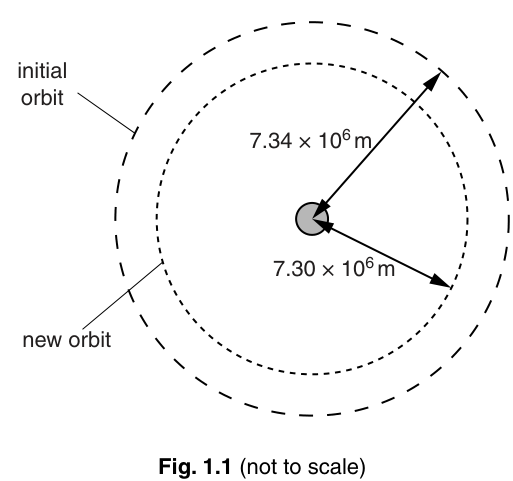
Resistive forces cause the satellite to move into a new orbit of radius .
Determine, for the satellite, the change in
- kinetic energy,
change in kinetic energy = ______
- gravitational potential energy.
change in potential energy = ______
Use your answers in (ii) to explain whether the linear speed of the satellite increases, decreases or remains unchanged when the radius of the orbit decreases.
The rest of this paper
11 more questions- Q2Thermodynamics · Ideal Gases7M
- Q3Temperature7M
- Q4Oscillations9M
- Q5Capacitance12M
- Q6Magnetic Fields · Electric Fields8M
- Q7Magnetic Fields · Alternating Currents9M
- Q8Quantum Physics8M
- Q9Electronics10M
- Q10Medical Physics6M
- Q11Communication7M
- Q12Communication7M