Physics 9702/41 — October/November 2012
Cambridge A-Level · A Level Structured Questions · worked solutions for every part, with the mark scheme
Topics Magnetic Fields · Communication · Gravitational Fields · Motion in a Circle · Thermodynamics · Ideal Gases · +8 more
State Newton’s law of gravitation.
Answer
For two point masses and separated by distance , the force is
It acts along the line joining the masses and is attractive.
For two point masses: F = G m1 m2 / r^2, attractive along the line joining them.
Background Concept
Newton’s law of gravitation describes the mutual gravitational force between two masses. It is a universal inverse-square law: the force depends on the product of the masses and decreases with the square of their separation.
Understanding the Question
You are asked to state the law itself (not to use it in a calculation). For full credit you must give both the mathematical form and the key descriptive features (inverse-square, along the line joining, attractive).
Approach
State the equation for the magnitude of the force between two point masses, then add a short statement about its direction and that it is always attractive.
Step-by-Step Reasoning
- Identify the standard form:
- Add the direction and nature: the force acts along the line joining the two masses and pulls them towards each other (attractive).
Key Takeaways
- Gravitational force between point masses follows an inverse-square law.
- A complete statement includes direction (along the line joining masses) and that the force is attractive.
Common Mistakes
- Writing (missing the square).
- Forgetting to mention that the force acts along the line joining the masses.
- Saying it can be repulsive (gravity between masses is always attractive).
Things to Be Careful About
- Use as the centre-to-centre separation of the masses.
- Make clear you are giving the magnitude; direction must be stated separately.
A satellite of mass is in a circular orbit of radius about a planet of mass .
For this planet, the product is , where is the gravitational constant.
The planet may be assumed to be isolated in space.
By considering the gravitational force on the satellite and the centripetal force, show that the kinetic energy of the satellite is given by the expression
Working
Gravitational force provides centripetal force:
So
Kinetic energy
Answer
EK = GMm / (2r)
Background Concept
For uniform circular motion of radius and speed , the required centripetal force is
In a circular orbit around an isolated planet (mass ), the only significant force on the satellite (mass ) is gravity, with magnitude
For a stable circular orbit, the gravitational force acts towards the centre and exactly supplies the centripetal force.
Understanding the Question
You must show (derive) the given expression for the satellite’s kinetic energy in a circular orbit of radius around mass . The key idea is: set gravitational force equal to centripetal force, find , then use .
Approach
- Write down and .
- Equate them because gravity is the centripetal force in an orbit.
- Rearrange to get in terms of and .
- Substitute into .
Step-by-Step Reasoning
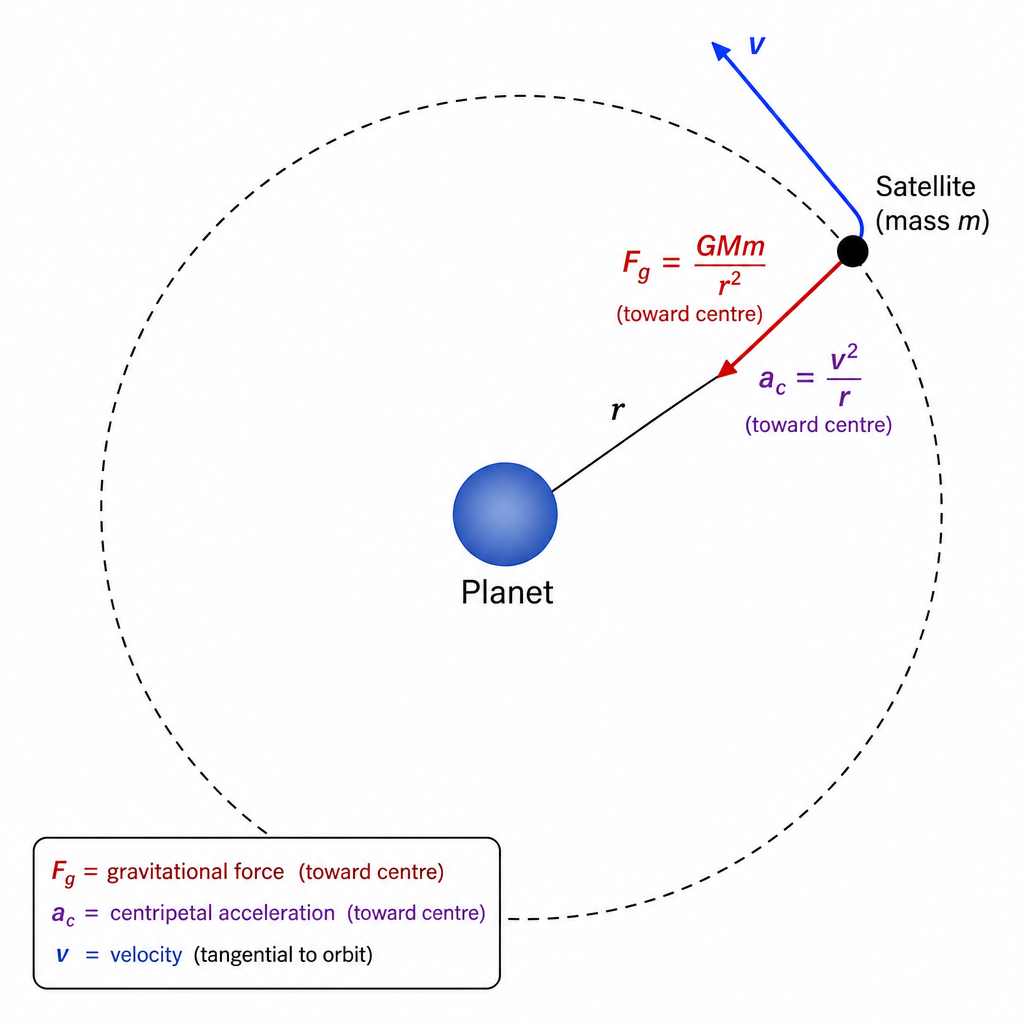
- Gravitational force on the satellite:
- Centripetal force needed for circular motion at speed :
- In orbit, the only force is gravity, directed towards the centre, so
Cancel and rearrange:
- Kinetic energy is
Substitute :
Key Takeaways
- In a circular orbit, gravity supplies the centripetal force.
- Orbital speed satisfies .
- Therefore varies as for circular orbits.
Common Mistakes
- Using but then mixing and incorrectly.
- Forgetting that centripetal force is not an extra force: it is provided by gravity here.
- Algebra slip: losing a factor of when equating to .
Things to Be Careful About
- This result is for a circular orbit (constant and ).
- is the orbital radius measured from the planet’s centre.
- Cancelling is valid because and appears on both sides.
The satellite has mass and is initially in a circular orbit of radius , as illustrated in Fig. 1.1.
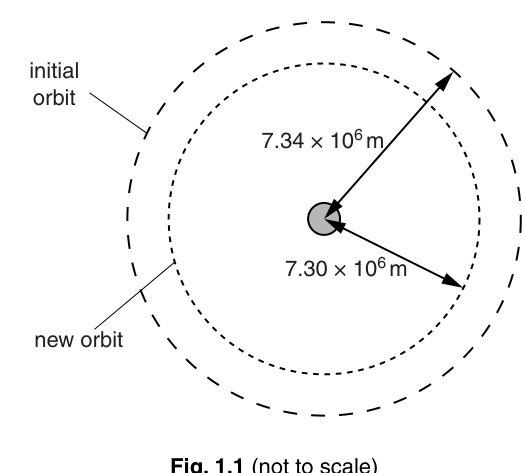
Resistive forces cause the satellite to move into a new orbit of radius .
Determine, for the satellite, the change in
- kinetic energy,
change in kinetic energy = ______
- gravitational potential energy.
change in potential energy = ______
Working
Given , .
Kinetic energy in circular orbit:
So
with , .
Gravitational potential energy:
Answer
Change in kinetic energy
Change in potential energy
ΔKE = +9.3 × 10^7 J, ΔU = −1.9 × 10^8 J
Background Concept
For a satellite in a circular orbit around a planet (mass ), two key energy expressions apply:
- From circular motion and gravitation,
- Taking gravitational potential energy to be zero at infinity,
When the orbit radius changes from to , the changes are
Signs matter: if decreases, becomes more negative, so is negative.
Understanding the Question
You are given for the planet and the satellite mass . The satellite moves from an orbit of radius to a slightly smaller orbit . You must calculate the numerical change in:
- kinetic energy ,
- gravitational potential energy .
Because the two radii are close, it is efficient (and reduces rounding error) to use the difference in rather than calculating two large energies and subtracting.
Approach
- Compute the constant product .
- Use
- Use
- Check signs: since , the bracket is positive, so positive and negative.
Step-by-Step Reasoning
- Calculate :
(Units are joules when divided by because has units , so has units .)
- Compute the difference in reciprocal radii:
- Kinetic energy change:
Positive means the satellite’s kinetic energy increases.
- Potential energy change:
Negative means the satellite loses gravitational potential energy (it is closer to the planet, so more tightly bound).
- Quick consistency check (useful in exams): for circular orbits,
So changes should satisfy approximately , which matches here: .
Key Takeaways
- For circular orbits: and .
- When decreases: increases (positive change) and decreases (negative change).
- Using is a neat way to avoid subtracting close large numbers.
Common Mistakes
- Forgetting the minus sign in .
- Reporting only magnitudes and not the sign of the change.
- Using (wrong sign).
- Rounding and too aggressively before subtracting, giving a poor .
Things to Be Careful About
- Keep in metres.
- is given; do not try to insert a value of separately.
- Quote final answers to appropriate significant figures and include units ().
Use your answers in (ii) to explain whether the linear speed of the satellite increases, decreases or remains unchanged when the radius of the orbit decreases.
Answer
From (ii), kinetic energy increases as the radius decreases, so since , the linear speed increases.
(Equivalently, , so smaller gives larger .)
Increases
Background Concept
For a mass moving at speed , kinetic energy is
So if increases (with constant ), then and hence must increase.
For a circular gravitational orbit, equating gravity to centripetal force gives
which also shows directly that decreasing increases .
Understanding the Question
You must use your calculated changes in kinetic energy and potential energy to decide what happens to the satellite’s linear speed when the orbit radius decreases from to .
Approach
Use the sign of from (ii). If , then the speed must have increased. You can also support it by quoting .
Step-by-Step Reasoning
-
From (ii), the change in kinetic energy is positive (). Therefore is larger in the smaller-radius orbit.
-
Since
and is constant, an increase in implies an increase in , so increases.
- This matches the orbit relation:
If decreases, the right-hand side increases, so must increase.
- Note how the energies fit together physically: the satellite loses gravitational potential energy (becomes more negative) and gains some kinetic energy; overall, the total mechanical energy becomes more negative (energy is dissipated by resistive forces), but the speed can still increase.
Key Takeaways
- Positive change in kinetic energy means speed increases.
- For circular orbits, smaller radius means higher orbital speed ().
- Decreasing radius can occur even with resistive forces because total energy decreases while kinetic energy can increase.
Common Mistakes
- Thinking “resistive forces always slow it down” and concluding speed decreases; in orbital decay the speed in the new lower circular orbit is actually higher.
- Using instead of .
- Ignoring the sign of the change and comparing magnitudes only.
Things to Be Careful About
- The conclusion applies to circular orbits at the stated radii (i.e. comparing speeds of two circular orbits). During the transition the motion need not be circular at every instant.
- Make the reasoning explicit: link to via (or quote ).
The rest of this paper
11 more questions- Q2Thermodynamics · Ideal Gases7M
- Q3Temperature7M
- Q4Oscillations9M
- Q5Capacitance12M
- Q6Magnetic Fields · Electric Fields8M
- Q7Magnetic Fields · Alternating Currents9M
- Q8Quantum Physics8M
- Q9Electronics10M
- Q10Medical Physics6M
- Q11Communication7M
- Q12Communication7M