Physics 9702/43 — October/November 2010
Cambridge A-Level · A Level Structured Questions · worked solutions for every part, with the mark scheme
Topics Electric Fields · Magnetic Fields · Medical Physics · Motion in a Circle · Gravitational Fields · Ideal Gases · +7 more
A planet of mass is in a circular orbit of radius about the Sun of mass , as illustrated in Fig. 1.1.
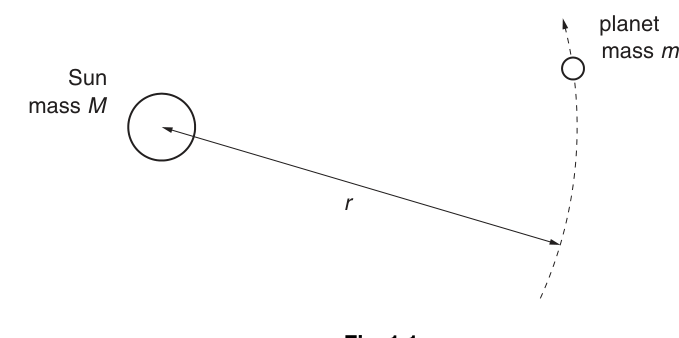
The magnitude of the angular velocity and the period of revolution of the planet about the Sun are and respectively.
State
what is meant by angular velocity,
Answer
Angular velocity is the rate of change of angular displacement with time:
(unit: ).
Angular velocity is the rate of change of angular displacement with time, ω = dθ/dt (unit rad s⁻¹).
Background Concept
When an object moves in a circle, its position can be described by an angle (in radians) measured about the centre. The angular velocity tells you how quickly this angle is changing.
By definition,
The SI unit is . (Radians are technically dimensionless, but we write rad to show it is an angular quantity.)
Understanding the Question
The planet is moving in a circular orbit, so it continually sweeps out angular displacement about the Sun. The question asks you to state what “angular velocity” means.
Approach
Give the definition in words and/or as an equation: “rate of change of angular displacement with time”. Including the equation and unit secures full credit.
Step-by-Step Reasoning
- In circular motion, the angular position is .
- “How fast the angle changes” means change in angle per unit time.
- Therefore , with unit .
Key Takeaways
- Angular velocity is a rate: angle per time.
- Standard definition: .
Common Mistakes
- Defining it as “speed” without mentioning it is angular (not linear) or without reference to angular displacement.
- Giving units as only; examiners usually expect .
Things to Be Careful About
- Use in radians when using circular-motion formulae such as .
- Do not confuse angular velocity with angular displacement .
the relation between and .
Answer
In one period , the angular displacement is rad, so
ω = 2π / T
Background Concept
For uniform circular motion, the object repeats its motion every period . In that time it completes one full revolution, which corresponds to an angular displacement of radians.
Angular velocity is the rate of change of angular displacement:
Understanding the Question
You are told the planet’s angular velocity is and its period of revolution is . The question asks for the relationship between these two quantities.
Approach
Use for one full orbit and .
Step-by-Step Reasoning
For one revolution:
Time taken:
So
Key Takeaways
- One full revolution corresponds to rad.
- and are inversely related: faster orbiting means smaller period.
Common Mistakes
- Writing instead of dividing by .
- Confusing period with frequency ; remember and .
Things to Be Careful About
- The formula assumes uniform angular speed (true for a circular orbit at constant speed).
- Keep exact rather than using a decimal too early.
Show that, for a planet in a circular orbit of radius , the period of the orbit is given by the expression
where is a constant. Explain your working.
Working
Gravitational force provides centripetal force:
Using ,
So where
Answer
with .
T^2 = (4π^2/GM) r^3, so c = 4π^2/(GM).
Background Concept
A planet in a circular orbit must have a centripetal (inward) acceleration to continuously change the direction of its velocity.
For circular motion of radius and angular speed :
The required centripetal force is therefore:
For a planet orbiting the Sun, the only significant force on the planet is the gravitational attraction between the Sun (mass ) and the planet (mass ):
A stable circular orbit occurs when gravity supplies exactly the centripetal force.
Understanding the Question
You are asked to show that the period satisfies
for a circular orbit of radius , where is a constant (for a given central mass ). This is essentially Kepler’s third law for circular orbits.
Approach
- Write the gravitational force on the planet.
- Write the centripetal force needed for circular motion.
- Set them equal (because gravity provides the centripetal force).
- Use to replace with .
- Rearrange into the required form and identify .
Step-by-Step Reasoning
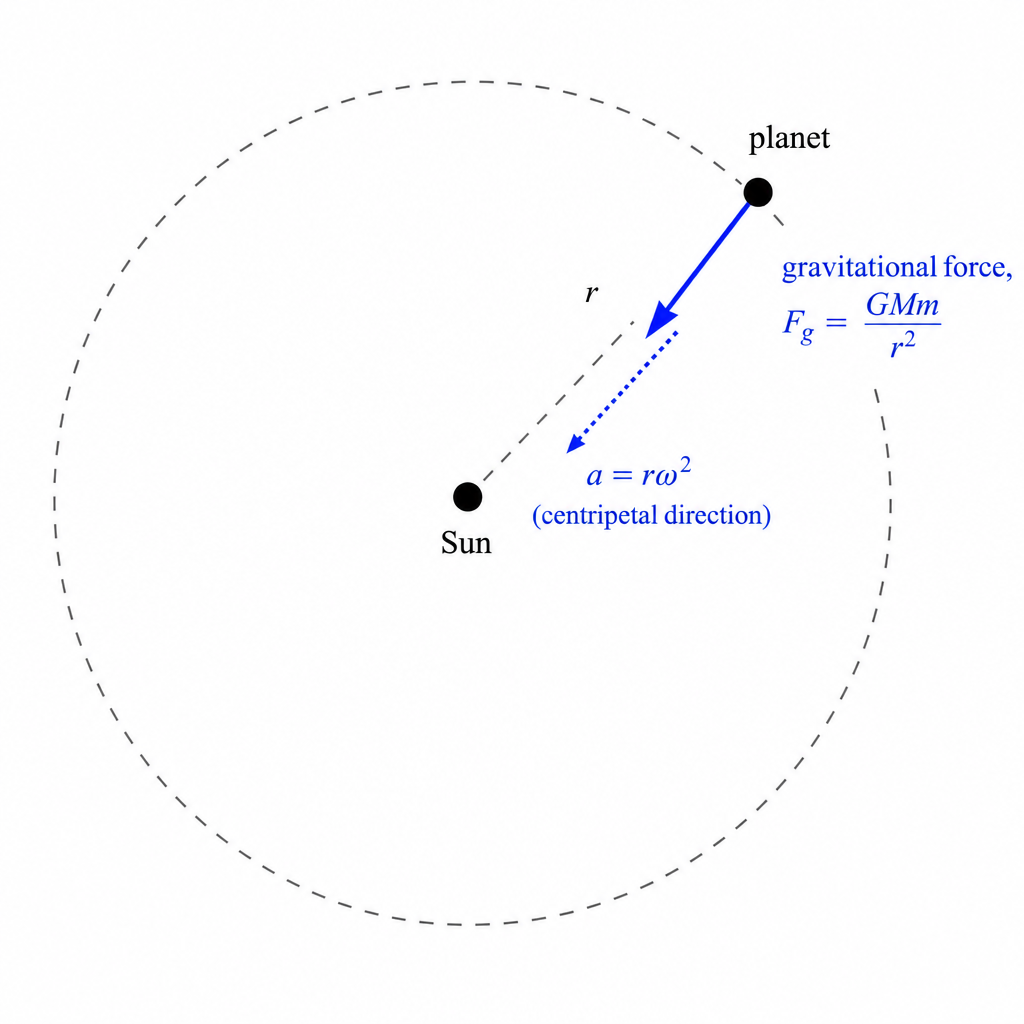
- Gravitational force on the planet due to the Sun is
- For circular motion, the required centripetal force is
- In a circular orbit, gravity is the centripetal force:
- Cancel (important insight: the planet mass does not affect the period):
So
- Relate to period:
Square both sides and substitute:
- Rearrange to make the subject:
Hence it matches with
So for planets orbiting the same Sun (same ), is constant.
Key Takeaways
- Circular orbit condition: gravitational force = centripetal force.
- Derivation leads to Kepler’s third-law form .
- The orbit period depends on and , not on the planet’s own mass .
Common Mistakes
- Using the wrong centripetal force form, e.g. instead of .
- Forgetting to square .
- Dropping a power of when rearranging, leading to or .
Things to Be Careful About
- is the orbital radius (distance from the Sun’s centre), not the planet’s radius.
- This result assumes a circular orbit and that gravity is the only significant force.
- When identifying , treat and as constants for all planets orbiting the same Sun.
Data for the planets Venus and Neptune are given in Fig. 1.2.
| planet | ||
|---|---|---|
| Venus | 1.08 | 0.615 |
| Neptune | 45.0 |
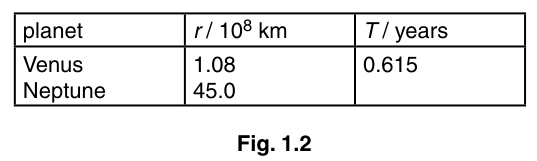
Assume that the orbits of both planets are circular.
Use the expression in (b) to calculate the value of for Neptune.
= ______
Working
For planets orbiting the Sun,
So
Answer
165 years
Background Concept
From part (b), for circular orbits around the same central mass (the Sun),
where is the same for all planets orbiting the Sun. Therefore,
This means you can compare two planets using ratios without ever calculating .
Understanding the Question
You are given:
- Venus: ,
- Neptune: , unknown
You must find assuming circular orbits about the same Sun.
Approach
Use the ratio form:
Then solve for . The factors of cancel automatically if you use the tabulated values consistently.
Step-by-Step Reasoning
Start with
Rearrange:
Take square root:
Now substitute (using the numbers from the table; common units cancel):
So
Compute .
Thus
Key Takeaways
- For orbits around the same central mass: is constant.
- Ratio methods avoid calculating or and avoid unit conversion here.
Common Mistakes
- Forgetting the exponent and using instead of .
- Mixing units between planets (e.g. one in km and one in m) if not using the table consistently.
- Rounding too early in the ratio, causing noticeable numerical drift.
Things to Be Careful About
- The relationship applies because both orbit the Sun (same ). It would not be valid if one orbited a different star.
- Keep at least 3 significant figures during intermediate steps; round at the end to a sensible number (typically 3 s.f. or to match the data).
Determine the linear speed of Venus in its orbit.
speed = ______
Working
Answer
35 km s⁻¹
Background Concept
For uniform circular motion, an object travels one circumference in one period . Therefore the linear (tangential) speed is
You must ensure and are in compatible units (e.g. km and s to get ).
Understanding the Question
You need the orbital speed of Venus.
Given:
Required: speed in , so convert years to seconds.
Approach
- Use .
- Convert from years to seconds.
- Substitute and calculate, keeping units consistent.
Step-by-Step Reasoning
- Start with
- Convert the period to seconds. Using ,
- Substitute in km and in s:
- Numerically this gives
Key Takeaways
- Linear speed in a circular orbit: .
- Correct unit conversion is essential to match requested units.
Common Mistakes
- Using (missing the ).
- Forgetting to convert years to seconds, producing a speed in .
- Converting into metres but still reporting .
Things to Be Careful About
- Use a consistent value for seconds per year (typically ) and keep enough significant figures during calculation.
- The speed found is tangential speed; direction is continually changing, but the magnitude is constant for a circular orbit.
The rest of this paper
11 more questions- Q2Ideal Gases · Nuclear Physics13M
- Q3Oscillations12M
- Q4Electric Fields · Capacitance9M
- Q5Magnetic Fields9M
- Q6Alternating Currents5M
- Q7Electric Fields · Magnetic Fields5M
- Q8Quantum Physics6M
- Q9Medical Physics8M
- Q10Electronics8M
- Q11Medical Physics6M
- Q12Communication8M