Physics 9702/42 — October/November 2010
Cambridge A-Level · A Level Structured Questions · worked solutions for every part, with the mark scheme
Topics Gravitational Fields · Communication · Ideal Gases · Thermodynamics · Oscillations · Capacitance · +8 more
Section A
Answer all the questions in the spaces provided.
Define gravitational field strength.
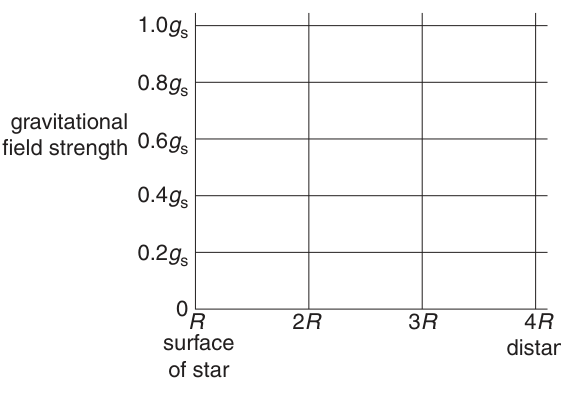
An isolated star has radius . The mass of the star may be considered to be a point mass at the centre of the star.
The gravitational field strength at the surface of the star is .
On Fig. 1.1, sketch a graph to show the variation of the gravitational field strength of the star with distance from its centre. You should consider distances in the range to .
The Earth and the Moon may be considered to be spheres that are isolated in space with their masses concentrated at their centres.
The masses of the Earth and the Moon are and respectively.
The radius of the Earth is and the separation of the centres of the Earth and the Moon is , as illustrated in Fig. 1.2.
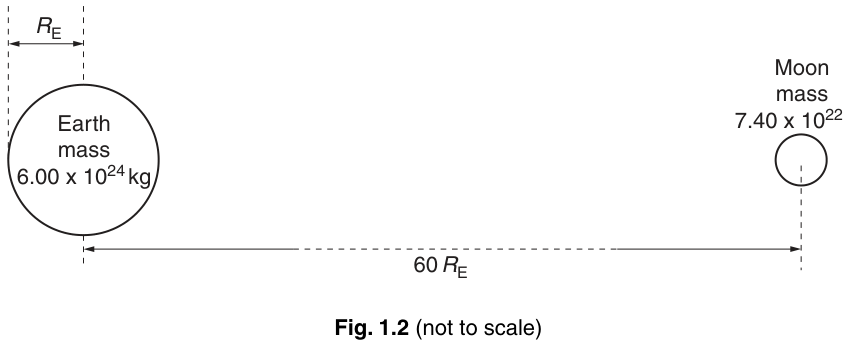
Explain why there is a point between the Earth and the Moon at which the gravitational field strength is zero.
Determine the distance, in terms of , from the centre of the Earth at which the gravitational field strength is zero.
distance = ______
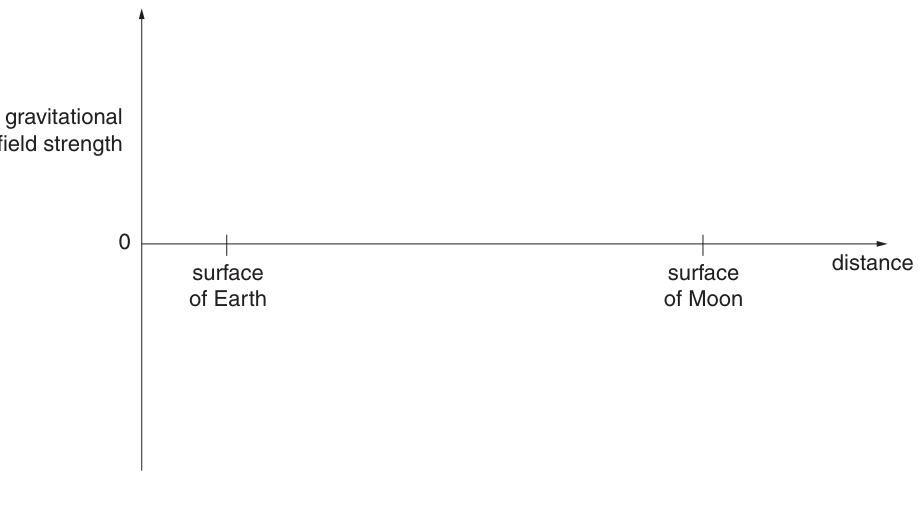
On the axes of Fig. 1.3, sketch a graph to show the variation of the gravitational field strength with position between the surface of the Earth and the surface of the Moon.
The rest of this paper
11 more questions- Q2Ideal Gases · Thermodynamics11M
- Q3Oscillations9M
- Q4Capacitance · Electric Fields11M
- Q5Magnetic Fields · Motion in a Circle7M
- Q6Alternating Currents8M
- Q7Quantum Physics5M
- Q8Nuclear Physics8M
- Q9Electronics5M
- Q10Medical Physics9M
- Q11Communication8M
- Q12Gravitational Fields · Communication8M