Physics 9702/43 — May/June 2010
Cambridge A-Level · A Level Structured Questions · worked solutions for every part, with the mark scheme
Topics Alternating Currents · Electronics · Gravitational Fields · Oscillations · Temperature · Electric Fields · +5 more
Define gravitational potential at a point.
Answer
Gravitational potential at a point is the work done per unit mass by an external agent in bringing a small test mass from infinity to that point (with no change in kinetic energy).
Work done per unit mass to bring a test mass from infinity to the point (no change in KE).
Background Concept
Gravitational potential at a point is a measure of “how much gravitational potential energy per unit mass” an object would have at that point, taking at infinity.
Because it is per unit mass, its unit is
For a gravitational field, the change in gravitational potential energy is related to potential by
Understanding the Question
You are asked to define gravitational potential at a point. A good Cambridge definition must include:
- that it is work done per unit mass, and
- that the reference position is infinity (where potential is taken as zero), and typically
- that the mass is brought slowly so there is no change in kinetic energy.
Approach
Write the standard definition: describe moving a small test mass from infinity to the point, then express it as work done per unit mass (or potential energy per unit mass).
Step-by-Step Reasoning
- Choose the reference: at infinity.
- Bring a small test mass from infinity to the point. If it is moved slowly, its kinetic energy does not change.
- The work done by an external agent (against the gravitational attraction) equals the gain in gravitational potential energy.
- Divide this work by the mass to get “per unit mass”, which is the gravitational potential .
Key Takeaways
- Gravitational potential is work done per unit mass from infinity.
- Units: .
- Infinity is the standard zero of potential for isolated spherical masses.
Common Mistakes
- Defining it as “force per unit mass” (that is gravitational field strength ).
- Missing “per unit mass”.
- Not stating the reference point (infinity).
Things to Be Careful About
- Potential is a scalar.
- In gravity, potentials near a mass are negative when .
The Earth may be considered to be an isolated sphere of radius with its mass concentrated at its centre.
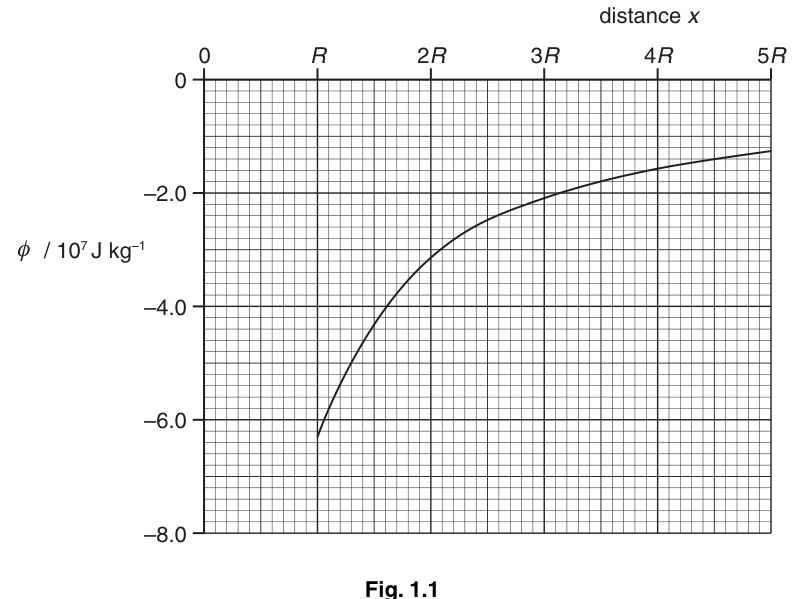
The variation of the gravitational potential with distance from the centre of the Earth is shown in Fig. 1.1.
The radius of the Earth is .
By considering the gravitational potential at the Earth’s surface, determine a value for the mass of the Earth.
mass = ______
Working
From Fig. 1.1 at , take
For a spherical mass,
Answer
6.0 × 10^24 kg
Background Concept
For a spherically symmetric body (mass concentrated at its centre), the gravitational potential at distance from the centre is
taking at infinity. This is why the graph approaches as increases.
Understanding the Question
You are given a graph of gravitational potential against distance from Earth’s centre, and the Earth’s radius .
At the Earth’s surface, the distance from the centre is . Reading at lets you solve for Earth’s mass using .
Approach
- Read the surface potential from the graph.
- Use .
- Rearrange to get .
- Substitute values carefully (including the negative sign and powers of ten).
Step-by-Step Reasoning
- From the graph, at the potential is about on the scale of , so
- Use the spherical potential formula:
- Rearrange:
- Substitute and :
The sign works out because is negative, but mass must be positive.
Key Takeaways
- For an isolated sphere, .
- Surface potential gives via .
- Care with signs: is negative, is positive.
Common Mistakes
- Using or another value instead of for the surface.
- Dropping the negative sign and getting a negative mass.
- Reading the graph value but forgetting the axis scale factor .
Things to Be Careful About
- is distance from the centre of Earth.
- Quote to a sensible number of significant figures consistent with the graph reading (typically 2 s.f.).
A meteorite is at rest at infinity. The meteorite travels from infinity towards the Earth.
Calculate the speed of the meteorite when it is at a distance of above the Earth’s surface. Explain your working.
speed = ______
Working
At above the surface, distance from centre
From the variation,
Meteorite starts from rest at infinity, so using energy per unit mass:
Answer
6.5 × 10^3 m s^-1
Background Concept
If gravitational potential is defined with , then for a mass at radius the gravitational potential energy is
If an object falls from infinity starting from rest, its total mechanical energy per unit mass stays constant:
At infinity, and , so the constant is :
This is a very efficient way to find the speed from a known potential.
Understanding the Question
A meteorite starts at rest at infinity and moves towards Earth. You must find its speed when it is a distance above Earth’s surface.
“ above the surface” is an altitude. The gravitational potential graph is plotted against distance from the centre, so you must convert to radius from the centre:
Then you need at , and use energy conservation to get .
Approach
- Convert altitude to distance from Earth’s centre ().
- Find from the graph (or from the form).
- Apply conservation of energy per unit mass: .
- Solve for .
Step-by-Step Reasoning
- Distance from centre:
- From the graph, . For an isolated sphere , so tripling makes the potential one third as negative:
- Use energy per unit mass. At infinity, total specific energy is . So at :
Hence
- Solve for speed:
Key Takeaways
- Convert “above the surface” to radius from the centre before using .
- Falling from rest at infinity gives the very useful relation .
- Gravitational potential is negative; the minus sign is essential.
Common Mistakes
- Taking the distance as instead of .
- Using with the wrong sign (getting negative kinetic energy).
- Treating as if it were gravitational field strength .
Things to Be Careful About
- Use distance from the centre consistently.
- Keep units as for potential; then comes out in because .
In practice, the Earth is not an isolated sphere because it is orbited by the Moon, as illustrated in Fig. 1.2.
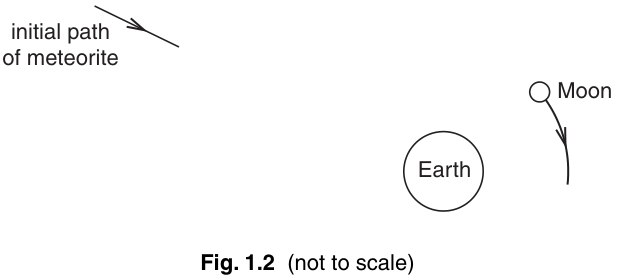
The initial path of the meteorite is also shown.
Suggest two changes to the motion of the meteorite caused by the Moon.
-
______
-
______
Answer
- The meteorite’s path is deflected (trajectory curves) towards the Moon, so it is not along the isolated-Earth path.
- The meteorite’s speed at a given position changes because the Moon’s gravity changes the gravitational potential/energy (it may be accelerated towards the Moon and could even strike or be captured by it).
Trajectory deflected towards Moon; speed at a given point altered (may be accelerated towards Moon / possibly collide or be captured).
Background Concept
Gravitational effects from more than one body combine by superposition:
- The net gravitational field at a point is the vector sum of the individual fields.
- The net gravitational potential at a point is the scalar sum of the individual potentials.
So with Earth and Moon present, the meteorite experiences an additional gravitational pull towards the Moon as well as towards Earth.
Understanding the Question
In the earlier parts, Earth was treated as an isolated sphere so the meteorite would accelerate directly towards Earth’s centre (a symmetric situation).
Now the Moon is present. The question asks for two changes to the motion (so typically one about direction/trajectory and one about speed/energy, or two distinct trajectory outcomes).
Approach
Think in terms of:
- Direction of acceleration: the Moon adds a sideways component of gravitational force, so the meteorite’s velocity direction changes.
- Speed/energy: the Moon changes the potential energy landscape, so the speed at a given location relative to Earth alone will not be the same.
Step-by-Step Reasoning
- Without the Moon, forces point towards Earth’s centre only, giving a path aimed at Earth.
- With the Moon, there is an additional force towards the Moon. Unless the meteorite is exactly on the Earth–Moon line in a symmetric position, this extra force is not collinear with the Earth’s force.
- Therefore the resultant acceleration is not directly towards Earth’s centre, so the path bends (deflects) towards the Moon.
- Because potential is a scalar that adds, the total gravitational potential at a point is more negative than with Earth alone (especially near the Moon). As the meteorite moves into a region of lower (more negative) potential, it loses more potential energy and gains kinetic energy differently, so its speed profile changes.
- Depending on the geometry, the meteorite could pass closer to the Moon, be pulled into collision with the Moon, or be gravitationally deflected so it misses Earth.
Key Takeaways
- Superposition: fields add as vectors, potentials add as scalars.
- An extra massive body generally causes (i) a change in direction (trajectory) and (ii) a change in speed/energy compared with the isolated-body case.
Common Mistakes
- Saying only “it goes faster” twice (need two distinct changes).
- Claiming the potential graph of Earth alone still applies exactly (it does not when another mass is nearby).
- Ignoring that force is a vector: the key effect is often a sideways deflection.
Things to Be Careful About
- Keep statements qualitative but physically specific (e.g. “deflected towards the Moon” is better than “path changes”).
- If you mention collision/capture, tie it to the Moon’s gravitational attraction (not random chance).
The rest of this paper
11 more questions- Q2Oscillations9M
- Q3Temperature9M
- Q4Electric Fields9M
- Q5Capacitance · Alternating Currents9M
- Q6Magnetic Fields9M
- Q7Alternating Currents7M
- Q8Nuclear Physics7M
- Q9Electronics10M
- Q10Electronics6M
- Q11Medical Physics6M
- Q12Communication8M