Chemistry 9701/38 — October/November 2025
Cambridge AS Level · Advanced Practical Skills · worked solutions for every part, with the mark scheme
Topics Manipulation, Measurement and Observation · Presentation of Data and Observations · Analysis, Conclusions and Evaluation · Qualitative Analysis
Many hydrated salts decompose when heated, losing water of crystallisation.
The number of molecules of water of crystallisation, , in hydrated aluminium sulfate can be determined by heating until it becomes anhydrous: is an integer.
FB 1 is hydrated aluminium sulfate, .
Method
- Weigh the crucible with its lid. Record the mass.
- Add between 1.80 and 2.00 g of FB 1 to the crucible.
- Weigh the crucible, lid and FB 1. Record the mass.
- Place the crucible on the pipeclay triangle. Gently heat the crucible and contents for approximately 2 minutes with the lid on.
- Remove the lid. Heat the crucible and contents strongly for approximately 5 minutes.
- Replace the lid and leave the crucible and residue to cool for at least 5 minutes.
While the crucible is cooling, you should begin work on Questions 2 or 3.
- Reweigh the crucible and contents with the lid on. Record the mass.
- Remove the lid. Heat the crucible and contents strongly for a further 2 minutes.
- Replace the lid and leave the crucible and residue to cool for at least 5 minutes.
- Reweigh the crucible and residue with the lid on. Record the mass.
- Calculate and record the mass of FB 1 used, the mass of residue obtained and the mass lost during heating.
Results
Prepare a table for your results in the space provided.
Answer
Results table (example readings, all to 2 decimal places):
| Reading | Mass / g |
|---|---|
| empty crucible + lid | 25.00 |
| crucible + lid + FB 1 | 26.90 |
| crucible + lid + residue after 1st heating | 26.05 |
| crucible + lid + residue after 2nd heating | 26.03 |
| mass of FB 1 used | 1.90 |
| mass of residue | 1.03 |
| mass of water lost | 0.87 |
- All four weighings recorded to the same number of decimal places (2 d.p.).
- Reading after 2nd heating (26.03 g) is within +0.02 / −0.05 g of the reading after 1st heating (26.05 g): constant mass achieved.
- Mass of FB 1 used (1.90 g) is within the required 1.80–2.00 g range.
Representative table: FB 1 = 1.90 g, residue = 1.03 g, water lost = 0.87 g; all readings to 2 d.p.; constant mass achieved (26.03 g vs 26.05 g).
Background Concept
Water of crystallisation is water trapped inside the crystal lattice of a hydrated salt. When the salt is heated, this water is driven off as steam, leaving the anhydrous salt behind. The mass lost on heating is therefore exactly the mass of water of crystallisation. By comparing the moles of water lost with the moles of anhydrous salt remaining, the stoichiometric coefficient in the formula can be found. The reliability of the whole experiment rests on the quality of the mass measurements: the balance readings must be precise and consistent, and heating must be repeated until two successive weighings agree (constant mass), proving that all the water has been driven off.
Understanding the Question
Part (a) asks the candidate to carry out the heating procedure and record the results in a table. The marks are awarded for the quality of the data table (seven unambiguous headings with units), the precision of the weighings (same decimal places), the agreement between the two post-heating weighings (constant mass), and correct subtractions giving the masses of FB 1, residue and water lost. The accuracy marks depend on the ratio mass FB 1 / mass residue falling in a set range, which reflects how close the candidate's value of is to the true value.
Approach
Weigh the empty crucible with lid, then with FB 1 added; the difference is the mass of FB 1. Heat gently with the lid on (to prevent spitting) then strongly with the lid off (to allow steam to escape). Cool, reweigh, heat again, cool, reweigh. If the two post-heating masses agree within about 0.02–0.05 g, all water has been removed. Record everything in a table with clear headings and units, all to the same number of decimal places.
Step-by-Step Reasoning
The seven headings required are: mass of empty crucible + lid; mass of crucible + lid + FB 1; mass of crucible + lid + residue after 1st heating; mass of crucible + lid + residue after 2nd heating; mass of FB 1; mass of residue; mass of water lost. Each heading must state the quantity and its unit (/ g). All four weighings must be to the same decimal places (two or three). The reading after the second heating must be within +0.02 and −0.05 g of the first — if the mass has dropped further, more water was still being driven off and further heating is needed; if it has increased, the residue has absorbed moisture while cooling. The subtractions are: mass FB 1 = (crucible + lid + FB 1) − (crucible + lid); mass residue = (crucible + lid + residue after 2nd heating) − (crucible + lid); mass lost = mass FB 1 − mass residue. The mass of FB 1 should be 1.80–2.00 g as instructed. The accuracy of the whole experiment is judged by the ratio mass FB 1 / mass residue: for this ratio is , and the mark scheme awards accuracy marks for ratios in the ranges 1.56–2.12 and 1.66–2.02.
Key Takeaways
- A results table must have unambiguous headings with units and consistent precision.
- Constant mass (two concordant weighings) proves complete dehydration.
- All derived masses come from simple subtractions of the four weighings.
Common Mistakes
- Missing units in table headings.
- Recording weighings to different numbers of decimal places.
- Not heating to constant mass — stopping after one heating leaves water behind, giving a residue that is too heavy and too low.
- Allowing the hot crucible to cool in air without the lid, so the anhydrous salt absorbs moisture and the mass loss is underestimated.
Things to Be Careful About
- The lid must be off during strong heating so steam can escape; if the lid is on, water vapour condenses and rehydrates the salt.
- Cool the crucible fully (at least 5 min) before weighing — a hot crucible creates convection currents that make balance readings unreliable.
- Use the same balance and the same precision for all weighings.
Calculations
Calculate the amount, in mol, of water of crystallisation lost during the thermal decomposition of FB 1.
Working
Answer
0.0483 mol
0.0483 mol
Background Concept
The amount of a substance, in moles, is found by dividing the mass by the molar mass: . The molar mass of water is 18.0 g mol (2 × 1.0 + 16.0). The mass of water lost during heating is exactly the mass loss recorded in part (a).
Understanding the Question
This part asks for the amount of water of crystallisation lost, in moles. The mass lost (mass of FB 1 − mass of residue) is divided by 18.0 g mol. The answer should be given to 2–4 significant figures.
Approach
Use with = mass loss and = 18.0 g mol.
Step-by-Step Reasoning
With the example data, mass loss = 1.90 − 1.03 = 0.87 g. mol. The mark scheme requires the calculation amount = mass loss / 18 and the answer to 2–4 s.f.
Key Takeaways
- is the fundamental mole calculation.
- The mass lost on heating equals the mass of water of crystallisation.
Common Mistakes
- Using the molar mass of the hydrated salt instead of water.
- Using the wrong mass (e.g. the mass of FB 1 instead of the mass loss).
- Giving the answer to too few significant figures.
Things to Be Careful About
- Use the mass loss, not the mass of FB 1.
- Give the answer to 2–4 significant figures as the mark scheme requires.
Calculate the amount, in mol, of anhydrous residue produced by the thermal decomposition. Show your working.
Working
Answer
0.00301 mol
0.00301 mol
Background Concept
The anhydrous residue is with molar mass 342.3 g mol (2 × 27.0 + 3 × (32.1 + 4 × 16.0) = 54.0 + 3 × 96.1 = 342.3). The amount of residue is found from the mass of residue divided by this molar mass.
Understanding the Question
Calculate the moles of anhydrous aluminium sulfate produced, showing working. Use the mass of residue from part (a).
Approach
with = mass of residue and = 342.3 g mol.
Step-by-Step Reasoning
With the example data, mass of residue = 1.03 g. mol. The mark scheme requires amount = mass of residue / 342.3 and the answer to 2–4 s.f.
Key Takeaways
- The molar mass of is 342.3 g mol.
- The residue is the anhydrous salt.
Common Mistakes
- Using the molar mass of the hydrated salt instead of the anhydrous salt.
- Using the mass of FB 1 instead of the mass of residue.
Things to Be Careful About
- Ensure the molar mass is correct: 2 Al + 3 S + 12 O.
- Show the working as required.
Calculate the number of molecules of water of crystallisation in the formula of hydrated aluminium sulfate, .
Working
Answer
x = 16
Background Concept
In the decomposition equation, 1 mol of hydrated salt produces 1 mol of anhydrous salt and mol of water. Therefore the mole ratio water : anhydrous salt equals . So , rounded to the nearest integer.
Understanding the Question
Use the results of (b)(i) and (b)(ii) to find , the number of molecules of water of crystallisation.
Approach
Divide the moles of water by the moles of residue, then round to the nearest whole number.
Step-by-Step Reasoning
. The mark scheme requires the correct use of the mole ratio and the answer as the closest integer. The value 16.0 rounds cleanly to 16, which is the expected formula .
Key Takeaways
- The stoichiometric coefficient equals the mole ratio of water to anhydrous salt.
- The final value must be a whole number.
Common Mistakes
- Not rounding to an integer.
- Inverting the ratio (residue/water).
- Using masses instead of moles.
Things to Be Careful About
- Use the mole values from (b)(i) and (b)(ii), not the masses.
- Round to the nearest integer — must be a whole number.
State how the appearance of the residue compares with the appearance of the hydrated solid before heating.
Answer
Before heating: FB 1 is a crystalline / finely divided solid.
After heating: the residue is lumpy / 'crusty' / has a 'skin'.
Before: crystalline/finely divided; after: lumpy/crusty with a 'skin'.
Background Concept
Hydrated salts often form well-defined crystals. On heating, water leaves the crystal lattice and the structure collapses, so the solid changes appearance.
Understanding the Question
Compare the appearance of the residue with the hydrated solid before heating. This is a qualitative observation question — the mark scheme accepts either description of the start (crystalline / finely divided) and either of the end (lumpy / 'crusty' / has a 'skin').
Approach
Describe the typical change: from crystalline or finely divided to lumpy or crusty.
Step-by-Step Reasoning
Before heating, FB 1 is a crystalline or finely divided solid. After heating, the residue is lumpy, 'crusty' or has a 'skin'. The mark scheme accepts either description of the start and either of the end.
Key Takeaways
- Loss of water of crystallisation changes the physical appearance of a salt.
Common Mistakes
- Describing a colour change (aluminium sulfate is white before and after).
- Saying the residue is 'powdery' when the expected answer is lumpy/crusty.
Things to Be Careful About
- Give both the before and after appearance to be safe.
Suggest why the crucible and contents are heated with the crucible lid on for the first two minutes of the experiment.
Answer
The lid prevents the solid / solution from spitting / frothing out of the crucible, which would cause loss of solid and inaccurate results.
Lid prevents spitting/frothing of solid out of the crucible.
Background Concept
When a hydrated salt is heated, the rapid escape of steam can cause the solid to spit or froth. If solid is lost from the crucible, the measured mass of residue is too low and the mass loss too high, giving a wrong value of .
Understanding the Question
Explain why the crucible is heated with the lid on for the first two minutes. The credited point is specifically about preventing mechanical loss of solid.
Approach
The lid prevents loss of solid by spitting/frothing during the initial vigorous release of steam.
Step-by-Step Reasoning
During gentle initial heating, water begins to leave the crystals; the escaping steam can carry solid particles out of the crucible (spitting/frothing). Keeping the lid on prevents this loss, so no solid is lost and the final mass measurements remain accurate. The mark scheme requires the idea of preventing the solid/solution from spitting/frothing out.
Key Takeaways
- The lid prevents mechanical loss of solid during heating.
- Loss of solid would corrupt the mass measurements.
Common Mistakes
- Saying the lid 'keeps the heat in' — that is not the credited reason.
- Not mentioning spitting/frothing or loss of solid.
Things to Be Careful About
- The credited point is specifically about preventing spitting/frothing out of the crucible.
A student carries out the experiment in (a), but obtains a value for that is higher than expected. The student suggests that this could be because the hydrated aluminium sulfate is contaminated with some anhydrous aluminium sulfate.
State whether the student's suggestion is correct.
Explain your answer.
Answer
The student is not correct.
If FB 1 were contaminated with anhydrous aluminium sulfate, the mass / amount of water lost would be lower / too low, and the mass / amount of anhydrous salt would be higher / too high. The ratio mol water : mol residue (and hence ) would therefore be lower, not higher.
Not correct — contamination lowers the water-to-residue ratio, so x would be lower, not higher.
Background Concept
If a sample is contaminated with anhydrous , that contaminant contains no water of crystallisation. So the mass of water lost is reduced, while the mass of anhydrous residue is increased (the contaminant adds to the residue). The ratio therefore decreases, giving a lower value of — not a higher one.
Understanding the Question
A student suggests contamination with anhydrous salt explains a value of higher than expected. The task is to state whether this is correct and explain. The mark scheme requires both the statement 'not correct' and a correct explanation.
Approach
Reason about how contamination affects both the numerator (water) and denominator (residue) of the ratio that gives .
Step-by-Step Reasoning
The student is not correct. If the sample contained anhydrous , that portion contributes no water, so the mass/amount of water lost is lower (too low). At the same time, the contaminant remains in the residue, so the mass/amount of anhydrous salt is higher (too high). Both effects push the ratio mol water / mol residue — which equals — downwards. So contamination would give a lower value of , not a higher one. (A higher value of would more plausibly come from loss of solid by spitting, which makes the residue too light and the mass loss too high.)
Key Takeaways
- Contamination with the anhydrous salt lowers the water-to-residue ratio, hence lowers .
- Always reason about how an error affects both the numerator and denominator of a ratio.
Common Mistakes
- Agreeing with the student without analysis.
- Only considering one effect (e.g. only that water is lower) without noting the residue effect.
Things to Be Careful About
- The mark scheme requires both the statement 'not correct' and a correct explanation (water lower and/or residue higher, so ratio lower).
The number of molecules of water of crystallisation, , in hydrated iron(II) sulfate can be determined by titration with acidified potassium manganate(VII): is an integer.
FB 2 is aqueous iron(II) sulfate, containing of .
FB 3 is aqueous potassium manganate(VII), containing of .
FB 4 is sulfuric acid, .
Method
-
Fill the burette with FB 3.
-
Pipette of FB 2 into a conical flask.
-
Use the measuring cylinder to transfer approximately of FB 4 to the conical flask.
-
Perform a rough titration and record your burette readings in the space below.
The rough titre is .............................. .
-
Carry out as many accurate titrations as you think necessary to obtain consistent results.
-
Make sure any recorded results show the precision of your practical work.
-
Record, in a suitable form below, all your burette readings and the volume of FB 3 added in each accurate titration.
Answer
Rough titration
Initial reading = 0.00 cm³, final reading = 24.70 cm³, rough titre = 24.70 cm³.
Accurate titrations
| Titration | Initial reading / cm³ | Final reading / cm³ | Titre / cm³ |
|---|---|---|---|
| 1 | 0.00 | 24.50 | 24.50 |
| 2 | 24.50 | 49.05 | 24.55 |
| 3 | 0.05 | 24.55 | 24.50 |
All burette readings are recorded to the nearest 0.05 cm³. The three accurate titres (24.50, 24.55, 24.50 cm³) are concordant, within 0.10 cm³ of one another.
Representative table shown: three accurate titres of 24.50, 24.55, 24.50 cm³ (candidate-dependent)
Background Concept
In a redox titration, the burette delivers the oxidising agent (potassium manganate(VII)) into a measured volume of the reducing agent (iron(II) sulfate). The reliability of the whole determination of depends entirely on how carefully the burette is read and how consistently the titrations are repeated. A burette is graduated in 0.1 cm³ divisions, but the eye can estimate between the marks, so readings are recorded to the nearest 0.05 cm³. A rough titration first establishes the approximate end-point; accurate titrations are then repeated until two or more agree within 0.10 cm³ of each other (concordant results). The end-point of this titration is the first faint permanent pink colour, caused by the first excess of manganate(VII) ions that is not decolourised by iron(II).
Understanding the Question
This part asks you to actually perform the titration and record the data properly. The 7 marks are awarded for the quality of your recorded data, not for a particular numerical answer. The mark scheme rewards: (I) two burette readings and a titre for the rough run; (II) initial and final readings for two or more accurate runs, with correct headings and units in the table; (III) all readings to 0.05 cm³; (IV) accurate titres concordant within 0.10 cm³; and three accuracy marks (V–VII) based on how close your mean titre is to the supervisor's value. Because the candidate's own readings are not known here, the solution presents a representative example that satisfies every criterion.
Approach
Perform the rough titration first to find the approximate end-point volume. Then carry out accurate titrations: run the burette quickly at first, then add the manganate(VII) dropwise as the end-point approaches, swirling the flask after each addition. Record every reading immediately in a table with proper headings (initial reading, final reading, titre) and units (cm³). Read the burette at eye level to the nearest 0.05 cm³. Repeat until two or more accurate titres agree within 0.10 cm³.
Step-by-Step Reasoning
- Rough titration: record the initial burette reading, add FB 3 until the end-point is passed, record the final reading, and calculate the rough titre (final − initial). This tells you roughly how much manganate(VII) is needed.
- Accurate titrations: repeat the titration at least twice more. Run the burette quickly until within about 1–2 cm³ of the rough titre, then add dropwise, swirling, until a faint permanent pink colour persists for about 30 seconds.
- Record readings: for each accurate run, record the initial and final readings to 0.05 cm³ (e.g. 24.50, not 24.5). The titre is final − initial.
- Concordance: the accurate titres must agree within 0.10 cm³. In the example, 24.50, 24.55 and 24.50 cm³ span 0.05 cm³, so they are concordant.
- Table headings: each column must state the quantity and its unit, e.g. "initial burette reading / cm³", "final burette reading / cm³", "titre / cm³".
Key Takeaways
- Burette readings are recorded to the nearest 0.05 cm³.
- Accurate titres must be concordant within 0.10 cm³.
- A results table needs clear headings with units for every column.
- The end-point is the first permanent faint pink colour.
Common Mistakes
- Recording readings to only 0.1 cm³ instead of 0.05 cm³ — loses the precision mark.
- Omitting units from table headings — the mark scheme requires a unit for each heading.
- Not recording the rough titration readings — the first mark is lost.
- Averaging non-concordant titres or using the rough titre in the mean.
- Reading the burette from above or below eye level, introducing parallax error.
Things to Be Careful About
- Read the burette at eye level, with the meniscus on the graduation line.
- Record readings immediately after each titration, not from memory.
- The end-point is the first permanent pink colour — over-titrating to a deep pink gives a falsely high titre.
- Use a white tile under the flask to see the colour change clearly.
From your accurate titration results, calculate a suitable mean value to be used in your calculations.
Show clearly how you obtained this value.
of FB 2 required .............................. of FB 3.
Working
Titres selected: 24.50, 24.55, 24.50 cm³ (spread = 0.05 cm³, within 0.20 cm³)
Answer
24.52 cm³ of FB 3
24.52 cm³
Background Concept
The mean titre is the average of the concordant accurate titrations, and it is the value carried forward into all subsequent calculations. Only titres that agree with one another within a total spread of 0.20 cm³ may be averaged; otherwise the mean is not a reliable measure of the true end-point volume. The mean is quoted to 2 decimal places (the same precision as the individual readings).
Understanding the Question
From the accurate titrations recorded in part (a), you must select the concordant readings, calculate their mean, and show your working (or tick the readings you used). The result is written into the sentence "25.0 cm³ of FB 2 required ...... cm³ of FB 3".
Approach
Identify the accurate titres that agree within 0.20 cm³ of one another, add them together, and divide by the number of titres used. Quote the mean to 2 decimal places.
Step-by-Step Reasoning
- Look at the accurate titres: 24.50, 24.55, 24.50 cm³.
- Check the spread: largest − smallest = 24.55 − 24.50 = 0.05 cm³, which is within the allowed 0.20 cm³, so all three may be averaged.
- Calculate the mean:
- Round to 2 decimal places: 24.52 cm³.
- Write this value into the answer line: "25.0 cm³ of FB 2 required 24.52 cm³ of FB 3".
Key Takeaways
- Only average titres that are concordant (spread ≤ 0.20 cm³).
- The mean is quoted to 2 decimal places.
- Show which readings you selected, either by ticks or by showing the working.
Common Mistakes
- Averaging non-concordant titres (spread greater than 0.20 cm³).
- Quoting the mean to 1 or 3 decimal places instead of 2.
- Including the rough titre in the mean — the rough titre is only an estimate.
- Not showing which readings were averaged, so the examiner cannot award the mark.
Things to Be Careful About
- Round to the nearest 0.01 cm³, not truncating.
- The mean titre is carried forward into part (c)(i), so an error here propagates through the whole calculation (error carried forward, ecf, is applied by the mark scheme).
Calculations
Calculate the amount, in mol, of potassium manganate(VII) present in the volume of FB 3 in (b). Show your working.
Working
Answer
5.40 × 10⁻⁴ mol
5.40 × 10⁻⁴ mol
Background Concept
The amount of a substance in moles is related to its mass and molar mass by , and to its concentration and volume by . Here the concentration of KMnO₄ is given in g dm⁻³, so the first step is to convert it to mol dm⁻³ by dividing by the molar mass. The volume of FB 3 used is the mean titre from part (b), which is in cm³ and must be converted to dm³ by dividing by 1000.
Understanding the Question
You are asked to find the number of moles of potassium manganate(VII) in the volume of FB 3 that reacted with 25.0 cm³ of FB 2. This is the starting point for the whole calculation chain, so it must be done correctly.
Approach
- Calculate .
- Convert the mass concentration (g dm⁻³) to molar concentration (mol dm⁻³).
- Multiply by the volume in dm³ to get the amount in mol.
Step-by-Step Reasoning
- Molar mass of KMnO₄:
- Molar concentration:
- Convert volume to dm³:
- Amount in mol:
The answer is given to 3 significant figures, as the mark scheme requires 3 or 4 sf.
Key Takeaways
- converts mass to moles; converts concentration and volume to moles.
- g dm⁻³ must be converted to mol dm⁻³ using the molar mass.
- cm³ must be converted to dm³ by dividing by 1000.
Common Mistakes
- Using the wrong molar mass for KMnO₄ (e.g. forgetting the four oxygen atoms).
- Forgetting to convert cm³ to dm³, giving an answer 1000 times too large.
- Quoting the answer to 2 significant figures — the mark scheme wants 3 or 4 sf.
Things to Be Careful About
- exactly; do not round prematurely.
- The volume used is the mean titre from (b), not the rough titre.
- Keep the intermediate value (0.02203 mol dm⁻³) unrounded until the final step.
An incomplete equation for the reaction of iron(II) ions with manganate(VII) ions is shown. The mole ratio of and is given correctly.
Complete the equation.
Answer
5Fe²⁺(aq) + MnO₄⁻(aq) + 8H⁺(aq) → 5Fe³⁺(aq) + Mn²⁺(aq) + 4H₂O(l)
Background Concept
This is a redox reaction in acid. Iron(II) is oxidised: each Fe²⁺ loses one electron to become Fe³⁺. Manganate(VII) is reduced: the manganese in MnO₄⁻ (oxidation state +7) gains five electrons to become Mn²⁺ (oxidation state +2). In acid, the reduction of MnO₄⁻ consumes H⁺ ions and produces water. The two half-equations are combined so that the number of electrons lost equals the number gained.
Understanding the Question
The skeleton equation is given with the correct mole ratio of Fe²⁺ to MnO₄⁻ (5:1). You must fill in the coefficients for H⁺, Fe³⁺, Mn²⁺ and H₂O. The mark is awarded for the fully balanced equation with correct state symbols.
Approach
Write the two half-equations, balance the electrons between them, then add them together and check that both atoms and charge balance.
Step-by-Step Reasoning
- Oxidation half-equation:
- Reduction half-equation (in acid):
- Balance electrons: the oxidation loses 1 e⁻ per Fe²⁺, the reduction gains 5 e⁻, so multiply the oxidation half-equation by 5:
- Add the half-equations:
- Check atoms: Fe 5 = 5; Mn 1 = 1; O 4 = 4; H 8 = 8. ✓
- Check charge: LHS = 5(+2) + (−1) + 8(+1) = +17; RHS = 5(+3) + (+2) = +17. ✓
Key Takeaways
- In acid, MnO₄⁻ is reduced to Mn²⁺ with 8H⁺ and 5e⁻, producing 4H₂O.
- Balance electrons first, then atoms, then check charge.
- The 5:1 stoichiometry is the key link between the two reactants.
Common Mistakes
- Writing the wrong coefficient for H⁺ (a common error is 4 or 16 instead of 8).
- Forgetting state symbols — the mark scheme requires them.
- Not checking charge balance, which would reveal an unbalanced equation.
- Writing H₂O on the wrong side of the equation.
Things to Be Careful About
- The mole ratio 5:1 is given in the stem — use it as a check.
- The reaction is in acid, so H⁺ appears on the left and H₂O on the right.
- Both atoms and charge must balance; the charge check is the fastest way to verify.
Working
From the equation, mole ratio .
(in 25.0 cm³)
Answer
0.108 mol dm⁻³
0.108 mol dm⁻³
Background Concept
The balanced equation from part (c)(ii) shows that 5 mol of Fe²⁺ react with 1 mol of MnO₄⁻. This 5:1 mole ratio is the bridge between the amount of manganate(VII) consumed and the amount of iron(II) present. Since each formula unit of FeSO₄ contains one Fe²⁺ ion, the amount of Fe²⁺ equals the amount of FeSO₄. Concentration is then found from , with volume in dm³.
Understanding the Question
You know the amount of KMnO₄ that reacted (from part (c)(i)) and the volume of FB 2 that was pipetted (25.0 cm³). You must find the concentration of iron(II) sulfate in mol dm⁻³.
Approach
- Multiply the amount of KMnO₄ by 5 to get the amount of Fe²⁺.
- Convert 25.0 cm³ to dm³.
- Divide amount by volume to get concentration.
Step-by-Step Reasoning
- Amount of Fe²⁺:
- Volume in dm³:
- Concentration:
Given to 3 significant figures, as required.
Key Takeaways
- The mole ratio from the balanced equation converts amount of one reactant to amount of another.
- with volume in dm³.
- One Fe²⁺ per FeSO₄, so .
Common Mistakes
- Forgetting the ×5 factor — this halves the answer.
- Using 25.0 cm³ directly without converting to dm³.
- Confusing amount and concentration.
Things to Be Careful About
- The concentration of FeSO₄ equals the concentration of Fe²⁺ because the salt dissociates fully and each formula unit gives one Fe²⁺.
- Quote the answer to 3 or 4 significant figures.
Working
Answer
y = 7
y = 7
Background Concept
The mass concentration of FB 2 is 30.00 g dm⁻³, and its molar concentration (from part (c)(iii)) is 0.108 mol dm⁻³. The molar mass of the hydrated salt is therefore:
This molar mass is the sum of and . The difference between the hydrated and anhydrous molar masses, divided by 18.0, gives .
Understanding the Question
You are asked to determine the integer — the number of water molecules of crystallisation per formula unit of FeSO₄. The stem states that is an integer, so the final answer must be rounded to a whole number.
Approach
- Calculate of the hydrated salt from its mass concentration and molar concentration.
- Calculate of anhydrous FeSO₄.
- Subtract and divide by 18.0 to find .
- Round to the nearest integer.
Step-by-Step Reasoning
-
Molar mass of the hydrated salt:
-
Molar mass of anhydrous FeSO₄:
-
Mass of water of crystallisation per mole:
-
Number of water molecules:
The result is 6.99, which rounds to 7. This is consistent with the common hydrated salt FeSO₄·7H₂O (green vitriol).
Key Takeaways
- .
- .
- The answer must be an integer, so round 6.99 to 7.
Common Mistakes
- Using the wrong for FeSO₄ (e.g. forgetting the four oxygen atoms).
- Not rounding to an integer — the stem says is an integer.
- Using instead of 18.0, which is fine, but be consistent.
- Dividing by the wrong value (e.g. using the molar mass of the anhydrous salt).
Things to Be Careful About
- The concentration from (c)(iii) is used here; if it was rounded too aggressively, the final may be slightly off. Keep intermediate values unrounded.
- is very close to 7; the rounding is unambiguous.
- The mark scheme awards M1 for the calculation and M2 for the calculation, with the final answer as an integer.
A student suggests that the experiment is more accurate if FB 4 is measured with a pipette.
State whether you agree with the student.
Explain your answer.
Answer
Disagree. The H₂SO₄ is present in excess, so the exact volume added does not affect the titration result — the acid is not the limiting reagent.
Disagree — H₂SO₄ is in excess, so the exact volume does not matter.
Background Concept
In any titration, the end-point is determined by the stoichiometric reaction between the analyte and the titrant. Any other reagent present in the flask only needs to be in sufficient excess to ensure the reaction goes to completion; its exact amount does not influence the volume of titrant needed. Here, sulfuric acid provides the H⁺ ions required for the reduction of MnO₄⁻, but as long as there is enough acid to keep the solution acidic throughout the titration, the precise volume is irrelevant.
Understanding the Question
A student suggests that measuring the approximately 10 cm³ of FB 4 (1.0 mol dm⁻³ H₂SO₄) with a pipette instead of a measuring cylinder would make the experiment more accurate. You must state whether you agree and explain why.
Approach
Consider the role of the acid in the reaction. It is a reactant (provides H⁺), but it is added in large excess. The volume of acid therefore does not affect the titre, and measuring it more precisely cannot improve the accuracy of the result.
Step-by-Step Reasoning
- The reaction requires H⁺ ions: the reduction half-equation consumes 8H⁺ per MnO₄⁻.
- FB 4 is 1.0 mol dm⁻³ H₂SO₄, and about 10 cm³ is added. This provides far more H⁺ than the reaction needs — it is in large excess.
- Because the acid is in excess, the exact volume (whether 9.5 or 10.5 cm³) does not change the amount of KMnO₄ required to reach the end-point.
- Therefore, measuring the acid with a pipette instead of a measuring cylinder does not improve the accuracy of the titre or of the calculated value of .
Key Takeaways
- Only the limiting reagent determines the stoichiometric end-point.
- Excess reagents need only be present in sufficient quantity; their precise volume is unimportant.
- Improving the precision of measuring an excess reagent does not improve the accuracy of the result.
Common Mistakes
- Agreeing with the student without realising the acid is in excess.
- Saying the acid "does not react" — it does react (provides H⁺), but it is in excess.
- Confusing precision of measurement with accuracy of the final result.
Things to Be Careful About
- The mark scheme requires both "disagree" AND the reason (acid in excess / not the limiting reagent).
- Do not say the acid is irrelevant — it is essential, but its exact amount is not.
Aqueous solutions of iron(II) sulfate are slowly oxidised by air.
State what effect this oxidation would have on the value of calculated in (c)(iv).
Explain your answer.
Answer
will be greater.
Fe²⁺ is oxidised by air to Fe³⁺, so the concentration of Fe²⁺ / FeSO₄ decreases. This gives a lower titre and fewer moles of KMnO₄ consumed. The calculated concentration of FeSO₄ is therefore lower, giving a higher calculated of the hydrated salt, and hence a larger value of .
y will be greater.
Background Concept
Iron(II) is a reducing agent and is slowly oxidised by atmospheric oxygen to iron(III):
This means that over time, a solution of FeSO₄ contains fewer Fe²⁺ ions than expected from the mass of salt dissolved. The titration measures only the Fe²⁺ present, because only Fe²⁺ reduces MnO₄⁻; Fe³⁺ does not react with manganate(VII).
Understanding the Question
You must predict whether the calculated value of (from part (c)(iv)) will be too high or too low if some Fe²⁺ has been oxidised to Fe³⁺ by air, and explain your reasoning.
Approach
Trace the effect of oxidation step by step through the calculation chain: less Fe²⁺ → lower titre → fewer moles of KMnO₄ → lower calculated concentration of FeSO₄ → higher calculated → higher .
Step-by-Step Reasoning
- Effect on the titre: If some Fe²⁺ has been oxidised to Fe³⁺, there are fewer Fe²⁺ ions available to react with KMnO₄. The titre of FB 3 will therefore be lower than it would be for the same mass of pure FeSO₄·yH₂O.
- Effect on moles of KMnO₄: A lower titre means fewer moles of KMnO₄ are consumed.
- Effect on calculated concentration: From the 5:1 ratio, the calculated amount of Fe²⁺ is lower, so the calculated concentration of FeSO₄ in FB 2 is lower than the true value.
- Effect on molar mass: . A lower gives a higher .
- Effect on : . A higher gives a higher .
So the calculated value of will be greater than the true value.
Key Takeaways
- Trace the effect of an experimental error through the entire calculation chain to predict its impact on the final answer.
- Fe²⁺ is oxidised by air to Fe³⁺; only Fe²⁺ reacts with MnO₄⁻.
- The direction of each step matters — one wrong link reverses the conclusion.
Common Mistakes
- Saying will be lower — the chain of reasoning shows the opposite.
- Stopping at "lower titre" without explaining how that affects .
- Confusing Fe²⁺ and Fe³⁺ — Fe³⁺ does not reduce MnO₄⁻.
Things to Be Careful About
- The mark scheme requires both the direction (greater) AND a supporting reason (lower titre / fewer moles of KMnO₄ / lower Fe²⁺ concentration / higher ).
- Explain the chain clearly; a bare "y will be greater" without reasoning may not score.
Qualitative analysis
For each test you should record all your observations in the spaces provided.
Examples of observations include:
- colour changes seen
- the formation of any precipitate and its solubility (where appropriate) in an excess of the reagent added
- the formation of any gas and its identification (where appropriate) by a suitable test.
You should record clearly at what stage in a test an observation is made.
Where no change is observed, you should write 'no change'.
Where reagents are selected for use in a test, the name or correct formula of the element or compound must be given.
If any solution is warmed, a boiling tube must be used. If a solid is heated, a hard-glass test-tube must be used.
Rinse and reuse test-tubes and boiling tubes where possible.
No additional tests should be attempted.
Use very small quantities of solid FB 5 and carry out each of the tests described in Table 3.1.
Identify any gases produced.
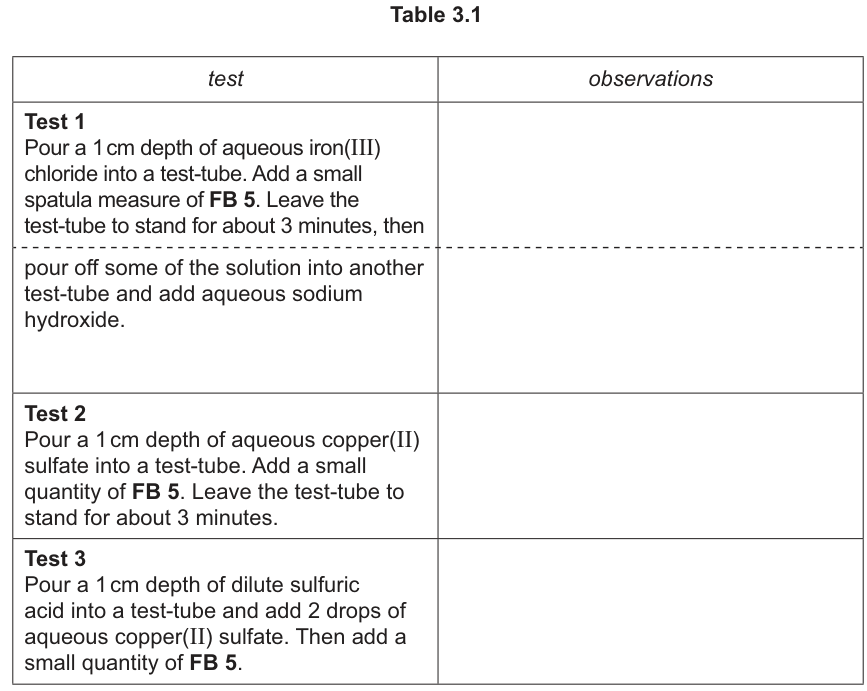
Answer
Test 1 (FeCl₃ then NaOH):
- Solution becomes colourless / pale green.
- Fizzing / effervescence observed.
- Pale green / green-white precipitate forms with NaOH; insoluble in excess NaOH (solid turns brown at surface).
Test 2 (CuSO₄):
- Pink-brown solid / precipitate forms.
- Solution becomes paler blue or colourless.
- Test-tube gets hot (exothermic).
Test 3 (H₂SO₄ + CuSO₄):
- Fizzing / effervescence.
- Gas produced pops with a lighted splint (hydrogen gas).
See table observations above.
Background Concept
Qualitative analysis involves performing a series of chemical tests on an unknown substance to identify its components. When a reactive metal like zinc is added to acidic or salt solutions, displacement reactions and acid-metal reactions can occur simultaneously. Zinc is above copper and iron in the reactivity series (though it reduces Fe³⁺ to Fe²⁺), and it reacts with dilute acids to produce hydrogen gas. Observations must be recorded precisely, noting colour changes, precipitate formation, solubility in excess reagent, and gas evolution.
Understanding the Question
You are given an unknown solid FB 5 and must carry out three specific tests, recording all observations. The tests involve reacting FB 5 with aqueous iron(III) chloride (followed by NaOH), aqueous copper(II) sulfate, and dilute sulfuric acid (with a drop of copper(II) sulfate). You must also identify any gases produced.
Approach
Execute each test as described in Table 3.1. Watch for colour changes in solution, solid deposition, temperature changes, and gas evolution. Use a lighted splint to test any gas from the acid reaction. Record observations systematically for each test.
Step-by-Step Reasoning
- Test 1: Iron(III) chloride solution is yellow/orange. Adding zinc reduces Fe³⁺ to Fe²⁺ (pale green) and the acidic solution reacts with zinc to produce H₂ gas (fizzing). Pouring off the solution and adding NaOH precipitates Fe²⁺ as Fe(OH)₂, which is a pale green precipitate. Fe(OH)₂ is insoluble in excess NaOH but oxidises in air to form brown Fe(OH)₃. Zinc ions (Zn²⁺) would also form a white ppt soluble in excess, but the iron observations dominate or co-occur. The mark scheme accepts pale green ppt insoluble in excess (turning brown).
- Test 2: Zinc displaces copper from copper(II) sulfate: . Copper metal is pink-brown. The blue Cu²⁺ solution fades as it is consumed. The reaction is exothermic, so the tube gets hot.
- Test 3: Zinc reacts with dilute sulfuric acid: . This produces fizzing. Hydrogen gas is identified by the 'pop' test with a lighted splint.
Key Takeaways
Accurate observation recording is critical in practical exams. Note the sequence of events (e.g., gas evolution before or after precipitate formation) and specific colour changes (pink-brown for Cu, pale green for Fe²⁺, brown for oxidised Fe(OH)₂).
Common Mistakes
- Writing 'no change' when a colour change or gas evolution occurs.
- Failing to identify the gas in Test 3 as hydrogen.
- Noting that Fe(OH)₂ precipitate turns brown on standing/oxidation.
- Forgetting that the reaction in Test 2 is exothermic (getting hot).
Things to Be Careful About
- Record observations at the correct stage (e.g., after adding NaOH in Test 1, not before).
- Use precise terminology: 'effervescence' or 'fizzing' for gas, 'pink-brown' or 'reddish-brown' for copper metal.
- Ensure state symbols are used if equations are required later.
FB 6 is the filtrate obtained after filtering the mixture that remains at the end of Test 3 in (a)(i).
Add aqueous ammonia to FB 6.
Record your observations.
Answer
- White precipitate forms.
- Precipitate is soluble in excess aqueous ammonia to give a colourless solution.
White precipitate, soluble in excess.
Background Concept
Aqueous ammonia acts as a weak base, providing hydroxide ions via the equilibrium: . When added to solutions containing certain metal ions, it forms insoluble hydroxide precipitates. For zinc ions, the precipitate is amphoteric and also forms a soluble complex ion with excess ammonia: .
Understanding the Question
FB 6 is the filtrate from Test 3, which contains zinc sulfate () produced from the reaction of zinc with sulfuric acid. You must add aqueous ammonia to this filtrate and record observations.
Approach
Add aqueous ammonia dropwise, then in excess. Observe the formation and subsequent dissolution of any precipitate.
Step-by-Step Reasoning
- Zinc ions react with hydroxide ions from ammonia to form zinc hydroxide: . This is a white precipitate.
- On adding excess ammonia, the precipitate dissolves to form the tetraamminezinc(II) complex: . The solution becomes colourless.
Key Takeaways
The ammonia test for zinc gives a white precipitate soluble in excess. This distinguishes it from ions like Fe²⁺/Fe³⁺ (insoluble in excess) or Cu²⁺ (blue ppt, soluble in excess to give deep blue solution).
Common Mistakes
- Stating the precipitate is 'colourless' (precipitates are described by their colour, white is correct).
- Forgetting to mention the solubility in excess ammonia.
Things to Be Careful About
- Specify 'aqueous ammonia' not just 'ammonia'.
- Note that the final solution is colourless, not just that the precipitate dissolves.
Answer
FB 5 is zinc (or Zn).
Zinc
Background Concept
Identifying an unknown metal solid requires analysing its reactions with acids, salt solutions, and reagents like NaOH/NH₃. Zinc is a reactive metal that produces hydrogen with acids, displaces less reactive metals like copper, and forms amphoteric hydroxides that dissolve in excess base and ammonia.
Understanding the Question
You must identify FB 5 based on the observations from parts (a)(i) and (a)(ii).
Approach
Correlate the observations: hydrogen gas with acid (reactive metal), displacement of copper (more reactive than Cu), white ppt with NaOH/NH₃ soluble in excess (characteristic of Zn²⁺ or Al³⁺, but Al doesn't displace Cu as vigorously or produce H₂ as readily in these specific contexts without acid, and the ppt from Fe³⁺ reduction points to Zn²⁺ in solution).
Step-by-Step Reasoning
- Test 3 produces H₂ with dilute acid → reactive metal.
- Test 2 displaces pink-brown copper → more reactive than Cu.
- Test 1 reduces Fe³⁺ to Fe²⁺ and produces Zn²⁺ in solution.
- Part (a)(ii) gives white ppt with NH₃ soluble in excess → characteristic of Zn²⁺.
- Therefore, FB 5 is zinc.
Key Takeaways
Metal identification relies on a combination of reactivity series position and characteristic ion tests.
Common Mistakes
- Guessing magnesium or iron without considering the ammonia test (Mg(OH)₂ is insoluble in excess NH₃; Fe gives coloured ppts).
- Writing 'zinc ions' instead of 'zinc metal' for the solid.
Things to Be Careful About
- Ensure the name or formula matches the solid state (Zn, not Zn²⁺).
Answer
- Copper ions () gain electrons to form copper metal () / copper changes oxidation state from +2 to 0.
- Zinc () loses electrons to form zinc ions () / zinc changes oxidation state from 0 to +2.
Copper ions gain electrons; zinc loses electrons.
Background Concept
A redox reaction involves the transfer of electrons. Oxidation is loss of electrons (increase in oxidation state), and reduction is gain of electrons (decrease in oxidation state). In a displacement reaction between a metal and a metal ion, the more reactive metal is oxidised, and the less reactive metal ion is reduced.
Understanding the Question
Explain why Test 2 (zinc + copper(II) sulfate) is a redox reaction.
Approach
Show that electrons are transferred from zinc to copper ions, or demonstrate a change in oxidation states for both species.
Step-by-Step Reasoning
- Reaction: .
- Zinc atoms lose 2 electrons to become Zn²⁺ ions (oxidation, OS 0 → +2).
- Copper(II) ions gain 2 electrons to become copper atoms (reduction, OS +2 → 0).
- Since both oxidation and reduction occur, it is a redox reaction.
Key Takeaways
Always define redox in terms of electron transfer or oxidation state changes. Do not just say 'electrons are transferred' without specifying which species loses and which gains.
Common Mistakes
- Saying 'zinc is oxidised and copper is reduced' without specifying ions vs atoms.
- Not mentioning electrons or oxidation states.
Things to Be Careful About
- Use precise terminology: 'copper ions' not just 'copper' when referring to Cu²⁺.
Give the ionic equation for the first reaction observed in (a)(ii). Include state symbols.
Answer
Zn2+(aq) + 2OH-(aq) -> Zn(OH)2(s)
Background Concept
When aqueous ammonia is added to a solution containing zinc ions, it produces hydroxide ions which react with Zn²⁺ to form a white precipitate of zinc hydroxide. The first reaction observed is this precipitation.
Understanding the Question
Write the ionic equation for the first reaction in part (a)(ii), including state symbols.
Approach
Identify the reactants (Zn²⁺ and OH⁻) and product (Zn(OH)₂). Balance the equation and add state symbols.
Step-by-Step Reasoning
- Reactants: from the filtrate, from the ammonia equilibrium.
- Product: , a white solid.
- Equation: .
- State symbols are mandatory: (aq) for ions, (s) for precipitate.
Key Takeaways
Ionic equations must be balanced for mass and charge. State symbols are often required and carry marks.
Common Mistakes
- Forgetting state symbols.
- Writing the molecular equation instead of the ionic equation.
- Unbalanced charges or atoms.
Things to Be Careful About
- The mark scheme specifically accepts . Writing the equation with NH₃ and H₂O is also chemically correct but may not be the exact mark scheme point; stick to the simplest ionic form if unsure, or follow the mark scheme's explicit example.
FB 7 contains one anion and one cation. The anion contains oxygen but not nitrogen.
Both ions are listed in the Qualitative analysis notes.
Transfer a small spatula measure of FB 7 into a hard-glass test-tube.
Heat gently at the start, then strongly until no further change occurs.
Leave the test-tube to cool.
Record all your observations. Identify any gases produced.
Answer
- FB 7 is a white powder / solid.
- Condensation / water droplets form on the cooler parts of the test-tube.
- The solid turns yellow (or yellow-green) when heated strongly.
- On cooling, the residue turns white (or paler).
- Gas produced turns limewater milky (forms a white precipitate), identifying it as carbon dioxide ().
White solid, condensation, yellow when hot, white when cool, CO2 gas.
Background Concept
Carbonates decompose on strong heating to give the metal oxide and carbon dioxide gas: . Zinc carbonate () is a white solid. Zinc oxide () is yellow when hot and white when cold (thermochromism). Carbon dioxide is identified by turning limewater () milky due to formation of insoluble .
Understanding the Question
FB 7 contains an anion with oxygen but no nitrogen (likely carbonate or sulfate). Heating it and observing changes helps identify it. You must record observations and identify the gas.
Approach
Heat the solid in a hard-glass test-tube. Observe colour changes, condensation, and test any gas evolved with limewater.
Step-by-Step Reasoning
- Initial state: White powder (ZnCO₃).
- Heating: Releases CO₂ gas. Moisture or lattice water may cause condensation.
- Residue colour: ZnO is yellow when hot, white when cold. This is a key identifier for zinc compounds.
- Gas test: Bubbling the gas through limewater gives a white precipitate (CaCO₃), confirming CO₂.
- Conclusion: The anion is carbonate ().
Key Takeaways
Thermal decomposition of carbonates produces CO₂. Thermochromic behaviour (yellow hot, white cold) is characteristic of ZnO and PbO.
Common Mistakes
- Not testing the gas with limewater.
- Describing the residue colour change incorrectly (must mention yellow when hot).
- Forgetting that the test-tube must be hard-glass for heating solids.
Things to Be Careful About
- Record observations at each stage (heating, cooling, gas test).
- 'Condensation' is acceptable even for anhydrous carbonates due to atmospheric moisture or slight hydration.
- Ensure gas identification is backed by evidence (limewater test).
Carry out one further positive test to confirm the identity of the anion in FB 7.
Record only the results shown in a positive test.
Describe the test you carry out and the observations you make in the space below.
The anion in FB 7 is ............................. .
Answer
Test: Add dilute mineral acid (e.g. hydrochloric acid, HCl) to FB 7.
Observation: Fizzing / effervescence occurs.
Anion in FB 7: carbonate (or ).
Add dilute acid; fizzing occurs. Carbonate (CO3^2-).
Background Concept
Carbonate ions react with dilute acids to produce carbon dioxide gas, water, and a salt: . This is a standard confirmatory test for carbonates.
Understanding the Question
Confirm the identity of the anion in FB 7 (which you deduced as carbonate from the heating test) using a further positive test.
Approach
Add a dilute acid to the solid and observe for gas evolution.
Step-by-Step Reasoning
- Reagent: Dilute hydrochloric acid (or any specified mineral acid like H₂SO₄, but HCl is standard).
- Observation: Vigorous fizzing/effervescence as CO₂ is released.
- Conclusion: The presence of CO₃²⁻ is confirmed.
Key Takeaways
The acid test is the definitive test for carbonates. Always name the acid or give its formula.
Common Mistakes
- Using a weak acid or organic acid (must be a mineral acid like HCl, HNO₃, H₂SO₄).
- Not observing or describing the fizzing.
- Confusing the anion with sulfate or nitrate.
Things to Be Careful About
- The question asks for 'only the results shown in a positive test', so describe the test and observation clearly.
- State the anion name and/or formula.