Chemistry 9701/31 — October/November 2025
Cambridge AS Level · Advanced Practical Skills · worked solutions for every part, with the mark scheme
Topics Manipulation, Measurement and Observation · Presentation of Data and Observations · Analysis, Conclusions and Evaluation · Qualitative Analysis
Hydrated ethanedioic acid is a diprotic acid with the formula where is an integer.
Ethanedioic acid reacts with manganate(VII) ions when heated.
You will determine the value of in by titrating a solution containing ethanedioic acid with manganate(VII) ions.
- FA 1 is aqueous ethanedioic acid, .
- FA 2 is potassium manganate(VII), .
- FA 3 is sulfuric acid, .
Method
- Fill the burette with FA 2.
- Pipette of FA 1 into a conical flask.
- Use the measuring cylinder to add approximately of FA 3 to the conical flask.
- Place the conical flask on a tripod and gauze and heat carefully until the temperature of the solution is approximately .
- Remove the flame.
- Carefully lift the hot conical flask and place it on the white tile under the burette.
- Add FA 2 drop-wise for the first . Any initial pink colouring may take several seconds to disappear.
- If the reaction mixture turns brown, reheat it to about . If the brown colour disappears, continue the titration. If the brown colour remains, discard the contents of the flask and begin a new titration.
- The end-point is reached when a permanent pale pink colour is formed.
- Perform a rough titration with FA 2. Record your burette readings in the space below.
The rough titre is .............................. .
- Carry out as many titrations as you think necessary to obtain consistent results.
- Make sure any recorded results show the precision of your practical work.
- Record all your burette readings and the volume of FA 2 added in each accurate titration.
Results
Answer
Rough titration
Initial reading = 0.00 cm³, final reading = 25.10 cm³, rough titre = 25.10 cm³.
Accurate titrations (representative example — your readings will differ)
| Titration | Initial reading / cm³ | Final reading / cm³ | Titre / cm³ |
|---|---|---|---|
| 1 | 0.00 | 24.60 | 24.60 |
| 2 | 24.60 | 49.25 | 24.65 |
| 3 | 0.00 | 24.60 | 24.60 |
All burette readings recorded to the nearest 0.05 cm³; accurate titres concordant within 0.10 cm³ of each other.
See working — candidate-dependent readings; representative example: rough titre 25.10 cm³, accurate titres 24.60, 24.65, 24.60 cm³
Background Concept
In a redox titration, the analyte (here ethanedioic acid, (COOH)₂) is oxidised and the titrant (manganate(VII) ion, MnO₄⁻) is reduced. The reaction between ethanedioic acid and manganate(VII) ions is slow at room temperature, so the mixture is heated to about 70 °C to increase the rate. The reaction also requires acidic conditions — H⁺ ions are consumed in the reduction of MnO₄⁻ to Mn²⁺ — hence sulfuric acid (FA 3) is added. The end-point is the first permanent pale pink colour, which appears when a tiny excess of MnO₄⁻ remains unreacted.
Understanding the Question
Part (a) asks you to carry out the titration and record your results. You must record: (i) the rough titration — both burette readings and the titre; (ii) at least two accurate titrations — initial and final burette readings for each; and (iii) the volume of FA 2 added (the titre) for each. All readings must be recorded to the nearest 0.05 cm³ (the precision of a burette), and the accurate titres must be concordant (within 0.10 cm³ of each other).
Approach
The marks in (a) are awarded for the quality of your data recording and the accuracy of your titres:
- Record the rough titre (two readings + titre).
- Perform at least two accurate titrations, recording initial and final readings for each.
- Set up a table with correct headings and units (initial reading / cm³, final reading / cm³, titre / cm³).
- Record all readings to 0.05 cm³.
- Ensure your accurate titres agree within 0.10 cm³.
- The accuracy marks depend on how close your mean titre is to the supervisor's value.
Step-by-Step Reasoning
The rough titration gives you an approximate end-point so you know roughly how much FA 2 to expect. For the accurate titrations, you add FA 2 drop-wise near the end-point. The first 2–3 cm³ may take several seconds to decolourise because the reaction is slow even at 70 °C. If the mixture turns brown, this indicates formation of MnO₂ (a brown solid) — this can happen if the mixture cools or if there is insufficient acid. Reheating to 70 °C may restore the colourless solution; if the brown colour persists, the titration must be restarted.
The end-point is the first permanent pale pink colour — this means all the ethanedioic acid has been oxidised and a tiny excess of MnO₄⁻ remains.
For a representative example:
- Rough: initial 0.00, final 25.10, titre 25.10 cm³
- Accurate 1: initial 0.00, final 24.60, titre 24.60 cm³
- Accurate 2: initial 24.60, final 49.25, titre 24.65 cm³
- Accurate 3: initial 0.00, final 24.60, titre 24.60 cm³
All readings are to 0.05 cm³. The accurate titres (24.60, 24.65, 24.60) are concordant within 0.10 cm³.
Key Takeaways
- Burette readings are recorded to the nearest 0.05 cm³.
- A rough titration precedes accurate titrations.
- Concordant titres (within 0.10 cm³) are required for reliability.
- The end-point of a manganate(VII) titration is the first permanent pale pink colour.
Common Mistakes
- Recording readings to only 1 decimal place (e.g. 24.6 instead of 24.60) — the mark scheme requires 0.05 cm³ precision.
- Not recording both initial and final readings.
- Not including units in table headings.
- Using the rough titre as an accurate titre.
- Labelling the rough titre as an accurate result.
Things to Be Careful About
- The rough titre is not used in the mean calculation.
- The mark scheme checks concordance of the accurate titres — if your final accurate titre is more than 0.10 cm³ from another, you lose the mark.
- Burette readings must be taken at eye level to avoid parallax error.
From your accurate titration results, calculate a suitable mean value to be used in your calculations.
Show clearly how you obtained this value.
of FA 1 required .............................. of FA 2.
Working
Mean titre = (24.60 + 24.65 + 24.60) / 3 = 24.6167 cm³
Answer
Mean titre = 24.62 cm³ (to 2 dp)
24.62 cm³
Background Concept
When you have several accurate titres that agree closely, you take their mean as the best estimate of the true titre. The mean must be quoted to 2 decimal places.
Understanding the Question
You must select your accurate titres (those within 0.20 cm³ spread), average them, and show your working. The mark is for the correct mean to 2 dp with working shown.
Approach
- Identify the accurate titres that agree within 0.20 cm³.
- Add them and divide by the number of titres.
- Round to 2 decimal places.
Step-by-Step Reasoning
Using the example titres 24.60, 24.65 and 24.60 cm³:
Mean = (24.60 + 24.65 + 24.60) / 3 = 24.6167 cm³
Rounded to 2 dp: 24.62 cm³
The mark scheme requires the mean to 2 dp, rounded to the nearest 0.01 cm³ (e.g. 26.675 → 26.68).
Key Takeaways
- Mean titre = sum of concordant titres / number of titres.
- Quote to 2 dp.
- Show your working or tick the readings you selected.
Common Mistakes
- Averaging titres that are not concordant (spread > 0.20 cm³).
- Not rounding correctly (e.g. leaving 24.6167 or writing 24.61 instead of 24.62).
- Including the rough titre in the mean.
Things to Be Careful About
- The mark scheme says the mean must be of two or more titres within 0.20 cm³ total spread.
- Rounding: 24.6167 → 24.62 (round up because the third decimal is 6).
Calculations
Give your answers to (c)(ii), (c)(iii) and (c)(iv) to the appropriate number of significant figures.
Answer
All answers to (c)(ii), (c)(iii) and (c)(iv) must be quoted to 3–4 significant figures.
3–4 significant figures
Background Concept
Significant figures reflect the precision of a measurement. The titre (24.62 cm³) has 4 significant figures; the concentration of FA 2 (0.0200 mol dm⁻³) has 3 significant figures. The mark scheme requires answers to (c)(ii), (c)(iii) and (c)(iv) to be given to 3–4 significant figures.
Understanding the Question
This part simply instructs you on the precision required for the subsequent calculation answers. It is a formatting requirement — you lose the mark if you give too few or too many significant figures.
Approach
When you calculate each value, round your final answer to 3 significant figures (the least precise input has 3 sf).
Step-by-Step Reasoning
The inputs are: titre = 24.62 cm³ (4 sf), concentration of KMnO₄ = 0.0200 mol dm⁻³ (3 sf), mass concentration of FA 1 = 6.20 g dm⁻³ (3 sf), volume of FA 1 = 25.0 cm³ (3 sf). The least precise input has 3 significant figures, so the answers should be given to 3 sf (or 4 sf, which is also allowed).
Key Takeaways
- Answers to calculations should reflect the precision of the inputs.
- 3–4 significant figures are required here.
Common Mistakes
- Giving answers to 2 sf or 5+ sf.
- Quoting calculator displays with many decimal places.
Things to Be Careful About
- The mark for (c)(i) is awarded if ALL of (c)(ii), (c)(iii) and (c)(iv) are to 3–4 sf.
Calculate the amount, in mol, of manganate(VII) ions, , in the volume of FA 2 calculated in (b).
amount of = .............................. mol
Working
Amount of = concentration volume
Answer
(3 sf)
4.92 × 10⁻⁴ mol
Background Concept
The amount of a solute in moles is given by: amount (mol) = concentration (mol dm⁻³) × volume (dm³). The titre volume is in cm³, so it must be divided by 1000 to convert to dm³.
Understanding the Question
You know the concentration of FA 2 (0.0200 mol dm⁻³) and the mean titre from (b) (24.62 cm³). Calculate the moles of MnO₄⁻ in that volume.
Approach
Use amount = concentration × volume, converting cm³ to dm³.
Step-by-Step Reasoning
Amount of MnO₄⁻ = 0.0200 × (24.62 / 1000) = 0.0200 × 0.02462 = 4.924 × 10⁻⁴ mol
To 3 sf: 4.92 × 10⁻⁴ mol.
Key Takeaways
- amount = concentration × volume (volume in dm³).
- cm³ → dm³: divide by 1000.
Common Mistakes
- Forgetting to convert cm³ to dm³ (giving 0.492 mol instead of 4.92 × 10⁻⁴ mol).
- Using the rough titre instead of the mean titre.
Things to Be Careful About
- The mark scheme formula: amount = 0.02 × volume in (b) / 1000 mol.
- Answer to 3–4 sf.
Calculate the amount, in mol, of ethanedioic acid that reacts with the manganate(VII) ions in (c)(ii).
amount of = .............................. mol
Hence calculate the concentration, in , of ethanedioic acid in FA 1.
concentration of = ..............................
Working
From the equation, 5 mol react with 2 mol .
Answer
Amount of = (3 sf)
Concentration of = (3 sf)
Amount of (COOH)₂ = 1.23 × 10⁻³ mol; concentration = 0.0492 mol dm⁻³
Background Concept
The balanced equation gives the stoichiometric ratio: 5 mol (COOH)₂ react with 2 mol MnO₄⁻. So moles of (COOH)₂ = moles of MnO₄⁻ × 5/2. The concentration of FA 1 is then moles ÷ volume in dm³ (25.0 cm³ = 0.0250 dm³).
Understanding the Question
Two calculations: (1) moles of ethanedioic acid that reacted; (2) its concentration in FA 1.
Approach
- Use the 5:2 ratio from the equation.
- Divide moles by 0.0250 dm³ to get concentration.
Step-by-Step Reasoning
Moles of (COOH)₂ = 4.924 × 10⁻⁴ × 5/2 = 1.231 × 10⁻³ mol
Concentration = 1.231 × 10⁻³ / 0.0250 = 0.04924 mol dm⁻³ ≈ 0.0492 mol dm⁻³ (3 sf)
The 5/2 factor comes directly from the coefficients in the balanced equation: 5(COOH)₂ + 2MnO₄⁻ → ... The volume 25.0 cm³ is the pipetted volume of FA 1, converted to dm³ by dividing by 1000.
Key Takeaways
- The stoichiometric ratio comes from the balanced equation.
- concentration = amount / volume (dm³).
Common Mistakes
- Using the wrong ratio (e.g. 2/5 instead of 5/2).
- Forgetting to convert 25.0 cm³ to 0.0250 dm³.
- Not giving the answer to 3–4 sf.
Things to Be Careful About
- The mark scheme gives M1 for the 5/2 ratio and M2 for the concentration calculation.
- Answer to 3–4 sf.
Calculate the relative molecular mass, , of the ethanedioic acid in FA 1.
= ..............................
Working
Answer
(3 sf)
126
Background Concept
The mass concentration of FA 1 is 6.20 g dm⁻³. The molar concentration (from (c)(iii)) is 0.04924 mol dm⁻³. Mr = mass concentration / molar concentration.
Understanding the Question
Use the two concentrations to find the relative molecular mass of the hydrated acid.
Approach
Mr = 6.20 / 0.04924
Step-by-Step Reasoning
Mr = 6.20 / 0.04924 = 125.9 ≈ 126 (3 sf)
The units work out: g dm⁻³ ÷ mol dm⁻³ = g mol⁻¹, which is the relative molecular mass expressed in grams per mole.
Key Takeaways
- Mr = mass concentration / molar concentration (units: g dm⁻³ ÷ mol dm⁻³ = g mol⁻¹).
Common Mistakes
- Inverting the ratio (dividing molar concentration by mass concentration).
- Not giving to 3–4 sf.
Things to Be Careful About
- The mark scheme: Mr = 6.2(0) / (c)(iii).
Working
of = 90; of = 18
Answer
2
Background Concept
The hydrated acid has formula (COOH)₂·xH₂O. Mr of (COOH)₂ = 2(12 + 16 + 16 + 1) = 90. Mr of H₂O = 18. So Mr(hydrated) = 90 + 18x, giving x = (Mr − 90) / 18.
Understanding the Question
Use the Mr from (c)(iv) to find the integer x.
Approach
x = (125.9 − 90) / 18 = 35.9 / 18 = 1.99 ≈ 2
Step-by-Step Reasoning
Mr of (COOH)₂: C = 12, O = 16, H = 1. (COOH)₂ has 2 C, 4 O, 2 H: 2(12) + 4(16) + 2(1) = 24 + 64 + 2 = 90.
Mr of H₂O = 2(1) + 16 = 18.
x = (125.9 − 90) / 18 = 35.9 / 18 = 1.99 ≈ 2.
The result 1.99 is essentially 2 — the small deviation from exactly 2 is due to rounding in earlier steps. The value of x must be an integer, so x = 2.
Key Takeaways
- The water of crystallisation contributes 18x to the Mr.
Common Mistakes
- Using the wrong Mr for (COOH)₂ (e.g. 45 for one COOH group instead of 90 for both).
- Not rounding to an integer.
Things to Be Careful About
- The answer must be an integer.
- The mark scheme: (Mr − 90) / 18 and correct integer.
Answer
ions are needed in the reaction — they are used up / appear as reactants in the equation. The sulfuric acid provides the required for the reduction of to .
H⁺ ions are needed in the reaction
Background Concept
The redox reaction between ethanedioic acid and manganate(VII) requires acidic conditions. In the balanced equation, 6H⁺ appear as reactants. The H⁺ ions are consumed as MnO₄⁻ is reduced to Mn²⁺.
Understanding the Question
Explain why sulfuric acid (FA 3) is added to each titration mixture.
Approach
Look at the equation: H⁺ is a reactant. Sulfuric acid provides the H⁺.
Step-by-Step Reasoning
The equation shows 6H⁺(aq) on the left. The reduction of MnO₄⁻ to Mn²⁺ consumes H⁺. Without sufficient acid, the reaction cannot proceed (or proceeds incompletely/slowly), and brown MnO₂ may form instead. FA 3 (H₂SO₄) supplies the H⁺ needed.
Key Takeaways
- MnO₄⁻ reduction requires acidic conditions.
- H₂SO₄ provides H⁺.
Common Mistakes
- Saying "it speeds up the reaction" without mentioning H⁺ — the mark is specifically for H⁺ being needed/used in the reaction.
- Saying "it is a catalyst" — incorrect.
Things to Be Careful About
- The mark scheme accepts: "H⁺ needed in the reaction / H⁺ used in / appears in the equation".
Hydrated zinc sulfate has the formula where is an integer.
Hydrated zinc sulfate decomposes when heated, losing only its water of crystallisation and becoming anhydrous.
You will determine the value of in by heating the hydrated salt until it becomes anhydrous.
FA 4 is hydrated zinc sulfate, .
Method
- Weigh the crucible with its lid. Record the mass in the space for Results.
- Add between and of FA 4 to the crucible.
- Weigh the crucible with its lid and FA 4. Record the mass.
- Place the crucible on the pipeclay triangle. Gently heat the crucible and contents for approximately 2 minutes with the lid on.
- Remove the lid. Heat the crucible and contents strongly for approximately 4 minutes.
- Replace the lid and leave the crucible and residue to cool for at least 5 minutes.
You may wish to begin work on Question 3 while the crucible is cooling.
- Weigh the crucible with its lid and its contents. Record the mass.
- Remove the lid. Heat the crucible strongly for approximately 3 minutes.
- Replace the lid and leave the crucible and residue to cool for at least 5 minutes.
- Weigh the crucible with its lid and its contents. Record the mass.
- Calculate the mass of FA 4 used and the mass of residue obtained. Record the masses.
Results
Answer
Results table - all six headings must include a unit (write / g in the heading):
- Mass of crucible + lid / g
- Mass of crucible + lid + FA4 / g
- Mass of crucible + lid + residue after 1st heating / g
- Mass of crucible + lid + residue after 2nd heating / g
- Mass of FA4 / g
- Mass of residue / g
Record all four weighings to the same number of decimal places (2 or 3 dp). The mass after the 2nd heating must be within +0.02 to -0.05 g of the mass after the 1st heating (constant mass).
Representative readings (your own will differ):
- Crucible + lid = 20.00 g
- Crucible + lid + FA4 = 23.30 g
- After 1st heating = 21.86 g
- After 2nd heating = 21.85 g
(theoretical value for is 1.78)
Candidate-dependent. Example: mass FA4 = 3.30 g, mass residue = 1.85 g, mass ratio = 1.78.
Background Concept
Hydrated salts such as contain a fixed number of water molecules - called water of crystallisation - locked into the crystal lattice. On strong heating this water escapes as steam, leaving the anhydrous salt, provided the anhydrous salt is thermally stable. Since the only mass lost is water,
Heating to constant mass means repeating the heat-cool-weigh cycle until two successive residue masses agree, which confirms all the water has been driven off. Weighing by difference measures a sample indirectly as (container + sample) - (container), avoiding the difficulty of weighing the sample on its own. The theoretical mass ratio for is .
Understanding the Question
Part (a) is the practical part - the candidate performs the experiment and records their OWN readings. Five marks are awarded for: (I) six correct headings with units; (II) the four weighings recorded to the same number of decimal places, with the reading after the 2nd heating within +0.02 to -0.05 g of the reading after the 1st heating; (III) correct subtractions to give mass of FA4 (between 2.90 and 3.40 g) and mass of residue; and (IV, V) accuracy - how close the candidate's mass ratio (mass FA4 divided by mass residue) is to the theoretical 1.78. Because it is a live practical, there is no single correct set of numbers - the marking rewards careful technique, sensible recording and accuracy.
Approach
Set out the six required rows with units in the header, record the four weighings consistently to 2 or 3 decimal places, subtract the empty-crucible mass to obtain the mass of FA4 and the mass of residue, confirm that the first and second heating residues agree (constant mass), and finally compute the mass ratio to judge accuracy against 1.78.
Step-by-Step Reasoning
- Headings and units: the marking rewards six labelled rows, each carrying the unit in the heading (... / g). Writing 'g' once in the column heading covers every entry; the mark is lost if units are scattered or missing.
- Record all four weighings to the same number of decimal places - either two or three. Mixing 0.1 g and 0.01 g readings loses the mark.
- Both heating stages are needed: the first strong heating removes most of the water rapidly; the second heating (and re-weighing) checks that no further mass is lost - this is the constant-mass check. If the second reading has dropped by more than about 0.05 g, more heating is needed.
- Cool before weighing: a hot crucible warms the surrounding air and sets up convection currents that make the balance reading too low. That is why the method says to cool for at least 5 minutes before each weighing.
- Subtractions (using the representative readings):
- Accuracy check: , matching the theoretical value - this would earn both accuracy marks (IV if the ratio is between 1.51 and 2.05, V if between 1.60 and 1.96).
Key Takeaways
Weighing by difference; heating to constant mass; table conventions (quantity with unit in the heading, consistent decimal places); and the accuracy check via a theoretical ratio. These ideas transfer directly to any gravimetric practical.
Common Mistakes
- Inconsistent decimal places across the four readings (mixing 2 dp and 3 dp, or writing only 0.1 g precision).
- Missing units in column headings.
- Weighing the crucible while still hot, giving a falsely low mass.
- Only one heating stage, so the residue still contains water.
- Forgetting that the ratio compares masses of the hydrated and anhydrous salt, not just any two readings.
Things to Be Careful About
The mark for readings requires the residue masses after the 1st and 2nd heating to agree closely (within +0.02/-0.05 g). Keep the lid on while cooling so the anhydrous salt does not re-absorb moisture. Use the 2nd-heating residue mass for the calculations, since it is the constant-mass value.
Calculations
Calculate the amount, in mol, of anhydrous zinc sulfate residue formed in the decomposition of FA 4.
amount of = .............................. mol
Calculate the amount, in mol, of water of crystallisation lost.
amount of = .............................. mol
Working
Answer
amount of ZnSO4 = 0.0115 mol; amount of H2O = 0.0806 mol
0.0115 mol; 0.0806 mol
Background Concept
The amount of substance in moles is found from mass and molar mass:
The anhydrous residue is pure ; its molar mass is . The water driven off has . Because only water is lost, the mass of water lost is the difference between the mass of FA4 and the mass of the residue.
Understanding the Question
Given the mass of FA4 and the mass of anhydrous residue from part (a), convert each to moles: the residue gives the amount of ; the difference (FA4 minus residue) gives the mass - and hence amount - of water lost. Two method marks are available, one per mole calculation; the answers must each be quoted to 2-4 significant figures.
Approach
Compute the molar mass of anhydrous zinc sulfate; divide the residue mass by it to obtain the amount of ; subtract to find the water mass; then divide the water mass by 18.0.
Step-by-Step Reasoning
Using the representative values (mass FA4 = 3.30 g, mass residue = 1.85 g):
- .
- (3 s.f.).
- .
- .
Both answers are within 2-4 s.f. as required. If the candidate's readings differ, the method is identical - only the numbers change.
Key Takeaways
Mole conversion from mass; finding a lost mass by difference; quoting answers to an appropriate number of significant figures.
Common Mistakes
- Using the molar mass of the hydrated salt (287.5) instead of the anhydrous 161.5 for the zinc sulfate - the residue is anhydrous.
- Forgetting to subtract to find the water mass before dividing by 18.
- Quoting mole answers to only 1 s.f., losing the significant-figures requirement.
- Reversing the two divisions (dividing by FA4 mass instead of residue mass).
Things to Be Careful About
Use the 2nd-heating residue mass (the constant-mass value). Keep units - g and mol - explicit. The mark scheme accepts 2-4 s.f., so both 0.01146 mol and 0.0115 mol would score.
Calculate the value of y in the formula .
Show your working.
y = ..............................
Working
y is an integer.
Answer
y = 7
()
7
Background Concept
The formula means each formula unit of anhydrous salt carries water molecules. The hydrated substance therefore contains moles of water for every 1 mole of , so
Because a formula ratio is a ratio of whole particles, must come out as a (small) integer.
Understanding the Question
Divide the two mole values computed in (b)(i). The first mark (M1) is for the correct ratio formula; the second mark (M2) is for evaluating it and quoting as an integer.
Approach
Divide by , recognise that the result is very close to a whole number, and quote that integer.
Step-by-Step Reasoning
Since must be an integer, , i.e. the salt is (zinc sulfate heptahydrate). If the ratio had come out slightly off (e.g. 7.2), the small discrepancy would be experimental error and it should still be rounded to the nearest integer - heating errors always make measured ratios slightly imperfect.
Key Takeaways
The hydration number is a mole ratio rounded to an integer; mole values feed into a formula ratio exactly like in a molecular formula.
Common Mistakes
- Dividing the MASSES instead of the mole amounts - this gives a completely different, false value.
- Quoting 7.0 or 7.03 instead of the integer 7.
- Reversing the division ( instead of 7).
Things to Be Careful About
The marks are method followed by integer answer: any correct ratio method earns M1 even if arithmetic is slightly off. Only the correctly evaluated expression with the integer quoted earns M2.
A student suggests using this thermal decomposition method to investigate the number of moles of water of crystallisation in hydrated ethanedioic acid. The teacher says that this method is unsuitable.
Suggest why this method is unsuitable.
Answer
The method is unsuitable because ethanedioic acid (or its anhydrous form) decomposes on heating / is flammable. It does not simply lose water of crystallisation, so the mass loss would not be due to water alone.
Ethanedioic acid decomposes on heating (or is flammable), so it does not simply lose water of crystallisation.
Background Concept
The thermal method works only when a substance loses water of crystallisation without itself reacting further. Zinc sulfate is an ionic salt that is stable at the temperature needed to drive off its water, so the residue is pure anhydrous salt. Ethanedioic acid (oxalic acid), , is an organic acid. When heated strongly it decomposes - producing carbon monoxide, carbon dioxide and other products (it may char or give off flammable gases) - and it is flammable. So heating it does more than remove water of crystallisation.
Understanding the Question
The teacher rejects the method for hydrated ethanedioic acid. The question asks why. One mark is available; the credited answers are that the (anhydrous) ethanedioic acid would decompose on heating, OR that it is flammable. Give one of these two specific points.
Approach
Ask: does this solid lose only water on heating, or does the solid itself react? Recall that ethanedioic acid decomposes (or catches fire) when heated, so the observed mass change could not be attributed to loss of water of crystallisation alone.
Step-by-Step Reasoning
The entire basis of the zinc sulfate experiment was that the only mass loss is water. For ethanedioic acid, heating would decompose the acid itself (or ignite it), so the residue would not be pure anhydrous ethanedioic acid, and the mass lost could not be equated with water of crystallisation. In short, ethanedioic acid decomposes on heating and is flammable, so strong heating is both invalid and hazardous. Either the decomposition point or the flammability point scores the mark.
Key Takeaways
Thermally decomposing (or flammable) solids cannot be analysed by loss-on-drying methods. The validity of a method depends on the chemistry of the substance, not just the equipment.
Common Mistakes
- Vague answers such as 'it melts' or 'it is not a salt' - these are not credited.
- Giving only 'it is dangerous' without specifying decomposition or flammability.
- Saying 'the water would not be removed' - the point is that the acid itself reacts, not that the water stays behind.
Things to Be Careful About
The mark scheme wants the specific property: decomposes on heating OR is flammable. State clearly that heating does more than drive off water - the acid itself breaks down.
Qualitative analysis
For each test you should record all your observations in the spaces provided.
Examples of observations include:
- colour changes seen
- the formation of any precipitate and its solubility (where appropriate) in an excess of the reagent added
- the formation of any gas and its identification (where appropriate) by a suitable test.
You should record clearly at what stage in a test an observation is made.
Where no change is observed, you should write 'no change'.
Where reagents are selected for use in a test, the name or correct formula of the element or compound must be given.
If any solution is warmed, a boiling tube must be used. If a solid is heated, a hard-glass test-tube must be used.
Rinse and reuse test-tubes and boiling tubes where possible.
No additional tests should be attempted.
A bottle labelled FA 5 is thought to contain hydrated zinc sulfate. It would therefore contain zinc ions and sulfate ions as well as water of crystallisation.
Devise and carry out tests to investigate whether zinc ions, sulfate ions and water of crystallisation are present.
Record the tests you carry out and the observations you see in the space provided.
Answer
Test for water of crystallisation:
- Heat a sample of solid FA 5 in a boiling tube.
- Observation: Condensation / droplets of water / steam form on the cooler parts of the tube.
Test for ions (prepare solution):
- Make an aqueous solution of FA 5 by dissolving it in distilled water.
Test for cation:
- Add aqueous ammonia () to a portion of the solution.
- Observation: A white precipitate forms, which is insoluble in excess aqueous ammonia.
Test for sulfate anion:
- Add aqueous barium chloride (or barium nitrate) to a portion of the solution.
- Observation: A white precipitate forms.
- Add dilute hydrochloric acid (or nitric acid) to the precipitate.
- Observation: The white precipitate remains insoluble.
(Alternatively: add acidified to the solution; it remains purple / is not decolourised.)
See working for tests and observations
Background Concept
Qualitative analysis involves using chemical tests to identify the ions present in an unknown substance. Water of crystallisation is identified by heating the solid and looking for condensation. Cations are identified by adding reagents like aqueous ammonia or sodium hydroxide and observing precipitate formation and solubility in excess. Sulfate ions are identified by adding barium ions in acidic conditions to form an insoluble white precipitate of barium sulfate.
Understanding the Question
The question asks you to devise and carry out tests to investigate whether zinc ions (), sulfate ions (), and water of crystallisation () are present in FA 5. You must record the tests and observations clearly.
Approach
- Water: Heat the solid directly. If hydrated, water is released as steam and condenses.
- Ions: Dissolve the solid in water to create an aqueous test solution.
- Cation ( vs others): Add aqueous ammonia. forms a white ppt soluble in excess. forms a white ppt insoluble in excess. The observation will tell you which is present.
- Anion (): Add barium chloride solution followed by dilute acid. A white ppt insoluble in acid confirms sulfate.
Step-by-Step Reasoning
- M1: To test for water of crystallisation, you must heat the solid FA 5. The observation is the formation of condensation, droplets, or steam.
- M2: To test for dissolved ions, you must make an aqueous solution of FA 5 by dissolving it in water.
- M3: To test for the cation, add aqueous ammonia to a portion of the solution. The mark scheme credits a white precipitate that is insoluble in excess ammonia (this actually identifies , meaning is absent).
- M4: To test for sulfate, add aqueous barium chloride or barium nitrate. A white precipitate of forms.
- M5: To confirm it is sulfate and not sulfite, add dilute hydrochloric or nitric acid. The precipitate remains insoluble. (Alternatively, adding which is not decolourised confirms no sulfite is present).
Key Takeaways
Always heat solids to test for water of crystallisation. Always dissolve solids to test for ions. For sulfate, the barium chloride test must be followed by acid to rule out sulfite or carbonate.
Common Mistakes
- Forgetting to make an aqueous solution before testing for ions.
- Not adding acid in the sulfate test, which could lead to a false positive from carbonate or sulfite.
- Writing 'no change' for the ammonia test without specifying the precipitate colour and solubility.
Things to Be Careful About
- Ensure you name the reagents correctly (e.g., 'aqueous ammonia', not just 'ammonia').
- Describe observations precisely: 'white precipitate', 'insoluble in excess', 'white precipitate insoluble in acid'.
Use your observations in (a)(i) to complete Table 3.1 to show whether each species is present in FA 5.
Use a tick (✓) if the species is present.
Use a cross (✗) if the species is not present.
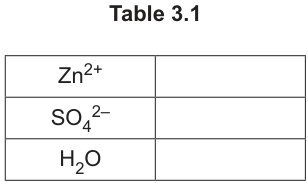
Answer
| Species | Present? |
|---|---|
| ✗ | |
| ✓ | |
| ✓ |
Zn2+: ✗, SO4 2-: ✓, H2O: ✓
Background Concept
The tests carried out in part (a)(i) give specific observations that allow us to confirm or deny the presence of specific species. Water of crystallisation is confirmed by condensation on heating. Sulfate is confirmed by the insoluble white barium sulfate precipitate. The cation test with ammonia gave a white precipitate insoluble in excess, which is characteristic of magnesium (), not zinc (). Zinc hydroxide is soluble in excess ammonia to form a colourless complex ion .
Understanding the Question
You must complete Table 3.1 using ticks (✓) or crosses (✗) to show whether , , and are present in FA 5, based on your observations from (a)(i).
Approach
- Water: Condensation observed on heating -> ✓
- Sulfate: White ppt with insoluble in acid -> ✓
- Zinc: White ppt with insoluble in excess indicates , not -> ✗
Step-by-Step Reasoning
- : Condensation/droplets formed on heating -> Present (✓).
- : White precipitate with barium chloride, insoluble in acid -> Present (✓).
- : The precipitate with ammonia was insoluble in excess. would dissolve in excess . Since it did not, is absent (✗). (The cation is actually ).
Key Takeaways
Use the specific solubility of hydroxides in excess ammonia to distinguish between cations like (soluble) and (insoluble).
Common Mistakes
- Assuming all white precipitates with ammonia are zinc.
- Forgetting that zinc hydroxide dissolves in excess ammonia.
Things to Be Careful About
- Ensure your ticks and crosses match the exact observations. 'Insoluble in excess' means it is NOT zinc.
You are provided with solid FA 6.
Heat a few crystals of FA 6 in a hard-glass test-tube until no further gas is evolved. Record all your observations.
Leave the test-tube until it is cool.
Keep the cooled residue for use in (b)(ii).
Answer
Observations on heating:
- The solid is purple.
- The solid jumps / moves around / hisses during heating.
- A black residue is left after heating.
- A gas is evolved that relights a glowing splint (or makes it glow more brightly).
Purple solid jumps, black residue, glowing splint relights
Background Concept
Potassium manganate(VII), , is a purple solid. When heated strongly, it undergoes thermal decomposition to form potassium manganate(VI) (, green), manganese(IV) oxide (, black), and oxygen gas ().
Equation:
Understanding the Question
You are heating solid FA 6 (which is ) and must record all observations, including the gas test.
Approach
Record the initial colour, the physical changes during heating (jumping/hissing), the final residue colour, and perform a glowing splint test on the evolved gas.
Step-by-Step Reasoning
- Initial colour: is purple.
- During heating: The release of oxygen gas causes the solid to jump or move around (hissing/spitting).
- Residue: is a black solid. ( is green but often obscured by the black or appears as a dark mixture).
- Gas test: Oxygen relights a glowing splint.
Key Takeaways
Thermal decomposition of produces oxygen and a black/green residue. Always test the gas evolved.
Common Mistakes
- Forgetting to test the gas with a glowing splint.
- Describing the residue as only 'black' without noting the initial purple colour or the jumping.
Things to Be Careful About
- Use a hard-glass test-tube as instructed.
- Ensure the splint is 'glowing', not 'burning'.
To the cooled residue from (b)(i), add approximately depth of distilled water and stir. Filter the solution formed into a test-tube.
The colour of the solution is .............................. .
Answer
The colour of the solution is (dark) green.
(dark) green
Background Concept
The thermal decomposition of produces (potassium manganate(VI)) and (manganese(IV) oxide). is soluble in water and forms a dark green solution. is insoluble in water and is removed by filtration.
Understanding the Question
After heating and cooling, you add water to the residue and filter. You need to state the colour of the resulting filtrate.
Approach
The filtrate contains dissolved , which is green. The black remains on the filter paper.
Step-by-Step Reasoning
- Residue contains (soluble, green) and (insoluble, black).
- Adding water dissolves .
- Filtering removes the black .
- The filtrate is a solution of , which is dark green.
Key Takeaways
Manganate(VI) ions () are green in solution. Manganate(VII) ions () are purple.
Common Mistakes
- Saying the solution is purple (confusing with ).
- Saying the solution is colourless.
Things to Be Careful About
- The question asks for the colour of the solution, not the residue.
You are provided with aqueous solutions FA 7 and FA 8 and with solid FA 9.
FA 7 is an aqueous solution of FA 6.
FA 7, FA 8 and FA 9 contain compounds which all have one metal that is the same but which may be in different oxidation states.
Carry out the following tests on FA 7, FA 8 and FA 9 and record your observations in Table 3.2. For each test use a depth of a solution or a spatula measure of solid.
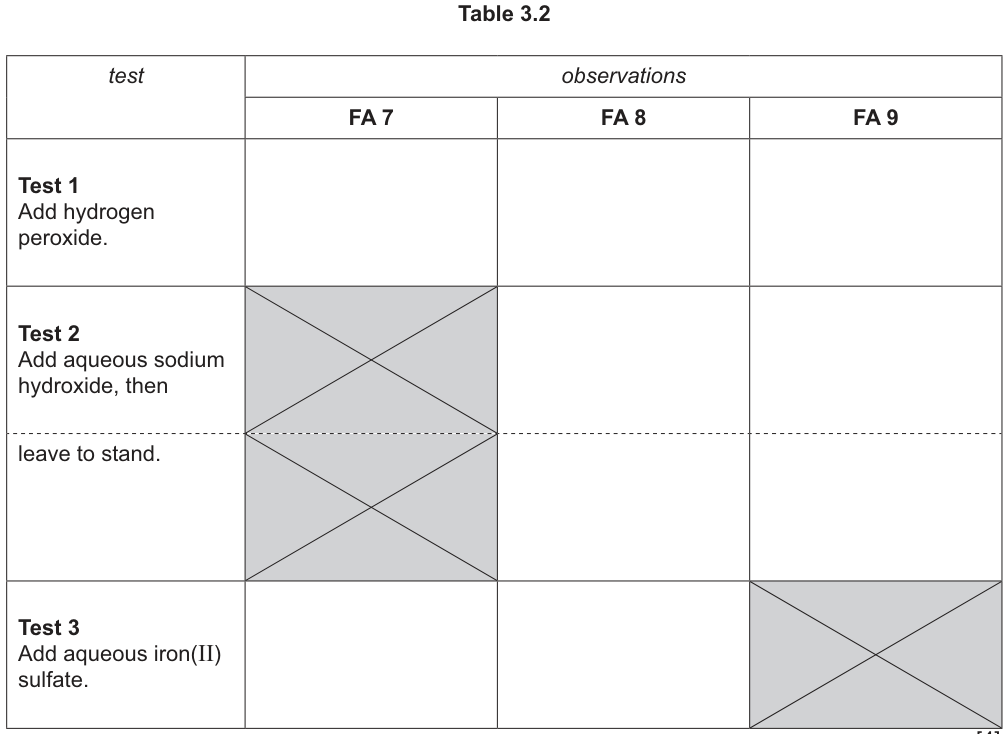
Answer
Table 3.2 Observations:
| test | FA 7 | FA 8 | FA 9 |
|---|---|---|---|
| Test 1 Add hydrogen peroxide. | Bubbles / effervescence. Purple solution turns colourless. | No change. | Bubbles / effervescence. (Gas relights glowing splint.) |
| Test 2 Add sodium hydroxide, then leave to stand. | (Not required) | Off-white precipitate forms, which turns brown on standing. | No change. |
| Test 3 Add aqueous iron(II) sulfate. | Solution turns colourless / yellow solution formed. | No change. | (Not required) |
(Note: 'No change' for at least 2 correct entries is required for partial credit, but the full table is as above.)
See table for observations
Background Concept
This question tests the chemistry of manganese in different oxidation states:
- FA 7: Acidified contains (Mn is +7, purple). It is a strong oxidising agent.
- FA 8: contains (Mn is +2, pale green/off-white precipitate with NaOH). is easily oxidised by air to brown or .
- FA 9: (Mn is +4, black solid). It can catalyse the decomposition of or be reduced by it.
Reactions:
- with : is reduced to colourless ; is oxidised to (bubbles).
- with : catalyses decomposition of to (bubbles) and , or is reduced to .
- with : Forms white/off-white , which rapidly turns brown on standing due to oxidation by atmospheric oxygen.
- with : (purple) oxidises (pale green) to (yellow/brown), and is reduced to colourless . The solution turns colourless or pale yellow.
Understanding the Question
You must record observations for three tests on three different manganese compounds (FA 7, FA 8, FA 9) and fill in Table 3.2.
Approach
Recall the specific colour changes and precipitate formations for each manganese species with the given reagents.
Step-by-Step Reasoning
-
Test 1 (Add ):
- FA 7 (): Purple solution is reduced to colourless . is oxidised to gas (bubbles/effervescence).
- FA 8 (): No reaction. No change.
- FA 9 (): reacts with/decomposes to produce gas (bubbles/effervescence, relights glowing splint).
-
Test 2 (Add , leave to stand):
- FA 7: Not required (crossed out).
- FA 8 (): (white/off-white ppt). On standing, is oxidised by air: (brown ppt). So: off-white ppt turning brown.
- FA 9 ( solid): No change (solid doesn't dissolve/react visibly with NaOH).
-
Test 3 (Add aqueous ):
- FA 7 (): Purple oxidises pale green to yellow . The purple colour disappears, leaving a colourless or yellow solution. .
- FA 8 (): No reaction. No change.
- FA 9: Not required (crossed out).
Key Takeaways
Manganese has multiple oxidation states with distinct colours and reactivity. is a strong oxidiser (purple -> colourless). forms a white ppt with NaOH that turns brown in air. reacts with to release oxygen.
Common Mistakes
- Forgetting that turns brown on standing.
- Saying FA 7 turns yellow only (it turns colourless first as purple disappears, then yellow from ).
- Not mentioning bubbles/effervescence for tests.
Things to Be Careful About
- Follow the table layout exactly (crossed-out cells are not required).
- Specify 'off-white' or 'white' for the initial precipitate in Test 2, FA 8.
Suggest the identity of the metal in FA 6/FA 7, FA 8 and FA 9.
The metal is .............................. .
Answer
The metal is manganese (or Mn).
manganese (or Mn)
Background Concept
The question states that FA 7, FA 8, and FA 9 contain compounds with the same metal but in different oxidation states. The tests show:
- Purple solution turning colourless with reducing agents (, ) -> characteristic of manganate(VII), .
- Off-white ppt turning brown with NaOH -> characteristic of manganese(II), .
- Black solid reacting with to give oxygen -> characteristic of manganese(IV) oxide, .
All these are classic manganese chemistry.
Understanding the Question
Identify the metal common to FA 6/FA 7, FA 8, and FA 9.
Approach
The purple colour of FA 7 and its reduction to colourless, plus the white-to-brown precipitate with NaOH in FA 8, uniquely identify manganese.
Step-by-Step Reasoning
- FA 7 is purple and acts as an oxidising agent -> (Mn(VII)).
- FA 8 gives a white ppt with NaOH that turns brown -> (Mn(II)).
- FA 9 is a black solid that reacts with -> (Mn(IV)).
- The metal is Manganese (Mn).
Key Takeaways
Manganese exhibits multiple oxidation states: +2 (pale green/white ppt), +4 (black solid), +7 (purple solution).
Common Mistakes
- Confusing with iron (Fe), but is yellow/brown, not purple. is pale green.
- Confusing with copper (Cu), but is blue, and is blue ppt soluble in excess NaOH.
Things to Be Careful About
- Ensure you write the full name or correct symbol.
Complete Table 3.3 to suggest the oxidation state of the metal in FA 6/FA 7 and FA 8.
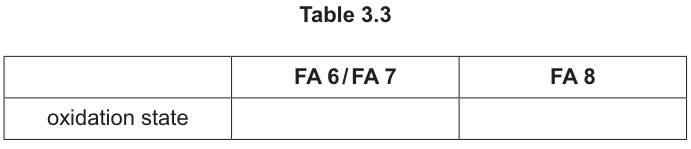
Answer
Table 3.3:
| FA 6 / FA 7 | FA 8 | |
|---|---|---|
| oxidation state | +7 | +2 |
FA 6/FA 7: +7, FA 8: +2
Background Concept
Oxidation state is the charge an atom would have if all bonds were ionic. For (FA 6/FA 7): K is +1, O is -2. . For (FA 8): is -2, so Mn is +2.
Understanding the Question
Complete Table 3.3 to show the oxidation state of the metal in FA 6/FA 7 and FA 8.
Approach
Determine the formulae from the context (FA 6 is , FA 7 is acidified , FA 8 is ) and calculate the oxidation state of Mn.
Step-by-Step Reasoning
- FA 6 / FA 7: Potassium manganate(VII), . Oxidation state of Mn is +7.
- FA 8: Manganese(II) sulfate, . Oxidation state of Mn is +2.
Key Takeaways
Manganate(VII) is Mn(+7). Manganate(II) or Mn(II) salts are Mn(+2).
Common Mistakes
- Writing '7' instead of '+7'. Oxidation states must include the sign.
- Confusing the oxidation state with the group number or charge without sign.
Things to Be Careful About
- Always include the '+' or '-' sign for oxidation states.