Chemistry 9701/24 — October/November 2025
Cambridge AS Level · AS Level Structured Questions · worked solutions for every part, with the mark scheme
Topics Chemical Bonding · States of Matter · Chemical Periodicity · Hydroxy Compounds · Halogen Compounds · Group 17 · +9 more
The Group 17 elements are oxidising agents.
Answer
The Group 17 elements act as oxidising agents because they can remove electron(s) from the species being oxidised (they gain electrons themselves, being reduced).
Halogens oxidise by removing electrons from the reactant (they are themselves reduced).
Background Concept
An oxidising agent is a species that oxidises another species by taking electrons from it; the oxidising agent is itself reduced. Halogens have seven outer electrons and a high electron affinity, so they readily gain one electron to complete their octet, forming a halide ion X⁻.
Understanding the Question
'Explain how' demands the mechanism of the oxidising action in terms of electrons — not just 'they are oxidising agents'.
Approach
State the electron-transfer definition applied to halogens: X₂ + 2e⁻ → 2X⁻.
Step-by-Step Reasoning
The mark scheme credits exactly one idea: halogens can remove electrons from a reactant. When chlorine reacts with, say, sodium, the chlorine molecule takes an electron from each sodium atom, forming Cl⁻ ions while the sodium is oxidised. So the halogen 'removes' electrons — that is what makes it an oxidising agent.
Key Takeaways
Oxidising agent = electron taker. Halogens are strong oxidising agents because gaining one electron completes their outer shell.
Common Mistakes
Writing 'halogens are oxidised' — wrong; the halogen is reduced while it oxidises the other species. Saying 'they gain oxygen' confuses oxidation with oxygen transfer.
Things to Be Careful About
Use the language of electron transfer: the halogen removes/gains electrons and is itself reduced.
Answer
2Al + 3Cl2 -> 2AlCl3
Background Concept
Aluminium forms the Al³⁺ ion, so with chlorine (Cl⁻) the formula of the product is AlCl₃ by charge balance (3 × Cl⁻ per Al³⁺).
Understanding the Question
You must write the balanced equation for Cl₂ oxidising Al metal to AlCl₃.
Approach
Write the product formula first (AlCl₃), then balance: 2 Al on the left needs 2 AlCl₃, which contains 6 Cl, so 3 Cl₂ molecules supply them.
Step-by-Step Reasoning
AlCl₃ is the only chloride of Al³⁺. Balancing: 2Al + 3Cl₂ → 2AlCl₃. Check: 2 Al and 6 Cl on each side. State symbols may be added: Al(s), Cl₂(g), AlCl₃(s).
Key Takeaways
Balance by fixing the ionic formula first, then scale coefficients.
Common Mistakes
Writing AlCl as the product, or leaving the equation unbalanced (Al + Cl₂ → AlCl₃).
Things to Be Careful About
The product is AlCl₃ (Al is +3), not AlCl₂; count chlorine atoms carefully when balancing.
A student heats equal amounts of and in a sealed flask. The student leaves the contents to cool.
State what you would observe during the reaction.
Answer
The purple vapour of iodine disappears (as it reacts with the hydrogen to form colourless HI, which on cooling remains in the flask).
The purple colour (of iodine vapour) disappears.
Background Concept
Iodine vapour is purple/violet. Iodine reacts with hydrogen on heating: H₂(g) + I₂(g) ⇌ 2HI(g). HI is a colourless gas, so as I₂ is consumed the purple colour fades. On cooling, the equilibrium mixture remains gaseous (HI and H₂ are colourless; any residual I₂ would still be vapour at these temperatures but the reaction has consumed it).
Understanding the Question
'State what you would observe during the reaction' — an observation, i.e. what the eye sees in the flask, not an equation.
Approach
Identify the coloured species (I₂ vapour, purple) and note it is used up, giving colourless products.
Step-by-Step Reasoning
At the start, purple iodine vapour is present. As the reaction proceeds, I₂ reacts with H₂ to form colourless HI, so the purple colour gradually disappears. The mark scheme credits 'purple (gas) disappears'.
Key Takeaways
Colour observations in halogen chemistry hinge on knowing the colours of the halogens themselves.
Common Mistakes
Saying 'a colourless gas forms' without mentioning the disappearance of the purple colour — the disappearance is the credited observation. Confusing iodine vapour with bromine (brown/red).
Things to Be Careful About
Iodine vapour is purple/violet, not black (that is solid iodine) and not brown (that is bromine).
and can each react with to give and a hydrogen halide, .
The relative bond strengths of and determine the difference in enthalpy change of the two reactions.
Answer
The Br–Br bond is weaker than the Cl–Cl bond because bromine atoms are larger than chlorine atoms. The larger atoms have longer bonds and less effective overlap of their orbitals, so the shared electron pair is attracted less strongly and the bond is weaker.
Br–Br is weaker than Cl–Cl because Br atoms are larger, giving less effective orbital overlap.
Background Concept
Covalent bond strength depends on how well the atomic orbitals of the two bonded atoms overlap. Smaller atoms allow closer approach and greater overlap, giving shorter, stronger bonds. Down Group 17, atomic radius increases as extra electron shells are added.
Understanding the Question
'Describe and explain the difference' — two marks: the description (which bond is stronger) and the explanation (why, in terms of atoms/orbitals).
Approach
State the trend (Br–Br weaker), give the reason (Br atoms larger), then the mechanism (less orbital overlap).
Step-by-Step Reasoning
M1: Br–Br is weaker than Cl–Cl, and Br atoms are larger (more electron shells). M2: because the atoms are larger, the bonding orbitals overlap less effectively when the bond forms; the overlap is less significant, so the bond is longer and weaker. This is why X–X bond energies fall down the group (Cl₂ ≈ 242 kJ mol⁻¹, Br₂ ≈ 193 kJ mol⁻¹).
Key Takeaways
Bond strength generally decreases down a group as atoms get bigger and orbital overlap worsens.
Common Mistakes
Explaining with 'van der Waals forces are weaker' — that is intermolecular, not the covalent bond. Saying 'the bond is longer' without linking to reduced overlap doesn't earn the explanation mark.
Things to Be Careful About
Both marks are needed: the comparison AND the atomic-size/overlap reasoning.
Answer
HCl is more thermally stable than HBr (the H–Cl bond is stronger than the H–Br bond, so HCl decomposes less easily on heating).
HCl is more thermally stable than HBr.
Background Concept
Thermal stability of the hydrogen halides depends on the strength of the H–X bond. The H–X bond weakens down the group because the halogen atom gets larger and the H–X bond gets longer and weaker, so less energy is needed to break it and decomposition is easier.
Understanding the Question
A one-mark 'describe' — state which of HCl and HBr is more thermally stable.
Approach
Apply the trend: stronger H–X bond ⇒ more thermally stable. H–Cl > H–Br in strength, so HCl is more stable.
Step-by-Step Reasoning
HCl is more thermally stable than HBr because the H–Cl bond is stronger. HBr decomposes to its elements more readily on heating.
Key Takeaways
Thermal stability of HX decreases down Group 17: HF > HCl > HBr > HI.
Common Mistakes
Reversing the trend by confusing it with the acidity trend (acidity increases down the group while stability decreases).
Things to Be Careful About
Thermal stability tracks bond strength, not acidity.
Answer
The enthalpy change of formation, ΔH_f, is the enthalpy change when one mole of a compound (substance) is formed from its constituent elements in their standard states.
Enthalpy change when one mole of a compound is formed from its elements in their standard states.
Background Concept
Standard enthalpy of formation is one of the reference definitions used in Hess's law cycles. Every word of the definition carries a mark: 'one mole' fixes the amount, 'formed from its elements' fixes the reactants, and 'standard states' fixes the conditions (the physical state each element is in at 298 K and 100 kPa).
Understanding the Question
'Define' — the answer must be the precise definition; partial versions lose marks.
Approach
Assemble the definition in order: enthalpy change when one mole of compound is formed from its elements in their standard states.
Step-by-Step Reasoning
M1: 'when one mole of a compound/substance is formed'. M2: 'from its (constituent) elements in their standard states'. Both parts are needed for the full two marks.
Key Takeaways
Learn formation, combustion, neutralisation and atomisation definitions precisely — examiners award marks word by word.
Common Mistakes
Omitting 'one mole' (e.g. defining per reaction as written). Omitting 'standard states'. Saying 'from its elements in their standard forms' without implying the physical states at standard conditions.
Things to Be Careful About
The definition applies to compounds; for an element in its standard state ΔH_f = 0 by convention.
Table 1.1 gives data relevant to the reaction of with .
Table 1.1
| compound | enthalpy change of formation, |
|---|---|
Use the data in Table 1.1 to calculate the enthalpy change of the reaction of with .
Working
For :
Answer
(exothermic)
-460 kJ mol^-1
Background Concept
ΔH_f of an element in its standard state is zero, so Cl₂(g) and N₂(g) contribute nothing. The reaction enthalpy from formation enthalpies is ΔH = ΣΔH_f(products) − ΣΔH_f(reactants), with each value multiplied by the stoichiometric coefficient.
Understanding the Question
Use the tabulated ΔH_f values for NH₃ (−46) and HCl (−92) with the balanced equation 3Cl₂ + 2NH₃ → N₂ + 6HCl to find ΔH for the reaction as written.
Approach
Multiply each ΔH_f by the number of moles in the equation, sum products, subtract reactants.
Step-by-Step Reasoning
Products: 6 mol HCl ⇒ 6 × (−92) = −552 kJ. Reactants: 2 mol NH₃ ⇒ 2 × (−46) = −92 kJ; Cl₂ and N₂ are elements, ΔH_f = 0. ΔH = −552 − (−92) = −552 + 92 = −460 kJ mol⁻¹. The negative sign shows the reaction is strongly exothermic.
Key Takeaways
Always multiply by coefficients and remember elements have ΔH_f = 0.
Common Mistakes
Forgetting to multiply HCl by 6 (giving −46 kJ). Subtracting wrongly: (−552) − (+92) = −644 is a sign error. Omitting the negative sign on the final answer.
Things to Be Careful About
The unit is kJ mol⁻¹ for the equation as written; keep the minus sign — the reaction is exothermic.
reacts with to form .
Predict the shape of a molecule of . Explain your answer.
shape
explanation
Answer
Shape: trigonal pyramidal
Explanation: nitrogen has three bonding pairs (N–I bonds) and one lone pair of electrons; the four electron pairs repel, and the lone pair repels more strongly, pushing the three bonding pairs into a pyramidal arrangement (bond angle about 107°).
Trigonal pyramidal, due to three bonding pairs and one lone pair on N.
Background Concept
VSEPR theory: electron pairs around a central atom repel and arrange to minimise repulsion. Lone pair–lone pair > lone pair–bonding pair > bonding pair–bonding pair repulsion. Four electron pairs with one lone pair give a trigonal pyramidal shape (like NH₃).
Understanding the Question
NI₃ has N central with three I atoms attached. Predict the shape and explain it via electron-pair counting.
Approach
Count electron pairs on N: 3 bonding pairs + 1 lone pair = 4 pairs ⇒ tetrahedral electron arrangement, but with one position occupied by the lone pair the molecular shape is trigonal pyramidal.
Step-by-Step Reasoning
N has 5 outer electrons: three used in N–I bonds, one pair left as a lone pair. Four electron pairs arrange tetrahedrally; the lone pair occupies one position and repels the bonding pairs slightly more, so the three N–I bonds form a trigonal pyramid with bond angle slightly less than 109.5° (≈107°). M1: trigonal pyramidal. M2: three bonding pairs AND one lone pair.
Key Takeaways
Shape depends on the number of bonding and lone pairs; always count both.
Common Mistakes
Saying 'tetrahedral' (that is the electron-pair arrangement, not the molecular shape). Forgetting the lone pair in the explanation — the explanation mark requires both the three bonding pairs and the lone pair.
Things to Be Careful About
Name the shape precisely: 'trigonal pyramidal', not 'pyramidal' alone ideally, and justify with both pair types.
Table 1.2 shows some information about reactions of , and .
Table 1.2
| observation with | white precipitate | ||
| type of reaction with concentrated | acid–base | acid–base, then redox | acid–base, then redox |
| observations with concentrated | • black solid • yellow solid • effervescence |
Answer
Completed Table 1.2:
| NaCl | NaBr | NaI | |
|---|---|---|---|
| with Ag⁺(aq) | white precipitate | cream precipitate | yellow precipitate |
| type of reaction with conc. H₂SO₄ | acid–base | acid–base, then redox | acid–base, then redox |
| observations with conc. H₂SO₄ | steamy fumes | brown liquid (or fizzing) | • black solid • yellow solid • effervescence |
NaBr: cream ppt with Ag+; NaI: yellow ppt with Ag+; NaCl with conc. H2SO4: steamy fumes; NaBr with conc. H2SO4: brown liquid (or fizzing).
Background Concept
Halide tests: Ag⁺(aq) + X⁻(aq) → AgX(s). AgCl is white, AgBr is cream, AgI is yellow. With concentrated H₂SO₄, halide ions are first protonated (acid–base: HX + steamy fumes), but Br⁻ and I⁻ are strong enough reducing agents to further reduce H₂SO₄ (redox), giving characteristic products: Br⁻ gives brown Br₂ vapour/liquid; I⁻ gives black I₂ solid, yellow sulfur, and (with deeper reduction) H₂S gas causing effervescence.
Understanding the Question
Complete the four empty cells: two precipitate colours and two sets of observations with concentrated sulfuric acid.
Approach
Fill in the standard halide-test results: AgBr cream, AgI yellow; NaCl + conc. H₂SO₄ gives only steamy fumes of HCl (chloride too weak a reducer for redox); NaBr gives brown bromine (or fizzing) after the initial steamy fumes.
Step-by-Step Reasoning
M1: NaBr + Ag⁺ → cream/off-white precipitate of AgBr. M2: NaI + Ag⁺ → yellow precipitate of AgI. M3: NaCl with conc. H₂SO₄: steamy fumes of HCl (acid–base only, no redox). M4: NaBr with conc. H₂SO₄: brown liquid/vapour of Br₂ (or fizzing), showing acid–base then redox.
Key Takeaways
Learn the AgX colour sequence white → cream → yellow down the group, and that reducing power of halide ions increases down the group, so only Br⁻ and I⁻ show redox with H₂SO₄.
Common Mistakes
Calling AgBr 'yellow' and AgI 'white' — order matters. Writing 'brown fumes' for NaCl (chloride does not produce bromine). Missing that NaCl shows no redox stage.
Things to Be Careful About
For NaBr the accepted observations are 'brown liquid' OR 'fizzing'; for NaCl 'steamy fumes' OR 'fizzing'. Use the precise colour words: cream, yellow, brown, black.
Suggest an identity for the species that produces each observation in the reaction of with concentrated .
black solid
yellow solid
effervescence
Answer
- black solid: iodine,
- yellow solid: sulfur, (S₈)
- effervescence: hydrogen sulfide,
black solid = I2; yellow solid = S; effervescence = H2S
Background Concept
I⁻ is a powerful reducing agent. With concentrated H₂SO₄ it first gives HI (acid–base), then reduces the sulfur in H₂SO₄ stepwise: S(+6) → S(0) as sulfur (yellow solid) and further to S(−2) as H₂S (gas, effervescence/rotten-egg smell). The iodide is oxidised to I₂, seen as black/grey solid or purple vapour.
Understanding the Question
Match each observation from the NaI + conc. H₂SO₄ reaction to the species responsible.
Approach
Recall the reduction products of H₂SO₄ by iodide: I₂ (black solid), S (yellow solid), H₂S (gas).
Step-by-Step Reasoning
The black solid is iodine formed by oxidation of I⁻ (e.g. 2I⁻ → I₂ + 2e⁻). The yellow solid is sulfur, produced when H₂SO₄ is reduced (H₂SO₄ + 2H⁺ + 2e⁻ → SO₂ + 2H₂O, then further to S). The effervescence is H₂S gas, the fully reduced sulfur product (H₂SO₄ + 8HI → H₂S + 4I₂ + 4H₂O).
Key Takeaways
The depth of reduction of H₂SO₄ increases down the halides: Cl⁻ none, Br⁻ → SO₂, I⁻ → S and H₂S.
Common Mistakes
Assigning the yellow solid to sulfur dioxide or the black solid to sulfur. Saying SO₂ for the effervescence — SO₂ is a choking gas from the Br⁻ reaction, not the bubbling here.
Things to Be Careful About
Effervescence implies a gas being produced — here it is H₂S; identify each observation separately and precisely.
Table 1.3 gives some information about and .
Table 1.3
| electrical conductivity when liquid | conducts | does not conduct |
| observation when added to water | dissolves | vigorous reaction |
Explain the difference between the electrical conductivity of liquid and of liquid . Refer to bonding and relevant particles in your answer.
Answer
Liquid MgCl₂ is ionic, so it contains mobile Mg²⁺ and Cl⁻ ions which can move and carry charge — it conducts. SiCl₄ is covalent (simple molecular); it has no ions and no delocalised electrons, so there are no mobile charge carriers — it does not conduct.
MgCl2 is ionic with mobile ions; SiCl4 is covalent with no charge carriers.
Background Concept
Electrical conduction requires mobile charged particles. Ionic compounds conduct when molten or dissolved because the ions become free to move. Simple molecular covalent substances have no charged particles (molecules are neutral, electrons are localised in bonds), so they never conduct.
Understanding the Question
Explain the conductivity difference using bonding and naming the relevant particles — the question explicitly asks for both.
Approach
Assign each chloride its bonding type, then name the mobile charge carriers (or their absence) in each liquid.
Step-by-Step Reasoning
M1: MgCl₂ is ionic (Mg²⁺ and Cl⁻ held in a lattice); when liquid, the ions are mobile and can carry charge, so it conducts. M2: SiCl₄ is covalent/molecular — there are no ions and no delocalised electrons, so there are no charge carriers to move, and it does not conduct.
Key Takeaways
Conductivity of a molten substance is a direct test of ionic bonding.
Common Mistakes
Saying 'MgCl₂ has free electrons' — ionic conduction is by ions, not electrons. For SiCl₄, saying only 'it is covalent' without stating the absence of charge carriers loses the second mark.
Things to Be Careful About
Name the particles explicitly: mobile ions for MgCl₂; no ions/no delocalised electrons for SiCl₄.
Answer
- MgCl₂: pH = 7 (neutral — dissolves without reacting with the water)
- SiCl₄: pH 0–4 (strongly acidic — vigorous hydrolysis releases HCl, e.g. )
MgCl2: pH 7; SiCl4: pH 0-4
Background Concept
Ionic chlorides of metals (NaCl, MgCl₂) simply dissolve in water, giving neutral solutions of the ions. Covalent chlorides such as SiCl₄ are hydrolysed violently by water: the Si–Cl bonds are attacked, and HCl fumes are released, making a strongly acidic solution.
Understanding the Question
Predict the pH of each solution formed on adding the chloride to water.
Approach
MgCl₂ dissolves as ions — neutral, pH 7. SiCl₄ reacts with water producing HCl — strongly acidic, low pH.
Step-by-Step Reasoning
MgCl₂(s) → Mg²⁺(aq) + 2Cl⁻(aq); neither ion significantly hydrolyses water at this level, so pH ≈ 7. SiCl₄ + 2H₂O → SiO₂ + 4HCl (or Si(OH)₄ + 4HCl); the HCl formed gives pH between 0 and 4, consistent with the 'vigorous reaction' noted in the table.
Key Takeaways
The acid-base behaviour of chlorides across Period 3 switches from neutral (ionic) to strongly acidic (covalent) at the metal–non-metal boundary.
Common Mistakes
Giving MgCl₂ an acidic pH (confusing it with AlCl₃, whose Mg²⁺-adjacent ion does hydrolyse slightly). Saying SiCl₄ is only mildly acidic — the hydrolysis is vigorous and releases HCl.
Things to Be Careful About
The mark scheme accepts pH 0–4 for SiCl₄ and exactly pH 7 for MgCl₂; quote the pH value, not just 'acidic' or 'neutral'.
Aluminium oxide, , and phosphorus(V) oxide, , are both used as reagents and catalysts.
The melting point of is 2072°C. The melting point of is 340°C.
Explain the difference in the melting points of these two compounds.
Answer
- has a giant ionic lattice; melting it requires breaking strong ionic bonds.
- is a simple molecular substance; melting it only requires overcoming weak intermolecular (van der Waals') forces between molecules.
- Ionic bonds are much stronger than intermolecular forces, so has the much higher melting point.
Al2O3 is ionic with strong ionic bonds; P4O10 is simple molecular with weak intermolecular forces, so Al2O3 has a much higher melting point.
Background Concept
Melting point is the temperature at which the forces holding a substance together are overcome. In a giant ionic lattice, oppositely charged ions are held by strong electrostatic attractions; these ionic bonds extend throughout the whole crystal. In a simple molecular solid, atoms within each molecule are joined by strong covalent bonds, but the molecules attract each other only through weak intermolecular forces, usually van der Waals' forces.
Understanding the Question
This part asks you to explain why melts at 2072°C but melts at only 340°C. The command word 'explain' means you must link the observed property to the type of bonding and structure of each compound.
Approach
First identify the structure of each compound. is a metal oxide with a giant ionic lattice. is a covalent oxide that exists as simple molecules. Then compare the strength of the forces that must be broken when the solid melts.
Step-by-Step Reasoning
- is ionic: it consists of and ions in a giant lattice. Melting requires breaking the strong ionic bonds between these ions, which needs a very high temperature.
- is a simple molecular substance: the atoms are joined by covalent bonds within each molecule, but molecules are held together only by weak intermolecular forces. Melting only needs to overcome these weak forces, not break covalent bonds.
- Because ionic bonds are much stronger than intermolecular forces, far more energy is needed to melt , so its melting point is much higher.
Key Takeaways
Physical properties such as melting point are determined by the type of structure and the strength of the forces between particles. A giant ionic lattice has a high melting point; a simple molecular solid has a low melting point.
Common Mistakes
- Saying that has covalent bonds broken when it melts. Covalent bonds stay intact; only intermolecular forces are overcome.
- Writing 'strong bonds' without saying which bonds, or confusing ionic bonds with intermolecular forces.
- Describing as molecular.
Things to Be Careful About
Use the precise terms: 'giant ionic lattice', 'simple molecular', 'ionic bonds', 'intermolecular forces'. The mark scheme rewards the comparison that ionic bonds are stronger than intermolecular forces.
A sealed flask contains of and of and an catalyst. The flask is heated to a temperature of 290°C and allowed to reach equilibrium. Equation 1 shows the reaction.
equation 1:
The equilibrium constant, , of equation 1 is given.
Answer
mol^-2 dm^6
Background Concept
For a reaction , the equilibrium constant is . Concentrations are measured in , so the units of depend on the powers in the expression.
Understanding the Question
You are given the expression for for and asked only for the units. No calculation is needed.
Approach
Replace each concentration term in the expression by its unit , then simplify the powers of mol and dm.
Step-by-Step Reasoning
Substituting units:
So the units are .
Key Takeaways
The units of are not fixed; they are found from the equilibrium expression. The denominator here has three concentration factors, giving .
Common Mistakes
- Forgetting the square on , which would give .
- Inverting the units and writing .
- Writing only without the mol power.
Things to Be Careful About
Treat the units algebraically: subtract powers in the denominator from those in the numerator. Include both mol and dm in the final unit.
The equilibrium mixture contains of .
Calculate the value of .
Give your answer to three significant figures.
Working
Moles at equilibrium:
Concentrations in :
Answer
1.01 x 10^3 mol^-2 dm^6
Background Concept
At equilibrium, the concentrations in the expression are equilibrium concentrations, not initial amounts. The stoichiometry of the reaction tells you how much of each reactant is consumed when product forms.
Understanding the Question
A flask initially contains and . At equilibrium is present. You must find equilibrium amounts of CO and H2, convert all amounts to concentrations, and substitute into .
Approach
Use the balanced equation: 1 mol CO + 2 mol H2 -> 1 mol CH3OH. Since 0.280 mol CH3OH formed, 0.280 mol CO and 0.560 mol H2 were consumed. Subtract from initial amounts, divide by volume to get concentrations, then substitute.
Step-by-Step Reasoning
Equilibrium moles:
Concentrations:
Substitute:
The answer is given to three significant figures.
Key Takeaways
Equilibrium calculations require a stoichiometric table: initial amounts, change, equilibrium amounts. Always divide equilibrium amounts by the volume to get concentrations before using .
Common Mistakes
- Using initial amounts instead of equilibrium amounts in .
- Forgetting that 2 mol H2 are consumed per mol CH3OH.
- Dividing by volume incorrectly or forgetting to convert moles to concentrations.
- Giving too many or too few significant figures.
Things to Be Careful About
Keep track of units. The final value is large because the denominator is small. Check the arithmetic: .
State and explain the effect, if any, on the value of when the overall pressure in the sealed flask is increased.
Answer
No effect. is constant at a given temperature and is not affected by changes in pressure.
No effect; Kc depends only on temperature.
Background Concept
is a constant for a given reaction at a given temperature. It depends only on temperature, not on pressure, concentration, or the presence of a catalyst. Changing pressure may shift the position of equilibrium, but it does not change the value of .
Understanding the Question
You are asked what happens to the value of when the overall pressure in the sealed flask is increased. The key is to distinguish between the position of equilibrium and the equilibrium constant.
Approach
Recall the only factor that changes is temperature. Pressure affects the position of equilibrium but not the constant itself.
Step-by-Step Reasoning
Increasing pressure will favour the side with fewer gas moles, so the position of equilibrium shifts to the right (1 mol gas on the right vs 3 mol gas on the left). However, is defined at a given temperature and remains unchanged. The concentrations will adjust so that the ratio still equals the same value.
Key Takeaways
changes only with temperature. Pressure and catalysts alter the rate or position of equilibrium but not the value of .
Common Mistakes
- Saying increases because equilibrium shifts right.
- Confusing with the position of equilibrium.
- Saying pressure changes .
Things to Be Careful About
If the question asked about the position of equilibrium, you would use Le Chatelier's principle. Here it asks about , so the answer is 'no effect'.
catalyses the reversible reaction of with to form .
equation 1:
then acts as a dehydrating agent, causing to form .
Answer
A catalyst increases the rate of reaction by providing an alternative reaction pathway with a lower activation energy.
Provides an alternative pathway with lower activation energy, increasing rate.
Background Concept
A catalyst speeds up a reaction without being consumed. It provides an alternative reaction pathway with a lower activation energy. With a lower activation energy, a greater proportion of reactant particles have energy equal to or greater than the activation energy, so the frequency of successful collisions increases and the rate increases.
Understanding the Question
This is a one-mark recall question: explain how the presence of a catalyst affects a chemical reaction. The mark scheme wants the idea of a lower activation energy alternative pathway.
Approach
State that the catalyst increases rate, and give the mechanism: alternative pathway with lower activation energy.
Step-by-Step Reasoning
A catalyst does not change the enthalpy change or the position of equilibrium. It lowers the activation energy by providing a different mechanism. More particles can now overcome the barrier, so the rate of reaction increases. The catalyst is regenerated at the end.
Key Takeaways
Catalysts increase rate by lowering activation energy; they affect kinetics, not thermodynamics or equilibrium position.
Common Mistakes
- Saying a catalyst is used up.
- Saying a catalyst increases the yield or changes the equilibrium position.
- Omitting 'lower activation energy'.
Things to Be Careful About
Use precise wording: 'alternative pathway with a lower activation energy'. This exact phrase is often required.
Answer
2CH3OH -> CH3OCH3 + H2O
Background Concept
Dehydration of an alcohol removes water. Two molecules of methanol can lose one water molecule between them to form an ether: . This is an example of ether formation by dehydration.
Understanding the Question
Construct a balanced equation for the dehydration of methanol to methoxymethane (dimethyl ether), . The question gives the product and asks for the equation.
Approach
Combine two methanol molecules, remove one water molecule, and balance the remaining atoms.
Step-by-Step Reasoning
Two molecules contain 2 C, 8 H, 2 O. Removing leaves (2 C, 6 H, 1 O) plus the water. The equation is:
Atoms balance: left 2C, 8H, 2O; right 2C, 8H, 2O.
Key Takeaways
Dehydration of an alcohol to an ether is a condensation reaction: two molecules join with loss of water. Balance atoms to check the equation.
Common Mistakes
- Writing without the 2.
- Forgetting the water product.
- Writing an equation that does not balance.
Things to Be Careful About
State symbols are not required here, but the equation must be balanced. The coefficient 2 on methanol is essential.
Answer
P4O10 + 6H2O -> 4H3PO4
Background Concept
is the acidic oxide of phosphorus. Acidic oxides react with water to form acids. Phosphorus(V) oxide reacts with excess water to give phosphoric(V) acid, .
Understanding the Question
Write the equation for the reaction of with an excess of water. 'Excess' ensures the product is the fully hydrated acid, not a partial product.
Approach
Identify the product as , then balance the equation.
Step-by-Step Reasoning
Each P atom ends up in , so 4 P atoms give 4 . Balance O: left has 10 O from plus O from water; right has O. So water must provide 6 O, requiring 6 . Balance H: left H; right H. Equation:
Key Takeaways
Acidic oxides react with water to form acids. Balancing an oxide-water reaction requires matching atoms of the non-metal, then oxygen and hydrogen.
Common Mistakes
- Writing instead of using as given.
- Forgetting the coefficient 6 on water or 4 on .
- Writing or another partial acid.
Things to Be Careful About
Use the formula given in the question, . Check that atoms of P, O, and H balance.
Propan-2-ol, , is sometimes added to fuel to help it burn.
Fig. 3.1 shows some reactions of propan-2-ol.
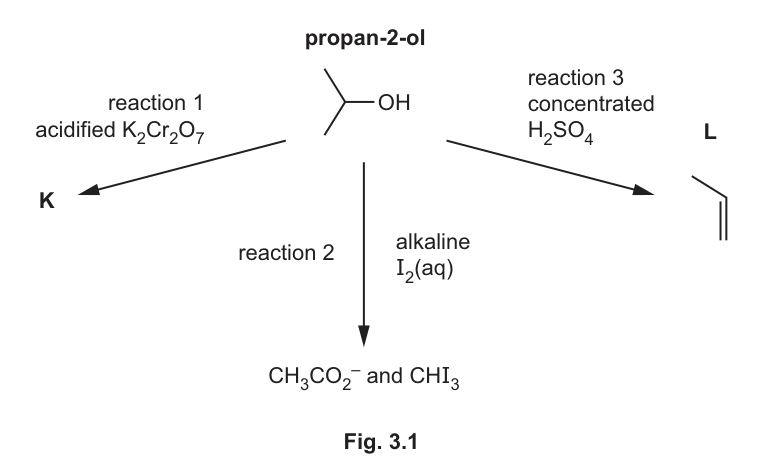
Answer
The structure of compound K (propanone) is:
(Skeletal formula: a central carbon double-bonded to oxygen, with two methyl groups attached.)
Propanone (CH3COCH3); skeletal structure: central C=O with two methyl groups
Background Concept
Secondary alcohols, such as propan-2-ol, contain the -OH group attached to a carbon atom bonded to two other carbon atoms. When treated with an oxidising agent like acidified potassium dichromate(VI) (), secondary alcohols are oxidised to ketones. The reaction involves the removal of two hydrogen atoms: one from the -OH group and one from the carbon atom bearing the -OH group, forming a carbon-oxygen double bond (C=O).
Understanding the Question
The question asks for the structure of organic compound K, which is formed when propan-2-ol reacts with acidified (Reaction 1). Since propan-2-ol is a secondary alcohol, the oxidation product is a ketone, specifically propanone (also known as acetone).
Approach
Identify the functional group transformation: secondary alcohol ketone. Draw the structure of propanone, ensuring the carbonyl group (C=O) is correctly placed on the central carbon.
Step-by-Step Reasoning
- Identify reactant: Propan-2-ol is . The -OH is on carbon-2, a secondary carbon.
- Identify reagent: Acidified is a strong oxidising agent.
- Determine product: Oxidation of a secondary alcohol yields a ketone. For propan-2-ol, the product is propanone ().
- Draw structure: The mark scheme accepts a skeletal formula. Draw a central carbon atom double-bonded to an oxygen atom, with two single bonds extending to represent the methyl groups (). In skeletal form, this is a 'Y' shape with a double bond to O at the junction.
Key Takeaways
- Secondary alcohols oxidise to ketones.
- Primary alcohols oxidise to aldehydes (and then carboxylic acids).
- Tertiary alcohols do not oxidise under these conditions.
Common Mistakes
- Drawing propanal (an aldehyde) instead of propanone. This happens if the student confuses primary and secondary alcohol oxidation.
- Forgetting the double bond to oxygen in the ketone structure.
Things to Be Careful About
- Ensure the carbon chain length is maintained (3 carbons).
- The carbonyl carbon in propanone is bonded to two other carbons, not a hydrogen.
Answer
Yellow precipitate.
Yellow precipitate
Background Concept
The reaction of propan-2-ol with alkaline iodine (/NaOH) is the triiodomethane (or iodoform) test. This test is positive for:
- Ethanol.
- Secondary alcohols containing a group (like propan-2-ol).
- Aldehydes and ketones containing a group (methyl carbonyls).
The reaction produces triiodomethane (), which is a pale yellow, crystalline solid with a characteristic antiseptic smell. In the context of the reaction scheme, propan-2-ol is first oxidised to propanone (), which then undergoes halogenation and cleavage to form the ethanoate ion () and triiodomethane ().
Understanding the Question
The question asks for an observation in Reaction 2, where propan-2-ol reacts with alkaline (aq) to form and . The formation of is the key observation.
Approach
Identify the product as triiodomethane (iodoform) and state its physical appearance.
Step-by-Step Reasoning
- Identify reaction: Alkaline iodine test (iodoform test) on a methyl carbinol ( group).
- Identify products: The scheme shows and .
- Observation: is a yellow precipitate. The solution may also turn from brown/orange (iodine) to colourless as iodine is consumed, but the formation of a yellow precipitate is the definitive positive test observation.
Key Takeaways
- Positive iodoform test: yellow precipitate of .
- Tests for: ethanol, methyl ketones, secondary alcohols with a methyl group on the carbinol carbon.
Common Mistakes
- Saying 'white precipitate' (that's for halide tests with ).
- Forgetting to mention 'precipitate' or 'solid'.
Things to Be Careful About
- The precipitate is specifically yellow. Do not just say 'precipitate'.
Answer
Elimination (or dehydration).
Elimination
Background Concept
Alcohols can react with concentrated sulfuric acid () or phosphoric acid () at high temperatures to form alkenes. This reaction involves the removal of a water molecule () from the alcohol molecule. Because a small molecule is removed to form a double bond, it is classified as an elimination reaction. Specifically, it is a dehydration reaction.
Understanding the Question
Reaction 3 shows propan-2-ol reacting with concentrated to form compound L. The image for L shows propene (an alkene). The question asks for the type of reaction.
Approach
Identify the transformation: alcohol alkene + water. Classify this transformation.
Step-by-Step Reasoning
- Reactant: Propan-2-ol ().
- Reagent: Concentrated (catalyst and dehydrating agent).
- Product L: The image shows a 3-carbon chain with a double bond, which is propene ().
- Process: . Water is lost.
- Classification: Removal of atoms/groups to form a double bond is elimination.
Key Takeaways
- Alcohol Alkene is elimination (dehydration).
- Reagents: conc. or conc. , heat ( for ).
Common Mistakes
- Calling it 'substitution' or 'oxidation'.
- Writing 'dehydration' is correct, but 'elimination' is the broader mechanistic class often required.
Things to Be Careful About
- Both 'elimination' and 'dehydration' are acceptable. 'Elimination' is the fundamental reaction type.
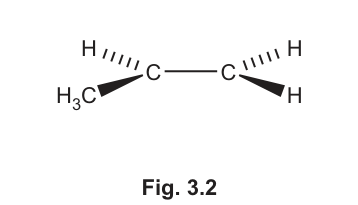
Answer
The bond is formed by the sideways overlap of p-orbitals above and below the plane of the sigma bond framework. In the diagram, add two shaded oval lobes (electron clouds) above and below the C-C single bond line.
See diagram for pi bond lobes above and below C-C axis
Background Concept
A carbon-carbon double bond (C=C) consists of one sigma () bond and one pi () bond.
- The sigma bond is formed by head-on overlap of hybridised orbitals along the internuclear axis. It is the strong bond shown in the provided skeletal structure.
- The pi bond is formed by the sideways (lateral) overlap of unhybridised p-orbitals on each carbon atom. These p-orbitals are perpendicular to the plane of the sigma bond framework (the plane containing the C-C bond and the attached atoms). The electron density of the pi bond is concentrated in two lobes, one above and one below the plane of the molecule.
Understanding the Question
Compound L is propene (). Fig 3.2 shows the sigma bond framework with wedges and dashes indicating 3D geometry (trigonal planar around the double-bonded carbons). The question asks to complete the diagram to show the pi bond formed from orbital overlap.
Approach
Draw the electron density lobes representing the pi bond. These must be above and below the plane defined by the sigma bonds.
Step-by-Step Reasoning
- Identify the sigma framework: The C-C bond is horizontal. The attached atoms (H, H, H3C) are in the plane (represented by wedges/dashes for 3D perspective, but effectively in a plane perpendicular to the p-orbitals).
- Locate p-orbitals: Each carbon in the C=C bond has an unhybridised p-orbital perpendicular to the molecular plane.
- Draw overlap: The sideways overlap creates two regions of electron density. Draw an oval/lobe above the C-C bond and an oval/lobe below the C-C bond. These should be aligned vertically with the C-C bond axis.
- Shading: Typically, the lobes are shaded or filled to represent electron density. One lobe might be shaded darker or both shaded to show the continuous cloud, but standard exam convention is two lobes (top and bottom) indicating the pi system.
Key Takeaways
- Double bond = 1 sigma + 1 pi.
- Pi bond electron density is above and below the internuclear axis.
- Pi bond prevents rotation around the C=C bond.
Common Mistakes
- Drawing the pi bond in the same plane as the atoms (this would be a second sigma bond or incorrect geometry).
- Forgetting that the p-orbitals are perpendicular to the plane of the paper/sigma bonds.
Things to Be Careful About
- The lobes must be clearly above and below the C-C line. Do not draw them to the sides.
Propan-2-ol reacts with sodium to produce anions.
These anions react with 2-bromopropane to form compound , as shown in Fig. 3.3.
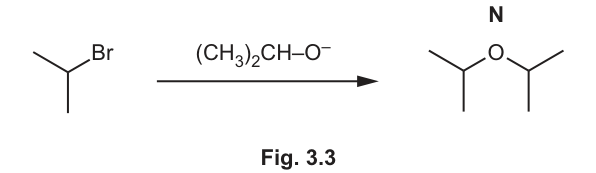
Answer
(Alternatively: )
(CH3)2CHOH + Na -> (CH3)2CHONa + 1/2 H2
Background Concept
Alcohols are weakly acidic and react with reactive metals (like sodium, potassium, magnesium) to produce metal alkoxides (or alkoxides) and hydrogen gas. The reaction is similar to the reaction of water with sodium, but slower. The O-H bond is broken, releasing which forms .
Understanding the Question
The question asks for the equation for the reaction of propan-2-ol with sodium. The product anion is given as .
Approach
Write the balanced chemical equation. Reactant: propan-2-ol + Na. Products: sodium propan-2-oxide + hydrogen.
Step-by-Step Reasoning
- Reactants: and .
- Products: The anion is . The cation is . So the salt is . Hydrogen gas () is evolved.
- Balancing: One mole of alcohol reacts with one mole of sodium to give half a mole of hydrogen. Or 2 moles alcohol + 2 moles Na -> 2 moles salt + 1 mole H2.
- Equation: .
Key Takeaways
- Alcohols + Na -> alkoxide + H2.
- Similar to water + Na -> NaOH + H2, but slower.
Common Mistakes
- Forgetting the hydrogen gas product.
- Writing instead of .
- Incorrectly balancing the sodium (needing 2 Na for 1 H2 if writing integer coefficients, or 1/2 H2 for 1 Na).
Things to Be Careful About
- The mark scheme accepts . Ensure charges are balanced if written as ions.
The reaction of 2-bromopropane with anions follows an mechanism.
Complete Fig. 3.4 to show this mechanism. Include charges, dipoles, lone pairs of electrons and curly arrows, as appropriate.
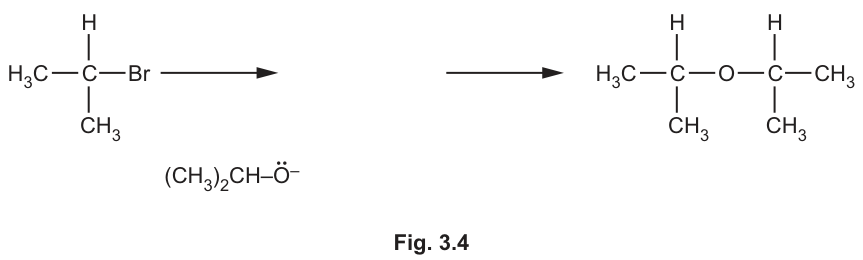
Answer
Step 1: Heterolytic fission of C-Br bond.
- Show on C and on Br.
- Curly arrow from the center of the C-Br bond to the Br atom.
- Intermediate formed: secondary carbocation .
Step 2: Nucleophilic attack.
- Curly arrow from a lone pair on the oxygen of to the positively charged carbon of the carbocation.
See mechanism diagram: C-Br dipole + arrow to Br -> carbocation + arrow from O lone pair to C+
Background Concept
The (Substitution Nucleophilic Unimolecular) mechanism occurs in two steps, primarily with secondary and tertiary halogenoalkanes.
- Step 1 (Slow, rate-determining): The C-X bond breaks heterolytically. The halogen takes both electrons, forming a halide ion and a carbocation intermediate. A dipole must be shown on the C-X bond ( on C, on X) before the arrow is drawn.
- Step 2 (Fast): The nucleophile attacks the carbocation. A curly arrow is drawn from a lone pair on the nucleophile to the positive carbon.
Understanding the Question
The reaction is between 2-bromopropane and the propan-2-oxide anion (). The mechanism is specified as . We need to complete Fig 3.4 showing the mechanism.
Approach
Draw the two steps: bond breaking to form carbocation, then nucleophilic attack. Include dipoles, lone pairs, and curly arrows.
Step-by-Step Reasoning
- Reactants: 2-bromopropane () and (with 3 lone pairs on O, though 1 is needed for the arrow).
- Step 1 - Bond breaking:
- The C-Br bond is polar. Draw on the central C and on Br.
- Draw a curly arrow starting from the middle of the C-Br bond and pointing to the Br atom (representing the pair of electrons moving to Br).
- This forms the intermediate: a secondary carbocation, (isopropyl cation). Draw this with a positive charge on the central carbon.
- Also form (though the mark scheme focuses on the organic intermediate and the arrow to Br).
- Step 2 - Nucleophilic attack:
- The nucleophile is . The oxygen has a negative charge and lone pairs.
- Draw a curly arrow from a lone pair on the oxygen of to the positively charged carbon of the carbocation .
- This forms the product: diisopropyl ether, .
Key Takeaways
- is two-step: carbocation formation then nucleophilic attack.
- Must show dipole on bond breaking.
- Curly arrow from bond to atom for heterolysis.
- Curly arrow from lone pair to positive center for attack.
Common Mistakes
- Drawing a curly arrow from the negative oxygen to the carbon in step 1 (wrong, step 1 is just bond breaking).
- Forgetting the positive charge on the carbocation intermediate.
- Not showing the dipole (/ ) on the C-Br bond.
- Drawing the arrow from the C-Br bond to the C (wrong direction).
Things to Be Careful About
- The mark scheme requires M1 (dipole + arrow to Br), M2 (intermediate carbocation), M3 (arrow from O lone pair to C+). All three are needed for full marks.
- Ensure the intermediate is clearly a carbocation (positive charge on carbon).
Suggest how the rate of the reaction would change, if at all, if 2-chloropropane were used instead of 2-bromopropane.
Explain your answer.
Answer
The rate would decrease.
Explanation: The C—Cl bond has a higher bond enthalpy (is stronger) than the C—Br bond, so it takes longer to break (or requires more energy to break).
Working
- Bond enthalpy: C—Cl > C—Br.
- Rate determining step in is C-X bond fission.
- Stronger bond -> slower fission -> slower rate.
Rate decreases; C-Cl bond is stronger/higher bond enthalpy than C-Br
Background Concept
In reactions, the rate-determining step (slow step) is the heterolytic fission of the carbon-halogen bond (C-X) to form a carbocation and a halide ion. Therefore, the rate of reaction depends on the strength of the C-X bond.
Bond enthalpy trend for carbon-halogen bonds: C—F > C—Cl > C—Br > C—I.
- Bond length increases down the group (Cl < Br < I).
- Bond enthalpy decreases down the group (Cl > Br > I).
- Weaker bonds break more easily/faster.
Understanding the Question
The question asks how the rate changes if 2-chloropropane is used instead of 2-bromopropane, and to explain why.
Approach
Compare the C-Cl and C-Br bonds. Relate bond strength to the rate-determining step of the mechanism.
Step-by-Step Reasoning
- Identify rate-determining step: In , the first step (C-X bond breaking) is slow and rate-determining.
- Compare bonds: We are changing from C-Br to C-Cl. Chlorine is above bromine in Group 17. The C-Cl bond is shorter and stronger (higher bond enthalpy) than the C-Br bond.
- Effect on rate: Since the C-Cl bond is stronger, it requires more energy to break and breaks more slowly.
- Conclusion: The rate of reaction decreases.
Key Takeaways
- rate depends on C-X bond strength.
- C-I > C-Br > C-Cl > C-F in terms of reactivity (inverse of bond strength).
- Iodoalkanes react fastest in ; chloroalkanes are slower.
Common Mistakes
- Saying the rate increases (confusing bond strength trend).
- Saying 'chlorine is more electronegative' (true, but doesn't directly explain rate; bond enthalpy is the key factor for the rate-determining step).
- Forgetting to say 'decrease'.
Things to Be Careful About
- Must mention bond strength or bond enthalpy. 'Bond is stronger' is a good keyword.
- Must link bond strength to the breaking of the bond in the mechanism.
is also added to petrol to make it burn more smoothly.
Construct an equation for the complete combustion of , .
Answer
(Or: )
C6H14O + 9O2 -> 6CO2 + 7H2O
Background Concept
Complete combustion of an organic compound containing C, H, and O in excess oxygen produces carbon dioxide () and water ().
General equation: .
Understanding the Question
Compound N is diisopropyl ether with molecular formula . The question asks for the equation for its complete combustion.
Approach
Balance the combustion equation: .
Step-by-Step Reasoning
- Carbon balance: 6 C in reactant -> 6 .
- Hydrogen balance: 14 H in reactant -> 7 .
- Oxygen balance:
- Products: oxygen atoms.
- Reactant N provides 1 oxygen atom.
- Need 18 oxygen atoms from .
- So, 9 molecules.
Key Takeaways
- Combustion products: and .
- Balance C, then H, then O last (accounting for O in the fuel).
Common Mistakes
- Forgetting the oxygen in the fuel molecule ( has 1 O).
- Wrong coefficient for water (7, not 14).
- Wrong coefficient for oxygen (9, not 19 or 18).
Things to Be Careful About
- State symbols are not explicitly asked for in the mark scheme snippet, but good practice is for all. The mark scheme just shows the balanced equation.
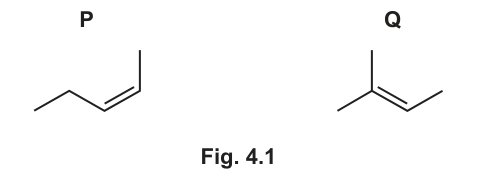
Compounds and are structural isomers.
Answer
Structural isomers are molecules with the same molecular formula but different structural formulae (different arrangement of atoms / different connectivity).
Same molecular formula but different structural formulae (different arrangement of atoms).
Background Concept
Isomerism in organic chemistry arises when two or more compounds share the same molecular formula (same number of each type of atom) but differ in how those atoms are connected or arranged in space. Structural (or constitutional) isomerism is the broadest category: the atoms are joined in a different order, giving different structural formulae. This contrasts with stereoisomerism, where the connectivity is identical but the spatial arrangement differs (e.g. cis/trans or optical isomers).
Understanding the Question
The command word is 'Define'. The question asks for the formal definition of structural isomerism. The two marks correspond to the two essential components of the definition: (M1) same molecular formula and (M2) different structural formulae. The stem provides compounds P (pent-2-ene) and Q (2-methylbut-2-ene) as examples, both with molecular formula .
Approach
State the definition in two parts matching the two marks. No working is needed; this is pure recall.
Step-by-Step Reasoning
- M1 (1 mark): Structural isomers must first share the same molecular formula — the same number of atoms of each element. For P and Q, both are .
- M2 (1 mark): They must differ in their structural formula — the atoms are connected in a different order. In P the carbon skeleton is a straight five-carbon chain with the double bond at position 2; in Q the skeleton is branched (a methyl substituent on carbon 2).
Key Takeaways
The definition of structural isomerism has two mandatory components: identical molecular formula AND different structural formulae. Omitting either half loses a mark.
Common Mistakes
- Saying 'same formula' without specifying 'molecular formula' — this could be confused with empirical formula.
- Saying 'different shapes' or 'different arrangements in space' — that describes stereoisomerism, not structural isomerism.
- Writing 'different structures' without first stating the same molecular formula.
Things to Be Careful About
The mark scheme requires 'same molecular formula' specifically. 'Same formula' alone may not earn M1. Also, 'different structural formulae' or 'different structures' or 'different arrangement of atoms' all satisfy M2.
shows geometrical isomerism.
Draw the geometrical isomer of . Explain why the two isomers are not identical.
explanation
Answer
The geometrical isomer of P is trans-pent-2-ene (E-pent-2-ene):
The two isomers are not identical because there is restricted (no) rotation about the double bond.
Trans-pent-2-ene (E-pent-2-ene); restricted rotation about the C=C double bond.
Background Concept
Geometrical (cis/trans or E/Z) isomerism occurs in alkenes when each carbon of the double bond carries two different substituents. The bond prevents free rotation about the axis, so the two substituents on each carbon are locked either on the same side (cis/Z) or opposite sides (trans/E). These are genuinely different molecules with different physical properties (different boiling points, dipoles, etc.).
Understanding the Question
Compound P is pent-2-ene, , drawn in the cis (Z) configuration in Fig. 4.1. The question asks you to draw the trans (E) geometrical isomer and explain why the two are not the same molecule.
Approach
Draw the trans isomer with the and groups on opposite sides of the bond. Then state the reason: the bond in the prevents rotation, so the two spatial arrangements cannot interconvert without breaking the bond.
Step-by-Step Reasoning
- M1 (drawing): Draw trans-pent-2-ene. In the skeletal formula the double bond is drawn horizontally (or at an angle) with the ethyl group () extending downward on one carbon and the methyl group () extending upward on the other carbon — i.e. the two alkyl groups are on opposite sides of the double bond. The remaining substituents (H atoms, implicit in skeletal notation) are on the other side.
- M2 (explanation): The double bond consists of one and one bond. The bond locks the two carbons so that free rotation is not possible at ordinary temperatures. Therefore the cis and trans arrangements are distinct, non-interconverting molecules — they are not identical.
Key Takeaways
Geometrical isomerism in alkenes is only possible when each carbon bears two different groups. The trans isomer is the 'opposite-side' arrangement. The explanation always rests on restricted rotation about the .
Common Mistakes
- Drawing the cis isomer again (i.e. not actually changing the geometry).
- Drawing a structural isomer (e.g. pent-1-ene) instead of the geometrical isomer.
- Explaining the difference as 'different shapes' without mentioning restricted rotation about the .
- Forgetting that the explanation must reference the double bond specifically, not just say 'the molecule cannot rotate'.
Things to Be Careful About
The skeletal drawing must clearly show the trans configuration: the main carbon chain must zigzag across the double bond so the two alkyl groups are on opposite sides. A poorly drawn 'trans' that looks like a straight chain may be ambiguous.
Answer
Electrophilic addition.
Electrophilic addition
Background Concept
Alkenes react with halogens (e.g. ) by electrophilic addition. The electron-rich bond of the polarises the approaching molecule, generating a temporary dipole (). The bromine acts as an electrophile, accepting electrons from the bond to form a cyclic bromonium ion intermediate, which is then attacked by to give a 1,2-dibromoalkane. The overall process adds two atoms across the double bond — hence 'addition' — and the first step is initiated by an electrophile — hence 'electrophilic'.
Understanding the Question
The command word is 'Name'. The question asks only for the mechanism name. Both P (pent-2-ene) and Q (2-methylbut-2-ene) contain a bond, so both undergo electrophilic addition with aqueous bromine.
Approach
Recognise the reaction type: alkene + bromine → dibromoalkane. This is the classic electrophilic addition reaction.
Step-by-Step Reasoning
- Aqueous bromine () is an electrophile in this context. The electrons of the bond attack , forming a bromonium ion, then (or in aqueous solution) opens the ring. The net result is addition across the double bond.
- The mechanism name required is 'electrophilic addition' (B1).
Key Takeaways
The reaction of alkenes with halogens (, ) and with hydrogen halides (, ) is electrophilic addition. This is one of the most frequently tested mechanism names at AS level.
Common Mistakes
- Writing 'addition reaction' alone (too vague — must specify 'electrophilic').
- Writing 'nucleophilic addition' (that is for carbonyl compounds, not alkenes).
- Writing 'free radical substitution' (that is for alkanes with halogens under UV).
Things to Be Careful About
The full two-word term 'electrophilic addition' is required. 'Electrophilic' alone or 'addition' alone will not earn the mark.
is oxidised by hot concentrated acidified , forming two different organic products.
Construct an equation for this reaction. Use to represent an atom of oxygen from the oxidising agent.
Working
Hot concentrated acidified cleaves the bond. The carbon bearing two alkyl groups becomes a ketone; the carbon bearing one H and one alkyl group becomes a carboxylic acid.
Answer
(CH3)2C=CHCH3 + 3[O] → CH3COCH3 + CH3COOH
Background Concept
Hot, concentrated, acidified potassium manganate(VII) () is a powerful oxidising agent that cleaves carbon-carbon double bonds completely. Each carbon of the is oxidised to its highest stable oxidation state given its substituents:
- A carbon with two alkyl substituents (no H) → ketone ().
- A carbon with one H and one alkyl substituent → carboxylic acid ().
- A carbon with two H atoms → (and ).
This is in contrast to cold, dilute, alkaline , which gives a diol (syn-hydroxylation) without cleavage.
Understanding the Question
Q is 2-methylbut-2-ene, . The question asks for the equation for its oxidation by hot concentrated acidified , using to represent an oxygen atom from the oxidising agent. Two marks are available: M1 for correct products, M2 for the balanced equation.
Approach
Identify the two carbons of the double bond and their substituents, determine the product from each, then balance the oxygen atoms using .
Step-by-Step Reasoning
- Left-hand carbon of the : bears two groups (no H). Oxidative cleavage gives a ketone: (propanone / acetone).
- Right-hand carbon of the : bears one H and one . Oxidative cleavage gives a carboxylic acid: (ethanoic acid / acetic acid).
- Balancing oxygen: The ketone requires 1 oxygen atom (). The carboxylic acid requires 2 oxygen atoms (, adding one O for the C=O and one O for the OH, but one of the original C–H is replaced). Net oxygen atoms needed = 3, so .
- Atom check: C: 5 = 3 + 2 ✓; H: 10 = 6 + 4 ✓; O: 3 = 1 + 2 ✓.
Key Takeaways
Hot concentrated cleaves completely. The product from each alkene carbon depends on how many H atoms that carbon originally carried: 0 H → ketone, 1 H → carboxylic acid, 2 H → . Always use notation when the question specifies it.
Common Mistakes
- Writing as a product (only occurs when the alkene carbon has two H atoms, which is not the case here).
- Forgetting to balance the equation (M2 requires the coefficient of 3 before ).
- Writing the products as aldehydes instead of carboxylic acids (aldehydes are further oxidised to acids under these harsh conditions).
- Using instead of when the question specifies .
Things to Be Careful About
The question explicitly says 'Use to represent an atom of oxygen'. Do not write or in the equation. The coefficient 3 before is essential for the balance.
reacts with to produce two structural isomers, and , as shown in Fig. 4.2.
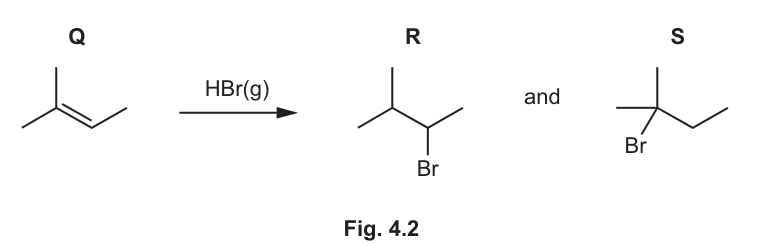
State and explain why isomer is the major product of the reaction.
Answer
Isomer S is the major product because the reaction proceeds via a more stable (tertiary) carbocation intermediate. The greater number of alkyl groups attached to the positively charged carbon exerts a stronger positive inductive effect (), which stabilises the centre more effectively than in the secondary carbocation leading to R.
S forms via the more stable tertiary carbocation; greater positive inductive effect of more alkyl groups stabilises the C+ intermediate.
Background Concept
When an unsymmetrical alkene reacts with a hydrogen halide (, ), the electrophilic addition can proceed via two possible carbocation intermediates, depending on which carbon of the the adds to. The reaction preferentially follows the pathway through the more stable carbocation (Markovnikov's rule). Carbocation stability increases with the number of alkyl groups attached to the centre: tertiary () > secondary () > primary (). This is because alkyl groups are electron-donating via the positive inductive effect ( effect): they push electron density toward the electron-deficient carbon, dispersing and stabilising the positive charge.
Understanding the Question
Q (2-methylbut-2-ene) reacts with to give two products: R (2-bromo-3-methylbutane, a secondary bromide) and S (2-bromo-2-methylbutane, a tertiary bromide). The question asks you to state and explain why S is the major product.
Approach
Identify the two possible carbocation intermediates. S arises from a tertiary carbocation; R from a secondary one. Explain that the tertiary carbocation is more stable due to the greater effect of three alkyl groups versus two.
Step-by-Step Reasoning
-
can add to either carbon of the :
- If adds to the carbon (right-hand carbon), the positive charge falls on the carbon bearing two methyl groups → tertiary carbocation .
- If adds to the carbon (left-hand carbon), the positive charge falls on the carbon bearing one methyl and one H → secondary carbocation .
-
The tertiary carbocation is more stable because it has three alkyl groups (two methyls and one ethyl) exerting the effect, compared to only two alkyl groups in the secondary carbocation.
-
then attacks the carbocation. Attack on the tertiary carbocation gives S (2-bromo-2-methylbutane); attack on the secondary gives R (2-bromo-3-methylbutane).
-
Since the tertiary carbocation is lower in energy, it forms faster (lower activation energy), so S is the major product.
-
M1: The reaction proceeds via a more stable intermediate / carbocation.
-
M2: Because of the greater positive inductive effect of more alkyl groups.
Key Takeaways
Markovnikov's rule is a consequence of carbocation stability. Always identify the intermediate carbocation and count the alkyl groups on the centre. The effect of alkyl groups is the standard explanation for carbocation stability at AS level.
Common Mistakes
- Saying 'S has more alkyl groups' without linking it to the carbocation intermediate.
- Saying 'tertiary is more stable' without mentioning the inductive effect (the mark scheme requires the explanation for M2).
- Confusing the products: R is the secondary bromide, S is the tertiary bromide.
- Saying 'more substituted alkene' — this is not the relevant argument here.
Things to Be Careful About
The explanation must explicitly reference the intermediate carbocation (M1) and the positive inductive effect of alkyl groups (M2). Simply saying 'tertiary carbocation is more stable' without the inductive effect reasoning may lose M2.
The mass spectrum of shows peaks at and .
Suggest structures for the ions responsible for these peaks.
Answer
The peaks at and are the molecular ion peaks of R (), corresponding to the two naturally occurring isotopes of bromine.
The ion at contains :
The ion at contains :
Molecular ions of R: [CH3CH(CH3)CH(79Br)CH3]+ at m/e = 150 and [CH3CH(CH3)CH(81Br)CH3]+ at m/e = 152
Background Concept
Bromine has two naturally occurring isotopes: (50.7%) and (49.3%), in an approximately 1:1 ratio. In a mass spectrum, a molecule containing one bromine atom therefore shows two molecular ion peaks of nearly equal height, separated by 2 mass units: the M peak (containing ) and the M+2 peak (containing ). This 1:1 doublet is a diagnostic signature of a bromine-containing compound.
Understanding the Question
R is 2-bromo-3-methylbutane, , with molecular formula . The mass spectrum shows peaks at and . The question asks you to suggest the structures of the ions responsible. Since and , these are the molecular ions containing and respectively.
Approach
Calculate the molecular mass with each bromine isotope. Confirm the peaks match the molecular ion. Draw the full molecular ion structure (in brackets with a + charge) showing the correct isotope label.
Step-by-Step Reasoning
- M1 (m/e = 150): The molecular ion containing . Structure: . In skeletal form, this is the 2-bromo-3-methylbutane skeleton with on C-2, enclosed in square brackets with a superscript +.
- M2 (m/e = 152): The molecular ion containing . Identical structure but with : .
- These are not fragment ions — they are the intact molecular ions. The 2-unit separation and roughly equal intensity confirm a single bromine atom.
Key Takeaways
A 1:1 doublet at M and M+2 in a mass spectrum is the fingerprint of one bromine atom. Always check whether the peaks correspond to the molecular ion or a fragment by calculating the mass.
Common Mistakes
- Drawing a fragment ion (e.g. loss of ) instead of the molecular ion. The masses 150 and 152 match the full molecule, not a fragment.
- Forgetting the brackets and + charge around the ion structure.
- Not labelling the bromine isotope ( vs ) — the mark scheme requires the isotope label.
- Drawing the wrong carbon skeleton (e.g. the S skeleton instead of R).
Things to Be Careful About
The structures must be drawn in square brackets with a superscript + to indicate a positive ion. The bromine isotope must be explicitly labelled as or . The carbon skeleton must match R (2-bromo-3-methylbutane), not S.
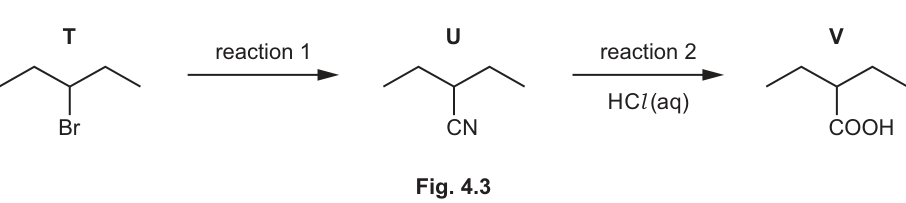
Fig. 4.3 shows a synthesis starting from , a different isomer of and .
Answer
in ethanol, heated under reflux.
KCN in ethanol, heat under reflux
Background Concept
Halogenoalkanes react with cyanide ions () by nucleophilic substitution. The ion acts as a nucleophile, attacking the electron-deficient carbon bonded to the halogen and displacing the halide ion (). This converts a halogenoalkane into a nitrile (), extending the carbon chain by one carbon. The standard conditions are potassium cyanide () dissolved in ethanol (to dissolve the organic halogenoalkane) and heating under reflux.
Understanding the Question
Reaction 1 converts T (3-bromopentane) to U (3-cyanopentane): the is replaced by . The question asks for the reagent and conditions.
Approach
Recognise the transformation: halogenoalkane → nitrile. This is nucleophilic substitution with . State the reagent (), solvent (ethanol), and condition (heat/reflux).
Step-by-Step Reasoning
- The on C-3 of T is replaced by on C-3 of U. This is a one-for-one substitution.
- Reagent: (provides nucleophile).
- Solvent: ethanol (the organic solvent needed to dissolve the halogenoalkane; aqueous conditions would favour hydrolysis to an alcohol instead).
- Condition: heat (under reflux) to provide sufficient activation energy.
- B1: in ethanol (and heat).
Key Takeaways
The conversion halogenoalkane → nitrile uses /ethanol/heat. The choice of ethanol (not water) is critical: aqueous would give an alcohol via hydrolysis. This is a standard AS-level reagent-and-conditions question.
Common Mistakes
- Writing 'NaCN' instead of 'KCN' — NaCN is also acceptable in practice, but the mark scheme specifies KCN.
- Omitting the solvent (ethanol) — without it, the reaction does not proceed effectively.
- Writing 'aqueous KCN' — this would give the alcohol, not the nitrile.
- Forgetting 'heat' or 'reflux' as the condition.
Things to Be Careful About
The mark scheme credits 'KCN in ethanol (and heat)'. Both the reagent and the solvent must be stated. 'Heat' or 'reflux' should be mentioned as the condition.
Answer
(C2H5)2CHCN + 2H2O + HCl → (C2H5)2CHCOOH + NH4Cl
Background Concept
Nitriles () undergo acidic hydrolysis when heated with aqueous acid (e.g. or ). The triple bond is cleaved and converted into a group, while the nitrogen is released as ammonium ion (). The overall reaction consumes 2 water molecules and 1 acid molecule, producing the carboxylic acid and the ammonium salt of the acid.
Understanding the Question
Reaction 2 is the hydrolysis of U, (3-cyanopentane), with to give V, (2-ethylbutanoic acid). The question asks for the balanced equation.
Approach
Write the nitrile on the left, add and , and produce the carboxylic acid and on the right. Check atom balance.
Step-by-Step Reasoning
- The group is hydrolysed: the C becomes and the N becomes .
- Oxygen atoms needed: 2 (for the group) → supplied by .
- Hydrogen: the needs 4 H; 2 from each gives 4 H to the nitrogen; the provides the to pair with forming .
- Balanced equation:
- Atom check: C: 7 = 7 ✓; H: 13+4+1 = 18; right: 14+4 = 18 ✓; N: 1 = 1 ✓; O: 2 = 2 ✓; Cl: 1 = 1 ✓.
Key Takeaways
Acidic hydrolysis of a nitrile: . The coefficient of 2 before water is essential. The nitrogen leaves as , not (in acidic solution).
Common Mistakes
- Writing instead of (in acidic solution, ammonia is protonated).
- Writing instead of (unbalanced).
- Forgetting on the left or on the right.
- Writing the organic product incorrectly (e.g. losing the ethyl branches).
Things to Be Careful About
The equation must be fully balanced. The mark scheme gives the exact form; any deviation in coefficients loses the mark. (not ) is the correct product in acidic solution.
reacts with propan-2-ol in the presence of a catalytic amount of to form organic compound .
Complete Table 4.1 to give details of this reaction.
Table 4.1
| reaction of with propan-2-ol | |
|---|---|
| type of reaction | |
| functional group formed | |
| molecular formula of organic product |
Answer
| reaction of V with propan-2-ol | |
|---|---|
| type of reaction | condensation |
| functional group formed | ester |
| molecular formula of organic product W |
Condensation; ester; C9H18O2
Background Concept
A carboxylic acid reacts with an alcohol in the presence of a catalytic amount of concentrated to form an ester and water. This is a condensation reaction (also called esterification or Fischer esterification): two molecules combine with the loss of a small molecule (). The functional group formed is the ester group, .
Understanding the Question
V is 2-ethylbutanoic acid, , with molecular formula . It reacts with propan-2-ol, (), catalysed by . The table asks for: (1) the type of reaction, (2) the functional group formed, and (3) the molecular formula of the ester W.
Approach
Identify the reaction as esterification (condensation). The functional group is an ester. Calculate the molecular formula of W by adding the two reactants and subtracting .
Step-by-Step Reasoning
- M1 — Type of reaction: The reaction of a carboxylic acid with an alcohol to form an ester and water is a condensation reaction. (Esterification is also acceptable but the mark scheme credits 'condensation'.)
- M2 — Functional group formed: The product contains the ester group ().
- M3 — Molecular formula of W:
- C: ✓
- H: ✓
- O: ✓
So W is , which is propan-2-yl 2-ethylbutanoate.
Key Takeaways
Carboxylic acid + alcohol → ester + water is a condensation reaction. The molecular formula of the ester is obtained by summing the reactant formulae and subtracting . Always check the atom balance.
Common Mistakes
- Writing 'esterification' for the reaction type when the mark scheme expects 'condensation' (though esterification may be accepted, 'condensation' is the credited answer).
- Writing 'carboxylic acid' or 'acid' as the functional group instead of 'ester'.
- Arithmetic error in the molecular formula: forgetting to subtract , giving instead of .
- Writing the structural formula instead of the molecular formula (the question asks for molecular formula).
Things to Be Careful About
The question asks for the molecular formula, not the structural formula. The answer must be in the form . The 'type of reaction' must be 'condensation' (or 'esterification' if accepted). The functional group is 'ester', not 'carboxylic acid' or 'alcohol'.