Chemistry 9701/23 — October/November 2025
Cambridge AS Level · AS Level Structured Questions · worked solutions for every part, with the mark scheme
Topics Atomic Structure · Atoms, Molecules and Stoichiometry · Introduction to Organic Chemistry · Hydrocarbons · Analytical Techniques · Electrochemistry · +11 more
Chromium, Cr, and its compounds are widely used in many chemical reactions.
Cr exists as four stable isotopes.
The most common isotope of Cr is chromium-52.
Determine the number of protons, neutrons and electrons in an atom of chromium-52.
number of protons .................. neutrons .................. electrons ..................
Answer
number of protons = 24, neutrons = 28, electrons = 24
24 protons, 28 neutrons, 24 electrons
Background Concept
In nuclide notation , is the proton (atomic) number and is the nucleon (mass) number. Chromium's proton number is 24. In a neutral atom, number of electrons = number of protons, and number of neutrons = .
Understanding the Question
Chromium-52 means for Cr, whose . State the counts of the three sub-atomic particles.
Approach
Use neutrons = mass number − proton number; electrons = protons for a neutral atom.
Step-by-Step Reasoning
- Protons: .
- Neutrons: .
- Electrons: neutral atom, so .
Key Takeaways
Isotope notation instantly gives all three particle counts for a neutral atom.
Common Mistakes
Subtracting the wrong way (24 − 52), or giving 28 electrons by confusing mass number with electron count.
Things to Be Careful About
The atom is neutral here — only for ions would electron count differ from proton number.
Describe how an atom of chromium-54 differs from an atom of chromium-52. Refer to numbers of particles in your answer.
Answer
An atom of has two more neutrons than an atom of (both have 24 protons and 24 electrons).
Chromium-54 has two more neutrons than chromium-52
Background Concept
Isotopes have the same proton number but different numbers of neutrons, hence different mass numbers.
Understanding the Question
Compare with , quoting particle numbers.
Approach
Protons and electrons are identical (both 24); only neutrons differ: more neutrons.
Step-by-Step Reasoning
: 24p, 30n, 24e. : 24p, 28n, 24e. Difference: two extra neutrons.
Key Takeaways
Isotopes differ only in neutron number.
Common Mistakes
Saying 'different mass' without referring to particle numbers, as the command word requires.
Things to Be Careful About
The question demands reference to numbers of particles — a vague 'heavier atom' scores no mark.
The relative isotopic masses of the isotopes of Cr can be determined using mass spectrometry.
State what other information is needed to calculate the relative atomic mass, , of Cr.
Answer
The relative abundance of each isotope.
The relative abundances of each isotope
Background Concept
— a weighted mean requiring both isotopic masses and their abundances.
Understanding the Question
Mass spectrometry gives relative isotopic masses; what else is needed to compute ?
Approach
Recall the weighted-average formula and identify the missing quantity.
Step-by-Step Reasoning
Without abundances, a simple average of isotopic masses would be meaningless; the natural abundance of each isotope weights the mean.
Key Takeaways
is an abundance-weighted average of isotopic masses.
Common Mistakes
Answering 'the number of isotopes' — that alone does not allow a weighted mean.
Things to Be Careful About
'Abundance' must be relative abundance (percentage or fraction), not just counts.
Atoms of , and make up more than 95% of naturally occurring chromium atoms. The of naturally occurring Cr is 51.996.
Suggest what these statements imply about the relative isotopic mass of the fourth stable isotope of chromium.
Answer
Since , and (RIMs 52, 53, 54) make up over 95% and the weighted mean is 51.996, the fourth isotope must have a relative isotopic mass less than 51.996 (it must be a lighter isotope, e.g. ).
The fourth isotope has a relative isotopic mass less than 51.996
Background Concept
lies between the lightest and heaviest isotopic masses, weighted by abundance. If three isotopes of mass ≥52 dominate (>95%) and the mean is 51.996 — just below 52 — the remaining small contribution must pull the average down.
Understanding the Question
Deduce what the two statements imply about the unseen fourth isotope's relative isotopic mass (RIM).
Approach
Note that 51.996 < 52, the lowest RIM of the three named isotopes. A weighted mean below the minimum of the dominant contributors requires the minor contributor to be lighter.
Step-by-Step Reasoning
If all four isotopes had RIM ≥ 52, could not fall below 52. Since , the fourth isotope must have RIM < 51.996 (in fact , ~4.3% abundance).
Key Takeaways
A weighted mean constrains the range of possible component values.
Common Mistakes
Claiming the fourth isotope must be exactly chromium-50, or saying 'heavier' — the direction of the deviation from 52 is the key deduction.
Things to Be Careful About
The mark scheme accepts any value of RIM less than 51.996; you need only the inequality, not the exact isotope.
The shorthand electronic configuration of chromium is .
Complete the full electronic configuration of chromium.
...........................................................................
Answer
1s2 2s2 2p6 3s2 3p6 3d5 4s1
Background Concept
denotes the electron configuration of argon, (18 electrons).
Understanding the Question
Expand the shorthand into the full configuration.
Approach
Replace with its full configuration and append the valence subshells.
Step-by-Step Reasoning
Argon's 18 electrons fill through ; chromium then has (the anomalous half-filled d subshell arrangement).
Key Takeaways
Know the core = .
Common Mistakes
Writing (calcium-like) or omitting a subshell.
Things to Be Careful About
Keep the given exactly as printed — do not 'correct' it to .
Answer
6 unpaired electrons (five in , one in ).
6
Background Concept
By Hund's rule, electrons occupy degenerate orbitals singly before pairing. A half-filled has five singly occupied d orbitals (5 unpaired); has one unpaired electron. Paired subshells (, ) contribute none.
Understanding the Question
Count total unpaired electrons in Cr: .
Approach
.
Step-by-Step Reasoning
Each of the five 3d orbitals holds one electron (all spin-parallel), and the single 4s electron is also unpaired: total 6.
Key Takeaways
Half-filled d subshells maximise unpaired electrons; s¹ adds one more.
Common Mistakes
Answering 5 (forgetting the 4s electron) or 4 (assuming ).
Things to Be Careful About
Use the anomalous configuration given in the stem, not the 'expected' filling order.
Acidified dichromate(VI) ions will convert methanal, , to carbon dioxide. The movement of electrons to or from relevant species is shown in the following half-equations.
half-equation 1
half-equation 2
Answer
(the chromium in it) is reduced, because it gains electrons (on the left-hand side of the half-equation).
Cr2O7^2- is reduced because it gains electrons
Background Concept
Reduction = gain of electrons (OIL RIG). In a half-equation, electrons appearing on the reactant side indicate reduction.
Understanding the Question
Half-equation 2 shows electrons on the left; name the reduced species and explain.
Approach
Electrons are reactants → the species consuming them is reduced: dichromate(VI) ions (Cr goes from +6 to +3).
Step-by-Step Reasoning
: Cr oxidation state falls from +6 to +3, consistent with electron gain.
Key Takeaways
Electrons on the left of a half-equation = reduction.
Common Mistakes
Naming or , or saying 'oxidised'.
Things to Be Careful About
The explanation must state electron gain, not just 'oxidation number decreases' alone — electron gain is the credited reason.
The oxidation state of the carbon atom in methanal is 0.
Calculate the oxidation state of carbon in carbon dioxide.
Answer
In : , so the oxidation state of carbon is .
+4
Background Concept
Oxygen is −2 in oxides; the sum of oxidation states in a neutral molecule is zero.
Understanding the Question
Find carbon's oxidation state in , given it is 0 in methanal.
Approach
Set up .
Step-by-Step Reasoning
. Carbon is oxidised from 0 to +4, losing 4 electrons — matching half-equation 1.
Key Takeaways
Oxidation-state arithmetic: assign O as −2, solve for the unknown.
Common Mistakes
Writing −4 or 4 without the sign; the oxidation state is .
Things to Be Careful About
Include the positive sign explicitly.
Construct the ionic equation for the reaction of dichromate(VI) ions with methanal in acidic conditions.
Answer
This part was removed from the question paper due to an issue with the question; for completeness, the combined ionic equation would be:
Part removed from the paper; see working for the combined ionic equation
Background Concept
To combine half-equations, multiply each so the electrons lost equal electrons gained (LCM of 4 and 6 is 12), then cancel electrons and any species appearing on both sides.
Understanding the Question
The published paper withdrew this part due to a printing issue, so no marks were awarded; the method is shown for learning purposes.
Approach
Multiply half-equation 1 by 3 (12 e⁻ lost) and half-equation 2 by 2 (12 e⁻ gained); add and cancel.
Step-by-Step Reasoning
and . Adding and cancelling 12 e⁻, 12 H⁺ and 3 H₂O gives . (Alternatively, dividing through by 2 gives the simplest whole-number ratio shown in the solution.)
Key Takeaways
Electron balance dictates the multipliers; cancel species common to both sides.
Common Mistakes
Forgetting to cancel H⁺ and H₂O after cancelling electrons.
Things to Be Careful About
Check atoms and charges balance as a final step.
Answer
- is non-polar, so its molecules have only instantaneous dipole–induced dipole (dispersion) forces between them; methanal is polar, so its molecules have permanent dipole–permanent dipole forces (as well as dispersion forces).
- The intermolecular forces in methanal are stronger than those in , so more energy is needed to separate methanal molecules: methanal is a liquid at while is a gas.
CO2 has only instantaneous dipole–induced dipole forces; methanal has stronger permanent dipole–permanent dipole forces, so methanal is liquid
Background Concept
Physical state at a given temperature depends on the strength of intermolecular forces (IMF), not covalent bond strength. is linear and symmetrical (), so bond dipoles cancel — the molecule is non-polar overall and only London dispersion forces act between molecules. Methanal () is polar (the C=O bond dipole does not cancel), giving permanent dipole–permanent dipole forces in addition to dispersion forces.
Understanding the Question
Explain why two small covalent molecules differ in state at — the answer lies in comparing IMFs, with two marks: identify the force types, then compare strengths.
Approach
Step 1: classify polarity of each molecule. Step 2: name the IMF each exhibits. Step 3: state which IMFs are stronger and link to the physical state.
Step-by-Step Reasoning
M1: — only instantaneous dipole–induced dipole forces; methanal — permanent dipole–permanent dipole (plus id-id). M2: methanal's IMFs are stronger, so its molecules need more energy to separate; at methanal remains liquid while molecules easily escape to the gas phase.
Key Takeaways
Molecular polarity determines whether permanent dipole forces exist; stronger IMFs mean higher boiling point and a liquid/solid state at higher temperatures.
Common Mistakes
Talking about covalent C=O bonds being broken (bonds are not broken on boiling); calling 's forces 'weak van der Waals' without naming the specific type; omitting the comparison of strength (M2).
Things to Be Careful About
Use the precise terms 'instantaneous dipole–induced dipole' and 'permanent dipole–permanent dipole'; both the force identification AND the strength comparison are needed for the two marks.
In acidic conditions, a dynamic equilibrium is established between and .
Answer
A dynamic equilibrium is one in which the rate of the forward reaction equals the rate of the backward reaction, so the concentrations of reactants and products remain constant.
Forward and backward reaction rates are equal; concentrations constant
Background Concept
'Dynamic' means both reactions continue to occur; 'equilibrium' means no net change. Rates are equal and macroscopic properties (concentrations) are constant, not necessarily equal.
Understanding the Question
State the meaning of dynamic equilibrium for this system.
Approach
Give either the rate equality or the constant-concentrations statement (mark scheme accepts either).
Step-by-Step Reasoning
Forward () and backward reactions occur at the same rate, so the yellow/orange composition stays constant.
Key Takeaways
Equal rates, constant (not equal) concentrations.
Common Mistakes
Saying 'concentrations of reactants and products are equal' — that is wrong.
Things to Be Careful About
'Constant' not 'equal' — a classic trap.
Answer
A closed system (nothing added to or removed from the reaction mixture).
Closed system
Background Concept
Dynamic equilibrium can only be established in a closed system, where no reactants or products escape or enter.
Understanding the Question
Name the condition needed for the equilibrium to be established.
Approach
Recall: closed system.
Step-by-Step Reasoning
In an open system, species leaving would prevent the rates from balancing; here all species remain in solution.
Key Takeaways
Closed system is the necessary condition.
Common Mistakes
Answering 'constant temperature' — temperature affects position, but the necessary condition for establishment is a closed system.
Things to Be Careful About
The question asks for the condition necessary to establish equilibrium — closed system.
ions are yellow and ions are orange.
State what is observed when the following changes are made to an equilibrium mixture of acidified and ions.
Explain your answers.
-
The equilibrium mixture is warmed gently.
observation ................................................................................................................
explanation ................................................................................................................
....................................................................................................................................
....................................................................................................................................
-
Dilute is added to the equilibrium mixture.
observation ................................................................................................................
explanation ................................................................................................................
....................................................................................................................................
....................................................................................................................................
Answer
Warming gently:
- observation: the mixture becomes more orange.
- explanation: the forward reaction is endothermic (), so by Le Chatelier's principle the equilibrium shifts forward (to the right) to absorb the added heat, producing more orange .
Adding dilute :
- observation: the mixture becomes more orange.
- explanation: adding acid increases ; the equilibrium shifts forward (to the right) to remove the added , producing more orange .
Both changes: mixture turns more orange; forward shift due to endothermic forward reaction / removal of added H+
Background Concept
Le Chatelier's principle: when a change is made to a system in dynamic equilibrium, the equilibrium shifts to oppose (minimise) the change. Here, , (forward endothermic). Yellow = ; orange = .
Understanding the Question
For each perturbation, state the colour observed and explain it via the direction of shift.
Approach
Temperature increase → shift in the endothermic direction (forward, right). Adding H⁺ → shift to consume H⁺ (forward, right). Both produce more orange dichromate.
Step-by-Step Reasoning
- Warming: extra heat is 'on the reactant side' of the endothermic forward reaction; the system shifts forward to absorb it → more → more orange (M1 observation, M2 explanation).
- HCl: raises ; equilibrium shifts forward to remove the added acid → more orange (M3 observation, M4 explanation).
Key Takeaways
Endothermic forward reactions shift right on heating; concentration additions shift the equilibrium away from the added species.
Common Mistakes
Saying the mixture turns yellow (wrong direction); explaining the HCl effect as 'Cl⁻ reacts' rather than via added H⁺; omitting 'to oppose the change' in the explanation.
Things to Be Careful About
Both the observation AND the explanation carry marks — a bare colour without the Le Chatelier reasoning loses half the marks.
Chromium(IV) fluoride, , is a covalent molecule that shows similar chemical properties to .
Suggest the type of reaction that occurs when is placed in water.
Construct a relevant equation for this reaction.
type of reaction .........................................................................................................................
equation ....................................................................................................................................
Answer
type of reaction: hydrolysis
equation:
Hydrolysis; CrF4 + 2H2O -> CrO2 + 4HF
Background Concept
Covalent tetrachlorides such as are rapidly hydrolysed by water: the central atom accepts attack by water (the Si–Cl bond is polarised and Si can expand its coordination), yielding the oxide and HCl. 'shows similar chemical properties to ', so it undergoes the analogous reaction — hydrolysis — giving the oxide and the hydrogen halide.
Understanding the Question
Name the reaction type when meets water, and write the equation.
Approach
By analogy: . Replace Si→Cr, Cl→F.
Step-by-Step Reasoning
M1: the reaction of a covalent halide with water splitting it into oxide + hydrogen halide is hydrolysis. M2: balance — one Cr, four F form 4HF; four O atoms needed, supplied by 2H₂O giving CrO₂. Check: Cr 1=1, F 4=4, H 4=4, O 2=2. ✓
Key Takeaways
Hydrolysis = reaction with water that breaks a molecule apart; tetrachlorides (and analogous fluorides) of Group 14/transition metals in high oxidation states hydrolyse to oxide + HX.
Common Mistakes
Writing 'neutralisation' or 'redox'; producing with wrong water coefficient, or writing instead of HF.
Things to Be Careful About
Chromium keeps its +4 oxidation state (CrO₂), so this is not a redox reaction — the water provides oxygen and hydrogen only.
The Period 3 elements show trends in physical and chemical properties across the period.
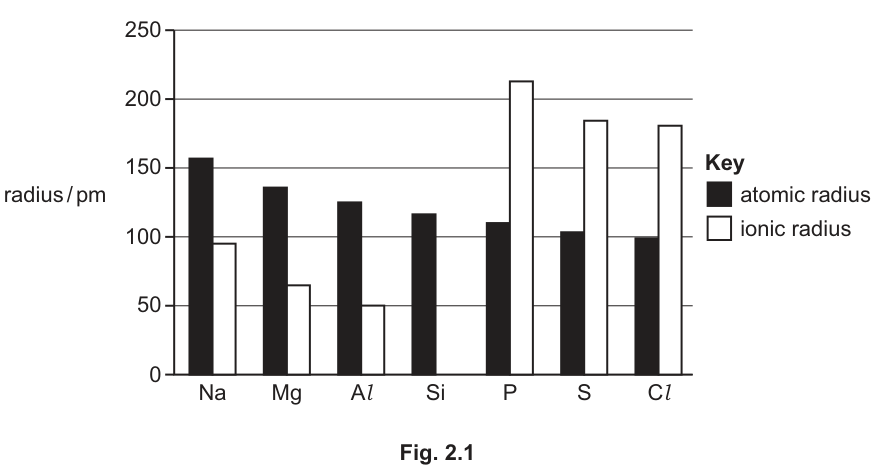
Fig. 2.1 shows the variation in atomic and ionic radii of the Period 3 elements to .
The ionic radius of is not shown.
Answer
Across the period, the nuclear charge increases while the shielding by inner electrons remains similar. The greater nuclear charge gives a stronger attraction for the outer-shell electrons, so the atomic radius decreases.
Nuclear charge increases across the period with similar shielding; stronger attraction pulls outer electrons closer, decreasing atomic radius.
Background Concept
Atomic radius is the distance from the nucleus to the outermost electrons. Across a period in the periodic table, each successive element has one more proton in the nucleus and one more electron in the same principal energy level. The inner-shell electrons provide shielding that screens the outer electrons from the full nuclear charge. Because the additional electrons are added to the same shell, the shielding effect increases only slightly, while the nuclear charge increases by one unit for each element.
Understanding the Question
The question asks for an explanation of the observed decrease in atomic radii from sodium (Na) to chlorine (Cl) across Period 3. The bar chart in Fig. 2.1 shows atomic radii falling from approximately 155 pm for Na to about 100 pm for Cl. The command word "explain" requires giving the cause, not merely describing the trend.
Approach
To explain a periodic trend in atomic radius, identify the two competing factors: (1) the increasing nuclear charge, which pulls electrons inward, and (2) the shielding effect from inner electrons, which opposes this pull. Show that the increase in nuclear charge dominates because shielding remains roughly constant across a period.
Step-by-Step Reasoning
Point 1 (M1): Across Period 3, each element has one more proton than the previous one, so the nuclear charge increases. For example, Na has nuclear charge +11 and Cl has nuclear charge +17. Simultaneously, the outer electrons are all added to the n = 3 shell, so the number of inner (shielding) electrons remains the same at 10 (1s² 2s² 2p⁶). Therefore, the shielding effect is similar across the period.
Point 2 (M2): Because the nuclear charge increases while shielding is similar, the effective nuclear charge felt by the outer electrons increases. This greater positive charge exerts a stronger electrostatic attraction on the outer-shell electrons, drawing them closer to the nucleus and reducing the atomic radius.
Key Takeaways
When explaining atomic radius trends across a period, always mention both (a) the increase in nuclear charge and (b) the similar (or constant) shielding by inner electrons. Omitting either point typically costs a mark.
Common Mistakes
- Saying "there are more electrons" without specifying they are in the same shell — this is irrelevant to the trend.
- Saying "shielding decreases" — shielding is roughly constant, not decreasing.
- Describing the trend without giving the cause (e.g., "the radius decreases" without explaining why).
Things to Be Careful About
The mark scheme requires both the increase in nuclear charge AND similar shielding as part of M1. A single point alone will not earn full credit. Use precise language: "nuclear charge increases" not "more protons pull harder", and "similar shielding" not "no shielding change".
Answer
Aluminium loses 3 electrons to form Al³⁺, while phosphorus gains 3 electrons to form P³⁻. The Al³⁺ ion has one fewer electron shell than the P³⁻ ion, so its ionic radius is much smaller.
Al forms Al3+ (fewer shells) while P forms P3- (more shells); Al3+ has one fewer electron shell than P3-.
Background Concept
When atoms form ions, their radius changes dramatically. Metals like aluminium lose electrons to form cations, which are smaller than the parent atom because electrons are removed from the outermost shell, often leaving the ion with one fewer complete shell. Non-metals like phosphorus gain electrons to form anions, which are larger than the parent atom because the added electrons increase electron-electron repulsion and the ion retains the same outer shell.
Understanding the Question
The bar chart shows Al³⁺ has an ionic radius of about 50 pm while P³⁻ has an ionic radius of about 210 pm — a factor of four difference. The question asks why this large difference exists.
Approach
Compare the electron configurations and number of electron shells in Al³⁺ and P³⁻. Aluminium is a metal that forms a cation by losing electrons; phosphorus is a non-metal that forms an anion by gaining electrons. The key difference is the number of electron shells in the resulting ions.
Step-by-Step Reasoning
Point 1 (M1): Aluminium (electron configuration 1s² 2s² 2p⁶ 3s² 3p¹) loses its 3 outer-shell electrons to form Al³⁺ with configuration 1s² 2s² 2p⁶. Phosphorus (1s² 2s² 2p⁶ 3s² 3p³) gains 3 electrons to form P³⁻ with configuration 1s² 2s² 2p⁶ 3s² 3p⁶.
Point 2 (M2): Al³⁺ has electrons only in the n = 1 and n = 2 shells (2 shells total). P³⁻ has electrons in the n = 1, n = 2, and n = 3 shells (3 shells total). The Al³⁺ ion has one fewer electron shell than P³⁻, which accounts for the large difference in ionic radii.
Key Takeaways
Cations are smaller than their parent atoms (often losing an outer shell); anions are larger. When comparing ions of different elements, the number of electron shells is the dominant factor affecting ionic radius.
Common Mistakes
- Saying "Al has a higher charge" without explaining the shell difference — this alone is not sufficient.
- Confusing ionic radius with atomic radius trends.
- Not specifying that Al loses electrons and P gains electrons.
Things to Be Careful About
The mark scheme awards one mark for identifying that Al loses 3 electrons (forming Al³⁺) and P gains 3 electrons (forming P³⁻), and the second mark for stating that Al³⁺ has one fewer shell than P³⁻. Both points are required for full credit.
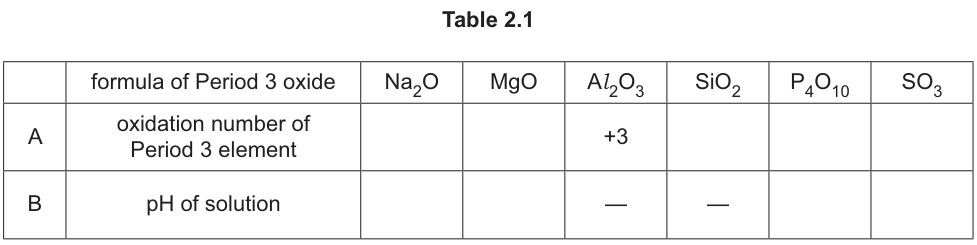
Table 2.1 gives some information about some of the Period 3 oxides.
Row B gives the pH of the solution that forms when the Period 3 oxide is added to water.
Answer
| Na₂O | MgO | Al₂O₃ | SiO₂ | P₄O₁₀ | SO₃ | |
|---|---|---|---|---|---|---|
| A oxidation number | +1 | +2 | +3 | +4 | +5 | +6 |
| B pH of solution | 12–14 | 8–10 | — | — | 0–4 | 0–4 |
Working
Oxidation number of O is always –2 in these oxides. For Na₂O: 2(ox. no. of Na) + (–2) = 0, so ox. no. of Na = +1. Similarly, MgO gives +2, SiO₂ gives +4, P₄O₁₀ gives +5, SO₃ gives +6.
pH values: Na₂O and MgO are basic oxides giving alkaline solutions (pH 12–14 and 8–10 respectively). P₄O₁₀ and SO₃ are acidic oxides giving strongly acidic solutions (pH 0–4).
Oxidation numbers: Na=+1, Mg=+2, Si=+4, P=+5, S=+6. pH values: Na2O=12-14, MgO=8-10, P4O10=0-4, SO3=0-4.
Background Concept
Period 3 oxides show a clear trend from basic (ionic) on the left to acidic (covalent) on the right, with aluminium oxide and silicon dioxide being amphoterically or inert. The oxidation number of the Period 3 element in its oxide equals the number of valence electrons it effectively donates or shares with oxygen. When these oxides react with water, basic oxides form alkaline solutions (high pH), acidic oxides form acidic solutions (low pH), and amphoteric/inert oxides do not dissolve.
Understanding the Question
Table 2.1 has blank cells for oxidation numbers (row A) and pH values (row B) for Na₂O, MgO, SiO₂, P₄O₁₀, and SO₃. The oxidation number +3 is given for Al₂O₃ and dashes for Al₂O₃ and SiO₂ in row B. The task is to fill in the blanks.
Approach
For oxidation numbers: use the rule that oxygen is –2 and the sum of oxidation numbers in a neutral compound is zero. For pH values: recall that Na₂O and MgO are basic oxides (high pH), P₄O₁₀ and SO₃ are acidic oxides (low pH), and Al₂O₃ and SiO₂ are insoluble (no pH data).
Step-by-Step Reasoning
Oxidation numbers (M1):
- Na₂O: 2x + (–2) = 0 → x = +1
- MgO: x + (–2) = 0 → x = +2
- SiO₂: x + 2(–2) = 0 → x = +4
- P₄O₁₀: 4x + 10(–2) = 0 → 4x = +20 → x = +5
- SO₃: x + 3(–2) = 0 → x = +6
pH values (M2):
- Na₂O reacts with water to form NaOH (strong base): pH 12–14
- MgO reacts with water to form Mg(OH)₂ (weak base): pH 8–10
- P₄O₁₀ reacts with water to form H₃PO₄ (strong acid): pH 0–4
- SO₃ reacts with water to form H₂SO₄ (strong acid): pH 0–4
Key Takeaways
Oxidation numbers in Period 3 oxides increase from +1 to +6, matching the group number. The pH of oxide-water solutions reflects the acid-base character: basic oxides (Na, Mg) give high pH, acidic oxides (P, S) give low pH.
Common Mistakes
- Calculating wrong oxidation numbers (e.g., saying P is +4 in P₄O₁₀ instead of +5).
- Giving a single pH value instead of a range — the mark scheme accepts ranges.
- Forgetting that SiO₂ does not react with water (it is covalent and insoluble).
Things to Be Careful About
The mark scheme gives acceptable ranges: pH 12–14 for Na₂O, 8–10 for MgO, and 0–4 for both P₄O₁₀ and SO₃. Values outside these ranges may not score. Oxidation numbers must be exact integers.
Answer
Al₂O₃ and SiO₂ are insoluble in water, so no solution forms and no pH can be measured.
They are insoluble in water.
Background Concept
Aluminium oxide (Al₂O₃) is amphoteric — it reacts with both acids and bases — but it does not dissolve in water. Silicon dioxide (SiO₂) is a giant covalent structure (like quartz) and is completely insoluble in water. Neither oxide reacts with water to produce a solution with a measurable pH.
Understanding the Question
Row B of Table 2.1 has dashes (—) for Al₂O₃ and SiO₂, indicating no pH data is given. The question asks why.
Approach
The pH of a solution requires a dissolved substance. If the oxide does not dissolve in water, no solution forms and no pH can be recorded.
Step-by-Step Reasoning
Al₂O₃ is amphoteric but insoluble in water. SiO₂ has a giant covalent structure and is also insoluble in water. Since neither oxide dissolves to form an aqueous solution, there is no solution whose pH can be measured. Hence the dashes in row B.
Key Takeaways
Not all Period 3 oxides react with water. Al₂O₃ and SiO₂ are exceptions — they are insoluble and do not produce a solution with a measurable pH.
Common Mistakes
- Saying "they are neutral" — Al₂O₃ is amphoteric, not neutral, and SiO₂ is acidic (just insoluble).
- Saying "they don't react with water" — while technically true, the key reason is insolubility.
Things to Be Careful About
The mark scheme specifically accepts "insoluble" as the answer. Other wordings like "do not dissolve" or "not soluble" also score.
Answer
Na2O + 2HCl -> 2NaCl + H2O
Background Concept
Sodium oxide (Na₂O) is a basic oxide. Basic oxides react with acids in a neutralisation reaction to form a salt and water. This is analogous to the reaction of a metal oxide with an acid, similar to how NaOH (a base) reacts with HCl.
Understanding the Question
Write a balanced equation for the reaction of Na₂O with dilute hydrochloric acid (HCl).
Approach
Na₂O is a basic oxide; HCl is an acid. The products are the salt (NaCl) and water (H₂O). Balance the equation.
Step-by-Step Reasoning
Na₂O + HCl → NaCl + H₂O
Balancing: Na₂O has 2 Na atoms, so we need 2 NaCl on the right. This requires 2 HCl on the left. The 2 H from HCl and the O from Na₂O give H₂O.
Balanced equation: Na₂O + 2HCl → 2NaCl + H₂O
Key Takeaways
Basic oxides react with acids to give salt + water. Always balance the equation and include correct state symbols if required (though not always required in this question).
Common Mistakes
- Writing Na₂O + HCl → NaCl + H₂O without balancing (missing the coefficient 2 for HCl and NaCl).
- Including state symbols incorrectly if the mark scheme doesn't require them.
Things to Be Careful About
The mark scheme gives the equation without state symbols. If state symbols are required, Na₂O is (s), HCl is (aq), NaCl is (aq), H₂O is (l). The equation must be fully balanced.
Answer
Al2O3 + 2NaOH -> 2NaAlO2 + H2O
Background Concept
Aluminium oxide (Al₂O₃) is amphoteric, meaning it reacts with both acids and bases. When it reacts with a base like sodium hydroxide (NaOH), it forms a sodium aluminate salt. The formula NaAlO₂ (sodium aluminate or sodium meta-aluminate) is given in the question. The reaction is analogous to how amphoteric hydroxides like Al(OH)₃ react with NaOH.
Understanding the Question
Construct a balanced equation for the reaction of Al₂O₃ with a base (NaOH) to form NaAlO₂.
Approach
Reactants: Al₂O₃ and NaOH. Product given: NaAlO₂. Also produce H₂O (from the oxide ion combining with H⁺ from NaOH). Balance the equation.
Step-by-Step Reasoning
Al₂O₃ + NaOH → NaAlO₂ + H₂O
Balancing Al: Al₂O₃ has 2 Al, so need 2 NaAlO₂ on the right.
Al₂O₃ + NaOH → 2NaAlO₂ + H₂O
Balancing Na: 2 NaAlO₂ requires 2 NaOH on the left.
Al₂O₃ + 2NaOH → 2NaAlO₂ + H₂O
Check O: Left: 3 (from Al₂O₃) + 2 (from 2NaOH) = 5. Right: 4 (from 2NaAlO₂) + 1 (from H₂O) = 5. ✓
Check H: Left: 2 (from 2NaOH). Right: 2 (from H₂O). ✓
Balanced equation: Al₂O₃ + 2NaOH → 2NaAlO₂ + H₂O
Key Takeaways
Amphoteric oxides react with bases to form salts. When given the product formula, use it to construct and balance the equation.
Common Mistakes
- Writing the wrong product formula (e.g., NaAl(OH)₄ instead of NaAlO₂ — the question specifies NaAlO₂).
- Not balancing the equation correctly.
- Forgetting water as a product.
Things to Be Careful About
The mark scheme gives the equation as Al₂O₃ + 2NaOH → 2NaAlO₂ + H₂O. This must be exactly balanced. State symbols are not required here unless specified.
Group 2 nitrates decompose on heating to form oxides.
Answer
Thermal stability increases down the group.
Thermal stability increases down the group.
Background Concept
Group 2 nitrates decompose on heating to give the metal oxide, nitrogen dioxide, and oxygen. The thermal stability of Group 2 nitrates increases down the group: Be(NO₃)₂ decomposes most easily, while Ba(NO₃)₂ requires the highest temperature. This is because the larger cations (like Ba²⁺) have lower charge density and polarise the nitrate ion less, making it more stable to heat.
Understanding the Question
State the trend in thermal stability of Group 2 nitrates as you go down the group from Be to Ba.
Approach
Recall the standard trend: thermal stability increases down Group 2 for both nitrates and carbonates.
Step-by-Step Reasoning
As you go down Group 2, the cation size increases and charge density decreases. The larger cation polarises the nitrate ion less effectively, so the nitrate is more stable and requires more heat to decompose. Therefore, thermal stability increases down the group.
Key Takeaways
Thermal stability of Group 2 nitrates (and carbonates) increases down the group. This is a standard trend that should be recalled.
Common Mistakes
- Saying "stability decreases down the group" — this is the opposite of the correct trend.
- Giving the trend for Group 1 instead (Group 1 nitrates decompose to nitrites + O₂, not oxides + NO₂ + O₂).
Things to Be Careful About
The mark scheme simply accepts "increases down the group". Be precise: it is the thermal stability that increases, not the decomposition temperature (though they are related).
Answer
NO₂ and O₂
The general equation is:
NO2 and O2
Background Concept
Group 2 nitrates decompose on heating to produce the metal oxide, nitrogen dioxide gas, and oxygen gas. The general equation is:
This is different from Group 1 nitrates, which decompose to give the metal nitrite and oxygen only (no NO₂).
Understanding the Question
The question states that Group 2 nitrates decompose to form oxides. Identify the other products besides the oxide.
Approach
Recall the full decomposition equation for Group 2 nitrates. The products are: metal oxide (given), nitrogen dioxide (NO₂), and oxygen (O₂).
Step-by-Step Reasoning
For example, with magnesium nitrate:
The other products besides the oxide are nitrogen dioxide (NO₂) and oxygen (O₂). Both must be stated for full credit.
Key Takeaways
Group 2 nitrate decomposition produces: metal oxide + NO₂ + O₂. Group 1 nitrate decomposition produces: metal nitrite + O₂ (no NO₂). Don't confuse the two.
Common Mistakes
- Only stating one product (e.g., just NO₂ or just O₂) — both are required.
- Saying CO₂ or H₂O — these are not products of nitrate decomposition.
- Confusing with Group 1 nitrate decomposition products.
Things to Be Careful About
The mark scheme requires both NO₂ AND O₂. Stating only one will not earn full credit. Also, write the formulas correctly: NO₂ (not NO, not N₂O₄), O₂ (not O).
Cycloalkanes show similar chemical properties to alkanes but have the same empirical formula as alkenes.
Answer
The simplest (lowest whole-number) ratio of atoms of each element in a compound.
The simplest (lowest whole-number) ratio of atoms of each element in a compound.
Background Concept
Chemical formulae can be expressed in several ways: molecular formula (actual number of atoms in a molecule), empirical formula (simplest whole-number ratio), structural formula (showing connectivity), and displayed formula (showing all atoms and bonds). The empirical formula is the most reduced representation of composition.
Understanding the Question
This is a straightforward definition question. The command word is 'Define', which requires a precise, textbook-standard statement.
Approach
Recall the standard definition of empirical formula, ensuring the key phrase 'simplest whole-number ratio' is included.
Step-by-Step Reasoning
The empirical formula expresses composition as the smallest set of whole numbers that preserves the ratio of each element. For example, ethene (C₂H₄) and cyclohexane (C₆H₁₂) both have the empirical formula CH₂. The definition must include 'simplest' or 'lowest' and 'whole-number ratio' to earn the mark.
Key Takeaways
The empirical formula is always a ratio, never an actual count of atoms. It is derived from percentage composition data by dividing by atomic masses and then by the smallest result.
Common Mistakes
- Saying 'the number of atoms of each element' (that is the molecular formula).
- Omitting 'simplest' or 'lowest whole-number'.
- Saying 'ratio of elements' instead of 'ratio of atoms of each element'.
Things to Be Careful About
The mark scheme requires 'simplest/lowest' AND 'whole number/integer ratio' AND 'atoms of each element'. Missing any one of these three components loses the mark.
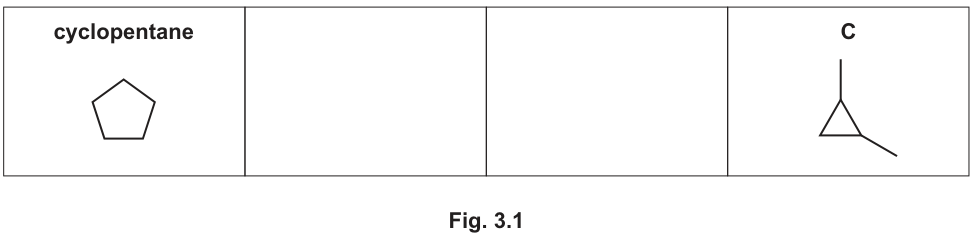
Cyclopentane, , has four cyclic structural isomers. One of these isomers is , shown in Fig. 3.1.
Complete Fig. 3.1 to show two other cyclic structural isomers of .
Answer
Two of the following cyclic structural isomers of :
Methylcyclobutane and 1,1-dimethylcyclopropane (or ethylcyclopropane)
Background Concept
Structural (constitutional) isomers have the same molecular formula but different connectivity of atoms. For cycloalkanes with formula , the ring size can vary, and alkyl substituents can be arranged differently on smaller rings. Cyclopentane () has four cyclic structural isomers: cyclopentane itself, methylcyclobutane, ethylcyclopropane, and 1,1-dimethylcyclopropane (as well as 1,2-dimethylcyclopropane, which is compound C in the question).
Understanding the Question
The question provides cyclopentane (box 1) and compound C, which is 1,2-dimethylcyclopropane (box 4). The candidate must draw two other cyclic isomers in boxes 2 and 3. Each must be a valid cyclic structure with molecular formula .
Approach
Systematically vary the ring size: a 4-membered ring with one methyl substituent gives methylcyclobutane; a 3-membered ring with substituents gives ethylcyclopropane or 1,1-dimethylcyclopropane. Any two of these three (excluding the already-shown 1,2-dimethylcyclopropane) earn full marks.
Step-by-Step Reasoning
- Methylcyclobutane: A four-membered ring (4 carbons) with one methyl branch (1 carbon) = 5 carbons total. The ring carbons each bear 2 H except the substituted one (1 H), and the methyl bears 3 H: 3×2 + 1 + 3 = 10 H. ✓
- 1,1-Dimethylcyclopropane: A three-membered ring (3 carbons) with two methyl groups on the same carbon = 5 carbons. H count: 2 ring CH₂ groups (4H) + 1 ring C with no H + 2×CH₃ (6H) = 10 H. ✓
- Ethylcyclopropane: A three-membered ring (3 carbons) with one ethyl group (2 carbons) = 5 carbons. H count: 2 ring CH₂ (4H) + 1 ring CH (1H) + CH₂ (2H) + CH₃ (3H) = 10 H. ✓
The mark scheme accepts any two of these three structures drawn as skeletal formulae.
Key Takeaways
When generating cyclic isomers, systematically reduce ring size and compensate with alkyl branches. Always verify the molecular formula by counting carbons and hydrogens.
Common Mistakes
- Drawing an acyclic structure (the question specifies cyclic isomers).
- Drawing 1,2-dimethylcyclopropane again (that is compound C, already given).
- Incorrect hydrogen count (e.g. drawing a structure that is or ).
Things to Be Careful About
Skeletal formulae must be drawn correctly: each vertex and line-end is a carbon, and hydrogens on carbon are implied. The ring must be closed (cyclic).
Cyclopentane reacts with in the presence of ultraviolet light to form .
The reaction is initiated by the bond fission of .
State the type of bond fission shown in the initiation step.
Answer
Homolytic (fission).
Homolytic
Background Concept
Bond fission can be homolytic (each atom takes one electron from the shared pair, producing radicals) or heterolytic (one atom takes both electrons, producing ions). In free-radical substitution, UV light provides enough energy to break the Cl-Cl bond homolytically, generating two chlorine radicals.
Understanding the Question
The question states the reaction is initiated by bond fission of Cl₂ under UV light. The candidate must name the type of fission.
Approach
UV-initiated reactions that produce radicals involve homolytic fission. The word 'homolytic' is the required answer.
Step-by-Step Reasoning
Cl₂ + UV light → 2Cl•. Each chlorine atom receives one electron from the bond pair, producing two neutral radicals. This is the definition of homolytic fission.
Key Takeaways
Homolytic fission produces radicals; heterolytic fission produces ions. UV light and radical chain reactions are always associated with homolytic fission.
Common Mistakes
- Writing 'heterolytic' (wrong — that produces ions, not radicals).
- Writing 'covalent' (that describes the bond type, not the fission type).
Things to Be Careful About
The mark scheme requires the exact word 'homolytic'. 'Homolytic bond fission' or 'homolysis' are also acceptable.
Complete the equations to show the two propagation steps that follow the initiation step.
propagation 1
propagation 2
Answer
Propagation 1:
Propagation 2:
Propagation 1: C5H10 + Cl• → C5H9• + HCl; Propagation 2: C5H9• + Cl2 → C5H9Cl + Cl•
Background Concept
In free-radical substitution, the propagation steps form a chain: a radical reacts with a stable molecule to produce a new radical, which then reacts with another stable molecule to produce the product and regenerate the original radical. This cycle sustains the chain reaction.
Understanding the Question
The initiation step produces Cl• radicals. The candidate must write the two propagation steps that convert cyclopentane to chlorocyclopentane while regenerating the chlorine radical.
Approach
Step 1: Cl• abstracts a hydrogen from cyclopentane, forming HCl and a cyclopentyl radical (C₅H₉•). Step 2: The cyclopentyl radical attacks Cl₂, forming chlorocyclopentane (C₅H₉Cl) and regenerating Cl•.
Step-by-Step Reasoning
- Propagation 1: The chlorine radical (electron-deficient) attacks a C-H bond in cyclopentane. One electron from the C-H bond pairs with the unpaired electron on Cl to form H-Cl; the other electron remains on carbon, giving C₅H₉•. M1 is awarded for correctly writing this step.
- Propagation 2: The cyclopentyl radical attacks Cl₂. One electron from the Cl-Cl bond pairs with the unpaired electron on carbon to form C-Cl; the other electron goes to the second Cl, regenerating Cl•. M2 is awarded for correctly writing this step.
- Note: The Cl• produced in propagation 2 can re-enter propagation 1, sustaining the chain.
Key Takeaways
The two propagation steps always involve: (1) radical + stable molecule → new radical + stable product, and (2) new radical + stable molecule → final product + regenerated radical. The net result is substitution of H by Cl.
Common Mistakes
- Writing Cl₂ instead of Cl• in propagation 1.
- Forgetting the radical dot on C₅H₉•.
- Writing the steps in the wrong order.
- Including the initiation or termination step instead.
Things to Be Careful About
Radical dots (•) must be shown on Cl• and C₅H₉•. The mark scheme awards M1 and M2 separately, so both steps must be correct.
Answer
Termination.
Termination
Background Concept
A free-radical chain reaction has three stages: initiation (radicals are created), propagation (radicals are consumed and regenerated in a cycle), and termination (two radicals combine to form a stable molecule, ending the chain).
Understanding the Question
The equation C₅H₉• + Cl• → C₅H₉Cl shows two radicals combining to form a stable product. The candidate must name this stage.
Approach
Two radicals combining with no new radical produced = termination.
Step-by-Step Reasoning
In this step, the unpaired electron on C₅H₉• pairs with the unpaired electron on Cl• to form a covalent C-Cl bond. No radicals remain, so the chain is terminated. This is the definition of a termination step.
Key Takeaways
Termination steps always involve radical + radical → stable molecule. They reduce the number of radicals in the system.
Common Mistakes
- Calling it a 'propagation' step (propagation regenerates a radical).
- Calling it 'initiation' (initiation creates radicals from a non-radical).
Things to Be Careful About
The answer must be 'termination' — not 'terminating step' or any other phrasing that might be ambiguous.
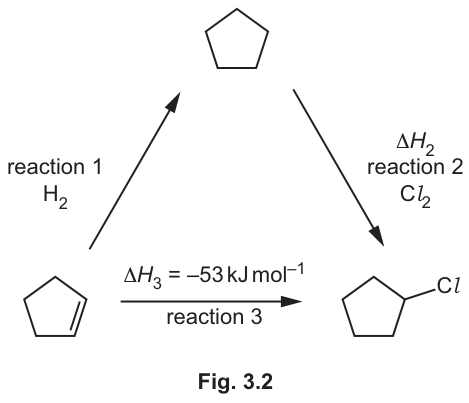
Fig. 3.2 shows a reaction cycle involving cyclopentane, cyclopentene and .
Answer
HCl (g)
Background Concept
Alkenes undergo electrophilic addition reactions. The C=C double bond acts as a nucleophile (electron source) and attacks an electrophile. HCl adds across the double bond: H⁺ attacks first to form a carbocation, then Cl⁻ completes the addition, giving a chloroalkane.
Understanding the Question
Reaction 3 converts cyclopentene to chlorocyclopentane. The candidate must identify a suitable reagent. Since the product has one H and one Cl added across the former double bond, the reagent is HCl.
Approach
Compare the structures: cyclopentene (C₅H₈) → chlorocyclopentane (C₅H₉Cl). The difference is +H +Cl = HCl addition.
Step-by-Step Reasoning
The molecular formula changes from C₅H₈ to C₅H₉Cl, a net addition of HCl. The mark scheme specifies HCl(g) — the gaseous form is used because aqueous HCl would give a different product (or no clean addition). The state symbol (g) is important.
Key Takeaways
Addition of HX to an alkene gives a haloalkane. The reagent must be specified with the correct state.
Common Mistakes
- Writing 'HCl(aq)' — aqueous HCl is not the correct reagent for this addition.
- Writing 'Cl₂' — that would give a dichloro product.
Things to Be Careful About
The mark scheme requires HCl(g). The state symbol matters.
Use the data in Fig. 3.2 and in Table 3.1 to calculate the enthalpy change of reaction 2, .
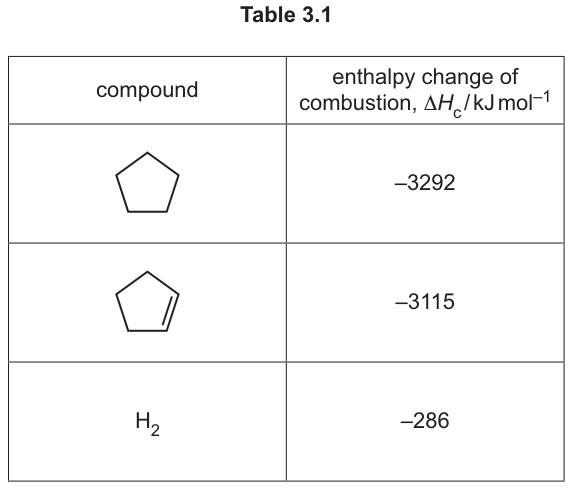
Working
First, calculate (cyclopentene + H₂ → cyclopentane) using combustion data:
Then, from the cycle:
Answer
+56 kJ mol^-1
Background Concept
Hess's law states that the total enthalpy change for a reaction is independent of the pathway taken, provided the initial and final states are the same. This allows unknown enthalpy changes to be calculated from known ones by constructing a cycle. Combustion data can be used to find the enthalpy change of a reaction via: ΔH_reaction = ΣΔHc(reactants) − ΣΔHc(products).
Understanding the Question
The cycle shows three reactions:
- Reaction 1: cyclopentene + H₂ → cyclopentane (ΔH₁ = unknown)
- Reaction 2: cyclopentane + Cl₂ → chlorocyclopentane + HCl (ΔH₂ = unknown, to find)
- Reaction 3: cyclopentene + HCl → chlorocyclopentane (ΔH₃ = −53 kJ mol⁻¹)
From the cycle geometry: going from cyclopentene to chlorocyclopentane via cyclopentane (reactions 1 then 2) equals going directly (reaction 3). So ΔH₁ + ΔH₂ = ΔH₃.
Approach
Step 1: Calculate ΔH₁ from combustion data using ΔH = ΣΔHc(reactants) − ΣΔHc(products).
Step 2: Rearrange the cycle equation to find ΔH₂ = ΔH₃ − ΔH₁.
Step-by-Step Reasoning
Finding ΔH₁:
Reactants of reaction 1: cyclopentene + H₂
Product of reaction 1: cyclopentane
Finding ΔH₂:
From the cycle: ΔH₁ + ΔH₂ = ΔH₃
The positive sign indicates reaction 2 is endothermic.
Key Takeaways
Hess's law cycles can be solved by writing the algebraic relationship between the reactions (pathway equivalence) and then substituting known values. Combustion data gives reaction enthalpies via reactants minus products.
Common Mistakes
- Getting the sign wrong in the combustion formula (should be reactants − products, not products − reactants).
- Forgetting that ΔHc of H₂ is −286 kJ mol⁻¹ (it is the combustion of hydrogen to water).
- Writing ΔH₂ = ΔH₃ + ΔH₁ instead of ΔH₃ − ΔH₁ (sign error in rearranging the cycle).
- Omitting the positive sign in the final answer.
Things to Be Careful About
M1 is awarded for correctly calculating ΔH₁ = −109. M2 is awarded for the final ΔH₂ = +56. If ΔH₁ is wrong but used correctly to find ΔH₂, M2 may still be awarded via ecf. The sign of ΔH₂ is important — it is positive (endothermic).
Cyclopentene, , reacts with hot concentrated acidified to form compound , .
Answer
Compound W is pentanedioic acid (glutaric acid):
HOOC-CH2-CH2-CH2-COOH (pentanedioic acid)
Background Concept
Hot concentrated acidified potassium manganate(VII) (KMnO₄) is a strong oxidising agent that cleaves carbon-carbon double bonds. In a cyclic alkene, the ring opens at the double bond, and both carbons of the former C=C are oxidised to carboxylic acid groups (−COOH) if they each bear at least one hydrogen. For cyclopentene, both alkene carbons have one H each, so both become −COOH groups, giving a dicarboxylic acid.
Understanding the Question
Cyclopentene (C₅H₈) is a five-membered ring with one C=C. Oxidative cleavage opens the ring at the double bond, producing a straight-chain compound with two −COOH ends. The molecular formula C₅H₈O₄ confirms a dicarboxylic acid (two COOH groups = 2×CO₂H, leaving a 3-carbon chain between them).
Approach
Open the ring at the C=C, add an oxygen to each former alkene carbon to form C=O, and add OH to each to form −COOH. The remaining three CH₂ groups form the chain between them.
Step-by-Step Reasoning
Cyclopentene: five carbons in a ring, one C=C between C1 and C2.
After oxidative cleavage:
C1 becomes −COOH, C2 becomes −COOH, C3-C4-C5 remain as −CH₂−CH₂−CH₂−.
Product: HOOC−CH₂−CH₂−CH₂−COOH = pentanedioic acid.
Check formula: 5C, 8H (2 from COOH + 6 from CH₂ groups), 4O (2 from each COOH). ✓
Key Takeaways
Hot concentrated KMnO₄ cleaves C=C to give carboxylic acids (or ketones if the carbon has no H). In cyclic alkenes, the ring opens to give a dicarboxylic acid (or keto-acid).
Common Mistakes
- Drawing a diol (that would be cold dilute KMnO₄, not hot concentrated).
- Drawing only one COOH group (forgetting both carbons of the double bond are oxidised).
- Incorrect chain length (must have 3 CH₂ groups between the two COOH).
Things to Be Careful About
The structure must show all atoms and bonds (displayed formula) or at least a clear skeletal structure showing both COOH groups and the three-carbon chain between them.
The infrared spectrum of is shown in Fig. 3.3.
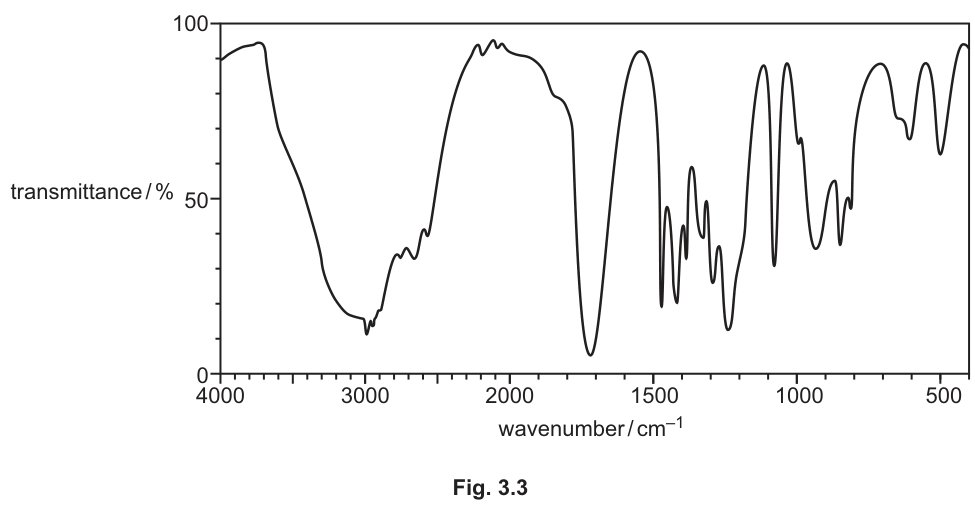
Identify two absorptions in the infrared spectrum of that would not be present in the infrared spectrum of cyclopentene.
- Write 1 or 2 on Fig. 3.3 against each of these two absorptions.
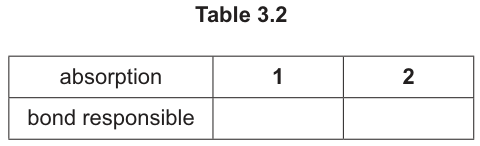
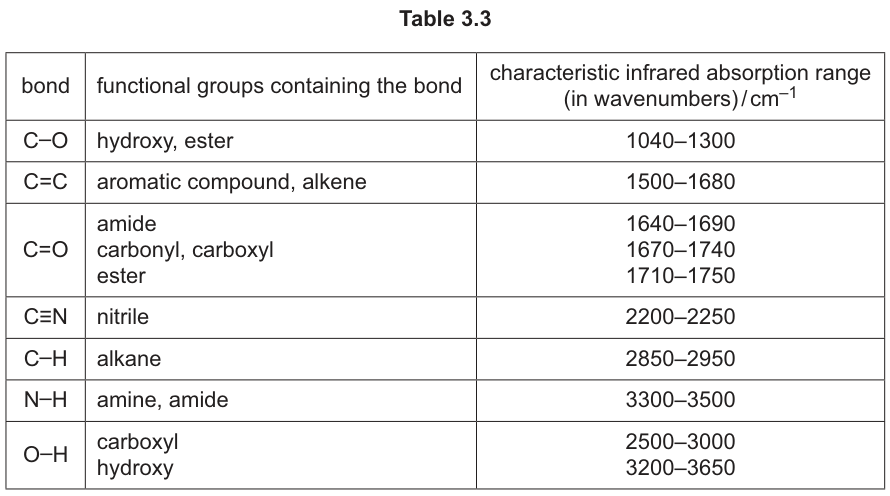
- Complete Table 3.2 to show which bond is responsible for each absorption that you have identified in Fig. 3.3.
Answer
Absorption 1 (at approximately 2500–3000 cm⁻¹): O–H bond (in carboxyl group)
Absorption 2 (at approximately 1710 cm⁻¹): C=O bond (in carboxyl group)
These two absorptions are present in W (pentanedioic acid) but absent in cyclopentene.
1: O-H (carboxyl); 2: C=O (carboxyl)
Background Concept
IR spectroscopy identifies functional groups by their characteristic bond stretching absorptions. A carboxylic acid shows two key absorptions not found in alkenes: a very broad O-H stretch (2500–3000 cm⁻¹ for carboxyl O-H, distinct from the sharper alcohol O-H at 3200–3650 cm⁻¹) and a strong C=O stretch (1670–1740 cm⁻¹ for carboxyl). Cyclopentene shows C=C (1500–1680 cm⁻¹) and C-H (2850–2950 cm⁻¹) but no O-H or C=O.
Understanding the Question
The candidate must identify two absorptions in the IR spectrum of W (pentanedioic acid) that would NOT appear in the spectrum of cyclopentene. From Table 3.3, the relevant new bonds in W are O-H (carboxyl) and C=O (carboxyl). The candidate labels these on Fig. 3.3 and writes the bond in Table 3.2.
Approach
Compare functional groups: cyclopentene has C=C and C-H only. W has C=O, O-H (carboxyl), and C-H. The two absorptions unique to W are O-H and C=O.
Step-by-Step Reasoning
- O-H (carboxyl): The broad absorption centred around 2500–3000 cm⁻¹ (labelled '1' on the spectrum) corresponds to the O-H stretch of the carboxylic acid group. Cyclopentene has no O-H bond, so this absorption is absent from its spectrum. M1 awarded.
- C=O (carboxyl): The sharp, strong absorption near 1710 cm⁻¹ (labelled '2' on the spectrum) corresponds to the C=O stretch. Cyclopentene has C=C (which absorbs at 1500–1680 cm⁻¹) but no C=O, so this is a new absorption. M2 awarded.
Note: The C=C absorption of cyclopentene (1500–1680 cm⁻¹) is NOT present in W, but the question asks for absorptions in W that are NOT in cyclopentene, so C=C is irrelevant here.
Key Takeaways
Carboxylic acids are identified in IR by the combination of a very broad O-H (2500–3000 cm⁻¹) and a strong C=O (1670–1740 cm⁻¹). These are absent in hydrocarbons.
Common Mistakes
- Identifying C-H as a new absorption (both compounds have C-H bonds).
- Confusing the carboxyl O-H range (2500–3000) with the alcohol O-H range (3200–3650).
- Labeling the C=C absorption (which is in cyclopentene, not W).
Things to Be Careful About
The question asks for absorptions in W that are NOT in cyclopentene. The two answers must be O-H and C=O. The wavenumber positions must match the spectrum (approximately 2500–3000 for O-H and approximately 1710 for C=O).
Fig. 4.1 shows a possible synthesis of propene, .

Answer
reduction
reduction
Background Concept
Carboxylic acids can be reduced to primary alcohols using strong reducing agents such as lithium aluminium hydride (LiAlH4) followed by acid workup, or catalytic hydrogenation under high pressure. In this process, the oxidation state of the carbonyl carbon decreases, which defines a reduction reaction.
Understanding the Question
The question asks for the type of reaction occurring in reaction 1, where propanoic acid () is converted to propan-1-ol (). This involves the addition of hydrogen (or removal of oxygen) to the carboxyl group.
Approach
Compare the functional groups of the reactant and product. A carboxylic acid () becoming a primary alcohol () is a classic reduction.
Step-by-Step Reasoning
The functional group changes from to . This requires the addition of hydrogen atoms and the removal of an oxygen atom. In organic chemistry, an increase in the number of C-H bonds or a decrease in C-O bonds is classified as reduction. Therefore, reaction 1 is a reduction.
Key Takeaways
Converting a carboxylic acid to a primary alcohol is a reduction reaction. This is a fundamental transformation in organic synthesis.
Common Mistakes
Students often confuse reduction with oxidation or simply write 'hydrogenation' without considering the specific functional group change. While hydrogenation is a type of reduction, 'reduction' is the broader and more accurate term here, especially if LiAlH4 is the reagent (which doesn't involve gas).
Things to Be Careful About
Ensure the term used matches the mark scheme. 'Reduction' is the precise term for this functional group transformation.
Answer
or or
or and
or and
PCl5 or PCl3 or SOCl2 or NaCl and conc. H2SO4
Background Concept
Primary alcohols can be converted to chloroalkanes using several reagents. The most common and cleanest methods involve phosphorus chlorides or thionyl chloride, which produce gaseous by-products that are easy to separate. Alternatively, a halide salt can be used with a strong acid to generate HCl in situ.
Understanding the Question
Reaction 2 converts propan-1-ol () to 1-chloropropane (). We need to suggest a suitable reagent for this substitution.
Approach
Recall the standard reagents for converting to in alcohols.
Step-by-Step Reasoning
- : Reacts vigorously at room temperature. .
- : Requires gentle warming. .
- (thionyl chloride): Produces gaseous and , making purification easy. .
- / + conc. / : The acid reacts with the chloride salt to produce HCl, which then substitutes the OH group. Note: conc. with can sometimes cause elimination or oxidation side reactions, but it is accepted in the mark scheme. is often preferred to avoid oxidation.
Key Takeaways
Know the three main phosphorus/chlorine reagents (, , ) and the salt + acid method for converting alcohols to chloroalkanes.
Common Mistakes
Writing alone: while possible, it is slow and reversible for primary alcohols; the mark scheme specifically expects the phosphorus chlorides or the salt/acid combination. Writing is incorrect as this would lead to free-radical substitution or addition, not simple substitution of the OH group.
Things to Be Careful About
If using or , you must state the acid (conc. or conc. ) as well. Just writing 'HCl' or 'chloride ions' is insufficient.
Reaction 3 is an elimination reaction.
Write an equation for this reaction and identify the solvent and conditions used.
equation ............................................................................................................................
solvent and conditions .......................................................................................................
Answer
equation:
solvent and conditions:
ethanol (solvent) and heat (or reflux)
C2H5CH2Cl + NaOH -> C3H6 + H2O + NaCl; ethanol, heat
Background Concept
Halogenoalkanes can undergo two competing reactions with hydroxide ions (): nucleophilic substitution (forming alcohols) and elimination (forming alkenes). The outcome depends heavily on the solvent and temperature.
- Aqueous NaOH / cold: Favors substitution ( for primary halogenoalkanes), producing an alcohol.
- Ethanolic (alcoholic) NaOH / hot (reflux): Favors elimination (E2 mechanism), producing an alkene. The ethanolic solvent makes the a stronger base rather than a nucleophile.
Understanding the Question
Reaction 3 converts 1-chloropropane to propene using NaOH. The question states this is an elimination reaction and asks for the equation, solvent, and conditions.
Approach
Write the balanced chemical equation for the dehydrohalogenation of 1-chloropropane. Then, specify the conditions that favor elimination: a non-aqueous solvent (ethanol) and heat.
Step-by-Step Reasoning
- Equation: The reactant is (or ). It reacts with . The products are propene (), water (), and sodium chloride ().
(Using the condensed formula as given in the question is also perfectly acceptable and often preferred to match the scheme). - Solvent: Must be ethanol (or 'alcoholic'). Aqueous conditions would lead to substitution (propan-1-ol).
- Conditions: Must include heat or reflux. Heating provides the activation energy required for the elimination pathway.
Key Takeaways
The solvent is the key differentiator between substitution and elimination of halogenoalkanes with . Ethanol + heat = elimination; water + cold = substitution.
Common Mistakes
- Writing instead of : while chemically valid, stick to the reagent given in the question () unless asked otherwise.
- Forgetting the by-products ( and ). The equation must be balanced.
- Writing 'water' as the solvent: this is the classic trap. Water favors substitution.
- Forgetting 'heat': elimination has a higher activation energy than substitution, so heat is required to favor it.
Things to Be Careful About
Ensure the equation is balanced. The mark scheme awards one mark for the correct organic/inorganic products and one for the solvent and conditions. Do not write 'alcohol' generally; specify 'ethanol'.
can be directly converted to .
Suggest the reagent and conditions for this conversion.
Answer
conc. or conc. or and heat
conc. H2SO4 and heat
Background Concept
Alcohols can be dehydrated to form alkenes. This is an elimination reaction (specifically, an acid-catalyzed dehydration or catalytic dehydration).
- Acid-catalyzed: Uses concentrated sulfuric acid () or concentrated phosphoric acid () with heating (typically around for ).
- Catalytic: Passes alcohol vapor over a heated catalyst like aluminum oxide () at around .
Understanding the Question
The question asks for a direct conversion of propan-1-ol () to propene (). This is a dehydration reaction. We need to suggest the reagent and conditions.
Approach
Recall the standard reagents for dehydrating alcohols to alkenes.
Step-by-Step Reasoning
- Reagent: Concentrated sulfuric acid () is the most common. Concentrated phosphoric acid () is also acceptable and often preferred in industry as it is less oxidizing. Alternatively, aluminum oxide () can be used as a solid catalyst.
- Conditions: Heat is required. For acids, this is typically 'heat' or 'reflux' or a specific temperature like . For , 'heat' or 'vapor over heated catalyst' is used.
Key Takeaways
Dehydration of alcohols to alkenes requires an acid catalyst (conc. or ) and heat, or a solid catalyst () and heat.
Common Mistakes
Writing 'dilute' acid: dilute acid favors hydration of alkenes (the reverse reaction) or substitution to form alcohols, not dehydration.
Writing just 'heat': heat alone is insufficient; a catalyst or reagent is needed to protonate the OH group and make it a good leaving group ().
Things to Be Careful About
Always specify concentrated for the acids. 'Conc. ' is the safest, most standard answer. Don't forget to include 'heat' or 'high temperature'.
Under suitable conditions, propene polymerises to form poly(propene).
Poly(propene) exhibits stereoisomerism.
Answer
addition
addition
Background Concept
Alkenes contain a carbon-carbon double bond (), which consists of a sigma bond and a pi bond. The pi bond is relatively weak and can be broken to form new sigma bonds with other monomer molecules. This process, where monomers add together without the loss of any small molecules, is called addition polymerisation.
Understanding the Question
Propene () is an alkene. The question asks for the type of polymerisation that forms poly(propene) from propene.
Approach
Identify the functional group in the monomer (alkene) and match it to the polymerisation type.
Step-by-Step Reasoning
Since the monomer is an alkene and the polymer chain contains only single bonds (the double bond opens up to link monomers), the reaction is addition polymerisation. No by-products (like water in condensation polymerisation) are formed.
Key Takeaways
Monomers with double bonds (alkenes) undergo addition polymerisation.
Common Mistakes
Writing 'condensation': this is for monomers with two different functional groups (e.g., diols and dicarboxylic acids) that lose a small molecule like water.
Things to Be Careful About
The answer is simply 'addition'. Do not overcomplicate it.
Answer
molecules that have the same structural formula (and same molecular formula)
but different 3D / spatial arrangement of atoms / groups
same structural formula but different spatial arrangement of atoms
Background Concept
Stereoisomers are molecules that have the same molecular formula and the same connectivity of atoms (same structural formula), but differ in the way their atoms are arranged in space. This includes:
- Geometric (cis/trans or E/Z) isomerism: Due to restricted rotation around a double bond or a ring.
- Optical isomerism: Due to the presence of a chiral center (a carbon atom bonded to four different groups).
Understanding the Question
The question asks for a definition of stereoisomerism. This is a standard recall question.
Approach
Provide the two-part definition: same connectivity, different 3D arrangement.
Step-by-Step Reasoning
- M1: Must state they have the same structural formula (and/or molecular formula). This distinguishes them from structural isomers, which have different connectivity.
- M2: Must state they have a different 3D or spatial arrangement of atoms or groups. This distinguishes them from the same molecule drawn differently.
Key Takeaways
Stereoisomerism = same structural formula + different spatial arrangement.
Common Mistakes
Saying 'same molecular formula but different structural formula': this is the definition of structural isomerism.
Saying 'different shape': 'shape' is vague; 'spatial arrangement' or '3D arrangement' is the precise terminology.
Things to Be Careful About
Both parts of the definition are usually required for the 2 marks. Ensure 'structural formula' is used, not just 'formula'.
Draw a section of poly(propene), showing two repeat units.
Use your diagram to identify the type of stereoisomerism shown by poly(propene). Explain your answer.
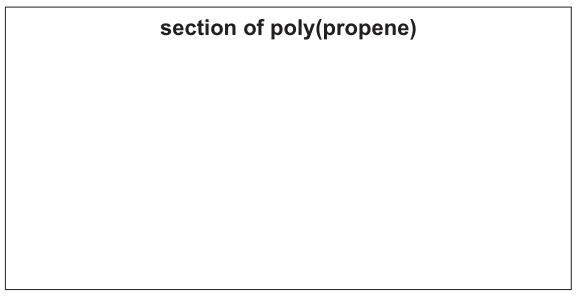
...........................................................................................................................................
...........................................................................................................................................
...........................................................................................................................................
...........................................................................................................................................
Answer
Diagram:
A section of poly(propene) showing two repeat units with all atoms and bonds displayed:
(with all C-H and C-C bonds shown explicitly, e.g., )
Type of stereoisomerism:
optical isomerism
Explanation:
the methylated carbon (the carbon with the group) has four different groups attached to it (chiral centre / asymmetric carbon)
optical isomerism; the carbon with the methyl group is bonded to four different groups
Background Concept
Poly(propene) is formed from propene () via addition polymerisation. The repeat unit is .
In the polymer chain, every other carbon atom (the one bearing the methyl group) is bonded to:
- A hydrogen atom ()
- A methyl group ()
- A group (part of the chain)
- Another carbon group from the rest of the chain (which is effectively different from due to length/continuation)
Actually, strictly speaking, in a polymer chain, the two 'chain' directions are considered different if the chain is long enough, making the carbon a chiral center. This leads to optical isomerism (specifically, isotactic, syndiotactic, or atactic arrangements, which are forms of stereoisomerism related to the chiral centers). For A-Level purposes, identifying the chiral center and stating 'optical isomerism' is the key.
Understanding the Question
We need to:
- Draw a section of poly(propene) showing two repeat units (displayed formula, showing all atoms and bonds).
- Identify the type of stereoisomerism.
- Explain the answer using the diagram.
Approach
Draw the displayed formula for . Identify the carbon with the methyl group. Check if it has 4 different groups. Conclude the type of stereoisomerism.
Step-by-Step Reasoning
- Drawing: Poly(propene) repeat unit is . Two repeat units: . Must show all C-H bonds and C-C bonds. The mark scheme shows a displayed formula with H and CH3 on alternating carbons.
- Type: The carbon atom bonded to the group is bonded to: , , (left side), and (right side). In a polymer, these chain ends are different, making it a chiral center. Thus, optical isomerism.
- Explanation: The carbon atom carrying the methyl group is bonded to four different groups (it is a chiral centre / asymmetric carbon).
Key Takeaways
Polymers with pendant groups on every other carbon can exhibit stereoisomerism (optical) due to chiral centers in the backbone.
Common Mistakes
- Drawing a skeletal formula instead of a displayed formula: the question asks to 'draw a section', and for stereoisomerism, showing the 3D arrangement or at least all bonds around the chiral center is crucial. The mark scheme image shows a displayed formula.
- Saying 'geometric isomerism' or 'cis/trans': there is no restricted rotation around the C-C single bonds in the backbone to give cis/trans isomerism in this context (though tacticity is a form of stereoisomerism, 'optical' is the expected A-Level answer for the chiral center).
- Forgetting to show all bonds in the diagram.
Things to Be Careful About
The diagram must clearly show the four different groups on the methylated carbon. Ensure the explanation explicitly mentions 'four different groups' or 'chiral centre'.
State two difficulties associated with the disposal of poly(propene).
1 ........................................................................................................................................
2 ........................................................................................................................................
Answer
- non-biodegradability (or persists in the environment / accumulates in landfill)
- harmful combustion products (if burned; produces toxic gases / CO / contributes to global warming / CO2)
non-biodegradable; harmful combustion products
Background Concept
Poly(alkene)s like poly(propene) and poly(ethene) are widely used but pose significant environmental disposal challenges.
- Landfill: They are not biodegradable because the strong C-C and C-H bonds in the polymer backbone are not recognized or broken down by natural enzymes/microorganisms. They persist for hundreds of years.
- Incineration: Burning them can release harmful gases (e.g., if impurities are present, or incomplete combustion producing CO), and they are derived from fossil fuels, so burning them releases , contributing to the greenhouse effect/global warming.
Understanding the Question
The question asks for two difficulties associated with disposing of poly(propene).
Approach
Think about the two main disposal methods: landfill and incineration. State a problem for each.
Step-by-Step Reasoning
- Landfill problem: Poly(propene) is a saturated hydrocarbon polymer. It is non-biodegradable. It will accumulate in landfills and persist in the environment for a very long time, causing pollution (e.g., microplastics, visual pollution, harm to wildlife).
- Incineration problem: If burned, it produces harmful combustion products. While poly(propene) itself produces and , incomplete combustion can produce toxic carbon monoxide (CO) or other pollutants. Also, releasing contributes to global warming. (The mark scheme accepts 'harmful combustion products' generally).
Key Takeaways
Polyalkenes are non-biodegradable (landfill issue) and their combustion can be harmful (incineration issue).
Common Mistakes
Writing 'human error' or 'not accurate': these are not specific to polymer disposal.
Writing 'it takes up space': while true, 'non-biodegradability' or 'persists in environment' is the scientifically precise answer.
Things to Be Careful About
Ensure the two points are distinct (e.g., one about landfill/biodegradability, one about combustion/pollution). Don't just repeat the same idea.
Under different conditions, two molecules of propene can combine to form compounds and .
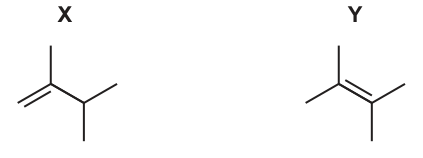
Answer
2,3-dimethylbut-1-ene
2,3-dimethylbut-1-ene
Background Concept
Naming alkenes with branches:
- Find the longest carbon chain containing the double bond. This is the parent chain.
- Number the chain from the end closest to the double bond to give the double bond the lowest possible locant.
- Identify and name the substituents (alkyl groups) and assign them locants based on the numbering.
- Assemble the name: substituents (alphabetical order, with multipliers like di-, tri-) + parent chain name + double bond locant + 'ene'.
Understanding the Question
Compound X is formed from two propene molecules. The skeletal structure shows a terminal double bond () on a carbon that also has a methyl group and an isopropyl group attached. We need to name it.
Approach
Translate the skeletal structure of X into a full formula, then apply IUPAC rules.
Step-by-Step Reasoning
- Structure of X: The image shows attached to a C. That C has a (up) and a (right, isopropyl). So the structure is .
- Longest chain containing : Start at (C1), go to C2 (with ), go to C3 (with ), go to C4 (end of isopropyl). The chain is 4 carbons long: butene.
- Numbering: Start from the left to give locant 1. So it's but-1-ene.
- Substituents: At C2, there is a methyl group. At C3, there is a methyl group. So 2,3-dimethyl.
- Full name: 2,3-dimethylbut-1-ene.
Key Takeaways
Always include the double bond locant in alkene names (but-1-ene, not just butene, though butene is sometimes accepted, but-1-ene is precise). Number from the end closest to the double bond.
Common Mistakes
Numbering from the wrong end: if you number from the right, you get 2,3-dimethylbut-3-ene, which is incorrect because the double bond must have the lowest locant (1, not 3).
Missing a methyl group: the isopropyl group has a methyl on C3, so there are two methyl groups in total (at C2 and C3).
Things to Be Careful About
Ensure the name matches the structure exactly. 2,3-dimethylbut-1-ene is correct.
Fig. 4.2 shows the mass spectrum of either compound or compound .
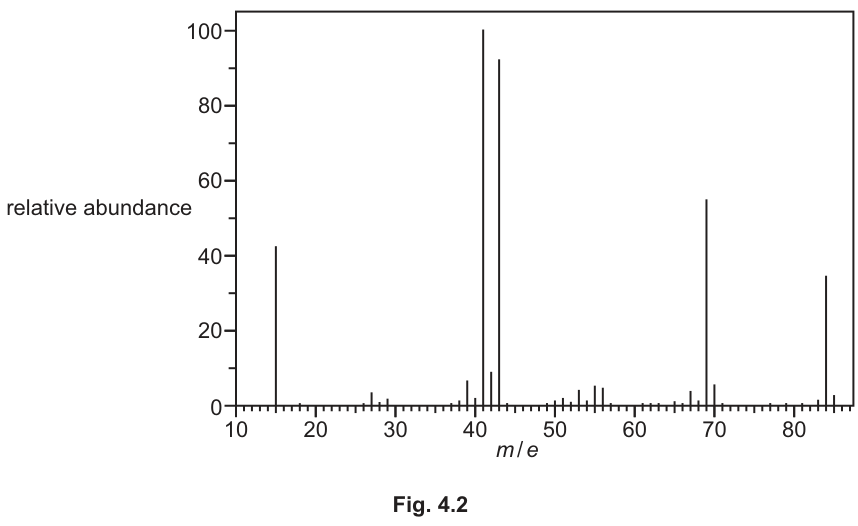
Identify which of and gives this mass spectrum.
Give one reason for your answer, referring to the fragmentation pattern.
Answer
(The spectrum is of) X
Reason:
41 is or
or 43 is or
(X would not have significant peak at 54 or 42)
X; 41 is [CH2=CCH3]+ or C3H5+
Background Concept
In mass spectrometry, the molecular ion peak () gives the molecular mass. Fragmentation patterns are characteristic of the structure. Common fragments:
- :
- : or
- : (allyl cation, or propenyl cation )
- : (isopropyl cation, or propyl cation)
- :
Understanding the Question
We have two isomers, X (2,3-dimethylbut-1-ene) and Y (4-methylpent-2-ene, or similar). The mass spectrum has a base peak at and a significant peak at . We need to identify which compound gives this spectrum and give a reason.
Approach
Analyze the likely fragmentation pathways for X and Y and match them to the prominent peaks (41 and 43).
Step-by-Step Reasoning
-
Structure of X: (2,3-dimethylbut-1-ene).
- Cleavage next to the double bond: The bond between C2 and C3 can break.
- Loss of isopropyl radical (, mass 43) leaves the cation , which has mass . This is a stable allylic/propenyl cation. This explains the base peak at 41.
- Alternatively, loss of the fragment (mass 41) leaves the isopropyl cation , which has mass . This explains the peak at 43.
- X has no significant way to form a stable (mass 54) or (mass 42) as major fragments.
-
Structure of Y: Let's assume Y is 4-methylpent-2-ene: (wait, that's 5 carbons in chain + methyl = 6 carbons total, , Mr = 84. X is also , Mr = 84. Correct).
- Fragmentation of Y would likely give different dominant peaks. For example, loss of methyl from the double bond side, or different allylic cleavages. The mark scheme notes that X would NOT have significant peaks at 54 or 42, implying Y might.
-
Conclusion: The spectrum matches X because of the prominent peaks at 41 and 43, corresponding to the propenyl/isopropyl fragmentation pattern of 2,3-dimethylbut-1-ene.
Key Takeaways
Fragmentation of alkenes often occurs adjacent to the double bond, producing stable allylic or resonance-stabilized carbocations. The base peak at 41 () and peak at 43 () are characteristic of the 2,3-dimethylbut-1-ene structure.
Common Mistakes
Guessing without analyzing the fragments: the mass spectrum provides specific evidence (m/z values) that must be linked to structural fragments.
Saying 'X has a higher abundance': the question asks for a reason referring to the fragmentation pattern, not just relative abundances.
Things to Be Careful About
The reason must explicitly link the m/z value to a specific fragment ion (e.g., '41 is '). Just saying 'it matches X' is not enough; the chemical justification is required.
The molecular ion peak in the spectrum in Fig. 4.2 has relative abundance 34.7.
Calculate the relative abundance of the peak in this spectrum.
relative abundance of peak = .........................................................
Working
Number of carbon atoms in = 6
Relative abundance of =
Answer
2.29
2.29
Background Concept
The peak in a mass spectrum is primarily due to the presence of the isotope. The natural abundance of is approximately 1.1% relative to .
For a molecule with carbon atoms, the relative abundance of the peak compared to the peak is given by:
where is the number of carbon atoms.
Understanding the Question
The molecular ion peak () is at (consistent with , ). Its relative abundance is given as 34.7%. We need to calculate the relative abundance of the peak.
Approach
- Determine the number of carbon atoms ( for ).
- Use the formula: .
Step-by-Step Reasoning
- Molecular formula is (from or from two propene molecules ).
- Number of carbons, .
- Contribution from carbon: .
- The peak is at 34.7% relative abundance (this is a scaled value, not a percentage of total, but the ratio holds).
- relative abundance = .
- Rounding to 3 significant figures (or appropriate for the data): 2.29.
Key Takeaways
The peak intensity is proportional to the number of carbon atoms. Use the formula: .
Common Mistakes
Forgetting to multiply by the number of carbon atoms: if you just do , you get 0.38, which is wrong.
Using the wrong molecular formula: ensure you count carbons correctly from the structure or .
Things to Be Careful About
The mark scheme shows the calculation as (wait, that's finding n from abundance? No, the mark scheme says: - this is finding the number of carbons if abundance was given. Here, abundance is 34.7, M=84 (6 carbons). So calculation is . The mark scheme text '()' seems to be showing how to find n if you had [M+1]. But we have n=6 and M=34.7, so we find [M+1]. . The mark scheme final answer is 2.29. My calculation matches.
Ensure correct significant figures. 2.29 is appropriate.