Chemistry 9701/22 — October/November 2025
Cambridge AS Level · AS Level Structured Questions · worked solutions for every part, with the mark scheme
Topics Atoms, Molecules and Stoichiometry · Introduction to Organic Chemistry · Hydrocarbons · Atomic Structure · Electrochemistry · Chemical Periodicity · +8 more
Manganese, Mn, and its compounds are widely used in many chemical reactions.
Mn is usually found as a single isotope, manganese-55.
Determine the number of protons, neutrons and electrons in an atom of manganese-55.
number of protons .......................... neutrons .......................... electrons ..........................
Answer
Manganese has atomic number 25.
- Protons: 25
- Neutrons: 55 − 25 = 30
- Electrons: 25 (neutral atom)
25 protons, 30 neutrons, 25 electrons
Background Concept
An atom is made of three sub-atomic particles. Protons carry a +1 charge and have a relative mass of 1; neutrons are neutral and also have a relative mass of 1; electrons carry a −1 charge and have negligible mass. The atomic (proton) number, , is the number of protons and it uniquely identifies the element. The mass (nucleon) number, , is the total number of protons plus neutrons. In a neutral atom the number of electrons equals the number of protons, because the positive and negative charges must balance.
The key relationship is:
For manganese-55, the notation "55" is the mass number , and manganese is element 25, so .
Understanding the Question
The parent stem tells us that manganese is found as the single isotope manganese-55. The question asks for the number of protons, neutrons and electrons in one neutral atom of this isotope. We are not dealing with an ion, so the electron count equals the proton count.
Approach
- Find the atomic number of manganese from the periodic table: 25.
- Since the atom is neutral, electrons = protons = 25.
- Subtract the atomic number from the mass number to find the neutrons: 55 − 25 = 30.
Step-by-Step Reasoning
- Protons: Mn is element 25, so it has 25 protons. This number is fixed for every atom of manganese.
- Neutrons: The mass number 55 is the sum of protons and neutrons, so neutrons = 55 − 25 = 30.
- Electrons: The atom is neutral (no charge is indicated), so there are 25 electrons to balance the 25 protons.
Each value is an integer count, so no units are written.
Key Takeaways
- The mass number is the sum of protons and neutrons: .
- A neutral atom always has equal numbers of protons and electrons.
- The atomic number identifies the element and never changes for a given element.
Common Mistakes
- Giving 55 protons: confusing the mass number with the atomic number.
- Writing neutrons as 55: forgetting to subtract the protons.
- Giving 30 electrons: forgetting that a neutral atom has electrons equal to protons, not to neutrons.
- Adding or subtracting incorrectly: 55 − 25 = 30, not 40 or 20.
Things to Be Careful About
- These are counts, so they are whole numbers with no units.
- If the atom were an ion (e.g. ), the electron count would change to 23, but this question specifies a neutral atom.
- The mark scheme expects the three values in the order protons, neutrons, electrons.
Answer
Isotopes are atoms of the same element with the same number of protons (same atomic number) but different numbers of neutrons (and therefore different mass numbers).
Atoms of the same element with the same number of protons but different numbers of neutrons
Background Concept
Isotopes are different atoms of the same element. Because they are the same element, they must have the same number of protons — the atomic number is fixed. What differs between isotopes is the number of neutrons, which changes the mass number but not the chemical identity. Since chemical behaviour is governed by the electron configuration, and a neutral atom of an isotope always has the same number of electrons as protons, isotopes have identical chemical properties.
Understanding the Question
This is a one-mark definition question. The mark scheme requires two halves: the atoms must be of the same element (same number of protons) AND have different numbers of neutrons. A definition that only gives one half loses the mark.
Approach
State the definition in the exact form the mark scheme uses: same number of protons, different number of neutrons. You may add "same element" and "different mass numbers" as supporting detail.
Step-by-Step Reasoning
- Isotopes are atoms of the same element.
- They have the same number of protons (same atomic number).
- They have different numbers of neutrons.
- As a consequence, they have different mass numbers (e.g. manganese-53 and manganese-55).
Key Takeaways
- The neutron number is what distinguishes isotopes.
- Isotopes of an element have the same chemical properties because they have the same electron configuration.
- The notation and shows two isotopes differing in mass number.
Common Mistakes
- Saying "same number of neutrons": this is the opposite of the truth and is wrong.
- Saying "different number of electrons": neutral atoms of isotopes have the same number of electrons.
- Omitting the "same element / same number of protons" half: the definition is incomplete and loses the mark.
- Saying "different mass" only: mass difference is a consequence, not the defining feature.
Things to Be Careful About
- Use precise wording: "same number of protons, different number of neutrons."
- Do not write "same mass number" — isotopes have different mass numbers.
- The word "atoms" (or "nuclides") should be present; the definition applies to atoms of an element.
A sample of manganese from the Moon is found to contain manganese-53 in addition to manganese-55.
State the two pieces of information needed to determine the relative atomic mass, , of manganese in this sample.
1 ........................................................................................................................................
2 ........................................................................................................................................
Answer
- The relative isotopic mass of each isotope (Mn-55 and Mn-53).
- The relative abundance of each isotope in the sample.
Relative isotopic masses of Mn-55 and Mn-53; relative abundance of each isotope
Background Concept
Relative atomic mass, , is the weighted mean of the masses of the isotopes of an element, weighted by their relative abundances. It is not a simple average of the mass numbers — an isotope that is more abundant contributes more to the value. The calculation requires the mass of each isotope and the proportion in which each is present:
where is the relative isotopic mass and is the relative abundance.
Understanding the Question
The Moon sample contains two isotopes, manganese-53 and manganese-55. To determine the relative atomic mass of this particular mixture, the candidate must state the two pieces of information needed. The mark scheme awards one mark for each.
Approach
Think about what goes into the weighted-average formula: you need the mass of each isotope present, and you need to know how much of each is present (their abundances).
Step-by-Step Reasoning
- M1 — the masses: the relative isotopic mass of each isotope, i.e. the mass of Mn-55 and the mass of Mn-53. The mark scheme accepts "relative isotopic mass" or "mass of each isotope."
- M2 — the abundances: the relative abundance (or percentage abundance, or proportion) of each isotope in the sample. Without this, you cannot weight the average.
With both pieces, the weighted mean can be computed.
Key Takeaways
- is a weighted average, not a simple mean.
- Both the isotopic masses and their abundances are required.
- The same logic applies to any element with multiple isotopes, such as chlorine or bromine.
Common Mistakes
- Giving only "the mass number": without the abundance, the value cannot be calculated.
- Giving only "the percentage abundance": without the masses, there is nothing to weight.
- Saying "the relative atomic mass of each isotope": the relative atomic mass is what you are trying to find; the input is the isotopic mass.
- Listing the two isotopes without saying what is needed about them: the question asks for information, not a list of isotopes.
Things to Be Careful About
- The mark scheme allows alternatives: "relative isotopic mass" or "mass of Mn-55 and Mn-53" for M1; "relative abundance" or "percentage abundance" for M2.
- Both marks are independent — each piece of information earns one mark.
- This is a two-mark question, so two distinct pieces of information must be given.
The shorthand electronic configuration of manganese is [Ar] .
Complete the full electronic configuration of manganese.
.........................................................................
Answer
1s2 2s2 2p6 3s2 3p6 3d5 4s2
Background Concept
The electronic configuration of an atom lists how its electrons are distributed among the orbitals, written in order of increasing energy. A shorthand form writes the previous noble gas in square brackets to represent the filled core, then lists only the remaining electrons. For manganese, means that the 18 electrons of argon fill the orbitals up to , and the remaining 7 electrons of manganese occupy and .
The full configuration is obtained by expanding the argon core into its individual subshells.
Understanding the Question
The part gives the shorthand configuration and asks for the full configuration. The answer is simply the expansion of followed by the given .
Approach
Write the full configuration of argon — — and then append .
Step-by-Step Reasoning
- Argon has 18 electrons: .
- Manganese has 25 electrons: the 18 argon electrons plus 7 more.
- Those 7 electrons are .
- Full configuration: .
- Check the total: 2 + 2 + 6 + 2 + 6 + 5 + 2 = 25. Correct.
Key Takeaways
- The full configuration expands the noble-gas core.
- The total number of electrons in the configuration must equal the atomic number.
- For transition metals the 3d subshell is written before 4s in the full configuration when following the given shorthand.
Common Mistakes
- Writing : the mark scheme follows the order given in the shorthand, .
- Omitting : the argon core must be complete.
- Writing : the 4s electrons must not be absorbed into the d subshell.
- Writing the wrong total: any configuration that does not sum to 25 electrons is wrong.
Things to Be Careful About
- The mark scheme accepts the full configuration with at the end, matching the shorthand.
- Count the electrons to verify: 25 total.
- This is a one-mark question, so the single correct string earns the mark.
Answer
5 unpaired electrons — one in each of the five 3d orbitals (Hund's rule); the 4s orbital is full.
5
Background Concept
Hund's rule states that electrons occupy each orbital of a subshell singly before any orbital is paired. This is because electrons repel each other, so they spread out to minimise repulsion. The 3d subshell contains five orbitals, each able to hold two electrons. With five electrons in the 3d subshell, Hund's rule places one electron in each orbital, giving five unpaired electrons.
The 4s subshell contains one orbital holding two electrons; these two are paired.
Understanding the Question
The question asks for the total number of unpaired electrons in a neutral manganese atom, whose configuration is . We must consider both subshells.
Approach
- Look at the 3d subshell: five electrons in five orbitals → one per orbital → five unpaired.
- Look at the 4s subshell: two electrons in one orbital → paired.
- Total unpaired electrons = 5.
Step-by-Step Reasoning
- The 3d subshell has five orbitals. With five electrons, Hund's rule puts one electron in each orbital before pairing, so all five 3d electrons are unpaired.
- The 4s subshell has one orbital holding two electrons; these two electrons are paired.
- Therefore the total number of unpaired electrons in the atom is 5.
This half-filled 3d subshell is also particularly stable, which is part of why manganese commonly forms with a configuration.
Key Takeaways
- Hund's rule determines how electrons fill orbitals and hence how many are unpaired.
- A half-filled d subshell (d5) has all five electrons unpaired.
- A full s subshell (s2) contributes no unpaired electrons.
Common Mistakes
- Saying 7: counting the two 4s electrons as unpaired — they are paired in the single 4s orbital.
- Saying 3 or 1: pairing electrons prematurely in the 3d orbitals instead of applying Hund's rule.
- Confusing with : the ion has configuration (also 5 unpaired), but this question is about the neutral atom.
Things to Be Careful About
- The answer is simply 5; the mark scheme accepts the number alone.
- Remember the 4s pair contributes nothing to the unpaired count.
- This is a one-mark question — no working is required, but the reasoning confirms the answer.
Manganese(IV) oxide reacts with methanal, , in acidic conditions to produce carbon dioxide. The movement of electrons to or from relevant species is shown in the following half-equations.
Answer
(the Mn in ) is reduced because it gains electrons: the oxidation state of Mn falls from +4 in to +2 in .
MnO2 (Mn), because it gains electrons
Background Concept
Reduction is defined as the gain of electrons. In a half-equation, the species on the reactant side that accepts electrons is reduced; the electrons appear on the left-hand side of the equation. A useful check is the oxidation state: reduction is accompanied by a decrease in oxidation number.
Half-equation 2 is:
The two electrons are on the left, so they are gained by .
Understanding the Question
The question asks which species is reduced in half-equation 2 and to explain the answer. The mark scheme requires both the species (Mn or MnO₂) and the reason (it gains electrons).
Approach
- Look at which side of the half-equation the electrons are on. Electrons on the left mean they are gained by the reactant → reduction.
- Confirm by checking the oxidation state of Mn: +4 in , +2 in — a decrease, consistent with reduction.
Step-by-Step Reasoning
- In half-equation 2, the electrons appear on the left as reactants, so gains two electrons.
- Gaining electrons is reduction, so (specifically the manganese) is the species reduced.
- Supporting check: the oxidation state of Mn falls from +4 in to +2 in . A decrease in oxidation number confirms reduction.
- The hydrogen and oxygen do not change oxidation state; they are merely part of the acidic medium and water formation.
Key Takeaways
- Reduction = gain of electrons.
- A decrease in oxidation number confirms reduction.
- In a half-equation, electrons on the left indicate the reactant is reduced.
Common Mistakes
- Saying is reduced: hydrogen stays at +1 throughout; it is not reduced.
- Saying is reduced: is the product, not the species gaining electrons.
- Confusing reduction with oxidation: oxidation is the loss of electrons, which is what happens to methanal in half-equation 1.
- Giving only the species without the reason: the mark requires both halves.
Things to Be Careful About
- The mark scheme wants "Mn / MnO₂ AND it gains electrons." Both the identity and the reason are needed for the mark.
- You may also mention the oxidation state change from +4 to +2 as supporting evidence.
- This is a one-mark question, so keep the answer concise but complete.
The oxidation state of carbon in methanal is 0.
Calculate the oxidation state of carbon in carbon dioxide.
Working
Oxygen is −2 in . For the neutral molecule: , so .
Answer
+4
+4
Background Concept
Oxidation state is a bookkeeping number assigned to an atom in a compound. The key rules: oxygen is usually −2 (except in peroxides and ), and the sum of oxidation states in a neutral molecule is zero. For a polyatomic ion, the sum equals the charge on the ion.
Understanding the Question
The question states that carbon in methanal () has oxidation state 0, and asks for the oxidation state of carbon in carbon dioxide. The methanal value is context — the calculation only involves .
Approach
Assign oxygen as −2 in , set the sum of oxidation states equal to zero (neutral molecule), and solve for carbon.
Step-by-Step Reasoning
- In there are two oxygen atoms, each −2, contributing a total of −4.
- The molecule is neutral, so the oxidation states must sum to zero:
- Solving: , so .
Carbon in is +4, which is the maximum oxidation state of carbon.
Key Takeaways
- Oxygen is −2 in most compounds.
- The sum of oxidation states in a neutral molecule is zero.
- Carbon in is +4, its highest oxidation state.
Common Mistakes
- Writing +2: that is the oxidation state of carbon in carbon monoxide, CO, not CO₂.
- Writing −4: forgetting that the oxidation states must sum to zero for a neutral molecule.
- Counting only one oxygen: there are two oxygen atoms in CO₂.
- Writing 0: confusing with the given value for methanal.
Things to Be Careful About
- The answer is +4, correct answer only (cao) — no alternative form scores.
- The sign matters: it is positive, not negative.
- This is a one-mark question; the working shown confirms the value but the mark is for +4.
Construct the ionic equation for the reaction of manganese(IV) oxide with methanal in acidic conditions.
Working
Multiply half-equation 2 by 2 so the electrons cancel:
Add to half-equation 1 and cancel the , and that appear on both sides.
Answer
Note: this part was removed from the question paper due to an error; the chemistry above is the correct overall equation.
CH2O + 2MnO2 + 4H+ -> CO2 + 2Mn2+ + 3H2O
Background Concept
A redox reaction can be split into two half-equations: one oxidation (loss of electrons) and one reduction (gain of electrons). To construct the overall ionic equation, the two half-equations are combined so that the number of electrons lost equals the number gained. This usually requires multiplying one or both half-equations by an integer factor.
Here:
- Half-equation 1 (oxidation of methanal):
- Half-equation 2 (reduction of ):
Half-equation 1 transfers 4 electrons; half-equation 2 transfers only 2, so half-equation 2 must be doubled.
Understanding the Question
The question asks for the balanced ionic equation for the reaction of manganese(IV) oxide with methanal in acidic conditions. The two half-equations are given in the stem, so the task is to combine them correctly. Note: this part was removed from the actual question paper due to an error, but the chemistry is shown here for completeness.
Approach
- Note the electron counts: 4 in half-equation 1, 2 in half-equation 2.
- Multiply half-equation 2 by 2 so both transfer 4 electrons.
- Add the two half-equations.
- Cancel any species that appear on both sides (, , ).
- Verify atoms and charge balance.
Step-by-Step Reasoning
- Double half-equation 2:
- Add this to half-equation 1:
- Cancel the 4 electrons on both sides.
- Cancel 4 of the on the left against the on the right, leaving on the left.
- Cancel 1 on the left against the on the right, leaving on the right.
- Result:
- Check atoms: C 1 = 1; H 2 + 4 = 6 on the left, 3 × 2 = 6 on the right; O 1 + 4 = 5 on the left, 2 + 3 = 5 on the right. Check charge: left +4, right 2 × (+2) = +4. Balanced.
Key Takeaways
- Combine half-equations by making the electron counts equal.
- Cancel any species common to both sides after adding.
- Always verify atom balance and charge balance.
Common Mistakes
- Forgetting to multiply half-equation 2 by 2: the electrons would not cancel.
- Not cancelling and : the equation would not be in its simplest form.
- Leaving electrons in the final equation: electrons must cancel completely.
- Unbalanced charge or atoms: check both after combining.
Things to Be Careful About
- This part was removed from the question paper due to an error, so no marks were awarded in the actual exam.
- State symbols (aq) for ions could be added if required, but the ionic equation is commonly written without them here.
- The correct stoichiometric coefficients are 1 : 2 : 4 : 1 : 2 : 3 for .
The Period 3 elements show trends in physical and chemical properties across the period.
Answer
Metals have delocalised electrons that are free to move through the structure and carry charge.
Delocalised electrons move freely through the structure.
Background Concept
Metals such as sodium, magnesium, and aluminium have a giant metallic lattice structure consisting of positive metal ions arranged in a regular array, surrounded by a 'sea' of delocalised electrons. These electrons originate from the outer shells of the metal atoms and are not bound to any specific ion.
Understanding the Question
The question asks for an explanation of why the first three Period 3 elements (Na, Mg, Al) are good conductors of electricity. This requires linking their metallic structure to the physical property of electrical conductivity.
Approach
Recall the definition of metallic bonding and identify the charge carriers in a metal. Explain how these charge carriers enable the flow of electric current.
Step-by-Step Reasoning
- Identify the structure: Na, Mg, and Al are metals and form giant metallic lattices.
- Identify the charge carriers: The delocalised outer electrons are free to move throughout the lattice.
- Link to conductivity: When a potential difference is applied, these mobile delocalised electrons drift towards the positive terminal, carrying charge and thus conducting electricity.
Key Takeaways
Metallic conductivity is directly due to the presence of mobile delocalised electrons within the giant metallic lattice.
Common Mistakes
- Stating 'electrons move' without specifying they are delocalised.
- Saying 'ions move' — in solid metals, the positive ions are fixed in the lattice and cannot move.
Things to Be Careful About
Ensure you use the precise term 'delocalised electrons'. Simply saying 'electrons' may not earn the mark if it is ambiguous.
Answer
P, S, and Cl have no mobile charge carriers; all electrons are localised in covalent bonds or lone pairs, and there are no mobile ions.
No delocalised electrons and no mobile ions.
Background Concept
Phosphorus, sulfur, and chlorine are non-metals. In their standard states at room temperature, they exist as simple molecular structures (e.g., P₄, S₈, Cl₂). The atoms within these molecules are held together by strong covalent bonds, but the electrons involved are localised between specific atoms or as lone pairs.
Understanding the Question
The question asks why these elements do not conduct electricity. This requires explaining the absence of mobile charge carriers in their structures.
Approach
Describe the bonding and structure of P, S, and Cl, and explain why this structure lacks the mobile charge carriers necessary for electrical conduction.
Step-by-Step Reasoning
- Identify the structure: P, S, and Cl form simple molecular structures with covalent bonding.
- Identify charge carriers: Electrical conduction requires mobile charge carriers (either delocalised electrons or mobile ions).
- Explain absence: In simple molecular non-metals, all valence electrons are involved in localised covalent bonds or exist as lone pairs. There are no delocalised electrons. Furthermore, they are uncharged molecules, so there are no mobile ions.
- Conclusion: Without mobile charge carriers, electricity cannot flow.
Key Takeaways
Non-metals that form simple molecular structures lack both delocalised electrons and mobile ions, making them non-conductors.
Common Mistakes
- Stating 'they have no electrons' — they have electrons, but they are not free to move.
- Saying 'they are covalent' without explaining that this means electrons are localised and not mobile.
Things to Be Careful About
Be precise: specify that there are no delocalised electrons and no mobile ions. Vague statements like 'no charge carriers' are acceptable but less descriptive.
Fig. 2.1 shows the variation in melting point of the Period 3 elements Si to Cl.
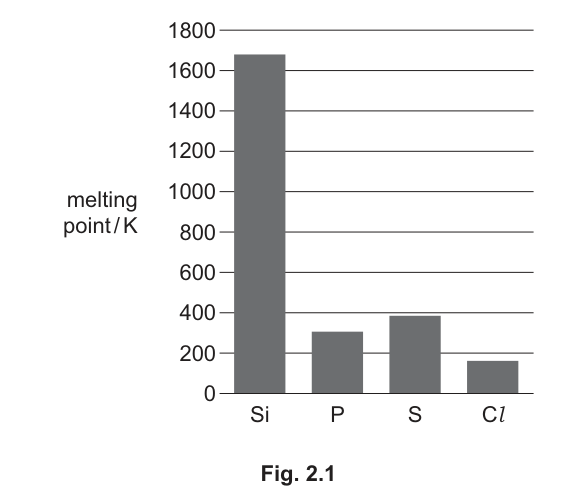
The Period 3 elements Si to Cl are all non-metals.
Explain why there is a large difference between the melting point of Si and the melting points of P, S and Cl.
Answer
Silicon has a giant covalent structure with many strong covalent bonds that must be broken to melt it. Phosphorus, sulfur, and chlorine exist as simple molecules with only weak intermolecular (Van der Waals) forces between them, which require much less energy to overcome.
Working
- Si: Giant covalent lattice. Melting requires breaking strong covalent bonds.
- P, S, Cl: Simple molecular. Melting only requires overcoming weak Van der Waals' forces between molecules.
Answer
The large difference arises because Si has a giant covalent structure requiring strong bonds to be broken, whereas P, S, and Cl have simple molecular structures with only weak intermolecular forces to overcome.
Si has strong covalent bonds in a giant lattice; P, S, Cl have weak Van der Waals' forces between simple molecules.
Background Concept
The melting point of a substance depends on the strength of the forces that must be overcome to separate the particles in the solid state. For giant structures (ionic, metallic, giant covalent), melting involves breaking strong primary bonds (ionic, metallic, or covalent). For simple molecular substances, melting only involves overcoming weak secondary intermolecular forces (Van der Waals' forces or hydrogen bonds), while the covalent bonds within the molecules remain intact.
Understanding the Question
The question asks for an explanation of the large difference in melting points between silicon (Si, ~1680 K) and the subsequent non-metals phosphorus (P, ~317 K), sulfur (S, ~390 K), and chlorine (Cl, ~172 K) as shown in Fig. 2.1.
Approach
Identify the structural type and bonding for Si and for P, S, Cl. Explain the energy required to melt each type of structure.
Step-by-Step Reasoning
- Silicon (Si): Si is a Group 4 element and forms a giant covalent (macromolecular) structure similar to diamond. Each Si atom is bonded to four others by strong covalent bonds. To melt Si, these strong covalent bonds must be broken, which requires a large amount of energy, hence the high melting point.
- Phosphorus, Sulfur, Chlorine (P, S, Cl): These are simple molecular substances (P₄, S₈, Cl₂). The atoms within each molecule are held by strong covalent bonds, but the molecules themselves are held together by weak Van der Waals' (dispersion) forces.
- Melting P, S, Cl: Melting these substances only requires overcoming the weak intermolecular forces between the molecules, not the strong covalent bonds within them. This requires much less energy, resulting in low melting points.
- Comparison: The difference in melting points is therefore due to the difference in structure and the forces that must be overcome: strong covalent bonds in a giant lattice (Si) vs. weak Van der Waals' forces between simple molecules (P, S, Cl).
Key Takeaways
Always specify what is being broken when a substance melts: bonds in giant structures vs. intermolecular forces in simple molecular substances.
Common Mistakes
- Saying 'Si has strong bonds and P/S/Cl have weak bonds' — this is ambiguous. Specify that P, S, Cl have weak intermolecular forces, not weak covalent bonds.
- Forgetting to mention that Si has a giant structure.
Things to Be Careful About
Use precise terminology: 'strong covalent bonds' for Si, and 'weak Van der Waals' forces' (or 'weak intermolecular forces') for P, S, Cl. Do not say 'bonds are broken' for P, S, Cl unless referring to intermolecular forces.
Table 2.1 gives some information about some Period 3 chlorides.
Row B refers to the pH of the solution that forms when the Period 3 chloride is added to water.
Table 2.1
| formula of Period 3 chloride | ||||||
|---|---|---|---|---|---|---|
| A | oxidation number of element bonded to | |||||
| B | pH of solution | 6.5 | ||||
| C | bonding | ionic | ||||
| D | structure | giant |
Complete Table 2.1.
You may use the following abbreviations.
Answer
| formula of Period 3 chloride | NaCl | MgCl₂ | AlCl₃ | SiCl₄ | PCl₅ | |
|---|---|---|---|---|---|---|
| A | oxidation number of element bonded to Cl | +1 | +2 | +3 | +4 | +5 |
| B | pH of solution | 7 | 6.5 | 0–4 | 0–4 | 0–4 |
| C | bonding | I | I | I | C | C |
| D | structure | G | G | G | S | S |
(I = ionic, C = covalent, G = giant, S = simple)
Working
- Oxidation numbers: Cl is -1. Na(+1), Mg(+2), Al(+3), Si(+4), P(+5).
- pH of solution: NaCl is neutral (pH 7). MgCl₂ is slightly acidic (pH ~6.5). AlCl₃, SiCl₄, PCl₅ are strongly acidic (pH 0–4) due to hydrolysis forming HCl and acidic oxoacids.
- Bonding: Electronegativity difference decreases across the period. Na, Mg, Al chlorides are ionic (I). Si and P chlorides are covalent (C).
- Structure: Ionic chlorides form giant ionic lattices (G). Covalent chlorides form simple molecular structures (S).
Answer
See completed table above.
Table completed: NaCl (+1, 7, I, G); MgCl₂ (+2, 6.5, I, G); AlCl₃ (+3, 0-4, I, G); SiCl₄ (+4, 0-4, C, S); PCl₅ (+5, 0-4, C, S).
Background Concept
Across Period 3, the chlorides show a clear trend in bonding and structure from ionic giant lattices (NaCl, MgCl₂, AlCl₃) to covalent simple molecules (SiCl₄, PCl₅, SCl₂, S₂Cl₂, Cl₂). This trend is due to the decreasing electronegativity difference between the Period 3 element and chlorine. Additionally, the pH of the solutions formed when these chlorides react with water changes from neutral (NaCl) to strongly acidic (AlCl₃, SiCl₄, PCl₅) due to hydrolysis reactions that release H⁺ ions.
Understanding the Question
The question requires completing a table with four rows (oxidation number, pH of aqueous solution, bonding type, structure type) for five Period 3 chlorides: NaCl, MgCl₂, AlCl₃, SiCl₄, PCl₅.
Approach
For each chloride, determine: (1) oxidation number of the central atom, (2) pH of the solution formed with water, (3) bonding type (ionic or covalent), and (4) structure type (giant or simple molecular).
Step-by-Step Reasoning
- Oxidation number (Row A): Chlorine is more electronegative, so it has an oxidation number of -1. The oxidation number of the Period 3 element is +1 for Na, +2 for Mg, +3 for Al, +4 for Si, and +5 for P.
- pH of solution (Row B):
- NaCl: Strong acid/strong base salt, neutral solution, pH = 7.
- MgCl₂: Slightly acidic due to partial hydrolysis of Mg²⁺, pH ≈ 6.5.
- AlCl₃, SiCl₄, PCl₅: These undergo vigorous hydrolysis with water to form HCl (strong acid) and acidic species (e.g., Al(OH)₃/H⁺, H₄SiO₄/H⁺, H₃PO₄/H⁺), resulting in strongly acidic solutions with pH between 0 and 4.
- Bonding (Row C): The electronegativity difference between the metal/non-metal and Cl determines bonding. Na, Mg, Al are metals with low electronegativity, forming ionic bonds (I) with Cl. Si and P are non-metals with higher electronegativity, forming covalent bonds (C) with Cl.
- Structure (Row D): Ionic compounds (NaCl, MgCl₂, AlCl₃) form giant ionic lattices (G). Covalent compounds (SiCl₄, PCl₅) exist as discrete simple molecules (S) held together by weak intermolecular forces.
Key Takeaways
The Period 3 chlorides transition from ionic giant structures to covalent simple molecules across the period. Their aqueous solutions range from neutral to strongly acidic.
Common Mistakes
- Assuming AlCl₃ is covalent: In the context of this syllabus and typical mark schemes, AlCl₃ is often classified as ionic and giant for simplicity in early Period 3 trends, though in reality it has significant covalent character and sublimes. Follow the mark scheme convention (I, G).
- Forgetting that SiCl₄ and PCl₅ hydrolyse to give acidic solutions (pH 0-4), not neutral.
Things to Be Careful About
Use the exact abbreviations provided: I, C, G, S. Ensure oxidation numbers have the correct sign (+1, not 1).
Answer
Answer
2Al + 3Cl2 -> 2AlCl3
Background Concept
A formation equation shows the formation of one mole (or the stoichiometric amount) of a compound from its constituent elements in their standard states. For aluminium chloride, the elements are aluminium (solid metal) and chlorine (diatomic gas).
Understanding the Question
Write a balanced chemical equation for the formation of AlCl₃ from its elements.
Approach
Write the unbalanced equation with correct formulas and state symbols, then balance it.
Step-by-Step Reasoning
- Reactants: Aluminium is Al(s), chlorine is Cl₂(g).
- Product: Aluminium chloride is AlCl₃(s).
- Unbalanced equation: Al(s) + Cl₂(g) → AlCl₃(s)
- Balancing: To balance Cl, use 3 Cl₂ and 2 AlCl₃. To balance Al, use 2 Al.
- Balanced equation: 2Al(s) + 3Cl₂(g) → 2AlCl₃(s)
Key Takeaways
Always include state symbols in formation equations. Balance the equation correctly.
Common Mistakes
- Forgetting state symbols.
- Writing Cl instead of Cl₂.
- Not balancing the equation.
Things to Be Careful About
Ensure the equation is fully balanced and state symbols are correct.
Answer
Answer
PCl5 + 4H2O -> H3PO4 + 5HCl
PCl5 + 4H2O -> H3PO4 + 5HCl
Background Concept
Covalent chlorides of non-metals like phosphorus react vigorously with water (hydrolysis) to produce acidic solutions. Phosphorus(V) chloride (PCl₅) hydrolyses to form phosphoric(V) acid (H₃PO₄) and hydrochloric acid (HCl). The reaction is highly exothermic and produces white fumes of HCl.
Understanding the Question
Write a balanced equation for the reaction of PCl₅ with water to form H₃PO₄.
Approach
Write the unbalanced equation with correct formulas, then balance it.
Step-by-Step Reasoning
- Reactants: PCl₅(l) and H₂O(l).
- Products: H₃PO₄(aq) and HCl(aq).
- Unbalanced equation: PCl₅ + H₂O → H₃PO₄ + HCl
- Balancing P: 1 P on each side.
- Balancing Cl: 5 Cl on left, so need 5 HCl on right.
- Balancing H: Right side has 3 (from H₃PO₄) + 5 (from 5HCl) = 8 H. Left side needs 4 H₂O.
- Balancing O: Left side has 4 O (from 4H₂O). Right side has 4 O (from H₃PO₄). Balanced.
- Final equation: PCl₅(l) + 4H₂O(l) → H₃PO₄(aq) + 5HCl(aq)
Key Takeaways
Covalent chlorides hydrolyse with water to give oxoacids and HCl. Balance the equation carefully, especially hydrogen and oxygen.
Common Mistakes
- Writing incorrect products (e.g., PCl₃ instead of H₃PO₄).
- Not balancing the equation correctly (especially the 4 H₂O and 5 HCl).
- Forgetting state symbols.
Things to Be Careful About
The question specifically asks for the formation of H₃PO₄, so ensure this is the correct phosphorus-containing product. Balance all atoms.
reacts with in a reversible reaction to form . Under certain conditions, a dynamic equilibrium is established.
Answer
Dynamic equilibrium is the state in a reversible reaction where the rate of the forward reaction equals the rate of the backward reaction, and the concentrations of reactants and products remain constant.
Answer
Rate of forward and backward reactions are equal; concentrations of reactants and products are constant.
Rate of forward and backward reactions are equal; concentrations of reactants and products are constant.
Background Concept
In a reversible reaction, both forward and backward reactions occur simultaneously. As reactants are converted to products, the concentration of reactants decreases and products increases. Eventually, the rates of the forward and backward reactions become equal, and the concentrations of all species remain constant. This is dynamic equilibrium.
Understanding the Question
State the definition of dynamic equilibrium.
Approach
Recall the two key features of dynamic equilibrium: equal rates and constant concentrations.
Step-by-Step Reasoning
- Equal rates: The rate at which reactants are converted to products (forward reaction) is exactly equal to the rate at which products are converted back to reactants (backward reaction).
- Constant concentrations: Because the rates are equal, there is no net change in the amounts of reactants or products. Their concentrations remain constant over time.
- Dynamic: The reactions are still occurring (dynamic), but there is no observable macroscopic change.
Key Takeaways
Dynamic equilibrium requires equal forward and backward rates and constant concentrations.
Common Mistakes
- Saying 'the reactions have stopped' — they are still occurring, hence 'dynamic'.
- Saying 'concentrations are equal' — they are constant, not necessarily equal.
Things to Be Careful About
Use the precise wording: 'rates are equal' and 'concentrations are constant'.
Answer
A closed system.
Answer
Closed system
Closed system
Background Concept
For a dynamic equilibrium to be established in a reversible reaction, the system must be closed. This prevents reactants or products from entering or leaving the system, which would otherwise shift the equilibrium or prevent it from being established.
Understanding the Question
Identify the condition necessary to establish dynamic equilibrium.
Approach
Recall the fundamental requirement for equilibrium: no exchange of matter with the surroundings.
Step-by-Step Reasoning
- Reversible reaction: The reaction must be reversible.
- Closed system: The system must be closed so that no reactants or products can escape or enter. If the system were open, a gas (like Cl₂ in this reaction) could escape, preventing equilibrium from being reached.
- Conclusion: The necessary condition is a closed system.
Key Takeaways
Dynamic equilibrium can only be established in a closed system.
Common Mistakes
- Saying 'constant temperature' — while temperature must be constant for a specific equilibrium position, the fundamental condition for equilibrium to be established is a closed system.
Things to Be Careful About
Simply state 'closed system'.
is yellow and is red.
State what is observed when the following changes are made to an equilibrium mixture of and .
Explain your answers.
-
The equilibrium mixture is warmed gently.
- observation ................................................................................................................
- explanation ................................................................................................................
-
The overall pressure of the equilibrium mixture is increased.
- observation ................................................................................................................
- explanation ................................................................................................................
Answer
The equilibrium mixture is warmed gently:
- Observation: The mixture becomes more yellow.
- Explanation: The forward reaction is exothermic (ΔH = -41 kJ mol⁻¹). Increasing the temperature shifts the equilibrium to the left (to absorb the added heat), producing more S₂Cl₂(l), which is yellow.
The overall pressure of the equilibrium mixture is increased:
- Observation: The mixture becomes more red.
- Explanation: There are fewer moles of gas on the right-hand side (1 mole of Cl₂ on the left, 0 moles of gas on the right). Increasing the pressure shifts the equilibrium to the right (to reduce the pressure), producing more SCl₂(l), which is red.
Working
- Temperature increase: Exothermic forward reaction → shift left → more yellow S₂Cl₂.
- Pressure increase: 1 mol gas (left) vs 0 mol gas (right) → shift right → more red SCl₂.
Answer
See explanations above.
Warmed: becomes more yellow (exothermic forward reaction, shifts left). Pressure increased: becomes more red (fewer moles of gas on right, shifts right).
Background Concept
Le Chatelier's principle states that if a dynamic equilibrium is disturbed by changing the conditions, the position of equilibrium moves to counteract the change.
- Temperature: Increasing temperature favours the endothermic direction. Decreasing temperature favours the exothermic direction.
- Pressure: Increasing pressure favours the side with fewer moles of gas. Decreasing pressure favours the side with more moles of gas.
Understanding the Question
The reaction is: S₂Cl₂(l) + Cl₂(g) ⇌ 2SCl₂(l), ΔH = -41 kJ mol⁻¹. S₂Cl₂(l) is yellow, SCl₂(l) is red. Predict and explain the observations when: (1) the mixture is warmed, (2) the pressure is increased.
Approach
Apply Le Chatelier's principle to each change. Determine the direction of the shift, then link this to the colour change based on the colours of the species.
Step-by-Step Reasoning
Part 1: Warmed gently (temperature increase)
- Identify the exothermic/endothermic direction: The forward reaction has ΔH = -41 kJ mol⁻¹, so it is exothermic. The backward reaction is endothermic.
- Apply Le Chatelier's principle: Increasing temperature favours the endothermic direction to absorb the added heat. The equilibrium shifts to the left (backward direction).
- Effect on concentrations: More S₂Cl₂(l) is produced, and less SCl₂(l) is present.
- Observation: Since S₂Cl₂(l) is yellow and SCl₂(l) is red, the mixture becomes more yellow.
Part 2: Pressure increased
- Count moles of gas on each side:
- Left-hand side: 1 mole of Cl₂(g) (S₂Cl₂ is liquid, so not counted).
- Right-hand side: 0 moles of gas (SCl₂ is liquid).
- Apply Le Chatelier's principle: Increasing pressure favours the side with fewer moles of gas to reduce the pressure. The equilibrium shifts to the right (forward direction).
- Effect on concentrations: More SCl₂(l) is produced, and less S₂Cl₂(l) is present.
- Observation: Since SCl₂(l) is red, the mixture becomes more red.
Key Takeaways
When applying Le Chatelier's principle, always consider the state of each substance (only gases count for pressure changes) and the sign of ΔH (exothermic vs endothermic).
Common Mistakes
- Forgetting that S₂Cl₂ and SCl₂ are liquids and should not be counted when comparing moles of gas for the pressure change.
- Saying 'equilibrium shifts to absorb heat' without specifying the direction (left or right).
- Confusing the colours: S₂Cl₂ is yellow, SCl₂ is red.
Things to Be Careful About
- Always state the observation before the explanation.
- For temperature, mention that the forward reaction is exothermic.
- For pressure, mention the number of moles of gas on each side (1 mol on left, 0 mol on right).
Aqueous reacts with aqueous to form a white precipitate. Upon heating, the white precipitate undergoes thermal decomposition.
Construct an equation to show the reaction of aqueous with aqueous . Use state symbols in your equation.
Answer
Answer
MgCl2(aq) + Na2CO3(aq) -> MgCO3(s) + 2NaCl(aq)
MgCl2(aq) + Na2CO3(aq) -> MgCO3(s) + 2NaCl(aq)
Background Concept
When aqueous solutions of an ionic compound containing a Group 2 metal ion and an aqueous solution of a soluble carbonate are mixed, a double displacement (precipitation) reaction occurs. The Group 2 metal carbonate is typically insoluble and precipitates out, while the sodium salt remains in solution.
Understanding the Question
Write a balanced equation with state symbols for the reaction of aqueous MgCl₂ with aqueous Na₂CO₃ to form a white precipitate.
Approach
Identify the reactants and products, write the unbalanced equation, balance it, and assign correct state symbols.
Step-by-Step Reasoning
- Reactants: MgCl₂(aq) and Na₂CO₃(aq).
- Products: The white precipitate is magnesium carbonate, MgCO₃(s). The other product is sodium chloride, NaCl(aq).
- Unbalanced equation: MgCl₂(aq) + Na₂CO₃(aq) → MgCO₃(s) + NaCl(aq)
- Balancing: There are 2 Na and 2 Cl on the left, so need 2 NaCl on the right.
- Balanced equation: MgCl₂(aq) + Na₂CO₃(aq) → MgCO₃(s) + 2NaCl(aq)
- State symbols: MgCl₂ and Na₂CO₃ are aqueous (given). MgCO₃ is a solid precipitate. NaCl is soluble, so aqueous.
Key Takeaways
Double displacement reactions between soluble salts form an insoluble product (precipitate). Always include correct state symbols.
Common Mistakes
- Forgetting state symbols.
- Writing MgCO₃ as (aq) instead of (s).
- Not balancing the equation (missing the coefficient 2 for NaCl).
Things to Be Careful About
Ensure the equation is fully balanced and state symbols are correct. MgCO₃ is insoluble, so it is (s).
Answer
Magnesium oxide (MgO) and carbon dioxide (CO₂).
Answer
MgO and CO2
MgO and CO2
Background Concept
Group 2 metal carbonates undergo thermal decomposition when heated to produce the metal oxide and carbon dioxide gas. The general equation is: MCO₃(s) → MO(s) + CO₂(g).
Understanding the Question
Identify the products of the thermal decomposition of the white precipitate (MgCO₃) formed in part (f)(i).
Approach
Recall the thermal decomposition products of Group 2 carbonates.
Step-by-Step Reasoning
- Reactant: The white precipitate is MgCO₃(s).
- Decomposition: Upon heating, MgCO₃ decomposes to form magnesium oxide (MgO) and carbon dioxide (CO₂).
- Products: MgO(s) and CO₂(g).
Key Takeaways
Group 2 carbonates decompose on heating to give the metal oxide and CO₂.
Common Mistakes
- Writing incorrect products (e.g., MgO and CO).
- Forgetting to name both products.
Things to Be Careful About
The question asks to 'identify the products', so name them (magnesium oxide and carbon dioxide) or give their formulas (MgO and CO₂).
Answer
Thermal stability increases down the group.
Answer
Increases down the group
Increases down the group
Background Concept
The thermal stability of Group 2 carbonates increases down the group. This is because the larger the metal ion, the lower its charge density, and the less polarising power it has on the large carbonate ion. A less polarised carbonate ion is more stable and requires more energy (higher temperature) to decompose.
Understanding the Question
State the trend in thermal stability of Group 2 carbonates down the group.
Approach
Recall the periodicity trend for thermal stability of Group 2 carbonates.
Step-by-Step Reasoning
- Trend: As you go down Group 2 (from Be to Ba), the thermal stability of the carbonates increases.
- Explanation (not required but good to know): Larger cations have lower charge density and polarise the carbonate ion less, making it more stable.
Key Takeaways
Thermal stability of Group 2 carbonates increases down the group.
Common Mistakes
- Saying 'decreases down the group' — this is the trend for Group 1 carbonates (mostly) and Group 2 nitrates, but increases for Group 2 carbonates.
- Not specifying 'down the group'.
Things to Be Careful About
Be precise: 'thermal stability increases down the group'. Do not confuse with Group 1 or Group 2 nitrates.
The alkanes are a homologous series of organic molecules. Alkanes are generally unreactive and are commonly used as fuels.
Answer
A homologous series is a family of organic compounds with the same general formula and similar chemical properties. Successive members differ by a repeating unit of in their molecular formula.
A family of compounds with the same general formula and similar chemical properties, differing by a unit.
Background Concept
Organic chemistry is organized into homologous series to make the study of millions of compounds manageable. A homologous series is a group of organic compounds that share a common structural feature (functional group) and thus exhibit similar chemical behavior. As the carbon chain lengthens, physical properties like boiling point change in a predictable way.
Understanding the Question
The question asks for a definition of a 'homologous series'. This is a fundamental concept introduced early in organic chemistry to classify alkanes, alkenes, alcohols, etc.
Approach
To define a homologous series, we need to state the two defining characteristics: the relationship between the molecular formulas of successive members and the chemical behavior of the group.
Step-by-Step Reasoning
- General Formula: Members of a homologous series share a general formula (e.g., for alkanes). This means each successive member differs from the previous one by a unit. This is the structural/quantitative definition.
- Chemical Properties: Because they share the same functional group (or in the case of alkanes, the same type of bonding), they undergo the same types of chemical reactions. This is the chemical definition.
Key Takeaways
Always include both the 'same general formula/differ by ' and 'similar chemical properties' when defining a homologous series to get full marks.
Common Mistakes
- Stating only that they have the same general formula (missing the chemical properties part).
- Saying they have the same molecular formula (they don't; they differ by ).
- Saying they have the same boiling point (physical properties change; chemical properties are similar).
Things to Be Careful About
Ensure you distinguish between 'molecular formula' (which changes) and 'general formula' (which is constant). The mark scheme accepts 'family of molecules' or 'series'.
Give two reasons to explain the general unreactivity of alkanes.
1 ................................................................................................................................................
2 ................................................................................................................................................
Answer
- The carbon-hydrogen (C—H) bonds are strong (have high bond enthalpy).
- The C—H bonds (and the alkane molecules) are non-polar.
- Strong C—H bonds. 2. Non-polar bonds/molecule.
Background Concept
Reactivity in organic molecules is largely determined by the types of bonds present and their polarity. Bonds that are weak can be broken easily, and bonds that are polar create regions of partial charge (dipoles) that attract reactive species (nucleophiles or electrophiles).
Understanding the Question
The question asks for two reasons why alkanes are generally unreactive. Alkanes consist only of C—C and C—H single bonds.
Approach
We need to analyze the C—H and C—C bonds in terms of bond energy (strength) and electronegativity difference (polarity).
Step-by-Step Reasoning
- Bond Strength: The C—H bond has a high bond enthalpy (approx. 413 kJ mol⁻¹). Strong bonds require a lot of energy to break, making the molecule stable and unreactive under normal conditions.
- Bond Polarity: Carbon (EN ≈ 2.5) and hydrogen (EN ≈ 2.1) have very similar electronegativities. The difference is small (0.4), so the C—H bonds are effectively non-polar. Without polar bonds or functional groups (like a lone pair or a pi bond), there are no attractive sites for electrophiles or nucleophiles to attack. The molecule as a whole is non-polar.
Key Takeaways
Unreactivity is due to strong bonds (kinetic stability) and lack of polarity (no reactive sites).
Common Mistakes
- Saying 'they have no functional groups' (true, but doesn't explain the bond-level reason; the mark scheme looks for bond strength/polarity).
- Saying 'the bonds are ionic' (they are covalent).
- Forgetting to specify that the bonds are non-polar (just saying 'non-polar molecule' is usually enough, but 'non-polar bonds' is safer).
Things to Be Careful About
The mark scheme specifically looks for 'strong C—H bonds' and 'non-polar'. Don't overcomplicate with 'lack of pi bonds' unless necessary, though that is also true. Stick to the mark scheme points: strength and polarity.
Alkanes with low relative molecular mass, , are more useful than those found in heavier crude oil fractions.
Name the process that is used to obtain alkanes with low from heavier crude oil fractions.
Answer
Cracking
Cracking
Background Concept
Crude oil contains a mixture of hydrocarbons, many of which are large, heavy alkanes (long carbon chains) with high boiling points. These are less useful as fuels because they are viscous, don't vaporize easily, and produce more soot on combustion. We need smaller, more volatile alkanes (like those in petrol/gasoline).
Understanding the Question
The question asks for the name of the process that converts heavy crude oil fractions (large alkanes) into alkanes with low relative molecular mass ().
Approach
Recall the industrial processes used in petroleum refining. The process of breaking large hydrocarbon molecules into smaller, more useful ones is called cracking.
Step-by-Step Reasoning
- Cracking involves breaking C—C bonds in large alkane molecules. This can be thermal cracking (high temperature/pressure) or catalytic cracking (using a zeolite catalyst at lower temperature). Both produce smaller alkanes and often alkenes.
Key Takeaways
Cracking is the standard method to convert heavy fractions into lighter, more valuable fuels.
Common Mistakes
- Confusing cracking with fractional distillation (which separates but doesn't break molecules).
- Spelling errors (e.g., 'cracking' is simple, but 'crakcing' is wrong).
Things to Be Careful About
Just the name 'cracking' is required. No need to specify thermal or catalytic unless asked.
Hexane, , has four structural isomers.
Fig. 3.1 shows hexane and two of its structural isomers.
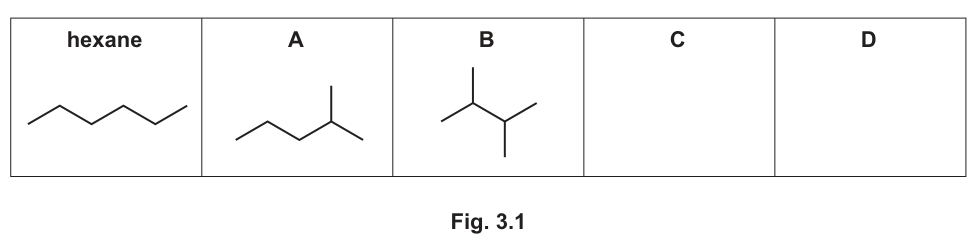
Complete Fig. 3.1 by drawing structures for C and D, the other two structural isomers of hexane.
Answer
C: 3-methylpentane
D: 2,2-dimethylbutane
C: 3-methylpentane; D: 2,2-dimethylbutane (structures drawn below)
Background Concept
Structural isomers are molecules with the same molecular formula but different structural formulae. For hexane (), there are five structural isomers. The question provides three: hexane (straight chain), 2-methylpentane (A), and 2,3-dimethylbutane (B). We need to draw the remaining two: 3-methylpentane and 2,2-dimethylbutane.
Understanding the Question
Complete the table by drawing the skeletal structures for the missing isomers C and D.
Approach
List all five isomers of and identify the missing ones. Then draw their skeletal structures.
- Hexane (straight chain) - given.
- 2-Methylpentane - given as A.
- 3-Methylpentane - missing.
- 2,2-Dimethylbutane - missing.
- 2,3-Dimethylbutane - given as B.
Step-by-Step Reasoning
- Isomer C (3-methylpentane): A 5-carbon chain with a methyl group on the 3rd carbon. Skeletal: a zigzag of 5 carbons with a branch on the middle carbon.
- Isomer D (2,2-dimethylbutane): A 4-carbon chain with two methyl groups on the 2nd carbon. Skeletal: a zigzag of 4 carbons with two branches on the second vertex.
Key Takeaways
When drawing isomers, systematically vary the main chain length and branch position. For , main chain can be 6, 5, or 4 carbons.
Common Mistakes
- Drawing 2-ethylbutane (this is actually 3-methylpentane; the longest chain must be identified correctly).
- Drawing structures with 5 or 7 carbons (counting vertices/ends incorrectly).
- Not using skeletal formula correctly (vertices and ends represent carbons).
Things to Be Careful About
Ensure the total number of carbons is 6. In skeletal formulas, every end of a line and every vertex is a carbon atom. Hydrogens are implied.
A, B and hexane have different boiling points.
Arrange A, B and hexane in order of increasing boiling point.
Explain your answer.
lowest .................................... < .................................... < .................................... highest
Answer
Order: B < A < hexane
Explanation:
- Hexane is unbranched, while A and B are branched.
- The unbranched hexane molecules have a larger surface area for contact.
- This leads to stronger London dispersion forces (van der Waals forces) between hexane molecules.
- More energy is required to overcome these stronger intermolecular forces, resulting in a higher boiling point.
B < A < hexane
Background Concept
Boiling point in covalent molecular substances is determined by the strength of intermolecular forces (IMFs). For alkanes, the only IMFs are London dispersion forces (a type of van der Waals force). The strength of these forces depends on the surface area of the molecule and its polarizability.
Understanding the Question
Arrange A (2-methylpentane), B (2,3-dimethylbutane), and hexane in order of increasing boiling point and explain why.
Approach
- Recall that increased branching makes molecules more compact/spherical.
- Compact molecules have less surface area for contact.
- Less surface area -> weaker London dispersion forces -> lower boiling point.
- Order by degree of branching: hexane (0 branches) < A (1 branch) < B (2 branches).
Step-by-Step Reasoning
- Hexane: Straight chain. Maximum surface area. Strongest IMFs. Highest boiling point (69 °C).
- A (2-methylpentane): One branch. Less surface area than hexane. Weaker IMFs. Intermediate boiling point (60 °C).
- B (2,3-dimethylbutane): Two branches. Most compact/spherical shape. Lowest surface area. Weakest IMFs. Lowest boiling point (58 °C).
- Explanation: As branching increases, the molecule becomes more compact, reducing the surface area available for intermolecular contact. This weakens the London dispersion forces, so less thermal energy is needed to separate the molecules.
Key Takeaways
More branching = more compact = less surface area = weaker van der Waals forces = lower boiling point.
Common Mistakes
- Ordering them incorrectly (e.g., thinking more branching = higher BP).
- Saying 'hydrogen bonding' (alkanes don't have H-bonding).
- Not mentioning 'surface area' or 'contact' (just saying 'branched' isn't enough explanation).
Things to Be Careful About
The mark scheme requires the order B < A < hexane and the explanation linking branching to surface area/IMFs/energy.
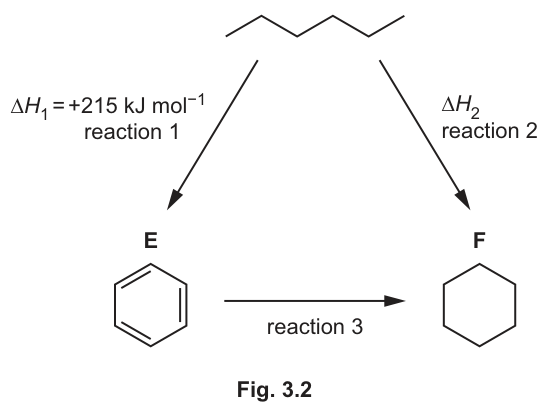
Hexane can be converted into compounds E and F at high temperature and pressure. Fig. 3.2 shows the reaction scheme involving hexane, E and F.
Answer
Hydrogen () (with a nickel catalyst)
H2 (g)
Background Concept
Reaction 3 converts benzene (E) to cyclohexane (F). This is an addition reaction where hydrogen is added across the double bonds (delocalized system) of benzene. This is catalytic hydrogenation.
Understanding the Question
Identify a suitable reagent for reaction 3 (benzene -> cyclohexane).
Approach
Benzene to cyclohexane requires adding 3 molecules of . The reagent is hydrogen gas. A catalyst (like Ni, Pt, or Pd) is required, though the mark scheme focuses on the reagent .
Step-by-Step Reasoning
- Benzene () + 3 -> Cyclohexane ().
- Reagent: Hydrogen gas ().
- Condition: Nickel catalyst (or Pt/Pd), heat, pressure.
- The mark scheme accepts 'H2' or 'hydrogen'.
Key Takeaways
Hydrogenation of alkenes/aromatics uses with a metal catalyst.
Common Mistakes
- Saying 'water' or 'HCl' (addition of HX or H2O gives different products).
- Forgetting the catalyst (though mark scheme is lenient, it's chemically necessary).
Things to Be Careful About
The mark scheme specifically says 'H2 ((g)) OR hydrogen (gas)'. Just writing 'H2' is sufficient.
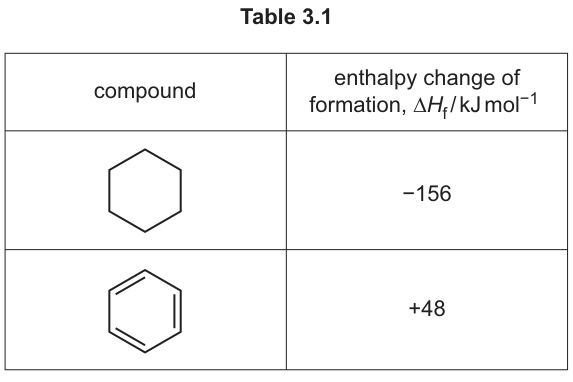
Use the data in Fig. 3.2 and in Table 3.1 to calculate the enthalpy change of reaction 2, .
Working
Using Hess's law cycle:
Where is the enthalpy change for reaction 3 (benzene to cyclohexane):
Alternatively, using the cycle directly from the diagram:
Answer
+11
Background Concept
Hess's Law states that the total enthalpy change for a reaction is independent of the route taken. We can use known enthalpy changes to calculate unknown ones.
Understanding the Question
Calculate (hexane -> cyclohexane) using (hexane -> benzene) and the formation enthalpies of benzene and cyclohexane.
Approach
Construct a cycle:
Route 1: Hexane -> Cyclohexane ()
Route 2: Hexane -> Benzene () -> Cyclohexane ()
So .
We know .
Step-by-Step Reasoning
- Identify the cycle: Hexane -> E -> F is equivalent to Hexane -> F.
- .
- .
- Calculate using formation data: kJ mol⁻¹.
- Calculate kJ mol⁻¹.
- Mark scheme formula: .
Key Takeaways
Hess's law cycles allow calculation of unknown enthalpies. Remember .
Common Mistakes
- Wrong sign in calculation (e.g., ).
- Forgetting that is products minus reactants.
- Arithmetic errors.
Things to Be Careful About
Pay attention to signs. for benzene is positive (+48). The mark scheme shows the calculation .
Answer
(or )
C6H14 + 9.5O2 -> 6CO2 + 7H2O
Background Concept
Complete combustion of a hydrocarbon produces carbon dioxide and water. The general equation is .
Understanding the Question
Write the equation for complete combustion of hexane ().
Approach
Balance C, then H, then O.
- C: 6 on left -> 6 .
- H: 14 on left -> 7 .
- O: Right side has oxygen atoms. So we need molecules.
Step-by-Step Reasoning
Multiply by 2 to remove fractions (optional but good practice):
The mark scheme accepts the fractional coefficient.
Key Takeaways
For combustion, balance C first, then H, then O. Fractional is allowed for 1 mole of fuel.
Common Mistakes
- Producing CO instead of (incomplete combustion).
- Unbalanced oxygen count.
- Wrong formula for hexane.
Things to Be Careful About
State symbols are not explicitly required in the mark scheme for this part, but it's good practice. The mark scheme shows: .
Fig. 4.1 shows how propane, , can be converted to propanoic acid, .

Reaction 1 in Fig. 4.1 takes place in the presence of sunlight.
The reaction takes place via initiation, propagation and termination steps.
Answer
free-radical substitution
free-radical substitution
Background Concept
Free-radical substitution is the characteristic reaction of alkanes with halogens (Cl₂ or Br₂) in the presence of ultraviolet light or sunlight. The UV radiation provides enough energy to break the halogen–halogen bond homolytically, generating halogen radicals that then attack the relatively unreactive C–H bonds of the alkane. The mechanism proceeds through three stages: initiation (radical formation), propagation (chain-carrying steps that regenerate radicals), and termination (radical combination).
Understanding the Question
The question states that reaction 1 converts propane to 1-chloropropane using Cl₂ in the presence of sunlight, and explicitly mentions initiation, propagation, and termination steps. The command word is "Name" — the answer is simply the mechanism type.
Approach
Recognise the combination of an alkane + halogen + UV/sunlight as the hallmark of free-radical substitution. The mention of initiation/propagation/termination confirms this.
Step-by-Step Reasoning
- The substrate is propane (an alkane), which is relatively unreactive toward ionic reagents.
- The reagent is Cl₂ and the condition is sunlight (UV radiation).
- This combination is diagnostic of free-radical substitution — the only common mechanism by which alkanes react with halogens.
- The three-stage description (initiation, propagation, termination) is the standard description of the free-radical chain mechanism.
Key Takeaways
- Alkanes + halogen + UV/sunlight → free-radical substitution.
- The three stages (initiation, propagation, termination) are characteristic of chain mechanisms.
Common Mistakes
- Writing "substitution" alone without "free-radical" — the mechanism type must be specified.
- Confusing with electrophilic addition (which applies to alkenes, not alkanes).
Things to Be Careful About
- The full name "free-radical substitution" is required; just "radical substitution" or "substitution" may not gain the mark.
Complete the mechanism for reaction 1.
Construct equations to describe the steps of the mechanism.
Answer
Propagation 1:
Propagation 2:
Termination:
Propagation 1: C₃H₈ + Cl• → CH₃CH₂CH₂• + HCl; Propagation 2: CH₃CH₂CH₂• + Cl₂ → CH₃CH₂CH₂Cl + Cl•; Termination: CH₃CH₂CH₂• + Cl• → CH₃CH₂CH₂Cl
Background Concept
The free-radical chain mechanism for halogenation of alkanes consists of three types of step:
- Initiation: Homolytic fission of the halogen molecule (Cl₂ → 2Cl•) produces the first radicals.
- Propagation: Two steps that sustain the chain. In the first, a halogen radical abstracts a hydrogen atom from the alkane, forming an alkyl radical and HX. In the second, the alkyl radical reacts with another halogen molecule, forming the haloalkane product and regenerating a halogen radical.
- Termination: Two radicals combine to form a stable molecule, ending the chain. Various combinations are possible (alkyl + alkyl, alkyl + halogen, halogen + halogen).
The key feature is that propagation steps regenerate a radical, so the chain continues; termination steps consume radicals without regenerating them.
Understanding the Question
The initiation step is already given (Cl₂ → 2Cl•). The question asks for the two propagation steps and one specific termination step (the one that produces CH₃CH₂CH₂Cl). Each step must be a balanced equation with correct radical species shown by the dot (•).
Approach
- Propagation 1: Cl• attacks C₃H₈, abstracts a hydrogen to give HCl and a propyl radical.
- Propagation 2: The propyl radical attacks Cl₂ to give the product (1-chloropropane) and regenerate Cl•.
- Termination: The question specifies the product is CH₃CH₂CH₂Cl, so the two radicals that combine must be CH₃CH₂CH₂• and Cl•.
Step-by-Step Reasoning
Propagation 1 (M1):
- Cl• is a radical with one unpaired electron.
- It abstracts a hydrogen atom from propane: C₃H₈ + Cl• → C₃H₇• + HCl.
- To show the specific radical formed (since the product is 1-chloropropane), write CH₃CH₂CH₂• rather than the generic C₃H₇•.
- Both forms are accepted by the mark scheme.
Propagation 2 (M2):
- The propyl radical CH₃CH₂CH₂• attacks a Cl₂ molecule.
- One Cl atom bonds to the carbon (forming the product), the other becomes a new Cl• radical.
- CH₃CH₂CH₂• + Cl₂ → CH₃CH₂CH₂Cl + Cl•.
- This regenerates the chlorine radical, allowing the chain to continue.
Termination (M3):
- The question gives the product as CH₃CH₂CH₂Cl.
- This must form from the combination of CH₃CH₂CH₂• and Cl•.
- CH₃CH₂CH₂• + Cl• → CH₃CH₂CH₂Cl.
- No other radicals are produced; the chain ends.
Key Takeaways
- Propagation steps always consume one radical and produce one radical (chain-carrying).
- Termination steps consume two radicals and produce a stable molecule.
- The dot (•) must be shown on radical species.
Common Mistakes
- Omitting the radical dot (•) on species like Cl• or CH₃CH₂CH₂•.
- Writing ionic equations or curly-arrow notation (this is a radical mechanism, not ionic).
- In the termination step, writing Cl• + Cl• → Cl₂ (which is a valid termination but does not produce the specified product).
- Writing the propagation steps in the wrong order.
Things to Be Careful About
- The mark scheme accepts C₃H₇• as an alternative to CH₃CH₂CH₂• in propagation 1 and 2.
- State symbols are not required for radical equations.
- The equations must be balanced in terms of atoms and the radical dot must appear.
Reaction 1 is initiated by the bond fission of .
State the type of bond fission shown in the initiation step.
Answer
homolytic
homolytic
Background Concept
Bond fission (bond breaking) can occur in two ways:
- Homolytic fission: The bonding pair of electrons is split equally, one electron going to each atom. This produces two radicals (species with unpaired electrons). It is favoured by non-polar bonds and UV radiation.
- Heterolytic fission: The bonding pair goes entirely to one atom, producing a cation and an anion. It is favoured by polar bonds and occurs in ionic/polar reactions.
Understanding the Question
The initiation step is Cl₂ → 2Cl•. Each chlorine atom receives one electron from the shared pair, producing two chlorine radicals. The question asks for the type of fission.
Approach
Since the products are radicals (each with one unpaired electron), the fission must be homolytic.
Step-by-Step Reasoning
- Cl₂ has a single covalent bond (one shared pair of electrons).
- In the initiation step, this bond breaks to give 2Cl• — two species each with one unpaired electron.
- Equal splitting of the bonding pair = homolytic fission.
- If it were heterolytic, we would get Cl⁺ and Cl (ions), not radicals.
Key Takeaways
- Radicals produced = homolytic fission.
- Ions produced = heterolytic fission.
- UV light is the typical energy source for homolytic fission.
Common Mistakes
- Writing "homolytic bond fission" is acceptable, but writing just "bond fission" without specifying the type earns no mark.
- Confusing with heterolytic fission (which produces ions).
Things to Be Careful About
- The spelling must be correct: "homolytic" (not "homolitic" or "homolytic fission" when only the adjective is asked for).
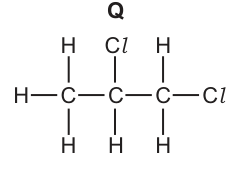
Answer
1,2-dichloropropane
1,2-dichloropropane
Background Concept
Naming halogenoalkanes follows IUPAC rules: identify the longest carbon chain (propane = 3 carbons), number the chain from the end nearest the first substituent, and list the halogen substituents with their position numbers in alphabetical/numerical order.
Understanding the Question
The displayed formula of Q shows a three-carbon chain. Looking at the structure: the first carbon (CH₃) has three H atoms, the second carbon (CHCl) has one H and one Cl, and the third carbon (CH₂Cl) has two H and one Cl. So chlorine atoms are on carbons 1 and 2 (numbering from the right end to give the lowest locants).
Approach
- Identify the parent chain: 3 carbons → propane.
- Identify substituents: two chlorine atoms.
- Number to give lowest locants: Cl on C1 and C2.
- Name: 1,2-dichloropropane.
Step-by-Step Reasoning
- The displayed formula shows: H₃C–CHCl–CH₂Cl (reading left to right as drawn).
- Numbering from the right gives Cl at positions 1 and 2 (lowest set of locants).
- Two Cl substituents → "dichloro".
- Full name: 1,2-dichloropropane.
- This is a by-product of the free-radical substitution of propane with Cl₂ — a second chlorine has been substituted onto the molecule.
Key Takeaways
- By-products of free-radical substitution include polyhalogenated compounds.
- Always number from the end giving the lowest locant set.
Common Mistakes
- Naming it "2,3-dichloropropane" (numbering from the wrong end — gives higher locants).
- Writing "1,2-dichloropropane" as "dichloropropane" without position numbers.
Things to Be Careful About
- The comma between numbers and the hyphen between the number and the name are required in IUPAC nomenclature.
The molecular formula of Q is .
Identify the types of structural isomerism and stereoisomerism that a molecule with molecular formula can show.
type of structural isomerism ..............................................................................................
type of stereoisomerism ....................................................................................................
Answer
type of structural isomerism: positional isomerism
type of stereoisomerism: optical isomerism
positional isomerism; optical isomerism
Background Concept
Structural isomerism occurs when compounds have the same molecular formula but different structural formulae (different connectivity). Types include:
- Chain isomerism (different carbon skeleton)
- Positional isomerism (same functional group in different positions)
- Functional group isomerism (different functional groups)
Stereoisomerism occurs when compounds have the same structural formula but different spatial arrangement:
- Geometric (cis/trans or E/Z) isomerism — requires restricted rotation (C=C or ring)
- Optical isomerism — requires a chiral centre (carbon with four different groups)
Understanding the Question
The molecular formula C₃H₆Cl₂ can give rise to several structural isomers (1,1-dichloropropane, 1,2-dichloropropane, 1,3-dichloropropane, 2,2-dichloropropane). The question asks what TYPE of structural isomerism exists between these, and what TYPE of stereoisomerism is possible.
Approach
- For structural isomerism: All isomers have the same carbon chain (propane) and the same functional group (two Cl atoms), but the Cl atoms are at different positions → positional isomerism.
- For stereoisomerism: Check if any isomer has a chiral centre. In 1,2-dichloropropane, the C2 carbon is bonded to H, Cl, CH₃, and CH₂Cl — four different groups → chiral centre → optical isomerism.
- There is no C=C double bond or ring, so geometric isomerism is impossible.
Step-by-Step Reasoning
Structural isomerism (M1):
- Possible isomers of C₃H₆Cl₂: 1,1-; 1,2-; 1,3-; 2,2-dichloropropane.
- All have the same parent chain (propane) and same functional groups (2 × Cl).
- They differ only in the POSITION of the chlorine atoms on the chain.
- Therefore: positional isomerism.
Stereoisomerism (M2):
- Consider 1,2-dichloropropane: CH₃–CHCl–CH₂Cl.
- The central carbon (C2) is bonded to: H, Cl, CH₃, CH₂Cl — four different groups.
- This is a chiral (asymmetric) carbon → the molecule exists as a pair of enantiomers.
- Therefore: optical isomerism.
- No C=C bond or ring present, so geometric (cis/trans) isomerism is not possible.
Key Takeaways
- Positional isomerism: same skeleton and functional group, different position of substituent.
- Optical isomerism requires a chiral centre (carbon with four different groups).
- Always check for chirality in molecules with multiple different substituents on the same carbon.
Common Mistakes
- Writing "chain isomerism" — the carbon skeleton is always propane (3 carbons cannot have chain isomers).
- Writing "geometric isomerism" or "cis/trans" — there is no C=C bond or ring in C₃H₆Cl₂.
- Writing "functional group isomerism" — all isomers have the same functional groups (halogenoalkanes).
Things to Be Careful About
- The question asks for the TYPE of isomerism, not to draw or name specific isomers.
- Both answers must be given for the two marks.
Answer
sodium hydroxide and water
sodium hydroxide and water
Background Concept
The conversion of a halogenoalkane to an alcohol is a nucleophilic substitution reaction. The hydroxide ion (OH⁻) acts as the nucleophile, attacking the electron-deficient carbon bonded to the halogen. The C–X bond breaks heterolytically, and the halide ion leaves. For this to work effectively, the OH⁻ must be in aqueous solution (water as solvent) to favour substitution over elimination. If ethanolic NaOH is used instead, elimination predominates, giving an alkene.
Understanding the Question
Reaction 2 converts CH₃CH₂CH₂Cl (a halogenoalkane) to CH₃CH₂CH₂OH (an alcohol). The question asks for both the reagent AND the solvent.
Approach
The standard reagent for nucleophilic substitution (hydrolysis) of a halogenoalkane is aqueous sodium hydroxide. The mark scheme requires both "sodium hydroxide" AND "water" to be stated.
Step-by-Step Reasoning
- The transformation is: halogenoalkane → alcohol (substitution of Cl by OH).
- The nucleophile needed is OH⁻.
- The source of OH⁻ is sodium hydroxide (NaOH).
- The solvent must be water (aqueous) to favour substitution.
- If ethanol were the solvent, elimination would compete, so water must be specified.
- Answer: sodium hydroxide AND water.
Key Takeaways
- Aqueous NaOH → nucleophilic substitution (alcohol product).
- Ethanolic NaOH → elimination (alkene product).
- Both reagent and solvent must be named for the mark.
Common Mistakes
- Writing only "NaOH" without specifying water as the solvent — this loses the mark.
- Writing "aqueous KOH" — while KOH would also work, the mark scheme specifically requires NaOH and water.
- Writing "ethanol" as the solvent (this would give elimination, not substitution).
Things to Be Careful About
- The mark scheme requires BOTH "sodium hydroxide" AND "water" — omitting either loses the mark.
Reaction 3 takes place when is heated under reflux with acidified potassium dichromate(VI) solution.
Answer
orange to green
orange to green
Background Concept
Acidified potassium dichromate(VI), K₂Cr₂O₇/H⁺, is a common oxidising agent in organic chemistry. The dichromate ion (Cr₂O₇²⁻) contains chromium in the +6 oxidation state and is orange. When it acts as an oxidising agent, it is reduced to Cr³⁺ ions, which are green in aqueous solution. This colour change (orange → green) is the visual indicator that oxidation has occurred.
Understanding the Question
Propan-1-ol (a primary alcohol) is being oxidised to propanoic acid using acidified K₂Cr₂O₇. The question asks for the colour change observed.
Approach
Recall that Cr(VI) is orange and Cr(III) is green. Since the dichromate is being reduced (it is the oxidising agent), the solution changes from orange to green.
Step-by-Step Reasoning
- Cr₂O₇²⁻ (dichromate, Cr in +6 state) → orange.
- On reduction: Cr³⁺ (chromium(III) ions) → green.
- The alcohol is oxidised; the dichromate is reduced.
- Colour change: orange to green.
Key Takeaways
- Acidified K₂Cr₂O₇: orange (Cr⁶⁺) → green (Cr³⁺) on reduction.
- This is the standard test for primary/secondary alcohols (and aldehydes).
Common Mistakes
- Writing "green to orange" (reversed direction).
- Confusing with acidified KMnO₄, which goes from purple to colourless.
- Writing "orange to colourless" (incorrect for dichromate).
Things to Be Careful About
- Both colours must be stated for the mark. "Orange to green" is the required answer.
Construct an equation to represent reaction 3. Use [O] to represent an atom of oxygen from the oxidising agent.
Answer
CH₃CH₂CH₂OH + 2[O] → CH₃CH₂COOH + H₂O
Background Concept
The oxidation of a primary alcohol to a carboxylic acid proceeds via an aldehyde intermediate. Using [O] to represent one atom of oxygen from the oxidising agent, the overall conversion requires two oxygen atoms: one to form the C=O of the aldehyde (losing 2H), and one to add an –OH to the carbonyl carbon (converting aldehyde to acid). A water molecule is produced as a by-product.
General pattern: RCH₂OH + 2[O] → RCOOH + H₂O
Understanding the Question
The question asks for an equation representing reaction 3 (propan-1-ol → propanoic acid) using [O] notation. The equation must be balanced.
Approach
- Write the reactant: CH₃CH₂CH₂OH.
- Write the product: CH₃CH₂COOH.
- Determine how many [O] atoms are needed by checking the atom balance.
- Include H₂O as a by-product to balance hydrogen and oxygen.
Step-by-Step Reasoning
- Reactant: CH₃CH₂CH₂OH (C₃H₈O)
- Product: CH₃CH₂COOH (C₃H₆O₂)
- Difference: product has 2 more O and 2 fewer H than reactant.
- Adding 2[O] provides the 2 extra oxygen atoms.
- The 2 lost H atoms combine with one of the added O atoms to form H₂O.
- Check: Left side = C₃H₈O + 2O = C₃H₈O₃. Right side = C₃H₆O₂ + H₂O = C₃H₈O. ✓
- Balanced equation: CH₃CH₂CH₂OH + 2[O] → CH₃CH₂COOH + H₂O.
Key Takeaways
- Primary alcohol → carboxylic acid requires 2[O] and produces H₂O.
- Primary alcohol → aldehyde requires only 1[O] and produces H₂O.
- Always check atom balance (C, H, O) on both sides.
Common Mistakes
- Writing only 1[O] (this would give the aldehyde, not the acid).
- Omitting H₂O from the products.
- Writing the molecular formula of the oxidising agent instead of [O] (the question specifies to use [O]).
Things to Be Careful About
- The question explicitly says to use [O], not the full formula of K₂Cr₂O₇ or any other oxidant.
- The equation must be balanced.
reacts with an unsaturated alcohol R to form unsaturated ester S.
Answer
condensation
condensation
Background Concept
When a carboxylic acid reacts with an alcohol to form an ester and water, the reaction is called esterification. In terms of reaction type, it is a condensation reaction because two molecules combine with the elimination of a small molecule (water). The reverse reaction (ester + water → acid + alcohol) is hydrolysis.
Understanding the Question
CH₃CH₂COOH (a carboxylic acid) reacts with an unsaturated alcohol R to form unsaturated ester S. The question asks for the type of reaction.
Approach
Carboxylic acid + alcohol → ester + water is a condensation reaction (also called esterification). The mark scheme accepts "condensation".
Step-by-Step Reasoning
- The reactants are a carboxylic acid and an alcohol.
- The product is an ester (plus water, eliminated).
- Two molecules join together with loss of a small molecule (H₂O) → condensation.
- This is also specifically called esterification, but "condensation" is the reaction type.
Key Takeaways
- Esterification is a type of condensation reaction.
- "Condensation" and "esterification" are both acceptable descriptions, but the mark scheme specifies "condensation".
Common Mistakes
- Writing "addition" (this is not addition — a small molecule is lost).
- Writing "substitution" (while mechanistically it involves substitution at the carbonyl carbon, the overall reaction type is condensation).
- Writing "hydrolysis" (that is the reverse reaction).
Things to Be Careful About
- The mark scheme requires "condensation" specifically.
The infrared spectrum of S is shown in Fig. 4.2.
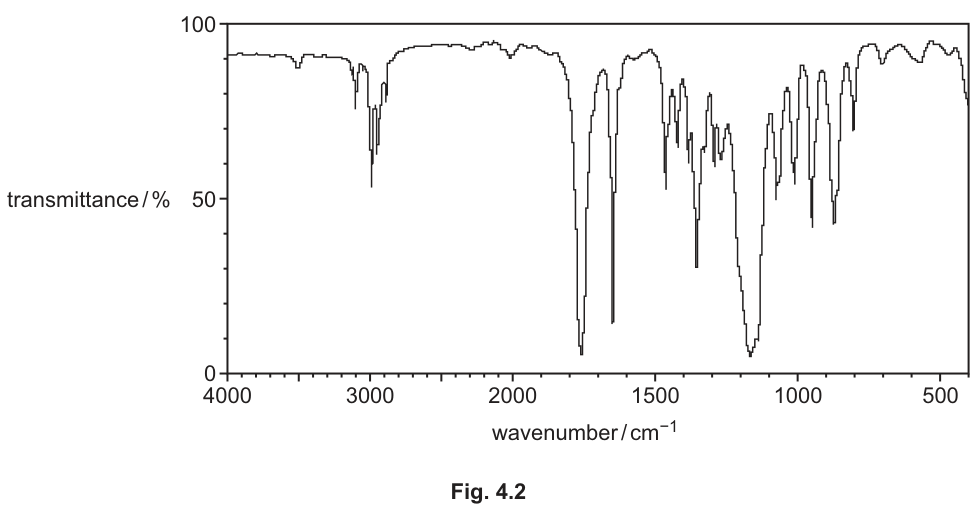
Three absorptions in the infrared spectrum in Fig. 4.2 confirm that S is an ester and is unsaturated.
- Write 1, 2 or 3 on Fig. 4.2 against each of these three absorptions.
- Complete Table 4.1 to show which bond is responsible for each absorption that you have identified in Fig. 4.2.
Table 4.1
| absorption | 1 | 2 | 3 |
|---|---|---|---|
| bond responsible |
Table 4.2
| bond | functional groups containing the bond | characteristic infrared absorption range (in wavenumbers) / |
|---|---|---|
| C–O | hydroxy, ester | 1040–1300 |
| C=C | aromatic compound, alkene | 1500–1680 |
| C=O | amide carbonyl, carboxyl ester | 1640–1690 1670–1740 1710–1750 |
| CN | nitrile | 2200–2250 |
| C–H | alkane | 2850–2950 |
| N–H | amine, amide | 3300–3500 |
| O–H | carboxyl hydroxy | 2500–3000 3200–3650 |
Answer
| absorption | 1 | 2 | 3 |
|---|---|---|---|
| bond responsible | C=O | C=C | C–O |
- Absorption 1 at approximately : C=O (ester carbonyl)
- Absorption 2 at approximately : C=C (alkene)
- Absorption 3 at approximately : C–O (ester)
1: C=O; 2: C=C; 3: C–O
Background Concept
Infrared spectroscopy identifies functional groups by the characteristic wavenumber at which bonds absorb. Each bond type has a specific range:
- C=O (ester): 1710–1750 cm⁻¹ — strong, sharp absorption
- C=C (alkene): 1500–1680 cm⁻¹ — moderate absorption
- C–O (ester): 1040–1300 cm⁻¹ — strong absorption
The question states that three absorptions confirm S is an ester AND unsaturated. An ester requires C=O and C–O absorptions. Unsaturation (C=C) requires a C=C absorption. Together, these three confirm both features.
Understanding the Question
The IR spectrum of S shows several peaks. Three of them, when identified, prove that S is an ester and is unsaturated. The student must label these three peaks (1, 2, 3) on the spectrum and state the bond responsible for each.
From the spectrum (Fig. 4.2), the key absorptions are at approximately:
- ~1750 cm⁻¹ (strong peak)
- ~1650 cm⁻¹ (moderate peak)
- ~1170 cm⁻¹ (strong peak)
Approach
- Use the reference table (Table 4.2) to match wavenumber ranges to bonds.
- Identify which bonds are needed to confirm "ester" (C=O and C–O) and "unsaturated" (C=C).
- Label the three peaks and fill in the table.
Step-by-Step Reasoning
Absorption 1 (~1750 cm⁻¹) → C=O:
- The table shows ester C=O absorbs at 1710–1750 cm⁻¹.
- This strong peak confirms the ester carbonyl group.
Absorption 2 (~1650 cm⁻¹) → C=C:
- The table shows alkene C=C absorbs at 1500–1680 cm⁻¹.
- This peak confirms the presence of a carbon–carbon double bond (unsaturation).
Absorption 3 (~1170 cm⁻¹) → C–O:
- The table shows ester C–O absorbs at 1040–1300 cm⁻¹.
- This peak, combined with the C=O peak, confirms the ester functional group specifically (rather than just a carbonyl compound).
Key Takeaways
- An ester is confirmed by BOTH C=O (~1710–1750) and C–O (~1040–1300) absorptions.
- Unsaturation (alkene) is confirmed by C=C (~1500–1680).
- The combination of all three proves the molecule is an unsaturated ester.
Common Mistakes
- Identifying the ~1650 peak as C=O (it is too low for ester C=O; it matches C=C).
- Omitting the C–O peak (needed to distinguish ester from ketone/aldehyde).
- Labelling the ~3000 cm⁻¹ peak (this is C–H, which does not specifically confirm ester or unsaturation).
- Writing "carbonyl" instead of "C=O" — the bond must be specified.
Things to Be Careful About
- The exact wavenumber reading from the spectrum may vary slightly; the key is matching to the correct range in the table.
- The label numbers (1, 2, 3) must be placed on the correct peaks in the figure.
The mass spectrum of S shows the following peaks.
Table 4.3
| peak | relative abundance |
|---|---|
| 4.7 | |
| 0.31 |
Use Table 4.3 to calculate the number of carbon atoms in S.
number of carbon atoms in S = ...................................................................................
Working
The [M+1] peak arises from molecules containing one atom. The natural abundance of is 1.1%.
Answer
number of carbon atoms in S = 6
6
Background Concept
In mass spectrometry, the molecular ion peak (M⁺) corresponds to molecules containing all the most abundant isotopes (all ¹²C). The [M+1]⁺ peak arises from molecules that happen to contain one ¹³C atom instead of ¹²C. Since ¹³C has a natural abundance of approximately 1.1% relative to ¹²C, the ratio of the [M+1] peak to the M peak is approximately 1.1n%, where n is the number of carbon atoms in the molecule.
Therefore: number of carbon atoms = ([M+1]/M) × (100/1.1)
Understanding the Question
Given: M⁺ relative abundance = 4.7, [M+1]⁺ relative abundance = 0.31. Calculate the number of carbon atoms in S.
Approach
Apply the formula: n = ([M+1]/M) × (100/1.1)
Step-by-Step Reasoning
- The ratio [M+1]/M = 0.31/4.7 = 0.06596 (as a fraction).
- Convert to percentage: 0.06596 × 100 = 6.596%.
- Divide by 1.1% (the natural abundance of ¹³C): 6.596/1.1 = 5.996 ≈ 6.
- Therefore, S contains 6 carbon atoms.
This is consistent with the structure: propanoic acid contributes 3 carbons, and the unsaturated alcohol R must contribute 3 more carbons (e.g., prop-2-en-1-ol, CH₂=CHCH₂OH) to give a 6-carbon ester.
Key Takeaways
- [M+1]/M ratio × (100/1.1) = number of carbon atoms.
- The 1.1% figure is the natural abundance of ¹³C and is given in the syllabus data booklet.
- This technique is useful for determining molecular formula from mass spectra.
Common Mistakes
- Forgetting to multiply by 100 (i.e., not converting the fraction to a percentage before dividing by 1.1).
- Dividing by 1.1 instead of multiplying by 100/1.1.
- Using 1.1 as a percentage directly without the 100 factor: 0.31/4.7/1.1 = 0.06 (wrong).
Things to Be Careful About
- The answer must be a whole number (number of atoms cannot be fractional). If the calculation gives 5.9 or 6.1, round to 6.
- The 1.1% value is from the data booklet; do not use a different value.