Chemistry 9701/12 — October/November 2025
Cambridge AS Level · Multiple Choice (AS Level) · answer key with instant marking and worked solutions
Topics Atoms, Molecules and Stoichiometry · Atomic Structure · Electrochemistry · Hydroxy Compounds · Chemical Periodicity · Introduction to Organic Chemistry · +16 more
Tap an option under each question to check it — your score builds as you go.
What is the electrons in boxes notation for the ion?
Options
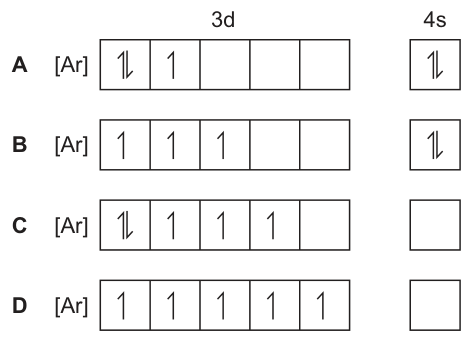
Working
Iron (Fe) has atomic number 26. The electron configuration of a neutral Fe atom is .
To form the ion, 3 electrons are removed. Transition metals lose their 4s electrons before their 3d electrons.
- Remove 2 electrons from the 4s subshell: .
- Remove 1 electron from the 3d subshell: .
The electron configuration of is .
By Hund's rule, the five 3d electrons will occupy each of the five 3d orbitals singly with parallel spins before pairing. The 4s orbital is empty.
This corresponds to Option D.
D
Background Concept
The electron configuration of transition metals and their ions depends on the filling order of orbitals and the order of electron removal. For neutral atoms, the 4s orbital fills before the 3d orbital (e.g., ). However, when transition metals form positive ions, electrons are removed from the 4s orbital before the 3d orbital, because in the ion, the 3d orbitals are lower in energy than the 4s orbital.
Hund's rule states that electrons will fill degenerate orbitals (orbitals of the same energy, like the five 3d orbitals) singly with parallel spins before they pair up. This minimises electron-electron repulsion and results in the most stable arrangement.
Understanding the Question
The question asks to identify the correct electrons-in-boxes (orbital diagram) notation for the ion. We are given four options showing the arrangement of electrons in the 3d and 4s orbitals after the core. We need to determine the correct number of electrons in each subshell and their correct arrangement according to Hund's rule.
Approach
- Determine the atomic number of iron and write the electron configuration of the neutral atom.
- Determine the number of electrons removed to form the ion and remove them in the correct order (4s first, then 3d).
- Write the resulting electron configuration for .
- Apply Hund's rule to distribute the 3d electrons among the five 3d boxes.
- Match the result with the given options.
Step-by-Step Reasoning
- Neutral Iron Atom: Iron (Fe) has a proton number of 26. The noble gas core is Argon (), which accounts for 18 electrons. The remaining 8 electrons fill the 4s and 3d subshells. The neutral atom configuration is .
- Forming : The ion has a charge of +3, meaning it has lost 3 electrons. Transition metals lose their 4s electrons before their 3d electrons.
- Remove 2 electrons from the 4s subshell: .
- Remove 1 electron from the 3d subshell: .
- The configuration of is .
- Electron Arrangement (Hund's Rule): The 3d subshell has five degenerate orbitals (boxes). There are 5 electrons to place in these 5 orbitals. According to Hund's rule, each orbital will receive one electron before any pairing occurs. Thus, all five 3d boxes will contain one electron (all with the same spin, typically represented as up arrows). The 4s box will be empty.
- Evaluating Options:
- Option A: Shows 3 electrons in 3d and 2 in 4s. Incorrect configuration.
- Option B: Shows 3 electrons in 3d and 2 in 4s. Incorrect configuration.
- Option C: Shows 5 electrons in 3d but one pair and three singles. This violates Hund's rule, which requires maximum unpaired electrons in degenerate orbitals.
- Option D: Shows 5 electrons in 3d, all unpaired (one in each box), and the 4s box is empty. This matches our derived configuration and correctly applies Hund's rule.
Key Takeaways
- Transition metals lose 4s electrons before 3d electrons when forming cations.
- Hund's rule must be applied when drawing orbital diagrams for partially filled degenerate subshells (like d or f orbitals) to ensure maximum multiplicity (unpaired electrons).
- The electrons-in-boxes notation visually represents the quantum mechanical filling rules (Aufbau, Pauli exclusion, and Hund's rule).
Common Mistakes
- Removing 3d electrons first: A common mistake is to remove electrons from the 3d subshell before the 4s subshell when forming ions, leading to an incorrect configuration like .
- Violating Hund's rule: Option C is a distractor that shows the correct number of electrons (5 in 3d, 0 in 4s) but pairs them up prematurely. Students might forget Hund's rule and just fill the first box with a pair.
- Confusing neutral atom and ion configurations: Forgetting that neutral Fe is and incorrectly assuming it is or similar.
Things to Be Careful About
- Always remove electrons from the highest principal quantum number () first. For transition metals, () is emptied before (), even though fills first in the neutral atom.
- Ensure the orbital diagram strictly follows Hund's rule: single electrons in all degenerate orbitals before any pairing. Arrows must be parallel (same direction) for unpaired electrons.
- Pay attention to the core notation: means the inner 18 electrons are not shown. Only the valence/outermost subshells (3d and 4s) need to be evaluated.
Which equation has an energy change that is equal to the first ionisation energy of bromine?
Options
A
B
C
D
Answer
A —
First ionisation energy is the energy required to remove one mole of electrons from one mole of gaseous atoms to form one mole of gaseous 1+ ions.
Option A shows exactly this: a gaseous bromine atom loses an electron to form a gaseous ion.
A
Background Concept
First ionisation energy is defined as the energy required to remove one mole of electrons from one mole of gaseous atoms to form one mole of gaseous singly positive ions. The three key features are: the starting material must be isolated gaseous atoms, one electron is removed per atom, and the product is a gaseous 1+ ion plus a free electron.
Understanding the Question
The question asks which of the four equations has an energy change equal to the first ionisation energy of bromine. We must check two things for each option: the starting state of bromine (must be a gaseous atom, not a molecule) and the direction of electron transfer (must be loss of an electron to form a +1 ion).
Approach
Test each option against the definition:
- Does it start from a gaseous bromine atom, Br(g)?
- Does it show loss of one electron to form a gaseous Br⁺ ion?
Only an option satisfying both conditions can represent the first ionisation energy.
Step-by-Step Reasoning
- First ionisation energy always starts from gaseous atoms — Br(g), never Br₂(g).
- It removes one electron to form a +1 ion, so the electron appears as a product.
- Option A: Br(g) → Br⁺(g) + e⁻ — starts from a gaseous atom and removes one electron to form a gaseous 1+ ion. This matches the definition exactly.
- Option B: Br(g) → Br⁻(g) − e⁻ — this shows formation of an anion by gaining an electron; that is electron affinity, not ionisation. The notation is also unusual.
- Option C: ½Br₂(g) → Br⁺(g) + e⁻ — starts from a bromine molecule, so the energy change includes the atomisation energy of Br₂ as well as the ionisation energy. It is not simply the first ionisation energy.
- Option D: ½Br₂(g) → Br⁻(g) − e⁻ — starts from a molecule and forms an anion; wrong on both counts.
Key Takeaways
- First ionisation energy ALWAYS starts from the gaseous atom and produces a gaseous 1+ ion plus a free electron.
- Do not confuse ionisation with atomisation (breaking a molecule into atoms) or with electron affinity (adding an electron to form a negative ion).
Common Mistakes
- Choosing C or D because they involve Br₂ — but the definition requires the starting material to be the gaseous atom, not the molecule.
- Choosing B because it involves removing an electron — but B actually forms an anion, which is the reverse of ionisation.
Things to Be Careful About
- The state symbol (g) is essential; the definition specifically requires gaseous atoms.
- The electron must appear on the product side for ionisation; if it appears on the reactant side, the process is electron gain, not removal.
The reaction of hydrogen sulfide with sulfur dioxide gives sulfur as one of the products.
The two relevant redox equations are shown.
How many moles of hydrogen sulfide are needed to react with sulfur dioxide to produce of sulfur?
Options
A
B
C
D
Working
The two half-equations must involve the same number of electrons.
H₂S loses 2e⁻ per molecule; SO₂ gains 4e⁻ per molecule.
Multiply the H₂S half-equation by 2:
2H₂S(aq) ⇌ 2S(s) + 4H⁺(aq) + 4e⁻
Add this to the SO₂ half-equation:
2H₂S(aq) + SO₂(aq) + 4H⁺(aq) + 4e⁻ → 2S(s) + 4H⁺(aq) + 4e⁻ + S(s) + 2H₂O(l)
Cancel the 4H⁺ and 4e⁻ on both sides:
2H₂S(aq) + SO₂(aq) → 3S(s) + 2H₂O(l)
So 2 mol H₂S produce 3 mol S.
Therefore, 1 mol S requires 2/3 mol H₂S.
Answer
B (2/3 mol)
B
Background Concept
This question combines redox chemistry with stoichiometry. A redox reaction can be split into oxidation and reduction half-equations. Electrons lost in oxidation must equal electrons gained in reduction. Once the half-equations are combined, the balanced overall equation gives the mole ratio between reactants and products.
Understanding the Question
We are told that hydrogen sulfide reacts with sulfur dioxide to produce sulfur. Two half-equations are given:
- H₂S is oxidised: H₂S → S + 2H⁺ + 2e⁻
- SO₂ is reduced: SO₂ + 4H⁺ + 4e⁻ → S + 2H₂O
We need the moles of H₂S required to produce 1 mol of sulfur overall.
Approach
- Compare electrons: H₂S releases 2e⁻, SO₂ accepts 4e⁻.
- Multiply the H₂S half-equation by 2 so both involve 4e⁻.
- Add the half-equations and cancel H⁺ and e⁻ that appear on both sides.
- Read the mole ratio H₂S : S from the overall equation.
- Scale to 1 mol of S.
Step-by-Step Reasoning
-
Write the two half-equations:
- Oxidation: H₂S → S + 2H⁺ + 2e⁻
- Reduction: SO₂ + 4H⁺ + 4e⁻ → S + 2H₂O
-
Balance electrons: multiply the oxidation half-equation by 2:
2H₂S → 2S + 4H⁺ + 4e⁻ -
Add the two half-equations:
2H₂S + SO₂ + 4H⁺ + 4e⁻ → 2S + 4H⁺ + 4e⁻ + S + 2H₂O -
Cancel the 4H⁺ and 4e⁻ that appear on both sides:
2H₂S + SO₂ → 3S + 2H₂O -
The overall equation shows 2 mol H₂S produce 3 mol S.
So 1 mol S is produced by 2/3 mol H₂S.
Key Takeaways
- Always balance electrons before combining half-equations.
- The overall balanced equation is the source of mole ratios.
- Species appearing on both sides after addition, here H⁺ and e⁻, must be cancelled.
Common Mistakes
- Assuming a 1:1 ratio because both half-equations produce sulfur.
- Forgetting to multiply the H₂S half-equation by 2.
- Misreading the ratio: 2 mol H₂S : 3 mol S, not 3 mol H₂S : 2 mol S.
Things to Be Careful About
- Keep charges balanced in half-equations.
- Include state symbols if required.
- The question asks for moles needed to produce 1 mol of total sulfur, so use the overall ratio.
Which statement is correct?
Options
A The relative atomic mass of a atom is 35.5.
B The relative molecular mass of is 16.0.
C The relative formula mass of is 100.1.
D The relative isotopic mass of a atom is 24.3.
Working
A is incorrect: the relative atomic mass of a atom is 35, not 35.5. The value 35.5 is the relative atomic mass of naturally occurring chlorine, which is a weighted mean of and .
B is incorrect: the relative molecular mass of is , not 16.0.
C is correct: the relative formula mass of is .
D is incorrect: the relative isotopic mass of a atom is 24, not 24.3. The value 24.3 is the relative atomic mass of naturally occurring magnesium, which is a weighted mean of its isotopes.
Answer
C
C
Background Concept
Relative atomic mass () is the weighted mean mass of an atom of an element compared with one-twelfth of the mass of one atom of carbon-12. It is a weighted mean because it takes into account the natural abundance of each isotope of the element. For example, naturally occurring chlorine is about 75% and 25% , giving .
Relative isotopic mass is the mass of a specific isotope compared with one-twelfth of the mass of one atom of carbon-12. For a particular isotope, this is approximately equal to its mass number (nucleon number), e.g. has relative isotopic mass 35, and has relative isotopic mass 24.
Relative molecular mass () is the sum of the relative atomic masses of all the atoms in a molecule. Relative formula mass is the same concept applied to an ionic compound, where the formula unit is used instead of a molecule.
Understanding the Question
This is a one-mark multiple-choice question asking which of four statements about relative masses is correct. Each option refers to a different type of relative mass: relative atomic mass, relative molecular mass, relative formula mass, and relative isotopic mass. The key is to know the precise definition of each term and to apply it to the given species.
Approach
For each option, identify the type of relative mass being described and calculate or recall the correct value:
- For a specific isotope, the relative isotopic mass equals its mass number.
- For a molecule, sum the relative atomic masses of its constituent atoms.
- For an ionic compound, sum the relative atomic masses of the atoms in its formula unit.
- For a naturally occurring element, the relative atomic mass is a weighted mean of its isotopes.
Evaluate each statement in turn and select the one that is correct.
Step-by-Step Reasoning
Option A: "The relative atomic mass of a atom is 35.5."
This is incorrect. A atom is a specific isotope, so its relative isotopic mass is 35 (equal to its mass number). The value 35.5 is the relative atomic mass of naturally occurring chlorine, which is a weighted mean of and . The statement confuses the relative isotopic mass of a single isotope with the relative atomic mass of the element.
Option B: "The relative molecular mass of is 16.0."
This is incorrect. The relative atomic mass of oxygen is 16.0. Since is a diatomic molecule containing two oxygen atoms, its relative molecular mass is . The statement gives the relative atomic mass of a single oxygen atom, not the relative molecular mass of the molecule.
Option C: "The relative formula mass of is 100.1."
This is correct. contains one calcium atom, one carbon atom, and three oxygen atoms. Using , , and :
Option D: "The relative isotopic mass of a atom is 24.3."
This is incorrect. A atom is a specific isotope, so its relative isotopic mass is 24 (equal to its mass number). The value 24.3 is the relative atomic mass of naturally occurring magnesium, which is a weighted mean of its isotopes (, , and ). The statement confuses the relative isotopic mass with the relative atomic mass of the element.
Therefore, the only correct statement is C.
Key Takeaways
- Relative isotopic mass of a specific isotope is approximately its mass number.
- Relative atomic mass of an element is a weighted mean of its isotopes' masses, taking natural abundance into account.
- Relative molecular mass is the sum of relative atomic masses of atoms in a molecule.
- Relative formula mass is the same sum applied to an ionic compound's formula unit.
- Be careful not to confuse the relative atomic mass of an element with the relative isotopic mass of one of its isotopes.
Common Mistakes
- Confusing relative atomic mass with relative isotopic mass: e.g. saying the relative atomic mass of a atom is 35.5, when 35.5 is the weighted mean for the element, not the mass of one isotope.
- Forgetting to multiply by the number of atoms in a molecule: e.g. saying instead of .
- Using the relative atomic mass of an element when a specific isotope is named: e.g. saying the relative isotopic mass of is 24.3 instead of 24.
Things to Be Careful About
- Read the question carefully to see whether it refers to a specific isotope or to a naturally occurring element.
- Always multiply the relative atomic mass of each element by its subscript in the formula.
- Use the correct terminology: "relative atomic mass" for an element, "relative isotopic mass" for a specific isotope, "relative molecular mass" for a covalent molecule, and "relative formula mass" for an ionic compound.
The bonding between two atoms of nitrogen in an molecule involves the hybridisation of atomic orbitals to form sp orbitals.
Which row is correct?
Options
| formation of the bond between the nitrogen atoms in | type of orbital which contains the lone pair of electrons on each nitrogen atom in | |
|---|---|---|
| A | an sp orbital from one atom overlaps with an sp orbital of the other atom | p |
| B | an sp orbital from one atom overlaps with an sp orbital of the other atom | sp |
| C | an s orbital from one atom overlaps with a p orbital of the other atom | p |
| D | an s orbital from one atom overlaps with a p orbital of the other atom | sp |
Working
Each nitrogen atom in is sp hybridised. One sp orbital from each atom overlaps head-on to form the bond; the other sp orbital holds the lone pair. The two unhybridised p orbitals on each atom form the two bonds.
Therefore the bond forms by overlap of an sp orbital from one atom with an sp orbital of the other atom, and the lone pair occupies an sp orbital.
Answer
B
B
Background Concept
Hybridisation is the mixing of atomic orbitals of similar energy to form a set of equivalent hybrid orbitals that are used for bonding. In a linear, two-electron-pair arrangement the central atom is sp hybridised: one s orbital and one p orbital mix to give two sp orbitals pointing in opposite directions at 180° to each other, leaving the other two p orbitals unhybridised.
In , each nitrogen atom (electron configuration ) is sp hybridised. Each nitrogen therefore has:
- two sp hybrid orbitals — one used to form the bond to the other nitrogen, and one holding a lone pair;
- two unhybridised p orbitals, which overlap sideways with the p orbitals of the other nitrogen to form two bonds.
The result is a triple bond (one + two ) between the nitrogen atoms, with each nitrogen also carrying a lone pair. This is why is so unreactive: the very strong triple bond (N≡N) must be broken before nitrogen can react.
Understanding the Question
This multiple-choice question asks you to match two features of the bonding in with the correct description:
- How the bond between the nitrogen atoms is formed — specifically, which orbitals overlap.
- Which type of orbital contains the lone pair of electrons on each nitrogen atom.
The stem already tells you that the bonding involves sp hybridisation, so the whole question turns on correctly assigning the sp orbitals and the p orbitals to their roles in the molecule.
Approach
Start by confirming the hybridisation of nitrogen in (sp, as stated in the stem). Then account for each orbital on one nitrogen atom:
- one sp orbital points toward the other nitrogen and forms the bond by head-on overlap with the other nitrogen's sp orbital;
- the other sp orbital points away and holds the lone pair;
- the two unhybridised p orbitals form the two bonds.
Once this assignment is clear, the correct row follows directly: sp–sp overlap for the bond, and an sp orbital for the lone pair.
Step-by-Step Reasoning
-
Confirm sp hybridisation. Each nitrogen in is sp hybridised because it has two regions of electron density around it (one bond and one lone pair), which requires a linear, 180° arrangement of two sp orbitals.
-
Assign the sp orbitals. One sp orbital on each nitrogen points directly toward the other nitrogen. The bond forms by head-on (end-on) overlap of these two sp orbitals — i.e. an sp orbital from one atom overlaps with an sp orbital of the other atom. This rules out rows C and D, which claim an s orbital overlaps a p orbital.
-
Locate the lone pair. The second sp orbital on each nitrogen points away from the other atom and contains the lone pair. So the lone pair is in an sp orbital, not a p orbital. This rules out row A, leaving row B as the only correct option.
-
Check the role of the p orbitals. The two unhybridised p orbitals on each nitrogen are perpendicular to the internuclear axis and overlap sideways to form the two bonds of the triple bond. They do not hold the lone pair.
So the correct row is B: the bond forms by sp–sp overlap, and the lone pair is in an sp orbital.
Key Takeaways
- In , each nitrogen is sp hybridised, giving a linear arrangement of two sp orbitals and leaving two p orbitals unhybridised.
- A bond always forms by head-on overlap of orbitals pointing along the internuclear axis — here, sp–sp overlap.
- A lone pair occupies a hybrid orbital (here, sp), not a pure p orbital.
- The triple bond in consists of one bond and two bonds.
Common Mistakes
- Placing the lone pair in a p orbital (row A): the lone pair occupies the sp orbital pointing away from the other nitrogen; the p orbitals are all used in the bonds.
- Describing the bond as s–p overlap (rows C and D): in an sp-hybridised molecule the bond forms between the two sp hybrid orbitals, not between an s and a p orbital.
- Forgetting that two p orbitals remain unhybridised: these are essential for the two bonds that complete the triple bond.
Things to Be Careful About
- The stem already states that sp hybridisation is involved — use that information rather than re-deriving the hybridisation from scratch.
- Distinguish clearly between the bond (head-on, sp–sp) and the bonds (sideways, p–p); mixing these up is the most common error in this question.
- For an MCQ, test each row against both criteria: the correct row must be right for both the bond formation and the lone-pair orbital.
Three bond angles are labelled on the molecule shown.
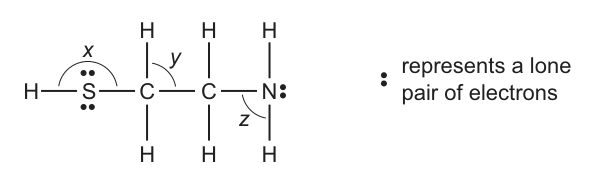
What is the order of decreasing size of the bond angles , and ?
Options
| largest smallest | |||
|---|---|---|---|
| A | |||
| B | |||
| C | |||
| D |
Working
To determine the order of bond angles, we analyze the electron domain geometry around the central atom for each angle using VSEPR theory:
- Angle (S–C–C): The central carbon atom is bonded to four atoms (S, C, and two H atoms) and has 0 lone pairs. This gives 4 bonding pairs and a tetrahedral electron geometry. The bond angle is the ideal tetrahedral angle, .
- Angle (C–N–H): The central nitrogen atom is bonded to three atoms (C and two H atoms) and has 1 lone pair. This gives 3 bonding pairs and 1 lone pair (4 electron domains), resulting in a trigonal pyramidal molecular geometry. The lone pair repels the bonding pairs more strongly, compressing the angle to approximately (similar to ammonia, ).
- Angle (H–S–C): The central sulfur atom is bonded to two atoms (H and C) and has 2 lone pairs. This gives 2 bonding pairs and 2 lone pairs (4 electron domains), resulting in a bent molecular geometry. Two lone pairs compress the bond angle significantly more than one. Additionally, sulfur is a period 3 element with larger atomic radius, leading to bond angles closer to (approximately –, similar to which is ).
Comparing the values: () > () > ().
The order of decreasing size is , , .
Answer
C
C
Background Concept
VSEPR Theory (Valence Shell Electron Pair Repulsion) predicts the 3D shape of molecules based on the repulsion between electron pairs in the valence shell of the central atom. Key principles include:
- Electron pairs (both bonding and lone pairs) arrange themselves to minimize repulsion.
- Lone pairs occupy more space and repel more strongly than bonding pairs because they are closer to the central nucleus and not shared with another atom.
- The presence of lone pairs compresses bond angles relative to the ideal geometry defined by the number of electron domains.
- Ideal bond angles for 4 electron domains (tetrahedral electron geometry) is .
- 4 bonding pairs, 0 lone pairs (e.g., ): .
- 3 bonding pairs, 1 lone pair (e.g., ): .
- 2 bonding pairs, 2 lone pairs (e.g., ): .
- For heavier central atoms (period 3 and below, like S, P, Cl), bond angles are often smaller than expected because the central atom is larger, the bonding pairs are further from the nucleus, and repulsion between them is weaker, allowing lone pairs to compress the angle more (or the atom may use nearly pure p-orbitals for bonding, leading to angles near , as in at ).
Understanding the Question
The question asks to order three specific bond angles (, , ) in the molecule 2-aminoethanethiol () from largest to smallest.
- Angle is the H–S–C angle around the sulfur atom.
- Angle is the S–C–C angle around the first carbon atom.
- Angle is the C–N–H angle around the nitrogen atom.
We must determine the number of bonding pairs and lone pairs around each central atom to apply VSEPR theory and estimate the angles.
Approach
- Identify the central atom for each labelled angle.
- Count the number of bonding pairs (atoms bonded to the central atom) and lone pairs on that central atom.
- Determine the electron domain geometry (tetrahedral for 4 domains) and the molecular shape.
- Apply the rule: more lone pairs = smaller bond angle. Also consider the effect of the central atom's period (larger atoms like S have smaller bond angles).
- Compare the estimated angles to find the decreasing order.
Step-by-Step Reasoning
-
Angle (S–C–C): The central atom is Carbon. It is bonded to S, C, and two H atoms. Total = 4 bonding pairs, 0 lone pairs.
- Geometry: Tetrahedral.
- Angle: Ideal tetrahedral angle = . This is the largest angle.
-
Angle (C–N–H): The central atom is Nitrogen. It is bonded to C and two H atoms, and has 1 lone pair (shown as two dots). Total = 3 bonding pairs, 1 lone pair.
- Geometry: Trigonal pyramidal (based on tetrahedral electron arrangement).
- Angle: The single lone pair compresses the angle from . Similar to ammonia (, ), this angle is approximately . This is smaller than but larger than .
-
Angle (H–S–C): The central atom is Sulfur. It is bonded to H and C, and has 2 lone pairs (shown as four dots). Total = 2 bonding pairs, 2 lone pairs.
- Geometry: Bent (based on tetrahedral electron arrangement).
- Angle: Two lone pairs compress the angle significantly. Furthermore, sulfur is in Period 3. In , the bond angle is only because sulfur uses nearly unhybridized p-orbitals for bonding. In organic sulfides like this (), the angle is slightly larger due to steric bulk of the carbon group, typically around –. Regardless of the exact value, it is the smallest angle due to having two lone pairs and being a period 3 element.
-
Comparison: () > () > ().
-
Order: , , . This corresponds to option C.
Key Takeaways
- Lone pairs repel more strongly than bonding pairs, reducing bond angles.
- The more lone pairs on a central atom (with the same number of electron domains), the smaller the bond angle (e.g., ).
- For central atoms in Period 3 and below (like S, P), bond angles are often significantly smaller than their Period 2 counterparts (like O, N) due to larger atomic size and weaker repulsion between bonding pairs.
Common Mistakes
- Ignoring lone pairs: Failing to count lone pairs on S and N would lead to assuming all angles are .
- Confusing electron geometry with molecular shape: While all three central atoms have 4 electron domains (tetrahedral electron geometry), their molecular shapes differ (tetrahedral, trigonal pyramidal, bent), which affects the bond angles.
- Overlooking the period of the central atom: Assuming S behaves exactly like O (in water, ). Sulfur compounds typically have much smaller bond angles (closer to ) because the larger central atom allows bonding pairs to be further apart with less repulsion, or the atom uses p-orbitals directly.
Things to Be Careful About
- State symbols and lone pairs: Always count lone pairs explicitly shown in the diagram (the dots). S has 4 dots (2 lone pairs), N has 2 dots (1 lone pair).
- Order of decreasing size: Ensure the answer is ordered from largest to smallest (), not smallest to largest.
- Approximate values: You don't need to memorize exact angles for every molecule, but knowing the trend () and the effect of period 3 elements is sufficient to rank them correctly.
X and Y are different elements in Period 3.
Atoms of X and Y each have only one completely filled orbital in their highest occupied energy sub-shell.
Y has a greater first ionisation energy than X.
Which row shows the structure and bonding in X and Y?
Options
| X | Y | |
|---|---|---|
| A | giant metallic | giant metallic |
| B | giant metallic | simple molecular |
| C | giant covalent | simple molecular |
| D | simple molecular | simple molecular |
Working
Period 3 elements with exactly one completely filled orbital in their highest occupied sub-shell:
- Mg: — the sub-shell is a single orbital, completely filled.
- S: — in the sub-shell, the four electrons give , so exactly one orbital is completely filled.
(Na, Al, Si and P have no completely filled orbital in their highest occupied sub-shell; Cl and Ar have more than one.)
So X and Y are Mg and S. Since Mg has a lower first ionisation energy than S, and .
Mg is a metal, so it has a giant metallic structure. S is a non-metal, so it has a simple molecular structure ().
Answer
B
B
Background Concept
This question weaves together three ideas from AS chemistry:
-
Electron configuration and orbital filling. Electrons occupy orbitals in order of increasing energy (, , , , , ...). Within a sub-shell, Hund's rule says electrons fill each orbital singly before any pairing occurs. A sub-shell contains three orbitals (, , ), each holding up to two electrons. A "completely filled orbital" means an orbital holding its full two electrons.
-
First ionisation energy. The energy needed to remove one mole of electrons from one mole of gaseous atoms. Across Period 3 it generally increases as nuclear charge increases and atomic radius shrinks, but there are dips at Al (the electron is easily removed) and at S (the fourth electron experiences repulsion when pairing into an already-occupied orbital).
-
Structure and bonding of Period 3 elements. Na, Mg and Al are metals with giant metallic structures; Si is giant covalent; P, S and Cl are simple molecular; Ar is monatomic.
Understanding the Question
We are told X and Y are different Period 3 elements. Each has exactly one completely filled orbital in its highest occupied energy sub-shell. Y has a greater first ionisation energy than X. We must identify X and Y, then match their structure and bonding to the correct option.
The key clue is the electron configuration: only certain Period 3 elements have exactly one completely filled orbital in the highest occupied sub-shell. The ionisation energy clue then tells us which is X and which is Y.
Approach
- Write out the electron configurations of all Period 3 elements (Na to Ar).
- For each, look at the highest occupied sub-shell and count completely filled orbitals (orbitals holding 2 electrons). Keep only those with exactly one.
- This narrows X and Y to two elements. Use the first ionisation energy comparison to assign which is which.
- Recall the structure and bonding of each element and pick the matching option.
Step-by-Step Reasoning
Step 1 — Electron configurations of Period 3.
- Na: — the orbital has only 1 electron, so it is not filled. ✗
- Mg: — the sub-shell is one orbital holding 2 electrons, so it is completely filled. ✓
- Al: — the highest occupied sub-shell is (higher energy than ); it holds just 1 electron, so no orbital is filled. ✗ (Even though is filled, it is not the highest occupied sub-shell.)
- Si: — by Hund's rule the two electrons occupy two different orbitals singly; none is filled. ✗
- P: — one electron in each orbital; none is filled. ✗
- S: — four electrons give ; exactly one orbital is completely filled. ✓
- Cl: — five electrons give ; two orbitals are completely filled. ✗
- Ar: — all three orbitals are filled. ✗
So only Mg and S satisfy the condition; X and Y are Mg and S.
Step 2 — Assign X and Y by ionisation energy.
First ionisation energies: and , so S has the greater value. Since Y has the greater first ionisation energy, and .
Step 3 — Structure and bonding.
- Mg is a metal, so it has a giant metallic structure — positive ions in a sea of delocalised electrons, held by metallic bonding.
- S is a non-metal, so it has a simple molecular structure — molecules held together by weak van der Waals forces.
X (Mg) = giant metallic; Y (S) = simple molecular. This matches option B.
Why the distractors fail:
- A: both giant metallic — S is a non-metal, not metallic.
- C: X giant covalent — X is Mg, a metal, not covalent.
- D: both simple molecular — Mg is a metal, not molecular.
Key Takeaways
- Hund's rule: electrons fill orbitals singly before pairing; a sub-shell has three orbitals.
- "Completely filled orbital" means an orbital with its full two electrons — count carefully.
- First ionisation energy rises across Period 3 but dips at Al and S; Mg still has a lower IE than S.
- Period 3 structures: Na/Mg/Al giant metallic, Si giant covalent, P/S/Cl simple molecular, Ar monatomic.
Common Mistakes
- Treating Al as qualifying because is filled — the highest occupied sub-shell is , which is not filled.
- Counting Cl as having one filled orbital — it has two ( and ).
- Assuming the IE dip at S makes S's IE lower than Mg's — it does not; S is still well above Mg.
- Confusing the structure of S (simple molecular) with that of Si (giant covalent).
Things to Be Careful About
- "Highest occupied energy sub-shell": for Al onwards this is , not .
- Hund's rule matters — (Si) has no filled orbital because the two electrons occupy separate orbitals.
- The IE trend has dips at Al and S; use the correct relative order ().
- Mg is metallic; never classify it as covalent or molecular.
A pure sample of a gas has a density of at and . The gas behaves ideally under these conditions.
Which expression gives the of the gas?
Options
A
B
C
D
Working
The ideal gas equation is where .
So , where is the density.
Temperature must be in kelvin: .
Density is given in ; converting to requires dividing by (i.e. multiplying by in the denominator):
Answer
D
D
Background Concept
The ideal gas equation describes the behaviour of an ideal gas, where is pressure (Pa), is volume (m), is amount (mol), and is temperature (K). Because , the equation can be rearranged to find the molar mass of a gas from its density.
Understanding the Question
The question gives the density of a pure gas (), its pressure () and its temperature (), and asks which of four expressions correctly gives . The traps are: temperature must be in kelvin, and the density must be converted so that the units match those of .
Approach
Start from , substitute , rearrange to make the subject, then replace with the density . Convert temperature to kelvin and density to , then compare with the options.
Step-by-Step Reasoning
- Write and substitute : .
- Rearrange: .
- Since density , this becomes .
- Convert temperature: .
- Convert density: because .
- Substitute: .
- This matches option D.
Key Takeaways
- The ideal gas equation rearranged for molar mass is .
- Temperature always goes into gas-law calculations in kelvin.
- Units of (Pa m) dictate that volume must be in m; a density in g dm needs the factor .
Common Mistakes
- Using 25 instead of 298 K — this is the most common error and produces options A and C.
- Forgetting to convert dm to m, which changes the power of ten.
- Inverting the fraction so that pressure ends up in the numerator.
Things to Be Careful About
- .
- , so g dm = g m.
- Check that the final value of is chemically sensible (here about 64, e.g. SO).
When of a hydrocarbon is completely burnt in air, the energy released heats of water from to .
What is the amount of energy absorbed, in Joules, by the water?
Options
A
B
C
D
Working
Energy absorbed by the water:
Answer
C
C
Background Concept
When a fuel such as a hydrocarbon burns, the chemical energy released is transferred to the surroundings. In a simple calorimetry experiment, this energy is used to heat a known mass of water, and the energy absorbed by the water is calculated using
where is the mass of water being heated (in grams), is the specific heat capacity of water (), and is the temperature rise. The key idea is that the water is the substance that absorbs the heat, so its mass and temperature change are what matter — the mass of fuel burnt is not part of this calculation.
Understanding the Question
The question states that of a hydrocarbon is completely burnt in air, and the energy released heats of water from to . We are asked to find the energy absorbed by the water, in Joules, and to select the correct expression from four options. The options are deliberately constructed to trap two common errors: using the mass of the hydrocarbon instead of the water, and adding 273 to the temperature change.
Approach
The correct approach is to apply directly:
- Use the mass of the water, .
- Use the specific heat capacity of water, .
- Calculate the temperature change: .
- Substitute into the equation and match the resulting expression to the options.
The mass of the hydrocarbon () is a distractor — it tells us about the fuel, not about the water that absorbs the energy.
Step-by-Step Reasoning
- Identify the substance that absorbs the energy: the water, with mass .
- Determine the temperature change: Because a temperature difference is the same in Celsius and Kelvin, we do not add 273. Adding 273 would only be correct for an absolute temperature, not for a change in temperature.
- Substitute into the calorimetry equation: This matches option C exactly.
- Check the distractors:
- Options A and B use (the mass of the hydrocarbon) instead of (the mass of water). The hydrocarbon is the source of energy, not the substance absorbing it, so its mass is irrelevant here.
- Options B and D add 273 to the temperature change. This is wrong because is a difference, and equals ; no conversion is needed.
Key Takeaways
- The calorimetry equation is , where is the mass of the substance being heated.
- The temperature change in Celsius is numerically identical to the temperature change in Kelvin, so 273 is never added to a .
- Always ask which substance actually absorbs the energy — here it is the water, not the fuel.
Common Mistakes
- Using the mass of the hydrocarbon () instead of the mass of water (). The fuel releases energy; the water absorbs it.
- Adding 273 to the temperature change. This is a common error when students confuse absolute temperature with a temperature change. Since is a difference, .
Things to Be Careful About
- The temperature change is a difference, so Celsius and Kelvin are interchangeable; never add 273 to a .
- Units: , which is consistent with the question asking for energy in Joules.
- The specific heat capacity of water is given as ; use it as provided without modification.
One commercially available ‘heat pad’ contains iron, activated carbon and water. The ‘heat pad’ is activated by air. This causes the pad to get hotter.
Which statement describes the chemical reaction occurring in the ‘heat pad’ when it is exposed to air?
Options
A The reaction is endothermic and iron gains electrons.
B The reaction is endothermic and iron loses electrons.
C The reaction is exothermic and iron gains electrons.
D The reaction is exothermic and iron loses electrons.
Working
When the heat pad is exposed to air, iron reacts with oxygen (rusting):
Iron is oxidised, losing electrons:
The pad gets hotter because heat is released to the surroundings, so the reaction is exothermic.
Answer
D (The reaction is exothermic and iron loses electrons)
D
Background Concept
This question tests two linked ideas: the electron-transfer definition of redox, and the classification of reactions as exothermic or endothermic.
Redox (reduction–oxidation) can be defined in terms of electron transfer. Oxidation is loss of electrons; reduction is gain of electrons. A useful mnemonic is OIL RIG (Oxidation Is Loss, Reduction Is Gain). When a metal such as iron reacts with oxygen, it is oxidised: each iron atom loses electrons and its oxidation state rises from 0 to +3.
An exothermic reaction releases heat energy to the surroundings, so the surroundings (and the reaction mixture) get hotter. An endothermic reaction absorbs heat energy from the surroundings, so the surroundings get colder. The sign of is negative for exothermic and positive for endothermic.
Understanding the Question
The heat pad contains iron, activated carbon and water. When it is activated by air (oxygen), it gets hotter. The question asks us to choose the statement that correctly describes the chemical reaction: whether it is exothermic or endothermic, and whether iron gains or loses electrons.
The key observation is that the pad gets hotter — this tells us heat is being released, so the reaction must be exothermic. The chemistry is the familiar oxidation of iron by oxygen, i.e. rusting. In rusting, iron is oxidised and therefore loses electrons.
Approach
- Identify the reaction: iron reacting with oxygen in the air (rusting/oxidation).
- Decide whether iron gains or loses electrons: oxidation is loss of electrons, so iron loses electrons.
- Decide whether the reaction is exothermic or endothermic: the pad gets hotter, meaning heat is released, so the reaction is exothermic.
- Match these two conclusions to the options.
Step-by-Step Reasoning
- The reaction in the heat pad is the oxidation of iron by oxygen:
- In this reaction, each iron atom goes from oxidation state 0 to +3, losing three electrons:
So iron loses electrons — it is oxidised. Oxygen is the oxidising agent (it accepts electrons) and iron is the reducing agent.
- The pad gets hotter when activated, which means heat energy is released to the surroundings. A reaction that releases heat is exothermic.
- Combining these two facts, the correct statement is: the reaction is exothermic and iron loses electrons. This is option D.
Why the other options are wrong:
- A and B say the reaction is endothermic. This is incorrect because the pad gets hotter — heat is given out, not absorbed.
- C says iron gains electrons. This is incorrect because iron is oxidised (it loses electrons). Gaining electrons would be reduction, which is what happens to oxygen, not iron.
Key Takeaways
- Oxidation is loss of electrons; reduction is gain of electrons (OIL RIG).
- A metal reacting with oxygen is oxidised and loses electrons.
- A reaction that makes its surroundings hotter is exothermic (releases heat).
- Rusting/oxidation of iron is an exothermic redox reaction.
Common Mistakes
- Confusing oxidation and reduction: thinking iron gains electrons because it 'combines' with oxygen. Iron actually loses electrons (it is oxidised), while oxygen gains them.
- Associating 'getting hot' with endothermic: heat released to the surroundings means exothermic. Endothermic reactions make the surroundings colder.
- Forgetting that oxidation number increases on oxidation: iron goes from 0 to +3, which is oxidation (loss of electrons).
Things to Be Careful About
- Always connect the temperature change of the surroundings to the enthalpy classification: hotter surroundings = exothermic, colder surroundings = endothermic.
- In redox questions, identify the oxidation state change of the element in question before deciding gain/loss of electrons.
- The mark scheme for this type of question requires both halves of the statement to be correct — the reaction type (exo/endothermic) and the electron transfer (gain/loss) — so check both before selecting an option.
In which substance is the average oxidation number of sulfur the highest?
Options
A
B
C
D
Working
A : elemental sulfur, so oxidation number .
B : let the average oxidation number of S be .
C : let the average oxidation number of S be .
D : let the oxidation number of S be .
The highest average oxidation number of sulfur is in .
Answer
D
D
Background Concept
The oxidation number of an element in a species is a bookkeeping number that represents the charge an atom would have if all bonds were ionic. The key rules are:
- The oxidation number of an element in its free state is 0.
- For a neutral compound, the sum of all oxidation numbers is 0.
- Oxygen usually has oxidation number .
- Hydrogen usually has oxidation number .
- Group 1 metals such as sodium have oxidation number .
- Halogens usually have oxidation number when bonded to less electronegative elements.
When a compound contains more than one atom of the same element, the oxidation number may be different for each atom. The average oxidation number is found by treating all atoms of that element as having the same value, , and solving the equation that makes the total charge equal to the charge on the species.
Understanding the Question
This question asks which substance contains sulfur with the highest average oxidation number. Four substances are given: , , , and . The word "average" is important because three of the compounds contain more than one sulfur atom, and in some of them the individual sulfur atoms have different oxidation numbers. We are not asked for individual oxidation numbers, only the average value for each compound.
Approach
For each neutral compound, set the sum of all oxidation numbers equal to zero. Let the oxidation number of sulfur be when there is one sulfur atom, or the average oxidation number of sulfur be when there are several. Then solve the resulting linear equation for and compare the values.
Step-by-Step Reasoning
A is the element sulfur in its standard state. Any element in its free state has oxidation number 0, so the average oxidation number of sulfur here is 0.
B contains two sodium atoms, four sulfur atoms, and six oxygen atoms. Sodium is , oxygen is . Let the average oxidation number of sulfur be .
So the average oxidation number of sulfur in tetrathionate is .
C contains two sodium atoms, two sulfur atoms, and three oxygen atoms. Again sodium is and oxygen is . Let the average oxidation number of sulfur be .
So the average oxidation number of sulfur in thiosulfate is .
D contains one sulfur atom, two oxygen atoms, and two chlorine atoms. Oxygen is and chlorine is . Let the oxidation number of sulfur be .
Comparing the four values:
- : 0
- :
- :
- :
The highest average oxidation number is , so the correct answer is D.
Key Takeaways
- The oxidation number of a free element is always 0.
- In a neutral compound, the sum of all oxidation numbers is 0.
- When an element appears more than once in a formula, its average oxidation number is found by solving for after summing all contributions.
- Oxygen is usually and chlorine is usually , so in sulfur must be .
Common Mistakes
- Forgetting that oxygen is in and treating it as .
- Forgetting that chlorine is in .
- Not multiplying the oxidation number by the number of atoms present, e.g. writing for instead of .
- Confusing individual oxidation numbers with the average. In thiosulfate, the two sulfur atoms have different oxidation numbers, but the question asks for the average.
- Assuming has a positive oxidation number because sulfur can show positive oxidation numbers; in its elemental form it is 0.
Things to Be Careful About
- Always check the charge of the species. All four substances here are neutral, so the sum of oxidation numbers must be 0.
- Include every atom in the formula when writing the equation.
- An average oxidation number can be fractional, as in for ; this is acceptable because it is an average.
- In , both oxygen and chlorine are more electronegative than sulfur, so they take negative oxidation numbers and sulfur takes a high positive value.
An equilibrium can be represented by the equation shown.
In a certain mixture, of volume , the equilibrium concentration of Q is .
What will be the new equilibrium concentration of Q if of pure Q is completely dissolved in the mixture?
Options
A
B between and
C
D between and
Working
Adding of Q to a fixed volume of raises from to .
The system is no longer at equilibrium, so the position of equilibrium shifts to the right to consume some of the added Q and oppose the increase. The shift cannot remove all of the added Q, so the new equilibrium concentration is lower than but higher than the original .
Answer
B — between and
B
Background Concept
A system at dynamic equilibrium has equal forward and backward rates, so concentrations remain constant. If a change is imposed, the position of equilibrium shifts to oppose that change (Le Chatelier's principle). For a reaction quotient comparison:
At equilibrium . Increasing a reactant concentration makes the denominator larger, so immediately after the addition ; the reaction therefore proceeds in the forward direction, consuming reactant and producing products, until rises back to .
Understanding the Question
This is a qualitative equilibrium question. The mixture has volume and is initially at equilibrium with . Then of pure Q is added and completely dissolves. Because the volume does not change, the immediate concentration of Q becomes . The question asks for the new equilibrium concentration, not the concentration immediately after addition. The options test whether you know both the direction and the extent of the shift.
Approach
Use Le Chatelier's principle: adding a reactant shifts the equilibrium to the product side, which consumes some Q. That tells us the new [Q] must be less than 15. To see why it must still be greater than 10, consider that consuming all 5 mol of added Q would return [Q] to 10, but would also change P, R and S in a way that makes the reaction quotient larger than ; equilibrium is reached before that point. So the answer is the range between 10 and 15.
Step-by-Step Reasoning
- The volume is , so adding of Q raises its concentration by .
- Immediately after addition, ; the concentrations of P, R and S are unchanged.
- The reaction quotient is now with a larger denominator, so .
- To restore equilibrium, the forward reaction is favoured: P and Q are consumed, R and S are formed, and [Q] falls.
- The forward reaction stops when . It cannot consume all 5 mol of added Q: if it did, [Q] would be back to 10, but [P] would be lower and [R] and [S] higher than initially, so would already be greater than . Hence the new [Q] lies between 10 and 15.
Distractors:
- A () ignores the equilibrium shift.
- C () assumes the shift exactly cancels the addition, which would overshoot.
- D (between 5 and 10) is the wrong direction; adding a reactant shifts the equilibrium to the right, not the left.
Key Takeaways
- Le Chatelier's principle predicts the direction of shift when a concentration is changed.
- The shift opposes the change but does not completely reverse it; the new equilibrium concentration lies between the original and the disturbed value.
- The reaction quotient compared with explains why the shift stops before all added reactant is consumed.
- For a fixed volume, moles added can be converted directly into a concentration change.
Common Mistakes
- Choosing A: forgetting that the system responds by shifting, so [Q] does not stay at 15.
- Choosing C: thinking equilibrium 'cancels' the disturbance. Le Chatelier only opposes it; returning exactly to 10 would require consuming all added Q, which is not the equilibrium position.
- Choosing D: reversing the direction of the shift. Adding a reactant favours the forward reaction, so [Q] must fall from 15, not from 10.
- Treating the question as a calculation requiring ; no value is needed.
Things to Be Careful About
- The volume is fixed at ; 'completely dissolved' means the added Q is fully available and does not change the volume.
- Keep units as .
- The question asks for the new equilibrium concentration, not the concentration immediately after addition.
- Le Chatelier's principle gives a qualitative range, not an exact value, unless and other concentrations are known.
In the Contact process, sulfur dioxide and oxygen react to form sulfur trioxide.
In the Haber process, nitrogen and hydrogen react to form ammonia.
Which statement about these processes is correct?
Options
A for the Haber process has no unit.
B In the Contact process, the value of falls when pressure is increased at constant .
C The Haber process uses a homogeneous catalyst.
D When is used in the Contact process, the position of equilibrium is unchanged.
Working
For the Contact process:
so has units of pressure, not no unit. A is false.
For the Haber process:
depends only on temperature, not on pressure. Increasing pressure at constant does not change , so B is false.
The Haber process uses solid iron as a catalyst, while the reactants and products are gases, so the catalyst is heterogeneous, not homogeneous. C is false.
A catalyst such as in the Contact process speeds up both forward and backward reactions equally, so it does not alter the position of equilibrium. D is correct.
Answer
D
D
Background Concept
For a gaseous equilibrium, the equilibrium constant is written in terms of the partial pressures of the gases. For a general reaction
The units of depend on the change in the number of moles of gas, . If , has no units; otherwise it has units of pressure raised to .
is constant for a given reaction at a given temperature. Changing pressure, adding a catalyst, or changing concentration does not change ; it may change the position of equilibrium, but not the value of the equilibrium constant. A catalyst lowers the activation energy for both the forward and reverse reactions equally, so it increases the rate at which equilibrium is reached but does not shift the equilibrium position.
Understanding the Question
This question asks which of four statements about the Contact process and the Haber process is correct. The statements test three ideas: the units of , the effect of pressure on , and the nature and effect of catalysts. You need to recall the balanced equations for both industrial processes and apply the definitions of and catalysts.
Approach
Write the balanced equations for both processes, derive the expressions, and check each statement in turn.
- For statement A, determine the units of from the stoichiometry of each reaction.
- For statement B, recall that changes only with temperature, not with pressure.
- For statement C, identify the phase of the catalyst and of the reactants/products in the Haber process.
- For statement D, recall that a catalyst does not change the position of equilibrium.
Step-by-Step Reasoning
Statement A:
The Contact process is
Here , so has units of pressure. The Haber process is
Here , so has units of pressure. Therefore statement A is false.
Statement B:
Increasing pressure at constant temperature changes the partial pressures of the gases, so the reaction quotient changes. The equilibrium position shifts in the direction that reduces the number of gas moles, but itself remains unchanged because it depends only on temperature. Therefore statement B is false.
Statement C:
The Haber process uses iron as a catalyst. Iron is a solid, while nitrogen and hydrogen are gases. A catalyst in a different phase from the reactants is heterogeneous, not homogeneous. Therefore statement C is false.
Statement D:
In the Contact process, is a solid catalyst and the reactants and products are gases, so it is a heterogeneous catalyst. A catalyst provides an alternative reaction pathway with lower activation energy, increasing the rate of both forward and reverse reactions equally. It does not change the equilibrium constant or the position of equilibrium. Therefore statement D is correct.
Key Takeaways
- units depend on the change in moles of gas, .
- changes only with temperature; pressure changes the position of equilibrium but not .
- A catalyst is homogeneous if it is in the same phase as the reactants, and heterogeneous if it is in a different phase.
- Catalysts do not shift equilibrium; they only help equilibrium to be reached faster.
Common Mistakes
- Assuming always has no units. In fact, units depend on .
- Confusing a shift in equilibrium position with a change in the value of .
- Calling the iron catalyst in the Haber process homogeneous because it is mixed with the gases; it is a solid, so it is heterogeneous.
- Thinking a catalyst changes the equilibrium yield; it changes only the rate of reaching equilibrium.
Things to Be Careful About
- Always write the balanced equation before deriving the expression.
- For units, use pressure: Contact process has , Haber process has .
- Distinguish between "position of equilibrium" and "rate of attainment of equilibrium".
- When pressure is increased at constant temperature, changes but does not.
of hydrogen peroxide decomposes to water and oxygen in the presence of a suitable catalyst.
of oxygen, measured at room conditions, is produced in .
What is the average rate of decomposition of hydrogen peroxide during this reaction period?
Options
A
B
C
D
Working
Balanced equation:
Molar volume at room conditions .
Moles of produced:
From the equation, forms from :
Time:
Average rate of decomposition:
Answer
B ()
B
Background Concept
The rate of a reaction is the change in amount (or concentration) of a reactant or product per unit time. For the decomposition of hydrogen peroxide,
the rate can be expressed as the disappearance of or the appearance of . These two rates are linked by the stoichiometric coefficients: two moles of hydrogen peroxide decompose to give one mole of oxygen, so the rate of decomposition of is twice the rate of formation of .
To find the amount of oxygen produced from its measured volume, we use the molar volume of a gas at room conditions (, 1 atm), which is approximately = . This is the key conversion that turns a gas volume into moles.
Understanding the Question
The question gives the volume of oxygen gas produced () over a time interval ( minutes) during the decomposition of hydrogen peroxide. It asks for the average rate of decomposition of hydrogen peroxide during this period. The answer options are in , so the final rate must be expressed as moles of decomposed per second — not per minute, and not as the rate of oxygen formation.
The word "average" tells us to divide the total amount decomposed by the total time, rather than finding an instantaneous rate.
Approach
- Convert the volume of oxygen to moles using the molar volume at room conditions.
- Use the balanced equation to convert moles of oxygen to moles of hydrogen peroxide decomposed (2:1 ratio).
- Convert the time from minutes to seconds.
- Divide the moles of hydrogen peroxide by the time in seconds to get the average rate.
Step-by-Step Reasoning
Step 1 — Moles of oxygen produced.
At room conditions, mole of any gas occupies .
Step 2 — Moles of hydrogen peroxide decomposed.
The balanced equation shows , so mole of comes from moles of .
Step 3 — Time in seconds.
Step 4 — Average rate.
This matches option B.
Key Takeaways
- Always write the balanced equation before doing a stoichiometric rate calculation — the coefficients determine the ratio between the rate of disappearance of a reactant and the rate of appearance of a product.
- At room conditions, use (or ) for the molar volume of a gas.
- Convert all times to seconds when the rate is requested in .
- The rate of decomposition of hydrogen peroxide is twice the rate of formation of oxygen because of the stoichiometry.
Common Mistakes
- Forgetting the 2:1 stoichiometric ratio: some candidates divide the moles of oxygen by 2 instead of multiplying, giving (option A). The equation clearly shows two moles of peroxide produce one mole of oxygen, so the peroxide decomposes twice as fast as oxygen forms.
- Using minutes instead of seconds: dividing by rather than gives (option D). Always match the time unit to the requested rate unit.
- Using the wrong molar volume: using (STP) instead of (room conditions) would give a slightly different value, which may not match any option exactly.
- Reporting the rate of oxygen formation instead of peroxide decomposition: the question specifically asks for the rate of decomposition of hydrogen peroxide, so the stoichiometric factor must be applied.
Things to Be Careful About
- Check the units of the answer options before starting: requires seconds, not minutes.
- "Room conditions" means and atm, for which the molar volume is . Do not confuse this with STP (, atm, ).
- The rate here is expressed as amount per time (), not concentration per time (). The question's options dictate which form is expected.
- Keep significant figures consistent: the given data (, ) support three significant figures, so is appropriate.
Which reaction pathway diagram shows an endothermic reaction that occurs in two steps and in which the second step of the reaction is likely to be faster than the first?
Options
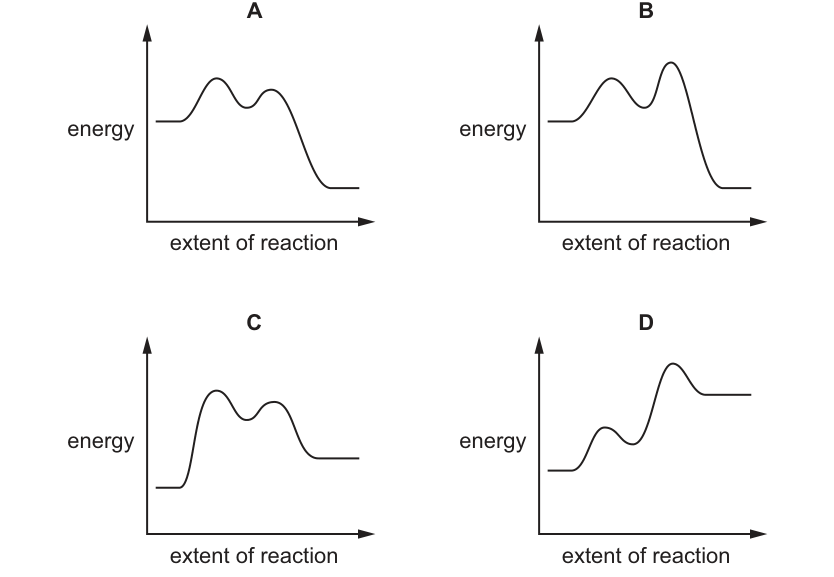
Working
- Endothermic reaction: The products must be at a higher energy level than the reactants (). This eliminates diagrams A and B, which show exothermic reactions (products lower than reactants).
- Two steps: The reaction must have two transition states, represented by two peaks on the diagram. All four diagrams show this.
- Second step is faster than the first: The rate of a reaction step is determined by its activation energy (). A lower means a faster step.
- For step 1: is the energy difference between the first peak and the reactants.
- For step 2: is the energy difference between the second peak and the intermediate (the valley between the peaks).
- We need .
Comparing C and D:
- Diagram C: The first peak is higher than the second peak. The activation energy for the first step () is large (height from reactants to first peak). The activation energy for the second step () is smaller (height from intermediate to second peak). Thus, , meaning the second step is faster. This matches all criteria.
- Diagram D: The second peak is higher than the first peak. The activation energy for the second step () is larger than for the first step (). Thus, the second step is slower.
Answer
C
C
Background Concept
A reaction pathway diagram (or energy profile) plots the potential energy of the system against the extent of reaction (reaction coordinate).
- Peaks represent transition states (activated complexes), which are high-energy, unstable arrangements of atoms.
- Valleys between peaks represent reaction intermediates, which are locally stable species formed during the reaction.
- The number of peaks indicates the number of steps in the reaction mechanism. Two peaks mean a two-step reaction.
- Activation energy () for a step is the energy difference between the transition state (peak) and the starting material for that step (reactants for step 1, intermediate for step 2). According to collision theory and the Boltzmann distribution, a lower means a larger fraction of molecules have sufficient energy to react, so the step is faster.
- Enthalpy change () is the energy difference between the final products and the initial reactants. If products are higher in energy than reactants, the reaction is endothermic (). If products are lower, it is exothermic ().
Understanding the Question
The question asks to identify a specific reaction pathway diagram from four options (A, B, C, D) based on three criteria:
- The reaction is endothermic.
- The reaction occurs in two steps.
- The second step is faster than the first step.
We must analyze the energy profiles to find the one that satisfies all three conditions simultaneously.
Approach
- Use the relative energy levels of reactants and products to identify endothermic vs. exothermic reactions. Eliminate the exothermic options.
- Verify the remaining options show two steps (two peaks).
- Compare the activation energies of the two steps in the remaining diagrams. The step with the lower activation energy barrier is the faster step. Select the diagram where the second step's barrier is lower than the first step's barrier.
Step-by-Step Reasoning
Step 1: Identify endothermic reactions.
- In an endothermic reaction, the products have higher potential energy than the reactants. The overall is positive.
- Looking at the diagrams:
- A: Products are lower than reactants. Exothermic.
- B: Products are lower than reactants. Exothermic.
- C: Products are higher than reactants. Endothermic.
- D: Products are higher than reactants. Endothermic.
- This eliminates A and B. We are left with C and D.
Step 2: Check for two steps.
- Both C and D show two distinct peaks separated by a valley (intermediate), confirming they represent two-step reactions. This criterion is satisfied by both.
Step 3: Determine which has a faster second step.
-
The rate of a reaction step is inversely related to its activation energy (). Lower = faster step.
-
For a two-step reaction:
- (activation energy of step 1) = Energy of peak 1 - Energy of reactants.
- (activation energy of step 2) = Energy of peak 2 - Energy of intermediate (valley).
-
We need the second step to be faster, so we need .
-
Analyze Diagram C:
- The first peak is significantly higher than the second peak.
- The rise from the reactants to the first peak () is large.
- The rise from the intermediate (valley) to the second peak () is smaller.
- Therefore, . The second step has a lower activation energy and is faster. This matches the requirement.
-
Analyze Diagram D:
- The second peak is higher than the first peak.
- The rise from the reactants to the first peak () is relatively small.
- The rise from the intermediate to the second peak () is large.
- Therefore, . The second step has a higher activation energy and is slower. This does not match the requirement.
Conclusion: Diagram C is the only one that is endothermic, has two steps, and has a faster second step (lower for step 2).
Key Takeaways
- Energy profiles visually represent the energy changes and activation energies in a reaction mechanism.
- Endothermic: Products higher than reactants. Exothermic: Products lower than reactants.
- Number of peaks = number of steps in the mechanism.
- Activation energy () determines the rate of a step. Lower barrier = faster step. Always measure from the starting material of that specific step (reactants for step 1, intermediate for step 2), not from the overall reactants.
Common Mistakes
- Confusing overall with activation energy: Students might look at the overall height of the product line instead of the peak heights to determine rates. The rate depends on the barrier height relative to the starting point of that step.
- Measuring incorrectly: Measuring the activation energy of the second step from the original reactants instead of from the intermediate. is the energy difference between the second peak and the intermediate valley.
- Misidentifying endothermic/exothermic: Forgetting that endothermic means products are higher in energy than reactants, leading to the selection of an exothermic diagram like A or B.
Things to Be Careful About
- Always define your reference points for activation energy: Step 1 starts at reactants, Step 2 starts at the intermediate.
- Ensure you are reading the y-axis correctly as 'energy' (potential energy), not 'temperature' or 'concentration'.
- In multi-step reactions, the step with the highest activation energy (the highest peak relative to its starting point) is the rate-determining step (slowest step). In diagram C, step 1 is the rate-determining step.
Oxides of nitrogen, , are involved in formation of photochemical smog and acid rain.
Which oxides of nitrogen are involved in each of these processes?
Options
| photochemical smog: NO | photochemical smog: | acid rain: NO | acid rain: | |
|---|---|---|---|---|
| A | ✓ | ✓ | ✓ | ✓ |
| B | ✗ | ✓ | ✗ | ✓ |
| C | ✓ | ✓ | ✗ | ✓ |
| D | ✗ | ✓ | ✓ | ✓ |
Working
In photochemical smog, both and participate: photolyses to and oxygen atoms, and is involved in the ozone-forming reactions. In acid rain, both and are oxidised to nitric acid. Hence both oxides are involved in both processes, matching row A.
Answer
A
A
Background Concept
Nitrogen oxides, and , are produced when air is heated to high temperatures in vehicle engines and power stations. In the atmosphere they take part in two important pollution cycles.
Photochemical smog. absorbs ultraviolet light and splits into and an oxygen atom:
The oxygen atom can combine with to form ozone, and itself is involved in the chain of reactions with hydrocarbons that produce secondary pollutants such as PAN. So both oxides are active in smog formation.
Acid rain. Nitrogen oxides are oxidised further in moist air. is oxidised to , and reacts with water to give nitric acid:
Nitric acid is a strong acid and is a major contributor to acid rain. Hence both and are also involved in acid rain formation.
Understanding the Question
The question presents a table with four statements: whether is involved in photochemical smog, whether is involved in photochemical smog, whether is involved in acid rain, and whether is involved in acid rain. The task is to select the row of ticks that correctly describes both pollutants. The correct answer is A, meaning all four statements are true.
Approach
Do not try to remember a single answer. Separate the chemistry into two processes. For each process, ask what happens to and what happens to . Then compare the row of ticks with your conclusions.
Step-by-Step Reasoning
- Photochemical smog: photolysis produces and oxygen atoms; the oxygen atoms help form ozone, and participates in the subsequent reactions with hydrocarbons. Therefore both and are involved.
- Acid rain: is oxidised to , and reacts with water to form nitric acid. Therefore both and are involved.
- Match to the table: All four entries should be ticked, which corresponds to row A. The other rows omit at least one true involvement.
Key Takeaways
Both and are interconverted in the atmosphere; when asked about nitrogen oxides and pollution, consider both. Photochemical smog is driven by photolysis of , while acid rain from nitrogen oxides involves oxidation to nitric acid.
Common Mistakes
Choosing B or D because you think is not involved in photochemical smog. Choosing C because you think is not involved in acid rain. Forgetting that is oxidised to before forming acid. Confusing nitrogen oxides with sulfur dioxide in acid rain.
Things to Be Careful About
Read the table carefully: the columns are process + oxide, and the rows are combinations of ticks. The mark scheme requires all four ticks. Use correct formula notation; there is no calculation or unit involved.
Sodium and sulfur react together to form sodium sulfide, .
How do the atomic radius and ionic radius of sodium compare with those of sulfur?
Options
| atomic radius | ionic radius | |
|---|---|---|
| A | sulfur is greater | sodium is greater |
| B | sulfur is greater | sulfur is greater |
| C | sodium is greater | sodium is greater |
| D | sodium is greater | sulfur is greater |
Working
Across Period 3, atomic radius decreases from left to right, so Na has a larger atomic radius than S.
Na forms by losing its outer-shell electrons, so is smaller than Na. S forms by gaining electrons, so is larger than S. Therefore the ionic radius of sulfur is greater than that of sodium.
Answer
D
D
Background Concept
Atomic radius is the distance from the nucleus to the outermost electron shell of an atom. Across a period (left to right), the nuclear charge increases while the number of shells stays the same, so the outer electrons are pulled more strongly towards the nucleus and the atomic radius decreases.
Ionic radius depends on how the ion compares with its parent atom. A cation (positive ion) is formed by losing electrons, so it has fewer shells (or a smaller electron cloud) and is smaller than the atom. An anion (negative ion) is formed by gaining electrons, so the electron cloud expands due to increased electron-electron repulsion and the ion is larger than the atom.
Understanding the Question
This question compares sodium and sulfur in two ways: their atomic radii and their ionic radii. Sodium and sulfur are both in Period 3. Sodium forms the cation and sulfur forms the anion in the compound . The question asks which element has the greater atomic radius and which has the greater ionic radius.
Approach
First, compare the atomic radii using the period trend: atomic radius decreases across a period, so sodium (left) has a larger atomic radius than sulfur (right).
Second, compare the ionic radii. Recognise that is smaller than Na because it has lost its outer shell, while is larger than S because it has gained electrons. So the ionic radius of sulfur is greater than that of sodium.
Step-by-Step Reasoning
-
Atomic radius comparison: In Period 3, the order of elements is Na, Mg, Al, Si, P, S, Cl, Ar. Moving from Na to S, the nuclear charge increases from +11 to +16, pulling the same three shells of electrons closer to the nucleus. Hence Na has the larger atomic radius.
-
Ionic radius comparison:
- Sodium loses its single 3s electron to form , which has the electron configuration of neon (). This leaves only two shells, so is much smaller than Na.
- Sulfur gains two electrons to form , which has the configuration of argon (). The added electrons increase electron-electron repulsion, expanding the electron cloud, so is larger than S.
- Comparing the ions directly, (three shells, expanded) is much larger than (two shells). So sulfur has the greater ionic radius.
-
Reading the options: The correct combination is "atomic radius: sodium is greater; ionic radius: sulfur is greater", which is option D.
Key Takeaways
- Atomic radius decreases across a period due to increasing nuclear charge with no extra shells.
- Cations are smaller than their parent atoms; anions are larger than their parent atoms.
- For ions of elements in the same period, the anion is generally much larger than the cation.
Common Mistakes
- Confusing the atomic radius trend: some might think sulfur is larger because it has more protons, but the trend is the opposite — more protons pull electrons in more tightly.
- Forgetting that loses its entire outer shell, making it dramatically smaller, not just slightly smaller.
- Assuming that because S has more electrons as , the ionic radius must be smaller; in fact, more electrons with the same nuclear charge means greater repulsion and a larger ion.
Things to Be Careful About
- Always compare ions to their parent atoms first, then compare the ions directly.
- Remember that the ionic radius of an anion is larger than the atomic radius, while the ionic radius of a cation is smaller.
- In a multiple-choice question like this, check both parts of the comparison before selecting the option, as the distractors often mix up the two trends.
Compound X is an oxide of a Period 3 element.
Compound X is a white solid at . It reacts with water to form an acidic solution.
What is compound X?
Options
A aluminium oxide
B silicon dioxide
C sulfur dioxide
D phosphorus(V) oxide
Working
Compound X must be a white solid at 25 °C, so it cannot be sulfur dioxide, which is a gas.
It reacts with water to form an acidic solution. Of the remaining white solids:
- is amphoteric and does not dissolve in water to give an acidic solution.
- is insoluble in water and does not react with water to form an acidic solution.
- is a white solid that reacts vigorously with water to form phosphoric acid, , an acidic solution.
So X is phosphorus(V) oxide.
Answer
D
D
Background Concept
Period 3 oxides show a clear trend in acid-base behaviour across the period. Metal oxides are basic, non-metal oxides are acidic, and the oxide at the metal/non-metal boundary, aluminium oxide, is amphoteric. The physical state and solubility in water also vary across the period.
Sodium oxide and magnesium oxide are white ionic solids. Aluminium oxide is a white ionic solid. Silicon dioxide is a white or colourless giant covalent solid. Phosphorus(V) oxide, , is a white molecular solid. Sulfur dioxide, , is a gas at room temperature. Chlorine oxides are also gases.
Acidic oxides of non-metals often react with water to form acids, but not all do. For example, is acidic in character but is insoluble and does not react with water under normal conditions. Phosphorus(V) oxide, however, reacts vigorously with water:
This produces phosphoric acid, which is an acidic solution.
Understanding the Question
The question gives two clues about compound X:
- It is a white solid at 25 °C.
- It reacts with water to form an acidic solution.
The four options are all oxides of Period 3 elements. The task is to identify which oxide satisfies both clues simultaneously. The command word "What is compound X?" asks for identification, not explanation, but the reasoning must use both physical state and chemical behaviour.
Approach
First, use the physical state to eliminate any option that is not a white solid at 25 °C. This removes sulfur dioxide, which is a gas.
Then use the reaction with water. For an oxide to form an acidic solution, it must react with water to produce an acidic species. This eliminates aluminium oxide, which is amphoteric and essentially insoluble in water, and silicon dioxide, which is an acidic oxide but does not react with water to form an acidic solution.
The only remaining option is phosphorus(V) oxide, which is a white solid and reacts with water to form phosphoric acid.
Step-by-Step Reasoning
Consider each option in turn.
A — Aluminium oxide,
Aluminium oxide is a white solid at 25 °C, so it passes the first clue. However, it is amphoteric: it reacts with acids and with strong alkalis, but it does not react with water to form an acidic solution. It is essentially insoluble in water. Therefore it does not satisfy the second clue.
B — Silicon dioxide,
Silicon dioxide is a white solid at 25 °C. It is an acidic oxide in the sense that it reacts with bases, but it is insoluble in water and does not react with water to form an acidic solution. Therefore it fails the second clue.
C — Sulfur dioxide,
Sulfur dioxide does react with water to form sulfurous acid, , which gives an acidic solution. However, sulfur dioxide is a gas at 25 °C, not a white solid. Therefore it fails the first clue.
D — Phosphorus(V) oxide,
Phosphorus(V) oxide is a white solid at 25 °C. It reacts vigorously with water to form phosphoric acid:
Phosphoric acid is an acid, so the solution formed is acidic. This option satisfies both clues, so compound X is phosphorus(V) oxide.
Key Takeaways
- Period 3 oxides show a trend from basic through amphoteric to acidic across the period.
- Physical state and water reactivity are separate clues and both must be considered.
- An oxide can be acidic in character without dissolving in water to form an acidic solution, as with .
- is a white solid acidic oxide that reacts with water to form phosphoric acid.
- Roman numerals such as (V) in phosphorus(V) oxide indicate the oxidation state of the element.
Common Mistakes
- Choosing because it is an acidic oxide: it does not react with water to form an acidic solution.
- Choosing because it forms an acidic solution: it is a gas at 25 °C, not a white solid.
- Thinking is acidic because it reacts with acids: it is amphoteric and does not form an acidic solution with water.
- Confusing the empirical formula with the molecular formula .
Things to Be Careful About
- Use both clues: physical state and reaction with water.
- Know the room-temperature states of common Period 3 oxides: is a gas, while is a solid.
- "Acidic solution" requires the oxide to react with water to produce an acid; not all acidic oxides do this.
- Write the balanced equation correctly: .
- "Phosphorus(V)" means phosphorus is in the +5 oxidation state, which corresponds to the formula .
When heated, magnesium nitrate decomposes.
Which equation for the thermal decomposition of magnesium nitrate is correct?
Options
A
B
C
D
Working
Thermal decomposition of a Group 2 nitrate gives the metal oxide, nitrogen dioxide and oxygen:
This matches option C and is balanced: Mg 2 = 2, N 4 = 4, O 12 = 12.
Answer
C
C
Background Concept
Nitrate salts of Group 2 metals decompose when heated strongly. The nitrate ion breaks down to give the metal oxide, nitrogen dioxide and oxygen. For a Group 2 nitrate with formula :
For magnesium, . This is a redox decomposition: nitrogen in the nitrate ion is reduced from +5 to +4 in , while oxide ions are oxidised to oxygen gas. The brown colour of is a characteristic observation.
Understanding the Question
This multiple-choice question asks you to identify the correct equation for the thermal decomposition of magnesium nitrate. The word correct means two things: the products must be the actual products of the reaction, and the equation must be balanced. The options include different nitrogen products (, , and even a nitride) and different coefficients, so you cannot just check atom balance alone.
Approach
First recall the decomposition pattern for Group 2 nitrates: metal oxide + nitrogen dioxide + oxygen. Then write the balanced equation for magnesium nitrate. Finally compare each option with this equation, checking both the products and the atom count.
Step-by-Step Reasoning
- The correct decomposition is:
-
Check the balance. Left: , , . Right: gives , ; gives , ; gives . Total . Balanced.
-
Compare with the options.
- A has as a product. Nitrogen monoxide is not formed in the thermal decomposition of a Group 2 nitrate, so A is wrong even though it is balanced.
- B also contains instead of . Wrong product set.
- C matches the correct products and is balanced: this is the answer.
- D contains magnesium nitride, , and , which are not products of this decomposition.
Key Takeaways
- Group 2 nitrates decompose to the metal oxide, nitrogen dioxide and oxygen.
- A correct chemical equation must have both the correct products and correct balancing.
- In equation-choice MCQs, check product identity before atom balance.
Common Mistakes
- Choosing an equation only because it is balanced. Here A, B, C and D are all balanced, so balancing alone cannot distinguish them.
- Confusing with . Nitrogen dioxide, not nitrogen monoxide, is the nitrogen oxide produced.
- Thinking the nitrate ion becomes nitrite. That pattern applies to some Group 1 nitrates; Group 2 nitrates give the oxide and .
- Forgetting the subscript 2 on the nitrate group, which would make balancing appear wrong.
Things to Be Careful About
- Write the formula correctly as ; the nitrate group is in brackets.
- Use whole-number coefficients. The balanced equation needs the coefficient 2 on to avoid a fractional .
- In a written (non-MCQ) answer, include state symbols: , , , .
- The question asks for the correct equation; the deciding feature is the product set, not just balancing.
R is the aqueous solution of an ionic compound.
- A white precipitate is formed when R is added to .
- No visible reaction is seen when R is added to dilute .
What is the anion present in compound R?
Options
A
B
C
D
Working
forms a white precipitate with because is insoluble:
and would react with dilute to give effervescence of , and gives no precipitate with . Since no visible reaction occurs with the acid, the anion is sulfate.
Answer
B ()
B
Background Concept
This question uses two classic qualitative tests for anions. First, many metal cations form insoluble salts with particular anions; a white precipitate with indicates an anion that forms an insoluble strontium salt. Second, carbonate and hydrogencarbonate ions are destroyed by acids, releasing carbon dioxide gas, whereas sulfate is not. The observations together identify the anion.
Strontium salts follow useful solubility patterns: nitrates are soluble, chlorides are soluble, sulfates are sparingly soluble or insoluble, and carbonates are insoluble. Thus would stay in solution, while and are white precipitates.
Understanding the Question
R is an aqueous solution of an ionic compound, so the anion is present in solution. Observation 1: adding R to gives a white precipitate. Observation 2: adding R to dilute gives no visible reaction. The task is to choose the anion consistent with both observations.
The command word "What is" asks for identification, not a written method. The key is that one observation alone is not enough: both sulfate and carbonate can give white precipitates with . The acid test is what separates them.
Approach
Start with the precipitate test to narrow the possibilities. Then use the acid test to distinguish between anions that both precipitate with but differ in acid reactivity. Carbonates and hydrogencarbonates react with acid to produce ; sulfate does not. Chloride can be ruled out because is soluble.
Step-by-Step Reasoning
-
Chloride, : is soluble in water, so adding to a chloride solution would not produce a precipitate. This contradicts observation 1, so A is not correct.
-
Sulfate, : is a white insoluble salt:
It is not attacked by dilute nitric acid, so no gas is evolved and the precipitate does not dissolve. This matches both observations, so B is correct.
- Hydrogencarbonate, : Strontium hydrogencarbonate is soluble, so it would not give the white precipitate described. Even if it were present, reacts with acid:
so there would be a visible reaction. C is not correct.
- Carbonate, : is a white precipitate, so observation 1 is satisfied. However, carbonate reacts vigorously with dilute acid:
The solid would dissolve and would bubble out, so observation 2 is not satisfied. D is not correct.
Therefore the only anion consistent with both observations is sulfate.
Key Takeaways
- A single test rarely identifies an ion; combine observations.
- A white precipitate with could be sulfate or carbonate; the acid test distinguishes them.
- Carbonates and hydrogencarbonates fizz with acid, releasing ; sulfates do not react with dilute acid in this way.
- Useful solubility rules: nitrates are soluble, chlorides are soluble, many sulfates are insoluble, and carbonates are insoluble except those of Group 1 and ammonium.
Common Mistakes
- Choosing because both and are white precipitates, while ignoring the acid test.
- Thinking sulfate reacts with dilute acid. Sulfate is not basic, and is insoluble in dilute acid.
- Confusing with ; both release with acid, but strontium hydrogencarbonate is soluble.
- Treating "no visible reaction" as unimportant. It rules out any anion that produces a gas or dissolves a precipitate in acid.
Things to Be Careful About
- Use ionic equations with state symbols when showing the precipitation and acid reactions.
- "No visible reaction" includes no effervescence and no dissolving of the precipitate.
- Dilute nitric acid is used rather than dilute sulfuric acid because sulfate ions from sulfuric acid would interfere with the sulfate test.
- is only sparingly soluble, so in qualitative tests it is observed as a white precipitate.
- Only the anion needs to be identified; the identity of the cation in R is not needed.
In an experiment, of chlorine gas, , is reacted with an excess of hot aqueous sodium hydroxide. One of the products is .
Which mass of is formed?
Options
A
B
C
D
Working
Chlorine disproportionates in hot aqueous alkali:
Mole ratio: , so
Answer
A ()
A
Background Concept
Chlorine is a strong oxidising agent, and when it reacts with aqueous alkali it undergoes disproportionation — a redox reaction in which the same element is simultaneously oxidised and reduced. In chlorine has oxidation state 0. In hot concentrated sodium hydroxide the products are chloride, (oxidation state ), and chlorate(V), (oxidation state ):
The stoichiometry is the heart of this question: three molecules of chlorine produce only one molecule of sodium chlorate. In cold dilute alkali the product is instead chlorate(I), (hypochlorite, chlorine oxidation state ):
So the temperature of the alkali determines which product forms — and therefore which mole ratio applies.
Understanding the Question
The question gives of reacting with an excess of hot aqueous NaOH, states that is one of the products, and asks for the mass of formed. Because the NaOH is in excess, the chlorine is the limiting reagent and all is consumed. The task is to (i) know the balanced equation for hot alkali, (ii) extract the mole ratio of to , (iii) convert moles of to mass using its molar mass. The four options are masses, so the final step is matching the calculated value.
Approach
- Write the balanced equation for chlorine with hot NaOH.
- Read the mole ratio from the coefficients ().
- Convert the given moles of into moles of .
- Calculate .
- mass moles , and select the matching option.
Step-by-Step Reasoning
Step 1 — Balanced equation.
Check the balance: Cl atoms on each side; Na each side; O each side; H each side.
Step 2 — Mole ratio. From the coefficients, produces .
Step 3 — Moles of product.
Step 4 — Molar mass.
Step 5 — Mass.
This matches option A.
Why the distractors are wrong.
- Option C () is — it assumes a false mole ratio, forgetting that only one in three chlorine molecules becomes chlorate.
- Option B () corresponds to of product — an incorrect ratio.
- Option D () is , i.e. using a doubled molar mass () — a wrong combined with a wrong ratio.
Key Takeaways
- Disproportionation is a single redox reaction in which one element is both oxidised and reduced; chlorine in hot alkali gives and .
- The balanced equation, not intuition, dictates the mole ratio — here .
- Converting moles to mass: mass moles molar mass.
- Temperature controls the product: hot alkali chlorate(V); cold alkali chlorate(I).
Common Mistakes
- Using the cold-alkali equation — this gives the wrong product and the wrong ratio.
- Assuming a mole ratio of to , producing option C.
- Calculating incorrectly — forgetting the three oxygen atoms or using instead of .
- Failing to divide by before multiplying by .
Things to Be Careful About
- The mole ratio is , not — the single most common error in this question.
- Use (Na , Cl , O ).
- Report the mass to a sensible number of significant figures: is consistent with (3 s.f.).
- The phrase "excess NaOH" signals that chlorine is the limiting reagent, so all reacts.
- "Hot" is a chemical condition, not decoration — it selects the chlorate(V) product and hence the ratio.
X and Y are sodium salts of Group 17 elements.
When X reacts with concentrated sulfuric acid, hydrogen sulfide, , is produced.
When Y reacts with concentrated sulfuric acid, there is no change in the oxidation number of the sulfur.
Which statement is correct?
Options
A Aqueous X reduces aqueous bromine.
B Aqueous Y reacts with aqueous silver nitrate to give a precipitate which is insoluble in concentrated aqueous ammonia.
C X and Y react separately with concentrated sulfuric acid to produce halogens.
D When X reacts with concentrated sulfuric acid, six halide ions are needed to reduce one sulfur atom to .
Working
X produces with concentrated sulfuric acid, so X is sodium iodide (iodide is a strong enough reducing agent to reduce sulfur from to ). Y gives no change in the oxidation number of sulfur, so Y is sodium chloride (only is formed).
A — Iodide reduces bromine:
B — is soluble in ammonia, so the precipitate is not insoluble in concentrated aqueous ammonia. Incorrect.
C — with concentrated sulfuric acid gives , not a halogen. Incorrect.
D — Sulfur in is and in is (change of 8), so 8 iodide ions are needed:
Six is incorrect.
Answer
A
A
Background Concept
Concentrated sulfuric acid is a strong oxidising agent. When solid sodium halides are warmed with concentrated , the outcome depends on whether the halide ion is a strong enough reducing agent to reduce the sulfur(VI) in .
- Chloride: . No redox occurs; sulfur stays at .
- Bromide: first forms, then reduces to (sulfur ).
- Iodide: forms, then reduces all the way to (sulfur ).
So the reducing power of halide ions increases down the group: .
Silver nitrate tests: . is white and dissolves in dilute ammonia; is cream and dissolves only in concentrated ammonia; is yellow and insoluble in ammonia.
Understanding the Question
X and Y are sodium halides. X reacts with concentrated sulfuric acid to produce , so X must be sodium iodide. Y reacts with concentrated sulfuric acid with no change in the oxidation number of sulfur, so Y must be sodium chloride. Four statements are given; only one is correct, and you must identify it.
Approach
First identify X and Y from their behaviour with concentrated sulfuric acid. Then test each statement in turn. Statement A involves the relative reducing power of iodide and bromide. Statement B involves the solubility of silver chloride in ammonia. Statement C asks whether both halides produce halogens. Statement D requires you to balance the redox equation to find how many iodide ions are needed to reduce one sulfur atom.
Step-by-Step Reasoning
Identify X. is produced when sulfur is reduced from to . Only iodide is a strong enough reducing agent to do this, so X is .
Identify Y. No change in the oxidation number of sulfur means no redox occurs; only is formed. Y is .
Statement A. In aqueous solution, iodide is a stronger reducing agent than bromide. It reduces bromine to bromide ions:
A is correct.
Statement B. , a white precipitate. Silver chloride dissolves in ammonia because forms the soluble complex . So the precipitate is soluble, not insoluble. B is false.
Statement C. with concentrated sulfuric acid gives gas, not chlorine. Only X (sodium iodide) produces a halogen (). C is false.
Statement D. The oxidation number of sulfur in is ; in it is . The change is 8. Each iodide ion goes from to , a change of 1. So 8 iodide ions are needed to reduce one sulfur atom:
D says six, so D is false.
Key Takeaways
- Reducing power of halides increases down Group 17: .
- Concentrated sulfuric acid is reduced stepwise: to by bromide, to by iodide.
- Silver halide solubility in ammonia: (dilute ), (concentrated ), (insoluble).
- Redox stoichiometry is found from oxidation number changes.
Common Mistakes
- Using the common but unbalanced equation . It does not balance (8 H on the left, 10 H on the right). The correct equation needs 8 .
- Calling a halogen. It is a hydrogen halide, not the element chlorine.
- Thinking is insoluble in ammonia. It dissolves to form the diamminesilver(I) complex.
- Confusing which halide is the stronger reducing agent (it is iodide, not chloride).
Things to Be Careful About
- The oxidation number of sulfur in is ; in it is .
- Balance redox equations fully, including hydrogen and oxygen atoms.
- Remember the silver halide solubility order in ammonia: chloride (dilute), bromide (concentrated), iodide (insoluble).
- The question asks for the correct statement; check every option before choosing.
Element E is in Period 3. It forms a chloride which reacts with a small amount of water to produce a white precipitate and steamy fumes. This precipitate is soluble in and in .
What is element E?
Options
A magnesium
B aluminium
C silicon
D phosphorus
Working
Aluminium chloride, , reacts with a small amount of water to give a white precipitate of and steamy fumes of :
is amphoteric, so it dissolves in both and . None of the other chlorides (, , /) gives an amphoteric precipitate on hydrolysis.
Answer
B (aluminium)
B
Background Concept
When covalent chlorides of Period 3 elements are added to water, they undergo hydrolysis — the chlorine atoms are replaced by hydroxide or oxide groups and hydrogen chloride, , is released. is a gas that dissolves in moisture in the air to form a white "steamy" mist, so steamy fumes are a diagnostic sign of chloride hydrolysis. The other product is often a hydroxide or oxide of the element. Amphoteric hydroxides (such as ) can act as both acids and bases: they dissolve in strong acids (forming the hydrated cation) and in strong alkalis (forming a soluble aluminate complex ion). This dual solubility is the key to identifying aluminium.
Understanding the Question
We are told element E is in Period 3 and that its chloride reacts with a small amount of water to give (i) a white precipitate and (ii) steamy fumes, and that the precipitate dissolves in both and . The task is to identify E. The command word "what is" requires a single identification. The two clues — steamy fumes () and an amphoteric precipitate — narrow the field to aluminium.
Approach
Work through the four options. For each, recall how its chloride behaves with water:
- is essentially ionic and does not hydrolyse to give a precipitate.
- is covalent and hydrolyses to (white, amphoteric) + .
- hydrolyses to (white, but acidic — soluble in , not in ) + .
- / hydrolyse to acids (/) + , giving no precipitate.
The amphoteric precipitate is the discriminating feature: only dissolves in both and .
Step-by-Step Reasoning
- Steamy fumes: gas is released by hydrolysis; it dissolves in atmospheric moisture, forming a misty white fume.
- White precipitate: this is the metal hydroxide or oxide formed alongside.
- Solubility in both and : this is the definition of amphoterism. is the classic amphoteric hydroxide in Period 3.
- Write the hydrolysis equation:
- Check the others: does not hydrolyse to a precipitate; is acidic (soluble in only, not in dilute ); phosphorus chlorides give acids and no precipitate.
Therefore E = aluminium.
Key Takeaways
- Covalent chlorides of Period 3 hydrolyse with water, releasing (steamy fumes) and forming a hydroxide or oxide.
- Amphoteric hydroxides dissolve in both acids and strong alkalis.
- The combination of steamy fumes and an amphoteric white precipitate is diagnostic of aluminium.
Common Mistakes
- Assuming is amphoteric: it is acidic, dissolving in but not in dilute .
- Forgetting that is ionic and does not hydrolyse to a precipitate.
- Missing that / give no precipitate at all.
Things to Be Careful About
- "Small amount of water": with a large excess of alkali, the precipitate will dissolve; the question specifies solubility in the given reagents.
- State symbols: the precipitate is ; is released as a gas.
- The steamy fumes are , not water vapour.
Four reaction mixtures are listed.
- and
- and
- and
- and
Which reaction mixtures produce ammonia as a product?
Options
A 1, 2 and 3
B 1 and 2 only
C 2 and 3 only
D 3 and 4 only
Working
Ammonia is released when an ammonium salt is treated with a base:
- with : hydroxide ions are present, so ammonia is produced.
- with : hydroxide ions are present, so ammonia is produced.
- with : reacts with water to form , so hydroxide ions are produced and ammonia is formed.
- with : is an acid, not a base, so it cannot remove a proton from ; no ammonia is produced.
Answer
A
A
Background Concept
Ammonium salts contain the ammonium ion, . Ammonia, , is a weak base; is its conjugate acid. When a base is added to an ammonium salt, the base accepts a proton from , regenerating ammonia gas:
Any reagent that can provide hydroxide ions, or act as a proton acceptor, can bring about this reaction. Soluble hydroxides such as and provide directly. Basic oxides such as react with water to form hydroxide ions. Acids such as do the opposite: they provide and cannot remove a proton from .
Understanding the Question
This multiple-choice question gives four reaction mixtures and asks which ones produce ammonia as a product. The correct option combines the mixtures that do so. The key is to decide, for each mixture, whether a base is present that can deprotonate the ammonium ion. The options are combinations of mixtures 1, 2, 3 and 4, so each mixture must be judged independently.
Approach
For each mixture, identify the ammonium salt and the other reagent. Ask: does the other reagent provide hydroxide ions, or act as a base? If yes, ammonia is produced. If the other reagent is an acid, or cannot accept a proton from , ammonia is not produced. Write the relevant ionic equation for each mixture to confirm.
Step-by-Step Reasoning
Mixture 1: and
is a strong soluble base and provides ions. The ammonium ion reacts:
So ammonia is produced.
Mixture 2: and
is a soluble strong base and provides ions. The same ionic reaction occurs, so ammonia is produced.
Mixture 3: and
is a basic oxide. In aqueous conditions it reacts with water:
The formed then reacts with to produce ammonia:
So ammonia is produced.
Mixture 4: and
is an acid. It provides ions, not ions. An acid cannot deprotonate ; in fact it would tend to protonate any available base such as . No ammonia is produced.
Therefore mixtures 1, 2 and 3 produce ammonia, matching option A.
Key Takeaways
- Ammonium salts release ammonia when treated with a base.
- The essential reaction is .
- Soluble hydroxides provide hydroxide ions directly.
- Basic oxides such as produce hydroxide ions in water, so they can also release ammonia from ammonium salts.
- Acids cannot release ammonia from ammonium salts because they donate protons rather than accepting them.
Common Mistakes
- Assuming that any ammonium salt mixed with any reagent produces ammonia. The reagent must be basic.
- Forgetting that reacts with water to form , so it can act as a base in aqueous mixtures.
- Thinking that and an ammonium salt will produce ammonia because both contain hydrogen. In fact is acidic and cannot deprotonate .
- Confusing the acid-base behaviour of oxides: metal oxides such as are basic, while non-metal oxides such as are acidic.
Things to Be Careful About
- Use the ionic equation to test each mixture quickly.
- Include state symbols where required: ammonia is produced as a gas, .
- Balance equations carefully, especially when the ammonium salt contains more than one ammonium ion, as in and .
- Read the option combinations carefully: the answer is the set of mixtures that all produce ammonia, not just one mixture.
Two statements about a molecule of methanal are given.
- It is planar.
- It contains three bonds.
Which statements are correct?
Options
A both 1 and 2
B 1 only
C 2 only
D neither 1 nor 2
Working
Methanal, , has a carbon atom bonded to two hydrogen atoms and one oxygen atom. The carbon is hybridised, giving a trigonal planar arrangement, so the whole molecule is planar — statement 1 is correct.
The two C–H bonds are bonds and the C=O double bond consists of one bond and one bond. Total bonds — statement 2 is correct.
Answer
A
A
Background Concept
Methanal (formaldehyde) has the structure . The carbonyl carbon is hybridised: it uses three hybrid orbitals to form three bonds (two C–H and one C–O) and has one unhybridised p orbital left over. The three orbitals point to the corners of an equilateral triangle, giving a trigonal planar geometry with bond angles of about 120°. The unhybridised p orbital overlaps sideways with a p orbital on oxygen to form the component of the C=O double bond.
Key bonding facts: every single bond is a bond; a double bond contains one bond and one bond; a triple bond contains one bond and two bonds. So counting bonds means counting single bonds plus the single component of every multiple bond.
Understanding the Question
The question makes two claims about a molecule of methanal: (1) it is planar, and (2) it contains three bonds. You must judge each statement true or false and then select the option that matches. This tests your ability to connect hybridisation to molecular shape and to count bond types correctly in a molecule containing a double bond.
Approach
First, work out the hybridisation of the carbon atom in methanal. The number of bonds plus lone pairs around the central atom tells you the hybridisation: three bonds and no lone pairs means , which gives a trigonal planar shape. Once you know the shape, you can judge planarity. Then count the bonds directly from the structure: two C–H single bonds and one C=O double bond (one + one ).
Step-by-Step Reasoning
-
Hybridisation and shape. The carbon in forms three bonds (two to hydrogen, one to oxygen) and has no lone pairs. Three electron domains around carbon → hybridisation → trigonal planar geometry, 120° bond angles. Because all atoms lie in one plane, the molecule is planar. Statement 1 is correct.
-
Counting bonds. The two C–H bonds are single bonds, so each is one bond. The C=O double bond contributes one bond (the head-on overlap) and one bond (the sideways overlap). Total bonds = 2 (C–H) + 1 (C=O ) = 3. Statement 2 is correct.
-
Selecting the option. Both statements are correct, so the answer is A.
Key Takeaways
- An -hybridised carbon is trigonal planar; the whole molecule containing it is planar.
- A double bond is one bond plus one bond — never count it as two bonds.
- To count bonds: count every single bond and add one per multiple bond.
Common Mistakes
- Counting C=O as two bonds. The double bond is one and one ; counting it twice gives four bonds and a wrong answer.
- Assuming a double bond makes the molecule non-planar. Planarity is set by hybridisation (here ), not by the presence of a bond.
- Confusing with . A tetrahedral carbon (as in methanol) would be non-planar, but methanal's carbon is .
Things to Be Careful About
- Distinguish from bonds precisely — the mark scheme rewards the exact distinction.
- Note the difference between methanal (, planar) and methanol (, tetrahedral at carbon).
- Remember that the carbonyl carbon has no lone pairs, so it is trigonal planar, not bent.
The structure of disodium cromoglycate is shown.
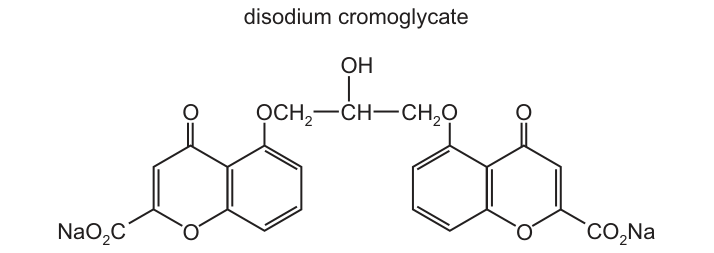
How many chiral centres are there in this molecule?
Options
A 0
B 1
C 2
D 3
Working
A chiral centre is a carbon atom that is sp³-hybridised and bonded to four different groups.
-
Rings and conjugated systems: All carbon atoms in the two chromone-like bicyclic systems are sp²-hybridised (part of aromatic rings, C=O, or C=C bonds). None of these can be chiral centres.
-
Central linker (-O-CH₂-CH(OH)-CH₂-O-): The only sp³-hybridised carbons are in this linker.
- The two -CH₂- carbons are each bonded to two identical hydrogen atoms, so they are not chiral.
- The central -CH(OH)- carbon is bonded to an -H, an -OH, and two -CH₂-O-Ar groups (where Ar is the chromone ring system). Because the two chromone ring systems are identical, the two -CH₂-O-Ar groups are identical substituents. Since this carbon does not have four different groups, it is not a chiral centre. The molecule has a plane of symmetry through this central carbon.
There are no carbon atoms bonded to four different groups.
Answer
A
A
Background Concept
A chiral centre (or stereocentre) in an organic molecule is typically a carbon atom that is sp³-hybridised and bonded to four different atoms or groups. This lack of symmetry means the molecule can exist as non-superimposable mirror images (optical isomers or enantiomers). To identify a chiral centre, one must look for sp³ carbons and check if all four attached groups are distinct. Carbons in double bonds (C=C, C=O), triple bonds, or aromatic rings are sp² or sp hybridised and cannot be chiral centres. Additionally, -CH₂- and -CH₃ groups cannot be chiral because they have at least two identical hydrogen atoms.
Understanding the Question
The question asks for the number of chiral centres in the molecule disodium cromoglycate, given its structure. The structure consists of two identical chromone-like bicyclic systems (each containing a benzene ring fused to a pyranone ring with a carboxylate group) linked by a central 2-hydroxypropane-1,3-diyldioxy chain: -O-CH₂-CH(OH)-CH₂-O-. We need to examine every carbon atom in the molecule to see if any meet the criteria for chirality.
Approach
- Identify all sp³-hybridised carbon atoms in the structure.
- For each sp³ carbon, list the four groups attached to it.
- Determine if any of the attached groups are identical. If two or more are identical, the carbon is not a chiral centre.
- Count the number of carbons that have four completely different groups.
Step-by-Step Reasoning
- Rings and conjugated systems: The two bicyclic chromone-like systems contain benzene rings (all carbons are sp²), carbonyl groups (C=O, sp²), and carbon-carbon double bonds (C=C, sp²). None of these carbons can be chiral centres.
- Central linker: The linker is -O-CH₂-CH(OH)-CH₂-O-.
- The two -CH₂- carbons are each bonded to two hydrogen atoms, an oxygen atom, and a carbon atom. Because they have two identical hydrogen atoms, they are not chiral.
- The central carbon is -CH(OH)-. It is bonded to:
- A hydrogen atom (-H)
- A hydroxyl group (-OH)
- A -CH₂-O-Ar group (where Ar is the left chromone ring)
- Another -CH₂-O-Ar group (where Ar is the right chromone ring)
- Because the two chromone ring systems are identical and attached in the same way, the two -CH₂-O-Ar groups are identical substituents. Since the central carbon has two identical groups attached to it, it does not have four different groups, and therefore it is not a chiral centre. The molecule has a plane of symmetry passing through the central CH(OH) group.
- Conclusion: There are no carbon atoms in disodium cromoglycate that are bonded to four different groups. The number of chiral centres is 0.
Key Takeaways
- A chiral centre requires an sp³ carbon with four different substituents.
- Always check for symmetry: if a molecule has a plane of symmetry, it cannot have chiral centres (unless there are other stereocentres, but a plane of symmetry through a carbon means that carbon is not chiral).
- -CH₂- and -CH₃ groups are never chiral.
- sp² and sp carbons are never chiral.
Common Mistakes
- Misidentifying the central carbon as chiral: A student might see the -CH(OH)- group and assume it is chiral because it has an -H, an -OH, and two carbon chains. They must carefully compare the two carbon chains. Since the two halves of the molecule are identical, the chains are the same group.
- Forgetting to check for identical groups: Simply spotting an sp³ carbon with 4 bonds is not enough; the 4 groups must be different.
- Confusing chiral centres with stereocentres in rings: Sometimes students look at ring junction carbons, but here all ring carbons are sp².
Things to Be Careful About
- When comparing groups attached to a potential chiral centre, trace out the entire group, not just the atom directly attached. In this case, tracing from the central carbon gives -CH₂-O-Ar on both sides, which are identical.
- Remember that sodium carboxylate groups (-CO₂Na) do not contain chiral centres (the carbon is sp²).
- The presence of a plane of symmetry in the molecule is a quick way to verify that there are no chiral centres if the molecule is symmetric and the central atom has two identical branches.
What is the major product when 2-methylpent-2-ene reacts with hydrogen bromide?
Options
A 1-bromo-2-methylpentane
B 2-bromo-2-methylpentane
C 3-bromo-2-methylpentane
D 4-bromo-2-methylpentane
Working
2-methylpent-2-ene has the structure . The double bond lies between C2 and C3. C2 carries no hydrogen atoms (it is bonded to C1, the methyl substituent and C3), while C3 carries one hydrogen. HBr adds by electrophilic addition: the H adds to the double-bond carbon with the greater number of hydrogen atoms (C3) and the Br adds to the more substituted carbon (C2), in accordance with Markovnikov's rule. The more stable tertiary carbocation forms on C2, so the major product is 2-bromo-2-methylpentane.
Answer
B
B
Background Concept
Alkenes undergo electrophilic addition with hydrogen halides. The π bond is electron-rich and attacks the electrophile ( of HBr), forming a carbocation; the halide ion then attacks the carbocation. For unsymmetrical alkenes, Markovnikov's rule predicts the regiochemistry: the hydrogen adds to the carbon of the double bond that already has the more hydrogen atoms, and the halogen adds to the carbon with fewer hydrogens. This reflects the relative stability of the two possible carbocation intermediates — the more substituted (more alkyl groups attached) carbocation is more stable because alkyl groups donate electron density (inductive effect) and stabilise the positive charge (hyperconjugation). Stability order: tertiary > secondary > primary.
Understanding the Question
The question names the alkene 2-methylpent-2-ene and asks for the major product of its reaction with HBr. The word "major" signals that we must apply Markovnikov's rule to predict the dominant regioisomer. We need to draw the structure from the IUPAC name, locate the double bond, and decide where H and Br add.
Approach
- Draw pent-2-ene: .
- Place the methyl group on C2: .
- Identify the double-bond carbons: C2 and C3. Count the H atoms on each.
- Apply Markovnikov: H to the carbon with more H; Br to the carbon with fewer H.
- Name the product and match it to the options.
Step-by-Step Reasoning
The parent chain is pent-2-ene: a five-carbon chain with the double bond between C2 and C3. Adding the 2-methyl substituent gives . C2 is bonded to C1, the methyl group and C3 — three carbon neighbours and no hydrogen. C3 is bonded to C2, C4 and one H. When HBr approaches, the π electrons form a bond to , breaking the π bond. Two carbocations are possible:
- adds to C3 → positive charge on C2: a tertiary carbocation (C2 bonded to C1, and C3).
- adds to C2 → positive charge on C3: a secondary carbocation (C3 bonded to C2 and C4).
The tertiary carbocation is more stable, so it forms preferentially (the rate-determining step). then attacks C2, giving the product with Br on C2. The product is , named 2-bromo-2-methylpentane — option B. Option C (3-bromo-2-methylpentane) would be the minor Markovnikov product (Br on C3 via the secondary carbocation). Options A and D place Br at positions not involved in the double bond and are incorrect.
Key Takeaways
- Markovnikov's rule: H adds to the carbon with more H; the halogen adds to the more substituted carbon.
- The regiochemistry is governed by carbocation stability (tertiary > secondary > primary).
- Always draw the structure from the name before reasoning about the product.
Common Mistakes
- Adding Br to the less substituted carbon (anti-Markovnikov) — that only occurs for HBr in the presence of peroxides, which is not the case here.
- Misidentifying which carbon is more substituted because the structure was not drawn.
- Forgetting that the "major" product is the Markovnikov product.
Things to Be Careful About
The peroxide effect applies only to HBr (not HCl or HI) and only when peroxides are present; the question gives no such condition. Number the longest carbon chain correctly so the locants are lowest, giving 2-bromo-2-methylpentane. The product name must reflect Br and methyl both on C2.
Pent-2-ene is reacted with cold, dilute, acidified manganate(VII) ions.
What is the major product?
Options
A
B
C a mixture of and
D and
Working
Pent-2-ene has the structure
Cold, dilute acidified manganate(VII) ions are a mild oxidising agent. They add an group to each carbon atom of the C=C double bond (hydroxylation), forming a vicinal diol.
Each doubly bonded carbon gains one group, so the product is
which is option A.
Note: hot, concentrated acidified manganate(VII) would cleave the double bond to give carboxylic acids (option D); here the conditions are cold and dilute, so no cleavage occurs.
Answer
A
A
Background Concept
Alkenes contain a carbon–carbon double bond, a region of high electron density that readily undergoes addition and oxidation reactions. Manganate(VII) ions, , are strong oxidising agents whose behaviour depends on the conditions:
- Cold, dilute (usually alkaline) manganate(VII) performs hydroxylation: it adds an group to each carbon of the C=C double bond, converting the alkene into a vicinal diol (two groups on adjacent carbon atoms). The carbon skeleton is preserved.
- Hot, concentrated acidified manganate(VII) performs oxidative cleavage: it breaks the C=C bond, converting a carbon into a carboxylic acid group and a carbon with no hydrogen into a carbonyl (ketone).
The deciding factor is therefore not the acidity alone but the temperature and concentration of the manganate(VII). In this question, "cold, dilute" signals the mild hydroxylating conditions, so the double bond survives as a carbon–carbon single bond with an on each of the two originally doubly bonded carbons.
Understanding the Question
Pent-2-ene, , is an alkene with the double bond between C2 and C3. The question asks for the major product when it reacts with cold, dilute, acidified manganate(VII) ions. The four options test whether you recognise which oxidation product corresponds to these conditions:
- A — pentane-2,3-diol: the hydroxylation product.
- B — a diketone: not formed by any common alkene oxidation.
- C — two monohydric alcohols: products of hydration (addition of water), not of manganate oxidation.
- D — two carboxylic acids: products of hot, concentrated oxidative cleavage.
Approach
- Draw/write the structure of pent-2-ene and locate the double bond.
- Recall the two modes of manganate(VII) oxidation of alkenes and the conditions that favour each.
- Match "cold and dilute" to mild hydroxylation, giving a vicinal diol.
- Compare the diol structure with the options and eliminate the products of alternative conditions.
Step-by-Step Reasoning
Pent-2-ene is ; the C=C lies between carbon 2 and carbon 3.
Under cold, dilute conditions the manganate(VII) adds one group to each carbon of the double bond:
Both originally doubly bonded carbons become centres, and the product is pentane-2,3-diol — exactly option A.
Why the others are wrong:
- B () is a diketone. Manganate(VII) oxidation does not produce a carbonyl adjacent to a carbonyl from an alkene under these conditions; this is not a recognised product.
- C ( and ) are monohydric alcohols. These would be formed by acid-catalysed hydration of the alkene (addition of water across the C=C), not by manganate(VII) oxidation. The reagent here is a manganate, not aqueous acid alone, so a monohydric alcohol is not the product.
- D ( and ) are the cleavage products that would form under hot, concentrated acidified manganate(VII): the C=C is broken and each fragment is oxidised to a carboxylic acid. Because the stem specifies cold and dilute, no cleavage occurs.
Hence the major product is A.
Key Takeaways
- Cold, dilute manganate(VII) → vicinal diol (hydroxylation); hot, concentrated acidified manganate(VII) → oxidative cleavage to carboxylic acids/ketones.
- The carbon skeleton is unchanged in the mild reaction — count the carbons to check.
- In a hydroxylation, every carbon of the C=C bond gains one group.
Common Mistakes
- Choosing D: applying the hot, concentrated cleavage conditions even though the stem says cold and dilute. Cleavage requires vigorous conditions.
- Choosing C: confusing manganate oxidation with acid-catalysed hydration. Hydration adds and across the C=C (giving a monohydric alcohol); manganate hydroxylation adds to both carbons (giving a diol).
- Assuming "acidified" means cleavage: the acidity is not the deciding factor; temperature and concentration are.
Things to Be Careful About
- Read the conditions precisely: cold/dilute vs hot/concentrated changes the product completely.
- Ensure the final structure has two groups on the two originally doubly bonded carbons (a vicinal diol), and that the carbon count remains five.
- Write the product with correct connectivity — , not a rearranged chain.
Limonene is an oil formed in the peel of citrus fruits.
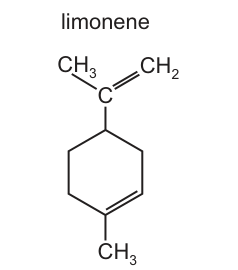
Which product is formed when an excess of bromine, , reacts with limonene at room temperature in the dark?
Options
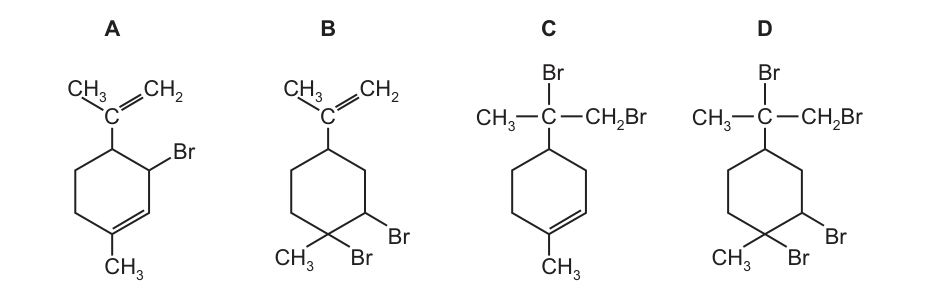
Answer
D
Limonene contains two carbon-carbon double bonds (one in the cyclohexene ring and one in the isopropenyl side chain). The reaction conditions (room temperature, dark) and reagent (bromine) indicate an electrophilic addition reaction. Since an excess of bromine is used, both double bonds will undergo addition. A bromine atom adds to each carbon of every C=C double bond, resulting in a saturated product with four bromine atoms in total. Structure D shows bromine added across both the ring double bond and the side-chain double bond.
D
Background Concept
Alkenes contain a carbon-carbon double bond (C=C) consisting of a sigma bond and a pi bond. The pi bond is an area of high electron density, making alkenes susceptible to attack by electrophiles. Bromine (Br₂) is a non-polar molecule, but as it approaches the electron-rich pi bond, it becomes polarised (induced dipole). This leads to electrophilic addition, where the pi bond breaks and a bromine atom adds to each of the two carbon atoms originally involved in the double bond.
The conditions of the reaction are critical:
- Room temperature and dark (no UV light): These conditions favour electrophilic addition across the double bond. If UV light were present, free-radical substitution could occur, particularly at allylic positions (carbons adjacent to the double bond) or on alkyl side chains, replacing a hydrogen atom with a bromine atom.
- Excess reagent: If there is excess bromine, all available double bonds in the molecule will react. If only 1 equivalent (molar amount) of bromine were used, the reaction might stop after one double bond reacts (though selectivity can be complex).
Understanding the Question
The question asks for the product of the reaction between limonene and excess bromine at room temperature in the dark.
- Limonene structure: As shown in the image, limonene is a cyclic terpene with two distinct C=C double bonds:
- One endocyclic double bond within the cyclohexene ring (with a methyl group attached to one of the double-bonded carbons).
- One exocyclic double bond in the isopropenyl side chain (–C(CH₃)=CH₂).
- Reagents & Conditions: Excess Br₂(l) at RT in the dark ensures that electrophilic addition occurs at all available alkene sites. No free-radical substitution will take place.
Approach
- Identify all functional groups in limonene that can react with Br₂ under these conditions. Here, there are two C=C double bonds.
- Determine the reaction type: Electrophilic addition (due to dark/RT conditions).
- Apply the stoichiometry: Excess Br₂ means both double bonds will react. Each C=C bond consumes one Br₂ molecule, adding two Br atoms across the bond.
- Compare the predicted product (a dibromo-adduct at each double bond, total 4 Br atoms) with the given options.
Step-by-Step Reasoning
-
Step 1: Analyze the side chain. The isopropenyl group is –C(CH₃)=CH₂. Electrophilic addition of Br₂ across this double bond yields –C(Br)(CH₃)–CH₂Br. The carbon that was part of the ring and the methyl group now has a Br attached, and the terminal CH₂ gets a Br.
- Looking at the options: Structures C and D show this correct modification to the side chain. Structures A and B leave the side chain double bond intact (or modify it incorrectly), so A and B are incorrect.
-
Step 2: Analyze the ring. The cyclohexene ring has a double bond with a methyl group on one of the carbons (let's call it C1, with the methyl, and C2). Addition of Br₂ across this bond places a Br atom on C1 and a Br atom on C2. The methyl group remains on C1.
- Looking at Structure C: The ring double bond is still present. This would imply only the side chain reacted, which contradicts the "excess" condition. So C is incorrect.
- Looking at Structure D: The ring double bond is gone. There is a Br atom on the carbon bearing the methyl group (C1) and a Br atom on the adjacent carbon (C2) of the ring. This represents correct addition across the ring double bond.
-
Step 3: Combine. Structure D shows bromine added across the side-chain double bond (forming –C(Br)(CH₃)–CH₂Br) and across the ring double bond (forming a 1,2-dibromo ring segment with the methyl group intact). This matches the expected product of complete electrophilic addition.
Key Takeaways
- Excess reagent implies reaction at all functional groups capable of reacting under the given conditions.
- Conditions matter: Dark/RT = addition; UV light = free-radical substitution (often at alkyl/allylic positions).
- Always check every functional group in a molecule (like limonene with two double bonds) when excess reagent is specified.
Common Mistakes
- Choosing A or C: These show reaction at only one double bond. This would happen if only 1 equivalent of Br₂ was used, or if the student missed one of the double bonds in the limonene structure.
- Choosing B: This structure shows incorrect substitution or addition patterns (e.g., Br on the methyl group or incorrect placement on the ring), possibly confusing addition with free-radical substitution or misinterpreting the structure.
- Confusing conditions: If the question had said "UV light", free-radical substitution at the allylic positions (e.g., the methyl group on the ring or the methyl on the side chain) would be a major competing pathway, leading to different products.
Things to Be Careful About
- Count the double bonds: Limonene is a diene (C₁₀H₁₆). Students might focus only on the ring or only on the side chain.
- State symbols and phases: Br₂(l) is liquid bromine, used for the bromine water/bromine test for unsaturation. The decolourisation of bromine water is a standard test for C=C bonds.
- Structure drawing: Ensure you can visualise the addition. The C=C becomes C-C with two new C-Br bonds. No atoms are lost; atoms are added. In the side chain –C(CH₃)=CH₂, the central C gets a Br and the terminal C gets a Br.
Which reaction mixture produces a nitrile?
Options
A halogenoalkane with KCN in ethanol
B halogenoalkane with in ethanol
C ketone with 2,4-DNPH
D carboxylic acid with in water
Working
A halogenoalkane reacts with in ethanol by nucleophilic substitution: the cyanide ion, , replaces the halogen atom, forming a nitrile.
with a halogenoalkane gives an amine, 2,4-DNPH with a ketone gives a hydrazone, and with a carboxylic acid gives an ammonium salt or amide — none is a nitrile.
Answer
A
A
Background Concept
Nitriles are organic compounds containing the functional group. They are commonly made by nucleophilic substitution of a halogenoalkane with cyanide ion. The cyanide ion, , is a strong nucleophile: the carbon end carries a lone pair and is able to attack the electron-deficient carbon of a carbon–halogen bond. In a halogenoalkane, the carbon attached to the electronegative halogen is , so it is attacked by the cyanide ion, which donates a pair of electrons and displaces the halide ion. This reaction extends the carbon chain by one carbon atom, which is valuable in organic synthesis. It is usually carried out with in ethanol; ethanol dissolves both the halogenoalkane and the cyanide salt and provides a medium in which substitution is favoured.
Understanding the Question
This one-mark question asks you to choose the reagent combination that produces a nitrile. The four options test whether you can distinguish the characteristic reactions of halogenoalkanes, carbonyl compounds, and carboxylic acids with nitrogen-containing reagents. The key is to know the functional group formed when each pair reacts: nitrile, amine, hydrazone, or ammonium salt/amide.
Approach
Identify the functional group formed by each mixture:
- A halogenoalkane with in ethanol gives a nitrile by nucleophilic substitution.
- A halogenoalkane with in ethanol gives an amine.
- A ketone with 2,4-DNPH gives a 2,4-dinitrophenylhydrazone, a derivative used to test for carbonyl compounds.
- A carboxylic acid with in water gives an ammonium salt, and on heating an amide.
Only option A gives a nitrile, so choose A.
Step-by-Step Reasoning
- Option A: provides cyanide ions, . The carbon atom of the cyanide ion is nucleophilic and attacks the carbon of the carbon–halogen bond. The halide ion is displaced, giving a nitrile:
This is a nucleophilic substitution reaction and is the standard route to a nitrile.
- Option B: Ammonia is also a nucleophile. It substitutes the halogen in a halogenoalkane to give a primary amine, not a nitrile:
-
Option C: 2,4-DNPH (Brady's reagent) reacts with aldehydes and ketones to form orange/yellow 2,4-dinitrophenylhydrazone precipitates. This is a test for the carbonyl group, not a method for making nitriles.
-
Option D: A carboxylic acid reacts with ammonia to form an ammonium salt, which on heating gives an amide. No nitrile is formed under these conditions.
Key Takeaways
- A halogenoalkane and cyanide ion is the standard route to a nitrile and lengthens the carbon chain by one carbon atom.
- Ammonia with a halogenoalkane gives an amine, not a nitrile.
- 2,4-DNPH is a test reagent for carbonyl compounds, not a nitrile-forming reagent.
- Carboxylic acids and ammonia form ammonium salts or amides, not nitriles.
Common Mistakes
- Choosing B: confusing amine formation with nitrile formation. Ammonia is a nitrogen nucleophile but substitutes to give an amine, not a nitrile.
- Choosing C: thinking that any nitrogen-containing reagent gives a nitrile. 2,4-DNPH gives a hydrazone derivative, used as a test for carbonyls.
- Choosing D: forgetting that carboxylic acid + ammonia gives an ammonium salt or amide, not a nitrile.
- Writing the product of A as instead of . The cyanide ion attacks through carbon to give a nitrile, not an isocyanide.
Things to Be Careful About
- The cyanide ion can bond through carbon or nitrogen; in this reaction it bonds through carbon to give a nitrile, , not an isocyanide, .
- The reaction is a nucleophilic substitution; the halogen atom is displaced as a halide ion.
- Solvent matters: ethanol is used with to favour substitution; aqueous conditions can lead to competing hydrolysis or alcohol formation.
- For a one-mark MCQ, do not over-explain; identify the correct mixture clearly.
Which reaction is classified as ?
Options
A the reaction of 1-chloropropane with ammonia in ethanol
B the reaction of 1-chloropropane with potassium hydroxide in ethanol
C the reaction of 2-chloro-2-methylpropane with potassium cyanide in ethanol
D the reaction of 2-chloro-2-methylpropane with potassium hydroxide in ethanol
Working
SN1 substitution is favoured by tertiary halogenoalkanes because they form a relatively stable tertiary carbocation.
2-chloro-2-methylpropane is a tertiary halogenoalkane. With potassium cyanide in ethanol, cyanide acts as a nucleophile and substitution occurs by an SN1 mechanism.
Answer
C
C
Background Concept
Halogenoalkanes can undergo nucleophilic substitution by two main mechanisms: SN1 and SN2.
- SN2: one step, back-side attack, favoured by primary halogenoalkanes.
- SN1: two steps, carbocation intermediate, favoured by tertiary halogenoalkanes because the tertiary carbocation is more stable.
Strong bases such as hydroxide in ethanol favour elimination instead of substitution.
Understanding the Question
The question asks which reaction is classified as SN1. We must identify the reagent and the halogenoalkane structure, then decide whether substitution is occurring and by which mechanism.
Approach
- Classify each halogenoalkane as primary, secondary or tertiary.
- Decide whether the reagent is a nucleophile or a strong base.
- Determine whether substitution or elimination is the major pathway.
- Identify the case where nucleophilic substitution occurs via a carbocation intermediate, i.e. SN1.
Step-by-Step Reasoning
- A: 1-chloropropane is primary. Ammonia in ethanol acts as a nucleophile, so substitution occurs, but primary halogenoalkanes react mainly by SN2, not SN1.
- B: 1-chloropropane is primary. Potassium hydroxide in ethanol is a strong base and favours elimination, not SN1 substitution.
- C: 2-chloro-2-methylpropane is tertiary. Potassium cyanide in ethanol provides cyanide as a nucleophile. Tertiary halogenoalkanes undergo nucleophilic substitution by SN1 because the tertiary carbocation intermediate is relatively stable.
- D: 2-chloro-2-methylpropane is tertiary, but potassium hydroxide in ethanol is a strong base. Elimination is strongly favoured, so this is not classified as SN1.
Therefore, the correct answer is C.
Key Takeaways
- Primary halogenoalkanes tend to react by SN2.
- Tertiary halogenoalkanes tend to react by SN1 when substitution occurs.
- Alcoholic KOH favours elimination, not substitution.
- The solvent and the reagent determine whether substitution or elimination dominates.
Common Mistakes
- Choosing D because it involves a tertiary halogenoalkane, while forgetting that alcoholic KOH favours elimination.
- Confusing SN1 with SN2 when the halogenoalkane is tertiary.
- Assuming all halogenoalkane reactions with nucleophiles are SN2.
Things to Be Careful About
- Always classify the halogenoalkane first.
- Check whether the reagent is a nucleophile or a strong base.
- Remember that tertiary carbocations are more stable and favour the SN1 pathway.
Which reaction mixture produces a primary alcohol as the major product?
Options
A propanone with
B propene with steam in the presence of
C butanoic acid with
D ethene with hot concentrated acidified
Working
A primary alcohol has the group attached to a carbon that is bonded to only one other carbon atom (a terminal carbon).
A — reduces propanone (a ketone) to propan-2-ol, a secondary alcohol.
B — Hydration of propene with steam and follows Markovnikov's rule, giving propan-2-ol, a secondary alcohol.
C — reduces butanoic acid (a carboxylic acid) to butan-1-ol, a primary alcohol.
D — Hot concentrated acidified oxidises ethene completely (to ), not to an alcohol.
Answer
C
C
Background Concept
Alcohols are classified by the number of carbon atoms attached to the carbon bearing the group. A primary alcohol has the on a carbon bonded to only one other carbon; a secondary alcohol has it on a carbon bonded to two other carbons; a tertiary alcohol has it on a carbon bonded to three other carbons.
Two key reaction families are relevant here:
-
Reduction of carbonyl compounds. is a mild reducing agent that reduces aldehydes and ketones to alcohols, but it does NOT reduce carboxylic acids. is a much stronger reducing agent and reduces carboxylic acids, esters, aldehydes, and ketones all the way to alcohols. A ketone () is reduced to a secondary alcohol, while a carboxylic acid () is reduced to a primary alcohol.
-
Reactions of alkenes. Hydration of an alkene with steam in the presence of an acid catalyst follows Markovnikov's rule: the hydrogen adds to the carbon with more hydrogens, and the adds to the more substituted carbon. Oxidation of an alkene with hot concentrated acidified causes oxidative cleavage — the bond is broken completely, and the carbon atoms are oxidised to (or carboxylic acids), not to alcohols.
Understanding the Question
This multiple-choice question asks which of four reaction mixtures produces a primary alcohol as the major product. Each option is a different reaction, and the task is to identify the functional-group transformation in each case and classify the alcohol product. The key is to know what each reagent does to each starting material.
Approach
For each option, ask two questions:
- What functional group is in the starting material?
- What does the reagent do to that functional group, and what class of alcohol (if any) results?
Then check whether the product is a primary alcohol. Only one option gives a primary alcohol.
Step-by-Step Reasoning
Option A: propanone with .
Propanone is a ketone, . reduces ketones to secondary alcohols. The product is propan-2-ol, , where the carbon is bonded to two other carbons. This is a secondary alcohol, so A is incorrect.
Option B: propene with steam in the presence of .
This is the acid-catalysed hydration of an alkene. According to Markovnikov's rule, the adds to the more substituted carbon of the double bond. For propene, , the goes to the middle carbon, giving propan-2-ol, a secondary alcohol. So B is incorrect.
Option C: butanoic acid with .
Butanoic acid is , a carboxylic acid. reduces the carboxyl group to a primary alcohol: the product is butan-1-ol, . The is on a terminal carbon bonded to only one other carbon, so this is a primary alcohol. This is the correct answer.
Option D: ethene with hot concentrated acidified .
Hot concentrated acidified is a powerful oxidising agent. It does not stop at the alcohol stage; it cleaves the bond and oxidises the carbons all the way to (for ethene, both carbons become ). No alcohol is formed, so D is incorrect.
Therefore the correct option is C.
Key Takeaways
- reduces aldehydes and ketones only; also reduces carboxylic acids and esters.
- Reduction of a ketone gives a secondary alcohol; reduction of a carboxylic acid gives a primary alcohol.
- Hydration of an alkene follows Markovnikov's rule, so propene gives a secondary alcohol.
- Hot concentrated acidified oxidises alkenes completely (oxidative cleavage), not to alcohols.
Common Mistakes
- Assuming reduces carboxylic acids. It does not — is required for that.
- Forgetting Markovnikov's rule and thinking propene hydration gives propan-1-ol (a primary alcohol). It actually gives propan-2-ol.
- Confusing cold dilute alkaline (which gives a diol) with hot concentrated acidified (which gives oxidative cleavage to ).
Things to Be Careful About
- Always classify the alcohol by counting the carbon atoms attached to the carbon, not by the length of the chain.
- Know the scope of each reducing agent: vs .
- Remember that Markovnikov's rule applies to the acid-catalysed hydration of alkenes.
is heated under reflux with an excess of acidified until there is no further reaction.
What is the final product of this reaction?
Options
A
B
C
D
Working
Both functional groups in can be oxidised by acidified :
- the primary alcohol group, , is oxidised to a carboxylic acid group, ;
- the aldehyde group, , is oxidised to a carboxylic acid group, .
Because the reagent is in excess and the mixture is heated under reflux, oxidation is complete at both positions. The final product is .
Answer
C
C
Background Concept
Acidified potassium dichromate, in acidic solution, is a strong oxidising agent. It oxidises primary alcohols in two stages: first to an aldehyde, then, under more forcing conditions, to a carboxylic acid. Aldehydes are themselves oxidised to carboxylic acids. Ketones, in contrast, are not oxidised under these conditions because further oxidation would require breaking a C–C bond. The conditions 'excess' and 'heated under reflux' are the key to exhaustive oxidation: reflux keeps volatile reactants and products in the flask and supplies enough energy, while excess oxidising agent ensures no partially oxidised intermediate survives.
Understanding the Question
We are given and asked for the final product after reflux with excess acidified dichromate. The molecule contains two separate oxidisable functional groups: a primary alcohol at one end and an aldehyde at the other. The options show different possible combinations of oxidised and unoxidised groups, so the task is to decide which groups are oxidised under these conditions.
Approach
Identify every functional group that can be oxidised by acidified dichromate. Apply the rule that primary alcohols and aldehydes both end as carboxylic acids under exhaustive oxidation. Convert each terminal carbon in to , then compare with the options.
Step-by-Step Reasoning
- Write the structure as . The left-hand carbon is bonded to , two hydrogen atoms and the adjacent carbon: this is a primary alcohol. The right-hand carbon is part of an aldehyde group, .
- Under acidified , a primary alcohol is oxidised to an aldehyde and then to a carboxylic acid. With reflux and excess oxidant, the final product of the alcohol end is .
- The aldehyde end is oxidised directly to a carboxylic acid, also .
- Combining the two oxidised ends gives , oxalic acid. This matches option C.
Why the other options are wrong:
- A, , would mean only the alcohol has been oxidised and the aldehyde has been left unchanged. But the aldehyde is also oxidisable, and the conditions are exhaustive.
- B, , would mean only the aldehyde has been oxidised and the alcohol has been left unchanged. But the primary alcohol is also oxidised under reflux with excess dichromate.
- D, , has three carbon atoms. The starting material has only two carbon atoms, so it cannot be formed by oxidation alone; oxidation does not change the carbon skeleton.
Key Takeaways
- Acidified oxidises primary alcohols all the way to carboxylic acids when heated under reflux with excess reagent.
- Aldehydes are oxidised to carboxylic acids under the same conditions.
- 'Excess' and 'reflux' signal complete oxidation: do not stop at the aldehyde stage.
- Oxidation never changes the carbon skeleton, so the product must have the same number of carbon atoms as the reactant.
Common Mistakes
- Choosing A or B by oxidising only one of the two functional groups. Both groups are oxidisable, and the question says 'no further reaction', meaning exhaustive oxidation.
- Thinking the primary alcohol stops at the aldehyde. It does under mild or distillation conditions, but not under reflux with excess dichromate.
- Choosing D by miscounting carbons or imagining a carboxyl group inserted into the chain. Oxidation does not add carbon atoms.
Things to Be Careful About
- Read the conditions carefully: 'excess' and 'heated under reflux' are deliberate clues for complete oxidation.
- Distinguish primary alcohols (oxidisable to carboxylic acids) from secondary alcohols (oxidised to ketones only) and tertiary alcohols (not oxidised).
- Keep the carbon skeleton unchanged when predicting oxidation products.
- Use correct terminology: the product is a dicarboxylic acid, .
An organometallic lithium compound, RLi, contains the nucleophile .
reacts with pentan-2-one. The mechanism is nucleophilic addition. The first step produces an anion which is then protonated to form the final product.
Which organic product is formed?
Options

Working
1. Identify the reactants:
- Nucleophile: Ethyllithium (). The carbon-lithium bond is polar, making the ethyl group a nucleophile ( or ). This adds an ethyl group ().
- Electrophile: Pentan-2-one (). The carbonyl carbon (C2) is electrophilic.
2. Nucleophilic Addition Mechanism:
- The nucleophilic ethyl group () attacks the electrophilic carbonyl carbon (C2) of pentan-2-one.
- The -bond of the breaks, pushing electrons onto the oxygen to form an alkoxide intermediate ().
- The central carbon (formerly C2) is now bonded to:
- The original methyl group () from C1 of pentan-2-one.
- The original propyl group () from C3-C5 of pentan-2-one.
- The new ethyl group () from the reagent.
- The oxygen anion ().
3. Protonation:
- The alkoxide ion is protonated (e.g., by water or dilute acid in the work-up step) to form an alcohol ().
- The final product is a tertiary alcohol with the central carbon bonded to: methyl, propyl, ethyl, and hydroxyl groups.
4. Determine the structure and name:
- The central carbon is bonded to a methyl group, an ethyl group, and a propyl group.
- Longest carbon chain containing the group: Propyl (3 carbons) + Central C (1 carbon) + Ethyl (2 carbons) = 6 carbons (hexane chain).
- Numbering from the end closer to the group (the ethyl end): C1-C2-C3(OH)-C4-C5-C6.
- At position 3, there is a methyl substituent (the original C1 of the ketone).
- IUPAC Name: 3-methylhexan-3-ol.
5. Match with options:
- Structure A: Pentan-2-ol (secondary alcohol, wrong carbon count/structure).
- Structure B: Central C with OH, methyl, ethyl, and propyl groups. This is 3-methylhexan-3-ol.
- Structure C: Central C with OH, methyl, methyl, and propyl groups (2-methylpentan-2-ol or similar, missing the extra ethyl carbon).
- Structure D: Heptan-3-ol (no methyl branch, wrong structure).
Answer
B
B
Background Concept
Nucleophilic Addition to Carbonyls:
Carbonyl compounds (aldehydes and ketones) contain a double bond. Oxygen is more electronegative than carbon, creating a dipole where the carbon is partially positive () and the oxygen is partially negative (). This makes the carbonyl carbon an electrophile (electron-pair acceptor) and susceptible to attack by nucleophiles (electron-pair donors).
Organolithium Reagents:
Compounds like methyllithium () or ethyllithium () are organometallic reagents. The bond between carbon and lithium is highly polar covalent, with carbon being more electronegative. This effectively makes the alkyl group a carbanion (), a strong nucleophile and base. When they react with carbonyls, they add the alkyl group to the carbonyl carbon, effectively extending the carbon chain.
Reaction Outcome:
- Aldehydes + RLi Secondary alcohols.
- Ketones + RLi Tertiary alcohols.
Understanding the Question
The question asks for the product of the reaction between ethyllithium () and pentan-2-one.
- Reactant 1 (Nucleophile source): provides the ethyl nucleophile ().
- Reactant 2 (Electrophile): Pentan-2-one is a 5-carbon ketone with the carbonyl at C2: .
- Process: Nucleophilic addition followed by protonation.
- Goal: Identify the correct skeletal structure (A, B, C, or D) corresponding to the product.
Approach
- Deconstruct the reactants: Draw out the full structural formula of pentan-2-one to see all groups attached to the carbonyl carbon. Identify the group added by ethyllithium.
- Perform the addition: Attach the ethyl group to the carbonyl carbon and change the to (then after protonation).
- Analyze the product: Determine the IUPAC name or the connectivity of the resulting alcohol. It will be a tertiary alcohol because the starting material is a ketone (not formaldehyde).
- Evaluate options: Match the derived structure/name against the provided skeletal diagrams.
Step-by-Step Reasoning
Step 1: Analyze Pentan-2-one
Structure: .
The carbonyl carbon (C2) is attached to:
- A methyl group (, from C1).
- A propyl group (, from C3-C5).
- An oxygen atom (double bond).
Step 2: Add the Nucleophile
The nucleophile is the ethyl anion: .
It attacks the carbonyl carbon (C2). The double bond to oxygen breaks, becoming a single bond to .
The central carbon (formerly C2) is now bonded to:
- (original methyl)
- (original propyl)
- (new ethyl group from reagent)
- (alkoxide)
Step 3: Protonation
Addition of (from water/acid workup) converts to .
The product is a tertiary alcohol.
Step 4: Name the Product
- Central carbon is bonded to: Methyl, Ethyl, Propyl, Hydroxyl.
- Longest chain containing the group: We must include the longest two alkyl chains attached to the central carbon to maximize length.
- Propyl (3C) + Central (1C) + Ethyl (2C) = 6 carbons. (Hexane chain).
- Methyl (1C) is the substituent.
- Numbering: Start from the end closer to .
- From ethyl end: C1-C2-C3(OH). OH is at position 3.
- From propyl end: C1-C2-C3-C4(OH). OH is at position 4.
- Lowest locant rule: Choose 3.
- Name: 3-methylhexan-3-ol.
Step 5: Check Options
- A: Shows a secondary alcohol (OH on a carbon with one H). Incorrect. (Actually pentan-2-ol).
- B: Shows a central carbon with OH, a methyl (down), an ethyl (right), and a propyl (left). Longest chain is 6. OH at C3. Methyl at C3. This matches 3-methylhexan-3-ol.
- C: Shows a central carbon with OH, two methyls (down and right), and a propyl (left). This is 2-methylpentan-2-ol (or similar). Incorrect.
- D: Shows a secondary alcohol with a longer chain (heptan-3-ol). Incorrect.
Key Takeaways
- Organolithium reagents () act as sources of carbanions () and add alkyl groups to carbonyl carbons.
- Reaction of a ketone with an organolithium reagent produces a tertiary alcohol.
- When naming the product, identify the longest carbon chain that includes the carbon bearing the hydroxyl group.
- Skeletal structures can be tricky; counting carbons and identifying branches is essential.
Common Mistakes
- Confusing the nucleophile: Thinking the nucleophile is or just . Remember, the carbon-lithium bond makes the alkyl group the nucleophile.
- Wrong product class: Reacting a ketone with a nucleophile gives a tertiary alcohol, not a secondary one (which comes from aldehydes) or a primary one (which comes from formaldehyde).
- Naming errors: Failing to identify the longest chain correctly. For example, in 3-methylhexan-3-ol, the longest chain is 6 carbons (propyl + central + ethyl), not 5 (propyl + central + methyl).
- Misinterpreting skeletal structures: Structure B has a vertical line down (methyl), a zigzag to the right (ethyl), and a zigzag to the left (propyl). Students might miscount the chain length.
Things to Be Careful About
- State of the intermediate: The first step produces an alkoxide ion (), which must be protonated to get the alcohol. The question implies this work-up step.
- Regiochemistry: The nucleophile attacks the carbonyl carbon specifically, not the oxygen or other carbons.
- Chain counting: In skeletal structures, ensure you count the vertices and ends correctly. In structure B, the central cross is a carbon. The lines ending without labels are methyl groups. The zigzags are chains.
The structure of a naturally occurring compound, Q, is shown.
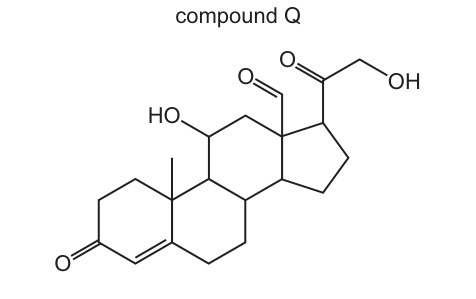
Compound Q is heated under reflux with an excess of acidified .
Organic product R is formed.
Which row is correct?
Options
| results of tests with compound Q | results of tests with organic product R | |
|---|---|---|
| A | orange precipitate with 2,4-DNPH and no reaction with alkaline | yellow precipitate with alkaline and no reaction with Fehling’s reagent |
| B | red precipitate with Fehling’s reagent and no reaction with alkaline | orange precipitate with 2,4-DNPH and no reaction with alkaline |
| C | yellow precipitate with alkaline and orange precipitate with 2,4-DNPH | no reaction with alkaline and no reaction with Fehling’s reagent |
| D | yellow precipitate with alkaline and red precipitate with Fehling’s reagent | yellow precipitate with alkaline and orange precipitate with 2,4-DNPH |
Working
Analysis of Compound Q:
- Contains a ketone (in ring A) and an aldehyde (–CHO group), so it gives a positive 2,4-DNPH test (orange precipitate).
- Contains an aldehyde group (–CHO), so it reduces Fehling's reagent (red precipitate of Cu₂O).
- Does not contain a CH₃CO– group or a CH₃CH(OH)– group, so there is no reaction with alkaline I₂(aq) (negative iodoform test).
Reaction with excess acidified KMnO₄ under reflux:
- Acidified KMnO₄ is a strong oxidizing agent.
- The aldehyde (–CHO) is oxidized to a carboxylic acid (–COOH).
- The primary alcohol (–CH₂OH) is oxidized to a carboxylic acid (–COOH).
- The secondary alcohol (–CH(OH)–) is oxidized to a ketone (C=O).
- The alkene (C=C) is cleaved.
- The original ketone groups remain (or are cleaved, but ketones generally survive or form new ketones/acids; crucially, no aldehydes remain).
Analysis of Organic Product R:
- Contains ketone groups (from original ketones and oxidized secondary alcohol), so it gives a positive 2,4-DNPH test (orange precipitate).
- Contains no aldehyde groups (all oxidized to carboxylic acids), so there is no reaction with Fehling's reagent.
- Does not contain a CH₃CO– group, so there is no reaction with alkaline I₂(aq).
Matching with options:
- Q: Red precipitate with Fehling's; no reaction with alkaline I₂.
- R: Orange precipitate with 2,4-DNPH; no reaction with alkaline I₂ (and no reaction with Fehling's).
This matches row B.
Answer
B
B
Background Concept
Carbonyl Tests:
- 2,4-Dinitrophenylhydrazine (2,4-DNPH): Reacts with both aldehydes and ketones to form an orange/yellow precipitate (a hydrazone). This is a general test for the C=O group.
- Fehling's Reagent: Contains Cu²⁺ ions in alkaline solution. It is reduced to a red precipitate of Cu₂O by aldehydes (and alpha-hydroxy ketones). Ketones (other than alpha-hydroxy ketones) do not react. This distinguishes aldehydes from ketones.
- Alkaline Iodine (Iodoform Test): Reagents are I₂/NaOH (or NaOI). It gives a yellow precipitate of CHI₃ (iodoform) with compounds containing a methyl ketone group (CH₃CO–) or a methyl carbinol group (CH₃CH(OH)–). Acetaldehyde (CH₃CHO) also gives a positive test.
Oxidation with Acidified KMnO₄:
- Potassium manganate(VII) (KMnO₄) in acid is a powerful oxidizing agent, especially under reflux conditions.
- Primary alcohols (–CH₂OH) are oxidized all the way to carboxylic acids (–COOH).
- Secondary alcohols (–CH(OH)–) are oxidized to ketones (C=O).
- Aldehydes (–CHO) are oxidized to carboxylic acids (–COOH).
- Alkenes (C=C) are cleaved (oxidative cleavage) to form carboxylic acids or ketones depending on substitution.
- Ketones are generally resistant to oxidation by KMnO₄ under normal conditions (though vigorous conditions can cleave C-C bonds adjacent to the carbonyl).
Understanding the Question
We are given a complex organic molecule Q (a steroid derivative) and asked to predict the results of chemical tests on Q and on R, the product formed when Q is heated under reflux with excess acidified KMnO₄.
Given Information:
- Structure of Q: Contains a ketone (ring A), an alkene (ring A), a secondary alcohol (ring C), an aldehyde (–CHO), and a primary alcohol (–CH₂OH in the side chain).
- Reagent: Excess acidified KMnO₄, heat under reflux (strong oxidation conditions).
Goal:
- Identify functional groups in Q to predict tests (2,4-DNPH, alkaline I₂, Fehling's).
- Determine the functional groups in R after oxidation.
- Predict tests for R.
- Select the correct row (A, B, C, or D).
Approach
- Analyze Q: Identify all functional groups capable of reacting with the three tests mentioned in the options.
- C=O (ketone/aldehyde) → 2,4-DNPH test.
- Aldehyde (–CHO) → Fehling's test.
- CH₃CO– or CH₃CH(OH)– → Iodoform test (alkaline I₂).
- Predict Oxidation: Apply the rules of strong oxidation (acidified KMnO₄, reflux) to Q to determine the functional groups in R.
- Aldehyde → Carboxylic acid.
- Primary alcohol → Carboxylic acid.
- Secondary alcohol → Ketone.
- Alkene → Cleaved (products are acids/ketones).
- Analyze R: Check which tests R will give positive results for.
- Ketones remain → 2,4-DNPH positive.
- No aldehydes left → Fehling's negative.
- No methyl ketone/carbinol → Iodoform negative.
- Match: Compare predictions with the table rows.
Step-by-Step Reasoning
Step 1: Tests on Compound Q
- 2,4-DNPH: Q contains a ketone (in the bottom-left ring) and an aldehyde (–CHO group at the top). Both react with 2,4-DNPH to give an orange precipitate.
- Fehling's Reagent: Q contains an aldehyde group (–CHO). Aldehydes reduce Cu²⁺ to Cu⁺, forming a red precipitate (Cu₂O). So, Q gives a positive Fehling's test.
- Alkaline I₂ (Iodoform test): This requires a CH₃CO– group or a CH₃CH(OH)– group.
- The ketones in Q are part of rings or are not methyl ketones (the side chain is –COCH₂OH, not –COCH₃).
- The alcohol is a secondary alcohol on a ring (–CH(OH)–), not a methyl carbinol (–CH(OH)CH₃).
- Therefore, there is no reaction with alkaline I₂.
Result for Q: Orange ppt with 2,4-DNPH; Red ppt with Fehling's; No reaction with alkaline I₂.
Looking at the table:
- Row A: Orange ppt 2,4-DNPH, no reaction alkaline I₂. (Correct for these, but misses Fehling's positive which is in B).
- Row B: Red ppt Fehling's, no reaction alkaline I₂. (Correct).
- Row C: Yellow ppt alkaline I₂. (Incorrect).
- Row D: Yellow ppt alkaline I₂. (Incorrect).
Step 2: Reaction to form R
Heating Q with excess acidified KMnO₄ under reflux causes strong oxidation:
- The aldehyde (–CHO) is oxidized to a carboxylic acid (–COOH).
- The primary alcohol (–CH₂OH) is oxidized to a carboxylic acid (–COOH).
- The secondary alcohol (–CH(OH)–) is oxidized to a ketone (C=O).
- The alkene (C=C) in ring A is cleaved (oxidative cleavage), likely forming dicarboxylic acids or keto-acids depending on substitution, but crucially, the double bond is gone.
- The original ketone groups are generally stable to oxidation (or may be cleaved, but ketones remain if not methyl ketones).
Step 3: Tests on Product R
- Functional groups in R: Carboxylic acids, ketones (from oxidized secondary alcohol and original ketones). No aldehydes, no primary/secondary alcohols, no alkenes.
- 2,4-DNPH: R contains ketone groups (C=O). So, orange precipitate.
- Fehling's Reagent: R contains no aldehyde groups (all oxidized to –COOH). Ketones do not react. So, no reaction.
- Alkaline I₂: R does not contain a CH₃CO– group (the side chain ketone is now likely cleaved or remains as a non-methyl ketone, and the original ring ketones are not methyl ketones). So, no reaction.
Result for R: Orange ppt with 2,4-DNPH; No reaction with Fehling's; No reaction with alkaline I₂.
Step 4: Match with Options
- Row B:
- Q: Red precipitate with Fehling's (correct, aldehyde present) and no reaction with alkaline I₂ (correct, no methyl ketone/carbinol).
- R: Orange precipitate with 2,4-DNPH (correct, ketones remain) and no reaction with alkaline I₂ (correct).
This matches our analysis perfectly.
Key Takeaways
- Functional Group Identification: In complex molecules (like steroids), identify all functional groups (ketone, aldehyde, alcohol, alkene) to predict reactivity.
- Specificity of Tests:
- 2,4-DNPH: General for C=O (aldehydes + ketones).
- Fehling's/Tollens': Specific for aldehydes (distinguishes from ketones).
- Iodoform (alkaline I₂): Specific for methyl ketones (CH₃CO–) or methyl carbinols (CH₃CH(OH)–).
- Oxidation with KMnO₄: Acidified KMnO₄ under reflux is a strong oxidant. It oxidizes aldehydes → carboxylic acids, primary alcohols → carboxylic acids, secondary alcohols → ketones, and cleaves alkenes. Ketones are generally resistant.
Common Mistakes
- Confusing Iodoform Test requirements: Students might think any alcohol or ketone gives a positive iodoform test. Remember, it specifically requires a methyl group attached to the carbonyl (CH₃CO–) or the carbinol carbon (CH₃CH(OH)–). The structure Q has –COCH₂OH (not –COCH₃) and a ring –CH(OH)– (not –CH(OH)CH₃), so it is negative.
- Forgetting Aldehyde Oxidation: Students might think the aldehyde survives oxidation. Acidified KMnO₄ is strong enough to oxidize aldehydes to carboxylic acids. Thus, R will not give a positive Fehling's test (no aldehyde left).
- Missing the Aldehyde in Q: The –CHO group is attached to the ring system. It must be identified as an aldehyde to predict the positive Fehling's test for Q.
- Ketone Stability: Assuming ketones are oxidized by KMnO₄. While vigorous conditions can cleave ketones, in the context of A-Level chemistry, ketones are generally considered resistant to oxidation by KMnO₄ (unlike aldehydes and alcohols), so they persist in R, giving a positive 2,4-DNPH test.
Things to Be Careful About
- Structure Reading: The structure is complex. Look carefully for the –CHO (aldehyde) at the top and the –CH₂OH (primary alcohol) in the side chain. The –CO–CH₂OH group is a hydroxy-ketone, not a methyl ketone.
- Reagent Conditions: "Heated under reflux with excess acidified KMnO₄" implies complete oxidation. Primary alcohols go to carboxylic acids (not aldehydes). Aldehydes go to carboxylic acids.
- Test Specificity: Ensure you know exactly what each test detects:
- 2,4-DNPH: C=O (orange ppt).
- Fehling's: Aldehyde (red ppt Cu₂O).
- Alkaline I₂: CH₃CO– or CH₃CH(OH)– (yellow ppt CHI₃).
Which organic starting material could be used in a single reaction to produce propanoic acid?
Options
A ethanenitrile
B propan-2-ol
C propanal
D propyl ethanoate
Working
Aldehydes are oxidised to carboxylic acids. Propanal, CH3CH2CHO, is an aldehyde. With acidified K2Cr2O7 or acidified KMnO4 it is oxidised to propanoic acid, CH3CH2COOH.
Answer
C — propanal
C
Background Concept
Aldehydes contain the –CHO group and can be oxidised to carboxylic acids (–COOH) under mild oxidising agents such as acidified K2Cr2O7 or acidified KMnO4. Ketones contain the –CO– group and are not oxidised under these conditions because further oxidation would require breaking a C–C bond.
Primary alcohols can be oxidised first to aldehydes and then to carboxylic acids. Secondary alcohols are oxidised to ketones, not carboxylic acids. Nitriles can be hydrolysed to carboxylic acids, but the acid formed has the same number of carbon atoms as the nitrile.
Understanding the Question
The question asks which starting material can be converted to propanoic acid, CH3CH2COOH, in a single reaction. We need to check the functional group and the carbon skeleton of each option.
Approach
For each option, identify the functional group and decide what one reaction would do to it:
- Aldehyde → carboxylic acid by oxidation.
- Secondary alcohol → ketone by oxidation.
- Nitrile → carboxylic acid by hydrolysis, with the same carbon count.
- Ester → alcohol + carboxylic acid by hydrolysis, with the acid part coming from the acyl group.
Compare the product with propanoic acid.
Step-by-Step Reasoning
- A — ethanenitrile, CH3CN: Hydrolysis of a nitrile gives a carboxylic acid with the same number of carbon atoms. Ethanenitrile has 2 carbons, so it gives ethanoic acid, CH3COOH, not propanoic acid.
- B — propan-2-ol, CH3CH(OH)CH3: This is a secondary alcohol. Oxidation gives propanone, CH3COCH3, a ketone, not propanoic acid.
- C — propanal, CH3CH2CHO: This is an aldehyde. Oxidation gives propanoic acid, CH3CH2COOH. This is the correct answer.
- D — propyl ethanoate, CH3COOCH2CH2CH3: This is an ester. Hydrolysis gives ethanoic acid and propan-1-ol, not propanoic acid.
Key Takeaways
- Aldehydes are readily oxidised to carboxylic acids.
- Secondary alcohols are oxidised to ketones, not carboxylic acids.
- The carbon skeleton of the starting material must match the target acid.
- A single reaction must be enough to produce the target product.
Common Mistakes
- Thinking propan-2-ol can be oxidised to propanoic acid. It is a secondary alcohol and gives propanone.
- Assuming propyl ethanoate hydrolysis gives propanoic acid. The acid part of the ester is ethanoate, so ethanoic acid is produced.
- Forgetting that ethanenitrile has only 2 carbons and therefore cannot give a 3-carbon acid.
Things to Be Careful About
- Count the carbon atoms in each starting material and in the target acid.
- Identify the functional group correctly: aldehyde, ketone, alcohol, nitrile, or ester.
- Remember that “single reaction” means one chemical step, not a multi-step synthesis.
In four separate reactions, W, X, Y and Z, of an organic compound reacts with an excess of a reagent.
| organic compound | reagent | |
|---|---|---|
| W | ||
| X | ||
| Y | ||
| Z |
The volume of any gas produced is collected and measured. All gas volumes are measured at the same temperature and pressure.
What is the order of the reactions from greatest total volume of gas collected to least total volume of gas collected?
Options
| greatest volume least volume | ||||
|---|---|---|---|---|
| A | W | Y | Z | X |
| B | W | Z | Y | X |
| C | Z | W | X | Y |
| D | Z | X | W | Y |
Working
For each 1 mol compound, count the groups that release gas with each reagent.
-
With , each group and each alcoholic group releases of :
- W: 2 groups .
- Z: 2 groups + 1 group .
-
With , each group releases of ; alcohols do not react:
- X: 1 group .
-
With , the group is neutralised but no gas is produced; alcohols do not react:
- Y: gas.
Order of gas volume: .
Answer
C
C
Background Concept
Carboxylic acids contain the group, which has an acidic hydrogen. This hydrogen can be removed by reactive metals such as sodium, by carbonates such as , and by alkalis such as . Alcohols contain the group. The hydrogen of an alcohol is far less acidic than that of a carboxylic acid, so alcohols react with sodium but do not react with carbonates or with sodium hydroxide under normal conditions.
The gas-producing reactions relevant here are:
- Sodium with a carboxylic acid or an alcohol produces hydrogen gas.
- Sodium carbonate with a carboxylic acid produces carbon dioxide gas.
- Sodium hydroxide with a carboxylic acid produces a salt and water, but no gas.
Because all gas volumes are measured at the same temperature and pressure, the volume of gas is directly proportional to the number of moles of gas produced. Therefore, comparing the number of moles of gas from 1 mol of each compound is equivalent to comparing the gas volumes.
Understanding the Question
The question gives four separate reactions, each starting with 1 mol of an organic compound and an excess of a reagent. The gas produced is collected and measured. We need to rank W, X, Y and Z from greatest to least volume of gas.
- W is , which contains two carboxylic acid groups.
- X and Y are both , which contains one alcohol group and one carboxylic acid group.
- Z is , which contains one alcohol group and two carboxylic acid groups.
The key is to identify, for each reagent, which functional groups react and how much gas each group produces.
Approach
For each reaction, count the number of gas-producing functional groups and use the stoichiometry of the reaction to find the moles of gas produced per mole of compound.
- With sodium: each and each produces per mole of group.
- With sodium carbonate: each produces per mole of group; produces nothing.
- With sodium hydroxide: no gas is produced.
Then compare the total moles of gas.
Step-by-Step Reasoning
W: with
W has two groups. Sodium reacts with each group:
So 2 mol of groups produce 1 mol of . Since W has exactly 2 groups, 1 mol of W produces 1 mol of .
X: with
X has one group and one group. Sodium carbonate reacts only with the carboxylic acid:
So 2 mol of groups produce 1 mol of . X has only 1 group, so 1 mol of X produces 0.5 mol of . The alcohol group does not react with carbonate, so it contributes no gas.
Y: with
Y has the same structure as X, but the reagent is sodium hydroxide. Sodium hydroxide neutralises the carboxylic acid:
No gas is formed. The alcohol group does not react with in this context. So Y produces 0 mol of gas.
Z: with
Z has two groups and one group. Sodium reacts with both types of group:
- 2 groups give 1 mol of .
- 1 group gives 0.5 mol of .
So 1 mol of Z produces mol of .
Comparing the volumes
Moles of gas per mole of compound:
- W: 1.0 mol
- X: 0.5 mol
- Y: 0 mol
- Z: 1.5 mol
Since volume is proportional to moles at the same temperature and pressure, the order from greatest to least is:
This corresponds to option C.
Key Takeaways
- Carboxylic acid groups and alcohol groups both react with sodium to produce hydrogen, but each group produces only half a mole of per mole of group.
- Sodium carbonate reacts only with carboxylic acid groups, producing carbon dioxide.
- Sodium hydroxide neutralises carboxylic acids but produces no gas.
- At the same temperature and pressure, gas volume is proportional to moles of gas, so stoichiometric comparison is sufficient.
Common Mistakes
- Thinking that produces hydrogen with a carboxylic acid. It does not; it simply forms a salt and water.
- Thinking that an alcohol reacts with . Alcohols are not acidic enough to react with carbonates.
- Forgetting that each or group gives only 0.5 mol of per mole of group, so counting 1 mol of per group is wrong.
- Misreading as having only one group; the subscript 2 means two complete units, so there are two groups.
- Comparing volumes without first converting to moles of gas.
Things to Be Careful About
- Use the correct stoichiometry for each reaction: sodium gives , carbonate gives , and hydroxide gives no gas.
- Count all functional groups in the compound before applying the stoichiometry.
- The phrase "excess of a reagent" means every available functional group reacts fully, so no limiting-reagent complications arise.
- All volumes are measured at the same temperature and pressure, so volume comparison is exactly a mole comparison.
Butylamine can be produced by the reaction of butanenitrile with hydrogen in the presence of a suitable catalyst.
Which volume of hydrogen, measured at room conditions, is required to react completely with of butanenitrile?
Options
A
B
C
D
Working
Molar mass of butanenitrile, :
Moles of butanenitrile:
Reduction of a nitrile to a primary amine:
So 1 mol nitrile requires 2 mol :
Volume at room conditions (molar volume ):
Answer
D
D
Background Concept
Nitriles () are reduced to primary amines () by hydrogen in the presence of a suitable catalyst such as nickel, palladium or platinum. Each nitrile group gains four hydrogen atoms: the carbon–nitrogen triple bond is hydrogenated so that the carbon becomes and the nitrogen becomes . In terms of hydrogen molecules, each mole of nitrile consumes 2 moles of . This 2:1 stoichiometric ratio is the key chemical fact needed for the calculation.
At room conditions (r.t.p., 25 °C and 1 atm), one mole of any gas occupies 24 dm³, which is 24000 cm³. This molar gas volume is the standard value used in Cambridge calculations unless the question specifies other conditions (e.g. s.t.p., 22.4 dm³ mol⁻¹).
Understanding the Question
The question gives the mass of butanenitrile (0.500 g) and asks for the volume of hydrogen gas, measured at room conditions, required to react completely. You are not told the balanced equation, so you must know (or deduce) that the reduction of a nitrile to an amine uses 2 mol per mole of nitrile. The calculation then follows the standard stoichiometry chain: mass → moles of butanenitrile → moles of (using the ratio) → volume of gas at r.t.p.
Approach
- Write the balanced reduction equation to establish the mole ratio.
- Calculate the molar mass of butanenitrile from its molecular formula.
- Convert the given mass to moles.
- Use the 2:1 mole ratio to find the moles of hydrogen.
- Convert moles of hydrogen to volume using the molar gas volume at room conditions (24000 cm³ mol⁻¹).
Step-by-Step Reasoning
- Molar mass of butanenitrile — the formula is (butanenitrile, ).
- Moles of butanenitrile:
- Balanced reduction equation:
So 1 mol nitrile requires 2 mol .
- Moles of hydrogen:
- Volume at r.t.p. (molar volume 24 dm³ mol⁻¹ = 24000 cm³ mol⁻¹):
This matches option D.
The most tempting distractor is B (174 cm³), which results from using a 1:1 ratio of to nitrile — forgetting that two hydrogen molecules are needed to reduce the triple bond. Option A (145 cm³) could arise from a molar mass error, and option C (289 cm³) from a different arithmetic slip.
Key Takeaways
- The reduction of a nitrile to a primary amine consumes 2 mol per mole of nitrile: .
- The molar gas volume at room conditions is 24 dm³ mol⁻¹ (24000 cm³ mol⁻¹).
- Stoichiometry problems always require a correctly balanced equation before applying mole ratios.
Common Mistakes
- Using a 1:1 ratio of to nitrile — this gives 174 cm³ (option B). Each nitrile group needs four H atoms, i.e. two molecules.
- Using the s.t.p. molar volume (22.4 dm³ mol⁻¹) instead of the r.t.p. value (24 dm³ mol⁻¹) — this gives about 325 cm³, which is not among the options.
- Incorrect molar mass — miscounting the hydrogens in butanenitrile (it is , not ).
- Unit confusion — forgetting that 24 dm³ = 24000 cm³, or mixing dm³ and cm³ in the final answer.
Things to Be Careful About
- Room conditions means 24 dm³ mol⁻¹, not 22.4 dm³ mol⁻¹ (which is s.t.p.). The question explicitly says "room conditions".
- Significant figures: 0.500 g has three significant figures, so the answer should be given to three significant figures (348 cm³).
- Check the ratio from the balanced equation every time — the most common error in this type of question is using the wrong mole ratio.
- Units: the final volume is asked in cm³, so convert from dm³ by multiplying by 1000.
A section of an addition polymer is shown.
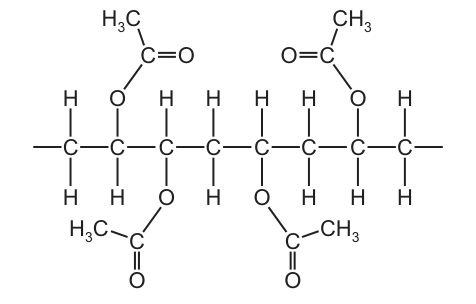
Which monomer is used to make this polymer?
Options
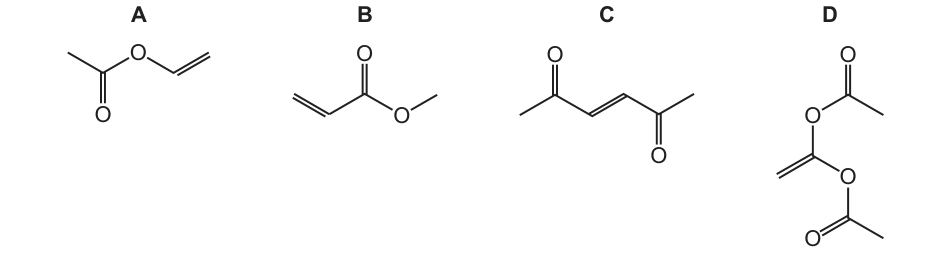
Working
The polymer backbone consists entirely of carbon atoms with no heteroatoms in the chain, confirming addition polymerisation (not condensation).
The repeating unit is , where the acetate group is attached to the backbone carbon through oxygen ().
This corresponds to the monomer vinyl acetate (ethenyl ethanoate): , which is option A.
Answer
A
A
Background Concept
Addition polymerisation involves the opening of a carbon-carbon double bond in a monomer to form a long carbon-chain backbone. The repeating unit of the polymer is derived directly from the monomer by converting into (with continuation bonds on each side). No small molecule is eliminated.
Vinyl monomers have the general structure , where X is a substituent. The polymer formed is . The identity of X determines the polymer's properties and, crucially, how X is attached to the backbone carbon.
For esters, the orientation matters enormously. An ester group attached through oxygen to the backbone gives a different monomer than attached through the carbonyl carbon.
Understanding the Question
The question shows a section of an addition polymer (8 backbone carbons) with acetate groups () as substituents on certain carbons. The student must identify which of four candidate monomers produces this polymer.
The command word is "which" — a single correct identification is required. The critical observation is the point of attachment of the ester group to the backbone.
Approach
- Confirm it is an addition polymer (all-carbon backbone, no heteroatoms in the chain).
- Identify the repeating unit by finding the shortest segment that, when repeated, regenerates the structure shown.
- Determine how the substituent is bonded to the backbone carbon — specifically, whether the oxygen or the carbonyl carbon of the ester is bonded to the backbone.
- Reverse the polymerisation: close the single bond between backbone carbons back into a double bond to regenerate the monomer.
- Match the resulting monomer to the given options.
Step-by-Step Reasoning
Step 1: Confirm addition polymerisation.
The backbone is a continuous chain of carbon atoms with no oxygen, nitrogen, or other heteroatoms interrupting it. This rules out condensation polymers (polyesters, polyamides). The polymer must be made from a vinyl-type monomer .
Step 2: Identify the repeating unit.
The repeating unit is . The acetate group hangs off every other carbon via an oxygen atom bonded directly to the backbone carbon.
Step 3: Determine the point of attachment.
In the polymer image, the bond from the backbone carbon goes to an oxygen atom, which is then bonded to a carbonyl carbon (), which is bonded to . So the linkage is:
This means the substituent X on the monomer is (an acyloxy group, specifically acetate/ethanoate).
Step 4: Regenerate the monomer.
Replacing the backbone single bond with a double bond gives:
This is vinyl acetate (ethenyl ethanoate / ethenyl acetate), which is option A.
Step 5: Eliminate distractors.
- Option B (methyl acrylate): . Here the carbonyl carbon is bonded to the backbone, giving a polymer with units. The ester is attached through carbon, not oxygen. This does not match the polymer shown.
- Option C: A diene structure with two carbonyl groups — this would not give a simple vinyl addition polymer with the observed repeating unit.
- Option D: A diester with two acetate groups on one carbon of the double bond — this would give a polymer with two acetate groups on every backbone carbon, which is not what is shown.
Key Takeaways
- In addition polymers, the repeating unit is found by identifying the shortest segment of the backbone that includes one full set of substituents.
- The orientation of an ester group relative to the backbone is the key discriminator between vinyl acetate and methyl acrylate: in vinyl acetate the backbone carbon is bonded to the ester oxygen; in methyl acrylate it is bonded to the ester carbonyl carbon.
- To find the monomer from a polymer section, identify the repeating unit and convert the backbone single bond back to a double bond.
Common Mistakes
- Confusing options A and B because both contain an ester group and a double bond. The critical difference is which atom of the ester bonds to the backbone: oxygen (A) vs. carbonyl carbon (B).
- Selecting option D because it contains acetate groups, without noticing it has two acetate groups on one carbon, which would produce a different polymer structure.
- Failing to recognise that the irregular appearance of the polymer section (some carbons with acetate above, some below) is simply a drawing convention and does not change the repeating unit.
Things to Be Careful About
- Always check the point of attachment of functional groups to the backbone — the direction of the ester linkage ( vs. ) completely changes the monomer identity.
- The polymer section shown may not display a perfectly regular alternating pattern due to head-to-head linkages or drawing style; focus on identifying the repeating unit rather than counting individual carbons.
- State symbols are irrelevant for polymer questions, but correct structural formulae with proper bond connectivity are essential.
The purity of a compound can be determined using infrared spectroscopy.
The table gives the characteristic infrared absorption frequencies for some selected bonds.
| bond | functional groups containing the bond | characteristic infrared absorption range (in wavenumbers) / |
|---|---|---|
| C–O | hydroxy, ester | 1040–1300 |
| C=O | amide, carbonyl, carboxyl, ester | 1640–1690, 1670–1740, 1710–1750 |
| C=C | aromatic compound, alkene | 1500–1680 |
| C–H | alkane | 2850–2950 |
| O–H | carboxyl, hydroxy | 2500–3000, 3200–3650 |
| N–H | amine, amide | 3300–3500 |
| CN | nitrile | 2200–2250 |
Propan-2-ol is made by hydration of propene. A sample of the product is obtained.
Which feature of the infrared spectrum of the product would show that no propene remains in the product?
Options
A absorption in the region
B strong absorption below
C the lack of absorption at or near
D the lack of absorption at or near
Working
Propene contains a C=C bond, which absorbs in the range 1500–1680 . Propan-2-ol has no C=C bond. Therefore the lack of absorption at or near 1550 shows that no propene remains in the product.
Answer
D
D
Background Concept
Infrared (IR) spectroscopy identifies functional groups in a molecule because each type of bond vibrates at a characteristic frequency. The absorption of infrared radiation is recorded as wavenumbers (). A peak in a particular region indicates the presence of the corresponding bond or functional group. Conversely, the absence of a characteristic absorption can be used to show that a particular functional group is not present.
In this question, the key functional group difference is the C=C bond. Alkenes contain a C=C bond, which typically absorbs in the region 1500–1680 . Alcohols, such as propan-2-ol, contain O–H and C–O bonds but no C=C bond.
Understanding the Question
Propan-2-ol is prepared by the hydration of propene. The product may contain unreacted propene as an impurity. The question asks which feature of the IR spectrum would prove that no propene remains. To show that an impurity is absent, we look for the absence of a characteristic absorption of that impurity. Propene is an alkene, so its most distinctive IR absorption is due to the C=C bond.
The options test whether you can distinguish absorptions due to C–H, C–O, and C=C bonds and apply the idea of absence of a peak.
Approach
- Identify the functional groups in propene and in propan-2-ol.
- Use the table to find the characteristic IR absorption for the C=C bond in alkenes.
- Determine which option corresponds to the absence of the C=C absorption.
- Eliminate options that refer to absorptions present in both compounds or that are not diagnostic.
Step-by-Step Reasoning
- Propene, , contains a C=C bond. According to the table, the C=C bond in an alkene absorbs in the range 1500–1680 . The value 1550 lies within this range.
- Propan-2-ol, , contains O–H, C–O, and C–H bonds, but it has no C=C bond.
- If the product contained propene, the IR spectrum would show an absorption near 1550 due to the C=C bond. If no propene remains, this absorption would be absent.
- Therefore, the lack of absorption at or near 1550 is the feature that shows no propene remains.
Now consider the other options:
- A: Absorption in the 2900 region is due to C–H bonds in alkanes. Both propene and propan-2-ol contain C–H bonds, so this absorption would be present regardless of whether propene remains. It is not diagnostic.
- B: Strong absorption below 1000 is in the fingerprint region. This region is not specific to a single functional group and would not reliably indicate the presence or absence of propene.
- C: The lack of absorption at or near 1250 would indicate the absence of a C–O bond. However, propan-2-ol contains a C–O bond, so this absorption should be present in the product. This option would suggest the product is not propan-2-ol, not that it is pure propan-2-ol.
Thus the correct answer is D.
Key Takeaways
- IR spectroscopy can be used to check purity by looking for the absence of a characteristic absorption of an impurity.
- The C=C bond in alkenes has a characteristic absorption around 1500–1680 .
- To decide whether a compound is absent, look for the absence of its distinctive functional group absorption, not for a peak that is common to both the product and the impurity.
Common Mistakes
- Choosing an absorption that is common to both compounds, such as C–H around 2900 , which cannot distinguish between propene and propan-2-ol.
- Confusing the C=C absorption with the C=O absorption. The C=O bond absorbs at higher wavenumbers (1640–1750 ), while C=C is lower (1500–1680 ).
- Thinking that the presence of a peak, rather than its absence, proves purity. To show that an impurity is absent, the absence of its characteristic peak is needed.
- Misreading the table and using the C–O absorption range (1040–1300 ) instead of the C=C range.
Things to Be Careful About
- Pay attention to the exact ranges given in the table. 1550 falls within the C=C alkene range, not the C=O range.
- The fingerprint region below about 1500 contains many overlapping absorptions and is generally not used to identify a specific functional group.
- In purity questions, distinguish between a peak that should be present in the desired product and a peak that should be absent if an impurity is removed.
Your score so far
Answer a question to start scoring
Your marks add up here as you work through the paper.