Chemistry 9701/11 — October/November 2025
Cambridge AS Level · Multiple Choice (AS Level) · answer key with instant marking and worked solutions
Topics Atoms, Molecules and Stoichiometry · Electrochemistry · Atomic Structure · Chemical Bonding · Hydrocarbons · Carbonyl Compounds · +15 more
Tap an option under each question to check it — your score builds as you go.
What is the electronic configuration for the particle ?
Options
A
B
C
D
Working
Aluminium has proton number 13, so a neutral Al atom has 13 electrons.
The Al⁺ ion has lost one electron: 13 − 1 = 12 electrons.
Configuration of 12 electrons: .
Answer
B
B
Background Concept
Electronic configuration describes how electrons are arranged in orbitals around the nucleus. For an ion, the number of electrons differs from the neutral atom: a positive ion has lost electrons, while a negative ion has gained electrons. The proton number (atomic number) never changes — only the electron count changes.
Understanding the Question
The particle is written as . The superscript 27 is the mass number (protons + neutrons), and the subscript 13 is the proton number (number of protons). The + charge means one electron has been removed from the neutral atom. So we must write the configuration for the 12 electrons that remain.
Approach
- Identify the number of electrons in the neutral atom — this equals the proton number.
- Adjust for the charge: subtract electrons for a positive charge, add electrons for a negative charge.
- Write the configuration in order of increasing orbital energy.
Step-by-Step Reasoning
- Neutral Al has 13 electrons: .
- For Al⁺, remove one electron. Electrons are removed from the highest-energy occupied orbital first, which is 3p.
- Removing that 3p electron leaves: .
- Check the total: 2 + 2 + 6 + 2 = 12 electrons. ✓
Key Takeaways
- For positive ions, remove electrons from the highest-energy occupied orbital (the outermost shell).
- The proton number stays the same; only the electron count changes.
- Always verify the total electron count after writing the configuration.
Common Mistakes
- Confusing the mass number (27) with the proton number (13).
- Removing an electron from an inner shell (e.g., 2p) instead of the valence shell (3p).
- Counting 13 electrons for Al⁺ instead of 12.
Things to Be Careful About
The charge tells you how many electrons were lost (positive) or gained (negative). Also remember that 3p is higher in energy than 3s, so it is emptied first when forming a positive ion.
The data in the table gives the 5th to the 10th ionisation energies of three elements from Period 3 of the Periodic Table.
| element | 5th | 6th | 7th | 8th | 9th | 10th |
|---|---|---|---|---|---|---|
| X | 6274 | 21269 | 25398 | 29855 | 35868 | 40960 |
| Y | 7012 | 8496 | 27107 | 31671 | 36579 | 43140 |
| Z | 6542 | 9362 | 11018 | 33606 | 38601 | 43963 |
Note: Ionisation energy values are in .
What are the correct identities of these three elements?
Options
| element X | element Y | element Z | |
|---|---|---|---|
| A | Na | Mg | Al |
| B | Mg | Al | Si |
| C | P | S | Cl |
| D | S | Cl | Ar |
Working
For each element, identify the ionisation energy where a large jump occurs, indicating completion of the valence shell and the start of removing electrons from the inner (noble gas) core.
- X: large jump between 5th and 6th IE (6274 → 21269). So X has 5 valence electrons → P.
- Y: large jump between 6th and 7th IE (8496 → 27107). So Y has 6 valence electrons → S.
- Z: large jump between 7th and 8th IE (11018 → 33606). So Z has 7 valence electrons → Cl.
Answer
C
C
Background Concept
Successive ionisation energies are the energies needed to remove, one by one, each electron from a gaseous atom or ion. Removing the first electron is the first ionisation energy; removing the second is the second, and so on.
Electrons are arranged in shells. Electrons in the same shell have broadly similar energies, so a small, steady increase is seen as successive electrons are removed from the same shell (each removal leaves a more positive ion, so the next electron is held a little more tightly). However, once all the valence electrons of the outermost shell have been removed, the next electron must come from the next shell in — the noble-gas core — which is at a much lower energy level and much closer to the nucleus. Removing that electron requires a dramatically larger amount of energy, producing a characteristically large jump in the succession of ionisation energies.
The position of this jump tells you how many electrons were in the outermost shell: for these Period 3 elements (Na through Ar), the number of electrons in the outermost shell equals the group number. For example, sulfur (group 16) has 6 valence electrons, so the 6th electron is removed reasonably easily, but the 7th comes from the inner shells — hence a jump between IE6 and IE7.
Understanding the Question
This question presents a table of the 5th to the 10th ionisation energies for three Period 3 elements, labelled X, Y and Z. The values are in kJ mol⁻¹. You must decide which element each of X, Y and Z is, choosing from the four answer options.
The data only show ionisation energies from the 5th to the 10th, so you cannot see jumps at the very start of the sequence (e.g. between IE1 and IE2, which would distinguish Na from Mg). Instead, you must recognise that the jumps visible in this window reveal how many electrons belong to the valence shell of each element.
Approach
For each element in turn, look down its column of ionisation energies and find where a large increase occurs between two consecutive values. The position of that leap indicates the end of the valence shell: if the jump is between the nth and the (n+1)th ionisation energy, the element has n valence electrons. Since all three elements are in Period 3, the number of valence electrons equals the group number, and the element can be named directly.
The steady small increases within the same shell do not matter — only the large leaps identify the shell boundary.
Step-by-Step Reasoning
Element X:
the values rise steadily from 6274 to 21269? Let's check carefully. The 5th value is 6274, the 6th is 21269. The jump from 6274 to 21269 is enormous (roughly trebling), while the following values (25398, 29855, 35868, 40960) rise only modestly. The large jump therefore occurs between the 5th and the 6th ionisation energises. This means the 5 valence electrons have been removed, and the 6th electron must come from an inner shell. So X has 5 valence electrons, placing it in group 15 — phosphorus, P.
Element Y:
the 5th, 6th, and 7th values are 7012, 8496 and 27107. The increase from 7012 to 8496 is small — both electrons come from the same (outermost) shell. The jump between the 6th and the 7th (8496 → 27107) is large, so the 7th electron is being removed from the inner core. Thus Y has 6 valence electrons, placing it in group 16 — sulfur, S.
Element Z:
the values rise steadily and slowly through 6542, 9362, 11018, then leap to 33606 between the 7th and the 8th values. So the 8th electron is the first one pulled from the inner shells, meaning Z has 7 valence electrons and is in group 17 — chlorine, Cl.
Matching these to the options:
- X = P
- Y = S
- Z = Cl
This corresponds to option C.
Key Takeaways
- A large jump between successive ionisation energies signals the boundary between the valence shell and the inner (core) shell.
- The position of the jump reveals the number of valence electrons, and hence the group of the element.
- Within the same shell, successive ionisation energies increase only slowly; the inner electrons demand far higher energies because they are closer to the nucleus and less shielded.
- In an MCQ, the same reasoning is applied repeatedly — identify each element from its own jump position before looking at the option list.
Common Mistakes
- Misidentifying where the jump occurs. For X, the jump is between the 5th and 6th values; for Y between the 6th and 7th; for Z between the 7th and 8th. Counting the electron number of rather than the boundary position causes wrong choices.
- Confusing the electron being removed with the number of electrons removed so far. The nth electron removed is drawn from the ion that already lost n−1 electrons; the jump tells you the identity of the electron being removed, which reveals the count of valence electrons.
- Forgetting that the elements are Period 3, so the count of valence electrons exactly equals the group number — if the elements were in another period, the same reasoning still works, but the group mapping is unchanged.n
- Picking options that pair the elements in the wrong order (e.g. swapping P and S). Checking each jump independently prevents this.
Things to Be Careful About
- The unit is kJ mol⁻¹; the absolute values are not needed, only their relative sizes.
- Ensure you compare consecutive pairs only — every element in the table shows a large jump somewhere, and it is the location that matters.
- The question asks for the identity of all three elements; the correct option must satisfy all three letters simultaneously.
- There is no need to calculate anything — this is a pattern-recognition question based on the trend in successive ionisation energies.
- In an MCQ, reasoning one element at a time and checking against the options is the most reliable approach; a single correct element often narrows the choice to one or two options.
What contains oxygen atoms?
Options
A 0.25 mol aluminium oxide
B 0.75 mol sulfur dioxide
C 1.5 mol sulfur trioxide
D 3.0 mol water
Working
Moles of O atoms required:
We need 1.5 mol of O atoms. Only gives this: mol O atoms.
Answer
B
B
Background Concept
The mole is the SI unit for the amount of substance. One mole contains exactly the Avogadro constant, , of particles (atoms, molecules, ions, or electrons). The relationship is:
When a question asks how many atoms of a particular element are present in a given amount of a compound, you must multiply the amount of compound by the subscript of that element in the chemical formula. For example, one formula unit of contains three O atoms, so 1 mol of contains 3 mol of O atoms.
Understanding the Question
The question gives a specific number of oxygen atoms, , and asks which of four amounts of compounds contains exactly that many oxygen atoms. The key steps are: (1) convert the given number of atoms into moles of atoms using the Avogadro constant, and (2) check each option by multiplying the amount of compound by the number of O atoms per formula unit.
Approach
- Convert the target number of O atoms to moles of O atoms.
- For each option, compute the moles of O atoms = (moles of compound) (subscript of O in the formula).
- Compare each result with the target and select the matching option.
Step-by-Step Reasoning
Step 1: Convert the target.
Step 2: Evaluate each option.
- Option A: contains 3 O atoms per formula unit. mol O atoms. This is O atoms — too few.
- Option B: contains 2 O atoms per molecule. mol O atoms. This is O atoms — exactly the target.
- Option C: contains 3 O atoms per molecule. mol O atoms. This is O atoms — too many.
- Option D: contains 1 O atom per molecule. mol O atoms. This is O atoms — too many.
Only option B matches the target of O atoms.
Key Takeaways
- The Avogadro constant links the number of particles to the amount in moles.
- Always multiply the amount of compound by the subscript of the element in the formula to find the amount of that element's atoms.
- The value is exactly , a common exam-friendly value.
Common Mistakes
- Forgetting to multiply by the subscript: e.g., taking 0.75 mol as 0.75 mol of O atoms instead of mol.
- Confusing (2 O atoms) with (3 O atoms).
- Using the wrong value of the Avogadro constant or dividing instead of multiplying.
Things to Be Careful About
- Read each formula carefully and note the subscript of oxygen.
- Keep track of units: "mol of compound" vs "mol of atoms".
- The answer must be expressed as the option letter, not the amount.
Methane and steam react to produce hydrogen.
of methane and of steam react. One of the reactants is used up.
Which volume of hydrogen, measured at room conditions, will be produced?
Options
A
B
C
D
Working
Moles of methane:
Moles of steam:
The equation requires 2 mol HO per 1 mol CH:
Only 0.075 mol HO is available, so steam is the limiting reactant.
From the equation, 2 mol HO produce 4 mol H (ratio 1:2):
Volume at room conditions (molar volume 24 dm mol):
Answer
B
B
Background Concept
This question tests stoichiometry: converting masses to moles, identifying the limiting reagent, and using the molar gas volume at room temperature and pressure (24 dm³ mol⁻¹).
Understanding the Question
Methane and steam react in a 1:2 mole ratio. Masses of both reactants are given, so one is in excess and one is used up (the limiting reagent). We must find which reactant is limiting, then calculate the volume of hydrogen produced.
Approach
- Convert both masses to moles.
- Compare the available mole ratio with the stoichiometric ratio to find the limiting reactant.
- Use the limiting reactant to calculate moles of H₂.
- Convert moles of H₂ to volume using the molar volume 24 dm³ mol⁻¹.
Step-by-Step Reasoning
- Moles of CH₄ = 0.80 / 16 = 0.050 mol
- Moles of H₂O = 1.35 / 18 = 0.075 mol
- The reaction needs 2 mol H₂O per 1 mol CH₄. 0.050 mol CH₄ needs 0.100 mol H₂O. Only 0.075 mol is present, so H₂O is the limiting reactant.
- Ratio H₂O : H₂ = 2 : 4 = 1 : 2, so 0.075 mol H₂O gives 0.150 mol H₂.
- Volume = 0.150 × 24 = 3.60 dm³, which is option B.
Key Takeaways
- Always identify the limiting reagent when masses of both reactants are given.
- Molar volume at room conditions is 24 dm³ mol⁻¹ (25°C, 1 atm).
- Use the stoichiometric ratio from the balanced equation.
Common Mistakes
- Assuming methane is limiting just because it has the smaller mass.
- Using the wrong mole ratio (e.g., 4 mol H₂ per 1 mol CH₄ without checking the limiting reagent).
- Using 22.4 dm³ mol⁻¹ (STP) instead of 24 dm³ mol⁻¹ (room conditions).
Things to Be Careful About
- Molar masses: CH₄ = 16 g mol⁻¹, H₂O = 18 g mol⁻¹.
- The ratio H₂O : H₂ is 1 : 2, not 1 : 4.
- Room conditions vs STP molar volumes.
Which statement explains why sodium and potassium have different melting points?
Options
A The attraction between cations and delocalised electrons is stronger in sodium.
B The attraction between cations and anions is stronger in sodium.
C The attraction between atoms is stronger in sodium.
D The attraction between nuclei and shared electron pairs is stronger in sodium.
Working
Sodium and potassium are metals with a giant metallic lattice structure. Their melting points depend on the strength of the electrostatic attraction between the positive cations and the delocalised electrons.
The sodium cation is smaller than the potassium cation and has the same charge, so the attraction between the cation and the delocalised electrons is stronger in sodium. More energy is therefore needed to overcome this attraction, giving sodium a higher melting point.
Answer
A (The attraction between cations and delocalised electrons is stronger in sodium.)
A
Background Concept
Metals consist of a giant lattice of positive ions surrounded by a sea of delocalised electrons. The metallic bond is the electrostatic attraction between these positive cations and the delocalised electrons. The strength of this attraction depends on the charge on the cation and its size: a smaller cation with the same charge attracts the delocalised electrons more strongly.
Understanding the Question
The question asks why sodium and potassium have different melting points. Both are Group 1 metals, so both have the same type of metallic bonding and the same cation charge (+1). The difference must come from the strength of the metallic bond, which is controlled by the size of the cation.
Approach
Compare the two metals in terms of the metallic bonding model. Identify which factor differs between sodium and potassium, then decide which option correctly describes the attraction responsible for metallic bonding.
Step-by-Step Reasoning
- Sodium and potassium are both metals, so their atoms lose one outer electron to form +1 cations and a sea of delocalised electrons.
- Sodium is above potassium in Group 1, so the sodium cation has a smaller ionic radius than the potassium cation.
- With the same charge but a smaller radius, the sodium cation has a higher charge density and attracts the delocalised electrons more strongly.
- A stronger metallic bond means more energy is needed to break the lattice, so sodium has a higher melting point than potassium.
- Option A correctly identifies this attraction between cations and delocalised electrons.
Key Takeaways
- Metallic bonding is the attraction between cations and delocalised electrons, not between atoms or between cations and anions.
- Down Group 1, the cation becomes larger, the metallic bond weakens, and melting points decrease.
- Charge density is key: smaller ions with the same charge form stronger metallic bonds.
Common Mistakes
- Choosing B: this describes ionic bonding between cations and anions, which does not apply to metals.
- Choosing C: metals do not contain discrete atoms held together by interatomic attractions; the metallic bond involves cations and delocalised electrons.
- Choosing D: this describes covalent bonding, where nuclei are attracted to shared electron pairs, not metallic bonding.
Things to Be Careful About
- Use the correct metallic bonding model: cations plus delocalised electrons.
- Remember that sodium and potassium have the same cation charge, so the deciding factor is cation size.
- Melting point trends in Group 1 are the opposite of trends in some other groups because the metallic bond weakens as the cation gets larger.
and react together to form , an ionic compound.
Which row states the number of coordinate bonds and the number of bonds in one formula unit of ?
Options
| number of coordinate bonds | number of bonds | |
|---|---|---|
| A | 0 | 2 |
| B | 1 | 2 |
| C | 0 | 3 |
| D | 1 | 3 |
Working
contains four bonds. Three are ordinary covalent bonds and one is formed when donates its lone pair to , so there is one coordinate bond.
has a carbon–nitrogen triple bond, , which consists of one sigma bond and two pi bonds.
Therefore one formula unit of contains 1 coordinate bond and 2 pi bonds.
Answer
B
B
Background Concept
A coordinate (dative) bond is a covalent bond in which the shared pair of electrons is supplied by only one of the bonded atoms. It is often formed when a lone pair on one atom is donated to an atom or ion with an empty orbital, as when accepts to form .
A pi bond is formed by sideways overlap of p orbitals above and below the internuclear axis. A single bond is one sigma bond; a double bond is one sigma + one pi bond; a triple bond is one sigma + two pi bonds.
is ionic and is composed of one ion and one ion, so the total number of bonds in the formula unit is found by adding the numbers for each ion separately.
Understanding the Question
The question asks you to count twice: the number of coordinate bonds and the number of pi bonds in one formula unit of . The options test whether you recognise (a) that contains a dative bond, and (b) that the cyanide ion contains a triple bond, which has two pi bonds.
Approach
Because the compound is ionic, treat the cation and anion separately.
- Count the coordinate bonds in .
- Count the pi bonds in .
- Add the two answers and select the row.
Step-by-Step Reasoning
For the ammonium ion:
- Ammonia, , has a lone pair on nitrogen. When it reacts with , the lone pair is donated into the empty 1s orbital of the proton to form a bond.
- This bond is therefore a coordinate (dative) bond, while the other three bonds in are ordinary covalent bonds.
- Even though all four bonds are identical after formation, the ion was formed using one lone pair donation, so there is exactly one coordinate bond.
For the cyanide ion:
- In , carbon and nitrogen are joined by a triple bond, .
- A triple bond contains one sigma bond and two pi bonds.
- No other multiple bonds are present, so the number of pi bonds is 2.
Combining these counts gives:
- coordinate bonds = 1
- pi bonds = 2
This matches option B.
The distractors can be understood as follows:
- Row A says 0 coordinate bonds, ignoring the dative bond in .
- Row C repeats the same error and also counts the pi bonds as 3.
- Row D has the correct coordinate bond count but incorrectly treats the triple bond as contributing three pi bonds rather than one sigma and two pi.
Key Takeaways
- Coordinate bonds are common in polyatomic ions such as , and complex ions.
- Multiple bonds always consist of one sigma bond plus one or two pi bonds.
- In an ionic compound, count structural features per ion and then combine them per formula unit.
Common Mistakes
- Counting the triple bond as three pi bonds. A triple bond has one sigma and two pi, so the pi count is 2, not 3.
- Forgetting that contains a dative bond. Three of the bonds are ordinary covalent; the fourth is coordinate.
- Thinking coordinate bonds are pi bonds. A dative bond is a sigma-type bond, not counted separately as a pi bond.
Things to Be Careful About
- Use the correct terminolgy: "coordinate bond" and "pi bond" are counted independently.
- Read "one formula unit" carefully: it means one and one , not a molecule of covalent .
- Remember that the dative bond is counted once, even though the four bonds in the ammonium ion are indistinguishable once formed.
When of ethanoic acid, , in aqueous solution is neutralised by an excess of aqueous sodium hydroxide, of energy is released.
Which statement about this reaction is correct?
Options
A The reaction is exothermic because only bond breaking takes place.
B The reaction is exothermic because only bond forming takes place.
C The reaction is exothermic because more energy is given out in breaking bonds than is taken in to form bonds.
D The reaction is exothermic because more energy is given out in forming bonds than is taken in to break bonds.
Working
In any chemical reaction, bonds are broken and new bonds are formed. Breaking bonds takes in energy; forming bonds gives out energy.
An exothermic reaction releases energy overall, so the energy given out when new bonds form must be greater than the energy taken in to break existing bonds.
Answer
D — The reaction is exothermic because more energy is given out in forming bonds than is taken in to break bonds.
D
Background Concept
In all chemical reactions, the energy change comes from two opposing processes:
- Bond breaking: energy must be supplied to break existing bonds — this is an endothermic process (energy absorbed).
- Bond forming: energy is released when new bonds form — this is an exothermic process (energy released).
The overall enthalpy change () of a reaction is the difference between the energy absorbed in breaking bonds and the energy released in forming bonds:
- If more energy is released in forming bonds than absorbed in breaking bonds → exothermic ( negative).
- If more energy is absorbed in breaking bonds than released in forming bonds → endothermic ( positive).
Understanding the Question
The neutralisation of ethanoic acid (CH3COOH) with excess aqueous NaOH releases 55 kJ mol⁻¹ of energy. The question asks us to identify which statement correctly explains why this reaction is exothermic. All four options agree the reaction is exothermic; they differ only in their explanation of why, in terms of bond breaking and bond forming.
Approach
Evaluate each statement against the fundamental rule: bond breaking absorbs energy, bond forming releases energy. An exothermic reaction must have more energy released in bond forming than absorbed in bond breaking.
Step-by-Step Reasoning
- Option A — "only bond breaking takes place": incorrect. Every chemical reaction involves both breaking old bonds and forming new ones. Also, bond breaking absorbs energy, it does not release it.
- Option B — "only bond forming takes place": incorrect. Bonds must also be broken for a reaction to occur; bond forming alone is not a complete description.
- Option C — "more energy is given out in breaking bonds than is taken in to form bonds": incorrect. Bond breaking takes in (absorbs) energy; bond forming gives out (releases) energy. This statement has the energy flow backwards.
- Option D — "more energy is given out in forming bonds than is taken in to break bonds": correct. This correctly states that the energy released during bond formation exceeds the energy absorbed during bond breaking, which is exactly why the reaction is exothermic.
Key Takeaways
- Bond breaking is always endothermic (absorbs energy); bond forming is always exothermic (releases energy).
- An exothermic reaction has a net release of energy because bond forming releases more energy than bond breaking absorbs.
Common Mistakes
- Confusing which process absorbs vs releases energy (bond breaking absorbs; bond forming releases).
- Thinking a reaction involves only bond breaking or only bond forming — both always occur.
Things to Be Careful About
- Read the direction of energy flow carefully in each option — options C and D are mirror images, and only D has it correct.
- The amount of energy released (55 kJ mol⁻¹) is not needed to answer; the question is purely about the qualitative explanation.
In an experiment, of a fuel is burnt. of the energy released is absorbed by of water. The temperature of the water rises from to .
What is the total energy released per gram of fuel burnt?
Options
A
B
C
D
Working
Energy absorbed by water:
Since only 45.0% of the energy released is absorbed by the water:
Energy released per gram of fuel:
Answer
B
B
Background Concept
This question tests calorimetry — the measurement of heat changes during a chemical reaction. When a fuel burns, the energy released heats the surrounding water. The key equation is , where is the heat absorbed, is the mass of water, is the specific heat capacity of water (4.18 J g⁻¹ K⁻¹), and is the temperature change.
Understanding the Question
The question gives:
- Mass of fuel = 1.60 g
- Percentage of energy absorbed by water = 45.0%
- Mass of water = 200 g
- Initial temperature = 18.0°C
- Final temperature = 66.0°C
We need to find the total energy released per gram of fuel.
Approach
- Calculate the heat absorbed by the water using .
- Since only 45.0% of the energy released is absorbed, divide by 0.450 to find the total energy released.
- Divide by the mass of fuel to get energy per gram.
Step-by-Step Reasoning
- Temperature change: K (temperature difference is the same in °C and K).
- Heat absorbed by water: J.
- Total energy released: Since 45.0% is absorbed, J.
- Energy per gram: J/g ≈ 55,700 J/g.
This matches option B.
Key Takeaways
- Always use for calorimetry, with J g⁻¹ K⁻¹ for water.
- Temperature differences in °C equal those in K.
- When a percentage of energy is absorbed, divide by the decimal fraction (0.450) to get the total.
Common Mistakes
- Forgetting to divide by the fuel mass: This gives 89,200 J (option C), which is the total energy, not per gram.
- Using 100% instead of 45%: This gives 40,128 J, which is not an option.
- Multiplying instead of dividing by 0.45: Would give a smaller number.
Things to Be Careful About
- The question asks "per gram of fuel", so the final step must divide by 1.60 g.
- The options are in J, but the answer is J/g — check the units carefully.
- Use the correct specific heat capacity of water (4.18 J g⁻¹ K⁻¹).
Sulfite ions, , react separately with zinc and with manganese dioxide.
and are all whole numbers.
Which numbers are correct for and ?
Options
| A | 1 | 2 | 2 | 4 |
| B | 2 | 2 | 2 | 4 |
| C | 1 | 2 | 4 | 2 |
| D | 2 | 2 | 4 | 2 |
Working
First equation
In , S is +4. In , S is +3.
Reduction:
Oxidation:
So , .
Charge balance:
H balance:
Thus , .
Second equation
In , Mn is +4; in , Mn is +2 (gain of 2e).
In , S is +4; in , S is +5 (loss of 1e per S, 2e per ).
So , .
O balance:
H balance:
Thus , .
Answer
B (, , , )
B
Background Concept
This question tests redox balancing. In a redox reaction, oxidation and reduction happen together; the total number of electrons lost in oxidation must equal the total number gained in reduction. Oxidation numbers are bookkeeping charges assigned to atoms to track electron transfer.
Understanding the Question
Two separate reactions are shown. In the first, sulfite ions react with zinc metal. In the second, sulfite ions react with manganese dioxide in acidic conditions. The coefficients are the coefficients of , , , and respectively. We need to balance each equation and match the coefficients to the options.
Approach
- Assign oxidation numbers to all species, especially S and the metal/Mn.
- Identify which element is oxidised and which is reduced.
- Balance the electron transfer using coefficients.
- Balance remaining atoms (O, H) and check charge balance.
- Match the coefficients to the options.
Step-by-Step Reasoning
First equation
- In , O is -2, so S is +4.
- In , O is -2, total O = -8, ion charge -2, so 2S = +6, S = +3.
- Zn goes from 0 to +2: oxidation, losing 2e.
- Each S goes from +4 to +3: reduction, gaining 1e per S. Since the product contains two S atoms, two sulfite ions are reduced while gaining 2e.
- Therefore 1 Zn supplies the 2e needed by 2 : , .
- Balance charge: left side has charge (from 2 sulfite ions). Right side has (from ) (from ) (from ) . Thus , so .
- Balance H: , so .
- Check O: left ; right . Balanced.
Second equation
- In , Mn is +4; in , Mn is +2. Reduction: gain of 2e.
- In , S is +4. In , O is -2, total O = -12, ion charge -2, so 2S = +10, S = +5. Oxidation: loss of 1e per S, or 2e per .
- One gains 2e; two lose 2e. Therefore , .
- Balance O: left has 2 (from ) + 6 (from 2 sulfite) = 8 O atoms. Right has 6 (from ) + (from water), so .
- Balance H: .
- Check charge: left ; right . Balanced.
Thus , , , , which is option B.
Key Takeaways
- Always assign oxidation numbers before balancing redox equations.
- Balance electron transfer first, then atoms and charge.
- In oxoanions, the oxidation state of the central atom can be found from the total charge and the -2 oxidation state of oxygen.
- A coefficient in front of a formula applies to every atom in that formula.
Common Mistakes
- Incorrectly assigning the oxidation state of S in or .
- Forgetting that the product contains two S atoms, so two sulfite ions are needed per redox unit.
- Balancing O and H without first balancing the electron transfer.
- Mixing up the coefficients for in the two different reactions.
Things to Be Careful About
- The options give only ; you do not need to find unless they help with balancing.
- Check both atom balance and charge balance; a balanced redox equation must satisfy both.
- In acidic conditions, and are used to balance H and O; in basic conditions, and are used.
Which equation shows hydrogen acting as an oxidising agent?
Options
A
B
C
D
Working
An oxidising agent is itself reduced (gains electrons). Assign oxidation states to hydrogen in each reaction:
- A: H in is 0; in , H is . Hydrogen is reduced (), so is the oxidising agent.
- B: H goes (oxidised); is the reducing agent.
- C: H goes (oxidised); is the reducing agent.
- D: H goes (oxidised); is the reducing agent.
Only A shows hydrogen being reduced.
Answer
A
A
Background Concept
An oxidising agent (oxidant) is a species that oxidises another species, meaning it causes the other species to lose electrons. In doing so, the oxidising agent itself is reduced — it gains electrons. Conversely, a reducing agent is itself oxidised (loses electrons). The key to identifying an oxidising agent is to find the species whose oxidation number decreases during the reaction.
Hydrogen normally has oxidation number in compounds such as , and . However, with very electropositive metals (Group 1 and Group 2 metals), hydrogen can have oxidation number , forming ionic hydrides such as , and . In these compounds hydrogen has gained an electron to achieve a noble-gas-like electron configuration, so it exists as the hydride ion, .
Understanding the Question
The question asks which of four equations shows hydrogen acting as an oxidising agent. This means we must find the reaction in which hydrogen is reduced — where its oxidation number decreases from 0 (in elemental ) to a negative value. The correct answer is the only reaction in which hydrogen gains electrons.
Approach
- Assign oxidation numbers to hydrogen in each reaction, both in reactants and products.
- Look for the reaction where hydrogen's oxidation number decreases (from 0 to ).
- That reaction shows hydrogen acting as an oxidising agent.
Step-by-Step Reasoning
Go through each option in turn.
Option A:
- K: oxidation number goes from 0 (element) to (in ). Potassium is oxidised (loses an electron).
- H: oxidation number goes from 0 (in ) to (in ). Hydrogen is reduced (gains an electron).
- Since hydrogen gains electrons, it is the oxidising agent. ✓
Option B:
- H: . Hydrogen is oxidised (loses an electron).
- I: . Iodine is reduced (gains an electron).
- Hydrogen is oxidised, so it acts as a reducing agent, not an oxidising agent. ✗
Option C:
- Cu: . Copper is reduced (gains electrons).
- H: . Hydrogen is oxidised (loses an electron).
- Hydrogen is oxidised, so it acts as a reducing agent. ✗
Option D:
- H: . Hydrogen is oxidised.
- N: . Nitrogen is reduced.
- Hydrogen is oxidised, so it acts as a reducing agent. ✗
Only option A shows hydrogen being reduced, so hydrogen acts as an oxidising agent only in A.
Key Takeaways
- An oxidising agent is itself reduced (gains electrons); a reducing agent is itself oxidised (loses electrons).
- Hydrogen is usually in compounds, but can be in ionic hydrides formed with very electropositive metals.
- To identify redox behaviour, always assign oxidation numbers and track the changes.
Common Mistakes
- Confusing oxidising and reducing agents: an oxidising agent is itself reduced, not oxidised. Many students pick B or D thinking hydrogen "gives" electrons, but in those reactions hydrogen is oxidised and is the reducing agent.
- Assuming hydrogen always has oxidation number : in ionic hydrides such as , hydrogen is .
- Not checking all options: each option must be tested; the reaction where hydrogen is reduced is the only correct one.
Things to Be Careful About
- The oxidation number of an element in its elemental form () is 0.
- In ionic hydrides, hydrogen is , not .
- The oxidising agent is the species that is reduced — look for the decrease in oxidation number.
of nitrogen gas is stored in a vessel at .
What is the pressure in the vessel?
Options
A
B
C
D
Working
Convert mass to moles:
Convert to SI units:
Apply :
Answer
C
C
Background Concept
The ideal gas equation is:
where is pressure, is volume, is the amount of gas in moles, is the gas constant, and is temperature in kelvin. For this equation to give pressure in pascals, the volume must be in cubic metres () and temperature in kelvin (K). The gas constant is .
Nitrogen gas is diatomic, so its molecule is . The molar mass is therefore:
Understanding the Question
We are given the mass of nitrogen gas, the volume of the vessel, and the temperature. We need to calculate the pressure. The question is a one-mark multiple-choice question, so the working must be quick but careful. Three conversions are needed before substituting into the ideal gas equation:
- mass of to moles,
- volume from to ,
- temperature from to K.
Approach
- Convert the mass of nitrogen to moles using .
- Convert the volume to .
- Convert the temperature to kelvin.
- Rearrange to give .
- Substitute the values and compare with the options.
Step-by-Step Reasoning
Step 1: Calculate moles of nitrogen.
Since nitrogen is , its molar mass is .
Step 2: Convert volume to SI units.
, so:
Step 3: Convert temperature to kelvin.
Step 4: Substitute into the ideal gas equation.
Evaluating the numerator first:
Then:
This matches option C.
If a candidate used instead of , they would get double the number of moles and hence double the pressure, , which is option D. This is a common trap because nitrogen atoms have , but nitrogen gas exists as molecules.
Key Takeaways
- Always use the molar mass of the actual gas molecule: nitrogen is , so .
- The ideal gas equation requires SI units: volume in , temperature in K.
- .
- .
Common Mistakes
- Using as the molar mass of nitrogen gas instead of . Nitrogen gas is diatomic.
- Forgetting to convert to . This would give a pressure in kPa rather than Pa, or a numerically incorrect value.
- Forgetting to add 273 to the Celsius temperature. Using would give a much smaller pressure.
- Using with inconsistent units. With in Pa, in , and in K, .
Things to Be Careful About
- Check the units at every step: mass in g, molar mass in g mol, volume in m, temperature in K.
- The answer should be reported to three significant figures because the data are given to three significant figures.
- In multiple-choice questions, a quick estimate can help: , , so , clearly identifying option C.
One molecule of haemoglobin, , can bind with four molecules of oxygen according to the equation shown.
When the equilibrium concentration of is , the equilibrium concentrations of and are equal.
What is the numerical value of for this equilibrium?
Options
A
B
C
D
Working
The equilibrium constant for
is
Since , these cancel:
, so
A
Background Concept
For a general equilibrium , the equilibrium constant is written as
where each concentration is raised to the power of its stoichiometric coefficient in the balanced equation. Solids and pure liquids are omitted; here every species is aqueous, so all four appear. The key feature of this question is the coefficient 4 in front of : it becomes the exponent 4 on in the denominator. Getting this exponent right is the entire point of the problem.
Understanding the Question
The equation shows one haemoglobin molecule binding four oxygen molecules. We are told that at equilibrium and that . The command is to find the numerical value of . This is a pure substitution-and-arithmetic task: write the correct expression, use the given equality to simplify it, then evaluate.
Approach
- Write the expression from the balanced equation, remembering the exponent 4 on .
- Use the given equality to cancel the numerator and denominator ratio.
- Substitute the value of and raise it to the fourth power.
- Take the reciprocal to obtain and compare with the options.
Step-by-Step Reasoning
The equilibrium constant expression is
The product is on top, the two reactants on the bottom, and the 4 from the equation becomes the power on .
Because the question states that and are equal, the ratio . The expression therefore collapses to
Now substitute: . Work this out in two parts: and , giving . Then
This matches option A.
Why the distractors are wrong:
- B () comes from using instead of — forgetting the exponent 4.
- C () just repeats the given concentration of oxygen, with no equilibrium expression at all.
- D () is itself — the denominator before taking the reciprocal. It is the value you would get if you forgot that is products over reactants.
Key Takeaways
- The stoichiometric coefficient in a balanced equation becomes the exponent in the expression — never ignore it.
- When two equilibrium concentrations are equal, the ratio of their terms simplifies to 1, which can dramatically simplify the expression.
- Always check the magnitude: a very small equilibrium concentration of a reactant raised to a power gives a very large when it appears in the denominator.
Common Mistakes
- Using power 1 instead of power 4 on — this gives option B. The coefficient 4 in the equation is not optional.
- Forgetting the reciprocal — writing rather than gives option D. Remember products over reactants.
- Quoting the given concentration as — option C is simply the data, not a calculation.
- Arithmetic slip with powers of ten: , not or . Keep the exponent bookkeeping separate from the coefficient.
Things to Be Careful About
- The exponent 4 applies to the whole concentration, including the power of ten: is not .
- Significant figures: the data has 2 s.f., so the answer is quoted to 2 s.f. as .
- Units: for this equilibrium would carry units, but the question asks only for the numerical value, so no unit is needed in the answer.
- Check the direction: is large here because the product is strongly favoured at equilibrium (the binding is effectively very favourable), which is consistent with a large value like .
Aqueous acid P and aqueous alkali Q have the same concentration.
of P is added to a conical flask.
Q is slowly added to the flask and the volume of Q and the pH are recorded.
The pH titration curve is shown.
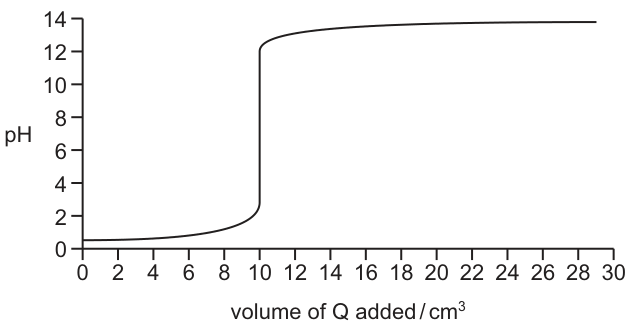
Which row gives the identity of P and Q?
Options
| P | Q | |
|---|---|---|
| A | ||
| B | ||
| C | ||
| D |
Working
- Initial pH = 1: The acid P has a concentration of 0.1 mol dm (since ). This indicates P is a strong acid. This eliminates D (CHCOOH is a weak acid, initial pH 2.8).
- Equivalence point volume = 10 cm: 20 cm of acid P is neutralised by 10 cm of alkali Q. Since they have the same concentration, the acid must provide twice as many reactive particles per mole as the base. Thus, P is monoprotic and Q is diprotic (provides 2 OH per formula unit). This eliminates A (both monoprotic, would need 20 cm) and B (HSO is diprotic, NH is monoprotic, would need 10 cm, but see next point).
- Equivalence point pH = 7: The salt formed is neutral, meaning P is a strong acid and Q is a strong base. This eliminates B (NH is a weak base, equivalence pH 7) and D (CHCOOH is a weak acid, equivalence pH 7).
- Final pH = 13: The excess alkali Q is a strong base. 0.1 mol dm Ba(OH) gives [OH] = 0.2 mol dm, so pH 13.3. This matches C.
Answer
C
C
Background Concept
A pH titration curve plots the pH of a solution against the volume of titrant added. The shape of the curve reveals the strengths of the acid and base, and the volume at the equivalence point reveals their stoichiometric ratio.
- Initial pH indicates the strength and concentration of the acid. A pH of 1 for a 0.1 mol dm solution means it is a strong monoprotic acid (fully dissociated).
- Equivalence point volume depends on the stoichiometry. For equal concentrations, the volume ratio is the inverse of the ratio of H to OH provided per formula unit.
- Equivalence point pH is 7 for strong acid + strong base, 7 for strong acid + weak base, and 7 for weak acid + strong base.
- Final pH indicates the strength and concentration of the excess titrant. A final pH of 13 for a 0.1 mol dm solution indicates a strong diprotic base (e.g., [OH] = 0.2 mol dm, pOH = 0.7, pH = 13.3).
Understanding the Question
We are given a titration curve for 20 cm of acid P titrated with alkali Q of the same concentration. We must identify P and Q from the four options based on the curve's features: initial pH, equivalence point volume, equivalence point pH, and final pH.
Approach
We will systematically check the four key features of the titration curve against the properties of the options:
- Initial pH to determine acid strength.
- Equivalence point volume to determine the proton/hydroxide ratio.
- Equivalence point pH to determine base strength.
- Final pH to confirm base strength and concentration.
Step-by-Step Reasoning
-
Initial pH = 1: The acid P is 0.1 mol dm (since ). A pH of 1 means it is fully dissociated, so P is a strong acid. This eliminates D (CHCOOH is a weak acid, its 0.1 mol dm solution would have an initial pH of about 2.8).
-
Equivalence point volume = 10 cm: 20 cm of acid P is neutralised by 10 cm of alkali Q. Since they have the same concentration (0.1 mol dm), the moles of P are twice the moles of Q (). For complete neutralisation, the total moles of H must equal the total moles of OH. Therefore, each mole of P must provide twice as many reactive particles as each mole of Q. This means P is monoprotic (1 H) and Q is diprotic (2 OH).
- A (HCl and NaOH): both monoprotic. Equivalence would be at 20 cm. Incorrect.
- B (HSO and NH): HSO is diprotic, NH is monoprotic. Equivalence would be at 10 cm, but NH is a weak base. Incorrect.
- C (HCl and Ba(OH)): HCl is monoprotic, Ba(OH) is diprotic. Equivalence is at 10 cm. Correct stoichiometry.
- D (CHCOOH and Sr(OH)): stoichiometry matches, but CHCOOH is weak. Incorrect.
-
Equivalence point pH = 7: The sharp vertical section passes exactly through pH 7. This indicates the salt formed is neutral, which only happens when a strong acid is titrated with a strong base.
- B involves NH, a weak base. The equivalence point would be acidic (pH 7) due to hydrolysis of the NH ion. Incorrect.
- D involves CHCOOH, a weak acid. The equivalence point would be basic (pH 7) due to hydrolysis of the CHCOO ion. Incorrect.
- C involves HCl (strong acid) and Ba(OH) (strong base). The equivalence point is exactly at pH 7. Correct.
-
Final pH = 13: After the equivalence point, the pH levels off at 13. This is the pH of excess 0.1 mol dm Ba(OH). Since Ba(OH) is a strong diprotic base, it fully dissociates to give [OH] = mol dm.
This matches the final pH on the curve perfectly, confirming C is correct.
Key Takeaways
- The initial pH and final pH of a titration curve immediately reveal whether the acid and base are strong or weak.
- The volume at the equivalence point relative to the initial volume of the analyte reveals the stoichiometric ratio of H to OH, allowing you to deduce if an acid or base is monoprotic, diprotic, etc.
- The pH at the equivalence point (7, 7, or 7) distinguishes between strong/weak acid and strong/weak base combinations.
Common Mistakes
- Ignoring the equivalence point volume: Many students focus only on the pH at the equivalence point and forget to check the volume. If they only look at pH 7, they might incorrectly choose A, forgetting that A would require 20 cm of NaOH, not 10 cm.
- Confusing weak base final pH: Choosing B because HSO and NH have the correct 2:1 volume ratio. However, NH is a weak base; its solution will not reach pH 13, and the equivalence point will be below pH 7.
- Misreading the initial pH: Choosing D because Sr(OH) is a strong diprotic base. However, CHCOOH is a weak acid, so its initial pH would be around 2.8, not 1.
Things to Be Careful About
- State symbols and dissociation: Remember that Ba(OH) and Sr(OH) are strong bases and fully dissociate in water to give 2 OH ions per formula unit. This doubles the [OH] and thus lowers the pOH by , raising the pH to for a 0.1 mol dm solution.
- Equivalence point vs. half-equivalence point: Do not confuse the pH at the equivalence point (where moles of H = moles of OH) with the pH at the half-equivalence point (where pH = p for a weak acid). The graph clearly shows the vertical section centered at pH 7.
- Concentration assumptions: The problem states P and Q have the same concentration. Always use this to set up the mole ratio: . If , then . This directly gives the proton/hydroxide ratio.
Photochromic glass, used for sunglasses, darkens when exposed to bright light and becomes more transparent again when the light is less bright. The darkness of the glass is due to the presence of silver atoms.
The following reactions are involved.
Which statement about these reactions is correct?
Options
A and ions act as catalysts.
B ions act as an oxidising agent in reaction 2.
C Reaction 3 increases the darkness of the glass.
D Silver atoms are reduced in reaction 3.
Working
Reaction 1:
- is reduced to (oxidation number ).
- is oxidised to (oxidation number ).
Reaction 2:
- is oxidised to (oxidation number ), so acts as a reducing agent.
- is reduced back to .
Reaction 3:
- is reduced back to (oxidation number ).
- is oxidised to (oxidation number ).
is consumed in reaction 2 and regenerated in reaction 3; is consumed in reaction 3 and regenerated in reaction 2. Neither is used up overall, so they act as catalysts.
Answer
A — and ions act as catalysts.
A
Background Concept
A catalyst is a substance that increases the rate of a reaction without being consumed overall. In a catalytic cycle, the catalyst is converted into another species in one step, but is regenerated in a later step, so its net concentration stays the same. In redox chemistry, a catalyst often shuttles between two oxidation states (here and ), accepting and donating electrons.
Oxidising agent: a species that is itself reduced (gains electrons).
Reducing agent: a species that is itself oxidised (loses electrons).
Understanding the Question
Photochromic glass darkens because silver atoms (Ag) are formed. The three reactions together describe how Ag⁺ is converted to Ag (reaction 1) and how the chlorine radical produced is dealt with. The question asks which statement about these reactions is correct. We must check each option against the oxidation-number changes in the three equations.
Approach
- Assign oxidation numbers to every species in each reaction.
- Identify which species is oxidised and which is reduced in each reaction.
- Check whether any species is consumed and later regenerated — that species is a catalyst.
- Evaluate each option (A–D) against these findings.
Step-by-Step Reasoning
Reaction 1:
- Ag goes from to : reduction (Ag⁺ is the oxidising agent).
- Cl goes from to : oxidation (Cl⁻ is the reducing agent).
Reaction 2:
- Cu goes from to : oxidation (Cu⁺ is the reducing agent).
- Cl goes from to : reduction (Cl is the oxidising agent).
Reaction 3:
- Cu goes from to : reduction (Cu²⁺ is the oxidising agent).
- Ag goes from to : oxidation (Ag is the reducing agent).
Now check the options:
A: Cu⁺ is consumed in reaction 2 but regenerated in reaction 3. Cu²⁺ is consumed in reaction 3 but regenerated in reaction 2. Neither is used up overall — they form a catalytic couple. Correct.
B: In reaction 2, Cu⁺ is oxidised (loses an electron), so it acts as a reducing agent, not an oxidising agent. Incorrect.
C: Reaction 3 converts Ag (the species that darkens the glass) into Ag⁺, so it decreases the darkness (makes the glass more transparent). Incorrect.
D: In reaction 3, Ag goes from to , so it is oxidised, not reduced. Incorrect.
Key Takeaways
- A catalyst is recognised by regeneration: it is consumed in one step and reformed in another, so it does not appear in the overall equation.
- Oxidation is loss of electrons (oxidation number increases); reduction is gain of electrons (oxidation number decreases).
- The oxidising agent is the species that gets reduced; the reducing agent is the species that gets oxidised.
Common Mistakes
- Confusing oxidising and reducing agents: remember the agent is the species that does the oxidising/reducing, which means it itself undergoes the opposite change.
- Thinking that any species appearing in multiple reactions is a catalyst — it must be regenerated, not merely present.
- Misreading reaction 3: Ag is oxidised, not reduced, so option D is a trap.
Things to Be Careful About
- Pay attention to the direction of each reaction: reaction 1 is reversible, but the others are shown as one-way.
- The darkness of the glass is due to Ag atoms, so any reaction that removes Ag (reaction 3) lightens the glass, not darkens it.
- In option B, the word "oxidising" is the trap — Cu⁺ is actually the reducing agent in reaction 2.
The reversible reaction between methanol and ethanoic acid liquids is catalysed by adding a small volume of concentrated sulfuric acid.
Two statements about this reaction are listed.
- The sulfuric acid is a homogeneous catalyst.
- The sulfuric acid lowers the activation energy of the reverse reaction.
Which statements are correct?
Options
A both 1 and 2
B 1 only
C 2 only
D neither 1 nor 2
Working
A catalyst is homogeneous when it is in the same phase as the reactants. Here methanol and ethanoic acid are liquids and concentrated sulfuric acid is also a liquid, so the sulfuric acid is a homogeneous catalyst.
A catalyst lowers the activation energy of both the forward and the reverse reaction by providing an alternative reaction pathway. Therefore statement 2 is also correct.
Answer
A (both 1 and 2)
A
Background Concept
A catalyst speeds up a reaction by providing an alternative pathway with a lower activation energy. It is not consumed in the reaction. Catalysts can be classified by phase: a homogeneous catalyst is in the same phase as the reactants, while a heterogeneous catalyst is in a different phase, often a solid with liquid or gaseous reactants.
Crucially, a catalyst lowers the activation energy for both the forward and the reverse reaction by the same amount. This is why a catalyst does not change the position of equilibrium: it speeds up the rate at which equilibrium is reached, but the equilibrium composition itself is unchanged.
Understanding the Question
The question describes the reversible esterification of methanol with ethanoic acid, both liquids, catalysed by adding a small volume of concentrated sulfuric acid. Two statements are given:
- The sulfuric acid is a homogeneous catalyst.
- The sulfuric acid lowers the activation energy of the reverse reaction.
We must decide whether each statement is correct. The reaction itself is:
The command is to evaluate both statements, so both must be tested independently.
Approach
For statement 1, compare the physical state of the catalyst with the physical state of the reactants. If all are liquids, the catalyst is homogeneous.
For statement 2, recall the fundamental action of a catalyst: it lowers the activation energy of the reaction. Because the reaction is reversible, this applies to both the forward and reverse directions. A catalyst does not favour one direction over the other.
Step-by-Step Reasoning
Statement 1: The sulfuric acid is a homogeneous catalyst.
Methanol and ethanoic acid are both liquids. Concentrated sulfuric acid is also a liquid, and it mixes with the reactants to form a single liquid phase. Since the catalyst is in the same phase as the reactants, it is a homogeneous catalyst. Statement 1 is correct.
Statement 2: The sulfuric acid lowers the activation energy of the reverse reaction.
A catalyst lowers the activation energy of a reaction by providing an alternative pathway. For a reversible reaction, the same alternative pathway applies in both directions. Therefore the activation energy of the reverse reaction is lowered, just as the activation energy of the forward reaction is lowered. Statement 2 is correct.
Since both statements are correct, the answer is A.
Key Takeaways
- A homogeneous catalyst is in the same phase as the reactants.
- A catalyst lowers the activation energy of both the forward and reverse reactions.
- A catalyst does not change the equilibrium position; it only helps equilibrium be reached faster.
Common Mistakes
- Thinking that because sulfuric acid is a strong acid it must be a heterogeneous catalyst if it is "added" to the reaction. The key is phase, not how it is added.
- Believing a catalyst only affects the forward reaction. This is incorrect: it affects both directions equally.
- Confusing a catalyst with a reactant that shifts the equilibrium. A catalyst does not alter the position of equilibrium.
Things to Be Careful About
- Always compare the phase of the catalyst with the phase of the reactants when deciding between homogeneous and heterogeneous.
- The phrase "lowers activation energy" should be understood as applying to both the forward and reverse reactions unless the question specifically states otherwise.
- Concentrated sulfuric acid in esterification can also act as a dehydrating agent, but in this context it is functioning as a catalyst. The question only asks about catalysis.
The atomic radii and ionic radii for three elements in Period 3 are shown.
| atomic radius / nm | ionic radius / nm | |
|---|---|---|
| element X | 0.118 | 0.053 |
| element Y | 0.099 | 0.180 |
| element Z | 0.160 | 0.072 |
Using this data, which statement is correct?
Options
A Element X has lower electrical conductivity than element Y.
B Element Y has a higher melting point than element X.
C Element Y and element Z react to form an ionic compound.
D Element Z forms ionic compounds by gaining electrons.
Working
A cation is smaller than its atom; an anion is larger than its atom.
- X: ionic 0.053 nm < atomic 0.118 nm → cation → metal → Al
- Y: ionic 0.180 nm > atomic 0.099 nm → anion → non-metal → Cl
- Z: ionic 0.072 nm < atomic 0.160 nm → cation → metal → Mg
C — Mg (metal) and Cl (non-metal) react to form , an ionic compound. This is correct.
A — Al (metallic, delocalised electrons) conducts better than Cl (molecular). False.
B — Cl (simple molecular) has a lower melting point than Al (giant metallic lattice). False.
D — Mg forms ions by losing electrons, not gaining them. False.
Answer
C
C
Background Concept
Across Period 3 (Na → Ar), atomic radius decreases steadily because the nuclear charge increases while the shielding provided by the inner shells stays essentially the same, so the outer electrons are pulled progressively closer to the nucleus.
The key idea for this question is what happens to radius when an atom forms an ion:
- A metal atom loses its outer-shell electrons to form a cation. The entire outer shell is removed, and the remaining electrons are held more tightly by the same nucleus, so the cation is much smaller than the neutral atom.
- A non-metal atom gains electrons to form an anion. The extra electrons increase electron–electron repulsion and reduce the effective pull per electron, so the anion is larger than the neutral atom.
So the sign of the change (ionic radius < atomic radius, or >) immediately tells you whether the element forms a cation (metal) or an anion (non-metal).
Understanding the Question
The table gives atomic and ionic radii for three un-named Period 3 elements, X, Y and Z. We must identify them and then judge four statements about electrical conductivity, melting point, ionic compound formation and electron transfer. The whole question hinges on correctly identifying the three elements from the radii, because each statement is about a specific element.
Approach
- For each element, compare ionic radius with atomic radius to decide cation or anion.
- Match the values to a known Period 3 element (the values here correspond to Al, Cl and Mg).
- Test each statement A–D against the known structure and bonding of the identified elements.
Step-by-Step Reasoning
Element X: atomic radius 0.118 nm, ionic radius 0.053 nm. The ion is much smaller than the atom, so X forms a cation and is a metal. The ionic radius of 0.053 nm matches (about 0.054 nm), so X = Al.
Element Y: atomic radius 0.099 nm, ionic radius 0.180 nm. The ion is larger than the atom, so Y forms an anion and is a non-metal. The ionic radius of 0.180 nm matches (about 0.181 nm), so Y = Cl.
Element Z: atomic radius 0.160 nm, ionic radius 0.072 nm. The ion is smaller than the atom, so Z forms a cation and is a metal. The ionic radius of 0.072 nm matches (about 0.072 nm), so Z = Mg.
Now test each statement:
A — "Element X has lower electrical conductivity than element Y." X = Al, a metal with a giant metallic lattice and delocalised electrons — an excellent conductor. Y = Cl, which exists as , a simple molecular substance with no free charge carriers — a very poor conductor. So Al actually has much higher conductivity. False.
B — "Element Y has a higher melting point than element X." Y = , held together only by weak van der Waals forces — low melting point. X = Al, a giant metallic lattice with strong metallic bonding — high melting point. So has the lower melting point. False.
C — "Element Y and element Z react to form an ionic compound." Y = Cl (non-metal), Z = Mg (metal). Magnesium reacts with chlorine to give : . Because it is a metal reacting with a non-metal, the compound is ionic ( and ions). True — this is the correct answer.
D — "Element Z forms ionic compounds by gaining electrons." Z = Mg, a metal. Metals form ionic compounds by losing their outer electrons to become cations (). They never gain electrons to form anions. False.
The only correct statement is C.
Key Takeaways
- If ionic radius < atomic radius, the element forms a cation (metal); if ionic radius > atomic radius, it forms an anion (non-metal).
- Metal + non-metal → ionic compound; the metal loses electrons, the non-metal gains them.
- Metals conduct electricity (delocalised electrons) and have high melting points; simple molecular non-metals are poor conductors with low melting points.
Common Mistakes
- Misreading which element is which: e.g. assuming the smallest atomic radius is the metal, or confusing Al and Mg.
- Forgetting that a cation is smaller than its atom and an anion is larger — this is the whole key to the identification.
- Thinking metals gain electrons; metals always lose electrons to form cations.
- Confusing melting point trends: metallic lattices melt high, molecular substances melt low.
Things to Be Careful About
- Always compare ionic radius with the atomic radius of the SAME element, not with another element's value.
- The identification relies on matching both the trend (cation/anion) and the numerical values to the known Period 3 elements.
- For statement C, recognise that a metal reacting with a non-metal always gives an ionic compound.
Three equations are listed. and are all whole numbers.
Which equations can be balanced if and ?
Options
A 1 and 3
B 1 only
C 2 only
D 3 only
Working
Equation 1: xAl + yO2 -> zAl2O3 with x = 4, z = 2
4Al + yO2 -> 2Al2O3
Al: 4 = 4, so Al balances.
O: 2y = 6, so y = 3.
Balanced: 4Al + 3O2 -> 2Al2O3. Yes.
Equation 2: xMg + yO2 -> zMgO with x = 4, z = 2
4Mg + yO2 -> 2MgO
Mg: 4 = 2, so Mg does not balance.
Not possible. No.
Equation 3: xNa + yO2 -> zNa2O with x = 4, z = 2
4Na + yO2 -> 2Na2O
Na: 4 = 4, so Na balances.
O: 2y = 2, so y = 1.
Balanced: 4Na + O2 -> 2Na2O. Yes.
Answer
A (equations 1 and 3)
A
Background Concept
A balanced chemical equation must have the same number of atoms of each element on both sides. Coefficients are whole numbers placed in front of formulae; they multiply every atom in that formula. Oxygen appears as O2, so a coefficient of y on O2 contributes 2y oxygen atoms.
Understanding the Question
We are told x = 4 and z = 2. For each equation, we must decide whether there is a whole-number value of y that makes the equation balance. We do not need to find the smallest possible coefficients; we only need to see if balancing is possible with x = 4 and z = 2.
Approach
Substitute x = 4 and z = 2 into each equation. Then compare the number of metal atoms on each side, and use the oxygen atoms to solve for y. If any element has unequal atom counts and cannot be fixed by changing y, the equation cannot be balanced under the given conditions.
Step-by-Step Reasoning
-
Equation 1: 4Al + yO2 -> 2Al2O3
- Aluminium: left = 4, right = 4. Aluminium balances.
- Oxygen: left = 2y, right = 2 × 3 = 6. So 2y = 6, giving y = 3.
- Balanced equation: 4Al + 3O2 -> 2Al2O3.
-
Equation 2: 4Mg + yO2 -> 2MgO
- Magnesium: left = 4, right = 2. These are unequal.
- Oxygen: left = 2y, right = 2. Oxygen would require y = 1, but the magnesium mismatch cannot be corrected by changing y because z is fixed at 2.
- So equation 2 cannot be balanced with x = 4 and z = 2.
-
Equation 3: 4Na + yO2 -> 2Na2O
- Sodium: left = 4, right = 2 × 2 = 4. Sodium balances.
- Oxygen: left = 2y, right = 2. So 2y = 2, giving y = 1.
- Balanced equation: 4Na + O2 -> 2Na2O.
Therefore equations 1 and 3 can be balanced, and the correct option is A.
Key Takeaways
- Always count atoms of every element on both sides, not just the element that looks most obvious.
- A coefficient in front of a formula multiplies every atom in that formula.
- Oxygen gas is diatomic, so yO2 contributes 2y oxygen atoms.
- If one element cannot be balanced because a coefficient is fixed, the equation is not balanced under those conditions.
Common Mistakes
- Choosing option C because equation 2 looks similar to equation 1. The key difference is that MgO contains one Mg per formula unit, while Al2O3 contains two Al atoms per formula unit.
- Forgetting that O2 is diatomic and has two oxygen atoms per molecule.
- Assuming that because y can be chosen freely, any equation can be balanced. Here x and z are fixed, so the metal atom count must already match.
Things to Be Careful About
- The coefficients x, y and z are all whole numbers; y must come out as a whole number.
- Check every element separately: aluminium/magnesium/sodium and oxygen.
- The balanced equations here are not the smallest whole-number ratios, but that is not required by the question.
- When substituting x = 4 and z = 2, make sure you apply z to the whole formula, e.g. 2Al2O3 contains 4 Al and 6 O atoms.
Which oxide has a simple structure rather than a giant structure?
Options
A
B
C
D
Working
- : giant ionic lattice.
- : giant ionic lattice.
- : giant covalent (macromolecular) structure.
- : discrete molecules held by van der Waals' forces, so simple molecular structure.
Answer
D
D
Background Concept
Solids can be classified by the way their particles are arranged. In a giant structure the atoms or ions are held in an extended network that repeats throughout the whole crystal. Examples are giant ionic lattices, giant metallic lattices and giant covalent (macromolecular) structures. In a simple molecular structure the substance is made of discrete, small molecules; strong covalent bonds hold the atoms together inside each molecule, but only weak van der Waals' forces act between molecules. The question uses 'simple structure' to mean this molecular type.
Understanding the Question
This is a one-mark recall question. It asks you to look at four oxides of elements from Period 3 and decide which one is not built as a giant lattice or network. The key distinction is between an extended structure (ionic or covalent network) and discrete molecules.
Approach
Recall the structure of each oxide:
- and are metal oxides, so they form giant ionic lattices.
- is a covalent oxide of a metalloid, but it forms a giant covalent network, not molecules.
- is a covalent oxide of a non-metal and exists as discrete molecules.
The only one with a simple molecular structure is therefore .
Step-by-Step Reasoning
A – : Magnesium is a metal and oxygen is a non-metal. The large electronegativity difference leads to formation of and ions arranged in a giant ionic lattice. This is not a simple structure.
B – : Aluminium oxide is also an ionic compound, with and ions in a giant lattice. Although it has some covalent character because of the high charge density of , it is still classified as a giant ionic structure.
C – : Silicon dioxide is a giant covalent (macromolecular) structure. Each silicon atom is bonded to four oxygen atoms and each oxygen atom is bonded to two silicon atoms, forming an infinite three-dimensional network. It is covalent, but it is not molecular.
D – : Phosphorus(V) oxide consists of discrete molecules. Within each molecule the atoms are joined by covalent bonds, but between molecules only weak van der Waals' forces exist. This is a simple molecular structure.
Therefore the correct option is D.
Key Takeaways
- 'Giant' means an extended lattice or network; 'simple' means discrete molecules.
- Metal oxides are usually giant ionic; non-metal oxides are usually simple molecular.
- Silicon dioxide is an important exception: it is covalent but giant, not molecular.
- Across Period 3, oxide structure changes from giant ionic to giant covalent to simple molecular as the element changes from metal to non-metal.
Common Mistakes
- Choosing because it is covalent. Covalent does not mean molecular: diamond, graphite and are giant covalent structures.
- Thinking all ionic compounds are 'simple' because the formula is simple. has a simple formula but a giant lattice.
- Confusing the empirical formula with the molecular formula . The oxide is molecular and its molecules contain four P atoms and ten O atoms.
Things to Be Careful About
- Use the exact term 'simple molecular structure' rather than just 'covalent', because covalent substances can be giant.
- Remember that van der Waals' forces between molecules are weak, which explains its relatively low melting/sublimation point compared with giant structures.
- The question asks for the oxide with a simple structure, not the oxide with the lowest oxidation state or the most acidic behaviour. Stick to structure and bonding.
The trends seen in Group 2 can be used to predict the properties of radium and its compounds.
Which statement is correct?
Options
A Radium has the highest second ionisation energy of the elements in Group 2.
B Radium hydroxide is the least soluble of the hydroxides of the elements in Group 2.
C Radium carbonate has the lowest thermal stability of the carbonates of the elements in Group 2.
D Radium reacts faster with water than the other elements in Group 2.
Working
- Down Group 2, both first and second ionisation energies decrease, so radium has the lowest second ionisation energy, not the highest. A is false.
- Solubility of Group 2 hydroxides increases down the group, so radium hydroxide is the most soluble, not the least. B is false.
- Thermal stability of Group 2 carbonates increases down the group, so radium carbonate is the most stable, not the least stable. C is false.
- Reactivity with water increases down Group 2, so radium reacts fastest with water. D is true.
Answer
D
D
Background Concept
Group 2 elements (beryllium, magnesium, calcium, strontium, barium, radium) show regular trends down the group. Atomic radius increases, ionisation energies decrease, reactivity with water increases, hydroxides become more soluble, and carbonates become more thermally stable. Radium is at the bottom of Group 2, so its properties should be the extreme version of these trends.
Understanding the Question
The question asks which statement about radium is correct, based on the trends seen in Group 2. Each option tests a different property: second ionisation energy, hydroxide solubility, carbonate thermal stability, and reactivity with water. We need to recall the direction of each trend and apply it to radium.
Approach
For each option, recall the relevant Group 2 trend and decide whether the statement about radium matches the expected extreme. Eliminate the false statements and select the one that is true.
Step-by-Step Reasoning
-
Option A: Second ionisation energy
- Down Group 2, the atomic radius increases and there is more electron shielding.
- The outer electrons are further from the nucleus and less strongly attracted, so ionisation energies decrease down the group.
- Radium, being at the bottom, has the lowest second ionisation energy, not the highest.
- Therefore, A is false.
-
Option B: Solubility of hydroxides
- The solubility of Group 2 hydroxides increases down the group.
- For example, Mg(OH)2 is sparingly soluble, Ca(OH)2 is slightly soluble, and Ba(OH)2 is soluble.
- Radium hydroxide should therefore be the most soluble hydroxide, not the least.
- Therefore, B is false.
-
Option C: Thermal stability of carbonates
- The thermal stability of Group 2 carbonates increases down the group.
- Magnesium carbonate decomposes relatively easily, while barium carbonate requires a very high temperature.
- The larger cation in radium carbonate is less polarising, so the carbonate ion is less distorted and more stable.
- Radium carbonate should therefore have the highest thermal stability, not the lowest.
- Therefore, C is false.
-
Option D: Reactivity with water
- Reactivity with water increases down Group 2.
- This is because ionisation energies decrease, making it easier for the metal to lose electrons and form positive ions.
- Radium, at the bottom of the group, should react fastest with water.
- Therefore, D is true.
Key Takeaways
- Group 2 trends are regular, so the properties of radium can be predicted by extending the trends to the bottom of the group.
- Ionisation energies decrease down Group 2.
- Hydroxide solubility increases down Group 2.
- Carbonate thermal stability increases down Group 2.
- Reactivity with water increases down Group 2.
Common Mistakes
- Thinking that ionisation energy increases down a group because the nuclear charge increases. The increase in atomic radius and shielding is more important, so ionisation energy actually decreases.
- Confusing hydroxide solubility with sulfate solubility. In Group 2, hydroxide solubility increases down the group, but sulfate solubility decreases down the group.
- Thinking that larger cations make carbonates less stable. In fact, larger cations are less polarising, so the carbonate ion is more stable.
Things to Be Careful About
- Read the wording carefully: "least soluble" is the opposite of the actual trend for radium hydroxide.
- "Lowest thermal stability" is the opposite of the actual trend for radium carbonate.
- "Highest second ionisation energy" is the opposite of the actual trend for radium.
- "Reacts faster" matches the actual trend for radium with water.
Equal masses of , , and are thermally decomposed. The volume of gas produced in each experiment is measured under the same conditions.
Which compound will produce the greatest volume of gas?
Options
A
B
C
D
Working
Thermal decomposition equations:
Molar masses: CaCO = 100, Ca(NO) = 164, BaCO = 197, Ba(NO) = 261.
Moles of gas per gram of compound:
Ca(NO) gives the greatest volume of gas.
Answer
B (Ca(NO))
B
Background Concept
Thermal decomposition is the breakdown of a compound by heat. Two important decompositions appear here:
- Group 2 carbonates decompose to the metal oxide and carbon dioxide:
- Group 2 nitrates decompose to the metal oxide, nitrogen dioxide and oxygen:
Understanding the Question
Four different compounds are decomposed, each with the same mass. The gas volume is measured under the same conditions. By Avogadro's law, equal volumes of gases at the same temperature and pressure contain equal numbers of moles. So the greatest volume of gas corresponds to the greatest number of moles of gas produced.
Because the masses are equal (not the number of moles), you cannot simply compare gas produced per mole of compound — you must compare gas produced per gram of compound.
Approach
- Write balanced decomposition equations.
- Determine moles of gas per mole of compound.
- Divide by molar mass to get moles of gas per gram.
- Compare the four values.
Step-by-Step Reasoning
- Carbonates: and . Each gives 1 mole of gas per mole of compound.
- Nitrates: and similarly for Ba. Per mole of nitrate, 2 moles NO + 0.5 mole O = 2.5 moles gas.
- Molar masses: CaCO = 100, Ca(NO) = 164, BaCO = 197, Ba(NO) = 261.
- Moles of gas per gram:
- CaCO: 1/100 = 0.0100
- Ca(NO): 2.5/164 = 0.0152
- BaCO: 1/197 = 0.00508
- Ba(NO): 2.5/261 = 0.00958
- The largest value is Ca(NO), so the answer is B.
Key Takeaways
- Gas volume at fixed conditions is proportional to moles of gas.
- Equal masses ≠ equal moles; always convert to moles.
- Nitrate decomposition produces more moles of gas per mole than carbonate decomposition.
Common Mistakes
- Comparing gas per mole instead of per gram — forgetting the masses are equal, not the moles.
- Using the wrong decomposition products for nitrates (e.g., forgetting O, or writing NO instead of NO).
- Arithmetic errors in molar masses.
Things to Be Careful About
- Use the molar mass correctly: Ca(NO) = 40 + 2(14) + 6(16) = 164.
- Remember the nitrate decomposition gives 2.5 moles of gas per mole of nitrate.
- The answer is the compound with the highest gas-per-gram ratio, not necessarily the one with the lowest molar mass or the most gas per mole.
Equation 1 and equation 2 show two different reactions of halide ion with concentrated sulfuric acid.
What is Q?
Options
A or
B or
C only
D only
Working
Equation 2 is a redox reaction: is oxidised to , and sulfur in is reduced from +6 to +4 in .
For this to happen, must be a strong enough reducing agent. Reducing power of halide ions increases down Group 17: . Chloride is too weak to reduce concentrated sulfuric acid, so only and fit equation 2.
Answer
B: or
B
Background Concept
When concentrated sulfuric acid is added to solid halides, two types of reaction can occur.
First, an acid-base reaction: protonates the halide ion to give the hydrogen halide and .
This happens for all halide ions. For chloride, the reaction stops here. For bromide and iodide, however, the hydrogen halide formed can further reduce the sulfuric acid because and are reducing agents.
Concentrated sulfuric acid contains sulfur in the +6 oxidation state. It can be reduced to (sulfur +4), to sulfur (0), or to (sulfur -2), depending on the strength of the reducing agent. In equation 2, the reduction product is and the halide is oxidised to the halogen .
The reducing power of halide ions increases down Group 17: . A larger halide ion holds its outer electrons less tightly, so it loses an electron more easily. Therefore only and are strong enough to reduce concentrated sulfuric acid to ; is not.
Understanding the Question
The question gives two equations for the reaction of a halide ion with concentrated sulfuric acid. Equation 1 is an acid-base reaction forming the hydrogen halide. Equation 2 is a redox reaction in which and are formed.
The task is to decide which halide ion(s) can undergo both reactions. The key is to recognise that equation 2 requires the halide ion to be a strong enough reducing agent to reduce to . The options test whether can do this as well as and .
Approach
- Identify equation 2 as a redox reaction by assigning oxidation states.
- Determine what is oxidised and what is reduced.
- Recall the trend in reducing power of halide ions down Group 17.
- Apply the trend: only halides strong enough to reduce to fit equation 2.
- Select the option that contains exactly those halides.
Step-by-Step Reasoning
-
Assign oxidation states in equation 2.
In , hydrogen is +1 and oxygen is -2, so sulfur is +6.
In , oxygen is -2, so sulfur is +4.
Sulfur is therefore reduced from +6 to +4, gaining two electrons per formed.In , the halide has oxidation state -1. In , each halogen atom has oxidation state 0. Each therefore loses one electron.
-
Write the two half-equations to confirm the electron transfer.
Oxidation:
Reduction:
This matches equation 2 exactly: one accepts two electrons, and two ions supply them.
-
Recall the reducing power trend.
Down Group 17, the halide ions become larger and their outer electrons are less strongly attracted to the nucleus. This makes electron loss easier, so reducing power increases: .
-
Apply the trend to the reaction with concentrated sulfuric acid.
- With , only equation 1 occurs: is formed, but is too weak a reducing agent to reduce . No or is formed from this redox step.
- With , is formed first, then some reduces to , forming .
- With , is formed first, then reduces . is one possible reduction product, along with sulfur and hydrogen sulfide depending on conditions.
-
Therefore can be or , but not .
Option A includes , so it is wrong.
Option C says only, which is wrong.
Option D says only, which is too narrow because also fits.
Option B correctly states or .
Key Takeaways
- Halide ions react with concentrated sulfuric acid in two ways: acid-base and redox.
- All halides form the hydrogen halide first, but only stronger reducing agents such as and reduce the sulfuric acid further.
- Reducing power increases down Group 17 because larger ions lose electrons more easily.
- When interpreting a reaction, assign oxidation states to identify what is oxidised and what is reduced.
Common Mistakes
- Assuming all halide ions reduce concentrated sulfuric acid. Chloride does not; it only forms .
- Confusing reducing power with oxidising power. Halogens are oxidising agents; halide ions are reducing agents.
- Choosing only because iodide is the strongest reducing agent. The question asks which halides can reduce to , and bromide also does this.
- Ignoring the product in equation 2. If were , the equation would require formation, which does not happen with concentrated sulfuric acid.
Things to Be Careful About
- Oxidation states: sulfur goes from +6 in to +4 in ; the halide goes from -1 in to 0 in .
- The stoichiometry of equation 2: two ions are needed because each loses one electron, while one molecule gains two electrons.
- Concentrated sulfuric acid can be reduced to , sulfur, or . For bromide, is the main reduction product; for iodide, further reduction can occur, but is still a valid product.
- The correct answer is the pair or , not just iodide alone.
What happens when iodine solution is added to a solution of sodium bromide?
Options
A A reaction occurs without changes in oxidation state.
B Bromide ions are oxidised; iodine atoms are reduced.
C Bromide ions are reduced; iodine atoms are oxidised.
D No reaction occurs.
Working
Iodine is below bromine in Group 17, so it is a weaker oxidising agent than bromine. It cannot oxidise bromide ions to bromine; the feasible displacement is the reverse reaction:
Answer
D — No reaction occurs.
D
Background Concept
Halogens act as oxidising agents because each halogen molecule gains electrons to form halide ions, e.g. . The strength of the halogens as oxidising agents decreases down Group 17: . This is because atomic radius increases down the group and the incoming electron is less strongly attracted to the nucleus, so the gain of an electron becomes less energetically favourable. As a result, a more reactive halogen can displace a less reactive halide ion from its salt solution, whereas a less reactive halogen cannot displace a more reactive halide.
Understanding the Question
The question asks what happens when iodine solution is added to a solution of sodium bromide. Sodium bromide provides bromide ions, , and iodine solution provides iodine molecules, . The options ask whether a reaction occurs and, if so, which species is oxidised and which is reduced. The key is to decide whether iodine is a strong enough oxidising agent to oxidise bromide ions to bromine.
Approach
Write the displacement reaction that would occur if iodine oxidised bromide ions:
Then compare the oxidising strengths of iodine and bromine. Because bromine is above iodine in Group 17, bromine is the stronger oxidising agent. That means the reverse reaction — bromine oxidising iodide ions — is the feasible one, and the forward reaction above does not occur. Therefore no reaction takes place when iodine solution is added to sodium bromide.
Step-by-Step Reasoning
- Identify the possible redox reaction: iodine would need to be reduced to iodide ions, and bromide ions would need to be oxidised to bromine.
- Recall the order of oxidising power of the halogens: .
- Since bromine is a stronger oxidising agent than iodine, iodine cannot remove electrons from bromide ions.
- The feasible displacement is the opposite one: bromine water oxidises iodide ions to iodine:
- Hence no reaction occurs when iodine solution is added to sodium bromide, so option D is correct.
- Options B and C are incorrect because they assume a reaction occurs. Option A is also incorrect because the question asks what happens, and the correct answer is that nothing happens.
Key Takeaways
- Halogen displacement reactions are redox reactions controlled by relative oxidising strength.
- The order of oxidising power of halogens is .
- A halogen can only displace a halide ion of a halogen below it in the group; iodine cannot displace bromide or chloride ions.
Common Mistakes
- Assuming that any halogen reacts with any halide solution. The reaction only occurs if the added halogen is a stronger oxidising agent than the halide ion present.
- Confusing the direction of the reaction: iodine is below bromine, so it cannot oxidise bromide ions.
- Misidentifying oxidation and reduction: if the reaction did occur, bromide ions would be oxidised and iodine molecules reduced, but it does not occur.
- Treating iodine as atoms rather than molecules; iodine exists as molecules in solution.
Things to Be Careful About
- The reducing power of halide ions is the reverse of the oxidising power of the halogens: is the strongest reducing agent among the halide ions.
- The question asks specifically what happens, so the answer must state that no reaction occurs, not merely that iodine is a weaker oxidising agent.
- In a displacement reaction, the halogen is reduced and the halide ion is oxidised; keep the electron transfer labels consistent if a reaction does occur.
Which statement is correct?
Options
A Nitrogen is unreactive due to the absence of lone pairs in the molecule.
B Aqueous ammonia contains both and . The ion is a Brønsted–Lowry acid.
C High temperatures are needed to supply the energy to break the strong double bonds in nitrogen molecules when they react.
D Atmospheric reacts with unburnt hydrocarbons to form a component of photochemical smog.
Working
- A is incorrect. has lone pairs on each nitrogen atom; its unreactivity is due to the very strong triple bond, not the absence of lone pairs.
- B is correct. In water, ammonia acts as a weak base: The ion can donate a proton, so it is a Brønsted–Lowry acid.
- C is incorrect. Nitrogen molecules contain a strong triple bond, not a double bond.
- D is incorrect. Photochemical smog is formed from nitrogen oxides and unburnt hydrocarbons in sunlight; is mainly linked to acid rain.
Answer
B
B
Background Concept
Nitrogen gas, , is a diatomic molecule held together by a very strong triple bond (). Its bond enthalpy is about 945 kJ mol, so a large amount of energy is needed to break the molecule apart before it can react. This gives nitrogen a high activation energy and makes it kinetically unreactive at room temperature, even though each nitrogen atom carries a lone pair of electrons.
Ammonia is a weak base. When dissolved in water, it accepts a proton from water, forming ammonium ions and hydroxide ions in an equilibrium. According to the Brønsted–Lowry theory, an acid is a proton donor and a base is a proton acceptor. In this equilibrium, accepts a proton, so it is the base, while can donate a proton, so it is the conjugate acid.
Photochemical smog is a mixture of pollutants formed when nitrogen oxides and unburnt hydrocarbons react in the presence of sunlight. A typical component is PAN (peroxyacetyl nitrate). Sulfur dioxide, , is mainly responsible for acid rain rather than photochemical smog.
Understanding the Question
This is a multiple-choice question asking which single statement is correct. Four statements are given, each testing a different idea: the reason for nitrogen's unreactivity, the acid–base behaviour of ammonia and ammonium ions, the bond order in nitrogen, and the chemistry of atmospheric pollutants. The correct statement must be identified by checking each one against established chemical facts.
Approach
The best strategy is to evaluate each statement independently and eliminate those that contain a factual error. Statement B should be checked carefully because it involves the Brønsted–Lowry definition, which is often tested. The other three statements can be rejected by recalling the structure of nitrogen, the conditions of the Haber process, and the origin of photochemical smog.
Step-by-Step Reasoning
-
Statement A: Nitrogen is unreactive, but not because it lacks lone pairs. Each nitrogen atom in has a lone pair. The unreactivity arises from the very strong triple bond between the two nitrogen atoms, which means a high activation energy must be overcome for reaction to occur. Therefore A is false.
-
Statement B: When ammonia dissolves in water, it establishes the equilibrium:
This shows that aqueous ammonia contains both and . The ion can donate a proton to a base, so it is a Brønsted–Lowry acid. Therefore B is correct.
-
Statement C: The nitrogen molecule contains a triple bond, not a double bond. High temperatures are used in processes such as the Haber process to provide enough energy for molecules to overcome the high activation energy, but the statement is wrong because it refers to “double bonds”. Therefore C is false.
-
Statement D: Photochemical smog is formed by reactions involving nitrogen oxides and unburnt hydrocarbons in sunlight. Sulfur dioxide does not react with unburnt hydrocarbons to form photochemical smog; it is more closely associated with acid rain. Therefore D is false.
Since only statement B is correct, the answer is B.
Key Takeaways
- Nitrogen is kinetically unreactive because of its strong triple bond, not because of any absence of lone pairs.
- Ammonia is a weak base; its conjugate acid is the ammonium ion, .
- A Brønsted–Lowry acid is a proton donor, and a Brønsted–Lowry base is a proton acceptor.
- Photochemical smog is linked to nitrogen oxides and hydrocarbons, while is mainly associated with acid rain.
Common Mistakes
- Confusing the triple bond in nitrogen with a double bond. The bond order in is three, not two.
- Thinking that nitrogen's unreactivity is due to a lack of lone pairs. In fact, each nitrogen atom has a lone pair.
- Describing as an acid. In water, ammonia acts as a base; it is that acts as the acid.
- Attributing photochemical smog to . Sulfur dioxide is mainly responsible for acid rain, not photochemical smog.
Things to Be Careful About
- Use the correct Brønsted–Lowry definitions: acid = proton donor, base = proton acceptor.
- Include state symbols when writing the equilibrium for ammonia in water.
- Read the wording of each statement carefully; in C, the word “double” is the key error.
- Remember that high temperature in the Haber process is used to increase the rate by helping molecules overcome the activation energy, not simply to break a bond in isolation.
When dry ammonia and hydrogen chloride gases are mixed, a solid white ionic compound is formed.
Two statements are listed.
- The formation of the ionic compound is a redox reaction.
- During the formation of the ionic compound, the H–N–H bond angle increases.
Which statements are correct?
Options
A both 1 and 2
B 1 only
C 2 only
D neither 1 nor 2
Working
Oxidation numbers are unchanged: N remains , H remains , Cl remains . So statement 1 is false.
is trigonal pyramidal with one lone pair, H–N–H angle . is tetrahedral with no lone pairs, H–N–H angle . The angle increases, so statement 2 is true.
Answer
C (2 only)
C
Background Concept
Ammonia and hydrogen chloride react by proton transfer:
The lone pair on nitrogen accepts a proton () from HCl, forming a coordinate (dative covalent) bond. The product is an ionic lattice of and ions.
A redox reaction is one in which oxidation numbers change: one species is oxidised, so its oxidation number increases, and another is reduced, so its oxidation number decreases. An acid–base or proton-transfer reaction is not automatically redox.
VSEPR theory says that electron pairs around a central atom repel and arrange themselves to minimise repulsion. A molecule with four bonding pairs and no lone pairs is tetrahedral, with bond angle . A molecule with three bonding pairs and one lone pair is trigonal pyramidal; the lone pair repels more strongly than a bonding pair, compressing the bond angle to about .
Understanding the Question
The question asks us to judge two statements about :
- Is this a redox reaction?
- Does the H–N–H bond angle increase when forms?
Both statements must be tested independently. The correct option is the one that matches the truth values of the two statements.
Approach
Check statement 1 by assigning oxidation numbers to every atom in reactants and products. If no oxidation number changes, the reaction is not redox.
Check statement 2 by comparing the electron-pair geometry of and . Count lone pairs and bonding pairs around nitrogen in each species, then recall the effect of lone-pair repulsion on bond angles.
Step-by-Step Reasoning
Statement 1: In , H is and N is , since gives . In , H is still ; with four H atoms, , so . In , H is and Cl is ; in , Cl remains . No element changes oxidation number, so no oxidation or reduction occurs. Statement 1 is false. The reaction is a proton transfer forming a coordinate bond, not a redox reaction.
Statement 2: has three N–H bonding pairs and one lone pair on N. VSEPR gives a trigonal pyramidal shape, with the H–N–H angle compressed from the ideal tetrahedral value to about because a lone pair repels more than a bonding pair. In , the lone pair has been used to form the fourth N–H bond, so there are four bonding pairs and no lone pairs. The shape is tetrahedral, with H–N–H angle . Since , the bond angle increases. Statement 2 is true.
Only statement 2 is correct, so the answer is C.
Key Takeaways
- Formation of an ionic compound does not imply redox; always check oxidation numbers.
- Acid–base reactions involving proton transfer and coordinate bond formation are not redox.
- VSEPR: lone pairs repel more strongly than bonding pairs, so they reduce bond angles from the ideal geometry.
- : trigonal pyramidal, about ; : tetrahedral, .
Common Mistakes
- Assuming that because an ionic compound forms, electrons must have been transferred. Here the change is proton transfer, not electron transfer.
- Thinking the H–N–H angle decreases because an extra H atom “crowds” the molecule. In fact, adding the fourth bond removes the lone pair, so repulsion is more symmetric and the angle increases to the full tetrahedral value.
- Confusing the shapes: is not tetrahedral; it is trigonal pyramidal.
Things to Be Careful About
- State symbols: the reaction is .
- Oxidation number of N in is , not or ; account for the overall charge.
- Use the correct bond-angle values: about for and for .
- In an MCQ, evaluate each statement separately before choosing the option.
The diagrams show skeletal formulas of some isomers of .
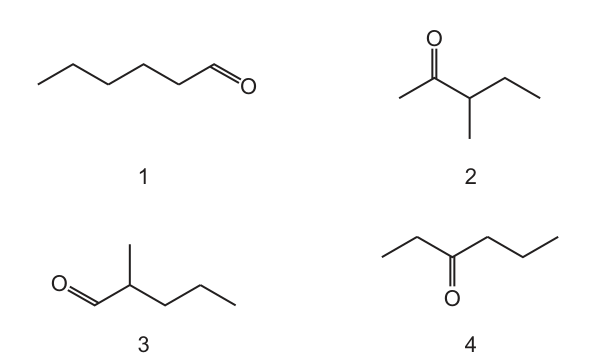
Which statement is correct?
Options
A 1 and 3 are chain isomers of each other and positional isomers of each other.
B 2 and 3 are functional group isomers of each other and both have a chiral centre.
C 1 and 4 are functional group isomers of each other and both have a chiral centre.
D 2 and 4 are positional isomers of each other and functional group isomers of each other.
Working
Structure 1 is hexanal (an aldehyde with a straight carbon chain). Structure 2 is 3-methylpentan-2-one (a ketone with a branched carbon chain). Structure 3 is 2-methylpentanal (an aldehyde with a branched carbon chain). Structure 4 is hexan-3-one (a ketone with a straight carbon chain).
- Option A: Structures 1 and 3 are both aldehydes. Structure 1 has a straight chain and structure 3 has a branched chain, so they are chain isomers. However, the aldehyde group is at the end of the main chain in both, so they are not positional isomers. This statement is incorrect.
- Option B: Structure 2 is a ketone and structure 3 is an aldehyde, so they are functional group isomers. Structure 2 has a chiral centre at carbon-3 (bonded to four different groups: -H, -CH3, -C(=O)CH3, -CH2CH3). Structure 3 has a chiral centre at carbon-2 (bonded to four different groups: -H, -CH3, -CHO, -CH2CH2CH3). Both have a chiral centre. This statement is correct.
- Option C: Structures 1 and 4 are functional group isomers (aldehyde and ketone). However, neither structure has a carbon atom bonded to four different groups, so neither has a chiral centre. This statement is incorrect.
- Option D: Structures 2 and 4 are both ketones, so they are not functional group isomers. They have different carbon skeletons, so they are chain isomers. This statement is incorrect.
Answer
B
B
Background Concept
Structural isomerism occurs when molecules have the same molecular formula but different arrangements of atoms. The three main types tested at AS Level are:
- Chain isomerism: Different arrangements of the carbon skeleton (e.g., straight chain vs. branched).
- Positional isomerism: The same carbon skeleton and the same functional group, but the functional group is attached at a different position on the chain.
- Functional group isomerism: The same molecular formula but different functional groups (e.g., an aldehyde and a ketone both have the formula CnH2nO).
A chiral centre (or stereocentre) is a carbon atom that is bonded to four different groups or atoms. Molecules with a chiral centre exist as a pair of non-superimposable mirror images called enantiomers (optical isomers). In skeletal formulas, hydrogen atoms attached to carbons are not drawn, so you must mentally add them to check if a carbon has four different substituents.
Understanding the Question
The question provides four skeletal structures, all with the molecular formula C6H12O. We must identify the functional group and carbon skeleton of each structure, check for chiral centres, and then evaluate four statements about their relationships (isomerism) and properties.
- Structure 1: A six-carbon straight chain with a C=O at the end. This is hexanal (an aldehyde).
- Structure 2: A five-carbon chain with a C=O at carbon-2 and a methyl branch at carbon-3. This is 3-methylpentan-2-one (a ketone).
- Structure 3: A five-carbon chain with a C=O at carbon-1 and a methyl branch at carbon-2. This is 2-methylpentanal (an aldehyde).
- Structure 4: A six-carbon straight chain with a C=O at carbon-3. This is hexan-3-one (a ketone).
Approach
To solve this, we will:
- Identify the functional group and carbon skeleton for each structure.
- Check each structure for a chiral centre by examining every carbon atom to see if it is bonded to four different groups.
- Evaluate each option (A, B, C, D) against these findings.
Step-by-Step Reasoning
Analyzing the structures:
- Structure 1 (hexanal): Straight-chain aldehyde. Carbon-1 is part of the C=O group (bonded to =O, -H, and the rest of the chain). No carbon has four different groups. No chiral centre.
- Structure 2 (3-methylpentan-2-one): Branched ketone. Look at carbon-3. It is bonded to: a hydrogen atom (-H), a methyl group (-CH3), an ethyl group (-CH2CH3), and a propan-2-one group (-C(=O)CH3). All four groups are different. Has a chiral centre at C-3.
- Structure 3 (2-methylpentanal): Branched aldehyde. Look at carbon-2. It is bonded to: a hydrogen atom (-H), a methyl group (-CH3), a formyl group (-CHO), and a propyl group (-CH2CH2CH3). All four groups are different. Has a chiral centre at C-2.
- Structure 4 (hexan-3-one): Straight-chain ketone. Carbon-3 is the C=O carbon. Adjacent carbons (C-2 and C-4) are bonded to at least two hydrogen atoms. No chiral centre.
Evaluating the options:
- Option A: Structures 1 and 3. Both are aldehydes, so they are not functional group isomers. Structure 1 is a straight chain and structure 3 is branched, making them chain isomers. However, the aldehyde group is at position 1 in both main chains, so they are not positional isomers. Statement A is false.
- Option B: Structures 2 and 3. Structure 2 is a ketone and structure 3 is an aldehyde. They have the same molecular formula but different functional groups, so they are functional group isomers. As established above, both structure 2 (at C-3) and structure 3 (at C-2) have a carbon bonded to four different groups, so both have a chiral centre. Statement B is true.
- Option C: Structures 1 and 4. Structure 1 is an aldehyde and structure 4 is a ketone, so they are functional group isomers. However, as established, neither structure has a chiral centre. Statement C is false.
- Option D: Structures 2 and 4. Both are ketones, so they have the same functional group and are not functional group isomers. They have different carbon skeletons (branched vs. straight), so they are chain isomers. Statement D is false.
Key Takeaways
- When comparing isomers, first identify the functional group and the carbon skeleton. Different functional groups = functional group isomers. Same functional group, different skeleton = chain isomers. Same functional group, same skeleton, different position = positional isomers.
- To find a chiral centre in a skeletal formula, mentally add the hydrogen atoms to every carbon and check if any carbon is bonded to four distinct groups. Carbons in C=O groups or with multiple hydrogens (like -CH2- or -CH3) cannot be chiral centres.
Common Mistakes
- Confusing chain and positional isomers: Students often call any two isomers with different branching "positional isomers". Remember, positional isomers must have the same carbon skeleton; the functional group just moves along it. Structures 1 and 3 have different skeletons, so they are chain isomers, not positional isomers.
- Missing chiral centres in skeletal formulas: Forgetting to add the implied hydrogen atoms. For example, in structure 2, carbon-3 looks like it only has three bonds drawn (to C-2, C-4, and the methyl branch). Adding the implicit hydrogen reveals it is bonded to four different groups.
- Assuming all isomers have chiral centres: Straight-chain aldehydes and ketones like hexanal and hexan-3-one do not have chiral centres because no carbon is bonded to four different groups.
Things to Be Careful About
- Always check the definition of each isomer type carefully. Functional group isomers must have genuinely different functional groups (e.g., -CHO vs -C(=O)- for C6H12O isomers).
- When identifying chiral centres, remember that the four groups must be completely different. For example, in hexan-3-one, carbon-2 is bonded to -H, -H, -CH3, and -C(=O)CH2CH2CH3. Because it has two hydrogen atoms, it is not chiral.
- In skeletal formulas, the ends of lines and vertices represent carbon atoms. Count carefully to ensure you have the correct molecular formula and structure name.
The skeletal formulas of two compounds are shown.
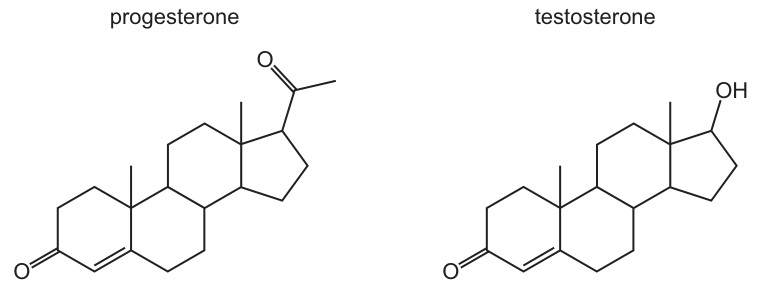
Which statements about progesterone and testosterone are correct?
Options
A They both contain a ketone group, and they both have geometrical isomers due to the C=C bond.
B They have the same molecular formula, and they both have geometrical isomers.
C They have the same number of chiral carbons, and they have the same molecular formula.
D They have the same number of chiral carbons, and they both contain a ketone group.
Working
- Ketone group: Both progesterone and testosterone contain a C=O group in the first six-membered ring bonded to two carbon atoms. This is a ketone functional group. (True for both molecules)
- Geometrical isomerism: Both molecules contain a C=C double bond within a six-membered ring. Endocyclic double bonds in small rings (up to ~7 carbons) are restricted to the cis configuration due to ring strain; a trans configuration would break the ring. Therefore, neither molecule exhibits geometrical isomerism due to this C=C bond. (False)
- Molecular formula: Progesterone has an acetyl group (-COCH) at carbon 17, while testosterone has a hydroxyl group (-OH). They have different molecular formulas (CHO vs CHO). (False)
- Chiral carbons: A chiral carbon is an sp hybridized carbon bonded to four different groups. Both molecules share the same fused steroid ring skeleton. The ring junction carbons (C8, C9, C10, C11, C13, C14) are chiral in both, as are carbon 17 (bonded to the side chain/hydroxyl). Thus, they have the same number of chiral carbons. (True)
Evaluating the options:
- A: Incorrect (no geometrical isomers due to ring C=C bond).
- B: Incorrect (different molecular formulas, no geometrical isomers).
- C: Incorrect (different molecular formulas).
- D: Correct (same number of chiral carbons, both contain a ketone group).
Answer
D
D
Background Concept
Functional Groups and Isomerism:
Organic molecules can exhibit different types of stereoisomerism. Geometrical (cis-trans or E/Z) isomerism occurs when there is restricted rotation, typically around a C=C double bond, and each carbon of the double bond is attached to two different groups. However, in cyclic systems, endocyclic double bonds (double bonds within the ring) in rings of fewer than approximately 8 carbons are locked in the cis (Z) configuration. The trans (E) configuration would require the ring to stretch across itself, introducing prohibitive angle and torsional strain, making it impossible to form under normal conditions. Therefore, cyclohexene and similar small-ring alkenes do not show geometrical isomerism.
Chiral Centers:
A chiral carbon (stereocenter) is an sp hybridized carbon atom bonded to four different atoms or groups. In complex fused ring systems like steroids, the ring junction carbons are often chiral because the four paths around the fused rings are chemically distinct. Optical isomerism arises from the presence of these chiral centers.
Understanding the Question
The question provides skeletal structures of two steroid hormones: progesterone and testosterone. We are asked to evaluate four statements comparing their structural features: functional groups, geometrical isomerism, molecular formulas, and chiral centers. We must use our knowledge of organic chemistry to determine which statement is entirely correct.
Approach
We will systematically evaluate each statement (A, B, C, D) by analyzing the structural features of both molecules:
- Identify the functional groups present (specifically looking for ketones).
- Analyze the C=C bond to determine if geometrical isomerism is possible.
- Compare the molecular formulas by counting atoms or identifying differing side chains.
- Count the number of chiral carbons in the fused ring framework.
Step-by-Step Reasoning
-
Ketone Group: Look at the first six-membered ring in both structures. There is a C=O group bonded to two carbon atoms within the ring. This is a ketone functional group. Both progesterone and testosterone contain this group. This part of statements A and D is correct.
-
Geometrical Isomerism: Both molecules have a C=C double bond in the first six-membered ring. Because this double bond is endocyclic (inside the ring) and the ring is only six members long, it is constrained to be cis. The ring cannot accommodate a trans double bond without breaking. Therefore, neither molecule can exhibit geometrical isomerism due to this C=C bond. This makes statements A and B incorrect.
-
Molecular Formula: Compare the side chains. Progesterone has an acetyl group (-COCH) attached to the five-membered ring (at C17). Testosterone has a hydroxyl group (-OH) at the same position. The acetyl group adds two carbon atoms and two fewer hydrogen atoms compared to the hydroxyl group (actually, -COCH is CHO vs -OH is HO, so progesterone is CHO and testosterone is CHO). They clearly have different molecular formulas. This makes statements B and C incorrect.
-
Chiral Carbons: A chiral carbon must be sp hybridized and have four different substituents. In the fused steroid backbone:
- The ring junction carbons (where rings meet) are chiral because the four paths around the rings are different. In both molecules, there are chiral centers at the ring junctions (typically C8, C9, C10, C11, C13, C14 in steroid numbering).
- Carbon 17 (on the five-membered ring) is bonded to a hydrogen, the side chain (-COCH in progesterone, -OH in testosterone), and two different ring paths. Thus, C17 is chiral in both molecules.
- Since the core ring structure and the positions of the angular methyl groups are identical, both molecules have the same number of chiral carbons (7 chiral centers). This part of statement D is correct.
-
Conclusion: Statement D is the only fully correct statement.
Key Takeaways
- Endocyclic double bonds in small rings (up to ~7 carbons) do not exhibit geometrical isomerism due to ring strain constraints.
- Chiral centers in fused ring systems are frequently found at ring junctions and at carbons bearing substituents on the rings.
- Always compare molecular formulas carefully by identifying differing functional groups or side chains, as even small differences (like -OH vs -COCH) change the molecular formula.
Common Mistakes
- Assuming all C=C bonds show geometrical isomerism: Students often see a C=C bond and immediately think of cis/trans isomerism, forgetting the critical exception for small cyclic alkenes.
- Miscounting chiral centers: Ignoring the ring junction carbons in fused systems, or assuming that changing the side chain at C17 from -OH to -COCH changes the number of chiral centers (it doesn't; C17 remains chiral in both cases, just with different groups).
- Confusing functional groups: Mistaking the ketone in the ring for an aldehyde or carboxylic acid, or missing it entirely in the skeletal structure.
Things to Be Careful About
- Ring strain and isomerism: Always check if a double bond is endocyclic in a small ring before concluding geometrical isomerism is possible.
- Skeletal structures: Remember that vertices and ends of lines represent carbon atoms, and hydrogen atoms attached to carbons are implied. Heteroatoms (O, N, etc.) and hydrogens attached to them are explicitly drawn.
- Chiral center definition: Ensure the carbon is sp hybridized (no double bonds) and check all four paths for uniqueness, especially in symmetric-looking but actually asymmetric fused ring systems.
Which intermediate ion forms in the greatest amount during the addition of to propene?
Options
A
B
C
D
Working
Addition of to propene is an electrophilic addition. The adds to the less substituted carbon of the double bond, giving the more stable secondary carbocation (Markovnikov's rule). This secondary carbocation is more stable than the primary carbocation , so it forms in the greater amount. Options C and D are carbanions and are not intermediates in this addition.
Answer
A
A
Background Concept
When an unsymmetrical alkene such as propene reacts with a hydrogen halide HX, the reaction is electrophilic addition. The pi bond acts as a nucleophile and attacks the partially positive hydrogen of the polar H–X bond. The hydrogen is transferred as to one carbon of the double bond, and the other carbon gains a positive charge, forming a carbocation intermediate. The halide ion then attacks this carbocation to form the product. When the alkene is unsymmetrical, two different carbocations are possible. Markovnikov's rule states that the hydrogen adds to the carbon of the double bond that already has the greater number of hydrogen atoms, so the positive charge develops on the more substituted carbon. This is because carbocation stability increases with the number of alkyl groups attached to the positively charged carbon: tertiary > secondary > primary > methyl. Alkyl groups are electron releasing (+I effect) and stabilise the positive charge.
Understanding the Question
The question asks which intermediate ion is formed in greatest amount during addition of HBr to propene. It presents four species: two carbocations (A and B) and two carbanions (C and D). The key is to identify the intermediate of the electrophilic addition mechanism and then apply carbocation stability/Markovnikov's rule to decide which carbocation predominates. The wording 'intermediate ion' points to the carbocation formed in the rate-determining step.
Approach
First, write the structure of propene and identify the two possible sites for protonation. Then draw the two carbocations that could form. Compare their stabilities using the order tertiary > secondary > primary. The more stable carbocation is formed in greater amount because the protonation step favours the pathway with the lower energy transition state leading to the more stable intermediate. Finally, eliminate the carbanion options because they are not formed in electrophilic addition of HBr.
Step-by-Step Reasoning
- Propene is . The double bond is between C1 (terminal, bonded to two H) and C2 (middle, bonded to one H and one CH3).
- When approaches, it can add to either carbon:
- Protonation at C1 (terminal carbon) leaves the positive charge on C2: (option A). This is a secondary carbocation (positive carbon bonded to two carbon groups).
- Protonation at C2 leaves the positive charge on C1: (option B). This is a primary carbocation (positive carbon bonded to one alkyl group and two H).
- Secondary carbocations are more stable than primary because alkyl groups donate electron density through the inductive effect, dispersing the positive charge. Therefore the secondary carbocation A is formed in greater amount. This is Markovnikov's rule: hydrogen adds to the carbon with more hydrogens, giving the more substituted (more stable) carbocation.
- Options C and D are carbanions (negative charge on carbon). They are not intermediates in electrophilic addition of HBr; the bromide ion acts as a nucleophile and attacks the carbocation, but no carbanion is formed. They are therefore not correct.
- Therefore A is the correct answer.
Key Takeaways
- Electrophilic addition of HX to unsymmetrical alkenes proceeds via a carbocation intermediate.
- Markovnikov's rule follows from carbocation stability: the more stable carbocation forms preferentially.
- Carbocation stability: tertiary > secondary > primary > methyl.
- Be able to identify the two possible carbocations and choose the more substituted one.
Common Mistakes
- Choosing B: thinking the proton adds to the more substituted carbon, forming the primary carbocation. The opposite is true; adds to the less substituted carbon to give the more stable carbocation.
- Forgetting that C and D are carbanions, not carbocations, and therefore cannot be intermediates in this electrophilic addition.
- Confusing 'greatest amount' with 'first formed' or 'most reactive'; the question asks about the intermediate present in greatest amount, which is the more stable one.
Things to Be Careful About
- The positive charge must be on the correct carbon; draw the carbocation carefully.
- Markovnikov's rule applies to addition of HX to unsymmetrical alkenes; it is a consequence of carbocation stability.
- In an exam, 'intermediate ion' should alert you to a carbocation, not a carbanion or radical.
- Use the correct terminology: secondary carbocation, not just 'more substituted' without specifying.
Two hydrocarbons, and , react separately with bromine in the presence of ultraviolet light. One of these hydrocarbons is unsaturated.
In each case, free radical substitution reactions occur.
is .
is .
Which row is correct?
Options
| a propagation stage for the saturated hydrocarbon | a termination stage for the unsaturated hydrocarbon | |
|---|---|---|
| A | ||
| B | ||
| C | ||
| D |
Working
The saturated hydrocarbon is the alkane ; contains a bond, so is the unsaturated hydrocarbon.
For the saturated hydrocarbon, a propagation step is hydrogen abstraction:
For the unsaturated hydrocarbon, a termination step is combination of two radicals:
These are both in row C.
Answer
C
C
Background Concept
Free radical substitution is the reaction of an alkane with a halogen under ultraviolet light. It proceeds by three types of step:
- Initiation: homolytic fission of produces two radicals.
- Propagation: a radical reacts with a molecule to form a new radical. For bromination there are two propagation steps: hydrogen abstraction, , and halogen abstraction, .
- Termination: two radicals combine to form a molecule, removing radicals from the system, e.g. or .
An alkene is unsaturated because it contains a double bond; an alkane is saturated because it contains only single bonds.
Understanding the Question
The question gives two hydrocarbons, and , and states that one is unsaturated. The group contains a bond, so is the unsaturated hydrocarbon. The group contains only single bonds, so is the saturated alkane. We must find the row in which the first entry is a propagation step for the saturated hydrocarbon and the second entry is a termination step for the unsaturated hydrocarbon.
Approach
First identify which hydrocarbon is saturated and which is unsaturated. Then recall the definitions: a propagation step converts one radical into another while conserving the number of radicals; a termination step removes radicals by combining two of them. Finally check each option against the correct hydrocarbon labels.
Step-by-Step Reasoning
-
Identify the hydrocarbons.
contains a bond, so is unsaturated. has only single bonds, so is the saturated hydrocarbon. -
Propagation for the saturated hydrocarbon.
A valid propagation step for is hydrogen abstraction by a bromine radical:
This appears in row C. -
Termination for the unsaturated hydrocarbon.
The radical formed from is . A termination step is the combination of two such radicals:
This also appears in row C. -
Why the other rows are wrong.
- Row A: the first entry is , which is a termination, not a propagation, and it uses the unsaturated radical. The second entry uses rather than , so it is not the termination stage for the unsaturated hydrocarbon.
- Row B: both entries are propagation steps, but the first uses (unsaturated) and the second is a propagation step for the saturated hydrocarbon, not a termination stage for the unsaturated one.
- Row D: the first entry is a termination for the saturated hydrocarbon, and the second is a propagation for the unsaturated hydrocarbon; the categories are reversed.
Therefore row C is correct.
Key Takeaways
- A bond makes a hydrocarbon unsaturated; only single bonds make it saturated.
- Propagation steps conserve the number of radicals; termination steps reduce the number of radicals.
- In free radical substitution, hydrogen abstraction and reaction with are propagation; combination of two radicals is termination.
- Always match the labels and to the correct hydrocarbon.
Common Mistakes
- Confusing and : is the unsaturated hydrocarbon, not .
- Calling a propagation step; it is a termination step because it removes radicals.
- Calling a termination step; it is a propagation step.
- Forgetting that termination can be the combination of two alkyl radicals, not only an alkyl radical with a bromine atom.
Things to Be Careful About
- Show the unpaired electron as a dot on the radical species.
- Ensure every equation is balanced in atoms and in number of unpaired electrons.
- Read the column headings: the first column asks for the saturated hydrocarbon, so use ; the second asks for the unsaturated hydrocarbon, so use .
- A propagation stage must involve a radical and a molecule, producing a molecule and a radical; a termination stage must involve two radicals producing a molecule.
The fumes from the exhausts of petrol-burning cars contain the following pollutants.
- unburnt hydrocarbons
- nitrogen dioxide
- carbon monoxide
Which pollutants are removed by oxidation in a catalytic converter?
Options
A 1, 2 and 3
B 1 and 2 only
C 1 and 3 only
D 2 and 3 only
Working
A catalytic converter removes all three pollutants, but by different processes:
- Unburnt hydrocarbons (1) are oxidised to CO and HO
- Carbon monoxide (3) is oxidised to CO
- Nitrogen dioxide (2) is reduced to N (not oxidised)
Answer
C — 1 and 3 only
C
Background Concept
A catalytic converter is fitted to petrol car exhausts to reduce harmful emissions. It works by promoting two types of reactions simultaneously:
- Oxidation: carbon monoxide (CO) is oxidised to carbon dioxide (CO), and unburnt hydrocarbons (CH) are oxidised to CO and water (HO).
- Reduction: nitrogen oxides (NO and NO) are reduced to nitrogen gas (N).
The catalyst is typically a platinum/rhodium/palladium coating on a ceramic honeycomb structure.
Understanding the Question
The question lists three pollutants found in car exhaust fumes:
- Unburnt hydrocarbons
- Nitrogen dioxide (NO)
- Carbon monoxide (CO)
It asks specifically which of these are removed by oxidation in a catalytic converter.
Approach
The key is to recall what happens to each pollutant in the catalytic converter and classify each transformation as oxidation or reduction.
Step-by-Step Reasoning
-
Unburnt hydrocarbons (1): These are oxidised by the catalyst to CO and HO. This is an oxidation reaction because the carbon atoms are fully oxidised to CO. ✓
-
Nitrogen dioxide (2): NO is reduced to N in the catalytic converter. This is a reduction reaction (nitrogen goes from oxidation state +4 in NO to 0 in N). It is NOT removed by oxidation. ✗
-
Carbon monoxide (3): CO is oxidised to CO by the catalyst. This is an oxidation reaction (carbon goes from oxidation state +2 in CO to +4 in CO). ✓
Therefore, pollutants removed by oxidation are 1 and 3 only.
Key Takeaways
- Catalytic converters oxidise CO and unburnt hydrocarbons.
- Catalytic converters reduce nitrogen oxides (NO) to N.
- The catalytic converter removes all three pollutants, but by different redox processes.
Common Mistakes
- Assuming NO is oxidised because it already contains oxygen atoms. In fact, NO is reduced to N.
- Forgetting that unburnt hydrocarbons are also oxidised in the catalytic converter.
- Choosing option A (all three) because the catalytic converter removes all three — but the question specifically asks which are removed by oxidation.
Things to Be Careful About
- Read the question carefully: it asks which are removed by oxidation, not which are removed overall.
- Remember that oxidation is the loss of electrons (or gain of oxygen), and reduction is the gain of electrons (or loss of oxygen).
- In the catalytic converter, the oxidation and reduction reactions happen simultaneously on the catalyst surface.
Compound X, , is dissolved in ethanol and the solution mixed with warm aqueous silver nitrate.
A precipitate is seen immediately.
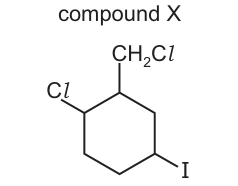
What is the colour of this precipitate and what is the structural formula of the first organic product?
Options
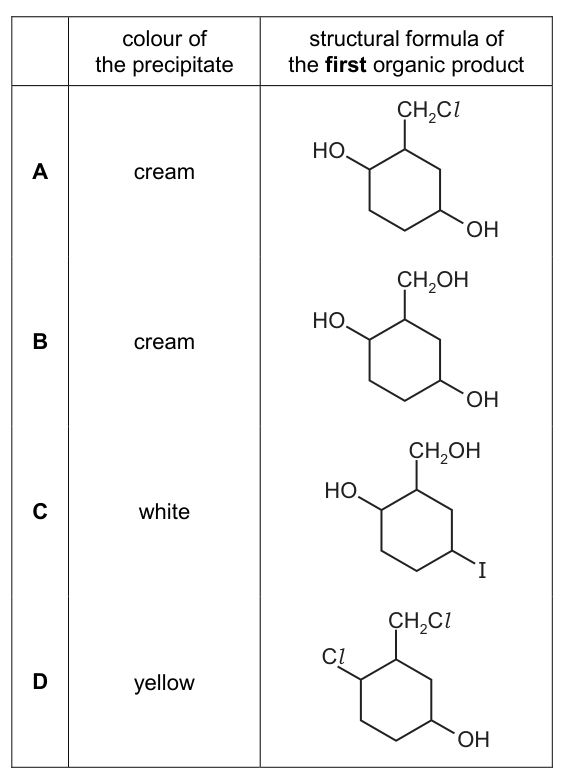
Working
The compound contains two C–Cl bonds (one primary in , one secondary on the ring) and one C–I bond (secondary on the ring).
Reactivity with aqueous silver nitrate depends on the C–X bond enthalpy. The C–I bond is the weakest (lowest bond enthalpy) and iodide is the best leaving group, so it hydrolyses the fastest.
The released iodide ions react with silver ions to form silver iodide:
Silver iodide () is a yellow precipitate. This eliminates options A, B, and C (which suggest cream or white precipitates associated with Br or Cl).
The first organic product forms from the fastest reaction, meaning only the C–I bond is hydrolysed. The iodine atom at C4 is replaced by a hydroxyl group (), while the and ring groups remain unchanged.
This matches the structure and precipitate colour in Option D.
Answer
D
D
Background Concept
When halogenoalkanes are warmed with aqueous silver nitrate in ethanol, a nucleophilic substitution reaction occurs. The water (or hydroxide ions) acts as a nucleophile, replacing the halogen atom to form an alcohol. Simultaneously, the halide ion released reacts with to form an insoluble silver halide precipitate.
The rate of this reaction depends primarily on the C–X bond enthalpy (bond strength):
- C–I bond: ~238 kJ mol (weakest, reacts fastest)
- C–Br bond: ~284 kJ mol (intermediate)
- C–Cl bond: ~338 kJ mol (strongest, reacts slowest)
Because the C–I bond is the weakest, alkyl iodides react most rapidly with silver nitrate. The colour of the precipitate identifies the halide ion released:
- : white precipitate
- : cream precipitate
- : yellow precipitate
Understanding the Question
Compound X () is a cyclohexane derivative with three different halogen-containing groups:
- A primary chloromethyl group () at C1.
- A secondary chlorine atom on the ring at C2.
- A secondary iodine atom on the ring at C4.
The solution is mixed with warm aqueous silver nitrate, and a precipitate is seen immediately. We are asked to identify the colour of this precipitate and the structural formula of the first organic product. The word "immediately" and "first" indicate we should focus on the fastest-reacting C–X bond, as the slower bonds will not have reacted significantly yet.
Approach
- Compare the reactivity of the three C–X bonds based on bond enthalpy and leaving group ability.
- Identify the halide ion released in the fastest reaction and determine the colour of its silver salt precipitate.
- Draw the organic product formed by replacing only the fastest-reacting halogen with an group.
- Match these findings to the given options.
Step-by-Step Reasoning
-
Step 1: Identify the fastest-reacting bond.
The compound has C–Cl bonds (primary and secondary) and a C–I bond (secondary). The C–I bond has the lowest bond enthalpy and iodide () is the best leaving group among the halides. Therefore, the C–I bond at C4 hydrolyses the fastest. -
Step 2: Determine the precipitate colour.
The hydrolysis of the C–I bond releases ions:
These react with to form :
Silver iodide is a yellow precipitate. Options A and B suggest "cream" (which is for ), and Option C suggests "white" (which is for ). Only Option D has "yellow". -
Step 3: Determine the first organic product.
Since the C–I bond reacts first, only the iodine at C4 is replaced by an group. The group at C1 and the atom at C2 remain unchanged because C–Cl bonds are much stronger and react much more slowly under these conditions.
The resulting structure is a cyclohexane ring with at C1, at C2, and at C4. This matches the structure shown in Option D.
Key Takeaways
- Reactivity order with aqueous : R–I > R–Br > R–Cl, due to decreasing C–X bond enthalpy.
- Precipitate colours: (white), (cream), (yellow).
- When a molecule contains multiple different halogens, the one with the weakest C–X bond reacts first. The question asking for the "first" product implies kinetic control where only the fastest reaction has occurred.
Common Mistakes
- Assuming all halogens react simultaneously: Students might think all three halogens are replaced, leading to a triol product (like Option A or B). The question specifies "first organic product" and "immediately", indicating only the fastest reaction has occurred.
- Confusing precipitate colours: Forgetting that is yellow. is white and is cream. If a student thinks the C–Cl bonds react first, they might choose "white" (Option C), but C–Cl bonds are the slowest to react here.
- Ignoring bond type: Thinking a primary C–Cl bond () reacts faster than a secondary C–I bond. While primary substrates can sometimes react faster than secondary ones in , the difference in C–I vs C–Cl bond strength (over 100 kJ mol) dominates the kinetics here, making the alkyl iodide react much faster.
Things to Be Careful About
- Always check the command words: "first organic product" and "immediately" are critical clues to only consider the fastest reaction.
- Memorise the exact precipitate colours: white (), cream (), yellow (). "Cream" is often confused with "white" or "yellow".
- Ensure the structural formula in the answer retains the unreacted groups. In Option D, the and ring are correctly preserved.
1,4-dibromobutane reacts with an excess of ethanolic sodium hydroxide until no further reaction takes place.
What is the relative formula mass of the major organic product?
Options
A 54
B 56
C 74
D 90
Working
Ethanolic sodium hydroxide promotes elimination of HBr from halogenoalkanes. 1,4-dibromobutane undergoes two eliminations to give buta-1,3-diene, .
Answer
A
A
Background Concept
Ethanolic sodium hydroxide (or alcoholic potassium hydroxide) is a strong base dissolved in ethanol. In this solvent, nucleophilic substitution is disfavoured and elimination is favoured, so halogenoalkanes lose HBr to form alkenes. Aqueous sodium hydroxide, by contrast, favours nucleophilic substitution and would give an alcohol. Because the reagent here is present in excess and the reaction is allowed to continue until no further change, every eliminable H–Br unit can be removed.
Understanding the Question
1,4-dibromobutane has the structure . The question asks for the relative formula mass of the major organic product after reaction with excess ethanolic sodium hydroxide. The key is to recognise that both bromine atoms can be eliminated, forming a diene, and then to calculate its .
Approach
- Identify the reagent/solvent combination as one that causes elimination.
- Write the structure of 1,4-dibromobutane and remove HBr from each end.
- Determine the molecular formula of the final organic product.
- Calculate using and .
Step-by-Step Reasoning
The starting molecule is .
First elimination: a base removes a hydrogen from carbon 2 and the bromine leaves from carbon 1, forming a double bond between C1 and C2:
Second elimination: the remaining bromine on carbon 4 is removed together with a hydrogen from carbon 3, forming a second double bond:
The product is buta-1,3-diene, . Its relative formula mass is:
So the correct option is A.
The other options correspond to incomplete elimination or to products from a different reaction: 56 would be the of a butene (), which would arise if only one HBr had been eliminated. 74 and 90 are not consistent with the fully eliminated diene.
Key Takeaways
- The solvent matters: ethanolic NaOH favours elimination, aqueous NaOH favours substitution.
- Excess reagent can drive multiple eliminations from a polyhalogenoalkane.
- Relative formula mass is found by summing the atomic masses shown in the molecular formula.
Common Mistakes
- Using aqueous NaOH in the reasoning and forming a diol instead of a diene.
- Stopping after only one elimination, giving butene () instead of buta-1,3-diene ().
- Miscounting hydrogens in the final alkene, especially forgetting that each double bond removes two hydrogens from the alkane.
Things to Be Careful About
- Always check whether the reagent is ethanolic or aqueous before deciding between elimination and substitution.
- Count the hydrogen atoms carefully in the final unsaturated product.
- Relative formula mass has no units, but the numerical value must match the molecular formula exactly.
A small section of a polymer produced from two monomers is shown.
What are the two monomers?
Options
A but-1-ene and propene
B but-2-ene and propene
C ethene and pent-2-ene
D methylpropene and propene
Working
The section shown consists of two repeat units joined together:
The first unit, , comes from the alkene , methylpropene.
The second unit, , comes from the alkene , propene.
Answer
D — methylpropene and propene
D
Background Concept
In addition polymerisation, each alkene monomer contains a carbon–carbon double bond. During polymerisation the double bond opens, and the monomers join end-to-end to form a long saturated chain. The repeat unit of the polymer therefore contains the two carbon atoms that were originally joined by the double bond, now joined by a single bond.
To identify the monomer from a polymer segment, you reverse this process: take a two-carbon repeat unit and restore the double bond between those two carbons. A terminal alkene of the form gives a repeat unit . The substituents on the polymer chain tell you exactly which alkene was used.
Understanding the Question
The question gives a short section of a copolymer made from two monomers:
There are four backbone carbon atoms in the section. The first two form one repeat unit, and the next two form the other repeat unit. You are asked to identify the two alkene monomers from the four options given.
Approach
- Split the polymer section into two repeat units by recognising the repeating two-carbon pattern.
- For each repeat unit, convert the single bond between the two backbone carbons back into a double bond.
- Add the correct hydrogen atoms so that each carbon has its normal valency.
- Name the alkene formed and match it to the options.
Step-by-Step Reasoning
The polymer section can be written as:
The first repeat unit is:
Restoring the double bond between the two backbone carbons gives:
This is methylpropene. Notice that both methyl groups are attached to the same carbon of the double bond.
The second repeat unit is:
Restoring the double bond gives propene:
or equivalently . The repeat unit can appear in either orientation in the polymer chain, but it is still propene.
Therefore the two monomers are methylpropene and propene, which is option D.
The other options are incorrect because they would give different repeat units:
- but-1-ene would give , not .
- but-2-ene would give , which does not match either unit.
- ethene would give , and pent-2-ene would give a repeat unit with a longer side chain, not the units shown.
Key Takeaways
- To find the monomer from an addition polymer, restore the C=C double bond between the two carbon atoms of a repeat unit.
- A copolymer section must be split into its separate repeat units before identifying the monomers.
- The pattern of substituents on the polymer chain is the key clue: two methyl groups on one carbon indicate methylpropene; one methyl group on a carbon indicates propene.
Common Mistakes
- Treating the whole four-carbon section as a single repeat unit. The question states that two monomers were used, so there must be two repeat units.
- Confusing methylpropene with but-1-ene. Both have the formula , but methylpropene has two methyl groups on the same carbon, whereas but-1-ene has an ethyl group on the second carbon.
- Forgetting that a polymer repeat unit can be written in either direction. Propene can appear as or ; both are the same monomer.
- Looking for an ethene unit when the polymer clearly contains substituted carbons.
Things to Be Careful About
- Count the carbon atoms and substituents carefully when splitting the polymer chain into repeat units.
- Remember that addition polymers are formed from alkenes, so each repeat unit must contain exactly two backbone carbons from one monomer.
- The order of the monomers in the polymer section does not affect the identification; the question only asks which two monomers were used.
- In multiple-choice questions, check the substituent pattern before choosing an option, since several alkenes can have the same molecular formula but different structures.
The balanced equation for the reaction of X with an excess of acidified is shown.
Compound Y is the only organic product of the reaction.
Which compound is X?
Options
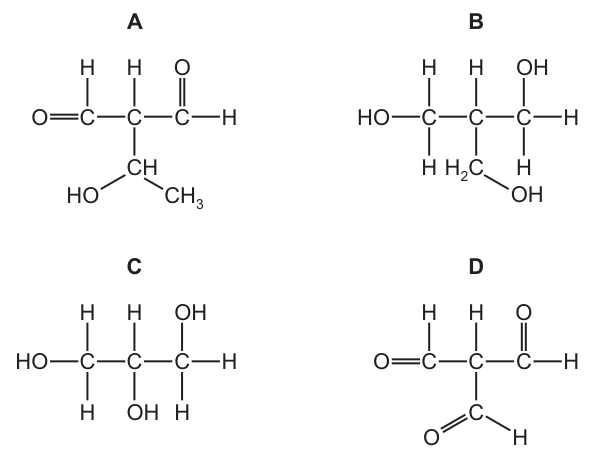
Working
The reagent is excess acidified , a strong oxidising agent. It oxidises:
- Primary alcohols () to carboxylic acids (), requiring per group.
- Secondary alcohols () to ketones (), requiring per group.
- Aldehydes () to carboxylic acids (), requiring per group.
The equation is . This indicates X requires exactly 3 oxygen atoms for oxidation.
Analysis of Option A:
Structure A contains:
- 2 aldehyde groups (): require .
- 1 secondary alcohol group (): requires .
- Total required = .
- Products: The aldehydes become carboxylic acids and the secondary alcohol becomes a ketone. Only one organic product Y is formed. Water is produced from the secondary alcohol oxidation ().
This matches the equation perfectly.
Analysis of other options (for verification):
- B: Contains 3 primary alcohol groups. Requires . Incorrect.
- C: Contains 2 primary and 1 secondary alcohol. Requires . Incorrect.
- D: Contains 3 aldehyde groups. Requires . However, oxidation of 3 aldehydes produces 3 carboxylic acid groups and no water (since aldehyde oxidation does not produce water). The equation shows as a product, which comes from alcohol oxidation. Thus, D is incorrect.
Answer
A
A
Background Concept
Acidified potassium dichromate(VI), , is a strong oxidising agent used in organic chemistry to oxidise alcohols and aldehydes.
- Primary alcohols () are oxidised first to aldehydes and then, under reflux with excess oxidant, to carboxylic acids (). The overall transformation requires 2 oxygen atoms: .
- Secondary alcohols () are oxidised to ketones (). This requires 1 oxygen atom: .
- Aldehydes () are oxidised to carboxylic acids (). This requires 1 oxygen atom: . Note that this step does not produce water.
- Tertiary alcohols are generally not oxidised by acidified dichromate under normal conditions.
The notation represents a single oxygen atom from the oxidising agent. The balanced equation tells us two things:
- The total oxidation capacity used is 3 oxygen atoms.
- Water is produced as a byproduct, which implies that at least one group being oxidised is an alcohol (specifically secondary or primary), as aldehyde oxidation does not yield water.
Understanding the Question
We are given a reaction equation where compound X reacts with 3 units of to form an organic product Y and water. We must identify X from four structural options (A, B, C, D) shown in the image.
The image shows:
- A: A molecule with a propanedial backbone (two aldehyde groups) and a secondary alcohol side chain (). Specifically, 2-(1-hydroxyethyl)propanedial.
- B: A molecule with three primary alcohol groups (trimethylolpropane / 2-(hydroxymethyl)propane-1,3-diol).
- C: Glycerol (propane-1,2,3-triol), containing two primary and one secondary alcohol.
- D: A molecule with three aldehyde groups (2-formylpropanedial).
We need to calculate the requirement for each and check if water is produced.
Approach
- Identify functional groups in each structure (A, B, C, D) from the displayed structural formulas.
- Determine the oxidation stoichiometry for each functional group using acidified .
- Primary alcohol: + produces
- Secondary alcohol: + produces
- Aldehyde: + no produced
- Sum the requirements for each molecule and compare with the '3' in the equation.
- Check for water production: The equation shows . Since aldehyde oxidation doesn't produce water, there must be at least one alcohol group (primary or secondary) in the correct molecule.
- Select the match: Structure A has 2 aldehydes () and 1 secondary alcohol (). Total = . Water is produced from the alcohol oxidation. This fits perfectly.
Step-by-Step Reasoning
Structure A:
- Functional groups: 2 x aldehyde (), 1 x secondary alcohol ().
- Oxidation:
- 2 aldehydes 2 carboxylic acids: requires . No water produced.
- 1 secondary alcohol 1 ketone: requires . Produces .
- Total : .
- Products: One organic molecule (a keto-dicarboxylic acid) and water.
- Matches the equation.
Structure B:
- Functional groups: 3 x primary alcohol ().
- Oxidation: required. Incorrect.
Structure C:
- Functional groups: 2 x primary alcohol, 1 x secondary alcohol.
- Oxidation: required. Incorrect.
Structure D:
- Functional groups: 3 x aldehyde ().
- Oxidation: required. Matches the oxygen count.
- However, oxidation of aldehydes to carboxylic acids () does not produce water. The equation explicitly includes as a product. Therefore, D cannot be correct.
Key Takeaways
- Acidified dichromate oxidises primary alcohols to carboxylic acids (), secondary alcohols to ketones (), and aldehydes to carboxylic acids ().
- Water is a product of alcohol oxidation, but not aldehyde oxidation. This is a crucial distinction for balancing equations involving .
- Always count functional groups carefully in complex displayed formulas.
Common Mistakes
- Confusing aldehyde and alcohol oxidation water production: Students might calculate for structure D (3 aldehydes) and choose it, forgetting that aldehyde oxidation doesn't produce water. The presence of in the product side is a key clue that an alcohol must be present.
- Miscounting oxygen atoms: Forgetting that primary alcohols need (not ) to reach the carboxylic acid stage with excess oxidant.
- Misreading structures: Confusing the aldehyde groups () with other groups or missing the secondary alcohol in structure A.
Things to Be Careful About
- State symbols and balancing: While not required here, ensure you understand that is a symbolic representation of oxidation. The actual half-equation is , meaning 1 mole of dichromate provides 6 moles of .
- Excess reagent: The question specifies 'excess' acidified dichromate. This ensures primary alcohols go all the way to carboxylic acids, not stopping at aldehydes.
- Only organic product: This confirms no carbon-carbon bond breaking occurred (which would happen under vigorous conditions with some structures, but not typically with simple alcohols/aldehydes here), so the carbon skeleton remains intact in Y.
Three mixtures are heated under reflux.
Which mixtures will produce sodium propanoate as one product?
Options
A 1, 2 and 3
B 1 and 2 only
C 2 and 3 only
D 3 only
Working
- is propanal. reduces it to propan-1-ol, not sodium propanoate.
- reacts with to give sodium propan-1-olate and hydrogen, not sodium propanoate.
- is propanenitrile. Heating under reflux with hydrolyses it:
Only mixture 3 gives sodium propanoate.
Answer
D
D
Background Concept
Sodium propanoate is the sodium salt of propanoic acid, . It is produced when a nitrile is hydrolysed under alkaline conditions. A nitrile, , contains a triple bond; heating with aqueous alkali hydrolyses it to a carboxylate salt and ammonia:
By contrast, is a reducing agent that converts aldehydes and ketones into alcohols, and sodium metal reacts with the bond of an alcohol to form an alkoxide and hydrogen. Recognising these three reaction types lets you identify which mixture gives sodium propanoate.
Understanding the Question
This question lists three mixtures and asks which, when heated under reflux, produce sodium propanoate as one product. You must evaluate each statement independently. Statement 1 uses propanal with aqueous ; statement 2 uses propan-1-ol with sodium metal; statement 3 uses propanenitrile with aqueous . The correct option is the combination of true statements.
Approach
For each mixture, identify the functional group and the reagent, then recall the characteristic reaction. Aldehydes are reduced by to primary alcohols. Alcohols react with to form alkoxides. Nitriles are hydrolysed by aqueous alkali to carboxylate salts. Then match each product to sodium propanoate.
Step-by-Step Reasoning
- is propanal, an aldehyde. provides hydride ions and reduces the carbonyl group to an alcohol:
The product is propan-1-ol, not sodium propanoate. Statement 1 is false.
2. is propan-1-ol. Sodium metal removes the acidic proton from the group:
The product is sodium propan-1-olate (an alkoxide), not sodium propanoate. Statement 2 is false.
3. is propanenitrile. Heating under reflux with aqueous hydrolyses the nitrile group:
The organic product is sodium propanoate. Statement 3 is true.
Only statement 3 is true, so the answer is D.
Key Takeaways
- Nitriles hydrolyse to carboxylic acids under acidic conditions and to carboxylate salts under alkaline conditions, with ammonia also formed.
- reduces aldehydes and ketones to alcohols; it does not produce carboxylate salts.
- Alcohols react with sodium metal to give alkoxides and hydrogen gas.
- When an MCQ combines numbered statements with options, judge each statement true or false before selecting the option.
Common Mistakes
- Assuming oxidises an aldehyde to a carboxylic acid. In fact it reduces the aldehyde to a primary alcohol.
- Confusing sodium propanoate () with sodium propan-1-olate ().
- Forgetting that under alkaline hydrolysis the product is the carboxylate salt, not the free carboxylic acid.
- Selecting an option that includes statement 1 or 2 without checking the functional group transformation.
Things to Be Careful About
- Include the correct reagent and conditions: for reduction, with reflux for nitrile hydrolysis.
- Balance the nitrile hydrolysis equation: atoms and charge must balance.
- Use precise names: sodium propanoate is a carboxylate salt; sodium propan-1-olate is an alkoxide.
- In the MCQ, only statement 3 is correct, giving option D.
Which compound is a product of the hydrolysis of using aqueous sodium hydroxide?
Options
A
B
C
D
Working
The ester is propyl ethanoate: the acyl group is and the alkyl group is .
Alkaline hydrolysis (saponification) cleaves the ester into a carboxylate salt and an alcohol:
The salt product is sodium ethanoate, .
Answer
A
A
Background Concept
Esters have the general structure (often written ). The carbonyl side, , comes from the carboxylic acid and is called the acyl group; the other side, , comes from the alcohol and is the alkoxy group.
Alkaline hydrolysis (saponification) uses aqueous sodium hydroxide. The hydroxide ion attacks the electron-poor carbonyl carbon, and the ester bond is cleaved to give two products:
Because the medium is strongly alkaline, the carboxylic acid that is transiently formed is immediately neutralised to its carboxylate salt; the free acid is not obtained. The alcohol is released as the neutral alcohol, not as an alkoxide, because water is present in large excess.
Understanding the Question
The ester given is . Parse it carefully:
- is the acyl part — it contains the carbonyl carbon and comes from ethanoic acid.
- is the alkyl part. Since , the group is a propyl group.
So the ester is propyl ethanoate. The question asks which compound is a product of its hydrolysis with aqueous sodium hydroxide — i.e. which of the two saponification products appears among the options.
Approach
- Identify the acyl and alkyl components of the ester.
- Apply the saponification equation: acyl group becomes the carboxylate salt, alkyl group becomes the alcohol.
- Compare the two products with the four options and select the one that matches.
Step-by-Step Reasoning
-
Identify the ester. is propyl ethanoate (propyl acetate). The acyl carbon carries the and the bond is the ester linkage.
-
Write the hydrolysis. With aqueous :
-
Identify the products.
- Sodium ethanoate, — this is option A.
- Propan-1-ol, — this is not among the options.
-
Check the distractors.
- B (, ethanoic acid): in alkaline hydrolysis the acid is neutralised to its salt, so the free acid does not form. Wrong.
- C (, sodium propan-1-olate): an alkoxide would only be obtained under anhydrous conditions; in aqueous the alcohol is the product. Wrong.
- D (, sodium butanoate): this has a butanoate acyl group, which would come from a different ester (e.g. butyl... or an ester of butanoic acid). Wrong.
Therefore the correct option is A.
Key Takeaways
- Alkaline hydrolysis (saponification) of an ester gives a carboxylate salt and an alcohol.
- Acid-catalysed hydrolysis gives the carboxylic acid and the alcohol — the medium decides which product forms.
- To name or predict the products, always split the ester at the single bond: the carbonyl side becomes the carboxylate/acid, the alkoxy side becomes the alcohol.
Common Mistakes
- Choosing B (the acid) — in alkaline conditions the acid is immediately neutralised to the salt; the free acid is only the product of acid hydrolysis.
- Choosing C (the alkoxide) — sodium alkoxides form only in the absence of water; aqueous gives the neutral alcohol.
- Mis-splitting the ester — putting the carbonyl on the wrong side would give sodium butanoate (option D), a trap for anyone who reads the formula carelessly.
Things to Be Careful About
- Note the phrase "aqueous sodium hydroxide" — it tells you the products are the salt and the alcohol, not the acid and not the alkoxide.
- Parse condensed formulae correctly: means , a propyl group, not a butyl group.
- In the balanced equation, the carboxylate is written as ; the ionic form with a separate is equally acceptable.
Compound Q reacts when heated with in the presence of a catalyst to produce compound R.
Molecules of compound R each contain four carbon atoms.
What is compound Q?
Options
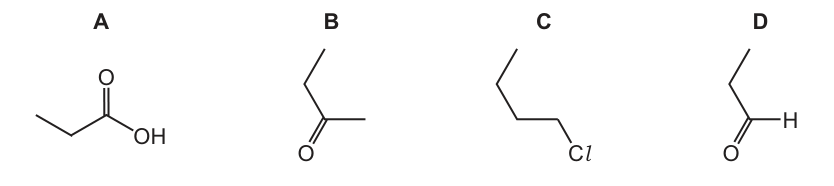
Working
HCN undergoes nucleophilic addition with the carbonyl group (C=O) of aldehydes and ketones to form a hydroxynitrile (cyanohydrin). This reaction adds one carbon atom to the original molecule.
Compound R has 4 carbon atoms, so compound Q must have 3 carbon atoms. All given options have 3 carbon atoms.
- A (propanoic acid) and C (1-chloropropane) do not contain a C=O group and do not react with HCN under these conditions.
- B (propanone) is a ketone and D (propanal) is an aldehyde. Both contain a C=O group.
- Aldehydes are more reactive than ketones towards nucleophilic addition with HCN due to less steric hindrance and a more electrophilic carbonyl carbon. The reaction proceeds readily with propanal to give 2-hydroxybutanenitrile (4 carbons).
Answer
D
D
Background Concept
Hydrogen cyanide (HCN) is a classic reagent for adding a cyanide group (–CN) to a carbonyl compound (aldehyde or ketone) via nucleophilic addition. The mechanism involves the cyanide ion (CN⁻), which is a nucleophile, attacking the electrophilic carbon of the C=O double bond. This forms a new C–C bond, breaking the π bond of the carbonyl and pushing electrons onto the oxygen to form an alkoxide intermediate. Protonation of the alkoxide by HCN (or an acid catalyst) then yields a hydroxynitrile (also called a cyanohydrin). Because the –CN group introduces one additional carbon atom, the product always contains one more carbon than the starting carbonyl compound.
Reactivity differences: Aldehydes are generally more reactive than ketones towards nucleophilic addition. This is due to two main factors:
- Steric hindrance: Ketones have two bulky alkyl groups attached to the carbonyl carbon, which physically block the approaching nucleophile more than the single alkyl group and small hydrogen atom in an aldehyde.
- Electronic effects: Alkyl groups are electron-donating. Two alkyl groups in a ketone reduce the partial positive charge (δ+) on the carbonyl carbon more than the one alkyl group in an aldehyde, making the ketone's carbonyl carbon less electrophilic.
Understanding the Question
The question states that compound Q reacts with HCN (with a catalyst) to form compound R, which has exactly four carbon atoms. We are given four skeletal structures (A, B, C, D) and must identify Q. The key constraints are:
- The reaction is with HCN (narrows the functional group to aldehydes or ketones).
- The product R has 4 carbons (meaning Q must have 3 carbons, since HCN adds 1 carbon).
- We must select the best candidate among the options.
Approach
- Count carbons: Verify that all options have 3 carbon atoms (since 3 + 1 from HCN = 4). All options (propanoic acid, propanone, 1-chloropropane, propanal) indeed have 3 carbons.
- Identify reactive functional groups: Eliminate molecules that do not undergo nucleophilic addition with HCN. Carboxylic acids (A) and halogenoalkanes (C) do not react with HCN in this manner.
- Differentiate remaining options: Both propanone (B, a ketone) and propanal (D, an aldehyde) contain a C=O group. Use the reactivity trend (aldehydes > ketones) to select the compound that reacts readily under the given conditions.
Step-by-Step Reasoning
- Option A (propanoic acid, CH₃CH₂COOH): Contains a carboxyl group (–COOH). Carboxylic acids do not undergo nucleophilic addition with HCN; the carbonyl carbon is not electrophilic enough due to resonance stabilization with the –OH group. Reject.
- Option B (propanone, CH₃COCH₃): A ketone. While ketones can react with HCN to form hydroxynitriles, the reaction is slow and often requires more vigorous conditions or specific catalysis due to steric and electronic factors. In the context of standard A-level chemistry, aldehydes are the primary substrates highlighted for this reaction.
- Option C (1-chloropropane, CH₃CH₂CH₂Cl): A halogenoalkane. It undergoes nucleophilic substitution (e.g., with KCN to form a nitrile), but this requires a different reagent (KCN/NaCN in ethanol, not HCN) and conditions (heating under reflux). It does not react with HCN to add a carbon to the chain in this manner. Reject.
- Option D (propanal, CH₃CH₂CHO): An aldehyde. Aldehydes readily undergo nucleophilic addition with HCN. The reaction adds the –CN group to the carbonyl carbon, producing 2-hydroxybutanenitrile (CH₃CH₂CH(OH)CN), which contains exactly 4 carbon atoms. This fits all criteria perfectly and represents the most reactive and standard answer. Accept.
Key Takeaways
- HCN adds to aldehydes and ketones to form hydroxynitriles, increasing the carbon chain length by one.
- Always count carbon atoms: if the product has carbons, the starting carbonyl must have carbons.
- Aldehydes are more reactive than ketones towards nucleophilic addition due to lower steric hindrance and higher electrophilicity of the carbonyl carbon.
Common Mistakes
- Confusing HCN with KCN: Students might think of the reaction of halogenoalkanes with KCN to form nitriles (which also adds a carbon). However, the question specifies HCN and a catalyst, which points to nucleophilic addition to a carbonyl, not substitution on an alkyl halide. KCN is used for substitution; HCN is used for addition.
- Ignoring the catalyst/reagent context: Assuming all carbonyl compounds react at the same rate. While ketones can react, aldehydes are the standard, more reactive substrates expected in this context.
- Miscounting carbons in skeletal structures: Forgetting that the end of a line and vertices represent carbon atoms. Propanal has 3 carbons in the main chain (including the carbonyl carbon), not 2.
Things to Be Careful About
- Reagent specificity: HCN (with a trace base or acid catalyst) is for carbonyl addition. KCN/NaCN (in ethanol) is for nucleophilic substitution of halogenoalkanes. The reagent name is the critical clue.
- Product structure: The product of propanal + HCN is 2-hydroxybutanenitrile. Ensure you can visualize the new C–C bond forming at the carbonyl carbon, making it a chiral center (though chirality isn't asked here, it's good to know the product has 4 carbons: C1 from CN, C2 from former carbonyl, C3 and C4 from the ethyl group).
- Ketone vs Aldehyde reactivity: In multiple-choice questions where both an aldehyde and a ketone are options for HCN addition, the aldehyde is almost always the intended answer unless the question specifically asks about a ketone or provides conditions that favor ketone reaction (which is rare at AS level).
The table shows the reagents and products of three reactions.
| reagents | products | |
|---|---|---|
| 1 | ethanoic acid + | |
| 2 | ethanoic acid + | |
| 3 | ethanoic acid + |
Which rows are correct?
Options
A 1, 2 and 3
B 1 and 2 only
C 1 and 3 only
D 2 and 3 only
Working
Row 1: Ethanoic acid with gives the salt, and . Correct.
Row 2: A carboxylic acid with a reactive metal gives a salt and hydrogen gas, not water:
The table shows , so this row is incorrect.
Row 3: Ethanoic acid with methanol forms an ester and water (esterification). Correct.
Answer
C
C
Background Concept
Ethanoic acid, , is a carboxylic acid. The functional group is the carboxyl group, , which contains an acidic hydrogen. Because of this proton, carboxylic acids undergo three characteristic types of reaction:
- With reactive metals (e.g. , , ): the acidic hydrogen is displaced as hydrogen gas, and a salt is formed.
- With carbonate salts (e.g. ): the acid neutralises the carbonate, releasing carbon dioxide gas and water along with a salt.
- With alcohols (esterification): a condensation reaction in which the acid and alcohol join, splitting out a molecule of water to form an ester.
Recognising which product is formed in each case — especially that a metal gives hydrogen, not water — is the key to answering this question.
Understanding the Question
This multiple-choice question presents a table listing three reactions of ethanoic acid with different reagents, each with a proposed product set. For each reaction, we must judge whether the displayed products are correct. The answer options combine the rows: option C means rows 1 and 3 are correct (and row 2 is wrong). The question is testing knowledge of the characteristic reactions of carboxylic acids.
Approach
Check each row against the established chemistry of carboxylic acids:
- Ethanoic acid + sodium carbonate — an acid–carbonate reaction.
- Ethanoic acid + magnesium — an acid–metal reaction.
- Ethanoic acid + methanol — esterification.
For each, compare the written products with the chemically correct ones. Then select the option that lists exactly the correct rows.
Step-by-Step Reasoning
Row 1 — ethanoic acid + sodium carbonate:
The acid reacts with the carbonate to give the sodium salt, water and carbon dioxide:
The table lists , which matches. Row 1 is correct.
Row 2 — ethanoic acid + magnesium:
A carboxylic acid reacts with a reactive metal by displacing the acidic hydrogen. The gas given off is hydrogen, not water:
The table shows . This is wrong on two counts: the correct gas is , and no water is produced. Row 2 is incorrect.
Row 3 — ethanoic acid + methanol:
This is a condensation (esterification) reaction. The acid and alcohol join, eliminating water, to form an ester:
The table lists , which matches. Row 3 is correct.
So rows 1 and 3 are correct; row 2 is wrong. That corresponds to option C.
Key Takeaways
- A carboxylic acid with a carbonate produces a salt, water and .
- A carboxylic acid with a reactive metal produces a salt and hydrogen gas, never water.
- A carboxylic acid with an alcohol undergoes esterification, producing an ester and water.
- When an MCQ offers combinations of statements, evaluate each statement independently, then match the correct set to the options.
Common Mistakes
- Thinking that acid + metal produces water. It produces hydrogen gas; the acidic proton is reduced to .
- Forgetting that the salt naming depends on the carboxylic acid (ethanoate) — writing "acetate" or an incorrect salt formula loses the point.
- Overlooking that the acid is a diprotic acid: two moles of ethanoic acid react with one mole of magnesium, so the salt is , not .
Things to Be Careful About
- The product of the acid–metal reaction is water-free; always check the gas produced.
- Balance the equations: two groups are consumed per or per .
- In esterification, water is a product — this is the one reaction here where water genuinely appears.
- State symbols are not required by this MCQ, but they clarify which species are aqueous, liquid or gas.
Seven aldehydes and ketones
- contain only one oxygen atom per molecule
- have four or fewer carbon atoms in their structures.
Alkaline is added to each of these carbonyl compounds separately.
How many of these carbonyl compounds produce a yellow precipitate with alkaline ?
Options
A 1
B 2
C 3
D 4
Working
A yellow precipitate with alkaline is the iodoform test, positive for compounds containing the group.
Seven possible aldehydes and ketones with one oxygen and ≤ 4 carbons:
Aldehydes: methanal, ethanal, propanal, butanal, 2-methylpropanal
Ketones: propanone, butanone
Positive iodoform test (contain ):
- ethanal ()
- propanone ()
- butanone ()
That is 3 compounds.
Answer
C (3)
C
Background Concept
The iodoform (tri-iodomethane) test is a qualitative test for the presence of a methyl carbonyl group, , or a secondary alcohol with a methyl group adjacent to the hydroxyl carbon, . When a compound containing one of these groups is warmed with alkaline iodine ( in ), the methyl group is tri-iodinated and then cleaved, producing a pale yellow precipitate of iodoform, , which has a characteristic antiseptic smell.
The key structural requirement is the group. For an aldehyde, only ethanal () contains this group. For a ketone, any ketone with the formula (a methyl ketone) gives a positive result. Secondary alcohols of the type also give a positive test because they are oxidised by the alkaline iodine to the corresponding methyl ketone, which then undergoes the iodoform reaction.
Understanding the Question
The question specifies seven aldehydes and ketones that each contain exactly one oxygen atom and have four or fewer carbon atoms. Alkaline is added to each separately, and we must determine how many produce a yellow precipitate — i.e., how many give a positive iodoform test.
The first task is to enumerate all possible structural isomers of aldehydes and ketones with one oxygen atom and at most four carbons. The second task is to apply the iodoform test criterion to each.
Approach
- List all aldehydes with 1–4 carbons: methanal, ethanal, propanal, butanal, and 2-methylpropanal.
- List all ketones with 3–4 carbons: propanone and butanone.
- Check each for the presence of the group.
- Count those that give a positive iodoform test.
Step-by-Step Reasoning
Enumerate the aldehydes:
- Methanal, : no group at all — negative.
- Ethanal, : contains (the carbonyl carbon is bonded to a methyl group) — positive.
- Propanal, : the carbon adjacent to the carbonyl is , not — negative.
- Butanal, : adjacent carbon is — negative.
- 2-Methylpropanal, : the carbon adjacent to the carbonyl is a group, not — negative.
Enumerate the ketones:
- Propanone, : contains — positive.
- Butanone, : contains — positive.
There are no other ketones with four or fewer carbons. A ketone must have at least three carbons (propanone is the smallest), and with four carbons only butanone is possible (the carbonyl carbon must be internal).
Count the positives: ethanal, propanone, and butanone — three compounds in total.
Key Takeaways
- The iodoform test is specific to the group (or which is oxidised to it).
- For aldehydes, only ethanal gives a positive result.
- For ketones, all methyl ketones () give a positive result.
- The ability to enumerate all structural isomers of a given molecular formula is a fundamental skill in organic chemistry.
Common Mistakes
- Thinking all aldehydes give a positive iodoform test. Only ethanal does, because only it has the group. Propanal and butanal do not.
- Forgetting 2-methylpropanal as a fourth-carbon aldehyde isomer. It is a structural isomer of butanal and must be counted among the seven compounds, but it gives a negative test.
- Confusing the iodoform test with the Tollens' or Fehling's test. Those tests distinguish aldehydes from ketones; the iodoform test distinguishes methyl ketones (and ethanal) from other carbonyls.
Things to Be Careful About
- The yellow precipitate is (iodoform), not or itself. The question tests recognition of this specific test.
- Count all structural isomers, including branched ones, when enumerating compounds with a given carbon count.
- The test requires alkaline conditions ( present); the question specifies alkaline , which is the correct reagent for the iodoform test.
Some properties of compound X are listed.
- X reacts with exactly oxygen when completely combusted.
- X does not react when heated with acidified .
What are the possible identities of X?

Options
A 1 and 3
B 2 and 4
C 3 only
D 4 only
Working
Step 1: Check combustion stoichiometry
For a compound with formula , the combustion equation requires moles of .
- Structure 1 (2,2-dimethylbutan-1-ol): Formula . Moles mol. (Incorrect)
- Structure 2 (1-methylcyclopentanol): Formula . Moles mol. (Correct)
- Structure 3 (3-methylpentan-3-ol): Formula . Moles mol. (Incorrect)
- Structure 4 (hexan-3-one): Formula . Moles mol. (Correct)
Step 2: Check reaction with acidified
Acidified potassium manganate(VII) is a strong oxidising agent.
-
Primary and secondary alcohols are oxidised (react).
-
Tertiary alcohols and ketones do not react.
-
Structure 1: Primary alcohol. Reacts. (Incorrect)
-
Structure 2: Tertiary alcohol. Does not react. (Correct)
-
Structure 3: Tertiary alcohol. Does not react. (Correct)
-
Structure 4: Ketone. Does not react. (Correct)
Conclusion:
Only structures 2 and 4 satisfy both conditions (formula giving 8.5 mol , and resistance to oxidation).
Answer
B
B
Background Concept
This question tests two fundamental areas of organic chemistry and stoichiometry:
-
Combustion Stoichiometry: The complete combustion of an organic compound follows the general equation:
This allows us to calculate the moles of oxygen required per mole of fuel based on its molecular formula. -
Oxidation of Organic Compounds: Acidified potassium manganate(VII) () is a strong oxidising agent used to distinguish between classes of alcohols and carbonyl compounds.
- Primary alcohols () are oxidised first to aldehydes, then to carboxylic acids.
- Secondary alcohols () are oxidised to ketones.
- Tertiary alcohols () have no hydrogen atom on the carbon bearing the hydroxyl group and are generally resistant to oxidation by acidified .
- Ketones are also resistant to oxidation by acidified under standard conditions (cleavage requires much harsher conditions).
Understanding the Question
We are given two properties for an unknown compound X:
- Combustion: 1.0 mol of X reacts with exactly 8.5 mol of .
- Oxidation resistance: X does not react with heated acidified .
We are given four skeletal structures (1-4) and must identify which ones fit both descriptions. The options combine these structures (e.g., "2 and 4").
Approach
We will test each structure against the two criteria sequentially.
- Criterion 1 (Combustion): Determine the molecular formula for each structure and calculate the required moles of using the formula . Eliminate any structure that does not require 8.5 mol .
- Criterion 2 (Oxidation): Identify the functional group and its class (primary/secondary/tertiary alcohol, ketone, etc.). Eliminate any structure that would react with acidified .
- The remaining structures are the correct answer.
Step-by-Step Reasoning
Analysis of Structure 1: 2,2-dimethylbutan-1-ol
- Structure: A butane chain with two methyls on C2 and an OH on C1. Formula: . Molecular formula: .
- Combustion: . Moles mol. This does not match 8.5 mol.
- Oxidation: It is a primary alcohol (). It will react with acidified to form a carboxylic acid.
- Verdict: Incorrect on both counts.
Analysis of Structure 2: 1-methylcyclopentanol
- Structure: A cyclopentane ring with a methyl group and an OH group on the same carbon (C1). Molecular formula: Ring is (one H replaced by methyl, one by OH? No. Cyclopentane is . Replace two H's on one carbon with methyl and OH. ).
- Combustion: . Moles mol. Matches.
- Oxidation: The carbon with the OH is bonded to three other carbons (two in ring, one methyl). It is a tertiary alcohol. Tertiary alcohols do not react with acidified . Matches.
- Verdict: Correct.
Analysis of Structure 3: 3-methylpentan-3-ol
- Structure: Pentane chain, OH and methyl on C3. Formula: . Molecular formula: .
- Combustion: . Moles mol. Does not match.
- Oxidation: Tertiary alcohol. Does not react. Matches.
- Verdict: Incorrect (fails combustion test).
Analysis of Structure 4: hexan-3-one
- Structure: 6-carbon chain with a ketone group at C3. Formula: . Molecular formula: .
- Combustion: . Moles mol. Matches.
- Oxidation: It is a ketone. Ketones do not react with acidified . Matches.
- Verdict: Correct.
Final Selection: Structures 2 and 4 fit both criteria. This corresponds to option B.
Key Takeaways
- Combustion Calculation: For any organic compound , the oxygen coefficient in the balanced combustion equation is . This is a quick way to check molecular formulas against combustion data.
- Oxidation Resistance: Only tertiary alcohols and ketones (and alkanes/alkenes under specific conditions, though alkenes react) are generally considered resistant to oxidation by acidified in this context. Primary and secondary alcohols react readily.
- Structure Identification: Being able to count atoms from skeletal structures (especially rings and branching) is crucial for determining molecular formulas.
Common Mistakes
- Miscounting atoms in skeletal structures: Especially with rings or branching. For example, counting the carbons in 1-methylcyclopentanol as 5 instead of 6 (ring carbons + methyl carbon).
- Confusing oxidation rules: Thinking that ketones react with or that tertiary alcohols oxidise. Remember: oxidation of alcohols requires breaking a C-H bond on the carbinol carbon (the carbon with the OH). Tertiary alcohols lack this hydrogen.
- Incorrect combustion formula: Forgetting to subtract for the oxygen already present in the molecule. If you calculate for , you get the wrong answer (9.0 instead of 8.5).
Things to Be Careful About
- State symbols and balancing: While not explicitly asked for in the final answer, ensuring the combustion equation is balanced correctly helps verify the mole ratio.
- Tertiary alcohol structure: Ensure you correctly identify the carbon bearing the OH group and count its carbon neighbors. In structure 2, the ring carbons count as neighbors.
- Ketone resistance: In A-level chemistry, ketones are treated as unreactive towards mild/standard oxidising agents like acidified (unlike aldehydes). This is a key distinction for identifying functional groups.
A sample of magnesium contains the isotopes , and only.
The percentage abundance of and is the same.
The relative atomic mass of magnesium in the sample is .
What is the percentage abundance of ?
Options
A
B
C
D
Working
Let the percentage abundance of be , and that of each of and be .
The abundances must add to 100%:
The relative atomic mass is the weighted average:
Substitute :
So .
Answer
D ( )
D
Background Concept
Relative atomic mass, , is defined as the weighted mean mass of the atoms of an element compared with one-twelfth of the mass of one atom of carbon-12. For a sample containing several isotopes, the weighted average is calculated by multiplying each isotope's mass by its fractional abundance and adding the contributions:
When abundances are given as percentages, the denominator is 100. The key idea is that the average is pulled towards whichever isotope is more abundant. Here magnesium's is 24.3, only just above 24, which already suggests that must dominate the sample.
Understanding the Question
This is a one-mark multiple-choice calculation. We are told there are only three magnesium isotopes, and that the abundances of and are equal. The relative atomic mass of the sample is 24.3. We need the percentage abundance of . The options are 10%, 20%, 60% and 80%.
The problem gives us two independent pieces of information: the percentages add to 100%, and the weighted average equals 24.3. With two unknowns, these two equations are enough to solve the problem.
Approach
Let the abundance of be and the abundance of each heavier isotope be . Then:
- The total percentage is .
- The weighted average is .
Use the first equation to express in terms of , substitute into the second, solve for , and then find .
Step-by-Step Reasoning
-
Write the abundance equation:
This uses the fact that two isotopes have the same abundance , so they contribute in total.
-
Write the weighted average equation. Multiply each mass number by its percentage and divide by 100:
The terms for the heavier isotopes combine: .
-
Substitute into the average equation and multiply both sides by 100:
-
Expand and collect terms:
-
Solve for :
So each of and is 10% abundant.
-
Find :
Therefore is 80% abundant, matching option D.
A quick check: . This confirms the answer.
Key Takeaways
- Relative atomic mass is a weighted average, not a simple average. An abundant isotope dominates the value.
- Percentage abundances of all isotopes in a sample must total 100%, which provides one equation.
- The weighted-average formula provides the second equation. Setting up both allows the abundances to be found without any additional data.
Common Mistakes
- Taking a simple arithmetic mean: . This ignores abundance and would give 25, not 24.3.
- Forgetting that the two heavier isotopes are equal in abundance; if the total abundance equation is written as , the algebra is wrong.
- Mixing up percentage and fraction. If using fractions, the denominator in the weighted average becomes 1 instead of 100, but the final ratio is the same.
- Misreading the options: 80% is considerably larger than the other choices, and the check calculation makes it easy to identify once is found.
Things to Be Careful About
- Keep the same convention throughout: if and are percentages, divide the weighted sum by 100. If they are fractions, do not divide by 100.
- Watch the algebra sign when substituting : becomes , not .
- It is worth testing the final abundances by recomputing the weighted average; a mismatch signals an arithmetic or setup error.
- The exam expects the letter D only, not the word 'eighty'. In the working, the percentage 80% is the meaningful result.
Your score so far
Answer a question to start scoring
Your marks add up here as you work through the paper.