Chemistry 9701/35 — May/June 2025
Cambridge AS Level · Advanced Practical Skills · worked solutions for every part, with the mark scheme
Topics Presentation of Data and Observations · Analysis, Conclusions and Evaluation · Manipulation, Measurement and Observation · Qualitative Analysis
Group 1 metal carbonates react with dilute acids to form a salt, water and carbon dioxide. The identity of the metal, , can be determined by measuring the volume of carbon dioxide produced when excess acid is added to a known mass of the carbonate, .
FA 1 is the metal carbonate, .
FA 2 is sulfuric acid, .
Method
- Weigh the container with FA 1. Record the mass in the space for results.
- Fill the tub with water to a depth of approximately .
- Fill the measuring cylinder completely with water. Holding a piece of paper towel firmly over the top, invert the measuring cylinder and place it in the water in the tub.
- Remove the paper towel and clamp the inverted measuring cylinder so the open end is in the water just above the base of the tub.
- Use the measuring cylinder to transfer of FA 2 into the flask labelled X. Check that the bung fits tightly into the neck of flask X, clamp flask X and place the delivery tube into the inverted measuring cylinder.
- Remove the bung from the neck of the flask. Add all of the FA 1 into the acid in the flask and replace the bung immediately. Remove the flask from the clamp and swirl it to mix the contents.
- Replace the flask in the clamp and leave until the fizzing stops. Swirl the flask occasionally.
- Weigh the container with any residual FA 1. Record the mass.
- Calculate and record the mass of FA 1 that is added to the acid.
- When no more gas is collected, record the final volume of gas.
You may wish to start Question 2 or Question 3 while the gas is being collected.
Results
Answer
Results table with unambiguous headings and units:
| Measurement | Reading |
|---|---|
| mass of container + FA 1 / g | 15.42 |
| mass of container + residual FA 1 / g | 14.54 |
| mass of FA 1 added / g | 0.88 |
| final volume of gas / cm³ | 200 |
- Both balance readings to the same precision (2 dp here).
- Mass of FA 1 = 15.42 − 14.54 = 0.88 g.
- Volume recorded as an integer (cylinder graduations at 2 cm³), within 125–250 cm³.
(Readings shown are representative examples — your own readings will differ.)
See working — candidate-dependent. Representative: mass FA 1 = 0.88 g, gas volume = 200 cm³.
Background Concept
This experiment determines the identity of a group 1 metal by measuring the volume of carbon dioxide released when a known mass of its carbonate reacts with excess acid. The gas is collected by water displacement in an inverted measuring cylinder. The marks in part (a) reward the quality of the recorded data: correct headings with units, consistent precision, correct calculation of the mass added by difference, and a volume within the expected range.
Understanding the Question
Part (a) asks you to record your results from the gas-collection method described. The three marks reward: (1) a clear results table with unambiguous headings and correct units for each quantity; (2) balance readings to consistent precision (2 or 3 dp) with the mass of FA 1 correctly calculated by difference, and the volume recorded as an integer; (3) a gas volume between 125 and 250 cm³.
Approach
Set up a results table with four rows: mass of container + FA 1, mass of container + residual FA 1, mass of FA 1 added, and final volume of gas. Give each a heading with its unit. Record the balance readings to the same precision, subtract to find the mass added, and record the volume as a whole number.
Step-by-Step Reasoning
- The balance readings must have units (g) and be given to the same number of decimal places — either 2 or 3 — because the balance gives a fixed precision.
- The mass of FA 1 added = mass of container with FA 1 − mass of container with residual FA 1. This is a "by difference" measurement: you weigh the container before and after tipping the solid in.
- The gas volume is read from the 250 cm³ measuring cylinder, which has graduations at 2 cm³, so the reading is an integer.
- The volume must fall between 125 and 250 cm³ for the experiment to be valid — smaller volumes would make the calculation imprecise, and the cylinder only holds 250 cm³.
Key Takeaways
- A results table needs unambiguous headings with units.
- Consistent precision across repeated readings is essential.
- Mass by difference is a standard weighing technique.
Common Mistakes
- Missing units in headings.
- Recording balance readings to different numbers of decimal places.
- Recording the volume with decimal places when the cylinder only reads to 2 cm³.
Things to Be Careful About
- The mark scheme requires the volume as an integer.
- The mass of FA 1 must be calculated, not just recorded.
Calculations
Calculate the amount, in mol, of carbon dioxide collected in the measuring cylinder (at room conditions).
amount of = .............................. mol
Working
Answer
amount of CO₂ = 0.00833 mol
0.00833 mol (example using 200 cm³)
Background Concept
At room temperature and pressure (r.t.p.), one mole of any gas occupies approximately 24 dm³, which is 24,000 cm³. This is the molar gas volume. The amount of a gas in moles is therefore its volume in cm³ divided by 24,000.
Understanding the Question
You measured the volume of carbon dioxide collected in part (a). Now convert that volume to an amount in mol using the molar gas volume at room conditions.
Approach
Use the relationship amount = volume ÷ molar gas volume. Since the volume is in cm³, divide by 24,000 cm³ mol⁻¹.
Step-by-Step Reasoning
Taking the representative volume of 200 cm³:
The answer should be given to 2–4 significant figures. 0.00833 has three significant figures, which is acceptable.
Key Takeaways
- The molar gas volume at r.t.p. is 24 dm³ mol⁻¹ = 24,000 cm³ mol⁻¹.
- Always match the units of the volume to the units of the molar volume.
Common Mistakes
- Using 24 dm³ instead of 24,000 cm³, giving an answer 1000 times too large.
- Giving the answer to too many significant figures.
Things to Be Careful About
- The mark scheme requires the answer to 2–4 significant figures.
- Use the volume you actually recorded in part (a), not a textbook value.
Write an equation for the reaction between sulfuric acid and the metal carbonate, . Include state symbols.
Answer
M2CO3(s) + H2SO4(aq) → M2SO4(aq) + H2O(l) + CO2(g)
Background Concept
A metal carbonate reacts with an acid to give a salt, water and carbon dioxide. For a group 1 carbonate M₂CO₃ reacting with sulfuric acid, the salt is the sulfate M₂SO₄. The general pattern is: carbonate + acid → salt + water + carbon dioxide.
Understanding the Question
Write the balanced symbol equation, with state symbols, for the reaction between the metal carbonate M₂CO₃ and sulfuric acid.
Approach
Identify the three products — the sulfate salt, water and carbon dioxide — then balance the equation and add state symbols.
Step-by-Step Reasoning
The reactants are M₂CO₃(s) and H₂SO₄(aq). The products are M₂SO₄(aq), H₂O(l) and CO₂(g). Balancing:
Each element balances: two M, one C, three O (plus four from the acid), two H, one S. The equation is already balanced as written.
Key Takeaways
- Acid + carbonate → salt + water + carbon dioxide.
- State symbols: solid carbonate, aqueous acid and salt, liquid water, gaseous carbon dioxide.
Common Mistakes
- Forgetting state symbols — the mark scheme requires them all.
- Writing the sulfate salt incorrectly (e.g. MSO₄ instead of M₂SO₄).
Things to Be Careful About
- The mark scheme requires all four state symbols.
- The metal is monovalent (group 1), so the sulfate is M₂SO₄.
Use your answers to (b)(i) and (b)(ii) to deduce the amount, in mol, of the metal carbonate in the mass of FA 1 you used in your experiment.
amount of = .............................. mol
Hence, calculate the relative formula mass, , of the metal carbonate.
of = ..............................
Working
From the equation, 1 mol M₂CO₃ gives 1 mol CO₂, so:
Answer
amount of M₂CO₃ = 0.00833 mol
M_r of M₂CO₃ = 105.6
0.00833 mol; M_r = 105.6 (example)
Background Concept
From the balanced equation in (b)(ii), one mole of M₂CO₃ produces one mole of CO₂, so the amounts are equal. The relative formula mass of a compound is its mass divided by the amount in mol: M_r = m ÷ n.
Understanding the Question
Use the amount of CO₂ from (b)(i) and the 1:1 stoichiometry from (b)(ii) to find the amount of M₂CO₃, then divide the mass of FA 1 (from part (a)) by that amount to obtain the relative formula mass.
Approach
First, set the amount of M₂CO₃ equal to the amount of CO₂. Then divide the mass of FA 1 by this amount.
Step-by-Step Reasoning
From the equation, 1 mol M₂CO₃ gives 1 mol CO₂, so:
The answer is given to 3 significant figures, within the required 2–4 sf range.
Key Takeaways
- The 1:1 stoichiometry between carbonate and CO₂ is the key link.
- M_r = mass ÷ amount.
Common Mistakes
- Using the wrong stoichiometric ratio.
- Confusing mass and amount when substituting into the formula.
Things to Be Careful About
- The answer must be to 2–4 significant figures.
- Use the mass of FA 1 you calculated in part (a).
Use your answer to (b)(iii) to calculate the relative atomic mass, , of metal M.
Hence, identify metal M in FA 1.
of M = ................................
M is .............................. .
Working
Answer
A_r of M = 22.8
M is sodium (Na, A_r = 23.0)
22.8; sodium (Na)
Background Concept
The relative formula mass of M₂CO₃ is the sum of the relative atomic masses: 2×A_r(M) + A_r(C) + 3×A_r(O) = 2A_r(M) + 12 + 48 = 2A_r(M) + 60. Rearranging gives A_r(M) = (M_r − 60) ÷ 2.
Understanding the Question
Deduce the relative atomic mass of metal M from the M_r calculated in (b)(iii), then identify which group 1 metal it is by comparing with known A_r values.
Approach
Subtract 60 (the mass of the CO₃ group) from M_r, divide by 2, then match the result to the periodic table.
Step-by-Step Reasoning
The group 1 metals have A_r values: Li 6.9, Na 23.0, K 39.1, Rb 85.5, Cs 132.9. The value 22.8 is closest to sodium (23.0).
The mark scheme uses boundary values between consecutive metals: Li ≤ 14.95 ≤ Na ≤ 31.05 ≤ K ≤ 62.30 ≤ Rb ≤ 109.20 ≤ Cs ≤ 250. Since 22.8 lies between 14.95 and 31.05, the metal is sodium.
Key Takeaways
- A_r(M) = (M_r(M₂CO₃) − 60) ÷ 2.
- Identify the metal by matching the calculated A_r to the periodic table.
Common Mistakes
- Forgetting to divide by 2.
- Not subtracting the mass of the carbonate group.
Things to Be Careful About
- The mark scheme provides boundary values for assigning the metal.
- Use the periodic table A_r values, not rounded mass numbers.
A student carries out a similar experiment on a powdered Group 2 carbonate. The student determines the relative atomic mass, , to be 49.3 and concludes that the metal in the carbonate is calcium.
Calculate the percentage error in the student’s result. Show your working.
percentage error in of Ca = .............................. %
Working
Answer
22.9%
22.9%
Background Concept
Percentage error compares an experimental value with the accepted true value: percentage error = (experimental − true) ÷ true × 100.
Understanding the Question
The student determined A_r = 49.3 for the metal in a group 2 carbonate and concluded it was calcium. The accepted A_r of calcium is 40.1. Calculate the percentage error in the student's result.
Approach
Substitute the experimental value 49.3 and the true value 40.1 into the percentage error formula.
Step-by-Step Reasoning
The error is positive because the experimental value is higher than the true value.
Key Takeaways
- Percentage error = (experimental − true) ÷ true × 100.
- The accepted A_r of calcium is 40.1.
Common Mistakes
- Dividing by the experimental value instead of the true value.
- Forgetting to multiply by 100.
Things to Be Careful About
- Use the accepted value 40.1 as the denominator.
- The answer should be given to a sensible number of significant figures (22.9%).
Suggest why the method you used in (a) would be unsuitable for use with small lumps of calcium carbonate.
Answer
Calcium sulfate is sparingly soluble in water and forms a surface layer on the lumps, which inhibits further reaction so the gas volume collected would be too low.
Calcium sulfate is sparingly soluble and forms a surface layer that inhibits further reaction.
Background Concept
Calcium sulfate is only sparingly soluble in water. When sulfuric acid reacts with calcium carbonate, the calcium sulfate formed precipitates as a surface layer on the solid, coating the unreacted carbonate and preventing the acid from reaching it.
Understanding the Question
Explain why the gas-collection method, which relies on the reaction going to completion, would be unsuitable for small lumps of calcium carbonate.
Approach
The key point is the sparingly soluble calcium sulfate coating the lumps and stopping the reaction before completion.
Step-by-Step Reasoning
With small lumps, the acid reacts only at the surface. The calcium sulfate produced is sparingly soluble and forms a surface layer over each lump. This layer prevents the acid from reaching the unreacted carbonate underneath, so the reaction stops early. The volume of carbon dioxide collected would therefore be too low, giving an inaccurate M_r.
Key Takeaways
- A sparingly soluble product can coat a reactant and stop a reaction.
- Complete reaction is essential for accurate gas-volume measurements.
Common Mistakes
- Saying "calcium sulfate is insoluble" without linking it to the surface layer.
- Giving a vague answer such as "the reaction is slow".
Things to Be Careful About
- The mark scheme accepts "sparingly/partially soluble surface layer formed".
The identity of a Group 1 metal in a metal carbonate may also be determined by titration with acid. is a Group 1 metal carbonate. The metal may or may not be the same as that in FA 1. You will determine which metal is present in .
FA 3 is .
FA 4 is sulfuric acid, .
FA 5 is bromophenol blue indicator.
Method
- Fill the burette with FA 4.
- Pipette of FA 3 into a conical flask.
- Add a few drops of FA 5 to the same conical flask.
- Perform a rough titration and record your burette readings in the space below.
The rough titre is .............................. .
- Carry out as many accurate titrations as you think necessary to obtain consistent results.
- Make sure any recorded results show the precision of your practical work.
- Record, in a suitable form in the space below, all your burette readings and the volume of FA 4 added in each accurate titration.
Results
Answer
Rough titration: initial reading = 0.00 , final reading = 34.50 , rough titre = 34.50 .
Accurate titrations:
| Titration 1 | Titration 2 | |
|---|---|---|
| initial burette reading / | 0.00 | 34.20 |
| final burette reading / | 34.20 | 68.40 |
| titre / | 34.20 | 34.20 |
All burette readings recorded to the nearest 0.05 . Both accurate titres are identical (within 0.10 of each other).
See working — candidate-dependent titration readings (representative example given)
Background Concept
Titration is a quantitative volumetric technique in which a solution of known concentration (the titrant, here FA 4, 0.0500 mol dm sulfuric acid) is added from a burette to a measured volume of the analyte (FA 3, the metal carbonate solution) until the reaction is complete. The end point is signalled by a colour change of the indicator — bromophenol blue changes from blue (alkaline, excess carbonate) to yellow (acidic, all carbonate neutralised). The burette allows the volume of acid added to be read to the nearest 0.05 cm. Accuracy depends on careful technique: reading the meniscus at eye level, recording readings with the correct precision, and repeating until concordant results are obtained.
Understanding the Question
This part asks you to perform the titration and record your results properly. Seven marks are available: for recording the rough titration data (two burette readings and the titre), for recording initial AND final burette readings for two or more accurate titrations, for correct table headings with units, for readings to the nearest 0.05 cm, for concordant titres (within 0.10 cm of each other), and for accuracy compared with the supervisor's value. There is no single "correct" answer — the marks reward the quality and precision of your recording.
Approach
- Fill the burette with FA 4, ensuring the jet is full with no air bubbles.
- Pipette 25.0 cm of FA 3 into a conical flask (use a pipette filler).
- Add a few drops of bromophenol blue indicator.
- Perform a rough titration: add acid fairly quickly while swirling, then dropwise near the end point. Record the rough titre.
- Repeat accurately: add acid rapidly at first, then dropwise as the colour begins to change. The end point is the first permanent colour change from blue to yellow.
- Record initial and final burette readings to the nearest 0.05 cm for each accurate titration.
- Repeat until two titres agree within 0.10 cm.
Step-by-Step Reasoning
The rough titration (here 34.50 cm) tells you approximately where the end point lies. For the accurate titrations, you can add acid quickly up to about 1 cm before the rough end point, then add dropwise while swirling continuously. For each accurate titration, record the initial burette reading (e.g., 0.00 cm), the final burette reading (e.g., 34.20 cm), and the titre = final − initial = 34.20 cm. The table must have clear headings with units, e.g., "initial burette reading / cm", "final burette reading / cm", "titre / cm". All readings must be to the nearest 0.05 cm — the precision of a burette. 34.20 is acceptable; 34.2 is not precise enough; 34.23 is too precise. The accurate titres must be within 0.10 cm of each other; here both are 34.20 cm, which is perfectly concordant.
Key Takeaways
- A rough titration establishes the approximate end point before accurate work.
- Accurate titrations require dropwise addition near the end point.
- Burette readings are recorded to the nearest 0.05 cm.
- Concordant titres (within 0.10 cm) are essential for reliability.
- Table headings must include units.
Common Mistakes
- Recording readings to only 1 decimal place (e.g., 34.2 cm) — the burette reads to 0.05 cm, so readings must have two decimal places ending in 0 or 5.
- Not recording both initial and final readings for each accurate titration.
- Including the rough titre in the mean calculation.
- Missing units in table headings.
- Titres that are not concordant (spread greater than 0.10 cm).
- Reading the burette from above or below eye level (parallax error).
Things to Be Careful About
- Read the burette at eye level, at the bottom of the meniscus.
- Ensure the burette jet is filled (no air bubbles) before starting.
- Swirl the flask continuously while adding acid.
- The end point is the first permanent colour change — do not overshoot.
- Record readings immediately, not from memory.
From your accurate titration results, calculate a suitable mean value to use in your calculations. Show clearly how you obtain the mean value.
of FA 3 required .............................. of FA 4.
Working
Select the two concordant accurate titres: 34.20 and 34.20 .
Answer
25.0 of FA 3 required 34.20 of FA 4.
34.20 cm^3 (representative example)
Background Concept
The mean titre is the average of the concordant accurate titrations. Concordant means agreeing within a specified tolerance — here, the titres selected for the mean must have a total spread of no more than 0.20 cm. The mean is calculated by summing the selected titres and dividing by the number of titres.
Understanding the Question
From your accurate titrations in part (a), select the titres that agree closely and calculate their mean. You must show your working — either by writing out the calculation or by ticking the selected readings in your results table.
Approach
Identify the two (or more) accurate titres that are closest together (within 0.20 cm total spread), add them, and divide by the number of titres. Quote the mean to 2 decimal places.
Step-by-Step Reasoning
In this representative example, the two accurate titres are 34.20 cm and 34.20 cm. They are identical, so they are clearly concordant. The mean is:
The mean is already to 2 d.p., so no rounding is needed. If the titres had been 34.20 and 34.25, the mean would be 34.225, rounded to 34.23 cm (to the nearest 0.01 cm).
Key Takeaways
- Select only concordant titres for the mean.
- Show your working (write the calculation or tick the selected readings).
- Quote the mean to 2 d.p., rounded to the nearest 0.01 cm.
Common Mistakes
- Including the rough titre in the mean.
- Using titres that are not concordant (spread greater than 0.20 cm).
- Not showing how the mean was obtained.
- Rounding incorrectly (e.g., quoting 34.2 instead of 34.20).
Things to Be Careful About
- The mean must be quoted to 2 d.p. and rounded to the nearest 0.01 cm.
- If you have three titres, use the two (or three) that are most concordant.
- The mean titre you quote here is used in all subsequent calculations, so accuracy matters.
Calculations
Calculate the amount, in mol, of sulfuric acid present in the volume of FA 4 in (b).
amount of = .............................. mol
Working
Answer
amount of = mol
1.71 × 10^-3 mol
Background Concept
The amount of substance (in mol) is calculated from the relationship:
The concentration of FA 4 is given as 0.0500 mol dm. The volume used is the mean titre from part (b), 34.20 cm. Since the concentration is in mol dm, the volume must be converted from cm to dm by dividing by 1000.
Understanding the Question
You are asked to calculate the amount, in mol, of sulfuric acid present in the mean titre volume of FA 4 from part (b). This is the first step in a chain of calculations that will eventually identify the metal Z.
Approach
Apply the formula amount = concentration × volume. Convert the titre from cm to dm by dividing by 1000, then multiply by the concentration.
Step-by-Step Reasoning
The answer is given to 3 significant figures, which is consistent with the data (0.0500 has 3 sf, 34.20 has 4 sf; 3 sf is appropriate).
Key Takeaways
- amount (mol) = concentration × volume (in dm).
- Always convert cm to dm by dividing by 1000.
- Give the answer to 3 or 4 significant figures.
Common Mistakes
- Forgetting to convert cm to dm (would give 1.71 mol instead of mol).
- Using the wrong volume (e.g., the rough titre instead of the mean titre).
- Giving the answer to too few significant figures.
Things to Be Careful About
- The volume used must be the mean titre from part (b) — this is the value you selected as most reliable.
- The answer must be given to 3 or 4 significant figures per the mark scheme.
- Keep the units consistent: mol dm × dm = mol.
Use your answer to (c)(i) to calculate the amount, in mol, of in of FA 3.
amount of = .............................. mol
Working
The neutralisation reaction is:
1 mol reacts with 1 mol .
Amount of in 25.0 = amount of = mol.
Amount in 1 :
Answer
amount of = mol
6.84 × 10^-2 mol
Background Concept
The reaction between a metal carbonate and sulfuric acid is a neutralisation (acid–carbonate) reaction:
For every 1 mol of carbonate, 1 mol of acid is consumed. This 1:1 stoichiometric ratio is the key to converting the moles of acid (from part (c)(i)) into moles of carbonate.
Understanding the Question
You are asked to use your answer to (c)(i) — the moles of HSO in the titre — to find the amount of ZCO in 1.0 dm of FA 3. The 25.0 cm pipetted into the flask contains the same number of moles of ZCO as the moles of acid that neutralised it (1:1 ratio). You then scale this up from 25.0 cm to 1 dm (1000 cm).
Approach
- Use the 1:1 stoichiometry: moles of ZCO in 25.0 cm = moles of HSO from (c)(i).
- Scale to 1 dm: multiply by 1000/25 = 40.
Step-by-Step Reasoning
From (c)(i), the amount of HSO is mol. Since the reaction is 1:1, the amount of ZCO in the 25.0 cm sample is also mol.
To find the amount in 1 dm, scale up:
This is the concentration of ZCO in FA 3 in mol dm.
Key Takeaways
- The stoichiometric ratio from the balanced equation converts moles of one reactant to moles of another.
- Scaling from a sample volume to 1 dm uses the factor 1000/sample volume.
- This result (moles per dm) is the molar concentration of ZCO in FA 3.
Common Mistakes
- Using the wrong stoichiometric ratio (e.g., assuming 2:1 because of the subscript 2 in ZCO). The balanced equation shows 1:1.
- Forgetting to scale from 25 cm to 1 dm.
- Using the rough titre instead of the mean titre.
Things to Be Careful About
- The answer must be given to 3 or 4 significant figures.
- This value (moles of ZCO per dm) is used in part (c)(iii) to find the molar mass, so accuracy matters.
- The balanced equation must be correct: ZCO + HSO → ZSO + CO + HO.
Use your answer to (c)(ii) to determine the identity of metal Z.
Metal Z is .............................. .
Working
Answer
Metal Z is Na (sodium).
Na (sodium)
Background Concept
The concentration of FA 3 is given as 7.26 g dm, meaning 1 dm of solution contains 7.26 g of ZCO. From part (c)(ii), 1 dm contains mol of ZCO. The molar mass is therefore:
The formula ZCO contains two atoms of Z, one carbon atom (Ar = 12), and three oxygen atoms (Ar = 16 each). So:
Rearranging gives the relative atomic mass of Z. Comparing this with the periodic table identifies the metal.
Understanding the Question
You are asked to identify the Group 1 metal Z. You have the mass per dm (7.26 g) and the moles per dm (from (c)(ii)). The molar mass links these. From the molar mass, subtract the contribution of CO (60) and divide by 2 to get the atomic mass of Z. Then identify the metal.
Approach
- Calculate (ZCO) = mass per dm ÷ moles per dm.
- Write (ZCO) = (Z) + 60.
- Solve for (Z).
- Compare with known Group 1 atomic masses: Li = 7, Na = 23, K = 39, Rb = 85, Cs = 133.
Step-by-Step Reasoning
Step 1 — Molar mass:
Step 2 — Set up the formula:
Step 3 — Solve:
Step 4 — Identify: The Group 1 metal with is sodium (Na, ).
The mark scheme provides ranges to allow for experimental error: Li ≤ 14.95 ≤ Na ≤ 31.05 ≤ K ≤ 62.30 ≤ Rb ≤ 109.20 ≤ Cs ≤ 250. Since 23.05 falls within the Na range (14.95–31.05), Z is sodium.
Key Takeaways
- Molar mass = mass ÷ moles.
- The formula of a compound relates its molar mass to the atomic masses of its elements.
- Experimental values may differ slightly from theoretical; use the mark scheme ranges to identify the metal.
- Group 1 carbonates have the general formula ZCO.
Common Mistakes
- Forgetting to subtract the CO contribution (60) before dividing by 2.
- Forgetting to divide by 2 (the subscript in ZCO).
- Misidentifying the metal (e.g., choosing K because 23 is "close" to K's Ar of 39 — it is not; 23 is clearly Na).
- Using the wrong value for moles per dm (e.g., using moles in 25 cm instead of 1 dm).
Things to Be Careful About
- The answer must be given to 3 or 4 significant figures throughout.
- The mark scheme's ranges are: Li ≤ 14.95 ≤ Na ≤ 31.05 ≤ K ≤ 62.30 ≤ Rb ≤ 109.20 ≤ Cs ≤ 250. Your calculated (Z) must fall within one of these ranges.
- If your titre were different, the metal identified could change — the calculation must be carried through with YOUR mean titre.
also exists as the hydrated salt.
State whether your titre will increase or decrease if of hydrated is dissolved to prepare of FA 3. Explain your answer.
Answer
The titre will decrease.
The hydrated salt contains water of crystallisation, so 7.26 g of hydrated contains fewer moles of than 7.26 g of anhydrous . Fewer moles of carbonate require fewer moles (and hence less volume) of .
Titre decreases
Background Concept
A hydrated salt contains water of crystallisation within its crystal lattice, e.g., NaCO·10HO. The water molecules add to the mass of the salt without contributing any carbonate. Therefore, for a fixed mass of salt (here 7.26 g), the hydrated form contains fewer moles of the anhydrous compound (ZCO) than the anhydrous form does.
Understanding the Question
The question asks whether the titre (volume of acid needed to neutralise the carbonate) will increase or decrease if 7.26 g of hydrated ZCO is dissolved to make 1 dm of FA 3, instead of 7.26 g of anhydrous ZCO. You must state the direction of change and explain why.
Approach
- Recognise that the hydrated salt contains water of crystallisation.
- Therefore, 7.26 g of hydrated salt contains fewer moles of ZCO.
- Fewer moles of carbonate require fewer moles of acid (1:1 ratio).
- Fewer moles of acid means a smaller titre volume.
Step-by-Step Reasoning
The key insight is that the water of crystallisation is part of the 7.26 g but does not react with the acid. For example, if Z = Na:
- Anhydrous NaCO: = 106, so 7.26 g contains 7.26/106 = 0.0685 mol.
- Hydrated NaCO·10HO: = 106 + 180 = 286, so 7.26 g contains 7.26/286 = 0.0254 mol of NaCO.
The hydrated salt contains far fewer moles of carbonate. Since the reaction is 1:1 (ZCO + HSO → ZSO + CO + HO), fewer moles of carbonate require fewer moles of HSO. With a fixed acid concentration (0.0500 mol dm), fewer moles of acid means a smaller volume — the titre decreases.
Key Takeaways
- Water of crystallisation adds mass without adding reactive carbonate.
- A fixed mass of hydrated salt contains fewer moles of the anhydrous compound.
- Fewer moles of carbonate → fewer moles of acid → smaller titre.
Common Mistakes
- Saying the titre increases because "the solution is more dilute" — this confuses concentration with the amount of reactive material. The concentration of carbonate IS lower, but the correct reasoning is that fewer moles of carbonate are present.
- Not mentioning that the moles of carbonate are fewer — the mark scheme requires "amount/moles of metal carbonate is less".
- Saying the titre stays the same because the same mass is used.
Things to Be Careful About
- The mark scheme requires BOTH points: (1) moles of metal carbonate is less with the hydrated salt, AND (2) therefore the titre is smaller.
- Use precise language: "fewer moles of carbonate" rather than "less carbonate" (which is ambiguous).
A titration is a more accurate method of determining the relative atomic mass of the metal in a metal carbonate than gas collection.
Give two reasons why titration is a more accurate method.
1 ................................................................................................................................................
2 ................................................................................................................................................
Answer
- Some / gas dissolves in water, so the gas volume collected is inaccurate.
- Some / gas escapes before the bung is inserted, so the volume collected is too low.
(Also acceptable: concordant titres can be obtained, improving reliability.)
See working — two reasons listed
Background Concept
Gas collection (e.g., measuring the volume of CO evolved when a carbonate reacts with acid) is a common method for determining the amount of carbonate present. However, it has inherent inaccuracies. Titration, by contrast, measures a volume of acid precisely with a burette and can be repeated to obtain concordant results.
Understanding the Question
You are asked to give two reasons why titration is a more accurate method than gas collection for determining the relative atomic mass of the metal in a metal carbonate. The mark scheme accepts any two of three specific points.
Approach
Identify the specific sources of error in gas collection and the specific advantage of titration. The mark scheme credits:
- Some CO/gas dissolves in water (so the volume is inaccurate).
- Some CO/gas escapes before the bung is inserted (so the volume is too low).
- Concordant titres can be obtained (titration is repeatable/reliable).
Step-by-Step Reasoning
When a carbonate reacts with acid, CO gas is evolved. If you collect this gas to measure its volume:
- CO is soluble in water — some of the gas dissolves in the water in the measuring cylinder or gas syringe, so the measured volume is less than the true volume evolved.
- There is a delay between adding the acid and sealing the apparatus (inserting the bung) — some CO escapes during this time, again making the measured volume too low.
In titration, you measure the volume of acid added from a burette to the nearest 0.05 cm, and you can repeat the titration to obtain concordant results (titres within 0.10 cm). This gives a precise, reproducible measurement.
Key Takeaways
- Gas collection has specific, identifiable sources of error: gas dissolving and gas escaping.
- Titration offers precision (burette readings to 0.05 cm) and reproducibility (concordant titres).
- The mark scheme rewards specific points, not vague statements like "human error".
Common Mistakes
- Giving vague answers like "titration is more precise" without explaining why.
- Saying "human error" — this is not a creditable point.
- Only giving one reason when two are required.
- Confusing the reasons (e.g., saying gas dissolves when the issue is gas escaping).
Things to Be Careful About
- The mark scheme accepts any two of the three listed points.
- Be specific: name the gas (CO) and the mechanism of error (dissolving, escaping before the bung is inserted).
- "Concordant titres" is a valid third point — it refers to the reproducibility of titration results, which gas collection cannot match.
Half-fill the beaker with water and place it on a tripod and gauze. Heat the water until boiling then switch off your Bunsen burner. This is your hot water bath for use in (b).
FA 6 and FA 7 are aqueous solutions that each contain one cation and one anion. All the ions are listed in the Qualitative analysis notes. None of the ions contains nitrogen.
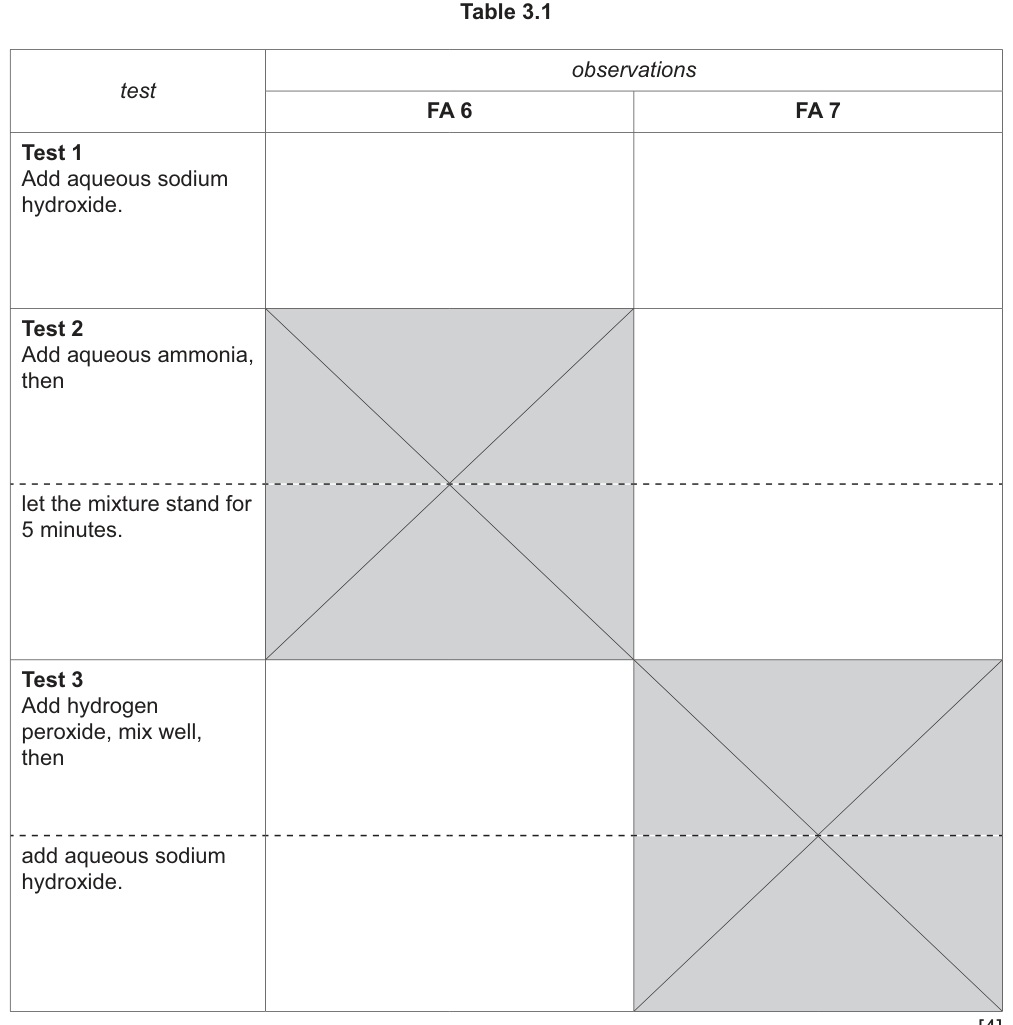
Carry out the following tests using a depth of FA 6 or FA 7 in a test-tube for each test. Record your observations in Table 3.1.
Answer
| test | observations (FA 6) | observations (FA 7) |
|---|---|---|
| Test 1: Add aqueous sodium hydroxide. | Green precipitate, insoluble in excess (turns brown on standing in air). | Grey-green precipitate, soluble in excess (forms dark green solution). |
| Test 2: Add aqueous ammonia, then let the mixture stand for 5 minutes. | Not required | Grey-green precipitate, insoluble in excess. Solution turns pale purple / mauve / lilac on standing. |
| Test 3: Add hydrogen peroxide, mix well, then add aqueous sodium hydroxide. | With peroxide: solution turns yellow. With hydroxide: dark brown precipitate. Bubbling / effervescence; gas relights a glowing splint. | Not required |
Key observations:
- FA 6 (Fe²⁺): green ppt with NaOH, insoluble in excess; turns brown on standing. With H₂O₂ then NaOH: brown ppt and effervescence (O₂ relights glowing splint).
- FA 7 (Cr³⁺): grey-green ppt with NaOH, soluble in excess (dark green solution). With NH₃: grey-green ppt insoluble in excess; turns purple/mauve on standing.
See table above. FA 6 gives green ppt (insoluble in excess, turns brown); FA 7 gives grey-green ppt (soluble in excess, turns purple on standing).
Background Concept
Qualitative analysis of aqueous cations relies on the formation of characteristic precipitates when aqueous sodium hydroxide (NaOH) or aqueous ammonia (NH₃) is added. The colour of the precipitate and its behaviour in excess reagent are diagnostic.
- Iron(II), Fe²⁺: Forms a green precipitate of iron(II) hydroxide, , with both NaOH and NH₃. It is insoluble in excess. However, is easily oxidised by atmospheric oxygen to , so the green precipitate gradually turns brown on standing as forms.
- Chromium(III), Cr³⁺: Forms a grey-green precipitate of chromium(III) hydroxide, , with both NaOH and NH₃. With NaOH, the amphoteric hydroxide dissolves in excess to form the dark green tetrahydroxochromate(III) ion, . With NH₃, it remains insoluble. On standing, can be oxidised to (chromate(VI)), turning the solution pale purple / mauve / lilac.
- Hydrogen peroxide test: oxidises to (solution turns yellow/brown). When NaOH is then added, a dark brown precipitate forms. also decomposes spontaneously (especially catalysed by metal ions) to give oxygen gas: . Oxygen is identified by relighting a glowing splint.
Understanding the Question
You are given two unknown aqueous solutions, FA 6 and FA 7, each containing one cation and one anion. You must carry out three specific tests using a 1 cm depth of each solution and record your observations in Table 3.1. Note that Test 2 is only required for FA 7 (the FA 6 box is crossed out), and Test 3 is only required for FA 6 (the FA 7 box is crossed out).
Approach
Recall the standard observations for Fe²⁺ and Cr³⁺ with NaOH and NH₃. For Test 3, recognise that hydrogen peroxide will oxidise Fe²⁺ to Fe³⁺ and also decompose to release oxygen gas.
Step-by-Step Reasoning
Test 1: Add aqueous sodium hydroxide.
- FA 6 (Fe²⁺): . Observation: green precipitate, insoluble in excess. On standing, it turns brown due to oxidation to .
- FA 7 (Cr³⁺): . Observation: grey-green precipitate. In excess NaOH, it dissolves: , forming a dark green solution.
Test 2: Add aqueous ammonia, let stand 5 minutes.
- Only FA 7 is tested. Cr³⁺ forms , which is insoluble in excess NH₃ (unlike Cu²⁺ or Zn²⁺). On standing, aerial oxidation of Cr³⁺ to chromate(VI) turns the supernatant pale purple / mauve / lilac.
Test 3: Add hydrogen peroxide, then NaOH.
- Only FA 6 is tested. oxidises Fe²⁺ to Fe³⁺ (solution may turn yellow). Decomposition of produces gas (bubbling/effervescence; relights glowing splint). Adding NaOH then gives a dark brown precipitate of .
Key Takeaways
- Fe²⁺ gives a green, air-sensitive precipitate with OH⁻; Cr³⁺ gives a grey-green precipitate that is soluble in excess NaOH but not excess NH₃, and oxidises to purple chromate on standing.
- Hydrogen peroxide acts as both an oxidising agent (Fe²⁺ → Fe³⁺) and a source of oxygen gas via decomposition.
Common Mistakes
- Writing "brown precipitate" for Fe²⁺ with NaOH directly; it is initially green and only turns brown on standing.
- Saying Cr³⁺ precipitate is soluble in excess NH₃; it is not (unlike Zn²⁺ or Cu²⁺).
- Forgetting to mention the gas test (relights glowing splint) for Test 3, which is a specific mark point.
Things to Be Careful About
- Ensure you only record observations for the uncrossed boxes in Table 3.1.
- Use precise colour descriptions: "green" (not just "coloured"), "grey-green", "dark green", "pale purple / mauve / lilac", "dark brown".
Carry out tests to identify the anions in FA 6 and FA 7.
Record your tests and observations in a suitable form in the space below.
Answer
| Test | Reagent added | Observation for FA 6 | Observation for FA 7 |
|---|---|---|---|
| Sulfate test | Barium chloride, , then dilute | White precipitate, insoluble in dilute | No precipitate / no change |
| Halide test | Silver nitrate, , then dilute | No precipitate / no change | White precipitate, soluble in dilute (aq) |
Key points:
- FA 6 contains sulfate, : white ppt with , insoluble in acid.
- FA 7 contains chloride, : white ppt with .
See table. FA 6 gives white ppt with BaCl₂ (insoluble in HNO₃); FA 7 gives white ppt with AgNO₃.
Background Concept
Anion identification in aqueous solutions uses specific precipitation reactions:
- Sulfate, : Added to barium chloride or barium nitrate solution in the presence of dilute nitric acid. A white precipitate of barium sulfate, , forms, which is insoluble in dilute acids. The acid is added first to remove carbonate ions that could also form a white precipitate () but would dissolve in acid.
- Chloride, : Added to silver nitrate solution acidified with dilute nitric acid. A white precipitate of silver chloride, , forms. This precipitate is soluble in dilute aqueous ammonia.
- Bromide, : Cream precipitate of , sparingly soluble in dilute (aq).
- Iodide, : Yellow precipitate of , insoluble in dilute (aq).
Understanding the Question
You must identify the anions in FA 6 and FA 7. The marking scheme requires you to present your tests and observations clearly, typically in a table with headings. You must test both solutions with at least one common reagent (like or ), or test one solution with two different reagents.
Approach
Construct a simple table with columns for the test, reagent, and observations for each solution. Perform the standard sulfate test on FA 6 and the halide test on FA 7.
Step-by-Step Reasoning
M1: Table format. Create a table with clear headings: "Test", "Reagent", "Observation (FA 6)", "Observation (FA 7)". Ensure at least one reagent and one observation are listed.
M2: Reagent choice. Test both FA 6 and FA 7 with one reagent (e.g., or ), or test one with two reagents.
M3: Sulfate test for FA 6. Add (or ) to FA 6, followed by dilute . Observation: white precipitate, insoluble in dilute . This confirms .
M4: Halide test for FA 7. Add to FA 7. Observation: white precipitate. (Optionally add dilute (aq) to confirm it dissolves, proving ). This confirms .
Key Takeaways
- Always acidify barium and silver nitrate tests with dilute to prevent false positives from carbonates.
- Present qualitative data in a clear, headed table to earn the presentation mark.
Common Mistakes
- Forgetting to include headings in the results table.
- Not testing both solutions with at least one common reagent, or not using enough reagents to identify both anions.
- Writing "white precipitate" for silver chloride without noting it is soluble in ammonia (though just "white ppt" with often scores if the conclusion is correct).
Things to Be Careful About
- The mark scheme requires a table with headings (M1). A loose list of observations may not score this mark.
- Use dilute for acidification, not (which would add chloride ions and interfere with the silver nitrate test).
- Ensure your observations are specific: "white precipitate" is better than "a precipitate forms".
Use your observations from (a)(i) and (a)(ii) to deduce the formulae of FA 6 and FA 7.
FA 6 is .............................. .
FA 7 is .............................. .
Answer
FA 6 is
FA 7 is
Reasoning:
- FA 6: Cation is (green ppt with NaOH, turns brown on standing). Anion is (white ppt with , insoluble in ). Formula: .
- FA 7: Cation is (grey-green ppt soluble in excess NaOH, turns purple on standing). Anion is (white ppt with ). Formula: .
FA 6 is FeSO₄; FA 7 is CrCl₃.
Background Concept
An ionic compound is formed from cations and anions in a ratio that ensures overall electrical neutrality. Once the individual ions are identified through qualitative analysis, the formula is written by balancing the charges.
- Iron(II) is , sulfate is → .
- Chromium(III) is , chloride is → .
Understanding the Question
Using the cation tests from (a)(i) and anion tests from (a)(ii), deduce the complete formulae for FA 6 and FA 7.
Approach
Pair the identified cation with the identified anion for each solution and ensure the charges balance.
Step-by-Step Reasoning
For FA 6:
- Cation test: Green precipitate with NaOH, insoluble in excess, turns brown on standing → .
- Anion test: White precipitate with , insoluble in dilute → .
- Combine: and balance in a 1:1 ratio → .
For FA 7:
- Cation test: Grey-green precipitate with NaOH, soluble in excess (dark green solution); grey-green ppt insoluble in excess NH₃, turns purple on standing → .
- Anion test: White precipitate with → .
- Combine: and require a 1:3 ratio to balance charges → .
Key Takeaways
- Always verify that the final formula is electrically neutral by checking the charges of the identified ions.
- Roman numerals or oxidation states must match the qualitative behaviour (e.g., Fe²⁺ not Fe³⁺ for the initial green precipitate).
Common Mistakes
- Writing for FA 6; the cation test clearly indicates Fe(II), not Fe(III).
- Writing or instead of the correct .
- Forgetting that the question states "none of the ions contains nitrogen", which rules out nitrate or ammonium.
Things to Be Careful About
- The question asks for the formulae, not the names. Write and , not "iron(II) sulfate".
- Ensure state symbols are not required unless specified; here, just the formulae are needed.
Ensure your water bath is hot and the Bunsen burner is turned off before you start (b).
FA 8 is an organic liquid containing one functional group and only the elements C, H and O. You will carry out two tests to investigate FA 8.
For each test you will record your observations and then conclude one of the following:
- at least two types of compound that FA 8 could be
or - one type of compound that FA 8 cannot be.
To a depth of FA 8 in a test-tube, add a few drops of acidified aqueous potassium manganate(VII), then place the test-tube in the hot water bath.
observation ........................................................................................................................
conclusion ........................................................................................................................
Answer
Observation: The purple / pink solution turns colourless / pale yellow / pale brown.
Conclusion: FA 8 could be a 1º alcohol or a 2º alcohol (or an aldehyde).
(Alternatively: FA 8 cannot be a ketone or a 3º alcohol.)
Reasoning: Acidified aqueous potassium manganate(VII) is an oxidising agent. It is reduced from purple to colourless/pale when it oxidises compounds that are easily oxidised, such as 1º and 2º alcohols and aldehydes. Ketones and 3º alcohols are not oxidised by under these conditions.
Observation: purple solution turns colourless/pale yellow. Conclusion: FA 8 could be a 1º or 2º alcohol (or aldehyde); it cannot be a ketone or 3º alcohol.
Background Concept
Acidified aqueous potassium manganate(VII), , is a strong oxidising agent. In acidic solution, the purple ion is reduced to the pale pink / colourless ion:
Organic compounds that can be oxidised by include:
- Primary (1º) alcohols: oxidised to aldehydes, then to carboxylic acids.
- Secondary (2º) alcohols: oxidised to ketones.
- Aldehydes: oxidised to carboxylic acids.
Compounds that are not oxidised by under these mild conditions:
- Tertiary (3º) alcohols: no hydrogen on the carbon bearing the -OH group.
- Ketones: already at a high oxidation state and resist further oxidation.
- Alkanes, alkenes (slow), aromatic rings: generally unreactive or require harsher conditions.
Understanding the Question
You are testing an organic liquid FA 8 (containing only C, H, O and one functional group) with acidified in a hot water bath. You must record the observation and draw a conclusion about what type of compound FA 8 is or is not.
Approach
Recall that is purple and turns colourless (or pale yellow/brown if concentrated) when reduced. Since the test is positive (it reacts), FA 8 must be a compound that is easily oxidised: a 1º alcohol, 2º alcohol, or aldehyde. Therefore, it cannot be a ketone or 3º alcohol.
Step-by-Step Reasoning
M1: Observation. The purple solution decolourises, turning colourless, pale yellow, or pale brown as is reduced to .
M2: Conclusion. Since the reaction occurs, FA 8 contains a functional group that is oxidisable. Therefore, FA 8 could be a 1º alcohol, 2º alcohol, or aldehyde. Conversely, FA 8 cannot be a ketone or a 3º alcohol, as these do not react with acidified .
Key Takeaways
- Acidified is a positive test for 1º/2º alcohols and aldehydes; a negative test (purple remains) indicates a ketone, 3º alcohol, or other unoxidisable group.
- Always state what the compound could be or cannot be based on the result.
Common Mistakes
- Saying the solution turns "blue" or "green"; those are for alkaline or reactions.
- Concluding FA 8 is definitely an alcohol; it could also be an aldehyde. The mark scheme allows either framing (could be X or cannot be Y).
- Forgetting to mention that the solution is heated; the reaction may be slow at room temperature.
Things to Be Careful About
- The colour change is from purple to colourless/pale yellow. Do not just write "decolourises" without mentioning the original purple colour.
- The conclusion must be logically linked to the observation: positive oxidation test → oxidisable functional group present.
To a depth of FA 8 in a test-tube, add a small spatula measure of sodium carbonate.
observation ........................................................................................................................
conclusion ........................................................................................................................
Answer
Observation: No change / no reaction / no effervescence / no bubbling.
Conclusion: FA 8 is not a (carboxylic) acid.
Reasoning: Carboxylic acids react with sodium carbonate to produce carbon dioxide gas (effervescence). Since no gas is produced, FA 8 does not contain a carboxylic acid group. This is consistent with FA 8 being an alcohol or aldehyde.
Observation: no change / no effervescence. Conclusion: FA 8 is not a carboxylic acid.
Background Concept
Carboxylic acids are weak acids that react with carbonates and hydrogen carbonates to produce carbon dioxide gas, water, and a salt:
The production of is observed as effervescence (bubbling/fizzing). This is a standard test to distinguish carboxylic acids from other oxygen-containing organic compounds like alcohols and aldehydes, which do not react with carbonates.
Understanding the Question
You add solid sodium carbonate to FA 8. You must record the observation and conclude what this tells you about the identity of FA 8.
Approach
If FA 8 were a carboxylic acid, would be produced (effervescence). Since it is not, FA 8 cannot be a carboxylic acid.
Step-by-Step Reasoning
M1: Observation. Adding sodium carbonate to FA 8 results in no visible change: no bubbles, no fizzing, no effervescence. The solid may remain unchanged or simply dissolve without gas evolution.
M2: Conclusion. Since no is produced, FA 8 does not react as an acid with a carbonate. Therefore, FA 8 is not a carboxylic acid.
Key Takeaways
- Sodium carbonate test is a quick way to rule out carboxylic acids. No effervescence = not a carboxylic acid.
- Combine this with the test: positive oxidation + no carbonate reaction = alcohol or aldehyde (not carboxylic acid).
Common Mistakes
- Writing "bubbles form" when no reaction occurs.
- Concluding FA 8 is an alcohol; the test only rules out carboxylic acids, it does not positively identify an alcohol.
- Forgetting to link the observation (no gas) to the conclusion (not an acid).
Things to Be Careful About
- Use precise language: "no effervescence" or "no change" is better than "nothing happens".
- The conclusion must specifically state that FA 8 is not a carboxylic acid; saying "it is an alcohol" is not fully supported by this test alone.
Suggest a further test you could carry out to identify one of the types of compound that you have concluded could be FA 8.
State the reagent you would use. State what a positive result would indicate about the identity of FA 8.
Do not carry out your test.
reagent ..............................................................................................................................
conclusion from a positive result .......................................................................................
Answer
Reagent: 2,4-dinitrophenylhydrazine (2,4-DNPH) / Brady's reagent OR Tollens' reagent / Fehling's solution / Sandell's reagent OR sodium metal / /
Conclusion from a positive result:
- If 2,4-DNPH: an orange/yellow precipitate forms, indicating FA 8 is an aldehyde (or ketone, but ketone is ruled out).
- If Tollens' / Fehling's: a silver mirror (Tollens') or brick-red precipitate (Fehling's) forms, indicating FA 8 is an aldehyde.
- If Na / : effervescence / bubbling (with Na) or steamy fumes (with ), indicating FA 8 is an alcohol.
(Choose one clear option for your answer.)
Example answer:
- Reagent: Tollens' reagent (ammoniacal silver nitrate)
- Conclusion from a positive result: A silver mirror forms, indicating FA 8 is an aldehyde.
Reagent: Tollens' reagent (or 2,4-DNPH, or Na). Positive result: silver mirror (or orange ppt, or effervescence), indicating FA 8 is an aldehyde (or aldehyde, or alcohol).
Background Concept
From parts (b)(i) and (b)(ii), we know FA 8 is oxidisable by (so it is a 1º alcohol, 2º alcohol, or aldehyde) but does not react with (so it is not a carboxylic acid). To distinguish between these remaining possibilities, we use specific functional group tests:
-
Aldehydes vs Alcohols:
- Tollens' reagent (ammoniacal ): Aldehydes reduce to metallic silver, forming a silver mirror. Alcohols do not react.
- Fehling's / Benedict's solution: Aldehydes reduce (blue) to (brick-red precipitate). Alcohols do not react.
- 2,4-DNPH (Brady's reagent): Reacts with carbonyl compounds (aldehydes and ketones) to form an orange/yellow precipitate (2,4-dinitrophenylhydrazone). Since ketones are ruled out, a positive test confirms an aldehyde.
-
Alcohols:
- Sodium metal: Reacts with alcohols to produce hydrogen gas (effervescence). . Aldehydes do not react with Na.
- Phosphorus pentachloride (): Reacts with alcohols to produce steamy white fumes of . Aldehydes do not react.
Understanding the Question
You must suggest one further test to identify one of the compound types that FA 8 could be (alcohol or aldehyde). State the reagent and what a positive result would indicate.
Approach
Choose a test that gives a clear positive result for either an aldehyde or an alcohol, and describe the observation and its meaning.
Step-by-Step Reasoning
Option 1: Test for aldehyde.
- Reagent: Tollens' reagent (warm gently in a water bath).
- Positive result: Formation of a silver mirror on the inside of the test tube.
- Conclusion: FA 8 is an aldehyde.
Option 2: Test for aldehyde (alternative).
- Reagent: 2,4-DNPH (Brady's reagent).
- Positive result: Formation of an orange / yellow precipitate.
- Conclusion: FA 8 is an aldehyde (or ketone, but ketone is already ruled out).
Option 3: Test for alcohol.
- Reagent: Sodium metal (add a small piece to FA 8).
- Positive result: Effervescence / bubbling; gas relights a glowing splint ().
- Conclusion: FA 8 is an alcohol.
Any one of these valid options scores the mark.
Key Takeaways
- Use functional group tests to narrow down possibilities: Tollens'/Fehling's/2,4-DNPH for aldehydes; Na/ for alcohols.
- Always link the specific observation to the specific functional group identified.
Common Mistakes
- Suggesting a test for carboxylic acids (e.g., pH paper, ); these are already ruled out.
- Suggesting a test for ketones (e.g., 2,4-DNPH) and concluding it is a ketone; ketones are ruled out by the test.
- Forgetting to state what the positive result indicates about the identity of FA 8.
Things to Be Careful About
- The question says "Do not carry out your test." You only need to describe it.
- Ensure the reagent and the positive result match: Tollens' → silver mirror; 2,4-DNPH → orange ppt; Na → effervescence.
- State the conclusion clearly: "indicating FA 8 is an aldehyde" or "indicating FA 8 is an alcohol".