Chemistry 9701/33 — May/June 2025
Cambridge AS Level · Advanced Practical Skills · worked solutions for every part, with the mark scheme
Topics Manipulation, Measurement and Observation · Analysis, Conclusions and Evaluation · Presentation of Data and Observations · Qualitative Analysis
Hydrogen peroxide, , reacts rapidly with acidified potassium manganate(VII), .
You will determine the concentration of a solution of hydrogen peroxide. You will first dilute the solution and then carry out a titration with acidified potassium manganate(VII).
FA 1 is aqueous hydrogen peroxide, .
FA 2 is potassium manganate(VII), .
FA 3 is sulfuric acid, .
Method
Dilution of FA 1
- Pipette of FA 1 into the volumetric flask.
- Add distilled water to make of solution.
- Shake the flask thoroughly.
- Label this diluted solution of hydrogen peroxide FA 4.
Titration
- Fill the burette with FA 2.
- Rinse the pipette with distilled water and then with FA 4.
- Pipette of FA 4 into a conical flask.
- Use the measuring cylinder to add of FA 3 to the conical flask.
- Perform a rough titration and record your burette readings in the space below.
The rough titre is = .............................. .
- Carry out as many accurate titrations as you think necessary to obtain consistent results.
- Make sure your recorded results show the precision of your practical work.
- Record, in a suitable form in the space for results, all your burette readings and the volume of FA 2 added in each accurate titration.
Keep FA 1 for use in Questions 2 and 3.
Keep FA 2 for use in Question 3.
Results
Answer
Rough titre (representative): 25.30 cm³
Accurate titrations (representative data):
| initial reading / cm³ | final reading / cm³ | titre / cm³ | |
|---|---|---|---|
| 1 | 0.00 | 24.95 | 24.95 |
| 2 | 24.95 | 49.95 | 25.00 |
| 3 | 0.00 | 25.05 | 25.05 |
All burette readings are recorded to the nearest 0.05 cm³. The table has correct headings, each with the unit cm³. The accurate titres are concordant — all within 0.10 cm³ of each other.
See working — candidate-dependent readings; representative data shown (rough titre 25.30 cm³; accurate titres 24.95, 25.00, 25.05 cm³)
Background Concept
In a redox titration the titrant (here potassium manganate(VII), ) is delivered from a burette into the conical flask containing the analyte (hydrogen peroxide, ) mixed with acid. The reaction is self-indicating: manganate(VII) is intensely purple, but its reduction product is almost colourless. While remains, every drop of purple is decolorised immediately; the endpoint is the first permanent pale pink colour, which appears when a tiny excess of survives because all the has been consumed. The accuracy of the whole determination depends on the quality of the practical work: readings taken to the nearest 0.05 cm³, titrations repeated until concordant (within 0.10 cm³), and results recorded in a clear table with units.
Understanding the Question
This part asks you to carry out a standard dilution and redox titration and record your results in a suitable form. The marks are awarded for technique and recording, not for a specific numerical answer, because your readings are your own. The specific requirements are: (i) record the rough titre (two burette readings and the titre); (ii) record initial and final burette readings and the titre for at least two accurate titrations; (iii) use correct headings with units in the table; (iv) record all readings to the nearest 0.05 cm³; (v) obtain accurate titres within 0.10 cm³ of each other.
Approach
First dilute FA1 tenfold to make FA4 (25.0 cm³ pipetted into a 250 cm³ volumetric flask, made up to the mark). Rinse the pipette with distilled water and then with FA4 so it delivers exactly 25.0 cm³ of FA4. Measure the acid FA3 with a measuring cylinder — precision is not needed because the acid is in excess. Do a rough titration to find the approximate end point, then repeat accurately, adding FA2 dropwise near the end, until two or more titres agree within 0.10 cm³. Record everything in a table with clear headings and units.
Step-by-Step Reasoning
- Dilution: 25.0 cm³ of FA1 is pipetted into a 250 cm³ volumetric flask and made up to the mark with distilled water. The dilution factor is , so FA4 is ten times more dilute than FA1. This factor is used later in (c)(iv).
- Pipette rinsing: the 25.0 cm³ pipette is rinsed with distilled water and then with FA4. Rinsing with FA4 removes the water film so the pipette delivers exactly 25.0 cm³ of FA4 rather than a slightly diluted solution.
- Acid addition: 10 cm³ of FA3 ( ) is added with a measuring cylinder. The acid supplies the needed for the reaction; it is in large excess, so its exact volume is not critical (see part (d)).
- Rough titration: FA2 is run in quickly while swirling, until the first permanent pale pink colour appears. Record the two burette readings and the rough titre.
- Accurate titrations: repeat, slowing to dropwise addition near the endpoint. The endpoint is the first permanent pale pink colour (persisting for about 30 s). Record initial and final readings to 0.05 cm³ each time.
- Concordance: continue until at least two accurate titres agree within 0.10 cm³ (total spread cm³).
- Recording: present a table with columns 'initial reading / cm³', 'final reading / cm³' and 'titre / cm³', so every heading carries its unit.
Key Takeaways
A good titration is judged by concordant results and careful recording: readings to 0.05 cm³, headings with units, and at least two accurate titres within 0.10 cm³. The rough titre guides the accurate runs.
Common Mistakes
- Recording readings to only 0.1 cm³ instead of 0.05 cm³ — loses the precision mark.
- Not rinsing the pipette with FA4, so the delivered volume is slightly diluted by the water film.
- Omitting units from table headings.
- Stopping after one accurate titration — at least two concordant titres are needed.
- Overshooting the endpoint (deep purple instead of pale pink), which ruins the accuracy.
Things to Be Careful About
- Read the burette at eye level to avoid parallax error.
- The endpoint is the first permanent pale pink — not the first hint of colour, and not a deep purple.
- Keep the same number of decimal places (0.05 cm³) in every reading.
- The mean titre must be quoted to 2 d.p. in part (b).
From your accurate titration results, calculate a suitable mean value to use in your calculations. Show clearly how you obtain the mean value.
of FA 4 required .............................. of FA 2.
Working
Accurate titres: 24.95, 25.00, 25.05 cm³ — all within a total spread of 0.10 cm³ (concordant).
Answer
Mean titre = 25.00 cm³
25.00 cm³
Background Concept
A mean titre is only meaningful if the individual titres are concordant — within 0.10 cm³ of each other (total spread not more than 0.20 cm³). The mean is then quoted to 2 decimal places (nearest 0.01 cm³).
Understanding the Question
From your accurate titrations, select the concordant values, show clearly how you average them, and state the mean titre that will be used in the calculations.
Approach
Choose two or more accurate titres that lie within a total spread of 0.20 cm³, add them together, divide by the number of values, and quote the mean to 2 d.p. Show the selection (e.g. by ticking the chosen readings) and the averaging working.
Step-by-Step Reasoning
With the representative accurate titres 24.95, 25.00 and 25.05 cm³, the spread is cm³, which is within the 0.20 cm³ limit, so all three are concordant.
This mean is quoted to 2 d.p. and will be used in (c)(ii).
Key Takeaways
The mean of concordant titres is the value used in all subsequent calculations. Concordance (spread cm³) and quoting to 2 d.p. are the mark-scheme requirements.
Common Mistakes
- Including a non-concordant titre in the mean.
- Quoting the mean to 1 d.p. instead of 2 d.p.
- Not showing which readings were selected or how the mean was obtained.
Things to Be Careful About
- Show the averaging working (or tick the chosen readings) so the examiner can see the selection.
- The mean must be rounded to the nearest 0.01 cm³.
Calculations
Give your answers to (c)(ii), (c)(iii) and (c)(iv) to an appropriate number of significant figures.
Answer
All answers in (c)(ii), (c)(iii) and (c)(iv) are given to 3 significant figures.
3 or 4 significant figures
Background Concept
Significant figures reflect the precision of the measurements. The concentration has 3 significant figures (the trailing zeros after the decimal point count). The answers to the calculations should therefore be given to 3 (or 4) significant figures.
Understanding the Question
This is a quality mark for expressing the answers to (c)(ii), (c)(iii) and (c)(iv) to an appropriate number of significant figures — 3 or 4 s.f. is required.
Approach
Give every calculated answer to 3 significant figures, matching the precision of the concentration.
Step-by-Step Reasoning
has 3 s.f. So the answers should be quoted as , (or , which is 4 s.f.) and (or ), all of which are 3 or 4 s.f.
Key Takeaways
Match the number of significant figures to the least precise given value. Trailing zeros after a decimal point are significant.
Common Mistakes
- Giving answers to 1 or 2 s.f. (e.g. 0.8 instead of 0.750).
- Truncating instead of rounding (e.g. 1.87 instead of 1.88 for 1.875).
Things to Be Careful About
- has 3 s.f.; has only 2 s.f. — keep the trailing zero.
- Round correctly: 1.875 rounds to 1.88 (3 s.f.).
Calculate the amount, in mol, of manganate(VII) ions in the volume of FA 2 in (b).
amount of = .............................. mol
Working
Answer
mol
7.50 × 10⁻⁴ mol
Background Concept
Moles = concentration × volume, with volume in dm³. The titre is measured in cm³, so it must be divided by 1000 to convert to dm³.
Understanding the Question
Calculate the amount of manganate(VII) ions in the mean titre volume of FA2 ( ).
Approach
.
Step-by-Step Reasoning
With mean titre 25.00 cm³:
This is the amount of that reacted with the in the 25.0 cm³ sample of FA4.
Key Takeaways
Always convert cm³ to dm³ (divide by 1000) before using .
Common Mistakes
- Forgetting to divide the titre by 1000, giving an answer 1000 times too large.
- Using the wrong concentration (e.g. FA1 or FA4 instead of FA2).
Things to Be Careful About
- The unit is mol.
- Quote to 3 s.f.: mol.
Calculate the amount, in mol, of hydrogen peroxide in of FA 4.
amount of = .............................. mol
Working
From the equation, , so:
Answer
mol
1.875 × 10⁻³ mol
Background Concept
The balanced equation gives the stoichiometric ratio between the reactants:
So the amount of is times the amount of .
Understanding the Question
Use the moles of from (c)(ii) to find the moles of in the 25.0 cm³ sample of FA4 that was titrated.
Approach
.
Step-by-Step Reasoning
This is the amount of in 25.0 cm³ of FA4. Note the ratio is 5/2 (), not 2/5.
Key Takeaways
The stoichiometric ratio comes from the coefficients in the balanced equation. Here 5 mol react with 2 mol .
Common Mistakes
- Using the inverted ratio (2/5 instead of 5/2).
- Not realising this is the amount in the 25.0 cm³ sample, not in the whole 250 cm³ flask.
Things to Be Careful About
- Keep the answer to 3 or 4 s.f.: mol (3 s.f.) or mol (4 s.f.).
Calculate the concentration, in , of hydrogen peroxide in FA 1.
concentration of in FA 1 = ..............................
Working
FA1 was diluted 25.0 → 250 cm³, a factor of 10, so:
Answer
0.750 mol dm⁻³
0.750 mol dm⁻³
Background Concept
Concentration = moles / volume (in dm³). The moles from (c)(iii) are in 25.0 cm³ = 0.0250 dm³ of FA4. FA4 was made by diluting FA1 tenfold (25.0 → 250 cm³), so FA1 is 10 times more concentrated than FA4.
Understanding the Question
Find the concentration of in the original solution FA1, accounting for both the volume of the titrated sample and the dilution factor.
Approach
First find in FA4: divide the moles by 0.0250 dm³. Then multiply by the dilution factor 10 to get in FA1.
Step-by-Step Reasoning
Dilution factor .
The mark scheme route is (c)(iii) × 40 × 10: the ×40 converts from per 25.0 cm³ to per dm³, and the ×10 is the dilution factor.
Key Takeaways
When a solution is diluted, its concentration decreases by the dilution factor; multiply by the factor to recover the original concentration.
Common Mistakes
- Forgetting the ×10 dilution factor, giving 0.0750 instead of 0.750 mol dm⁻³.
- Using 25 cm³ instead of 0.025 dm³ in the concentration formula.
Things to Be Careful About
- The answer is the concentration in FA1 (the original solution), not FA4.
- Quote to 3 s.f.: 0.750 mol dm⁻³.
A student suggests that the experiment would be more accurate if a pipette is used to measure FA 3 in place of the measuring cylinder.
State whether the student’s suggestion is correct. Explain your answer. Include a calculation as part of your explanation.
Working
, so the acid is in large excess.
Answer
The student is not correct. The sulfuric acid is present in large excess — it merely supplies , which is not the limiting reagent. The endpoint depends only on the amounts of and , so measuring the acid volume more precisely with a pipette instead of a measuring cylinder would not improve the accuracy of the titration.
Not correct — sulfuric acid is in excess (0.020 mol H⁺ added vs 2.25 × 10⁻³ mol required)
Background Concept
In this titration the sulfuric acid is not the limiting reagent — it is present in large excess. The endpoint depends only on the amounts of and . The acid merely supplies the that the reaction consumes. As long as enough is present, the exact volume of acid does not affect the result, so measuring it more precisely with a pipette does not improve accuracy.
Understanding the Question
The student proposes using a 10 cm³ pipette instead of a measuring cylinder to measure FA3 (the acid), claiming this would make the experiment more accurate. You must state whether this is correct and explain, including a calculation. The calculation must compare the amount of added with the amount required by the reaction.
Approach
Calculate added from the acid: 10 cm³ of , remembering each gives 2 . Then calculate required from the equation: 6 per 2 , i.e. 3 per (or equivalently 1.2 per ). Compare the two.
Step-by-Step Reasoning
Since , the acid is in large excess. Therefore the student is not correct: the acid volume does not limit the reaction, and a more precise measurement of it (pipette instead of measuring cylinder) would not improve the accuracy of the titration. The accuracy depends on the volumes of FA2 (burette) and FA4 (pipette), which are the quantities that enter the calculation.
Key Takeaways
To evaluate a proposed improvement, ask whether the measured quantity actually affects the result. A reagent present in excess does not need precise measurement.
Common Mistakes
- Forgetting that each provides 2 (so mol, not 0.01 mol).
- Saying the suggestion is correct.
- Omitting the calculation — the explanation must be supported by numbers.
Things to Be Careful About
- The mark scheme wants: (M1) 'not correct' AND 'acid is in excess'; (M2) added = 0.02 mol AND required = (c)(ii) × 3 (or (c)(iii) × 1.2) AND the comparison added > required.
- Use the moles of from your own (c)(ii) — the numbers here are based on the representative titre.
You will now determine the concentration of a solution of hydrogen peroxide by a different method.
Hydrogen peroxide decomposes slowly into water and oxygen at room temperature. This reaction is exothermic. When a catalyst is added, the decomposition is fast and there is a measurable temperature rise.
FA 1 is aqueous hydrogen peroxide, .
FA 5 is manganese(IV) oxide, .
Method
Experiment 1
- Support one of the cups in the beaker.
- Use the measuring cylinder to add of FA 1 to the cup.
- Place the thermometer in the FA 1 and tilt the cup, if necessary, so that the bulb of the thermometer is fully covered. Record the temperature in the space for results.
- Add a heaped spatula measure of FA 5 to the solution in the cup.
- Stir constantly until the maximum temperature is reached. Record this temperature.
- Calculate and record the temperature rise.
- Rinse and dry the thermometer.
Experiment 2
- Support the second cup in the beaker.
- Use the measuring cylinder to add of FA 1 to the second cup.
- Measure and record the initial temperature of the solution.
- Add a heaped spatula measure of FA 5 to the solution in the second cup.
- Stir constantly until the maximum temperature is reached. Record this temperature.
- Calculate and record the temperature rise.
Keep FA 5 for use in Question 3.
Results
Answer
Record the results in a clear table with:
- Headings and units for all readings: initial temperature / °C, maximum temperature / °C, temperature rise / °C.
- Readings recorded to the nearest 0.5 °C for both Experiment 1 (25.0 cm³) and Experiment 2 (40.0 cm³), clearly labelled.
- Temperature rise correctly calculated for each experiment: maximum temperature initial temperature.
See working — results table with headings and units, readings to nearest 0.5 °C, correct ΔT for both experiments.
Background Concept
In this experiment the concentration of hydrogen peroxide is found by a calorimetric method: the decomposition of is exothermic, so when the catalyst is added the temperature of the solution rises. The size of the temperature rise depends on how much is present. Before any calculation, the raw data must be recorded properly — this is what part (a) rewards. The mark scheme for a practical paper places great weight on clear, unambiguous recording: every reading needs a heading and a unit, readings must be taken to an appropriate precision (here, the nearest 0.5 °C), and derived quantities (here, the temperature rise) must be correctly calculated.
Understanding the Question
You carry out two experiments. In Experiment 1 you use 25.0 cm³ of FA 1; in Experiment 2 you use 40.0 cm³ of FA 1. In each case you record the initial temperature, add a heaped spatula of , stir until the maximum temperature is reached, record it, and calculate the temperature rise. Part (a) awards up to 5 marks for how you present these results: the table structure, the headings and units, the precision of the readings, the correctness of the calculations, and the internal consistency between the two experiments.
Approach
Set up a results table with one row (or column) per experiment. Give every measured quantity a heading that includes its unit. Read the thermometer to the nearest 0.5 °C. For each experiment, subtract the initial temperature from the maximum temperature to get . Check that the two values are reasonably consistent, since both experiments use the same FA 1.
Step-by-Step Reasoning
The five marks break down as follows:
- Unambiguous headings with units for all recorded results: initial temperature, maximum temperature, and temperature change, each with °C.
- Initial and final (maximum) temperatures recorded for both experiments, with Experiments 1 and 2 clearly indicated.
- All thermometer readings to the nearest 0.5 °C, and temperature changes correctly calculated.
- The difference between the two temperature changes falls within the allowed range for the candidate's mean (e.g. for a mean between 5.25 and 10.0 °C, °C).
- The mean agrees with the supervisor's value within the allowed tolerance.
So the candidate's job is simply to record carefully and consistently. A typical set of readings might be: Experiment 1: initial 21.0 °C, maximum 26.0 °C, = 5.0 °C; Experiment 2: initial 21.0 °C, maximum 31.0 °C, = 10.0 °C. (These are representative; your own readings will differ.)
Key Takeaways
- Every recorded value needs a heading and a unit.
- Read instruments to the precision they allow (here, 0.5 °C).
- Derived quantities must be calculated correctly from the raw readings.
- Consistency between repeats is a markable skill.
Common Mistakes
- Writing numbers without headings or units — the mark scheme requires unambiguous headings AND units.
- Recording readings to 1 °C or 0.1 °C instead of the nearest 0.5 °C.
- Forgetting to label which row is Experiment 1 and which is Experiment 2.
- Calculating in the wrong direction (initial maximum instead of maximum initial), giving negative values.
Things to Be Careful About
- Put °C with each heading or with each piece of data — either is acceptable, but be consistent.
- Rinse and dry the thermometer between experiments so the readings are not affected by residual solution.
- Make sure the thermometer bulb is fully covered by the solution before taking the initial reading.
Calculations
Calculate the energy change, in J, in Experiment 2.
energy change = .............................. J
Working
Energy change
Using a representative :
Answer
(representative value — substitute your own )
1.67 × 10³ J (representative, using ΔT₂ = 10.0 °C)
Background Concept
The energy change in a calorimetry experiment is given by , where is the mass of the solution being heated, is its specific heat capacity, and is the temperature rise. For dilute aqueous solutions, the density is taken as 1 g cm⁻³, so the mass in grams equals the volume in cm³. The specific heat capacity of the solution is taken as that of water, 4.18 J g⁻¹ °C⁻¹.
Understanding the Question
In Experiment 2 you used 40.0 cm³ of FA 1, so the mass of solution is taken as 40 g. You measured the temperature rise . Part (b)(i) asks for the energy change in joules: .
Approach
Identify = 40 g, = 4.18 J g⁻¹ °C⁻¹, = (your measured value). Substitute into and give the answer to 2–4 significant figures.
Step-by-Step Reasoning
Using a representative = 10.0 °C:
The mark scheme accepts the answer to 2–4 significant figures, so 1672 J or J both score. Substitute your own to get your own value.
Key Takeaways
- is the fundamental calorimetry equation.
- For aqueous solutions, mass in g = volume in cm³.
- = 4.18 J g⁻¹ °C⁻¹ for water/dilute aqueous solutions.
Common Mistakes
- Using 25.0 cm³ (Experiment 1's volume) instead of 40.0 cm³ for Experiment 2.
- Forgetting to use the temperature rise — using the maximum temperature instead.
- Giving the answer in kJ instead of J, or with the wrong number of significant figures.
Things to Be Careful About
- The answer must be in joules (J), not kJ.
- Give the answer to 2–4 significant figures as the mark scheme requires.
- The density assumption (1 g cm⁻³) is implicit — the mass is taken as 40 g.
Use the information given and your answer to (b)(i) to calculate the concentration, in , of hydrogen peroxide in FA 1.
concentration of in FA 1 = ..............................
Working
Amount of decomposed:
Concentration:
(Equivalent combined formula: )
Answer
(representative value — substitute your own and your answer to (b)(i))
0.426 mol dm⁻³ (representative, using ΔT₂ = 10.0 °C)
Background Concept
The enthalpy change of the decomposition is = −98.2 kJ mol⁻¹, meaning 1 mol of releases 98.2 kJ (98 200 J) of heat. So the number of moles of that decomposed equals the energy change (in J) divided by 98 200 J mol⁻¹. The concentration is then the number of moles divided by the volume in dm³.
Understanding the Question
You know the energy change from (b)(i). You need the concentration of in FA 1 in mol dm⁻³. The volume used in Experiment 2 was 40.0 cm³ = 0.0400 dm³.
Approach
Two steps:
- = energy change (J) / 98 200 (J mol⁻¹)
- = / 0.0400 (dm³)
Step-by-Step Reasoning
Using the representative energy change from (b)(i), 1672 J:
The mark scheme also accepts the combined formula = (b)(i) / (98.2 × 40) = 1672 / 3928 = 0.426 mol dm⁻³. This works because dividing the energy in J by 98 200 (J mol⁻¹) gives moles, then dividing by 0.040 dm³ gives concentration; 98 200 × 0.040 = 3928 = 98.2 × 40. So the shortcut is mathematically identical to the two-step route.
Key Takeaways
- Energy change links to moles via .
- Concentration = moles / volume (in dm³).
- The combined formula = E / (98.2 × 40) is a valid shortcut.
Common Mistakes
- Forgetting to convert cm³ to dm³ (40 cm³ = 0.040 dm³).
- Using in kJ without converting to J.
- Using the wrong volume (25.0 instead of 40.0 cm³).
- Not showing working — the accuracy mark requires "some working shown".
Things to Be Careful About
- Answer to 2–4 significant figures.
- Show your working to secure both method marks.
- The mark scheme's M1 is for the correct formula; M2 for the correct answer with working.
The concentration of hydrogen peroxide in FA 1 calculated using the method given for Question 1 is more accurate than that using the method given for Question 2.
Heat loss is a large source of error when carrying out the method for Question 2. Describe and explain the effect of heat loss on the value of the concentration of hydrogen peroxide calculated.
Answer
The calculated concentration will be lower.
- Heat is lost to the surroundings, so the maximum temperature (and hence ) recorded is lower than the true value.
- A lower gives a lower calculated energy change.
- A lower energy change gives a lower calculated amount (moles) of .
- Therefore the calculated concentration is lower than the true value.
Concentration will be lower — heat loss lowers measured ΔT, energy change and calculated moles.
Background Concept
In an uninsulated cup, heat generated by the reaction is lost to the surroundings (the beaker, the air, the thermometer). The thermometer therefore records a maximum temperature lower than the true adiabatic value, so the measured temperature rise is an underestimate.
Understanding the Question
You must state the effect of heat loss on the calculated concentration and explain why. The command "describe and explain" requires both the direction of the effect and the reasoning chain.
Approach
Trace the chain of reasoning: heat loss → lower measured → lower calculated energy change → lower calculated moles of → lower calculated concentration.
Step-by-Step Reasoning
- Heat is lost to the surroundings, so the maximum temperature recorded is lower than it would be without heat loss. Hence is lower.
- The energy change is calculated from , so a lower gives a lower (apparent) energy change.
- The moles of are found from energy change ÷ 98.2 kJ mol⁻¹, so lower energy gives lower moles.
- Concentration = moles ÷ volume, so the calculated concentration of is lower than the true value.
Key Takeaways
- Heat loss is a systematic error that biases the result in one direction (here, downward).
- Trace the effect through each step of the calculation.
Common Mistakes
- Saying the concentration would be higher (wrong direction).
- Stopping at " is lower" without explaining the effect on the calculated concentration.
- Not mentioning that the energy change (and hence moles) is also affected.
Things to Be Careful About
- The mark scheme requires "concentration will be lower" plus two supporting points ( lower; energy change lower; moles lower). Give all three for safety.
A student suggests that calculating the concentration of hydrogen peroxide using the method in Question 2 would be less accurate when the concentration is lower.
Suggest whether the student is correct. Explain your answer.
Answer
The student is correct.
- At lower concentration, less decomposes, so is smaller.
- A fixed amount of heat loss is a larger percentage of the smaller energy change, so the percentage error is greater.
- The reaction is also slower at lower concentration, giving more time for heat to escape before the maximum temperature is reached.
Student is correct — lower ΔT gives larger percentage error; slower reaction allows more heat loss.
Background Concept
Percentage error matters more than absolute error. If a fixed amount of heat is lost, that loss is a larger fraction of a small total energy change than of a large one. So when is small (low concentration), the percentage error is larger. Additionally, at lower concentration the reaction is slower, giving more time for heat to escape.
Understanding the Question
The student claims the method is less accurate at lower concentration. You must say whether this is correct and explain. Note the mark scheme accepts several valid lines of reasoning — the key is to give a clear, chemically sound argument.
Approach
Consider the student's claim. The most direct argument: at lower concentration, is smaller, so the same absolute heat loss is a larger percentage of the total, making the percentage error greater. A supporting argument: lower concentration → slower reaction → more time for heat loss.
Step-by-Step Reasoning
The student is correct. At lower concentration, less decomposes, so less heat is released and is smaller. Heat loss is roughly a fixed absolute amount, so it represents a larger percentage of the smaller energy change — the percentage error is greater. Also, the decomposition is slower at lower concentration, giving more time for heat to escape before the maximum temperature is reached.
(Alternative acceptable arguments per the mark scheme: the student is correct because the reaction is slower giving more time for heat loss; or the student is not correct because although is lower, the heat loss is also less, or the lower is cancelled out by the slower reaction. Any one clear, correct argument scores the mark.)
Key Takeaways
- Distinguish absolute error from percentage error.
- Rate of reaction affects the time available for heat loss in calorimetry.
Common Mistakes
- Giving a vague answer without a mechanism (e.g. just "less accurate" without explaining why).
- Confusing the direction: saying the concentration would be overestimated.
- Not addressing the student's specific claim.
Things to Be Careful About
- The mark scheme accepts "correct" or "not correct" with appropriate reasoning — but the most defensible answer is that the student is correct, with the percentage-error argument.
- Give both the argument and the rate argument for a robust answer.
Qualitative analysis
For each test you should record all your observations in the spaces provided.
Examples of observations include:
- colour changes seen
- the formation of any precipitate and its solubility (where appropriate) in an excess of the reagent added
- the formation of any gas and its identification (where appropriate) by a suitable test.
You should record clearly at what stage in a test an observation is made.
Where no change is observed, you should write ‘no change’.
Where reagents are selected for use in a test, the name or correct formula of the element or compound must be given.
If any solution is warmed, a boiling tube must be used. If a solid is heated, a hard-glass test-tube must be used.
Rinse and reuse test-tubes and boiling tubes where possible.
No additional tests should be attempted.
Transfer a depth of FA 2, , into a test-tube. Add the same volume of aqueous sodium hydroxide followed by a small spatula measure of FA 5, . Stir for approximately 30 seconds then filter the mixture into a second test-tube.
observations ......................................................................................................................
Add dilute sulfuric acid to the filtrate until no further change.
observations ......................................................................................................................
Answer
First blank: Filtrate / solution is dark green.
Second blank: Solution turns pink / purple.
First blank: dark green filtrate. Second blank: solution turns pink/purple.
Background Concept
Manganate(VII) ions, , are deep purple. In alkaline conditions, they can react with manganese(IV) oxide, , to form manganate(VI) ions, , which are dark green. When a green manganate(VI) solution is acidified, it disproportionates back into purple manganate(VII) and brown manganese(IV) oxide precipitate.
Understanding the Question
You are mixing (purple) with and (solid), then filtering. The first observation is the colour of the filtrate. Then, acid is added to the filtrate, and you must observe the colour change.
Approach
- Recognise that and react in to form (green). The filtrate will be green.
- Recognise that acidifying causes disproportionation: . The solution turns purple/pink (and a brown precipitate may form, though the mark scheme focuses on the solution colour turning pink/purple).
Step-by-Step Reasoning
First observation: When is mixed with and , the purple is reduced by in alkaline conditions to form green . After filtering, the filtrate is a dark green solution.
Second observation: Adding dilute acidifies the green solution. The manganate(VI) ion disproportionates into manganate(VII) (purple/pink) and manganese(IV) oxide (brown solid). The solution turns pink or purple.
Key Takeaways
- (purple) + + (green).
- Acidifying (green) causes disproportionation to (purple) and (brown ppt).
Common Mistakes
- Writing 'brown' for the first observation instead of 'green'. The solid is filtered off; the filtrate is green.
- Forgetting that the second observation is about the solution colour changing to pink/purple, not just 'brown precipitate forms'.
Things to Be Careful About
- The mark scheme specifically awards marks for 'filtrate / solution' and 'dark green', and 'solution' and 'pink / purple'. Be precise about what is being observed (the liquid, not the solid).
Transfer a depth of aqueous iron(II) sulfate into a boiling tube. Add the same depth of dilute sulfuric acid followed by a very small spatula measure of FA 5, . Carefully warm the mixture using a Bunsen burner for about 20 seconds. Filter the warm mixture into a test-tube.
observations ......................................................................................................................
Add aqueous sodium hydroxide dropwise to the filtrate until no further change.
observations ......................................................................................................................
Answer
First blank: Filtrate / solution is yellow / pale brown.
Second blank: Red-brown / brown precipitate, insoluble in excess.
First blank: yellow/pale brown solution. Second blank: red-brown/brown precipitate insoluble in excess.
Background Concept
Iron(II) ions, , are pale green in solution. Iron(III) ions, , are yellow or pale brown. When aqueous is added to , a red-brown (or brown) precipitate of iron(III) hydroxide, , forms. This precipitate is insoluble in excess .
Manganese(IV) oxide, , is an oxidising agent. In acidic conditions, it can oxidise to .
Understanding the Question
You warm with dilute and . The oxidises to . You filter and observe the filtrate colour. Then you add and observe the precipitate.
Approach
- Identify that oxidises to in acid. The filtrate will contain , which is yellow/pale brown.
- Recall the test for with : red-brown precipitate, insoluble in excess.
Step-by-Step Reasoning
First observation: The mixture is warmed in dilute acid. oxidises to . The filtrate contains , which is yellow or pale brown.
Second observation: Adding to the solution produces a red-brown (or brown) precipitate of . This precipitate does not dissolve in excess .
Key Takeaways
- oxidises to in acidic solution.
- gives a red-brown ppt with , insoluble in excess.
Common Mistakes
- Describing the precipitate as 'green' (that's for ).
- Saying the precipitate is 'soluble in excess' (only amphoteric hydroxides like , , are soluble in excess ).
Things to Be Careful About
- The mark scheme accepts 'yellow', 'pale brown', 'red-brown', or 'brown'. Use precise terminology.
- Must state 'insoluble in excess' for the second mark.
Suggest a conclusion about the chemical behaviour of FA 5 using your observations in (a)(ii).
FA 5 is acting as ..........................................................................................................
Answer
oxidising agent (or oxidant)
oxidising agent
Background Concept
In a redox reaction, the substance that is reduced (gains electrons) is the oxidising agent (or oxidant). It causes another substance to be oxidised.
Understanding the Question
In part (a)(ii), caused to be oxidised to . Therefore, itself was reduced. You must state the role played.
Approach
Since oxidised , it acted as an oxidising agent.
Step-by-Step Reasoning
accepted electrons from , reducing the iron(II) to iron(III) (wait, no, it caused iron to be oxidised, so was reduced). By oxidising to , acted as an oxidising agent.
Key Takeaways
- If a reagent causes another species to be oxidised, it is the oxidising agent.
Common Mistakes
- Writing 'reducing agent' (that would be if it caused another species to be reduced).
- Writing 'catalyst' (it is consumed in the reaction, as seen by the filtration step removing unreacted solid).
Things to Be Careful About
- The mark scheme accepts 'oxidising agent' or 'oxidant'.
Write an ionic equation for the reaction between aqueous sodium hydroxide and the filtrate in (a)(ii). Include state symbols.
Answer
(Alternatively: )
Fe^{3+}(aq) + 3OH^{-}(aq) -> Fe(OH)_{3}(s)
Background Concept
When aqueous sodium hydroxide is added to a solution containing metal ions, insoluble metal hydroxides may precipitate. The ionic equation shows only the species that actually change.
Understanding the Question
The filtrate from (a)(ii) contains ions (and excess from the dilute sulfuric acid). You must write the ionic equation for the reaction with that produced the red-brown precipitate observed.
Approach
The primary observation was the formation of a red-brown precipitate. This is . Write the ionic equation for its formation. State symbols are required.
Step-by-Step Reasoning
reacts with to form solid .
Note: The mark scheme also accepts the neutralisation of excess acid: , but the precipitation equation is the primary one linked to the observation in part (ii).
Key Takeaways
- Always include state symbols in ionic equations for precipitation reactions.
- Balance the charges and atoms.
Common Mistakes
- Forgetting state symbols.
- Writing the full molecular equation instead of the ionic equation.
- Incorrect balancing (e.g., missing the coefficient 3 for ).
Things to Be Careful About
- The mark scheme requires state symbols: (aq) for ions, (s) for the precipitate.
FA 6 and FA 7 are both aqueous solutions of salts. Neither solution includes an ion that contains sulfur.
FA 6 contains two cations and one anion. Two of the ions are listed in the Qualitative analysis notes.
FA 7 contains one cation and one anion. One of the ions is listed in the Qualitative analysis notes.
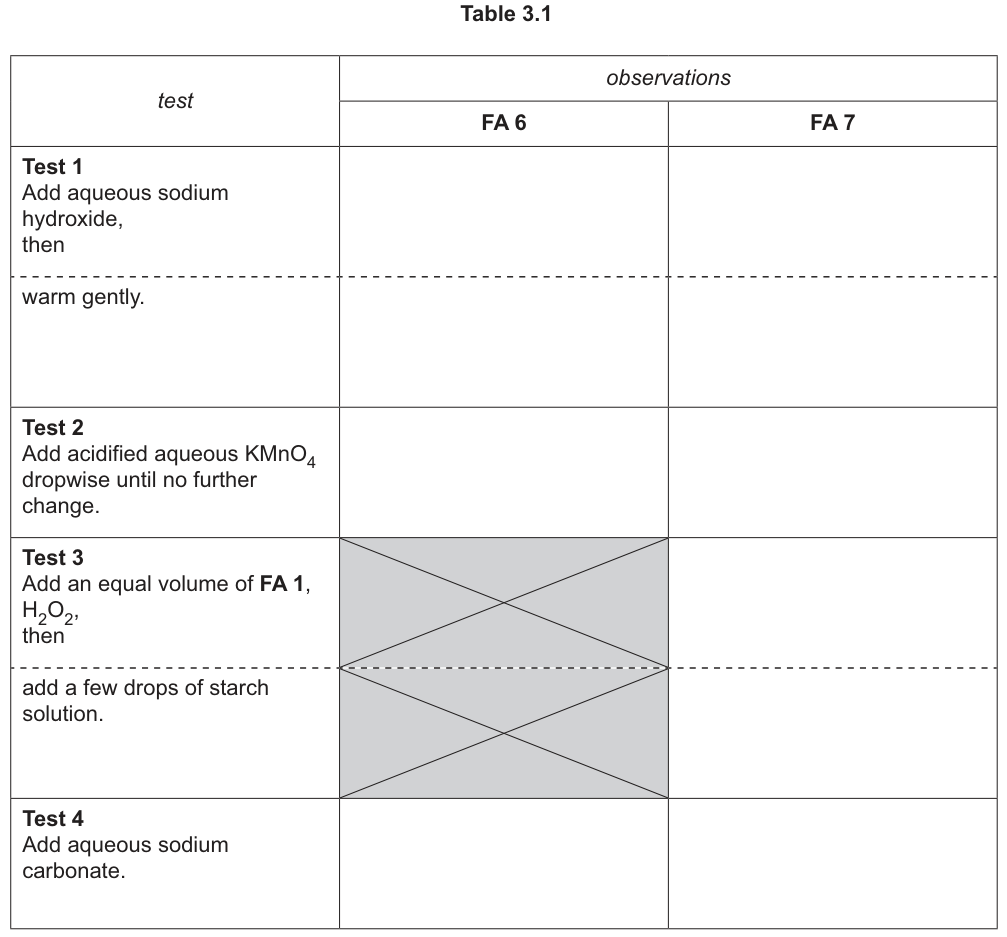
Carry out the following tests and record your observations in Table 3.1.
Use a depth of FA 6 or FA 7 in a boiling tube for Test 1. Use a depth of FA 6 or FA 7 in a test-tube for Tests 2, 3 and 4.
Answer
| test | FA 6 () | FA 7 (KI) |
|---|---|---|
| Test 1 + NaOH (aq) | Red-brown / brown / rust precipitate Insoluble in excess | No change / no precipitate |
| Heat | No change / red litmus does not turn blue | No change / red litmus does not turn blue |
| Test 2 + acidified (aq) | No change / purple colour remains | Solution turns brown / red-brown |
| Test 3 + FA 1 (), then starch | (Shaded out - do not perform) | Solution turns yellow / red-brown Effervescence / fizzing (gas relights glowing splint) Dark blue / blue-black with starch |
| Test 4 + (aq) | Effervescence Gas forms white ppt with limewater Red-brown / brown precipitate | No change |
See table above for observations.
Background Concept
FA 6 is : Contains (yellow/brown solution) and (chloride ion). gives a red-brown ppt with and . is not oxidised by or .
FA 7 is KI: Contains (no characteristic tests) and (iodide ion). is oxidised by (purple to brown ) and by (to , yellow/brown, with evolution). turns starch blue-black.
Understanding the Question
You must perform four tests on both FA 6 and FA 7 and record observations. Test 3 is shaded out for FA 6.
Approach
Work through each test systematically, predicting the observation for each solution based on the ions present.
Step-by-Step Reasoning
Test 1: + NaOH (aq), then warm
- FA 6 (): Red-brown / brown precipitate of , insoluble in excess . Warming produces no change (no ammonia gas, so red litmus does not turn blue).
- FA 7 (, ): No precipitate forms (both and are soluble). Warming produces no change.
Test 2: + acidified (aq)
- FA 6 (, ): cannot be oxidised further. Purple colour of remains (no change). Note: dilute does not decolourise at room temperature.
- FA 7 (): is oxidised to . The solution turns brown / red-brown.
Test 3: + , then starch
- FA 6: Shaded out, do not perform.
- FA 7 (): oxidises to (solution turns yellow / red-brown). also decomposes to give gas (effervescence / fizzing; gas relights a glowing splint). Adding starch turns the solution dark blue / blue-black.
Test 4: + (aq)
- FA 6 (): hydrolyses water, producing which reacts with to give (effervescence; gas turns limewater milky). A red-brown / brown precipitate of also forms (not which is unstable in water).
- FA 7 (, ): No reaction. No change.
Key Takeaways
- gives red-brown ppt with and (with effervescence).
- is oxidised by and to give brown and blue-black with starch.
- and give no characteristic observations in these tests.
Common Mistakes
- Saying gives a blue-black with starch (only does).
- Saying is oxidised by (it is already in its highest common oxidation state).
- Forgetting the effervescence in Test 4 for (hydrolysis of with carbonate produces ).
Things to Be Careful About
- Test 3 is shaded out for FA 6; do not record observations for it.
- In Test 1, you must record observations for both adding and warming.
- Use precise colour descriptions: 'red-brown', 'brown', 'purple', 'blue-black'.
The anion in FA 6 does not contain nitrogen. Select one further reagent to identify the anion present in FA 6.
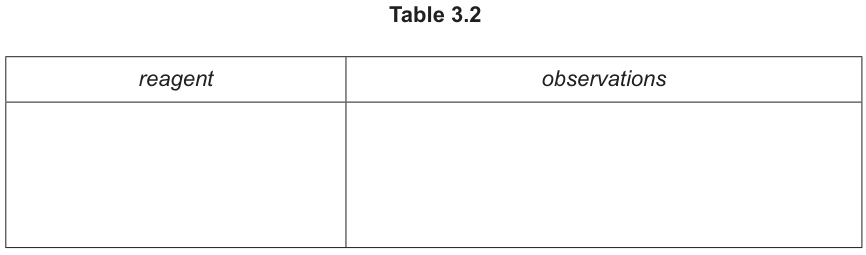
Carry out a test with this reagent and record your observations in Table 3.2.
Answer
| reagent | observations |
|---|---|
| aqueous silver nitrate () | white precipitate |
Reagent: silver nitrate (aq). Observations: white precipitate.
Background Concept
The anion in FA 6 is not stated, but we know FA 6 is (from the mark scheme and the fact that the anion doesn't contain nitrogen or sulfur). The halide test uses acidified silver nitrate, .
- gives a white precipitate of , soluble in dilute ammonia.
- gives a cream precipitate of , sparingly soluble in dilute ammonia.
- gives a yellow precipitate of , insoluble in dilute ammonia.
Understanding the Question
You must select a reagent to identify the anion in FA 6. Since FA 6 is , the anion is . You need the test for chloride.
Approach
Use aqueous silver nitrate (acidified with dilute nitric acid, though the mark scheme just requires ). The observation is a white precipitate.
Step-by-Step Reasoning
Add aqueous silver nitrate, , to FA 6. reacts with to form a white precipitate of silver chloride, .
Key Takeaways
- Chloride ions give a white precipitate with acidified silver nitrate.
Common Mistakes
- Using barium chloride or barium nitrate (that's for sulfate).
- Using lead(II) nitrate (that's for halides but less common in CIE; silver nitrate is standard).
- Not specifying 'white' precipitate.
Things to Be Careful About
- The mark scheme accepts 'silver nitrate' or '' and 'white ppt'.
Give the formulae of the ions present in FA 6 and FA 7. If you are unable to identify an ion from your tests, write ‘unknown.’
The ions present in FA 6 are ......................... and ......................... and ......................... .
The ions present in FA 7 are ......................... and ......................... .
Answer
The ions present in FA 6 are , , and .
The ions present in FA 7 are and unknown.
FA 6: Fe^{3+}, H^{+}, Cl^{-}. FA 7: I^{-}, unknown.
Background Concept
FA 6 contains two cations and one anion. FA 7 contains one cation and one anion. Neither contains sulfur. The anion in FA 6 does not contain nitrogen.
Understanding the Question
Use your observations from (b)(i) and (b)(ii) to identify the ions.
Approach
FA 6:
- Test 1 (NaOH): Red-brown ppt .
- Test 4 (): Effervescence acidic solution (or hydrolysis of , but the mark scheme explicitly includes as one of the cations, likely from the preparation of the solution or excess acid).
- Test 2 (): No change not , not halide that reduces easily (dilute doesn't).
- Test (ii) (): White ppt .
- Ions: , , .
FA 7:
- Test 1 (NaOH): No change (or other alkali metal, but 'unknown' is accepted if not tested).
- Test 2 (): Turns brown halide, specifically (or , but Test 3 confirms ).
- Test 3 ( + starch): Blue-black .
- Cation: is likely, but since no flame test or specific test was done, 'unknown' is acceptable per the mark scheme.
- Anion: .
- Ions: , unknown.
Step-by-Step Reasoning
FA 6:
- Red-brown ppt with identifies .
- Effervescence with indicates acidity ().
- White ppt with identifies .
- Formulae: , , .
FA 7:
- Brown colour with and blue-black with starch/ identifies .
- No test performed for the cation (no ppt, no flame test), so it is 'unknown'.
- Formulae: , unknown.
Key Takeaways
- Synthesise multiple tests to confirm ion identity.
- If an ion cannot be identified from the tests performed, write 'unknown'.
Common Mistakes
- Guessing for FA 7 without a flame test (the mark scheme accepts 'unknown').
- Forgetting in FA 6 (the effervescence with carbonate indicates acid).
- Writing molecular formulae instead of ion formulae.
Things to Be Careful About
- The mark scheme awards marks for correct ions: 2-3 correct = 1 mark, 4 correct = 2 marks, 5 correct = 3 marks.
- FA 6 has 3 ions, FA 7 has 2 ions. Total 5 possible marks.