Chemistry 9701/31 — May/June 2025
Cambridge AS Level · Advanced Practical Skills · worked solutions for every part, with the mark scheme
Topics Manipulation, Measurement and Observation · Presentation of Data and Observations · Analysis, Conclusions and Evaluation · Qualitative Analysis
You will determine the percentage purity of a sample of calcium carbonate by reacting it with excess hydrochloric acid and measuring the volume of carbon dioxide produced.
FA 1 is impure calcium carbonate, .
FA 2 is hydrochloric acid, .
Method
- Weigh the container with FA 1. Record the mass in the space for results.
- Fill the tub with water to a depth of approximately .
- Fill the measuring cylinder completely with water. Holding a piece of paper towel firmly over the top, invert the measuring cylinder and place it in the water in the tub.
- Remove the paper towel and clamp the inverted measuring cylinder so the open end is in the water just above the base of the tub.
- Using the measuring cylinder, transfer of FA 2 into the flask labelled X. Check that the bung fits tightly into the neck of flask X, clamp flask X and place the end of the delivery tube into the inverted measuring cylinder.
- Remove the bung from the neck of the flask. Tip all of the FA 1 into the acid in the flask and replace the bung immediately. Remove the flask from the clamp and swirl it to mix the contents.
- Replace the flask in the clamp and leave until the fizzing stops. Swirl the flask occasionally.
- Weigh the container with any residual FA 1. Record the mass.
- Calculate and record the mass of FA 1 that is added to the acid.
- When no more gas is collected, record the final volume of gas.
You may wish to start Question 2 or Question 3 while the gas is being collected.
Results
Results
| Quantity | Reading |
|---|---|
| Mass of container + FA 1 / g | 4.80 |
| Mass of container + residual FA 1 / g | 4.00 |
| Mass of FA 1 added / g | 0.80 |
| Volume of CO2 produced / cm3 | 150 |
Both mass readings are given to 2 decimal places and the gas volume is recorded as an integer.
Results table: mass of FA 1 added = 0.80 g, volume of CO2 produced = 150 cm3 (representative readings).
Background Concept
The acid–carbonate reaction is:
One mole of calcium carbonate gives one mole of carbon dioxide, so measuring the CO2 volume allows the amount of CaCO3 that actually reacted to be found. At room conditions, one mole of gas occupies about 24.0 dm3 (24000 cm3). The sample is impure, so the mass weighed is not all calcium carbonate; the reacting mass of CaCO3 must be deduced from the gas volume.
Understanding the Question
Part (a) is not a question printed as such, but the experiment and a results space. The marks are earned by how the data are recorded: clear headings with correct units, consistent decimal places for the two weighings, correct calculation of the mass of FA 1 added, and a sensible final gas volume.
Approach
The solid must be weighed before and after the reaction because the tiny solid is added all at once; any residue left after pouring gives the actual mass of FA 1 put into the acid. The gas is collected by water displacement in an upturned 250 cm3 measuring cylinder, so the final reading gives the volume of CO2 produced.
Step-by-Step Reasoning
- Weigh the container with FA 1, for example 4.80 g.
- Add all FA 1 to the acid and, after the reaction finishes, weigh the container again with any residual solid, for example 4.00 g.
- Subtract the second reading from the first to obtain the mass of FA 1 used:
- Read the volume of gas in the inverted cylinder. If the cylinder was full at the start and now reads 100 cm3 of gas space, that is the collected volume: 150 cm3 in the worked example.
The mark scheme requires the two masses to be given to the same number of decimal places, and the gas volume to be recorded as a whole number of cm3.
Key Takeaways
Concise, consistent and headed results tables with correct units are a major part of practical marks. Mass is found by difference and the gas volume is measured directly from the displacement cylinder.
Common Mistakes
Using different numbers of decimal places in the two mass readings is a common error. Also a common mistake is writing the total gas volume as 150.0 cm3 when the cylinder only allows whole cm3. Do not record a negative mass: the second weighing must be smaller than the first, because some sample has been added to the acid.
Things to Be Careful About
The units must be stated next to the quantity in every heading. The mass of FA 1 is not the mass of the sample bottle; it is the mass of powder actually tipped in. The open measuring cylinder is labelled in cm3, so convert the gas volume to dm3 or leave in cm3 depending on the divisor used in the next calculation.
Calculations
Calculate the amount, in mol, of carbon dioxide collected in the measuring cylinder (at room conditions).
amount of = .............................. mol
Hence, deduce the amount, in mol, of calcium carbonate present in the FA 1 used.
amount of = .............................. mol
Working
Using the representative readings,
From the balanced equation:
amount of CO2 = 0.00625 mol; amount of CaCO3 = 0.00625 mol (using example V = 150 cm³)
Background Concept
For gases at room temperature and pressure, 1 mole occupies about 24 dm3 (24000 cm3). The reaction has a 1-to-1 molar ratio between CaCO3 and CO2, so the moles of gas produced equals the moles of CaCO3 in the sample.
Understanding the Question
One mark is given for both values. The answer must use the volume already collected; you are not expected to subtract anything or correct for gas pressure if the apparatus was at laboratory conditions. The moles of CO2 and the moles of CaCO3 are numerically equal.
Approach
Change cm3 to dm3, divide by the molar gas volume, then use the balanced equation to copy the same number of moles to CaCO3.
Step-by-Step Reasoning
- Using , converting to dimensional units: .
- .
- Equation says 1 mol CaCO3 gives 1 mol CO2, so
The result should be reported to 2–4 significant figures, matching the scale of the volumes.
Key Takeaways
Molar volume is used only for a gas at ‘room conditions’. Stoichiometry ratios are taken directly from the balanced equation; if the equation showed 1:2, the factor would be different.
Common Mistakes
Using 22.4 instead of 24.0 is a very common error. Mixing cm3 and dm3: dividing cm3 by 24 is also wrong—divide by 24000, or first convert to dm3.
Things to Be Careful About
Write the gas volume in dm3 before dividing so the units cancel. The moles of gas collected are never the same as the moles of acid used; the acid is present in excess.
Use your answer to (b)(i) and the mass of FA 1 used to calculate the percentage purity of calcium carbonate. Show your working.
purity of calcium carbonate = .............................. %
Working
Using the representative values from (a) and (b)(i):
Answer
purity of calcium carbonate = 78.2% (using example mass 0.80 g and 150 cm3 gas)
78.2% (using example values)
Background Concept
Percentage purity compares the mass of pure calcium carbonate present in the powder to the total mass of FA1 that was weighed, usually expresses it as a percentage.
Understanding
You are asked to use the moles CaCO3 found in (b)(i) with the mass of FA1 that was actually added. The mass of the sample is already known from part (a).
The required answer carries the worked calculation.
Approach
First determine the mass of pure CaCO3:
mass = moles × molar mass. Then divide by mass of the sample and multiply by 100.
Step-by-Step
Using the illustrative values:
- moles CaCO3 = 0.00625 mol.
- = 40.1 + 12.0 + (3×16.0) = 100.1.
- mass pure CaCO3 = 0.00625 × 100.1 = 0.6256 g.
- mass of FA1 = 0.80 g.
- % purity = (0.6256 / 0.80) × 100 = 78.2.
The example values show an impure sample; any larger gas volume and same mass would give a larger purity, and vice versa.
Key Takeaways
The mass of the solid sample is larger than the mass of the pure carbonate; the ratio gives the purity.
Common Mistakes
Using the mass of the total weighed container instead of the mass of FA1 in the purity denominator; forgetting to multiply by 100; using mixture moles from gas but not converting to mass first.
Things to Be Careful About
The molar mass must be one genuine value. Give the final percentage to 2–4 significant figures; the mark scheme does not insist on a particular number of figures, but not huge or tiny numbers. If the candidate’s gas volume gives e.g. 0.0062 mol, use that and help.
A student carries out the experiment described in (a) using of hydrochloric acid. The mass of FA 1 is not changed.
Suggest the consequence of this change on the percentage purity of calcium carbonate calculated by placing one tick () in Table 1.1.
Table 1.1
| The percentage purity calculated would increase. | |
| The percentage purity calculated would stay the same. | |
| The percentage purity calculated would decrease. |
Explain your answer.
Answer
- Tick the bottom box: The percentage purity calculated would decrease.
- The acid has the same total volume of HCl (25 cm³ × 1.00 mol dm⁻³ = 25 × 10⁻³ mol, same as 50 cm³ × 0.500 mol dm⁻³), but its concentration is higher.
- The higher concentration makes the initial reaction/main rate faster, so more CO2 escapes before the bung is replaced.
- Less CO2 is collected, fewer moles/amount of CaCO3 appear to be present, and so the calculated percentage purity is lower.
Tick bottom: purity calculated would decrease.
Background
The rate of a gas-forming reaction usually increases with the concentration of a reactant. A faster reaction gives a higher initial rate and more gas is evolved immediately. The method requires tipping the solid into the acid and then replacing the bung “immediately”; during this short delay some gas always escapes.
The amount of acid is not changed: 50.0 cm3 of 0.500 mol dm–3 gives the same 0.0225 mol as 25.0 cm3 of 1.00 mol dm-3. Therefore if no gas escaped, the collision volume would be identical. But the experiment measures the gas captured in the cylinder, not the gas produced.
Understanding
Part (c) asks for a qualitative and predictive use of the results, not a calculation. You must choose the effect on the width of percentage purity and justify it.
Approach
Calculate both HCl moles and compare concentrations; decide whether extra acid is still in excess; then follow the physical path: faster rate → gas left the flask before the bung was sealed → measured volume is smaller → calculated purity seems lower.
Step-by-Step
Original: mol HCl, mol dm–3.
New: mol HCl, concentration = 1.00 mol.
Same moles, double concentration. In the brief interval between tipping the solid and sealing, a faster reaction drives more gas out. Later the collected volume is less than the theoretical amount. Because amount of gas is less, the calculated moles of CaCO3 and the calculated purity are both below the true value.
Misunderstanding
Some students tick “stay the same” because the total HCl moles are equal; that reasoning ignores the experimental timing and gas escape. Others tick “decrease” but explain that “there is less acid” – that is wrong because moles are same. The correct explanation is the rate/loss of gas.
Pitfalls
Use square brackets for concentration, or write “1.00 mol dm-3”. Do not say “more acid” when you mean “more concentrated acid”. The volume collected, not the total CO2 actually generated, is what is used in the purity calculation.
Things to Be Careful About
Write the tick clearly in the bottom blank. The first credit point requires the right box; the second requires “more gas escapes before the bung is replaced” and “rate is greater.” These two ideas must both be present.
The student repeats the method in (a) but the hydrochloric acid is not used in excess.
Answer
Unreacted solid FA 1 / CaCO3 remains in the flask after the bubbling / effervescence has stopped.
(or: not all the FA 1 has reacted / disappeared at the end of the reaction)
Unreacted solid / CaCO3 remains in the flask after bubbling stops.
Background
In the experiment the acid should be in excess so that all the CaCO3 dissolves. If the acid becomes the limiting reagent, the reaction stops while some CaCO3 is still solid in the flask.
Approach
The only visible sign is the unreacted powder. The stopper must be removed to see inside; after all fizzing has stopped the solid should have vanished if enough acid were present. If it has not, acid (HCl) is not in excess.
Step-by-Step Reasoning
During the reaction CO2 leaves as bubbles, so fizzing. When fizzing stops the calcium carbonate has either all been used up or acid available is exhausted. If solid remains, the amount of acid has become insufficient before the carbonate is fully consumed. This shows the acid is not in excess.
Key Points
The acid being not in excess is not observed directly; it is inferred from the leftover powder. Do not answer “effervescence stops” alone, because that should occur even with an excess acid (after all carbonate reacted).
Common Mistakes
Stating “a gas is given off” is too vague. The required observation is specifically that unreacted solid remains, or that all the solid has not disappeared by the end.
Things to Be Careful About
Observations should be objective and physical. Do not claim to see HCl molecules; write about the solid’s appearance or absence.
Explain what effect, if any, this would have on the percentage purity of calcium carbonate calculated in (b)(ii).
Answer
The percentage purity calculated would be lower.
If the acid is not in excess, not all of the CaCO3 reacts, so the volume/moles of CO2 collected is smaller.
The moles (and therefore the calculated mass) of calcium carbonate used in (b)(ii) are then lower, so the percentage purity is lowered.
Lower purity is calculated.
Background
With insufficient HCl, CaCO3 is no longer the only limiting reagent; the reaction stops when all the acid is used. The stoichiometry 1 CaCO3 : 2 HCl fixes the maximum amount of carbonate that can react.
Understanding
In this part, the acid is deliberately not in excess, so the carbon dioxide volume is limited by the acid, not approximated by the amount of solid weighed. The question asks how this changes the purity calculated from (b)(ii).
Approach
Compare the volume that should have been collected with the true value: acid limited → CaCO3 is left unreacted → less CO2 → the calculated amount of CaCO3 is too low → purity appears too low.
Step-by-Step Reasoning
Because acid is not in excess, some calcium carbonate bleibt unreacted. Consequently the measured gas volume collected is lower. In (b)(i) we use that volume to calculate n(CO2), then set n(CaCO3) = n(CO2). Hence the deduced amount of CaCO3 is too low. The percentage purity = mass pure CaCO3 / mass sample, and the numerator is smaller, so the computed purity decreases.
This is not a “no effect” case, because the mass of CaCO3 used up to the calculation is no longer the true mass initially weighed.
Key Takeaways
Lit. results only reflect reaction that actually occurred; a limiting reactant makes the laboratory result appear lower than real purity.
Common Mistakes
Stating “% purity stays the same” because the sample mass did not change; the calculated amount is now limited deep. Saying “more acid would make purity higher” is also incorrect.
Things to Be Careful About
The marks are two: (1) say the gas volume is less, and (2) say the smaller gas volume lowers calculated moles/mass of CaCO3. Both ideas score. Present them clearly as two separate sentences.
You will determine the percentage purity of another sample of calcium carbonate, , by titration.
The experiment involves three steps.
- step 1: A known mass of the same impure calcium carbonate, FA 1, is reacted with an excess of hydrochloric acid to form FA 3. This step has been done for you.
- step 2: You will dilute the products of step 1 to a known volume.
- step 3: You will carry out a titration to find out how much acid remains after the reaction in step 1.
FA 3 has been prepared by reacting of FA 1 with of hydrochloric acid, .
FA 5 is sodium hydroxide, .
FA 6 is bromophenol blue indicator.
Method
step 2
- Pipette of FA 3 into the volumetric flask.
- Make the solution up to with distilled water.
- Thoroughly mix the contents of the volumetric flask. This solution is FA 4.
step 3
- Fill the burette with FA 5.
- Rinse the pipette with distilled water and then with FA 4.
- Pipette of FA 4 into a conical flask.
- Add several drops of FA 6.
- Perform a rough titration and record your burette readings in the space below.
The rough titre is .............................. .
- Carry out as many accurate titrations as you think necessary to obtain consistent results.
- Make sure any recorded results show the precision of your practical work.
- Record, in a suitable form in the space below, all your burette readings and the volume of FA 5 added in each accurate titration.
Results
Answer
Rough titre: 27.00 cm³ (representative example)
Accurate titrations (all readings to the nearest 0.05 cm³):
| Titration 1 | Titration 2 | Titration 3 | |
|---|---|---|---|
| Initial burette reading / cm³ | 0.00 | 26.70 | 0.00 |
| Final burette reading / cm³ | 26.70 | 53.35 | 26.70 |
| Titre / cm³ | 26.70 | 26.65 | 26.70 |
(Representative example — the candidate records their own readings. Headings must include units; every accurate titre must be within 0.10 cm³ of another accurate titre.)
See working — candidate-dependent; representative titres 26.70, 26.65, 26.70 cm³
Background Concept
In a titration, the burette delivers the titrant (here sodium hydroxide, FA 5) and is read before and after each addition; the titre is the difference between final and initial readings. A burette is graduated in 0.1 cm³ divisions, so a careful reader can estimate to the nearest 0.05 cm³. A rough titration finds the approximate end-point volume so that accurate titrations can be completed quickly. Accurate titrations are repeated until two (or more) agree within 0.10 cm³ — these are concordant titres — and their mean is used in the calculations. The indicator bromophenol blue changes colour at the equivalence point of a strong acid–strong base titration: yellow in acid, blue in alkali.
Understanding the Question
Part (a) asks you to carry out the titration yourself and record your own results properly. You must show a rough titre (two burette readings and the titre) and at least two accurate titrations, each with initial and final readings. All readings must be to the nearest 0.05 cm³, the results table must have correct headings with units, and the accurate titres must be concordant (within 0.10 cm³ of each other). The marks reward technique and presentation, not a specific numerical value.
Approach
First perform a rough titration to find roughly how much FA 5 is needed. Then refill the burette and do accurate titrations: pipette 25.0 cm³ of FA 4 into a conical flask, add a few drops of indicator, and run in FA 5 until the colour changes. Record initial and final readings each time. Repeat until two titres agree within 0.10 cm³. Present all readings in a table with headings that include units.
Step-by-Step Reasoning
The rough titration gives an approximate end-point, e.g. about 27 cm³. For each accurate titration, record the initial reading (burette level before adding NaOH) and the final reading (level at the colour change). The titre is final minus initial. All readings must be to the nearest 0.05 cm³ — a reading such as 26.70 or 26.65 is acceptable, while 26.7 is not precise enough. Continue accurate titrations until the titres are concordant. In the example, titres of 26.70, 26.65 and 26.70 cm³ all lie within 0.10 cm³ of one another, satisfying the concordance requirement.
Key Takeaways
Precise burette reading, concordant titres, and a clearly labelled results table are the core skills. The titre values themselves are candidate-dependent; the technique is what is marked.
Common Mistakes
- Recording readings to only 0.1 cm³ instead of 0.05 cm³.
- Missing units in table headings.
- Performing only one accurate titration (at least two concordant titres are required).
- Forgetting to record the rough titre.
- Titres that differ by more than 0.10 cm³ (not concordant).
Things to Be Careful About
Read the burette at eye level to avoid parallax error. The titre is always final minus initial. Use consistent decimal places (2 dp) for all readings. Bromophenol blue changes from yellow (acid) to blue (alkali) at the end-point.
From your accurate titration results, calculate a suitable mean value to use in your calculations. Show clearly how you obtain the mean value.
of FA 4 required .............................. of FA 5.
Working
Titres selected: 26.70 cm³ and 26.65 cm³ (within 0.10 cm³ of each other)
Answer
26.68 cm³
26.68 cm³
Background Concept
The mean titre is the average of two or more accurate titres that are concordant — that is, within a total spread of not more than 0.20 cm³ of one another. Only concordant titres should be averaged; including a non-concordant value would distort the mean. The mean is quoted to two decimal places, rounded to the nearest 0.01 cm³.
Understanding the Question
From your accurate titrations in part (a), you must choose the titres that agree and calculate their mean. You must show how you obtained the mean, either by writing out the calculation or by ticking the selected readings.
Approach
Identify two (or more) accurate titres within 0.20 cm³ of each other. Add them and divide by the number of values. Round the result to 2 decimal places.
Step-by-Step Reasoning
From part (a), the accurate titres are 26.70, 26.65 and 26.70 cm³. The two values 26.70 and 26.65 differ by 0.05 cm³, well within the 0.20 cm³ limit. Their mean is (26.70 + 26.65)/2 = 26.675 cm³. Rounding to the nearest 0.01 cm³: the third decimal is 5, so round up to 26.68 cm³. (Alternatively, averaging all three titres gives (26.70 + 26.65 + 26.70)/3 = 26.683 → 26.68 cm³, the same result.)
Key Takeaways
The mean titre is the value used in all subsequent calculations, so it must be computed from concordant titres and rounded correctly to 2 dp.
Common Mistakes
- Averaging non-concordant titres.
- Rounding 26.675 down to 26.67 instead of up to 26.68.
- Quoting the mean to 3 dp or more.
Things to Be Careful About
The mark scheme requires the mean to be rounded to the nearest 0.01 cm³. A value ending in 5 rounds up. Show your working or tick the selected readings to make your choice clear.
Calculations
Give your answers to (c)(ii), (c)(iii), (c)(iv) and (c)(v) to an appropriate number of significant figures.
Answer
All answers in (c)(ii)–(c)(v) are expressed to 3 or 4 significant figures.
3 or 4 significant figures
Background Concept
Significant figures reflect the precision of the data. The concentrations (0.0900 mol dm⁻³ and 2.00 mol dm⁻³) and volumes (25.0, 250, 19.0 cm³) are given to 3 significant figures, so calculated answers should carry 3 (or 4) significant figures to avoid false precision.
Understanding the Question
This instruction tells you how to present the numerical answers in the following parts: each must be to 3 or 4 significant figures. It is a presentation requirement, not a calculation.
Approach
After each calculation, count the significant figures in the result and adjust the rounding so that 3 or 4 significant figures are shown.
Step-by-Step Reasoning
For example, 0.0024012 mol has 5 significant figures and must be rounded to 0.00240 mol (3 sf). Leading zeros do not count as significant figures. A value such as 0.240 mol has 3 significant figures (the trailing zero after the decimal point counts).
Key Takeaways
Match the precision of your answers to the precision of the given data. Leading zeros are placeholders; trailing zeros after a decimal point are significant.
Common Mistakes
- Quoting calculator output with 5 or more significant figures.
- Quoting too few significant figures (e.g. 0.002 mol instead of 0.00240 mol).
Things to Be Careful About
Leading zeros (e.g. in 0.00240) never count as significant figures. A trailing zero after the decimal point (e.g. in 0.240) does count.
Calculate the amount, in mol, of sodium hydroxide in the volume of FA 5 in (b).
amount of = .............................. mol
Working
Answer
0.00240 mol
0.00240 mol
Background Concept
The amount of a dissolved substance is given by , where is concentration in mol dm⁻³ and is volume in dm³. Since burette volumes are measured in cm³, they must be divided by 1000 to convert to dm³.
Understanding the Question
You know the concentration of FA 5 (0.0900 mol dm⁻³) and the volume used in the titration from part (b) (26.68 cm³). Calculate the amount of NaOH in that volume.
Approach
Substitute the concentration and the converted volume into .
Step-by-Step Reasoning
Volume = 26.68 cm³ = 26.68/1000 = 0.02668 dm³. Amount = 0.0900 × 0.02668 = 0.0024012 mol. To 3 significant figures, this is 0.00240 mol. The leading zeros are placeholders and do not count as significant figures.
Key Takeaways
Always convert cm³ to dm³ before using . The result must be to 3 or 4 significant figures.
Common Mistakes
- Forgetting to divide the volume by 1000.
- Quoting the unrounded value 0.0024012 (5 sf) instead of 0.00240 (3 sf).
Things to Be Careful About
The concentration 0.0900 has 3 significant figures. The volume 26.68 has 4. The answer is quoted to 3 sf to match the least precise given value.
Use your answer to (c)(ii) to calculate the amount, in mol, of hydrochloric acid in of FA 4.
amount of in of FA 4 = .............................. mol
Hence, calculate the amount, in mol, of hydrochloric acid present in of FA 3.
amount of in of FA 3 = .............................. mol
Working
Neutralisation: (1:1)
Amount of HCl in 25.0 cm³ of FA 4 = amount of NaOH = 0.00240 mol
Amount of HCl in 250 cm³ of FA 4 = mol
FA 4 is FA 3 diluted 10×, so:
Amount of HCl in 250 cm³ of FA 3 = mol
Answer
Amount of HCl in 250 cm³ FA 4 = 0.0240 mol
Amount of HCl in 250 cm³ FA 3 = 0.240 mol
0.0240 mol; 0.240 mol
Background Concept
Hydrochloric acid and sodium hydroxide neutralise in a 1:1 ratio: HCl + NaOH → NaCl + H₂O. Therefore the amount of HCl in the 25.0 cm³ portion of FA 4 titrated equals the amount of NaOH in the titre. To find the amount in the whole 250 cm³ flask, multiply by 10. Then, because FA 4 was prepared by diluting 25.0 cm³ of FA 3 to 250 cm³ (a 10× dilution), the amount of HCl in 250 cm³ of FA 3 is 10× the amount in 250 cm³ of FA 4.
Understanding the Question
This part asks for two amounts: the HCl in the full 250 cm³ of FA 4, and the HCl in the original 250 cm³ of FA 3. Both require scaling up from the titre result.
Approach
Step 1: amount HCl in 25.0 cm³ FA 4 = amount NaOH (from c(ii)). Step 2: multiply by 10 to get the amount in 250 cm³ FA 4. Step 3: multiply by 10 again because FA 4 is a 10× dilution of FA 3.
Step-by-Step Reasoning
The titre used 25.0 cm³ of FA 4, so the amount of HCl in that portion is 0.00240 mol. The volumetric flask holds 250 cm³, which is 10× the titre volume, so the amount in the flask is 0.00240 × 10 = 0.0240 mol. FA 4 was made by diluting 25.0 cm³ of FA 3 to 250 cm³, so FA 4 is 10× more dilute than FA 3; therefore the amount of HCl in 250 cm³ of FA 3 is 0.0240 × 10 = 0.240 mol.
Key Takeaways
Dilution factors and volume ratios both multiply the amount. Keep track of which solution is being scaled and in which direction.
Common Mistakes
- Applying only one ×10 instead of two.
- Confusing the direction of the dilution factor (FA 3 is more concentrated than FA 4).
Things to Be Careful About
The two ×10 factors are different in origin: one is the volume ratio (25 → 250 cm³), the other is the dilution factor (FA 3 → FA 4). Both must be applied.
Calculate the amount, in mol, of hydrochloric acid used to prepare FA 3.
amount of = .............................. mol
Working
Answer
0.500 mol
0.500 mol
Background Concept
FA 3 was prepared by adding 19.0 g of FA 1 to 250 cm³ of 2.00 mol dm⁻³ hydrochloric acid. The amount of HCl initially present is found from : concentration 2.00 mol dm⁻³ and volume 250 cm³ = 0.250 dm³.
Understanding the Question
Calculate the total amount of HCl that was used to prepare FA 3, before any reaction with the calcium carbonate occurred.
Approach
Convert the volume to dm³ and multiply by the concentration.
Step-by-Step Reasoning
Volume = 250 cm³ = 0.250 dm³. Amount = 0.250 × 2.00 = 0.500 mol. This is the initial amount of acid before any reacted with the calcium carbonate in FA 1.
Key Takeaways
The initial amount of HCl is a fixed reference value; the amount that reacted is found by subtracting the amount remaining (from c(iii)).
Common Mistakes
- Forgetting to convert cm³ to dm³.
- Using the wrong concentration (e.g. 0.0900 instead of 2.00).
Things to Be Careful About
The value 0.500 mol has 3 significant figures. This is the acid added in step 1, not the acid in FA 4.
Use your answers to (c)(iii) and (c)(iv) to calculate the amount, in mol, of hydrochloric acid that reacted with the FA 1 in step 1.
amount of that reacted with FA 1 = .............................. mol
Working
Answer
0.260 mol
0.260 mol
Background Concept
In step 1, FA 1 (impure calcium carbonate) was added to an excess of hydrochloric acid. The acid that reacted with the carbonate was consumed; the acid that remained is what was titrated in step 3. Therefore: acid reacted = initial acid − acid remaining.
Understanding the Question
Use the initial amount of HCl (c(iv) = 0.500 mol) and the amount remaining in FA 3 (c(iii) = 0.240 mol) to find how much acid reacted with the calcium carbonate.
Approach
Subtract the remaining amount from the initial amount.
Step-by-Step Reasoning
Initial HCl = 0.500 mol. HCl remaining after reaction = 0.240 mol. HCl that reacted = 0.500 − 0.240 = 0.260 mol.
Key Takeaways
The "back-titration" idea: measure what is left over after a reaction to deduce how much was consumed.
Common Mistakes
- Subtracting in the wrong order (0.240 − 0.500 gives a negative value).
- Using the amount in FA 4 instead of FA 3.
Things to Be Careful About
Both values must refer to the same volume (250 cm³ of FA 3). The result 0.260 mol has 3 significant figures.
Use your answer to (c)(v) to calculate the amount, in mol, of calcium carbonate present in FA 1.
amount of in FA 1 = .............................. mol
Working
From the equation: 1 mol CaCO₃ reacts with 2 mol HCl.
Answer
0.130 mol
0.130 mol
Background Concept
The balanced equation is CaCO₃(s) + 2HCl(aq) → CaCl₂(aq) + H₂O(l) + CO₂(g). The stoichiometric ratio is 1 mol CaCO₃ : 2 mol HCl. To find the amount of calcium carbonate that reacted, divide the amount of HCl that reacted by 2.
Understanding the Question
Use the amount of HCl that reacted with FA 1 (c(v) = 0.260 mol) and the balanced equation to find the amount of CaCO₃ in the sample.
Approach
Divide the amount of HCl by the stoichiometric coefficient 2.
Step-by-Step Reasoning
0.260 mol of HCl reacted. Since 2 mol HCl react with 1 mol CaCO₃, the amount of CaCO₃ = 0.260/2 = 0.130 mol. This is the amount of pure calcium carbonate in the 19.0 g sample of FA 1.
Key Takeaways
Always read the stoichiometric ratio from the balanced equation before converting between amounts of different substances.
Common Mistakes
- Multiplying by 2 instead of dividing (0.260 × 2 = 0.520, which is wrong).
- Using the wrong equation or forgetting the ratio.
Things to Be Careful About
The coefficient of HCl is 2, so CaCO₃ is half the amount of HCl. The answer 0.130 mol has 3 significant figures.
Use your answer to (c)(vi) and the mass of FA 1 used to calculate the percentage purity of calcium carbonate. Show your working.
purity of calcium carbonate = .............................. %
Working
Answer
68.5%
68.5%
Background Concept
Percentage purity is the mass of pure substance divided by the mass of the impure sample, multiplied by 100. The mass of pure CaCO₃ is found from moles × molar mass, where .
Understanding the Question
From the amount of CaCO₃ found in (c)(vi) = 0.130 mol, calculate the mass of pure calcium carbonate, then express it as a percentage of the 19.0 g sample of FA 1 that was used.
Approach
Convert moles of CaCO₃ to mass using the molar mass, then divide by the sample mass and multiply by 100.
Step-by-Step Reasoning
Mass of pure CaCO₃ = 0.130 × 100.1 = 13.01 g. The sample of FA 1 weighed 19.0 g. Percentage purity = (13.01/19.0) × 100 = 68.5%. This means 68.5% of the impure sample is calcium carbonate; the rest is the impurity.
Key Takeaways
Percentage purity links the amount of a pure component to the mass of the impure sample. The molar mass must be calculated correctly (100.1 for CaCO₃).
Common Mistakes
- Using the wrong molar mass (e.g. forgetting the oxygen atoms).
- Dividing by the wrong mass (e.g. 13.01/100.1 instead of 13.01/19.0).
- Quoting the answer to too many significant figures.
Things to Be Careful About
The sample mass is 19.0 g (3 sf), so the percentage should be quoted to 3 significant figures (68.5%). Show your working, as the mark scheme requires it.
The percentage purity of calcium carbonate in FA 1 has been determined by two different methods, gas collection and titration. The gas collection method used in Question 1 is less accurate.
Suggest two reasons why the gas collection method is less accurate.
1 ........................................................................................................................................
2 ........................................................................................................................................
Answer
-
Some carbon dioxide dissolves in the water in the trough / measuring cylinder, so less gas is collected than is produced.
-
Some gas escapes before the bung is replaced on the conical flask, so the measured volume is too low.
CO₂ dissolves in water; gas escapes before the bung is replaced
Background Concept
In the gas collection method, the volume of carbon dioxide produced by the reaction CaCO₃(s) + 2HCl(aq) → CaCl₂(aq) + H₂O(l) + CO₂(g) is measured (typically by collecting gas over water in a measuring cylinder). The percentage purity is then calculated from the gas volume. Several practical issues make this method less accurate than titration.
Understanding the Question
The question asks for two reasons why the gas collection method gives a less accurate percentage purity than the titration method. You need to identify specific, credible sources of error in collecting and measuring the gas.
Approach
Think about where gas can be lost or the measured volume distorted during the collection process: dissolution in the collecting water, escape before sealing, and interference from the impurity.
Step-by-Step Reasoning
Reason 1: Carbon dioxide is soluble in water. When the gas is collected over water, some CO₂ dissolves, so the measured volume is less than the volume actually produced. This makes the calculated purity too low.
Reason 2: When the acid is added to the flask containing the calcium carbonate, gas is produced immediately. If the bung is not replaced instantly, some gas escapes before the apparatus is sealed, again reducing the measured volume.
Reason 3 (alternative): The impurity in FA 1 might itself react with the acid to produce gas, which would make the measured volume too high and inflate the calculated purity.
Key Takeaways
Gas collection methods lose accuracy through gas dissolving, gas escaping before sealing, and side reactions of impurities. Each error either reduces or inflates the measured volume and hence distorts the calculated purity.
Common Mistakes
- Giving vague answers such as "human error" or "not accurate" without a specific mechanism.
- Saying gas "evaporates" instead of "dissolves" — CO₂ dissolves in water; it does not evaporate from it.
- Repeating the same idea twice in different words (both marks require distinct reasons).
Things to Be Careful About
Each reason must be a distinct, specific source of error. The mark scheme accepts "some gas dissolves in the water", "some gas escapes before the bung is replaced", and "the impurity may react to produce gas".
Describe a change to the gas collection method that would improve the accuracy of the percentage purity determined in Question 1.
Answer
Keep the CaCO₃ and the acid separate inside the stoppered flask until the reaction is started — for example, place the CaCO₃ in a small container that can be tipped over, or hold it in a small package by a thread — so that no gas escapes before the apparatus is sealed.
Separate CaCO₃ and acid within the stoppered flask until reaction starts (e.g. small container tipped over)
Background Concept
The main source of error in the gas collection method is gas escaping before the apparatus is sealed, or gas dissolving in the collecting water. Improvements target these specific losses.
Understanding the Question
Describe one change to the gas collection method that would make the percentage purity more accurate. The change must address one of the error sources identified in (d)(i).
Approach
Choose one error from part (d)(i) and describe a concrete modification that eliminates or reduces it.
Step-by-Step Reasoning
If the problem is gas escaping before the bung is replaced, the fix is to have both reactants inside the sealed flask from the start, separated so they only mix when you are ready. For example, put the CaCO₃ in a small container (or a paper package held by a thread) inside the flask, add the acid, seal the flask, then tip the container over to start the reaction. No gas can escape because the flask was sealed before the reaction began.
Alternatively, to reduce CO₂ dissolving, saturate the water with CO₂ before the experiment, or use warmer water (less gas dissolves at higher temperature). Another option is to use a gas syringe instead of collecting over water, which avoids dissolution entirely.
Key Takeaways
A good improvement is specific and directly addresses a named source of error. "Be more careful" is not an improvement; describing how the apparatus is changed to prevent gas loss is.
Common Mistakes
- Giving a vague answer such as "repeat the experiment" or "be more careful".
- Suggesting an improvement that does not address a specific error (e.g. "use a bigger flask").
Things to Be Careful About
The improvement must be a change to the method or apparatus, not a general statement about accuracy. The mark scheme accepts: separating CaCO₃ and acid within the stoppered flask until reaction starts, saturating the water with CO₂ or using warmer water, or using a gas syringe.
Qualitative analysis
For each test you should record all your observations in the spaces provided.
Examples of observations include:
- colour changes seen
- the formation of any precipitate and its solubility (where appropriate) in an excess of the reagent added
- the formation of any gas and its identification (where appropriate) by a suitable test.
You should record clearly at what stage in a test an observation is made.
Where no change is observed, you should write 'no change'.
Where reagents are selected for use in a test, the name or correct formula of the element or compound must be given.
If any solution is warmed, a boiling tube must be used. If a solid is heated, a hard-glass test-tube must be used.
Rinse and reuse test-tubes and boiling tubes where possible.
No additional tests should be attempted.
FA 7 is a solution containing two cations and one anion. All of the ions are listed in the Qualitative analysis notes.
Carry out the following tests and record your observations in Tables 3.1 and 3.2. For each test use a depth of FA 7 in a test-tube unless the solution requires heating.
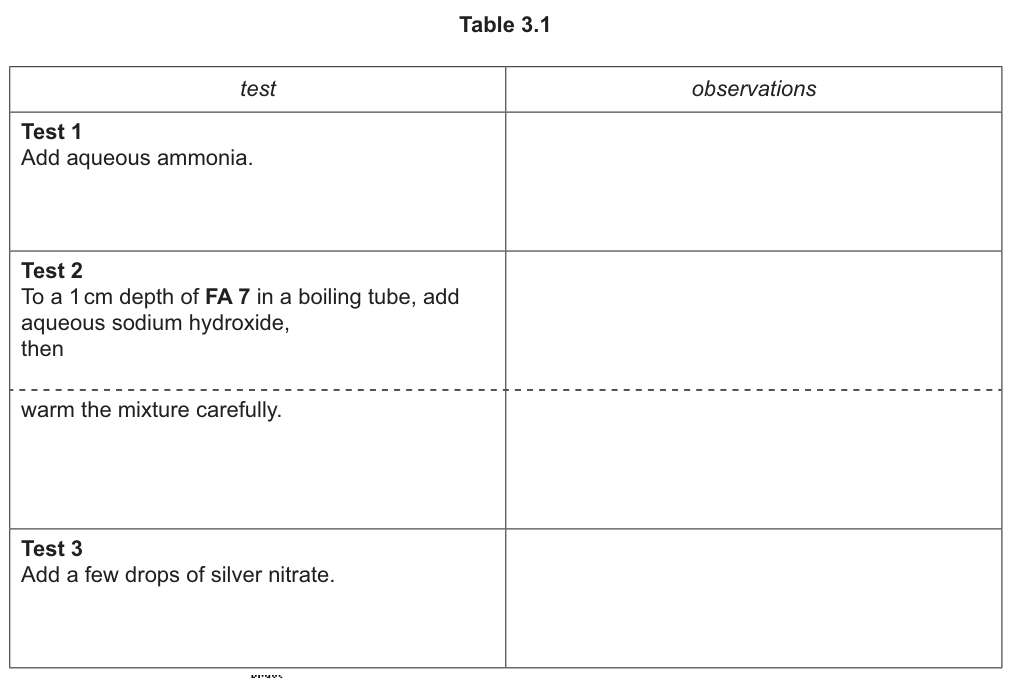
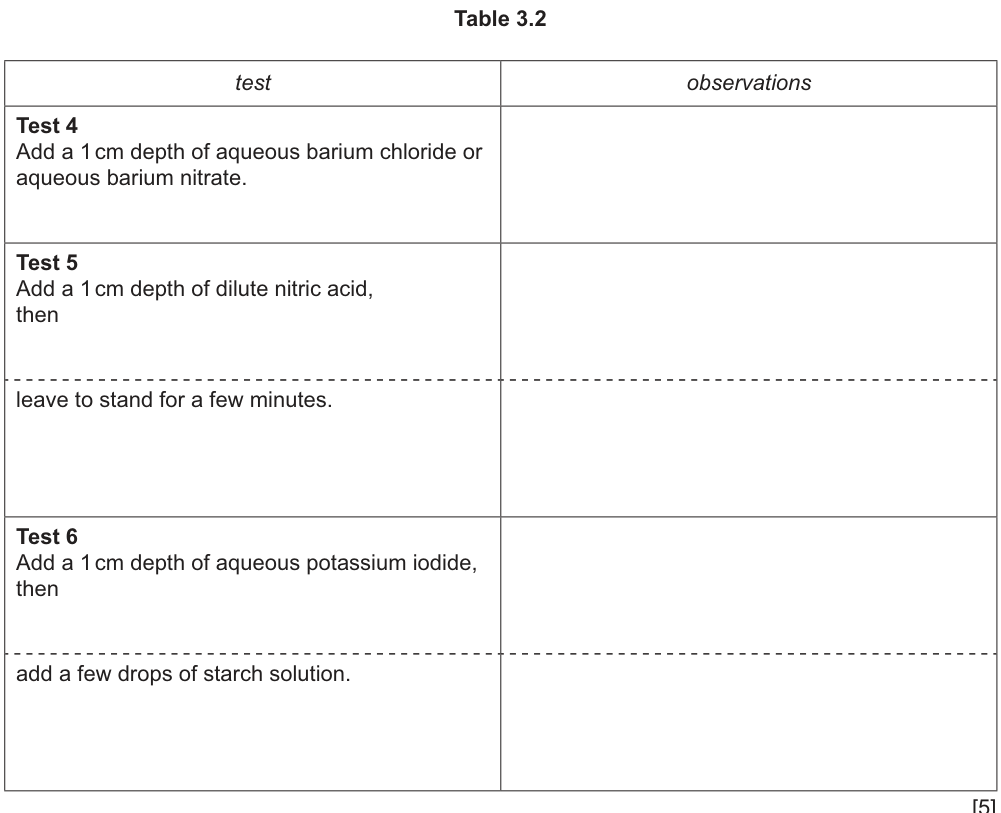
Answer
Test 1 (aqueous ammonia): (pale) blue precipitate formed, soluble in excess to give a dark / deep blue solution.
Test 2 (aqueous sodium hydroxide): (pale) blue precipitate formed, insoluble in excess.
Warm: gas / bubbles evolved; gas turns red litmus blue; black solid / residue forms.
Test 3 (silver nitrate): white precipitate formed.
Test 4 (barium chloride / nitrate): no visible change / remains pale blue solution.
Test 5 (dilute nitric acid): no visible change / no effervescence. Standing: no change / remains pale blue solution.
Test 6 (potassium iodide): solution turns brown. Starch: blue-black / dark blue / black colour.
See working / candidate-dependent observations (see detailed explanation)
Background Concept
Qualitative analysis of aqueous solutions relies on characteristic reactions of ions with specific reagents. Transition metal cations like form coloured precipitates with and , and can form soluble complex ions with excess ammonia. Ammonium ions () release ammonia gas when warmed with strong alkali. Halide anions form characteristic precipitates with acidified silver nitrate. Oxidising cations like can oxidise iodide ions to iodine, which forms a blue-black complex with starch.
Understanding the Question
You are given FA 7, a solution containing two cations and one anion. You must perform six tests (Table 3.1 and 3.2) and record the exact observations. The tests cover cation identification (ammonia, sodium hydroxide, potassium iodide), anion identification (silver nitrate, barium salts, nitric acid), and gas testing (warming with NaOH).
Approach
Systematically apply each test to FA 7 and record what is seen. Compare your observations against known reactions:
- gives a pale blue ppt with (aq) and (aq), soluble in excess to give a deep blue complex.
- gives gas with hot , turning damp red litmus blue.
- gives a white ppt with .
- oxidises to , turning the solution brown and starch blue-black.
- Absence of or is shown by no reaction with or dilute .
Step-by-Step Reasoning
- Test 1 ((aq)): reacts to form (pale blue ppt). Excess forms the tetraamminecopper(II) complex , which is deep blue and soluble. Observation: (pale) blue ppt soluble in excess to give a dark blue solution.
- Test 2 ((aq) then warm): forms (pale blue ppt), insoluble in excess. Warming with releases gas from (turns red litmus blue) and decomposes to black residue.
- Test 3 (): forms , a white precipitate.
- Test 4 (): No or present, so no precipitate. Solution remains pale blue.
- Test 5 (dilute then stand): Confirms no carbonate/sulfite (no effervescence). No change.
- Test 6 ( then starch): . Iodine turns solution brown; starch turns it blue-black.
Key Takeaways
Precise observation recording is critical in practical papers. Note colour changes, precipitate formation and solubility, and gas evolution with appropriate tests. Complexation with excess ammonia is a key differentiator for copper(II).
Common Mistakes
- Writing 'blue solution' instead of 'blue precipitate soluble in excess' for Test 1.
- Forgetting to mention the black solid () formed upon warming in Test 2.
- Stating 'white ppt' for Test 3 without specifying it is insoluble in excess (though not strictly required here, precision matters).
- Claiming effervescence in Test 4 or 5.
Things to Be Careful About
- Record observations at the correct stage (e.g., before and after adding excess reagent, before and after warming).
- Use precise colour terms: 'pale blue' for , 'dark/deep blue' for the complex, 'white' for , 'brown' for iodine water, 'blue-black' for starch-iodine.
- State symbols are not required in the observation tables, but must be in ionic equations.
Write an ionic equation for a reaction in (a)(i) that resulted in the formation of a precipitate. Include state symbols.
Answer
OR
OR
Cu^{2+}(aq) + 2OH^{-}(aq) -> Cu(OH)_{2}(s)
Background Concept
Ionic equations represent the actual chemical species involved in a reaction, omitting spectator ions. State symbols ((s), (l), (g), (aq)) are mandatory in Cambridge practical papers to show understanding of the physical state of each species. Precipitation reactions occur when soluble ions combine to form an insoluble solid.
Understanding the Question
You must write an ionic equation for any reaction in (a)(i) that produced a precipitate. The mark scheme accepts three valid options based on the tests performed.
Approach
Identify the tests that formed precipitates: Test 2 (), Test 3 (), and Test 6 ( and , though is aqueous, is solid). Write the net ionic equation for one of them, ensuring charges and atoms are balanced and state symbols are included.
Step-by-Step Reasoning
- Option 1: Reaction of copper(II) with hydroxide ions. . Balanced, correct states.
- Option 2: Reaction of silver ions with chloride ions. . Balanced, correct states.
- Option 3: Redox reaction between copper(II) and iodide. . Note that is the precipitate here.
Key Takeaways
Always include state symbols in ionic equations for practical questions. Check that the total charge is balanced on both sides.
Common Mistakes
- Forgetting state symbols (especially (aq) for ions and (s) for precipitates).
- Writing molecular equations instead of ionic equations (e.g., ).
- Incorrectly balancing charges or atoms.
Things to Be Careful About
The mark scheme explicitly allows any of the three equations. Ensure you only write one if asked for 'an' equation, though writing multiple correct ones is usually not penalised unless specified. The redox equation for iodide is often overlooked but is fully creditable.
Give the formula of each ion present in FA 7. If you cannot identify an ion, write 'unknown.'
cations ..................... and .....................
anion .....................
Answer
Cations: and
Anion:
Cations: Cu^{2+} and NH_4^+; Anion: Cl^-
Background Concept
Deduction of ions in a mixture requires cross-referencing positive and negative tests. A cation test that is positive confirms the ion's presence; a negative test (no reaction) helps rule out others. The combination of tests must be consistent with the observed colours and precipitates.
Understanding the Question
You must give the formula of each ion in FA 7. Two cations and one anion are present. You have 2 marks for this (2 correct = 1 mark, all 3 = 2 marks).
Approach
- Cations: Test 1 and 2 confirm (blue ppt, deep blue complex). Warming with NaOH confirms (gas turning litmus blue). No other cations are indicated.
- Anion: Test 3 confirms (white ppt with ). Tests 4 and 5 rule out and .
Step-by-Step Reasoning
- Pale blue ppt with and , soluble in excess to deep blue .
- Gas with hot turning red litmus blue .
- White ppt with , insoluble in dilute (implied by no change in Test 5) .
- No ppt with no .
Key Takeaways
Use a process of elimination. Positive tests identify ions; negative tests (no reaction) rule out common anions like sulfate and carbonate.
Common Mistakes
- Writing instead of (copper(I) is not stable in aqueous solution with these reagents).
- Forgetting the charge on ions (e.g., writing instead of ).
- Missing the ammonium ion and assuming the gas was from something else.
Things to Be Careful About
The question asks for 'formula', so write , not 'copper(II) ion'. Include charges explicitly.
FA 8 is an anhydrous sodium compound.
Transfer a spatula measure of FA 8 to a hard-glass test-tube. Heat the test-tube gently at first, then more strongly until no further change occurs. Record your observations.
Answer
Condensation / colourless droplets / steam forms on the cooler upper parts of the test-tube.
Condensation / colourless droplets / steam
Background Concept
Thermal decomposition of hydrated salts or bicarbonates often releases water of crystallisation or water from the decomposition reaction. When heated in a test-tube, water vapour travels to the cooler upper parts and condenses into visible droplets.
Understanding the Question
You are heating FA 8, an anhydrous sodium compound. You must record observations during gentle then strong heating.
Approach
Sodium bicarbonate () decomposes on heating to sodium carbonate, water, and carbon dioxide. The water will condense on the cooler parts of the tube.
Step-by-Step Reasoning
- Heat FA 8 ().
- Reaction: .
- Water vapour condenses on the cooler upper walls of the test-tube.
- Observation: condensation, colourless droplets, or steam.
Key Takeaways
When heating solids that release water, look for condensation on the cooler parts of the apparatus.
Common Mistakes
- Saying 'the solid melts' (sodium compounds generally have high melting points and won't melt in a test-tube).
- Not specifying where the condensation forms (upper/cooler part of the tube).
Things to Be Careful About
Use precise language: 'condensation' or 'colourless droplets'. Do not just say 'water' without describing its appearance as droplets/steam.
The FA 9 provided is a sample of the residue obtained from heating FA 8.
To a depth of nitric acid in a test-tube, slowly add a small spatula measure of FA 9. Record your observations.
Answer
Effervescence / bubbling / fizzing occurs as the solid dissolves to form a colourless solution. (The gas evolved turns limewater milky / forms a white precipitate with limewater.)
Effervescence / bubbling / fizzing
Background Concept
Carbonates react with dilute acids to produce carbon dioxide gas, water, and a salt. This is a standard test for the carbonate ion (). The residue from heating sodium bicarbonate is sodium carbonate.
Understanding the Question
FA 9 is the residue from heating FA 8. You add it to dilute nitric acid. You must record observations.
Approach
FA 8 is . Heating gives FA 9 (). Adding dilute to produces gas.
Step-by-Step Reasoning
- FA 9 is (white solid).
- Add dilute .
- Reaction: .
- Observation: effervescence (bubbling/fizzing) as is released. The solid dissolves to form a colourless solution.
- Confirmatory test (if mentioned): turns limewater milky (white ppt of ).
Key Takeaways
Carbonates fizz with dilute acids. The gas is , confirmed by limewater.
Common Mistakes
- Saying 'no reaction' (carbonates definitely react with acids).
- Not mentioning the solid dissolving or the solution becoming colourless.
- Confusing the gas with hydrogen (hydrogen is colourless and odourless, but is the product here).
Things to Be Careful About
The mark scheme awards M1 for effervescence and M2 for either the gas identification (limewater test) or the formation of a colourless solution. Include both if possible for full marks.
Answer
FA 8 is .
NaHCO_3
Background Concept
Sodium hydrogen carbonate (bicarbonate) decomposes on heating to sodium carbonate, water, and carbon dioxide. This is distinct from sodium carbonate, which is stable to heat (under normal test-tube conditions).
Understanding the Question
Deduce the formula of FA 8 based on the observations in (b)(i) and (b)(ii).
Approach
- (b)(i) shows water is released on heating contains hydrogen or is a hydrate. Since it's anhydrous, it must contain hydrogen in a decomposable group like .
- (b)(ii) shows is released with acid contains carbonate or hydrogen carbonate.
- Combined: the compound is a hydrogen carbonate. Since it's a sodium compound, it is .
Step-by-Step Reasoning
- Heating FA 8 releases water (condensation) decomposes: .
- Residue FA 9 () reacts with acid to give (effervescence).
- Therefore, FA 8 is sodium hydrogen carbonate, .
Key Takeaways
Thermal decomposition of bicarbonates produces carbonates, water, and . This is a key distinguishing test from carbonates.
Common Mistakes
- Writing (this is the residue, not the original compound; it doesn't release water on heating).
- Writing (doesn't decompose to give ).
- Forgetting to balance the formula (e.g., is correct, is wrong).
Things to Be Careful About
Ensure the formula is written correctly: , not or . The question states FA 8 is anhydrous, so don't add water of crystallisation.