Chemistry 9701/24 — May/June 2025
Cambridge AS Level · AS Level Structured Questions · worked solutions for every part, with the mark scheme
Topics States of Matter · Introduction to Organic Chemistry · Chemical Bonding · Atoms, Molecules and Stoichiometry · Chemical Periodicity · Atomic Structure · +9 more
Elements in Period 3 of the Periodic Table show trends in their properties.
Complete Table 1.1 by identifying the lattice structures of the crystalline solids of Mg, Si and P.
Table 1.1
| element | Mg | Si | P |
|---|---|---|---|
| lattice structure in crystalline solid |
Answer
| Element | Lattice structure |
|---|---|
| Mg | Giant metallic |
| Si | Giant covalent |
| P | Simple molecular |
Mg: giant metallic; Si: giant covalent; P: simple molecular
Background Concept
The Period 3 elements display a progression in bonding and structure across the period. On the left, the metals (Na, Mg, Al) have giant metallic lattices consisting of positive metal ions in a sea of delocalised electrons. Silicon in the middle is a metalloid with a giant covalent (diamond-like) structure where every atom is bonded to four others by strong covalent bonds. Moving right, phosphorus, sulfur, chlorine, and argon exist as simple molecular substances — discrete molecules held together by weak van der Waals forces between them.
Understanding the Question
The question asks you to identify the lattice structure of the crystalline solid form of three Period 3 elements: magnesium, silicon, and phosphorus. The command word is "complete" — you simply need to name the correct structure type for each.
Approach
Recall the position of each element in Period 3 and the type of bonding it exhibits. Metals form giant metallic lattices, metalloids like silicon form giant covalent lattices, and non-metals on the right form simple molecular lattices.
Step-by-Step Reasoning
- Magnesium (Mg): A Group 2 metal. In its crystalline solid form, it consists of Mg²⁺ ions arranged in a regular lattice surrounded by a sea of delocalised electrons. This is a giant metallic structure.
- Silicon (Si): A Group 14 element and metalloid. Each silicon atom forms four covalent bonds with neighbouring atoms in a tetrahedral arrangement, creating a continuous three-dimensional network identical in type to diamond. This is a giant covalent (giant molecular) structure.
- Phosphorus (P): A Group 15 non-metal. In its crystalline solid form (white phosphorus), it exists as discrete P₄ molecules held together by weak intermolecular van der Waals forces. This is a simple molecular structure.
Key Takeaways
The Period 3 elements show a clear progression from metallic bonding (left) through giant covalent (middle) to simple molecular (right), reflecting the change from metallic to non-metallic character across the period.
Common Mistakes
- Calling silicon's structure "giant molecular" when the mark scheme accepts this but "giant covalent" is the more precise and commonly expected term. Note: the mark scheme uses "giant molecular" for Si, which is acceptable.
- Writing "simple covalent" for phosphorus instead of "simple molecular" — while sometimes accepted, "simple molecular" is the standard term.
- Confusing the lattice structure with the bonding type. The question asks for the lattice structure, not the type of bond within it.
Things to Be Careful About
Use the exact terminology expected: "giant metallic", "giant covalent" (or "giant molecular"), and "simple molecular". Avoid vague terms like "covalent" or "molecular" alone.
The relative electrical conductivities of the Period 3 elements are shown in Fig. 1.1.
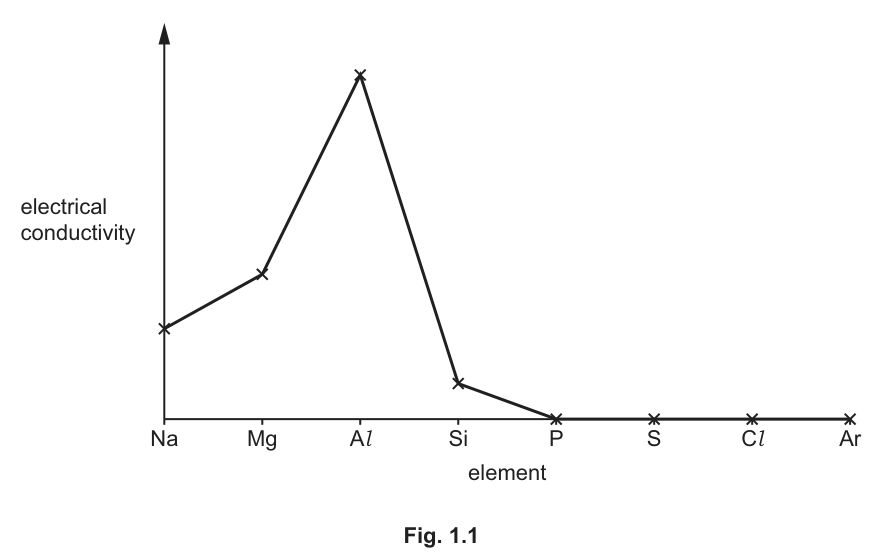
Explain why there is an increase in conductivity from Na to Al and why P, S and Cl are non-conductors of electricity.
Answer
Na to Al are metals with delocalised electrons that can move through the lattice and carry charge; P, S, and Cl are simple molecular substances with no delocalised electrons (no mobile charge carriers), so they cannot conduct.
From Na to Al, the number of delocalised electrons per atom increases, so conductivity increases.
Na to Al have delocalised electrons that can move; P, S, Cl have no delocalised electrons. Increasing number of delocalised electrons from Na to Al increases conductivity.
Background Concept
Electrical conductivity in solids requires mobile charge carriers. In metallic lattices, the charge carriers are delocalised electrons that are free to move through the structure under an applied potential difference. In simple molecular substances, all electrons are localised in covalent bonds within molecules, and there are no free-moving charges, so these substances are electrical insulators. The number of delocalised electrons per atom in a metal depends on how many electrons are contributed to the sea — Na contributes 1, Mg contributes 2, and Al contributes 3.
Understanding the Question
The question asks you to explain two features visible in Fig. 1.1: (1) why conductivity increases from Na to Al, and (2) why P, S, and Cl are non-conductors. The command word is "explain", so you must give reasons, not just state observations.
Approach
Identify the structural difference between the metallic elements (Na, Mg, Al) and the non-metallic elements (P, S, Cl). For the increase from Na to Al, focus on the number of delocalised electrons. For the non-conductors, focus on the absence of mobile charge carriers.
Step-by-Step Reasoning
- Na to Al (increase in conductivity): All three are metals with giant metallic lattices containing delocalised electrons. Sodium has 1 valence electron per atom delocalised, magnesium has 2, and aluminium has 3. More delocalised electrons means more charge carriers available to move through the lattice, hence higher conductivity. This explains the steady rise from Na to Al in Fig. 1.1.
- P, S, Cl (non-conductors): These are simple molecular substances. Their electrons are all held in localised covalent bonds within discrete molecules. There are no free electrons and no mobile ions to carry charge, so they cannot conduct electricity regardless of the applied voltage.
- Note that Si shows very low conductivity (it is a semiconductor), which is consistent with its giant covalent structure having no free electrons under normal conditions.
Key Takeaways
Electrical conductivity requires mobile charge carriers. Metals conduct because of delocalised electrons; the more delocalised electrons per atom, the higher the conductivity. Simple molecular substances lack mobile charges and are insulators.
Common Mistakes
- Saying "metals conduct because they have free electrons" without specifying that these are delocalised electrons that can move through the lattice.
- Forgetting to explain why P, S, Cl do NOT conduct (the mark scheme requires both the positive and negative statements in M1).
- Saying "they don't have electrons" — all substances have electrons; the point is that the electrons are not free to move.
- Not mentioning the increasing number of delocalised electrons for the Na-to-Al trend.
Things to Be Careful About
The mark scheme combines both the presence of delocalised electrons (Na-Al) and their absence (P-S-Cl) into one mark (M1), so both must appear together. The second mark (M2) specifically requires the point about increasing number of delocalised electrons.
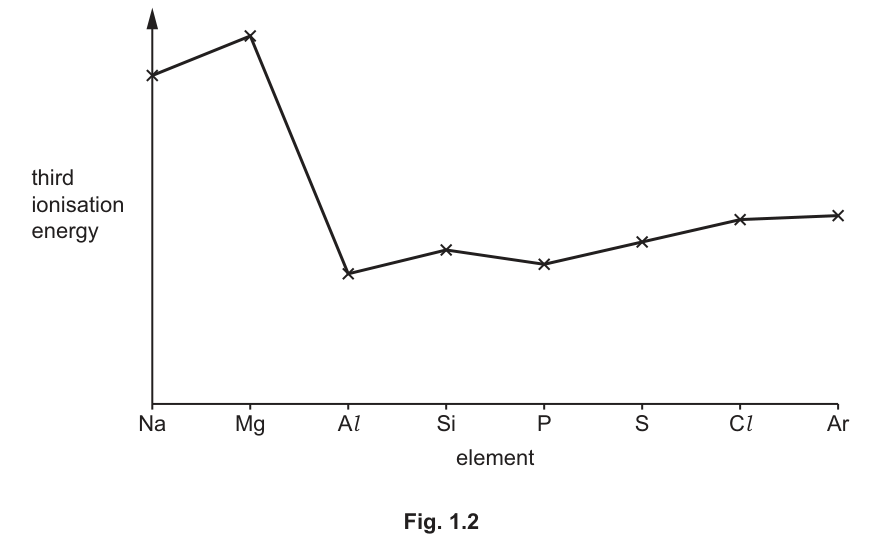
The third ionisation energies of the Period 3 elements are shown in Fig. 1.2.
Write an equation, including state symbols, to represent the third ionisation energy of argon.
Answer
Ar²⁺(g) → Ar³⁺(g) + e⁻
Background Concept
Ionisation energy is the energy required to remove an electron from a gaseous atom or ion. The first ionisation energy removes an electron from a neutral gaseous atom; the second removes an electron from the resulting 1+ gaseous ion; the third removes an electron from the 2+ gaseous ion. Each successive ionisation energy is larger because the remaining electrons experience greater effective nuclear attraction. State symbols (g) are essential because ionisation energy is defined for gaseous species only.
Understanding the Question
The question asks for an equation representing the third ionisation energy of argon. The command word is "write an equation, including state symbols". You must show the removal of one electron from Ar²⁺(g) to form Ar³⁺(g).
Approach
Apply the general form: Xⁿ⁺(g) → X⁽ⁿ⁺¹⁾⁺(g) + e⁻, with n = 2 for the third ionisation energy.
Step-by-Step Reasoning
- The third ionisation energy involves removing the third electron, so we start with the 2+ ion: Ar²⁺(g)
- After removal, we get the 3+ ion: Ar³⁺(g)
- The removed particle is an electron: e⁻
- All species must be gaseous: include (g) after each
- The equation is: Ar²⁺(g) → Ar³⁺(g) + e⁻
Key Takeaways
The nth ionisation energy always involves removing an electron from the (n-1)+ gaseous ion. State symbols are mandatory for full marks.
Common Mistakes
- Writing Ar(g) → Ar⁺(g) + e⁻ (this is the first ionisation energy, not the third).
- Omitting state symbols (g) — this loses a mark.
- Writing the electron as e without the minus sign.
- Using (aq) instead of (g).
Things to Be Careful About
The mark scheme awards M1 for a correct ionisation equation format (Xⁿ⁺ → X⁽ⁿ⁺¹⁾⁺ + e) and M2 specifically for correct state symbols with argon. Both must be present for full marks.
The differences in the values for third ionisation energy shown in Fig. 1.2 are due to differences in the strength of attraction between the nucleus and the outer electron of each ion.
State two factors that affect the strength of attraction between the nucleus and the outer electron.
-
........................................................................................................................................
-
........................................................................................................................................
Answer
- Nuclear charge (number of protons)
- Distance of the outer electron from the nucleus (or shielding by inner electrons)
- Nuclear charge; 2. Distance of outer electron from nucleus (or shielding)
Background Concept
The strength of attraction between the nucleus and an outer electron is governed by Coulomb's law: the force is proportional to the product of the charges and inversely proportional to the square of the distance between them. In multi-electron atoms, the effective nuclear charge felt by an outer electron is reduced by shielding from inner electrons. The two key factors are therefore (1) the nuclear charge (number of protons) and (2) the distance of the electron from the nucleus, which is influenced by the number of inner shells (shielding).
Understanding the Question
The question asks you to state two factors that affect the strength of attraction between the nucleus and the outer electron. The command word is "state", so brief answers are sufficient. The mark scheme accepts nuclear charge as one factor and distance/shielding/ionic radius as the other.
Approach
Recall the factors that determine effective nuclear attraction from the study of periodic trends in ionisation energy and atomic radius.
Step-by-Step Reasoning
- Factor 1 — Nuclear charge: The more protons in the nucleus, the stronger the electrostatic attraction on the outer electron (assuming other factors are constant).
- Factor 2 — Distance from nucleus / Shielding: Electrons in shells further from the nucleus experience weaker attraction because the distance is greater and because inner electrons shield the nuclear charge. The mark scheme accepts "distance of outer electron(s) from nucleus", "ionic radius", or "shielding by inner shells and/or sub-shells" as the second factor.
Key Takeaways
Effective nuclear attraction depends on nuclear charge and the balance between distance and shielding. These are the two factors that explain all periodic trends in ionisation energy.
Common Mistakes
- Writing "number of electrons" as a factor — it is the nuclear charge (protons) that matters, not the total electron count.
- Giving "electron-electron repulsion" as a factor when the question asks about nucleus-electron attraction specifically.
- Writing only one factor and leaving the second blank.
Things to Be Careful About
The mark scheme is specific: M1 must be "nuclear charge" and M2 must be distance/shielding/ionic radius. Do not confuse these with "number of shells" alone, which is really a proxy for distance.
Use Fig. 1.2 to suggest the most significant factor that determines the size of attraction between the nucleus and the outer electron. Explain your answer.
Answer
The most significant factor is the distance of the outer electron from the nucleus (or shielding).
The third ionisation energies of Na and Mg are much greater than those of Al to Ar because the electron removed from Na⁺ and Mg²⁺ comes from the n = 2 shell (closer to the nucleus, less shielding), whereas for Al to Ar the electron is removed from the n = 3 shell.
Distance from nucleus / shielding; Na and Mg 3rd IE much greater than Al-Ar because electron removed from n=2 shell (closer to nucleus, less shielding)
Background Concept
When examining successive ionisation energies, a large jump occurs when an electron is removed from an inner shell (closer to the nucleus, experiencing much less shielding). This is the basis for deducing the number of electrons in the outer shell and hence the group of an element. For the third ionisation energy across Period 3, the key insight is that Na and Mg have their third electron removed from the n = 2 shell (inner shell), while Al through Ar have it removed from the n = 3 shell (outer shell).
Understanding the Question
The question asks you to use Fig. 1.2 to identify the most significant factor determining the attraction between nucleus and outer electron, and to explain your choice. The graph shows a dramatic drop from Mg to Al in the third ionisation energy, which is the key feature to interpret.
Approach
Compare the electronic configurations of the ions from which the electron is being removed:
- Na²⁺: 1s² 2s² 2p⁵ (electron removed from n=2)
- Mg²⁺: 1s² 2s² 2p⁶ (electron removed from n=2)
- Al²⁺: 1s² 2s² 2p⁶ 3s¹ (electron removed from n=3)
- Si²⁺: 1s² 2s² 2p⁶ 3s² (electron removed from n=3)
The huge drop from Mg to Al indicates a change in shell, pointing to distance/shielding as the dominant factor.
Step-by-Step Reasoning
- From Fig. 1.2, Na and Mg have very high third ionisation energies, while Al to Ar have much lower values.
- For Na: the electron configuration is 1s² 2s² 2p⁶ 3s¹. The third electron removed comes from the 2p subshell (n = 2 shell), which is much closer to the nucleus.
- For Mg: the electron configuration is 1s² 2s² 2p⁶ 3s². The third electron removed comes from the 2p subshell (n = 2 shell).
- For Al: the electron configuration is 1s² 2s² 2p⁶ 3s² 3p¹. The third electron removed comes from the 3p subshell (n = 3 shell), which is further from the nucleus and experiences more shielding.
- The dramatic drop from Mg to Al in the graph confirms that the distance from the nucleus (and associated shielding) is the most significant factor, not nuclear charge alone.
Key Takeaways
A large jump in successive ionisation energies indicates removal of an electron from an inner shell. The distance from the nucleus (number of shells) is the dominant factor in determining attraction strength, as evidenced by the sharp drop between Mg and Al.
Common Mistakes
- Saying "nuclear charge" is the most significant factor — it increases steadily across the period but does not explain the dramatic drop from Mg to Al.
- Not explaining WHY Na and Mg have high values (electron from inner shell) versus Al-Ar (electron from outer shell).
- Simply restating the graph without identifying the shell change.
Things to Be Careful About
The mark scheme requires both the identification of the factor (M1) and the explanation linking it to the data (M2). The explanation must reference the shell difference between Na/Mg and Al-Ar.
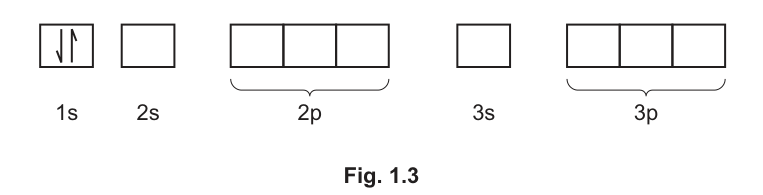
In the third ionisation energy of argon, the ion produced has the electronic configuration .
Complete Fig. 1.3 to show the arrangement of electrons in the orbitals of this ion.
Answer
The completed orbital diagram for ():
The 2s box contains two opposite arrows (↑↓), the three 2p boxes each contain two opposite arrows (↑↓ ↑↓ ↑↓), the 3s box contains two opposite arrows (↑↓), and the three 3p boxes each contain one upward arrow (↑ ↑ ↑), following Hund's rule.
2s: ↑↓; 2p: ↑↓ ↑↓ ↑↓; 3s: ↑↓; 3p: ↑ ↑ ↑ (three unpaired electrons)
Background Concept
The electrons-in-boxes (orbital) diagram represents the arrangement of electrons in individual orbitals within subshells. Each box represents one orbital and can hold a maximum of two electrons with opposite spins (↑↓). The s subshell has 1 orbital, the p subshell has 3 orbitals. Hund's rule states that when electrons occupy degenerate (equal-energy) orbitals, they fill singly with parallel spins before pairing up. The Pauli exclusion principle states that no two electrons in the same orbital can have the same spin.
Understanding the Question
The question gives the electronic configuration of the ion produced after the third ionisation of argon: . Fig. 1.3 shows the orbital boxes with only the 1s box already filled. You must complete the diagram by filling in the remaining boxes according to the configuration.
Approach
Work through each subshell in order, placing the correct number of electrons in each box, applying Hund's rule for the 3p subshell which has 3 electrons in 3 orbitals.
Step-by-Step Reasoning
- 1s: 2 electrons → one box with ↑↓ (already shown in Fig. 1.3)
- 2s: 2 electrons → one box with ↑↓
- 2p: 6 electrons → three boxes, each with ↑↓ (all paired since 6 electrons fill 3 orbitals completely)
- 3s: 2 electrons → one box with ↑↓
- 3p: 3 electrons → three boxes, each with ↑ (one electron per orbital, all with the same spin, following Hund's rule — they do NOT pair up)
The key point is the 3p³ configuration: three electrons in three p orbitals means each orbital gets one electron with parallel spin. This is analogous to the ground-state configuration of nitrogen.
Key Takeaways
Hund's rule is essential when filling degenerate orbitals. Three electrons in three p orbitals gives three unpaired electrons with parallel spins, not one paired and one unpaired.
Common Mistakes
- Pairing electrons in the 3p subshell (e.g., ↑↓ ↑ ↑ or ↑↓ ↑↓) instead of placing one in each orbital.
- Drawing opposite spins for the unpaired 3p electrons (should all be the same direction, typically up).
- Forgetting to fill the 2s box (it is empty in Fig. 1.3 and needs ↑↓ added).
- Drawing only 2 electrons in 3p instead of 3.
Things to Be Careful About
Arrows must be clearly drawn as up or down. All three 3p electrons should have the same spin direction. The 2p boxes must all be filled with pairs (↑↓) since there are 6 electrons.
Most Period 3 elements react with oxygen to form oxides.
Answer
P₄ + 5O₂ → P₄O₁₀
Background Concept
Phosphorus burns readily in oxygen to form phosphorus(V) oxide (also called phosphorus pentoxide), P₄O₁₀. The formula is written as P₄O₁₀ because phosphorus exists as P₄ molecules and the oxide has a molecular structure based on four phosphorus atoms bonded to ten oxygen atoms. The empirical formula is P₂O₅, but the molecular formula P₄O₁₀ is the correct one to use in equations.
Understanding the Question
The command word is "write an equation". You need the balanced symbol equation for the reaction of phosphorus with oxygen. Phosphorus is P₄ (not P) and the product is P₄O₁₀ (not P₂O₅).
Approach
Write the reactants (P₄ and O₂) and product (P₄O₁₀), then balance by inspection.
Step-by-Step Reasoning
- Phosphorus exists as P₄ molecules, so the reactant is P₄.
- Oxygen is diatomic: O₂.
- The product is phosphorus(V) oxide: P₄O₁₀.
- Balancing: P₄ + ?O₂ → P₄O₁₀. We need 10 oxygen atoms on the left, so 5O₂.
- Balanced equation: P₄ + 5O₂ → P₄O₁₀
Key Takeaways
Always use the molecular formula P₄ for phosphorus and P₄O₁₀ for the oxide in equations. State symbols are not required for this mark but would be P₄(s) + 5O₂(g) → P₄O₁₀(s).
Common Mistakes
- Writing P + O₂ → P₂O₅ (using empirical formula and atomic phosphorus).
- Writing P₄ + 5O₂ → P₂O₅ (mixing molecular reactant with empirical product).
- Forgetting to balance: P₄ + O₂ → P₄O₁₀ (unbalanced).
Things to Be Careful About
The mark scheme requires the molecular formulas P₄ and P₄O₁₀ specifically. Using P and P₂O₅ would not score.
Write an equation for the reaction of aluminium oxide with an excess of aqueous sodium hydroxide.
Answer
Al₂O₃ + 2NaOH + 3H₂O → 2NaAl(OH)₄
Background Concept
Aluminium oxide is amphoteric — it reacts with both acids and bases. With excess aqueous sodium hydroxide, it acts as an acid and forms the tetrahydroxoaluminate(III) ion, [Al(OH)₄]⁻. The sodium salt is written as NaAl(OH)₄ (sodium tetrahydroxoaluminate). Water is a reactant in this equation because the oxide ion (O²⁻) must be hydrated to form the hydroxo complex.
Understanding the Question
The command word is "write an equation". You need the balanced equation for Al₂O₃ reacting with excess aqueous NaOH. The key challenge is knowing the correct product formula and that water is needed as a reactant.
Approach
Al₂O₃ is amphoteric and dissolves in excess NaOH to form the soluble complex NaAl(OH)₄. Balance the equation by ensuring Al, Na, O, and H atoms are conserved.
Step-by-Step Reasoning
- Al₂O₃ contains 2 aluminium atoms, so we need 2 NaAl(OH)₄ on the product side.
- Each NaAl(OH)₄ contains 1 Na, so we need 2 NaOH.
- Count oxygen: left has 3 (from Al₂O₃) + 2 (from NaOH) = 5 from those two, plus 3 from water = 8. Right has 2 × 4 = 8 from NaAl(OH)₄. ✓
- Count hydrogen: left has 2 (from NaOH) + 6 (from 3H₂O) = 8. Right has 2 × 4 = 8. ✓
- Balanced: Al₂O₃ + 2NaOH + 3H₂O → 2NaAl(OH)₄
Key Takeaways
Al₂O₃ is amphoteric. With excess NaOH, it forms NaAl(OH)₄ (sodium tetrahydroxoaluminate), and water must be included as a reactant. This is a common exam equation that requires memorisation of the product formula.
Common Mistakes
- Writing Al₂O₃ + 2NaOH → 2NaAlO₂ + H₂O (this is the equation with molten NaOH or at high temperature, not aqueous excess NaOH).
- Omitting water as a reactant.
- Writing the product as Na₃AlO or Al(OH)₃ instead of NaAl(OH)₄.
- Not balancing correctly.
Things to Be Careful About
The question specifies "excess aqueous sodium hydroxide", which means the product is the soluble complex NaAl(OH)₄, not a precipitate of Al(OH)₃. The ionic equation is Al₂O₃ + 2OH⁻ + 3H₂O → 2[Al(OH)₄]⁻.
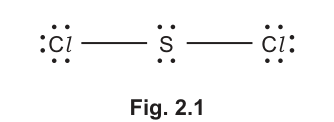
Fig. 2.1 shows the covalent bonds and lone pairs of electrons in a molecule of .
Answer
non-linear (or bent / angular)
non-linear
Background Concept
VSEPR (Valence Shell Electron Pair Repulsion) theory predicts the three-dimensional shape of molecules based on the repulsion between electron pairs (both bonding and lone pairs) in the valence shell of the central atom. Electron pairs arrange themselves as far apart as possible to minimise repulsion. Lone pairs occupy more space than bonding pairs, so lone pair–lone pair repulsion > lone pair–bonding pair repulsion > bonding pair–bonding pair repulsion.
Understanding the Question
The question asks for the molecular shape of using VSEPR theory. Fig. 2.1 shows the central sulfur atom bonded to two chlorine atoms via single covalent bonds, with two lone pairs of electrons on the sulfur atom.
Approach
Count the total number of electron domains (bonding pairs + lone pairs) around the central sulfur atom to determine the electron geometry, then ignore the lone pairs to name the molecular shape.
Step-by-Step Reasoning
- The central sulfur atom has 6 valence electrons.
- It forms 2 single covalent bonds with two chlorine atoms, using 2 electrons.
- The remaining 4 electrons form 2 lone pairs on the sulfur atom.
- Total electron domains around S = 2 bonding pairs + 2 lone pairs = 4 domains.
- Four electron domains arrange themselves in a tetrahedral electron geometry.
- Because two of these domains are lone pairs, the molecular shape (considering only the positions of the atoms) is non-linear (also accepted as bent or angular).
Key Takeaways
When a central atom has 4 electron domains with 2 lone pairs and 2 bonding pairs, the electron geometry is tetrahedral but the molecular shape is non-linear (bent).
Common Mistakes
- Stating the shape is "tetrahedral". Tetrahedral is the electron geometry; the question asks for the molecular shape, which is non-linear.
- Stating "trigonal planar" or "linear" without correctly counting the lone pairs.
Things to Be Careful About
- Use precise terminology: "non-linear", "bent", or "angular" are all acceptable for the molecular shape. "Tetrahedral" alone is incorrect for the molecular shape.
Answer
104.5
104.5
Background Concept
In a perfect tetrahedral arrangement of four electron domains, the bond angles are . However, lone pairs repel bonding pairs more strongly than bonding pairs repel each other. This extra repulsion compresses the bonding pair–bonding pair angle to less than . For a molecule with two lone pairs and two bonding pairs (an system, analogous to water ), the bond angle is typically compressed to approximately .
Understanding the Question
Predict the bond angle in the molecule. The central sulfur has two bonding pairs and two lone pairs.
Approach
Use the VSEPR model. The electron geometry is tetrahedral (), but the two lone pairs on sulfur compress the bond angle. The standard expected value for this configuration is .
Step-by-Step Reasoning
- Electron domains around S: 4 (tetrahedral arrangement, ideal angle ).
- Lone pair–lone pair and lone pair–bonding pair repulsions are stronger than bonding pair–bonding pair repulsions.
- This compresses the bond angle below .
- The accepted value for a molecule with this electron configuration (similar to water) is .
Key Takeaways
Molecules with 4 electron domains and 2 lone pairs have bond angles less than , typically around .
Common Mistakes
- Writing : this ignores the compressive effect of the lone pairs.
- Writing : this would be for a trigonal planar or trigonal pyramidal geometry, which is incorrect here.
Things to Be Careful About
- Ensure the numerical value is correct (). The degree symbol () is already provided in the question prompt, so only the number is required in the answer line.
is a red liquid that reacts with water.
Describe two observations, other than temperature change, that are made when an excess of water is added to .
Answer
- the (red) liquid/solution becomes colourless
- a yellow solid appears
red liquid to colourless; yellow solid appears
Background Concept
When observing a chemical reaction, physical observations include colour changes, state changes (formation of a precipitate or gas), and temperature changes. The balanced chemical equation provides the identities and physical states of the reactants and products, which allow us to predict these observations.
Understanding the Question
The reaction is . We are told is a red liquid. We need to describe two observations other than temperature change when excess water is added.
Approach
Compare the initial physical states and colours with the final products. is a red liquid; water is colourless. The products are aqueous , solid sulfur , and aqueous . Aqueous solutions of these products are colourless, and elemental sulfur is a yellow solid.
Step-by-Step Reasoning
- Initial state: is a red liquid mixed with colourless water.
- Final state: The products and are dissolved in water, forming a colourless aqueous solution. Thus, the red liquid/solution becomes colourless.
- Solid sulfur is produced. Elemental sulfur is a yellow solid. Thus, a yellow solid (precipitate) appears.
- These two observations (colour change from red to colourless, and appearance of a yellow solid) are the expected visual changes.
Key Takeaways
Always check the physical states and known colours of reactants and products in a balanced equation to predict observable changes in a reaction.
Common Mistakes
- Describing the disappearance of the red liquid without mentioning the resulting colourless solution.
- Not specifying the colour of the solid (sulfur is yellow, not just "a solid appears").
- Mentioning temperature change, which the question explicitly excludes.
Things to Be Careful About
- The question asks for observations "other than temperature change". Do not include exothermic/endothermic observations.
- Ensure both observations are distinct: one relates to the liquid/solution (red to colourless), the other to the solid (yellow solid appears).
When reacts with water, the is broken down and a disproportionation reaction occurs.
State the oxidation numbers of sulfur in and .
oxidation number of S in ...........................................................................................
oxidation number of S in ...........................................................................................
Answer
oxidation number of S in : +2
oxidation number of S in : +4
+2 in SCl2; +4 in H2SO3
Background Concept
Oxidation numbers are assigned using a set of rules: fluorine is always -1, oxygen is usually -2 (except in peroxides), hydrogen is +1 (except in metal hydrides), and the sum of oxidation numbers in a neutral molecule is zero. In , chlorine is more electronegative than sulfur, so chlorine takes the -1 oxidation state.
Understanding the Question
State the oxidation numbers of sulfur in and in . The reaction is a disproportionation, meaning sulfur is both oxidised and reduced.
Approach
Apply standard oxidation number rules to each compound. For , Cl is -1. For , H is +1 and O is -2.
Step-by-Step Reasoning
- In : Let the oxidation number of S be . Chlorine is more electronegative, so each Cl is -1. The molecule is neutral: . Oxidation number of S is +2.
- In : Let the oxidation number of S be . Hydrogen is +1, oxygen is -2. The molecule is neutral: . Oxidation number of S is +4.
- (Note: In the products, elemental sulfur has an oxidation number of 0, confirming disproportionation: S(+2) is oxidised to S(+4) and reduced to S(0)).
Key Takeaways
Oxidation numbers are calculated using standard rules: H = +1, O = -2, halogens = -1 (when bonded to less electronegative elements). The sum must equal the overall charge of the species.
Common Mistakes
- Assigning chlorine an oxidation number other than -1 in .
- Forgetting that hydrogen is +1 in (it is not a hydride here).
- Calculating the sum incorrectly (e.g., , not -4).
Things to Be Careful About
- Use the correct sign convention: write "+2" or "+4", not "2-" or "4-". Roman numerals (+II, +IV) are also acceptable but must have the correct sign.
State the general name to describe the type of reaction that occurs when a substance is broken down by water.
Answer
hydrolysis
hydrolysis
Background Concept
When a chemical compound is broken down by reaction with water, the process is called hydrolysis. This typically involves the cleavage of covalent bonds in the molecule, with the and components of water adding to the fragments. Common examples include the hydrolysis of esters, halogenoalkanes, and covalent non-metal halides like or .
Understanding the Question
The question asks for the general name of the reaction type where a substance is broken down by water.
Approach
Recall the standard terminology for reactions involving water as a reactant that breaks chemical bonds.
Step-by-Step Reasoning
- The reaction is .
- Water is reacting with to break it down into new products.
- The general term for a reaction in which a substance is decomposed by water is hydrolysis.
Key Takeaways
Reactions where water breaks down a compound are classified as hydrolysis reactions.
Common Mistakes
- Writing "hydration": hydration is the addition of water molecules to form a hydrated compound without breaking the main covalent framework (e.g., ).
- Writing "dissolution" or "dissolving": these refer to the physical process of a substance mixing with water, not a chemical reaction breaking bonds.
Things to Be Careful About
- Use the precise term "hydrolysis". Ensure correct spelling: h-y-d-r-o-l-y-s-i-s.
and react to form in a reversible reaction, as shown in equation 1.
In three separate experiments, a student combines different amounts of two or more of the gases from equation 1. In each experiment, the gases are left to reach equilibrium at a given temperature.
In experiment 1, and are combined.
Water is then added to the equilibrium mixture to produce of solution A.
The amount of present in of solution A is found by titration with .
Exactly of reacts with all of the in a sample of solution A.
Working
Convert the titre volume to :
Amount of thiosulfate:
Answer
0.00658 mol
Background Concept
In a titration, the amount of a reagent that reacts is found from its concentration and the volume used: , where must be in when is in . Because , a volume in is converted to by dividing by .
Understanding the Question
The question gives the titre volume and the concentration of . It asks only for the amount of thiosulfate reacting. The balanced equation with iodine is not needed for this part; it is needed in the next part.
Approach
Apply directly, first converting the titre from to .
Step-by-Step Reasoning
- Convert to : .
- Substitute into : .
- The answer is , or .
Key Takeaways
Always express volume in when using in . The product gives amount in mol directly.
Common Mistakes
Leaving the volume in and multiplying, which gives an answer 1000 times too large. Also misreading the value as instead of .
Things to Be Careful About
The mark scheme accepts . Use consistent significant figures; here three are appropriate.
Use your answer to (a)(i) to calculate the amount, in mol, of present in of solution A.
(If you were unable to obtain an answer in (a)(i), then use . This is not the correct answer.)
Working
From the equation, of reacts with of :
The sample is a fraction of :
Answer
0.132 mol
Background Concept
The titration reaction is . The ratio shows that twice the amount of thiosulfate is needed as iodine. An aliquot is a portion of the whole solution; any amount in the aliquot is proportional to the amount in the whole solution by volume.
Understanding the Question
We already know the amount of thiosulfate from part (i) is . That thiosulfate reacted with all the iodine in only of solution A. We need the total iodine in the full of solution A.
Approach
First use the mole ratio to find iodine in the sample, then scale up by the ratio of total volume to sample volume.
Step-by-Step Reasoning
- From , moles of iodine in the sample .
- , so the sample is of the total solution.
- Total iodine .
If the alternative fallback value were used, the corresponding answers would be in the sample and in .
Key Takeaways
Balanced equations give the mole ratio for stoichiometry. Dilution or sampling means the amount scales with volume.
Common Mistakes
Using the ratio the wrong way, i.e. multiplying by , or forgetting to scale up from the aliquot to the whole .
Things to Be Careful About
The mark scheme awards M1 for the half of thiosulfate and M2 for the volume scaling. Keep your working visible so the method marks can be awarded even if the final value slips.
In experiment 2, of , of and of are combined.
At equilibrium of is present.
Calculate the amounts, in mol, of and in the equilibrium mixture produced in experiment 2.
amount of in equilibrium mixture = .............................. mol
amount of in equilibrium mixture = .............................. mol
Working
Equation: .
The amount of that reacts is:
So of also reacts, and of is formed.
Answer
;
0.054 mol; 0.392 mol
Background Concept
At equilibrium, the amounts of reactants and products are constant, but reaction has occurred from the starting amounts. For the reaction , any amount of that is consumed is accompanied by the same amount of consumed and the production of of .
Understanding the Question
Initial amounts are , and . At equilibrium the amount of is , which is less than the initial , so the forward reaction has taken place. We need the equilibrium amounts of and .
Approach
Subtract the equilibrium iodine amount from its initial amount to find the change . Then apply the same change to and twice the change to .
Step-by-Step Reasoning
- Change in : consumed.
- is consumed in the same mole ratio , so .
- is produced with coefficient : .
Key Takeaways
The reaction stoichiometry ties all equilibrium amounts together. The change in one species fixes the change in the others.
Common Mistakes
Forgetting that increases by twice the decrease in ; or adding to instead of subtracting.
Things to Be Careful About
State symbols are not needed in the calculation. The mark scheme uses error carried forward, so if you misread one change but use it correctly afterwards you can still gain later marks.
In experiment 3, of and of are present in an equilibrium mixture at .
Use the equilibrium constant, , to calculate the amount, in mol, of present in the equilibrium mixture in experiment 3.
Working
For a fixed volume , the volumes cancel in the expression:
Answer
2.46 mol
Background Concept
For , the equilibrium constant is . Concentrations are amounts divided by volume. If all gases share the same volume , the terms cancel, leaving . This is an approximation that works for a constant volume, as here.
Understanding the Question
At equilibrium there are of and of ; . We need the amount of .
Approach
Set the simplified amount expression equal to the given , substitute the known amounts, and solve for .
Step-by-Step Reasoning
- Write .
- Substitute: .
- Multiply both sides: .
- Square root: .
Key Takeaways
When all species are in the same container, the volume cancels out of the expression, so amounts can be used directly. Check the power of each concentration when writing the expression.
Common Mistakes
Forgetting the coefficient 2 as a square on , or taking the square root of the wrong side.
Things to Be Careful About
The answer is ; the mark scheme quotes . Round appropriately and include mol.
The value of for the dissociation of at is .
Answer
A covalent bond is the electrostatic attraction between the nuclei of two atoms and a shared pair of electrons.
A covalent bond is the electrostatic attraction between the nuclei of two atoms and a shared pair of electrons.
Background Concept
Covalent bonding arises when two atoms share a pair of electrons. The bond is not the electrons themselves but the electrostatic attraction between the positively charged nuclei and the negatively charged electron pair that holds the atoms together.
Understanding the Question
The question asks for a definition only. The mark scheme expects both parts: the shared pair of electrons and the electrostatic attraction involving the nuclei.
Approach
State the definition using the exact terms from the mark scheme: electrostatic attraction, nuclei, shared pair of electrons.
Step-by-Step Reasoning
- Identify the two species involved: the nuclei of the two atoms.
- Identify the shared entity: a pair of electrons.
- Combine: electrostatic attraction between the nuclei and the shared pair of electrons.
Key Takeaways
A covalent bond is an electrostatic attraction, not just electron sharing. Including both nuclei and shared pair is essential.
Common Mistakes
Saying merely "sharing electrons" without mentioning the electrostatic attraction between nuclei and the shared pair loses the definition mark.
Things to Be Careful About
The mark scheme requires the idea that the shared pair lies between the two nuclei.
Answer
is more thermally stable than .
The Cl atom is smaller than the I atom, so the H–Cl bond is shorter and the shared electron pair is closer to the nucleus. There is also less shielding in HCl, so the attraction between the nucleus and the shared pair is stronger than in HI. More energy is therefore needed to break the H–Cl bond.
Thus decomposes only at higher temperatures than .
HCl is more thermally stable than HI.
Background Concept
Thermal stability of a hydrogen halide means how readily it remains undecomposed when heated; decomposition breaks the H–X bond. Down Group 17 the halogen atom becomes larger and has more electron shells. A longer bond and greater shielding weaken the attraction between the nucleus and the shared electron pair, lowering the bond dissociation enthalpy. Thus H–F is most stable and H–I is least stable.
Understanding the Question
Compare only HCl and HI for relative thermal stability. The explanation must use atomic size and bond strength, not electronegativity alone. The command is explain, so each observation needs a reason.
Approach
State which is more stable, then give two linked reasons: (1) Cl is smaller than I, giving a shorter bond and a closer electron pair; (2) there is less shielding in HCl, giving a stronger nucleus–shared-pair attraction.
Step-by-Step Reasoning
- Stability is determined by the strength of the H–X bond.
- Cl has fewer electron shells than I, so the Cl atom is smaller.
- The H–Cl bond is shorter than H–I, so the shared electron pair is closer to the Cl nucleus.
- There is less shielding by inner electrons in HCl.
- Therefore the nucleus attracts the shared pair more strongly in HCl; more energy is needed to break H–Cl than H–I.
- So HCl decomposes at a higher temperature and is more thermally stable.
Key Takeaways
The trend down Group 17: larger atom, longer and weaker bond, lower thermal stability. Use core concepts of atomic radius, shielding, and bond energy.
Common Mistakes
Citing only "HCl is more stable" without a reason, or giving electronegativity as the sole explanation. Also saying H–I is more stable because I is bigger is wrong.
Things to Be Careful About
The mark scheme awards one mark for HCl more stable plus a correct size/bond-length reason, and one for stronger attraction/less shielding/greater orbital overlap. Include both ideas.
Use the data given in (c) and (d) to suggest a value for the equilibrium constant for the dissociation of at .
Working
For the reverse of the reaction in (c):
The dissociation of is intermediate in extent between and , so its lies between:
Answer
Any value in this range, e.g. .
1.00 × 10^-20 (any value between 5.50×10^-34 and 1.26×10^-3)
Background Concept
For a reversible reaction, for the reverse reaction is the reciprocal of for the forward reaction. A small means very little product at equilibrium; for dissociation of a hydrogen halide, a smaller means the hydrogen halide is more stable. The hydrogen halides become less stable down the group, so the order of dissociation constants is .
Understanding the Question
Part (c) gives for . Part (d) gives for . We are to suggest a for the dissociation of , which lies between HCl and HI in stability.
Approach
Convert the (c) constant to the reverse reaction, , by taking the reciprocal. Then, using the trend that HBr is intermediate between HCl and HI, choose a value between the two dissociation constants.
Step-by-Step Reasoning
- The reaction in (c) written in the forward direction is the reverse of HI dissociation. Therefore .
- The given for dissociation is , extremely small because HCl is very stable.
- HBr is less stable than HCl but more stable than HI, so its dissociation constant should be larger than that of HCl but smaller than that of HI.
- Hence . Any value in this range, e.g. , is acceptable.
Key Takeaways
The relationship between forward and reverse equilibrium constants is reciprocal. Trends in bond stability translate into trends in : a more stable compound means a smaller dissociation constant.
Common Mistakes
Using directly as the HI dissociation constant instead of taking its reciprocal, or suggesting a value outside the allowed range.
Things to Be Careful About
The mark scheme accepts any value strictly between the two limits. Do not include the endpoints.
The skeletal formula of E is shown in Fig. 4.1.
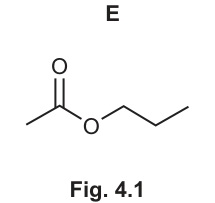
Answer
CHO
C5H10O2
Background Concept
A skeletal formula represents organic molecules where carbon atoms are implied at the vertices and ends of lines, and hydrogen atoms attached to carbons are omitted. Heteroatoms (like O) and hydrogens attached to heteroatoms are shown explicitly. To find the molecular formula, one must count all carbon, hydrogen, and oxygen atoms implied by the structure.
Understanding the Question
The question asks for the molecular formula of compound E, whose skeletal formula is given in Fig. 4.1. The image shows a carbonyl group (C=O) bonded to a methyl group on one side and an oxygen atom on the other, which is bonded to a three-carbon chain (propyl group). This is an ester.
Approach
Count the carbon atoms at each vertex and end of the chain. Count the oxygen atoms explicitly shown. Calculate the number of hydrogen atoms by ensuring each carbon has four bonds (octet rule for carbon).
Step-by-Step Reasoning
- Count Carbons: The left side has a methyl group (1 C) and a carbonyl carbon (1 C). The right side has a propyl chain (3 C). Total C = 1 + 1 + 3 = 5.
- Count Oxygens: There is a C=O oxygen and an -O- oxygen. Total O = 2.
- Count Hydrogens:
- Left methyl group (CH-): 3 H.
- Carbonyl carbon (C=O): 0 H (4 bonds used: 2 to O, 1 to C, 1 to O).
- Oxygen atom: 0 H.
- Propyl chain (-CH-CH-CH): 2 + 2 + 3 = 7 H.
- Total H = 3 + 7 = 10.
- Assemble Formula: CHO.
Key Takeaways
Skeletal formulas hide C-H bonds. Always verify carbon valency (4 bonds) to determine hidden hydrogens.
Common Mistakes
Forgetting to count hydrogens on the terminal methyl group or miscounting the propyl chain length.
Things to Be Careful About
Ensure the formula is empirical or molecular as requested. Here, molecular formula is required, so CHO is correct (not simplified to CHO).
Answer
propyl ethanoate
propyl ethanoate
Background Concept
Esters are named in two parts: the alkyl group (from the alcohol) and the alkanoate group (from the carboxylic acid). The alkyl part is named first, derived from the alcohol chain attached to the single-bonded oxygen. The alkanoate part is named from the carboxylic acid chain containing the carbonyl group (C=O), with the suffix '-oic acid' replaced by '-oate'.
Understanding the Question
The question asks to name compound E based on its structure. The structure is an ester with a 2-carbon acid part (ethanoic acid derivative) and a 3-carbon alcohol part (propanol derivative).
Approach
Identify the two parts of the ester: the acyl group (left of O) and the alkyl group (right of O). Name each part and combine them.
Step-by-Step Reasoning
- Acyl part (left of O): CH-C(=O)-. This comes from ethanoic acid (2 carbons). So, 'ethanoate'.
- Alkyl part (right of O): -O-CH-CH-CH. This is a propyl group (3 carbons). So, 'propyl'.
- Combine: propyl ethanoate.
Key Takeaways
Ester nomenclature: [alkyl from alcohol] [alkanoate from acid]. The carbon in the carbonyl group belongs to the acid part.
Common Mistakes
Naming the acid part as 'acetate' (common name) instead of 'ethanoate' (systematic name). Swapping the order (ethanoate propyl is wrong).
Things to Be Careful About
Use systematic IUPAC names. 'Propyl ethanoate' is correct; 'n-propyl acetate' is not accepted in this context.
E is made when a carboxylic acid and an alcohol react together.
Answer
condensation
condensation
Background Concept
Esterification is the reaction between a carboxylic acid and an alcohol to form an ester and water. Since two molecules join together with the loss of a small molecule (water), it is classified as a condensation reaction.
Understanding the Question
Part (c) states E (an ester) is made from a carboxylic acid and an alcohol. The question asks for the name of this reaction type.
Approach
Recall the definition of esterification and its classification in reaction types.
Step-by-Step Reasoning
- Reaction: Acid + Alcohol Ester + Water.
- Two molecules combine to form a larger molecule with the loss of water.
- This is a condensation reaction.
Key Takeaways
Esterification is a condensation reaction because water is eliminated.
Common Mistakes
Calling it 'dehydration synthesis' (more biological) or just 'synthesis'. The specific term is condensation.
Things to Be Careful About
Do not write 'esterification' if asked for the 'type of reaction' in a general sense, though often accepted. 'Condensation' is the precise classification based on mechanism/outcome (loss of small molecule).
Write an equation for the formation of E from a carboxylic acid and an alcohol. Use structural formulae to represent the organic species.
Answer
CH3COOH + CH3CH2CH2OH -> CH3COOCH2CH2CH3 + H2O
Background Concept
Esterification involves the carboxyl group (-COOH) of a carboxylic acid reacting with the hydroxyl group (-OH) of an alcohol. The -OH from the acid and the -H from the alcohol combine to form water. The remaining parts join to form the ester linkage (-COO-).
Understanding the Question
Write an equation for the formation of E (propyl ethanoate) from a carboxylic acid and an alcohol. Structural formulae must be used for organic species.
Approach
Identify the carboxylic acid (ethanoic acid) and alcohol (propan-1-ol) that form propyl ethanoate. Write the balanced equation.
Step-by-Step Reasoning
- Identify reactants: To get propyl ethanoate (CHCOOCHCHCH), we need ethanoic acid (CHCOOH) and propan-1-ol (CHCHCHOH).
- Write equation: CHCOOH + CHCHCHOH CHCOOCHCHCH + HO.
- Check structural formulae: CHCOOH is structural for ethanoic acid. CHCHCHOH is structural for propan-1-ol. The ester is written as CHCOOCHCHCH.
Key Takeaways
Esterification equation: RCOOH + R'OH RCOOR' + HO. Ensure structural formulae are used, not molecular.
Common Mistakes
Using molecular formulae (CHO) instead of structural. Forgetting water as a product. Incorrectly linking the propyl group (e.g., writing CHCOOCH(CH) which is isopropyl ethanoate).
Things to Be Careful About
The question asks for 'structural formulae'. CHCOOH is acceptable. Displayed formulae are not required unless specified. Balance the equation (it is already balanced 1:1:1:1).
Answer
propan-1-ol
propan-1-ol
Background Concept
In an ester R-COO-R', the R' group comes from the alcohol. If the ester is 'propyl ethanoate', the 'propyl' part comes from propanol. Since the oxygen is attached to the end of the chain (in propyl ethanoate, not isopropyl ethanoate), the alcohol is propan-1-ol (n-propanol).
Understanding the Question
State the systematic name of the alcohol used to make E (propyl ethanoate).
Approach
Break down the ester name 'propyl ethanoate'. 'Propyl' indicates the alcohol part has 3 carbons in a straight chain attached via the terminal carbon.
Step-by-Step Reasoning
- Ester name: propyl ethanoate.
- 'Propyl' group: -CHCHCH. Attached to oxygen.
- Alcohol precursor: CHCHCHOH.
- Systematic name: propan-1-ol.
Key Takeaways
The alkyl name in an ester (first word) corresponds to the alcohol. 'Propyl' implies the oxygen is on carbon 1 of propane.
Common Mistakes
Writing 'propanol' without the position number (though often accepted for propan-1-ol if unambiguous, 'propan-1-ol' is safer). Writing 'propan-2-ol' (which would give isopropyl ethanoate).
Things to Be Careful About
Systematic name requires locant if necessary. For propan-1-ol, the '1' is often omitted in common usage but required in strict systematic naming for clarity, especially to distinguish from propan-2-ol. The mark scheme accepts 'propan-1-ol'.
F is an isomer of E.
F reacts with to produce G and H.
G is a secondary alcohol.
H is also produced when is added to .
Answer
CH3CN + HCl + 2H2O -> CH3COOH + NH4Cl
Background Concept
Nitriles (R-CN) undergo acid hydrolysis to form carboxylic acids (R-COOH) and ammonium salts (NHX). The reaction requires water and an acid catalyst (like HCl). The nitrile carbon is hydrolyzed to a carboxyl group, and the nitrogen becomes ammonia, which immediately reacts with the acid to form an ammonium salt.
Understanding the Question
Construct an equation for the acid hydrolysis of CHCN with HCl(aq). This produces H (identified later as ethanoic acid).
Approach
Write the hydrolysis reaction. R-CN + 2HO R-COOH + NH. In acidic conditions (HCl), NH + HCl NHCl. Combine these.
Step-by-Step Reasoning
- Hydrolysis: CHCN + 2HO CHCOOH + NH.
- Neutralization: The NH produced is basic and reacts with HCl: NH + HCl NHCl.
- Overall equation: CHCN + 2HO + HCl CHCOOH + NHCl.
- Check atoms:
- Left: C=2, H=3+4+1=8, N=1, O=2, Cl=1.
- Right: C=2, H=4+4=8, N=1, O=2, Cl=1.
- Balanced.
Key Takeaways
Acid hydrolysis of nitriles yields carboxylic acid and ammonium salt (not free ammonia). Requires 2 water molecules.
Common Mistakes
Writing NH as a product instead of NHCl. Forgetting the HCl in the reactants. Incorrect number of water molecules (need 2 for full hydrolysis to acid, not amide).
Things to Be Careful About
The mark scheme specifically requires NHCl. If written as NH + HCl separately, it might not score depending on strictness, but usually combined is best. Ensure state symbols are not required (mark scheme doesn't show them, but good practice is (aq) or (l)).
Answer
The displayed formula is propan-2-ol:
      H   H   H
      |   |   |
  H - C - C - C - H
      |   |   |
      H   O   H
          |
          H
(Note: The central carbon is bonded to H, OH, CH, and CH).
Displayed formula of propan-2-ol (see diagram)
Background Concept
G is a secondary alcohol produced from the acid hydrolysis of F. F is an isomer of E (propyl ethanoate, CHO). Acid hydrolysis of an ester RCOOR' gives RCOOH and R'OH. We established H is ethanoic acid (CHCOOH) from part (d)(i). Therefore, F must be an ester of ethanoic acid with a 3-carbon alcohol part. Since G is a secondary alcohol, the alcohol part cannot be propan-1-ol (primary). It must be propan-2-ol (isopropanol). Thus, F is isopropyl ethanoate (propan-2-yl ethanoate).
Understanding the Question
Draw the displayed formula of G, which is a secondary alcohol. Based on deduction, G is propan-2-ol.
Approach
Deduce that G is propan-2-ol. Draw its displayed formula showing all atoms and bonds.
Step-by-Step Reasoning
- Identify G: Hydrolysis of ester F (isomer of propyl ethanoate) gives acid H (ethanoic acid) and alcohol G (secondary). The only 3-carbon secondary alcohol is propan-2-ol.
- Structure: CH-CH(OH)-CH.
- Displayed formula: Show all C-C, C-H, C-O, O-H bonds.
- Central C bonded to: H (top), OH (bottom), CH (left), CH (right).
- Left C bonded to 3 H.
- Right C bonded to 3 H.
- O bonded to H.
Key Takeaways
Secondary alcohols have the OH group on a carbon bonded to two other carbons. Propan-2-ol is the only secondary C alcohol.
Common Mistakes
Drawing propan-1-ol (primary). Missing any hydrogen atoms in the displayed formula. Incorrect connectivity.
Things to Be Careful About
'Displayed formula' means showing all bonds. Skeletal or condensed formulae will not score. Ensure the OH is on the middle carbon.
is used to make in a two-step process, as shown in Fig. 4.2.

State the reagents and conditions required for steps 1 and 2.
step 1 ................................................................................................................................
step 2 ................................................................................................................................
Answer
step 1: PCl and heat (or HCl(g) / PCl / SOCl)
step 2: KCN dissolved in ethanol, and heat
Step 1: PCl3 and heat; Step 2: KCN in ethanol and heat
Background Concept
Step 1: Conversion of alcohol (CHOH) to halogenoalkane (CHCl). Reagents for this include phosphorus(III) chloride (PCl), phosphorus(V) chloride (PCl), thionyl chloride (SOCl), or concentrated HCl with a catalyst (though for methanol, HCl gas or ZnCl catalyst is needed, but PCl/PCl are standard). For methanol specifically, PCl or PCl or SOCl are common. NaCl/KCl with conc. HSO can also work but is less standard for primary alcohols in some syllabuses, though marked acceptable here.
Step 2: Conversion of halogenoalkane (CHCl) to nitrile (CHCN). This is a nucleophilic substitution reaction using potassium cyanide (KCN) or sodium cyanide (NaCN). The solvent is typically ethanol (to dissolve both organic halide and ionic cyanide), and heat is required.
Understanding the Question
Fig 4.2 shows CHOH CHCl CHCN. State reagents and conditions for steps 1 and 2.
Approach
Identify the reaction type for each step and recall standard reagents/conditions from the syllabus.
Step-by-Step Reasoning
Step 1: Alcohol to chloroalkane.
- Reagent: PCl (phosphorus(III) chloride) or PCl or SOCl or HCl(g).
- Condition: Heat (or reflux).
- Mark scheme accepts: PCl and heat; OR HCl(g); OR PCl; OR SOCl; OR NaCl/KCl and conc. HSO.
Step 2: Chloroalkane to nitrile.
- Reagent: KCN (potassium cyanide) or NaCN.
- Solvent/Condition: Dissolved in ethanol (aqueous ethanol is often used, but 'dissolved in ethanol' is key to avoid elimination/substitution with OH). Heat (reflux).
- Mark scheme requires: reagent KCN AND conditions dissolved in ethanol AND heat.
Key Takeaways
Alcohol RCl: PCl/PCl/SOCl + heat.
RCl RCN: KCN in ethanol + heat.
Common Mistakes
Using aqueous KCN (leads to alcohol product via hydrolysis instead of nitrile). Forgetting 'heat' or 'ethanol' for step 2. Using PCl for step 1 is fine, but condition 'heat' is often needed.
Things to Be Careful About
For step 2, the solvent is crucial. KCN(aq) gives alcohol. KCN(ethanol) gives nitrile. Must specify 'ethanol'. Heat is also required.
The skeletal formula of W is shown in Fig. 5.1.
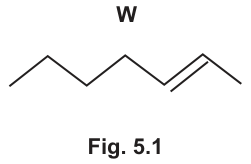
W has two positional isomers. Only one shows stereoisomerism.
Draw the structures of the two positional isomers of W in the boxes.
Answer
Box 1:
Box 2:
hept-1-ene and hept-3-ene
Background Concept
Structural isomerism occurs when compounds have the same molecular formula but different structural arrangements of atoms. For alkenes, positional isomerism arises when the carbon-carbon double bond is located at different positions along the carbon chain. A skeletal formula represents the carbon backbone as a zigzag line, where each vertex and endpoint is a carbon atom, and hydrogen atoms attached to carbons are implied. Double bonds are shown as two parallel lines.
Understanding the Question
Compound W is given as hept-2-ene, a seven-carbon alkene with the double bond between C2 and C3. The question asks for the two positional isomers of W to be drawn in skeletal form. Positional isomers of hept-2-ene must have the same molecular formula () but the double bond at a different position. Moving the double bond along the chain gives hept-1-ene (double bond at C1-C2) and hept-3-ene (double bond at C3-C4). Note that hept-4-ene is identical to hept-3-ene when numbered from the other end, and hept-5-ene is identical to hept-2-ene.
Approach
- Identify the molecular formula and carbon chain length of W (7 carbons, one double bond).
- Shift the double bond to all unique positions: C1-C2 (hept-1-ene) and C3-C4 (hept-3-ene).
- Draw the skeletal structures for hept-1-ene and hept-3-ene, ensuring the double bond is clearly represented.
Step-by-Step Reasoning
- Hept-1-ene: The double bond is at the end of the chain. The skeletal structure is a 7-carbon chain (6 line segments) where the first segment is a double line. This is drawn as a zigzag starting with a double bond at the terminal end.
- Hept-3-ene: The double bond is in the middle of the chain, between the third and fourth carbons. The skeletal structure is a 7-carbon chain where the third segment is a double line. The chain can be drawn in a standard zigzag conformation.
Key Takeaways
- Positional isomers of alkenes differ only in the location of the double bond along the carbon chain.
- When numbering the chain, always start from the end that gives the double bond the lowest possible number, so hept-4-ene is incorrectly named and is actually hept-3-ene.
Common Mistakes
- Drawing isomers with a different carbon chain length (e.g., branching), which would be chain isomers, not positional isomers.
- Forgetting to draw the double bond explicitly in the skeletal formula.
- Numbering the chain incorrectly and drawing hept-4-ene instead of hept-3-ene.
Things to Be Careful About
- Ensure the skeletal formula has exactly 7 carbon atoms (7 vertices/ends).
- The double bond must be clearly drawn as two parallel lines.
- Do not add hydrogens to the skeletal formula; they are implied.
Answer
Restricted rotation around the C=C double bond (pi bond).
Restricted rotation around the C=C double bond
Background Concept
Stereoisomerism occurs when molecules have the same structural formula but a different spatial arrangement of atoms. In alkenes, this manifests as cis-trans (or E-Z) isomerism. The carbon-carbon double bond consists of a sigma bond and a pi bond. The pi bond is formed by the sideways overlap of p-orbitals, which locks the bond in place and prevents free rotation around the C=C axis. This restricted rotation, combined with having two different groups on each carbon of the double bond, allows for distinct spatial arrangements (cis and trans).
Understanding the Question
The question asks for the origin of stereoisomerism in W (hept-2-ene). This is a standard recall question asking for the fundamental structural feature that causes cis-trans isomerism in alkenes.
Approach
State the direct cause of restricted rotation in alkenes: the presence of the pi bond in the C=C double bond.
Step-by-Step Reasoning
- The C=C double bond contains a pi bond formed by p-orbital overlap.
- This pi bond prevents free rotation around the carbon-carbon axis.
- Therefore, the groups attached to the double-bonded carbons are fixed in space, leading to stereoisomers.
Key Takeaways
- Cis-trans isomerism in alkenes is caused by restricted rotation around the C=C double bond.
- This restricted rotation is due to the pi bond.
Common Mistakes
- Saying "no rotation" without mentioning the C=C bond or pi bond.
- Attributing it to steric hindrance (which is a consequence, not the origin).
Things to Be Careful About
- Use precise terminology: "restricted rotation" or "no rotation" around the C=C (or pi bond). Avoid vague terms like "fixed structure".
Answer
W has two different groups bonded to each carbon atom of the C=C double bond, whereas hept-1-ene has two identical hydrogen atoms bonded to one of the carbon atoms of the double bond.
W has different groups on each C of the C=C; hept-1-ene has two H's on C1
Background Concept
For an alkene to exhibit cis-trans stereoisomerism, each carbon atom of the double bond must be bonded to two different groups. If either carbon of the C=C bond has two identical groups (usually two hydrogen atoms), rotation (if it were possible) or spatial arrangement does not create a distinct isomer because the molecule is superimposable on its mirror image or alternative orientation.
Understanding the Question
The question asks why W (hept-2-ene) shows stereoisomerism, but one of its positional isomers (hept-1-ene) does not. We need to compare the groups attached to the double-bonded carbons in both molecules.
Approach
- Analyze the groups on the C=C carbons in W (hept-2-ene).
- Analyze the groups on the C=C carbons in hept-1-ene.
- Show that W meets the condition (different groups on each C) while hept-1-ene fails it (two H's on C1).
Step-by-Step Reasoning
- In W (hept-2-ene), C2 is bonded to a methyl group () and a hydrogen atom (). C3 is bonded to a butyl group () and a hydrogen atom (). Since both carbons have two different groups, stereoisomerism is possible.
- In hept-1-ene, C1 is bonded to two hydrogen atoms () and C2 is bonded to a pentyl group and a hydrogen. Because C1 has two identical groups (two H's), no stereoisomerism exists.
Key Takeaways
- The condition for cis-trans isomerism in alkenes is that each carbon of the double bond must have two different substituents.
- Terminal alkenes (like hept-1-ene) generally do not show cis-trans isomerism because the terminal carbon always has two hydrogen atoms.
Common Mistakes
- Simply stating "hept-1-ene has two hydrogens" without specifying that they are on the same carbon of the double bond.
- Failing to mention that W has different groups on each carbon.
Things to Be Careful About
- Be precise: say "two identical groups (e.g., two hydrogen atoms) bonded to one carbon of the double bond".
- Explicitly name the isomer that lacks stereoisomerism (hept-1-ene) or refer to it as "the other positional isomer".
Answer
Skeletal structure of (E)-hept-2-ene (or (Z)-hept-2-ene, opposite to W)
Background Concept
Geometric (cis-trans or E-Z) isomers of alkenes differ in the spatial arrangement of groups around the C=C double bond. In the cis (or Z) isomer, the higher priority groups (or main chain continuation) are on the same side of the double bond. In the trans (or E) isomer, they are on opposite sides. When drawing skeletal structures, the cis isomer often looks like a 'cup' or 'C' shape around the double bond, while the trans isomer has a zigzag continuation through the double bond.
Understanding the Question
The question asks to draw the stereoisomer of W. Since W is hept-2-ene and shows stereoisomerism, it must be either (E)-hept-2-ene or (Z)-hept-2-ene. The drawing must show the opposite geometric arrangement to W.
Approach
- Identify the main chain continuation across the double bond in W.
- Draw the same carbon chain (7 carbons) but with the double bond geometry reversed (trans if W is cis, or cis if W is trans).
Step-by-Step Reasoning
- W is shown in Fig 5.1. Assuming W is the cis (Z) isomer (where the chain continues on the same side), the stereoisomer is the trans (E) isomer.
- Draw a 7-carbon chain. The double bond is between C2 and C3.
- For the trans isomer, the C1 methyl group and the C4-C7 butyl group are on opposite sides of the double bond. This is drawn as a zigzag line where the double bond segment is parallel to the adjacent single bond segments but on opposite sides.
Key Takeaways
- Stereoisomers of alkenes have the same connectivity but different spatial arrangements around the double bond.
- Trans isomers typically have the main chain continuing in a zigzag pattern across the double bond.
Common Mistakes
- Drawing a structural isomer instead of a stereoisomer (e.g., changing the double bond position).
- Drawing the same isomer as W (must be the opposite geometry).
- Incorrectly numbering or drawing the carbon chain length.
Things to Be Careful About
- Ensure the skeletal structure has exactly 7 carbons.
- The double bond must be clearly shown.
- The geometry must be clearly trans (or cis, opposite to W). Avoid ambiguous drawings where it's unclear if it's cis or trans.
W reacts with reagent X to produce ethanoic acid and pentanoic acid.
Answer
Oxidising agent.
Oxidising agent
Background Concept
Alkenes can be oxidised by strong oxidising agents like acidified potassium manganate(VII) (). Under hot, concentrated conditions, the C=C double bond is completely cleaved (broken). Each carbon of the double bond becomes a carbonyl carbon (). If the carbon has a hydrogen attached, it forms a carboxylic acid. If it has two alkyl groups, it forms a ketone. This reaction is a powerful way to determine the position of a double bond in an unknown alkene by identifying the cleavage products.
Understanding the Question
Compound W (hept-2-ene) reacts with reagent X to produce ethanoic acid (2 carbons) and pentanoic acid (5 carbons). The question asks for the role of X in this reaction.
Approach
Recognise that the cleavage of a C=C bond to form carboxylic acids is an oxidation reaction. Therefore, X must be an oxidising agent.
Step-by-Step Reasoning
- The reaction breaks the C=C bond and adds oxygen to form carboxylic acids.
- This is an increase in the number of C-O bonds and a decrease in C-C bonds, which is oxidation.
- Therefore, reagent X acts as an oxidising agent.
Key Takeaways
- Hot concentrated acidified cleaves alkenes to form carboxylic acids (or ketones/CO2 depending on substitution).
- This is an oxidative cleavage reaction, so is the oxidising agent.
Common Mistakes
- Calling a reducing agent.
- Saying "catalyst" (it is consumed in the reaction).
Things to Be Careful About
- Use the exact term "oxidising agent".
- Do not confuse this with hydrogenation (which uses a reducing agent or addition of ).
Answer
X is (potassium manganate(VII)).
Conditions: hot, concentrated, acidified (with dilute ).
hot concentrated acidified KMnO4
Background Concept
The oxidative cleavage of alkenes is typically carried out using acidified potassium manganate(VII) () or ozone () followed by hydrolysis. For A-Level Chemistry, the standard reagent taught is hot, concentrated, acidified . The acid is usually dilute sulfuric acid (). Under these vigorous conditions, the double bond is completely broken, and each carbon of the double bond is oxidised to a carbonyl group. If the carbon is monosubstituted (has one H), it becomes a carboxylic acid. If disubstituted, it becomes a ketone. If it has two H's (terminal alkene), it becomes .
Understanding the Question
The question asks to identify reagent X and state the conditions. We know X cleaves hept-2-ene into ethanoic acid and pentanoic acid. This matches the oxidative cleavage using .
Approach
- Identify the reagent: potassium manganate(VII) ().
- State the required conditions: hot, concentrated, and acidified.
Step-by-Step Reasoning
- Reagent X must be to perform oxidative cleavage.
- The conditions must be hot and concentrated to ensure complete cleavage to carboxylic acids (dilute, cold would only form diols).
- The solution must be acidified, typically with dilute , to provide the acidic medium required for the reaction.
Key Takeaways
- Hot, concentrated, acidified cleaves alkenes to carboxylic acids/ketones.
- Cold, dilute, acidified converts alkenes to diols (addition reaction, not cleavage).
- Conditions are critical: temperature, concentration, and pH must be specified.
Common Mistakes
- Saying "cold dilute " (this gives a diol, not cleavage products).
- Forgetting to specify "acidified" or "hot" and "concentrated".
- Writing instead of the full reagent (though is often accepted, is safer).
Things to Be Careful About
- Always include all three conditions: hot, concentrated, acidified.
- Do not say "boiling"; "hot" or "warm" is the standard terminology, though boiling is implied by concentrated hot conditions. Stick to the mark scheme wording: "hot concentrated acidified ".
P, Q and R are three different hydrocarbon molecules.
Answer
The simplest whole-number ratio of atoms of each element present in a compound.
simplest whole-number ratio of atoms of each element in a compound
Background Concept
An empirical formula gives the simplest whole-number ratio of atoms of each element in a compound. It does not necessarily represent the actual number of atoms in a molecule. For example, hydrogen peroxide has the molecular formula but its empirical formula is ; glucose has the molecular formula but its empirical formula is .
The empirical formula is derived from percentage composition or reacting masses by converting to moles and then dividing by the smallest number of moles to obtain a ratio, which is then scaled to whole numbers if necessary.
Understanding the Question
This part asks for the definition of empirical formula. No calculation is required — it is a straightforward recall question worth one mark.
Approach
Recall the standard Cambridge definition: simplest whole-number ratio of atoms of the elements in a compound.
Step-by-Step Reasoning
The mark scheme awards one mark for stating that the empirical formula is the simplest whole-number ratio of atoms of each element in a compound. Key words that must appear: simplest, whole number ratio, atoms, and elements. Omitting any of these can cost the mark.
Key Takeaways
Be able to distinguish between molecular formula (actual numbers of atoms) and empirical formula (simplest ratio). Both describe the same compound but give different information.
Common Mistakes
- Saying "the formula with the smallest numbers" without mentioning it is a ratio of atoms — this is vague and may not score.
- Writing "the formula of the simplest compound" — this is incorrect; empirical formula applies to any compound, not just simple ones.
- Forgetting to say whole number — fractional ratios are not empirical formulas.
Things to Be Careful About
Use the exact phrasing: "simplest whole-number ratio of atoms of each element in a compound." Mark scheme examiners look for these specific keywords.
Hydrocarbon P contains 85.7% by mass of carbon.
Calculate the empirical formula of P.
Show your working.
empirical formula of P = ..............................
Working
Assume 100 g of P:
Ratio C : H =
Answer
empirical formula of P =
CH2
Background Concept
To find an empirical formula from percentage composition:
- Assume a 100 g sample, so percentages become grams directly.
- Divide each mass by the atomic mass (or molar mass) of the element to get moles.
- Divide all mole values by the smallest mole value to obtain a ratio.
- If the ratio contains fractions (e.g., 0.5, 1.33, 1.5), multiply through by the appropriate integer (2, 3, 2) to get whole numbers.
For hydrocarbons, only carbon and hydrogen are present, so the hydrogen percentage is .
Understanding the Question
Hydrocarbon P is 85.7% carbon by mass. Since it is a hydrocarbon, the remainder (14.3%) must be hydrogen. We need to find the simplest whole-number ratio of C to H atoms.
Approach
Convert the mass percentages to moles using atomic masses (, ), then divide by the smallest value to get the ratio.
Step-by-Step Reasoning
Step 1: Assume 100 g of P. Then mass of C = 85.7 g, mass of H = 100 - 85.7 = 14.3 g.
Step 2: Calculate moles:
Step 3: Divide by the smallest (7.14):
Step 4: The empirical formula is .
The mark scheme awards M1 for showing the mole calculation ( and ) and M2 for the final empirical formula .
Key Takeaways
Always assume 100 g when given percentages — this makes the conversion from percentage to grams trivial. The ratio step (dividing by the smallest value) is where most errors occur; check your arithmetic carefully.
Common Mistakes
- Forgetting to calculate the hydrogen percentage: if C is 85.7%, H must be 14.3%, not 100%.
- Using wrong atomic masses (e.g., using 13.0 for carbon instead of 12.0).
- Writing the empirical formula as instead of reducing to .
- Not showing the division step — the mark scheme requires seeing the ratio calculation.
Things to Be Careful About
- Show all working: the mark scheme gives one method mark (M1) for the mole calculation and one accuracy mark (M2) for the final formula.
- Use correct significant figures in intermediate steps (at least 3 sf is acceptable here).
- The final answer must be written as , not .
Answer
alkenes
alkenes
Background Concept
A homologous series is a family of organic compounds with the same functional group, similar chemical properties, and a general formula. Each member differs from the next by a unit.
Key homologous series and their general formulas:
- Alkanes:
- Alkenes:
- Alkynes:
- Cycloalkanes:
The empirical formula corresponds to a general formula of , which fits both alkenes and cycloalkanes.
Understanding the Question
Hydrocarbon P has empirical formula (from part (ii)) and its molecules have straight chains. We need to name the homologous series.
Approach
The empirical formula suggests a general formula of . This matches both alkenes and cycloalkanes. The clue "straight chains" rules out cycloalkanes (which are cyclic, not straight-chain). Therefore, P belongs to the alkenes.
Step-by-Step Reasoning
- Empirical formula → general formula .
- corresponds to alkenes (containing one C=C double bond) or cycloalkanes (ring structures with only C-C single bonds).
- The question states P has straight chains, which means it is not cyclic. Cycloalkanes are excluded.
- Therefore, P is an alkene.
Note: Alkynes () have a different hydrogen count and are ruled out.
Key Takeaways
When deducing a homologous series from an empirical formula, consider both the general formula and any structural information given (straight chain, cyclic, etc.). The combination of empirical formula + straight chain uniquely identifies alkenes.
Common Mistakes
- Answering "alkanes" — alkanes have general formula , empirical formula would be close to for large n, not .
- Answering "alkynes" — these have empirical formula closer to for large n.
- Answering "cycloalkanes" — the question specifies straight chains, ruling out rings.
- Writing "alkene" in singular — the mark scheme accepts "alkene(s)" but the series name is "alkenes".
Things to Be Careful About
- The command word is "name" — give the name of the series, not a description.
- "Alkenes" is the correct term for the series; "alkene" (singular) may or may not score depending on examiner discretion, but "alkenes" is safer.
Q is a volatile hydrocarbon.
of gaseous Q occupies a volume of at and .
Use the ideal gas equation to calculate the of Q.
of Q = ..............................
Working
Convert units:
Answer
of Q = 84.1
84.1
Background Concept
The ideal gas equation relates pressure, volume, temperature, and amount of gas:
where:
- = pressure in pascals (Pa)
- = volume in cubic metres (m³)
- = amount of substance in moles (mol)
- = gas constant =
- = temperature in kelvin (K)
Critical unit requirements:
- Pressure must be in Pa (not kPa, atm, or mmHg)
- Volume must be in m³ (not cm³ or dm³)
- Temperature must be in K (not °C)
To convert:
- (or 273.15, but 273 is acceptable at A-Level)
Once is found, molar mass is: .
Understanding the Question
We are given:
- Mass of gaseous Q:
- Volume:
- Temperature:
- Pressure:
We need to calculate using the ideal gas equation.
Approach
- Convert all quantities to SI units (Pa, m³, K).
- Rearrange to find .
- Calculate .
Step-by-Step Reasoning
Step 1: Convert units
Step 2: Calculate moles
Step 3: Calculate
The mark scheme awards M1 for converting temperature to 373 K and using it correctly, and M2 for the correct rearrangement and final answer of 84.1.
Key Takeaways
Unit conversion is the most common source of error in ideal gas calculations. Always check:
- Temperature in K (add 273 to °C)
- Volume in m³ (multiply cm³ by )
- Pressure in Pa (multiply kPa by )
Common Mistakes
- Forgetting to convert °C to K: using instead of gives a wildly wrong answer.
- Forgetting to convert cm³ to m³: using directly gives that is times too large.
- Using with pressure in kPa and volume in cm³ without converting — the units must be consistent with .
- Rounding too early: keep at least 4 significant figures in intermediate calculations.
- Writing instead of 84.1: the mark scheme accepts 84.1 (3 sf is appropriate given the data).
Things to Be Careful About
- The gas constant requires SI units throughout.
- If you use , you must use atm and dm³ instead. Both approaches are valid but must be internally consistent.
- is dimensionless (relative molecular mass), so no unit is needed in the final answer.
The mass spectrum of hydrocarbon R is recorded.
Information about the two peaks with greater than 135 is shown in Fig. 6.1.
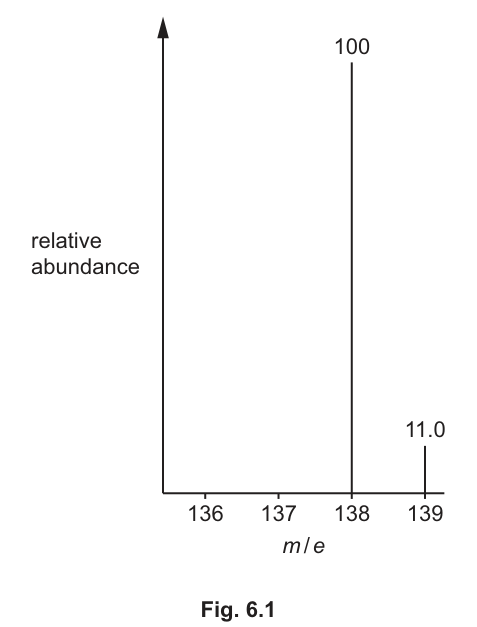
Use Fig. 6.1 to deduce the number of carbon atoms in a molecule of R.
Show your working.
number of carbon atoms = ..............................
Working
The peak at is the molecular ion (relative abundance = 100).
The peak at is the peak (relative abundance = 11.0).
The peak arises from molecules containing one atom.
Natural abundance of .
Answer
number of carbon atoms = 10
10
Background Concept
In mass spectrometry, molecules are ionised (typically by electron impact) to form a molecular ion . The mass spectrum shows peaks at various values corresponding to the molecular ion and fragment ions.
The molecular ion peak () appears at the highest value (excluding isotope peaks) and gives the relative molecular mass.
The peak appears at and is primarily due to molecules containing one atom instead of . The natural abundance of is approximately 1.1% (more precisely 1.07-1.11%, but 1.1% is used at A-Level).
The relationship is:
where is the number of carbon atoms. Rearranging:
Note: Hydrogen contributes negligibly to the peak (natural abundance of is only 0.015%), so we can ignore it.
Understanding the Question
Fig. 6.1 shows a mass spectrum with two peaks:
- , relative abundance = 100 (this is )
- , relative abundance = 11.0 (this is )
We need to deduce the number of carbon atoms in a molecule of R.
Approach
Use the ratio of the peak to the peak and the known natural abundance of (1.1%) to calculate the number of carbon atoms.
Step-by-Step Reasoning
Step 1: Identify the peaks.
- with abundance 100 → molecular ion , so .
- with abundance 11.0 → peak.
Step 2: Apply the carbon counting formula.
The mark scheme shows this as .
Step 3: Verify.
With 10 carbon atoms, the expected abundance relative to is:
This matches the observed 11.0%, confirming 10 carbon atoms.
Key Takeaways
The peak in a mass spectrum is a powerful tool for determining the number of carbon atoms. The formula is:
This works because each carbon atom has a 1.1% chance of being , and for a molecule with carbons, the probability of exactly one being is approximately (valid for small percentages).
Common Mistakes
- Confusing and : the molecular ion is at the lower (138), not 139.
- Using the wrong isotope abundance: using 1.0% or 1.5% instead of 1.1% gives the wrong number of carbons.
- Forgetting to divide by 100 or multiply incorrectly: the ratio 11.0/100 must be multiplied by 100/1.1, not just 100/1.1.
- Assuming the peak is due to : hydrogen's contribution is negligible at A-Level.
Things to Be Careful About
- The mark scheme accepts the calculation as or equivalently . Show the working clearly.
- The answer must be a whole number (10). If you get a non-integer, recheck your calculation.
- This method assumes only contributes significantly to . For molecules with many hydrogen atoms, a small correction for deuterium () would be needed, but this is beyond A-Level.
Answer
(from peak at )
Mass of 10 carbon atoms =
Mass of hydrogen =
Number of hydrogen atoms = 18
molecular formula of R =
C10H18
Background Concept
From the mass spectrum:
- The peak at gives .
- Part (c)(i) established 10 carbon atoms.
For a hydrocarbon :
With and :
So the molecular formula is .
Note: has a degree of unsaturation (index of hydrogen deficiency) of:
This means R has either two double bonds, one triple bond, or two rings (or a combination). This is consistent with it being a hydrocarbon that is not fully saturated.
Understanding the Question
We know:
- (from the molecular ion peak)
- Number of carbon atoms = 10 (from part (c)(i))
We need to deduce the molecular formula.
Approach
Calculate the mass contributed by carbon, subtract from to get the mass of hydrogen, then divide by 1 to get the number of hydrogen atoms.
Step-by-Step Reasoning
Step 1: from the peak.
Step 2: Mass of 10 C atoms = .
Step 3: Mass of H = .
Step 4: Number of H atoms = .
Step 5: Molecular formula = .
Key Takeaways
Once you know and the number of carbon atoms in a hydrocarbon, finding the molecular formula is straightforward subtraction. Always verify: ✓.
Common Mistakes
- Using the wrong : the molecular ion peak is at , not 139.
- Arithmetic errors: , not 16 or 20.
- Writing as with incorrect subscripts.
Things to Be Careful About
- The molecular formula must be written with correct subscripts: .
- Check your answer: ✓.
Answer
corresponds to :
fragment =
(C4H9)+
Background Concept
In mass spectrometry, the molecular ion fragments into smaller ions and neutral radicals. The fragment ions appear at lower values.
A peak at in a hydrocarbon mass spectrum commonly corresponds to the butyl cation :
This is a very common fragment in the mass spectra of alkanes and alkyl-substituted compounds. The butyl cation can arise from cleavage of a C-C bond in a molecule containing a butyl group ().
For , losing a fragment (Mr = 85) from the molecular ion gives:
Actually, let's reconsider: . The neutral fragment lost has , which could be (81) — but that's an unusual radical. More likely, the peak is simply the ion formed by fragmentation.
The mark scheme accepts as the answer.
Understanding the Question
Given molecular formula () and a peak at , we need to suggest the molecular formula of this fragment ion.
Approach
Find a combination of C and H atoms that gives . The most common hydrocarbon fragment with is (butyl cation).
Step-by-Step Reasoning
Step 1: means the fragment ion has .
Step 2: Try :
Step 3: This is a well-known fragment ion (butyl cation) commonly seen in mass spectra of compounds containing butyl groups.
Step 4: The fragment is written as to indicate it is a cation.
Key Takeaways
Common fragment ions to remember:
- :
- :
- :
- :
- :
These are alkyl cations with the general formula .
Common Mistakes
- Writing without the charge: the fragment is an ion, so is required.
- Trying : this doesn't make chemical sense (too many hydrogens for 3 carbons).
- Not showing any working or justification for the choice.
Things to Be Careful About
- The answer must include the positive charge: .
- The mark scheme accepts specifically. Other valid fragments with are not commonly expected at this level.