Chemistry 9701/23 — May/June 2025
Cambridge AS Level · AS Level Structured Questions · worked solutions for every part, with the mark scheme
Topics Atoms, Molecules and Stoichiometry · Chemical Bonding · Hydrocarbons · Nitrogen and Sulfur · Reaction Kinetics · Atomic Structure · +12 more
The chemical properties of an element are related to the electronic configuration of its atoms.
Answer
1s^2 2s^2 2p^5
Background Concept
The electronic configuration of an atom describes how its electrons are distributed among the various atomic orbitals. Electrons fill orbitals in order of increasing energy according to the Aufbau principle: 1s, 2s, 2p, 3s, 3p, 4s, 3d, and so on. Each s subshell holds a maximum of 2 electrons, and each p subshell holds a maximum of 6.
Understanding the Question
The question asks for the full electronic configuration of a fluorine atom. Fluorine has an atomic number of 9, meaning a neutral atom contains 9 electrons.
Approach
Distribute the 9 electrons into the lowest available energy orbitals in order: fill the 1s orbital, then the 2s orbital, and place the remaining electrons in the 2p orbitals.
Step-by-Step Reasoning
- The first 2 electrons go into the 1s orbital: .
- The next 2 electrons go into the 2s orbital: .
- This leaves 5 electrons (9 - 2 - 2 = 5) to be placed in the 2p subshell: .
- Combining these gives the full configuration: .
Key Takeaways
Always fill orbitals in the correct energy order (1s before 2s before 2p) and ensure the total number of electrons matches the atomic number for a neutral atom.
Common Mistakes
- Writing the configuration in order of principal quantum number (e.g., is correct, but some students write ). While technically containing the right numbers, the standard convention is to write in filling order.
- Forgetting the superscripts or omitting spaces between subshells.
Things to Be Careful About
The mark scheme requires the exact notation . Ensure all superscripts are correct and no orbitals are skipped.
Deduce the number of pairs of electrons in the second energy shell, , of an oxygen atom.
Answer
2
2
Background Concept
The principal quantum number defines the energy shell. For , the shell contains the 2s and 2p subshells. Electrons in these subshells can be paired (in the same orbital with opposite spins) or unpaired (in different orbitals of the same subshell, according to Hund's rule).
Understanding the Question
We need to deduce the number of electron pairs in the second energy shell () of an oxygen atom. Oxygen has an atomic number of 8.
Approach
Write the electronic configuration of oxygen, isolate the shell, and count the number of orbitals that contain two electrons.
Step-by-Step Reasoning
- Oxygen (Z = 8) has the configuration .
- The shell consists of the 2s and 2p subshells.
- The 2s subshell is fully occupied with 2 electrons, which form 1 pair.
- The 2p subshell has 4 electrons. According to Hund's rule, they occupy the three available 2p orbitals as follows: one orbital gets a pair (2 electrons), and the other two orbitals get one electron each (unpaired).
- Therefore, the 2p subshell contains 1 pair of electrons.
- Total pairs in the shell = 1 (from 2s) + 1 (from 2p) = 2 pairs.
Key Takeaways
When counting electron pairs, remember Hund's rule: electrons fill degenerate orbitals singly before pairing up. The 2s orbital always holds 1 pair when occupied.
Common Mistakes
- Assuming all 4 electrons in the 2p subshell are paired (giving 3 pairs total). This violates Hund's rule.
- Forgetting to include the 2s electrons in the count for the shell.
Things to Be Careful About
The question asks for the number of pairs, not the number of electrons. Ensure you count orbital pairs correctly.
Draw the shape of the highest energy orbital that contains electrons in an atom of calcium.
Answer
Spherical s orbital (see diagram)
Background Concept
Atomic orbitals have characteristic shapes determined by their angular momentum quantum number ().
- s orbitals () are spherically symmetric.
- p orbitals () are dumb-bell shaped.
- d orbitals () have more complex cloverleaf shapes.
The highest energy orbital containing electrons in an atom is simply the last subshell to be filled according to the Aufbau principle.
Understanding the Question
We must identify the highest energy orbital that contains electrons in a calcium atom (Z = 20) and draw its shape.
Approach
Write the electronic configuration of calcium, identify the last subshell filled, and recall the shape associated with that subshell type.
Step-by-Step Reasoning
- Calcium (Z = 20) has the configuration: .
- The highest energy subshell containing electrons is 4s.
- The 4s orbital is an s orbital.
- All s orbitals, regardless of principal quantum number, are spherically symmetric.
- The drawing is a simple circle (representing a cross-section of the sphere) or a sphere with no directional lobes.
Key Takeaways
The highest energy orbital in calcium is 4s. All s orbitals are spherical. Do not confuse the principal quantum number (n=4) with the shape; the shape is determined by the subshell type (s, p, d).
Common Mistakes
- Identifying the 3d or 3p orbital as the highest energy (calcium's 4s fills before 3d, and 3d is empty).
- Drawing a dumb-bell shape (which would be for a p orbital).
- Drawing concentric circles to represent different energy levels within the orbital (an orbital is just one region of space, drawn as a single boundary or sphere).
Things to Be Careful About
The mark scheme accepts a simple circle or sphere. Do not add axes, lobes, or phase shading unless specifically asked; a plain spherical boundary is sufficient for an s orbital.
Answer
S(g) -> S+(g) + e-
Background Concept
The first ionisation energy is defined as the enthalpy change when one mole of gaseous atoms loses one mole of electrons to form one mole of gaseous 1+ ions. The equation must represent the removal of a single electron from a single gaseous atom.
Understanding the Question
Write the chemical equation that represents the first ionisation energy of sulfur.
Approach
Write the symbol for sulfur in the gaseous state on the left, and the sulfur cation (with a +1 charge) and an electron on the right. Ensure all state symbols are included.
Step-by-Step Reasoning
- Reactant: Sulfur atom in gaseous state .
- Products: Sulfur 1+ ion in gaseous state , and one electron .
- Equation: .
- Alternatively written as: .
Key Takeaways
Always include the state symbol (g) for all species in ionisation energy equations. The electron is written as , not or any other species.
Common Mistakes
- Forgetting the state symbols (g). This is a very common error that costs a mark.
- Writing or removing more than one electron.
- Using solid sulfur instead of gaseous sulfur .
Things to Be Careful About
The mark scheme accepts or . Ensure the charge on the sulfur ion is exactly +1.
Explain why the first ionisation energy of sulfur is less than the first ionisation energy of phosphorus.
Answer
- In sulfur (), there is a pair of electrons in one of the orbitals, which repel each other.
- This electron–electron repulsion outweighs the effect of the increased nuclear charge compared to phosphorus (), making it easier to remove the paired electron.
Electron repulsion in paired 3p orbital outweighs increased nuclear charge.
Background Concept
First ionisation energy generally increases across a period from left to right due to increasing nuclear charge (more protons) while electrons are added to the same shell (similar shielding). However, there are drops in the trend between Group 2 and 13 (s to p) and between Group 15 and 16 (p to p).
For Group 15 (e.g., P) to Group 16 (e.g., S):
- Phosphorus (Z=15): . The 3p subshell has three electrons, each in a separate orbital (Hund's rule), so they are unpaired.
- Sulfur (Z=16): . The 3p subshell has four electrons, meaning one orbital must contain a pair of electrons.
Understanding the Question
Explain why the first ionisation energy of sulfur is less than that of phosphorus, despite sulfur having a higher nuclear charge.
Approach
Compare the electronic configurations of P and S. Identify the presence of an electron pair in S's 3p subshell. Explain that the repulsion between these paired electrons makes one easier to remove, and state that this effect dominates the increased nuclear charge.
Step-by-Step Reasoning
- M1 (Observation/Configuration): Sulfur has the configuration . One of the orbitals contains a pair of electrons. Phosphorus has with all electrons unpaired.
- M1 (Repulsion): The two electrons in the same orbital in sulfur repel each other (electron–electron repulsion).
- M2 (Outweighing nuclear charge): Normally, increased nuclear charge from P to S would increase ionisation energy. However, the repulsion between the paired electrons outweighs this increase in nuclear charge.
- Conclusion: Less energy is required to remove the repelled electron from sulfur than from phosphorus.
Key Takeaways
When explaining ionisation energy anomalies across a period, always refer to the specific electron configuration (paired vs unpaired) and the balance between nuclear charge and electron repulsion.
Common Mistakes
- Saying "sulfur has more electrons so it's easier to remove" (vague, not chemical).
- Forgetting to mention that the repulsion outweighs the nuclear charge effect. Just saying "repulsion is greater" is often not enough; you must explain why it leads to a lower IE.
- Not specifying that the pair is in a 3p orbital.
Things to Be Careful About
Use precise terminology: "electron–electron repulsion" or "repulsion between paired electrons". Do not say "electrons repel each other" without specifying it is between the paired electrons in the same orbital.
Arrange the three species , and in order of increasing radius.
Explain your answer.
.................................. < .................................. < ..................................
smallest radius largest radius
Answer
Order:
Explanation:
- All three species have the same number of electrons (10 electrons) / are isoelectronic.
- has the smallest nuclear charge (11 protons), has 10, and has the largest nuclear charge? No, has 9 protons.
- Correct logic: (11 protons) > (10 protons) > (9 protons) in terms of nuclear charge.
- Therefore, exerts the greatest nuclear attraction on the outer electrons, pulling them closer and giving the smallest radius.
- has the smallest nuclear charge (9 protons), so it exerts the weakest nuclear attraction on the outer electrons, resulting in the largest radius.
Final Order:
Na+ < Ne < F-
Background Concept
Isoelectronic species are atoms or ions that have the same number of electrons and the same electronic configuration. For the species , , and :
- (Z=9) gains 1 electron has 10 electrons ().
- (Z=10) has 10 electrons ().
- (Z=11) loses 1 electron has 10 electrons ().
Since they all have the same electron configuration, the size is determined by the nuclear charge (number of protons).
Understanding the Question
Arrange , , and in order of increasing radius (smallest to largest) and explain the reasoning.
Approach
- Confirm they are isoelectronic (same number of electrons).
- Compare their nuclear charges (proton numbers).
- Apply the principle: greater nuclear charge with the same number of electrons leads to stronger attraction and a smaller radius.
Step-by-Step Reasoning
- M1 (Order): .
- M2 (Isoelectronic): All three species have 10 electrons (or the same number of electrons / are isoelectronic).
- M3 (Nuclear charge): has 11 protons, has 10, has 9. Therefore, has the largest nuclear charge, and has the smallest.
- M4 (Attraction/Radius): The species with the largest nuclear charge () exerts the greatest nuclear attraction on the electron cloud, pulling it in tighter and giving the smallest radius. Conversely, has the smallest nuclear charge, so the nuclear attraction is weakest, resulting in the largest radius.
Key Takeaways
For isoelectronic species, radius decreases as nuclear charge (atomic number) increases. More protons pull the same number of electrons closer to the nucleus.
Common Mistakes
- Ordering them by atomic number instead of considering the ion charge (e.g., thinking is smallest because fluorine is smallest atom).
- Forgetting to state that they have the same number of electrons. Without this, the comparison of nuclear charge is meaningless.
- Saying "more protons = smaller" without explaining why (nuclear attraction/force on electrons).
Things to Be Careful About
The order must be strictly increasing radius: smallest to largest. is the smallest, is the largest. Ensure the explanation explicitly links nuclear charge to the strength of attraction on the outer electrons.
The chemical properties of oxides are related to the chemical bonding present in these compounds.
A Period 3 oxide produces a solution with a pH greater than 10 when it is added to water.
State the formula of the oxide.
Answer
Na2O
Background Concept
Across Period 3, the oxides change from strongly basic (, ) through amphoteric () to increasingly acidic (, , , ). When a basic oxide dissolves/reacts with water it produces hydroxide ions, giving an alkaline solution. reacts to give , a strong alkali, so the pH exceeds 10. is only slightly soluble, so its solution is only mildly alkaline (pH around 9-10 at most).
Understanding the Question
The command word is 'State' — a one-line recall answer is expected. The clue 'pH greater than 10' points to the oxide that produces the most strongly alkaline solution in water.
Approach
Recall the Period 3 oxide trend: only gives a strongly alkaline solution (pH 13-14) because it forms NaOH in water.
Step-by-Step Reasoning
, a fully dissociated strong base, so pH > 10. No other Period 3 oxide gives such a high pH: is barely soluble, is insoluble and amphoteric, and the rest are acidic or neutral.
Key Takeaways
Learn the Period 3 oxide acidity/basicity trend and the pH each oxide gives in water.
Common Mistakes
Writing — its low solubility means the solution does not reach pH > 10. Writing instead of the oxide asked for.
Things to Be Careful About
The question asks for the formula of the oxide, not the product of its reaction with water.
Answer
P4O10 + 12NaOH -> 4Na3PO4 + 6H2O
Background Concept
is an acidic oxide (phosphorus(V) oxide). Acidic oxides react with bases/alkalis to give salt and water, exactly as an acid would. With excess NaOH, phosphoric acid (, formed when meets water) is fully neutralised to the phosphate ion, , giving sodium phosphate, .
Understanding the Question
'Write an equation to describe the reaction' demands a fully balanced symbol equation for + excess NaOH. 'Excess' matters: it means complete neutralisation to , not an acid salt such as or .
Approach
Treat as equivalent to , i.e. it reacts with water to give . Each needs 3 NaOH for full neutralisation, so 4 × 3 = 12 NaOH per , producing 4 and 6 . Check the balance: P 4 = 4; Na 12 = 12; O 10 + 12 = 22 and 16 + 6 = 22; H 12 = 12. ✓
Step-by-Step Reasoning
- Identify the products: excess NaOH + phosphoric acid → sodium phosphate () + water.
- Balance phosphorus: 4 P on the left, so 4 .
- Balance sodium: 4 × 3 = 12 Na, so 12 NaOH.
- Balance hydrogen and oxygen: 6 on the right completes the balance.
Key Takeaways
Acidic oxide + alkali → salt + water; 'excess alkali' means the fully deprotonated (normal) salt, not an acid salt.
Common Mistakes
Writing or an acid salt () — with excess NaOH the neutral phosphate forms. Writing -based equations that are not correctly scaled to . Leaving the equation unbalanced.
Things to Be Careful About
Check every element is balanced before moving on; the mark is for the correctly balanced equation.
Table 2.1 shows the melting points of some oxides.
Table 2.1
| oxide | melting point/ °C |
|---|---|
| –73 | |
| 0 | |
| 17 | |
| 1610 | |
| 1132 | |
| 2852 | |
| 2072 |
Identify the oxide from Table 2.1 that contains the element with the highest oxidation number.
Answer
(S has oxidation number +6, the highest in the table)
SO3
Background Concept
The oxidation number of an element in an oxide is deduced from oxygen being −2 (unless peroxide etc.). Across Period 3 the maximum oxidation number rises from +1 (Na) to +7 (Cl).
Understanding the Question
'Identify' — a one-line answer naming the oxide containing the element in its highest oxidation state.
Approach
Assign oxidation numbers: Na +1, Mg +2, Al +3, Si +4, P (in , not listed) +5, S in +4 and in +6, H in +1.
Step-by-Step Reasoning
In : 3 × (−2) = −6, so S = +6 — the highest oxidation number among the listed oxides ( has S at +4).
Key Takeaways
Oxygen is −2 in normal oxides; the oxidation number of the other element follows by charge balance.
Common Mistakes
Choosing (S = +4, not the highest). Confusing oxidation number with charge on the ion.
Things to Be Careful About
Compare all oxides in the table, not just the sulfur ones.
A student suggests the following hypothesis.
The melting point of an ionically bonded oxide is only determined by the charge on the cation.
Use Table 2.1 to deduce if this hypothesis is true or false or if there is not enough information to make a conclusion. Explain your answer.
Answer
The hypothesis is false.
- has a lower melting point (2072 °C) than (2852 °C), yet
- the charge on the ion (+3) is greater than that on (+2).
If cation charge alone determined melting point, should melt higher than ; it does not, so the hypothesis is false.
False: Al2O3 (charge +3 cation) melts lower than MgO (charge +2 cation), contradicting the hypothesis
Background Concept
The melting point of an ionic solid depends on the strength of the electrostatic attraction in the lattice, which depends on BOTH the charges on the ions AND their radii (lattice energy ∝ ). Larger charges and smaller ions give stronger attraction and higher melting points.
Understanding the Question
The command word is 'deduce... explain'. You must decide true / false / not enough information, and justify with data from Table 2.1. The hypothesis claims cation charge alone determines the melting point of an ionic oxide.
Approach
Test the hypothesis with a counter-example. Compare and : both ionic oxides, both with anions. has a higher charge than , so the hypothesis predicts should melt higher — but the table shows the opposite (2072 vs 2852 °C). This single comparison is sufficient to falsify the hypothesis.
Step-by-Step Reasoning
- Conclusion: false.
- Evidence 1: melting point (2072 °C) < melting point (2852 °C).
- Evidence 2: charge on (+3) > charge on (+2).
- Together these contradict the hypothesis: higher cation charge but lower melting point. (In reality, ionic radius and lattice structure also matter.)
Key Takeaways
Melting point of ionic compounds depends on charge AND ionic radius (and lattice type); a hypothesis is falsified by a single counter-example.
Common Mistakes
Saying 'true' because Na₂O < MgO fits the charge trend. Saying 'not enough information' — the MgO/Al₂O₃ comparison IS enough. Giving the conclusion without the supporting data (both the melting-point comparison and the charge comparison are needed for full marks).
Things to Be Careful About
Quote the actual values from the table and state both the melting-point order and the charge order explicitly — the mark scheme requires all three points for 2 marks.
Answer
accepts protons () from the acid, e.g. , so it is a Brønsted–Lowry base.
ZnO accepts protons (H+)
Background Concept
A Brønsted–Lowry base is a proton () acceptor; an acid is a proton donor. Metal oxides act as bases because the oxide ion accepts to form water.
Understanding the Question
'State why' — one mark for the definition applied to ZnO. The key word is 'accepts protons'.
Approach
Recall the definition and show ZnO doing exactly that in the reaction with : .
Step-by-Step Reasoning
The ions in ZnO each accept two protons from the acid to form water, so ZnO is a proton acceptor — a Brønsted–Lowry base.
Key Takeaways
Brønsted–Lowry: acid = proton donor, base = proton acceptor. Metal oxides/hydroxides are bases by this definition.
Common Mistakes
Saying ZnO 'neutralises the acid' or 'donates OH⁻ ions' — the mark requires the proton-accepting language. Describing ZnO as an Arrhenius base instead.
Things to Be Careful About
Use the exact phrase 'accepts protons (H⁺)'.
is a white amphoteric compound.
Answer
(i.e. the aluminate ion, )
NaAl(OH)4
Background Concept
Amphoteric oxides react with both acids and bases. with hot concentrated NaOH gives sodium aluminate. In aqueous solution the aluminium-containing species is the tetrahydroxoaluminate ion, , so the salt is .
Understanding the Question
'State the formula' — one mark for the correct formula of the aluminium-containing species.
Approach
Recall: .
Step-by-Step Reasoning
The oxide ion accepts protons from water in alkaline conditions and the centre coordinates four hydroxide ions, giving paired with .
Key Takeaways
Amphoteric oxides dissolve in both acid and alkali; the alkali product is the aluminate .
Common Mistakes
Writing (insoluble hydroxide, not the species in solution). Writing or — not accepted at AS for the aqueous species.
Things to Be Careful About
The question asks for the species produced in aqueous NaOH, so the hydrated form is required.
Answer
Al2(SO4)3
Background Concept
When an amphoteric oxide acts as a base with an acid, the products are a normal salt and water: .
Understanding the Question
'State the formula' — one mark for the aluminium-containing salt formed with sulfuric acid.
Approach
Combine with : charges balance as 2 × (+3) = 3 × (−2).
Step-by-Step Reasoning
Two ions (+6 total) balance three ions (−6 total), giving .
Key Takeaways
Amphoteric oxide + acid → salt + water; formulae of salts from ion charges.
Common Mistakes
Writing or — incorrect charge balancing.
Things to Be Careful About
Bracket the sulfate group correctly: .
Different hydrocarbon mixtures produced from fractional distillation of crude oil have different uses.
State the compound that is heated with long‑chain hydrocarbons to produce more useful smaller alkanes and alkenes.
Answer
aluminium oxide (AlO)
aluminium oxide
Background Concept
Cracking is the process of breaking down long-chain hydrocarbons into shorter, more useful alkanes and alkenes. This can be achieved via thermal cracking (high temperature and pressure) or catalytic cracking. In catalytic cracking, the hydrocarbons are passed over a hot catalyst, typically aluminium oxide (AlO) or a zeolite catalyst, at around 450 °C. The catalyst lowers the activation energy required for the C–C bond cleavage, allowing the reaction to proceed at lower temperatures than thermal cracking.
Understanding the Question
The question asks for the specific compound that is heated with long-chain hydrocarbons to produce smaller, more useful alkanes and alkenes. This is a direct reference to the catalyst used in catalytic cracking of crude oil fractions.
Approach
Recall the standard catalysts used in the industrial cracking process. The mark scheme specifies aluminium oxide, which is the classic zeolite/alumina-based catalyst used in fluid catalytic cracking.
Step-by-Step Reasoning
- Identify the process described: converting long-chain hydrocarbons to smaller alkanes and alkenes is cracking.
- Recall the catalyst for catalytic cracking: aluminium oxide (AlO) or zeolites.
- State the compound as required by the mark scheme.
Key Takeaways
Catalytic cracking uses aluminium oxide (AlO) or zeolite catalysts to break C–C bonds at lower temperatures than thermal cracking, producing a higher proportion of branched alkanes and alkenes.
Common Mistakes
- Writing 'silicon dioxide' or 'silica' instead of aluminium oxide.
- Confusing the catalyst for cracking with the catalyst for hydrogenation (nickel) or the Haber process (iron).
- Stating 'heat' or 'high temperature' as the compound; the question asks for the compound (the catalyst).
Things to Be Careful About
- Ensure the formula is correctly written as AlO if using chemical notation.
- 'Alumina' is also acceptable, but 'aluminium oxide' is the preferred terminology.
Describe how photochemical smog is produced during the combustion of petrol in an internal combustion engine.
Answer
Unburned hydrocarbons from the exhaust react with nitrogen oxides (NO / NO) in the presence of sunlight to produce PAN (peroxyacetyl nitrate), which is a major component of photochemical smog.
Unburned hydrocarbons react with NO/NO2 to produce PAN.
Background Concept
Photochemical smog is a type of air pollution primarily associated with urban areas and heavy traffic. It forms when sunlight drives chemical reactions between nitrogen oxides (NO) and volatile organic compounds (unburned hydrocarbons) in the atmosphere. One of the key products is PAN (peroxyacetyl nitrate), a powerful eye irritant and a major component of smog.
Understanding the Question
The question asks to describe the production of photochemical smog during petrol combustion in an internal combustion engine. Petrol (gasoline) combustion in engines is incomplete, releasing both nitrogen oxides (formed from N and O at high engine temperatures) and unburned hydrocarbons.
Approach
Identify the three key ingredients/regions in the mark scheme: (1) unburned hydrocarbons, (2) nitrogen oxides (NO/NO), and (3) their reaction to form PAN. Link these to the environmental outcome (photochemical smog).
Step-by-Step Reasoning
- Incomplete combustion of petrol in the engine releases unburned hydrocarbons into the exhaust.
- High temperatures in the engine cylinder cause nitrogen and oxygen from the air to react, forming nitrogen oxides (NO, which oxidises to NO).
- When these emissions are released into the atmosphere, sunlight (UV radiation) provides the energy for photochemical reactions.
- The unburned hydrocarbons react with the nitrogen oxides (NO / NO) to produce peroxyacetyl nitrate (PAN).
- PAN and other secondary pollutants accumulate to form photochemical smog.
Key Takeaways
Photochemical smog is not emitted directly but is formed in the atmosphere via sunlight-driven reactions between primary pollutants: unburned hydrocarbons and nitrogen oxides. PAN is a characteristic secondary pollutant.
Common Mistakes
- Stating that smog is directly emitted from the exhaust (it is a secondary pollutant).
- Forgetting to mention unburned hydrocarbons; focusing only on NO.
- Confusing photochemical smog with industrial smog (which involves SO and particulates from burning coal).
- Not mentioning sunlight/UV light as the energy source driving the reaction (though 'photochemical' implies this, it is good practice to be explicit).
Things to Be Careful About
- The mark scheme awards 1 mark for any 2 points and 2 marks for all 3 points. Ensure all three elements (unburned hydrocarbons, NO/NO, PAN) are clearly linked.
- PAN stands for peroxyacetyl nitrate; writing the acronym is sufficient if the full name is not known, but stating it shows understanding.
reacts with an excess of to produce .
Answer
nickel (or platinum)
nickel
Background Concept
The reaction CH + H CH is the catalytic hydrogenation of an alkene (butene) to an alkane (butane). This is an addition reaction where the C=C double bond is broken and two hydrogen atoms are added across it. The reaction requires a metal catalyst to proceed at a reasonable rate because the H–H bond is strong and the alkene -bond is relatively stable.
Understanding the Question
The question asks for the name of a catalyst that facilitates the addition of hydrogen to an alkene (reaction 1).
Approach
Recall the standard heterogeneous catalysts used for the hydrogenation of alkenes. Finely divided nickel (often at 150 °C) or platinum (at room temperature) are the standard answers.
Step-by-Step Reasoning
- Identify the reaction type: hydrogenation of an alkene (addition of H across a C=C bond).
- Recall the catalyst: nickel (Ni) or platinum (Pt) are the standard transition metal catalysts for this reaction.
- State the name as required.
Key Takeaways
Alkenes undergo catalytic hydrogenation using nickel or platinum catalysts to form alkanes. This is an important industrial process for converting unsaturated fats to saturated fats and for upgrading hydrocarbon fractions.
Common Mistakes
- Writing 'palladium' or 'palladium on carbon' (Pd/C) — while technically correct in advanced organic chemistry, CIE typically expects 'nickel' or 'platinum' at AS level.
- Writing the symbol 'Ni' instead of the name 'nickel' when the question asks to 'name' a catalyst (though symbols are often accepted, names are safer).
- Confusing this with the catalyst for the Haber process (iron) or cracking (aluminium oxide).
Things to Be Careful About
- The question asks to 'name' a catalyst. 'Nickel' or 'platinum' are the safest answers. 'Finely divided nickel' is also acceptable but 'nickel' alone is sufficient.
Answer
The minimum energy required for a collision between particles to be effective (i.e., to result in a reaction).
minimum energy required for a collision to be effective
Background Concept
For a chemical reaction to occur, reactant particles must collide with sufficient energy and the correct orientation. The minimum amount of kinetic energy that colliding particles must possess for the collision to be successful (result in product formation) is called the activation energy (). It represents the energy barrier that must be overcome to break existing bonds and form new ones.
Understanding the Question
The question asks for a definition of activation energy, . This is a fundamental concept in chemical kinetics.
Approach
Recall the standard IUPAC/inspection board definition of activation energy. Focus on the keywords: 'minimum energy', 'collision', and 'effective' (or 'to react').
Step-by-Step Reasoning
- Recall that not all collisions lead to a reaction.
- The threshold energy for a successful collision is the activation energy.
- Formulate the definition: is the minimum energy required for a collision to be effective.
Key Takeaways
Activation energy is a kinetic barrier, not a thermodynamic one. A reaction may be highly exothermic () but still have a high , making it slow at room temperature (e.g., combustion of wood requires a spark).
Common Mistakes
- Defining as the energy 'released' or 'absorbed' in a reaction (that is enthalpy change, ).
- Saying 'the energy needed to start a reaction' — this is vague and not the precise scientific definition.
- Forgetting the word 'minimum' or 'effective'.
Things to Be Careful About
- Use the exact phrasing 'minimum energy required for a collision to be effective'. Mark schemes are strict on this definition at AS level.
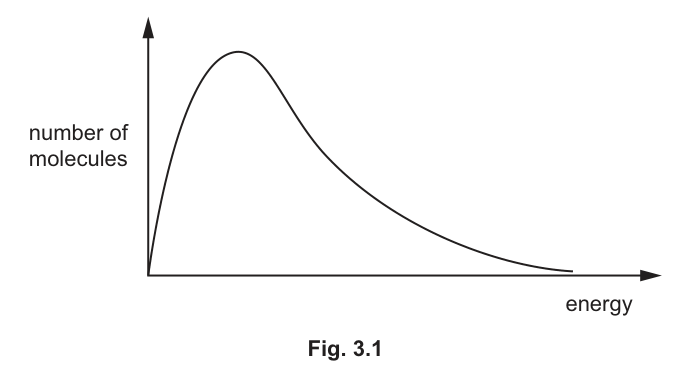
The Boltzmann distribution for the reaction mixture in reaction 1 is shown in Fig. 3.1.
Use the Boltzmann distribution to explain the effect of adding a catalyst on the rate of reaction.
Answer
A catalyst lowers the activation energy (). On the Boltzmann distribution, this shifts the effective line to the left, increasing the area under the curve to the right of the new . This means a greater proportion of particles have sufficient energy to react, leading to a higher frequency of successful collisions and a faster rate of reaction.
Catalyst lowers Ea, increasing the proportion of particles with sufficient energy and the frequency of successful collisions.
Background Concept
The Boltzmann distribution shows the distribution of kinetic energies among particles in a gas or liquid at a constant temperature. The curve starts at the origin (0,0), rises to a maximum (most probable energy), and tails off asymptotically. The area under the entire curve represents the total number of particles, which remains constant if temperature and amount of substance are unchanged.
Activation energy () is marked on the x-axis. The area under the curve to the right of represents the proportion (or number) of particles with energy , i.e., those capable of reacting upon collision.
A catalyst provides an alternative reaction pathway with a lower activation energy. It does not change the temperature (so the overall shape and area of the distribution remain the same), but it changes the threshold energy required for reaction.
Understanding the Question
The question asks to use the Boltzmann distribution (Fig 3.1) to explain why adding a catalyst increases the rate of reaction. The candidate must connect the graphical representation (area under the curve) to the kinetic theory (proportion of particles, collision frequency, rate).
Approach
- State that a catalyst lowers .
- Explain the graphical consequence: the area under the curve for energies new is larger.
- Translate this to particle statistics: a greater proportion of particles have sufficient energy.
- Link to collision theory: more energetic particles mean a higher frequency of successful collisions.
- Conclude: rate increases.
Step-by-Step Reasoning
M1: Graphical/Statistical explanation
- A catalyst provides an alternative pathway with a lower activation energy ( is reduced).
- On the Boltzmann distribution graph, the vertical line marking moves to the left (to a lower energy value).
- The area under the curve to the right of this new, lower is larger than the original area.
- This means a greater proportion (or percentage) of particles now possess kinetic energy .
M2: Kinetic/Rate explanation
- Because more particles have sufficient energy to react, a higher proportion of collisions will be successful (effective).
- This increases the frequency (or rate) of successful collisions per unit time.
- Therefore, the overall rate of reaction is faster.
Key Takeaways
Catalysts do not change the temperature or the total energy distribution of particles. They only lower the energy threshold (), allowing a larger fraction of the existing particle population to react. This is fundamentally different from increasing temperature, which shifts the entire curve to the right and increases the average kinetic energy.
Common Mistakes
- Saying the catalyst 'gives particles more energy' or 'increases the energy of particles' — this is false; temperature is constant, so average kinetic energy is constant.
- Saying the curve 'shifts to the right' or 'changes shape' — the curve remains the same; only the line moves.
- Forgetting to link the graphical change (area under curve) to the macroscopic observation (rate increase). The mark scheme requires both the statistical point (proportion of particles) and the kinetic point (frequency of successful collisions).
- Using the word 'more particles' instead of 'greater proportion of particles' — if the total number of particles is constant, the number increases only because the proportion increases; 'proportion' is the more precise and mark-awarding term.
Things to Be Careful About
- The mark scheme explicitly awards M1 for the area/proportion point and M2 for the collision frequency/rate point. Both are required for full marks.
- Ensure you mention 'effective' or 'successful' collisions, not just 'collisions'. All particles collide frequently, but only those with react.
- Do not mention 'orientation' or 'steric factor' unless specifically asked; the Boltzmann distribution only addresses the energy criterion.
The reaction between and is monitored at constant temperature.
Fig. 4.1 shows how the concentration of varies with time.
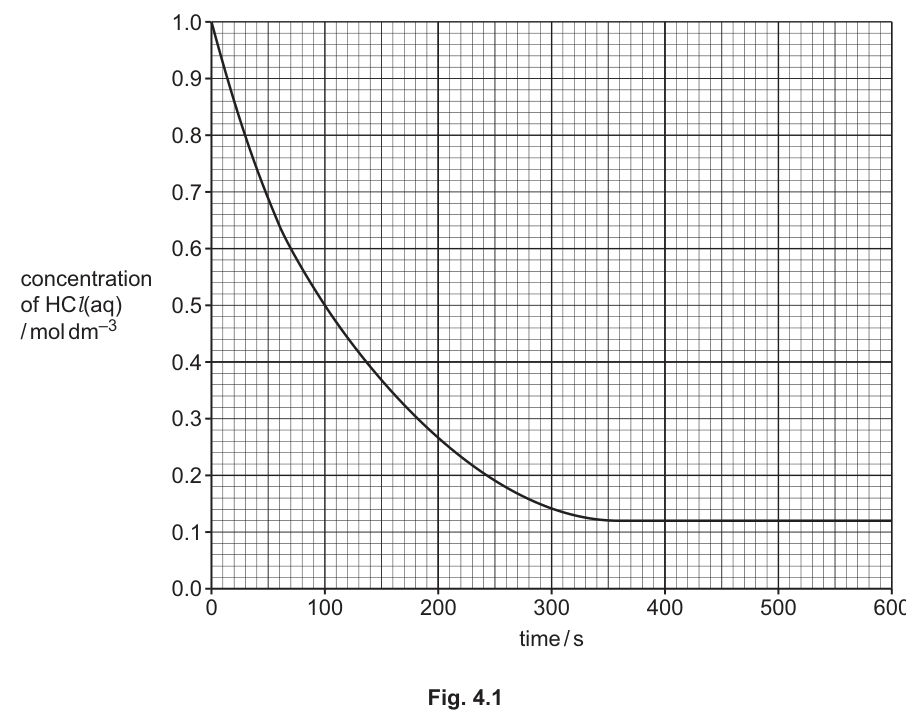
Use Fig. 4.1 to find the average rate of change of concentration of in this reaction between 0–100 seconds and between 400–500 seconds. Include units in your answers.
0–100 seconds .................................................. units ...........................................
400–500 seconds .............................................. units ...........................................
Working
0–100 seconds:
At s, mol dm; at s, mol dm.
400–500 seconds:
At s, mol dm; at s, mol dm.
Answer
0–100 seconds: mol dm s
400–500 seconds: mol dm s
0–100 s: 0.005 mol dm⁻³ s¹; 400–500 s: 0 mol dm⁻³ s⁻¹
Background Concept
The average rate of reaction over a time interval is defined as the change in concentration of a reactant or product divided by the time taken. For a reactant being consumed, rate = −Δ[reactant]/Δt (the negative sign gives a positive rate). The units are concentration per unit time, typically mol dm⁻³ s¹.
When a concentration–time graph is plotted, the rate at any point is the gradient of the curve. The average rate over an interval is the gradient of the chord connecting the two endpoints of that interval.
Understanding the Question
This part asks you to read values from Fig. 4.1 (a concentration–time graph for HCl) at specific times and calculate the average rate over two intervals: 0–100 s and 400–500 s. The mark scheme requires three points: the numerical value for the first interval (0.005), the numerical value for the second interval (0), and the correct units for both answers. Any two of these three points earns 1 mark; all three earns 2 marks.
Approach
- Read [HCl] at t = 0 and t = 100 s from the graph.
- Calculate the change in concentration and divide by the time interval.
- Read [HCl] at t = 400 and t = 500 s.
- Note that the curve has levelled off, so the change is zero.
- State units as mol dm⁻³ s¹ for both.
Step-by-Step Reasoning
Interval 0–100 s:
- At t = 0 s, the curve starts at [HCl] = 1.0 mol dm⁻³.
- At t = 100 s, reading from the graph, [HCl] ≈ 0.5 mol dm⁻³.
- Change in concentration = 1.0 − 0.5 = 0.5 mol dm⁻³.
- Average rate = 0.5 / 100 = 0.005 mol dm⁻³ s⁻¹.
The mark scheme allows a tolerance of ±0.005 around the expected value, so answers between 0.004 and 0.006 are acceptable.
Interval 400–500 s:
- At t = 400 s, [HCl] ≈ 0.12 mol dm⁻³.
- At t = 500 s, [HCl] ≈ 0.12 mol dm⁻³ (the curve is flat).
- Change in concentration = 0.
- Average rate = 0 / 100 = 0 mol dm⁻³ s⁻¹.
The curve has reached a plateau, meaning the reaction has stopped (one reactant is exhausted), so the rate is zero.
Units:
- Rate = concentration / time = mol dm⁻³ / s = mol dm⁻³ s⁻¹.
- This must be stated for both answers.
Key Takeaways
- Average rate is calculated as Δ[concentration]/Δt, read directly from a graph.
- When a concentration–time curve levels off, the rate is zero because the reaction has stopped.
- Units for rate must always include both concentration and time dimensions.
Common Mistakes
- Forgetting to include units, or writing incorrect units such as mol dm⁻³ or mol s⁻¹ alone.
- Reading the graph inaccurately — at t = 100 s the concentration is 0.5, not 0.6 or 0.4.
- Reporting the 400–500 s rate as a small positive number rather than recognising the plateau gives exactly zero.
- Writing the rate as negative (the question asks for rate of change of concentration, which for a reactant is negative, but the convention in this context is to give magnitude).
Things to Be Careful About
- The mark scheme awards marks for all three points (first value, second value, units). You need at least two for one mark and all three for two marks.
- Ensure you read values from the correct gridlines on the graph.
- The units mol dm⁻³ s⁻¹ must appear for both parts of the answer.
Answer
The limiting reagent is .
The concentration of does not fall to zero (it plateaus at approximately mol dm), so is still present when the reaction stops. This means has been completely consumed and is the limiting reagent.
Na₂S₂O₃ is the limiting reagent because HCl remains (concentration does not reach zero) when the reaction stops.
Background Concept
In a reaction between two reactants, the limiting reagent is the one that is completely consumed first, causing the reaction to stop. The excess reagent remains in solution after the reaction ceases. On a concentration–time graph for one reactant, if the curve levels off at a non-zero value, that reactant was in excess — the other reactant must have been the limiting reagent.
Understanding the Question
The graph in Fig. 4.1 shows [HCl] decreasing over time and then plateauing at approximately 0.12 mol dm⁻³. The question asks you to identify which reactant is limiting and explain why.
Approach
Observe that [HCl] does not reach zero. Therefore HCl was in excess. The other reactant, Na₂S₂O₃, must have been used up completely, making it the limiting reagent.
Step-by-Step Reasoning
- The curve for [HCl] flattens at about 0.12 mol dm⁻³, not at 0.
- This means some HCl remains unreacted when the reaction stops.
- The reaction stops not because HCl ran out, but because the other reactant (Na₂S₂O₃) was completely consumed.
- Therefore Na₂S₂O₃ is the limiting reagent.
The mark scheme accepts either "reaction stops before all the HCl is used up" or "there is still HCl remaining when the reaction has stopped" as the explanation.
Key Takeaways
- A plateau at non-zero concentration on a reactant's concentration–time graph proves that reactant was in excess.
- The limiting reagent is identified by elimination: whichever reactant is NOT in excess must be limiting.
Common Mistakes
- Saying HCl is the limiting reagent because its concentration decreased (it decreased but not to zero).
- Failing to give the reason (just naming the reagent without explanation loses the mark).
Things to Be Careful About
- The answer must include both the identification (Na₂S₂O₃) AND the reason (HCl is not used up / reaction stops while HCl remains).
Answer
As the reaction proceeds, the concentrations of and/or decrease. This reduces the frequency of effective collisions between reactant particles, so the rate of reaction decreases with time.
The frequency of effective collisions decreases as the concentration of reactants decreases.
Background Concept
Collision theory states that for a reaction to occur, reactant particles must collide with sufficient energy (≥ activation energy) and the correct orientation. The rate of reaction is proportional to the frequency of effective collisions. As reactants are consumed, their concentrations fall, meaning particles are further apart on average and collide less frequently. Fewer collisions per unit time means fewer effective collisions per unit time, so the rate decreases.
Understanding the Question
The graph shows the rate decreasing over time (the curve becomes less steep). You must explain why this happens using collision theory.
Approach
Connect the observation (rate decreases) to the cause (concentrations of reactants decrease → fewer effective collisions per second).
Step-by-Step Reasoning
- At the start, concentrations of both HCl and Na₂S₂O₃ are at their maximum, so collision frequency is highest and the rate is fastest.
- As the reaction proceeds, both reactants are consumed, so their concentrations fall.
- Lower concentration means fewer particles per unit volume, so the frequency of collisions decreases.
- Since the proportion of collisions that are effective remains roughly constant (temperature is constant), the frequency of effective collisions also decreases.
- Therefore the rate of reaction decreases with time.
The mark scheme requires mention of: frequency of effective collisions decreasing AND the reason (concentration of reactants decreases).
Key Takeaways
- Rate depends on frequency of effective collisions.
- Concentration is a key factor affecting collision frequency.
- At constant temperature, the energy distribution doesn't change — only the number of collisions per second changes.
Common Mistakes
- Saying "there are fewer particles" without linking to collision frequency.
- Saying "the particles lose energy" — they don't; temperature is constant.
- Omitting the word "effective" (not all collisions lead to reaction).
Things to Be Careful About
- The mark scheme specifically requires the phrase "frequency of effective collisions" (or equivalent) AND the link to decreasing concentration. Just saying "concentration decreases" without the collision theory link may not earn the mark.
The reaction between and is repeated in a second experiment.
In this second experiment, of reacts with of . Calculate the number of sulfur atoms produced.
number of sulfur atoms produced = ..............................
Working
Moles of = mol
Moles of = mol
From the equation, the ratio
Moles of needed for mol = mol
Since only mol is available, is the limiting reagent.
From the equation, mol produces mol :
Answer
Number of sulfur atoms produced =
6.02 × 10²⁰
Background Concept
To find the number of atoms produced in a reaction, you need to: (1) determine the moles of each reactant, (2) identify the limiting reagent by comparing the actual mole ratio to the stoichiometric ratio from the balanced equation, (3) use the stoichiometric ratio between the limiting reagent and the product to find moles of product, and (4) convert moles to number of particles using Avogadro's constant ( mol⁻¹).
Understanding the Question
Given 25.0 cm³ of 0.050 mol dm⁻³ Na₂S₂O₃ and 0.0020 mol HCl, calculate the number of sulfur atoms produced. The equation is:
Na₂S₂O₃ + 2HCl → 2NaCl + SO₂ + S + H₂O
You must first determine which reactant is limiting, then use the correct mole ratio to find moles of S, then multiply by Avogadro's constant.
Approach
- Calculate moles of Na₂S₂O₃ from volume and concentration.
- Compare available moles to the 1:2 stoichiometric ratio to identify the limiting reagent.
- Use the ratio between the limiting reagent and S to find moles of S.
- Multiply by Avogadro's constant.
Step-by-Step Reasoning
Step 1: Moles of Na₂S₂O₃
- Volume = 25.0 cm³ = 0.0250 dm³
- Concentration = 0.050 mol dm⁻³
- Moles = 0.0250 × 0.050 = 0.00125 mol
Step 2: Identify limiting reagent
- The equation requires 2 mol HCl per 1 mol Na₂S₂O₃.
- HCl needed for 0.00125 mol Na₂S₂O₃ = 0.00125 × 2 = 0.0025 mol.
- Available HCl = 0.0020 mol < 0.0025 mol.
- Therefore HCl is the limiting reagent.
Step 3: Moles of S produced
- From the equation: 2 mol HCl → 1 mol S.
- Moles of S = 0.0020 / 2 = 0.0010 mol.
Step 4: Number of S atoms
- Number = 0.0010 × 6.02 × 10²³ = 6.02 × 10²⁰.
The mark scheme awards M1 for 0.0010 mol sulfur and M2 for multiplying by Avogadro's constant to get 6.02 × 10²⁰.
Key Takeaways
- Always check which reactant is limiting before calculating product amounts.
- The ratio from the balanced equation links the limiting reagent to the product.
- Avogadro's constant converts moles to number of particles.
Common Mistakes
- Using Na₂S₂O₃ moles instead of HCl moles (failing to identify the correct limiting reagent).
- Using the wrong stoichiometric ratio (e.g., 1:1 instead of 2:1 for HCl:S).
- Forgetting to multiply by Avogadro's constant and leaving the answer in moles.
- Writing 6.02 × 10²³ instead of 6.02 × 10²⁰ (off by three orders of magnitude).
Things to Be Careful About
- The volume must be converted from cm³ to dm³ (divide by 1000).
- The mark scheme specifically requires 0.0010 mol for M1 — if you get a different value but carry it through correctly, you may still earn M2 via ecf.
- Ensure the final answer is a number (of atoms), not a quantity in moles.
Explain why the rate of reaction cannot be monitored accurately by measuring the volume of produced in this reaction.
Answer
is soluble in water (it reacts with water to form ), so the volume of gas collected would be less than the actual volume produced, making it impossible to monitor the rate accurately.
SO₂ is soluble in water (reacts with water to form H₂SO₃), so the measured gas volume would be inaccurate.
Background Concept
When monitoring a reaction by collecting a gas, the gas must be insoluble (or very sparingly soluble) in the reaction medium. If the gas dissolves in or reacts with the aqueous solution, the volume collected in a gas syringe will be less than the true volume produced, leading to an inaccurate rate measurement.
SO₂ is a polar molecule that reacts with water:
SO₂ + H₂O → H₂SO₃ (sulfurous acid)
This means a significant proportion of the SO₂ produced dissolves in the aqueous reaction mixture rather than escaping as a gas.
Understanding the Question
The question asks why measuring the volume of SO₂ gas produced cannot be used to accurately monitor this reaction's rate. The key is the chemical property of SO₂ in aqueous solution.
Approach
Identify that SO₂ is soluble in water and reacts with it, so the gas collected will underrepresent the actual amount produced.
Step-by-Step Reasoning
- The reaction takes place in aqueous solution.
- SO₂ is produced as a gas but is highly soluble in water.
- SO₂ reacts with water: SO₂(aq) + H₂O(l) → H₂SO₃(aq).
- Therefore, much of the SO₂ dissolves in the solution rather than being collected as a gas.
- The volume collected in a gas syringe would be significantly less than the true volume produced.
- This makes rate measurement by gas collection unreliable.
Key Takeaways
- Gas collection is only a valid method for monitoring reactions that produce an insoluble gas (like H₂ or CO₂ from certain reactions).
- SO₂'s high solubility in water (and its reaction with water to form an acid) makes it unsuitable for gas-volume monitoring.
Common Mistakes
- Saying "SO₂ is toxic" — while true, this is not the reason the measurement is inaccurate.
- Saying "the reaction is too fast" — the issue is specifically about the gas dissolving.
- Saying "SO₂ is produced in too small a quantity" — it's about solubility, not quantity.
Things to Be Careful About
- The mark scheme specifically requires mention of SO₂ reacting with water (or being soluble in water). Simply saying "SO₂ is a gas" or "it escapes" is insufficient.
Fig. 4.2 shows a possible arrangement of outer‑shell electrons in one molecule.
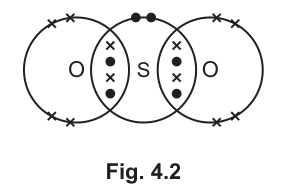
Use Fig. 4.2 to predict the shape and bond angle of a molecule of .
shape .............................................
bond angle .......................°
Answer
From Fig. 4.2, sulfur has three regions of electron density (two bonding pairs and one lone pair).
Shape: non-linear (bent / V-shaped)
Bond angle:
(The lone pair repels more strongly than bonding pairs, compressing the O–S–O angle below the ideal trigonal planar angle of 120°.)
Non-linear (bent); bond angle between 116° and 120°
Background Concept
VSEPR (Valence Shell Electron Pair Repulsion) theory predicts molecular shapes by minimising repulsion between electron pairs around a central atom. Three regions of electron density give a trigonal planar arrangement (ideal angle 120°). However, if one of those regions is a lone pair rather than a bonding pair, the lone pair–bonding pair repulsion is greater than bonding pair–bonding pair repulsion, compressing the bond angle below 120°. The molecular shape is then described as non-linear (bent or V-shaped) because we only consider the positions of atoms, not lone pairs.
Understanding the Question
Fig. 4.2 shows a dot-and-cross diagram of SO₂. You must use it to determine the number of electron pairs around the central sulfur atom, then predict the shape and bond angle.
From the diagram: S has two bonding pairs (one double bond to each O, shown as overlapping regions) and one lone pair (two dots on S). This gives three regions of electron density.
Approach
- Count regions of electron density around S: 3 (2 bonding + 1 lone pair).
- Electron pair geometry: trigonal planar.
- Molecular shape: non-linear (bent) because one region is a lone pair.
- Bond angle: less than 120° due to greater lone pair repulsion, but the mark scheme accepts 116° ≤ angle < 120°.
Step-by-Step Reasoning
- Looking at Fig. 4.2, the central S atom has:
- Two bonding regions (one to each O, shown as overlaps containing electron pairs).
- One lone pair (shown as two dots on S, not in an overlap).
- Total = 3 regions of electron density → trigonal planar electron geometry.
- With one lone pair, the molecular shape is non-linear (bent/V-shaped).
- Ideal angle for trigonal planar = 120°. The lone pair repels more strongly than bonding pairs, pushing the two O atoms closer together.
- Bond angle is therefore less than 120° but not as low as 109.5° (which would require four regions). The mark scheme accepts 116° to 120° (not including 120°).
M1 is for "non-linear" and M2 is for the bond angle in the range 116° ≤ x < 120°.
Key Takeaways
- Always count ALL regions of electron density (bonding pairs + lone pairs) to determine the electron geometry.
- The molecular shape ignores lone pairs but the bond angle is affected by them.
- One lone pair on three regions gives a bent shape with angle slightly less than 120°.
Common Mistakes
- Saying "trigonal planar" as the shape — that is the electron pair geometry, not the molecular shape.
- Giving the bond angle as exactly 120° (ignoring lone pair compression).
- Giving 109.5° (confusing with tetrahedral geometry).
- Saying "linear" — the molecule is bent.
Things to Be Careful About
- The mark scheme requires "non-linear" (or bent/V-shaped) — "trigonal planar" would not earn M1.
- The bond angle must be in the range 116° to less than 120°. The mark scheme states 120 > x ≥ 116°.
Use Table 4.1 to predict the strength of the dipole moment of , if any, compared to that of . Explain your answer.
Table 4.1
| H | O | S | |
|---|---|---|---|
| electronegativity | 2.1 | 3.5 | 2.6 |
Answer
has a weaker dipole moment than .
The electronegativity difference between and is , while the difference between and is . Since the electronegativity difference is smaller for than for , the bonds are less polar, giving a weaker overall dipole moment than .
SO₂ has a weaker dipole moment than H₂O because the electronegativity difference for S–O (0.9) is less than for H–O (1.4), making S=O bonds less polar.
Background Concept
A dipole moment arises from the separation of charge within a molecule due to polar bonds and an asymmetric shape. The magnitude of a bond dipole depends on the electronegativity difference between the bonded atoms: the greater the difference, the more polar the bond. The overall molecular dipole moment depends on both the individual bond polarities and the molecular geometry (whether bond dipoles cancel or reinforce).
Both H₂O and SO₂ are bent (non-linear) molecules, so their bond dipoles do not cancel — both have a net dipole moment. The comparison of dipole strength therefore comes down to comparing the polarity of the individual bonds.
Understanding the Question
Using the electronegativity values in Table 4.1 (H = 2.1, O = 3.5, S = 2.6), predict whether SO₂ has a stronger or weaker dipole moment than H₂O, and explain why.
Approach
- Calculate the electronegativity difference for each bond type.
- Compare: larger difference → more polar bond → stronger bond dipole.
- Since both molecules are bent (so geometry doesn't cancel dipoles in either case), the molecule with more polar bonds has the stronger dipole moment.
Step-by-Step Reasoning
Electronegativity differences:
- H–O:
- S–O:
Comparison:
The H–O bond has a larger electronegativity difference (1.4) than the S–O bond (0.9). This means H–O bonds are more polar than S–O bonds.
Effect on molecular dipole:
Both H₂O and SO₂ are bent molecules (non-linear), so in both cases the bond dipoles do not cancel. Since the individual bonds in H₂O are more polar, the overall dipole moment of H₂O is stronger than that of SO₂. Equivalently, SO₂ has a weaker dipole moment than H₂O.
M1 is for stating SO₂ has a weaker dipole moment. M2 is for the explanation using electronegativity differences (the difference is larger for H and O than for S and O).
Key Takeaways
- Bond polarity is determined by electronegativity difference.
- A larger electronegativity difference means a more polar bond and a stronger bond dipole.
- For molecules with the same shape, the one with more polar bonds has the stronger overall dipole moment.
- Both H₂O and SO₂ are bent, so geometry does not cause dipole cancellation in either.
Common Mistakes
- Saying SO₂ has no dipole moment because it is symmetric — it is NOT symmetric (it is bent), so it does have a dipole.
- Confusing the direction of comparison (saying SO₂ has a stronger dipole).
- Giving only the numerical differences without stating which molecule has the stronger/weaker dipole.
- Saying the shape is different between the two molecules (both are bent/non-linear).
Things to Be Careful About
- The mark scheme requires BOTH the conclusion (weaker dipole for SO₂) AND the reason (electronegativity difference is smaller for S–O than H–O). Either alone earns only one mark.
- The mark scheme also accepts "S=O bond is less polar than H–O" as an alternative phrasing for M2.
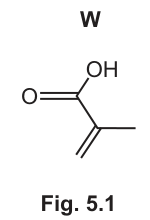
W is a colourless liquid.
Answer
reduces to empirical formula
C2H3O
Background Concept
The empirical formula gives the simplest whole-number ratio of atoms of each element in a compound. To deduce it from a structural (or skeletal) formula, one must first count every carbon and hydrogen atom present, then divide the subscripts by their highest common factor.
Understanding the Question
Part (a)(i) asks for the empirical formula of W, a colourless liquid shown as a skeletal structure in Fig. 5.1. The image displays a carboxylic acid group () attached to a carbon that forms a double bond to a terminal and a single bond to a methyl group . This is methacrylic acid.
Approach
Translate the skeletal drawing into a full molecular formula by applying the rules of skeletal notation: each vertex and each line-end is a carbon, and hydrogens are added to satisfy carbon's tetravalency (4 bonds). Then reduce the resulting subscripts to the lowest ratio.
Step-by-Step Reasoning
- Carboxyl carbon: bonded to , and the central carbon (4 bonds total), so it carries 0 H.
- Central carbon: bonded to the carboxyl carbon, the methyl carbon, and double-bonded to the terminal carbon (4 bonds), so it carries 0 H.
- Terminal carbon: double bond to the central carbon plus 2 H.
- Methyl carbon: single bond to the central carbon plus 3 H.
- The contributes 1 H.
Summing: C = 4, H = 2 + 3 + 1 = 6, O = 2, giving the molecular formula . The ratio 4 : 6 : 2 shares a common factor of 2, so the empirical formula is .
Key Takeaways
Skeletal formulas hide hydrogens on carbon; they must be reconstructed by counting bonds to satisfy valency. The empirical formula is the molecular formula divided by the highest common factor of its subscripts.
Common Mistakes
- Forgetting the acidic hydrogen of the group (writing instead of ).
- Reporting the molecular formula without reducing it to the empirical form.
- Miscounting the terminal as having only one hydrogen.
Things to Be Careful About
Always check that the empirical ratio cannot be simplified further; here 4 : 6 : 2 must become 2 : 3 : 1.
Two different reagents are each added to separate samples of W as shown in Table 5.1.
Complete Table 5.1.
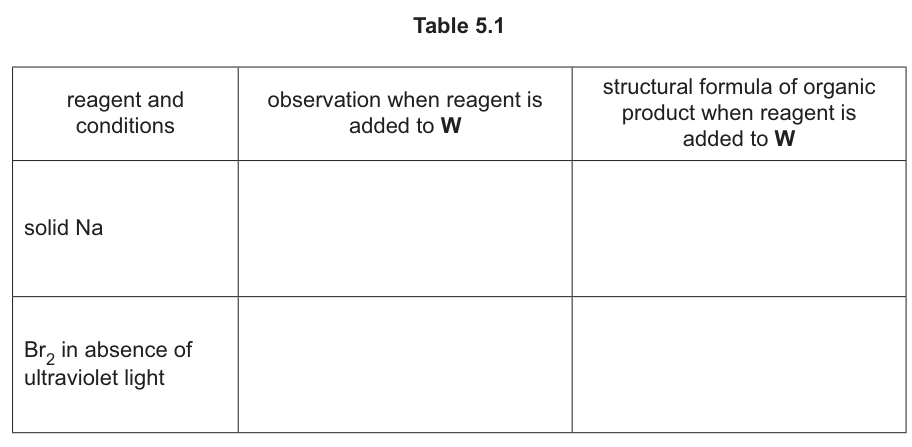
Answer
Solid Na
- Observation: effervescence / bubbles of gas (hydrogen); the solid sodium dissolves.
- Organic product: (sodium 2-methylpropenoate).
in the absence of ultraviolet light
- Observation: the brown/orange colour of bromine is discharged (decolourised).
- Organic product: (2,3-dibromo-2-methylpropanoic acid).
Na: effervescence, product CH2=C(CH3)CO2Na. Br2 (dark): brown to colourless, product CH2BrCBr(CH3)CO2H
Background Concept
W contains two reactive functional groups: a carboxylic acid () and a carbon–carbon double bond (). Each reacts with a different reagent.
- Carboxylic acid + sodium: the acidic proton is displaced by sodium, releasing hydrogen gas and forming a sodium carboxylate salt.
- Alkene + bromine (no UV): bromine adds across the double bond by electrophilic addition, breaking the bond and forming a dibromoalkane; the brown colour disappears because is consumed.
Understanding the Question
Table 5.1 asks, for each reagent, (i) the observation on adding it to W and (ii) the structural formula of the organic product. The phrase "in the absence of ultraviolet light" is deliberate: it rules out free-radical substitution at the bonds and forces the addition reaction at the .
Approach
Identify which functional group each reagent attacks, recall the standard observation, then write the product by modifying only that group while leaving the rest of the skeleton intact.
Step-by-Step Reasoning
- Solid Na: Sodium is a reactive metal; the proton is replaced by , giving and gas. The visible sign is fizzing/effervescence as hydrogen evolves and the sodium disappears. (The is untouched by sodium.)
- in the dark: The undergoes addition; one bromine atom attaches to each doubly bonded carbon, converting into , while the group remains unchanged. The product is 2,3-dibromo-2-methylpropanoic acid. The observation is the brown/orange bromine colour being discharged.
Key Takeaways
A molecule with several functional groups reacts selectively: the metal tests the acidic , while bromine in the dark tests the . Writing the product means changing only the reacting group.
Common Mistakes
- Confusing "no UV" conditions with free-radical substitution (which needs UV) and brominating a instead of adding across the double bond.
- Forgetting to keep the intact in the bromine product, or the intact in the sodium product.
- Describing the sodium observation only as "a precipitate forms" instead of effervescence/hydrogen.
Things to Be Careful About
State observations precisely ("brown to colourless", "effervescence"). In the structural formulas, ensure every bond and atom is shown and the carbon valencies are correct.
Fig. 5.2 shows two reactions of W to produce organic compounds Y and Z.
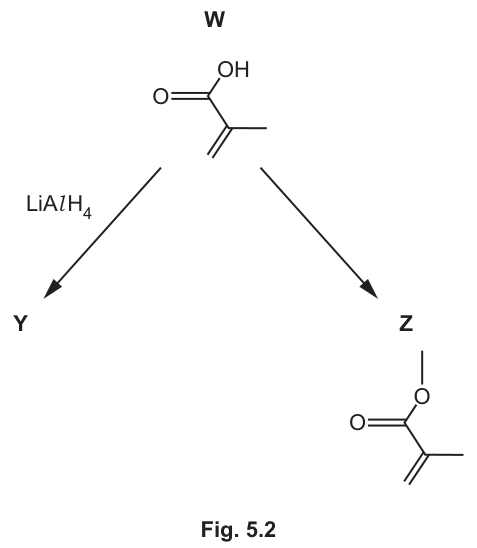
Deduce the number of sigma (σ) bonds and pi (π) bonds present in Z.
number of σ bonds ....................
number of π bonds ....................
Answer
number of bonds = 14
number of bonds = 2
σ = 14, π = 2
Background Concept
Every covalent single bond is one bond. A double bond consists of one bond plus one bond. To count reliably, expand the skeletal formula into its full displayed form (all atoms and bonds shown) and tally each bond line as a , then add the extra for each double bond.
Understanding the Question
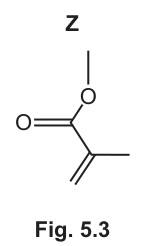
Z is methyl methacrylate, . The task is to state the total number of and bonds in this molecule.
Approach
Write the full displayed formula, count every bond line (each contributes one ), then add one for each double bond present.
Step-by-Step Reasoning
Expanded structure: .
bonds:
- : 2 bonds.
- : 1 bond.
- (the methyl on the central carbon): 1 + 3 = 4.
- (central C to carbonyl C): 1 .
- : 1 .
- (carbonyl C to ester O): 1 .
- : 1 + 3 = 4.
Total = 2 + 1 + 4 + 1 + 1 + 1 + 4 = 14.
bonds: one from the and one from the = 2.
Key Takeaways
A double bond always hides a bond behind its bond; counting bonds is equivalent to counting bond lines in the displayed formula, while bonds equal the number of double bonds.
Common Mistakes
- Omitting the bonds of the methyl groups (the most frequent error, giving too few ).
- Counting a double bond as two bonds instead of one + one .
- Forgetting the bond and reporting only one .
Things to Be Careful About
Always expand to the displayed formula before counting; skeletal shorthand makes it easy to miss the eight bonds (two on , three on each methyl).
Answer
(2-methylprop-2-en-1-ol)
CH2=C(CH3)CH2OH
Background Concept
Lithium tetrahydridoaluminate, , is a powerful reducing agent that converts carboxylic acids into primary alcohols by reducing the group to . It does not normally reduce isolated carbon–carbon double bonds under standard conditions, so the in W survives.
Understanding the Question
Part (b)(ii) asks for the structure of Y, the product when W (methacrylic acid) is treated with .
Approach
Replace the group of W with , keeping the rest of the carbon skeleton (the and the methyl branch) unchanged.
Step-by-Step Reasoning
W = . Reduction of the carboxyl carbon (which goes from the +3 oxidation state in to the state in ) gives , named 2-methylprop-2-en-1-ol. The double bond between the terminal and the central carbon, and the methyl substituent, are retained.
Key Takeaways
reduces ; recognise that the alkene is unaffected, distinguishing this from catalytic hydrogenation which would also saturate the .
Common Mistakes
- Reducing the as well, giving 2-methylpropan-1-ol.
- Drawing a secondary or tertiary alcohol instead of the primary .
- Forgetting the methyl branch on the central carbon.
Things to Be Careful About
Show all atoms/bonds in the drawn structure and place the on the carbon that was formerly the carboxyl carbon.
Answer
reducing agent
reducing agent
Background Concept
A reducing agent is a species that causes reduction in another substance by donating electrons (or, in organic terms, by adding hydrogen / removing oxygen). It is itself oxidised in the process.
Understanding the Question
Part (b)(iii) asks for the role of when it converts W into Y.
Approach
Since W's carboxyl group is reduced to an alcohol, the reagent that brings about this reduction is the reducing agent.
Step-by-Step Reasoning
supplies hydride () which adds to the carboxyl carbon, reducing it from to . A reagent that reduces another compound is, by definition, a reducing agent.
Key Takeaways
In organic reductions, (and ) act as reducing agents; the organic substrate is reduced and the reagent is oxidised.
Common Mistakes
Writing "catalyst" (it is consumed) or "oxidising agent" (the opposite role).
Things to Be Careful About
The expected term is exactly "reducing agent".
Answer
Reagent: methanol, .
Conditions: concentrated sulfuric acid catalyst (and heat / reflux).
methanol and concentrated sulfuric acid
Background Concept
Carboxylic acids react with alcohols in a condensation (esterification) reaction to form esters, catalysed by concentrated sulfuric acid. The alkyl group of the ester's portion comes from the alcohol.
Understanding the Question
W is converted into Z, methyl methacrylate, . Part (b)(iv) asks what reagent and conditions produce this ester from the acid.
Approach
Compare W () with Z (). The has become a methyl ester, so the alcohol used is methanol; the reaction needs an acid catalyst.
Step-by-Step Reasoning
The group in Z is the signature of methanol having provided the that, after losing water with the acid's , forms the ester linkage. Esterification requires concentrated as catalyst (and warming/reflux). Thus reagent = methanol, conditions = conc. sulfuric acid.
Key Takeaways
Work backwards from an ester: the acyl part comes from the acid and the alkoxy part () from the alcohol.
Common Mistakes
Naming ethanol or another alcohol (the product clearly contains , so it must be methanol). Omitting the concentrated sulfuric acid catalyst.
Things to Be Careful About
Both the reagent (methanol) AND the catalyst (conc. ) are needed for the mark.
Fig. 5.3 shows the structure of Z.
Fig. 5.4 is the infrared spectrum of Z.
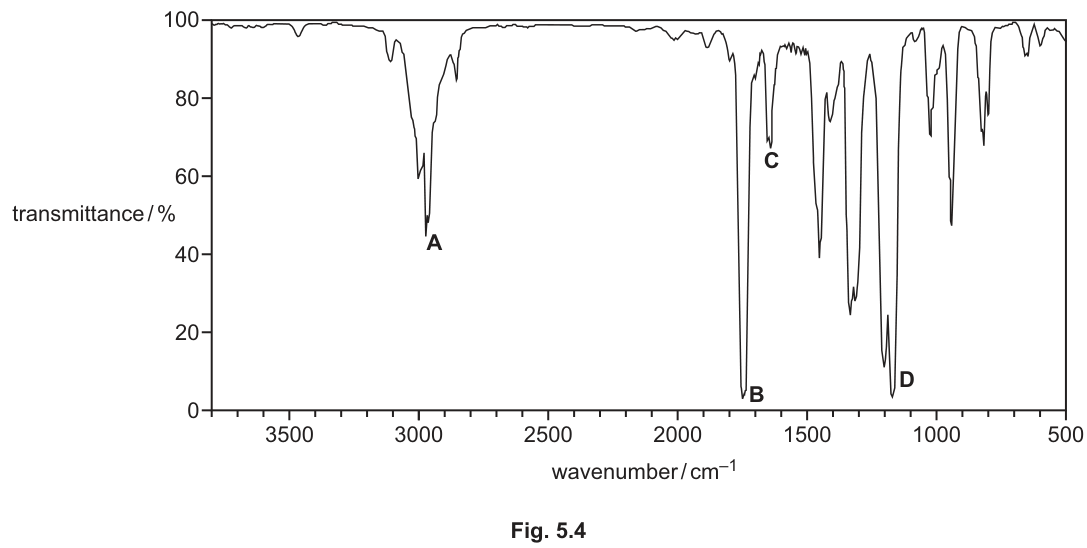
Identify the bond and functional group responsible for each of the absorptions labelled A, B, C and D in Fig. 5.4.
Table 5.2
| bond | functional groups containing the bond | characteristic infrared absorption range (in wavenumbers)/ |
|---|---|---|
| C–O | hydroxy, ester | 1040–1300 |
| C=C | aromatic compound, alkene | 1500–1680 |
| C=O | amide carbonyl, carboxyl ester | 1640–1690 1670–1740 1710–1750 |
| C≡N | nitrile | 2200–2250 |
| C–H | alkane | 2850–2950 |
| N–H | amine, amide | 3300–3500 |
| O–H | carboxyl hydroxy | 2500–3000 3200–3650 |
A ........................................................................................................................................
B ........................................................................................................................................
C ........................................................................................................................................
D ........................................................................................................................................
Answer
- A: bond; functional group: alkane.
- B: bond; functional group: ester.
- C: bond; functional group: alkene.
- D: bond; functional group: ester.
(2 correct points = 1 mark; all 4 correct = 2 marks)
A: C-H (alkane); B: C=O (ester); C: C=C (alkene); D: C-O (ester)
Background Concept
Infrared spectroscopy identifies bonds by the wavenumber at which they absorb. Different bonds vibrate at characteristic frequencies: (alkane) around 2850–2950 , (ester) around 1710–1750 , (alkene) around 1500–1680 , and (ester) around 1040–1300 . The data table in the question provides these ranges for matching.
Understanding the Question
Fig. 5.4 shows the IR spectrum of Z (methyl methacrylate) with four labelled absorptions A, B, C, D at decreasing wavenumber. For each, name the bond and the functional group containing it, using the supplied table.
Approach
Read each label's approximate position from the axis, then consult the table to find the bond whose range matches, and state the functional group (choosing the one present in Z).
Step-by-Step Reasoning
- A (~2950 ): falls in the alkane range (2850–2950) → , alkane.
- B (~1720 , very strong): falls in the ester range (1710–1750) → , ester.
- C (~1640 ): falls in the alkene range (1500–1680) → , alkene.
- D (~1150 ): falls in the ester range (1040–1300) → , ester.
Key Takeaways
IR is a bond-matching technique: locate the peak on the wavenumber axis and pair it with the table. The same bond type (e.g. ) can belong to several functional groups, so use the molecule's identity (an ester) to choose the correct row.
Common Mistakes
- Assigning B to a carboxyl instead of ester (Z has no ).
- Confusing the (C) and (D) positions.
- For the peak, writing "alkene" rather than "alkane" (the table lists alkane at 2850–2950).
Things to Be Careful About
Both the bond AND the functional group must be correct for each point; partial credit (2 points = 1 mark) rewards getting the pairs right.
Answer
Repeat unit of poly(methyl methacrylate): -[CH2-C(CH3)(COOCH3)]n-
Background Concept
Addition polymerisation joins alkene monomers by breaking the component of the bond, converting each doubly bonded carbon into a single-bonded backbone carbon. The repeat unit is drawn inside square brackets with an extending bond on each side and a subscript ; all side groups (the methyl and the ester) remain attached to the backbone carbon.
Understanding the Question
Z (methyl methacrylate, ) polymerises to Q. Part (b)(vi) asks for the repeat unit of Q.
Approach
Take the two carbons of the as the backbone, change the double bond to a single bond, attach the and groups to the substituted carbon, and enclose in brackets with .
Step-by-Step Reasoning
The backbone becomes . On the central carbon sit the methyl () and the ester () groups. Thus the repeat unit is , i.e. poly(methyl methacrylate). The of the ester is retained (it is a side group, not part of the backbone).
Key Takeaways
In addition polymerisation only the opens; every other bond and substituent is preserved unchanged in the repeat unit.
Common Mistakes
- Including the in the backbone or losing the ester group.
- Omitting the square brackets or the subscript .
- Drawing the repeat unit with a double bond still present.
Things to Be Careful About
Show bonds extending beyond the brackets on both sides of the repeat unit and keep both side groups ( and ) on the same carbon.
Poly(ethene) is an addition polymer made from ethene.
Explain why ethene reacts with electrophiles but poly(ethene) does not.
Answer
Ethene contains a double bond whose bond is a region of high electron density located above and below the bond; this attracts electrophiles. In poly(ethene) the double bond has opened during polymerisation, leaving only bonds (a saturated chain) with no exposed electron density, so it does not react with electrophiles.
Ethene has a pi bond (region of high electron density above/below the C-C bond) that attracts electrophiles; poly(ethene) has no C=C / pi bond, only sigma bonds.
Background Concept
Electrophiles are electron-pair acceptors. They attack sites of high electron density. The bond of an alkene is an exposed cloud of electrons lying above and below the internuclear -bond axis, so it is readily attacked by electrophiles (electrophilic addition). A saturated molecule containing only bonds has its electron density concentrated between nuclei, not exposed, so electrophiles are not attracted.
Understanding the Question
Part (c) asks why ethene reacts with electrophiles whereas poly(ethene) does not.
Approach
Compare the bonding: ethene has a (one + one ); poly(ethene) is the addition polymer in which those double bonds have been converted into single bonds along the chain.
Step-by-Step Reasoning
In ethene the bond provides a region of high electron density above and below the bond; an electrophile is attracted to and attacks this electron cloud, initiating addition. During polymerisation the bond is broken to form new bonds linking monomers, so the resulting poly(ethene) chain has only bonds and no exposed electron density; with no electron-rich site, electrophiles have nothing to attack and the polymer is unreactive toward them.
Key Takeaways
Reactivity toward electrophiles is governed by the availability of an exposed electron-rich site (the bond); saturation removes it.
Common Mistakes
Saying poly(ethene) "has no bonds" or "has no electrons" — it has bonds; the point is the absence of the exposed electron density.
Things to Be Careful About
The mark specifically rewards mentioning the bond as a region of high electron density above and below the bond.
reacts with to produce in an electrophilic addition reaction.
Answer
Two or more reactant molecules combine to form a single product.
Two or more reactants react to form a single product.
Background Concept
In organic chemistry, reactions are broadly classified by the change in the carbon skeleton and functional groups. An addition reaction occurs when two or more molecules combine to form a larger one. This is characteristic of unsaturated compounds (like alkenes and alkynes) where a pi bond is broken to form new sigma bonds, increasing the saturation of the molecule.
Understanding the Question
The question asks for a definition of an 'addition reaction'. This is a fundamental term used throughout organic chemistry, particularly when discussing the reactions of alkenes.
Approach
Recall the standard IUPAC-style definition: multiple reactants -> one product.
Step-by-Step Reasoning
- Identify the key feature: reactants combine, only one product is formed.
- Draft the definition: 'Two or more reactant molecules combine to form a single product.'
Key Takeaways
- Addition: A + B -> C.
- Elimination: A -> B + C.
- Substitution: A + B -> C + D.
Common Mistakes
- Saying 'atoms combine to form a molecule' (too general, applies to inorganic).
- Forgetting to specify that there is only one product (distinguishes it from substitution).
Things to Be Careful About
- Ensure the wording matches the mark scheme: 'two or more reactants/molecules' and 'one product'.
Answer
Chlorine gas is mixed with (or bubbled through) water.
Mix chlorine gas with water.
Background Concept
Chlorine reacts with water in a disproportionation reaction. One chlorine atom is oxidised (to form HOCl, oxidation state +1) and the other is reduced (to form HCl, oxidation state -1). This reaction is the basis for chlorination of water supplies.
Understanding the Question
The question asks how Cl2 is used to produce HOCl. This is a direct recall of the reaction between chlorine and water.
Approach
State the physical process: mixing chlorine with water.
Step-by-Step Reasoning
- Chlorine gas (Cl2) is passed into or mixed with water.
- The reaction produces hydrochloric acid (HCl) and hypochlorous acid (HOCl).
- The mark scheme accepts 'mix' or 'add Cl2 into water'.
Key Takeaways
- Cl2 + H2O -> HCl + HOCl.
- HOCl is the active disinfectant in chlorinated water.
Common Mistakes
- Writing the reaction with NaOH (that produces sodium hypochlorite, NaOCl, not HOCl directly, though HOCl is an intermediate).
- Forgetting that it's a reversible reaction.
Things to Be Careful About
- The question asks 'how it is used', so a simple descriptive answer like 'mix with water' is sufficient, though the equation adds clarity.
Answer
Water purification (or killing bacteria/microbes).
Water purification.
Background Concept
Hypochlorous acid (HOCl) is a weak acid but a strong oxidising agent. It is the primary species responsible for killing bacteria and viruses in water treatment.
Understanding the Question
State one use for HOCl. This links back to the production method in (a)(ii).
Approach
Recall the application of chlorine water/HOCl.
Step-by-Step Reasoning
- HOCl is used in water purification.
- It kills bacteria and microbes.
Key Takeaways
- Chlorine/HOCl is used for disinfection.
Common Mistakes
- Saying 'bleaching' (while HOCl can bleach, water purification is the primary context here and matches the mark scheme).
Things to Be Careful About
- Be specific: 'water purification' or 'killing bacteria'.
Complete Fig. 6.1 to show the mechanism for the reaction between and to produce .
Include charges, dipoles, lone pairs of electrons and curly arrows, as appropriate.
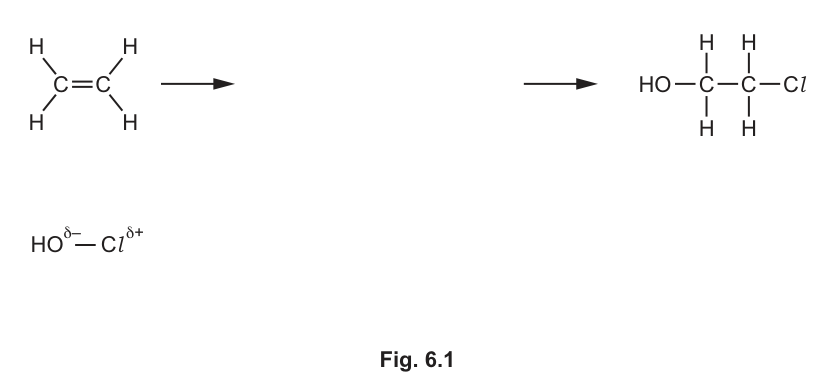
Answer
Step 1:
- Curly arrow from the C=C double bond to the Cl atom of HO-Cl.
- Curly arrow from the HO-Cl bond to the O atom (forming :OH⁻).
- Intermediate formed: Carbocation [CH₃-CH₂-Cl]⁺ (positive charge on the carbon not bonded to Cl) and hydroxide ion :OH⁻.
Step 2:
- Curly arrow from a lone pair on the oxygen of :OH⁻ to the positive carbon of the carbocation.
- Product: HO-CH₂-CH₂-Cl.
(See diagram below for full mechanism with charges and dipoles)
See mechanism diagram.
Background Concept
Electrophilic addition to alkenes involves the attack of the electron-rich pi bond on an electrophile. In HOCl, oxygen is more electronegative (3.5) than chlorine (3.0), so the dipole is HO^(δ-) - Cl^(δ+). The electrophile is the Cl^(δ+) end. The reaction proceeds via a carbocation intermediate.
Understanding the Question
Complete the mechanism for the addition of HOCl to ethene. This requires showing the heterolytic fission of the Cl-O bond, the formation of the carbocation, and the subsequent attack by the nucleophile (OH⁻).
Approach
- Identify the electrophile (Cl) and nucleophile (OH).
- Draw the first curly arrow: pi bond to Cl.
- Draw the second curly arrow: Cl-O bond to O (to form OH⁻).
- Draw the intermediate: carbocation on the carbon that didn't get Cl, and OH⁻ ion.
- Draw the final step: lone pair on OH⁻ to C⁺.
Step-by-Step Reasoning
- M1: Arrow from the middle of the HO-Cl bond pointing to the Oxygen atom. This shows the bond breaking heterolytically, with both electrons going to the more electronegative oxygen, forming :OH⁻.
- M2: Arrow from the center of the C=C double bond pointing to the Cl atom. The pi electrons attack the electrophilic Cl.
- M3: The intermediate must show a carbocation. Since ethene is symmetrical, the positive charge can be on either carbon, but the Cl is attached to the other. So, [CH₂⁺-CH₂-Cl]. Also show the :OH⁻ ion with lone pairs and negative charge.
- M4: Arrow from a lone pair on the oxygen of :OH⁻ pointing to the carbon with the positive charge (C⁺). This forms the final C-O bond.
Key Takeaways
- In HOCl, Cl is the electrophile because O is more electronegative.
- The mechanism is similar to HBr addition, but the nucleophile is OH⁻ instead of Br⁻.
Common Mistakes
- Drawing the arrow from HO-Cl bond to Cl (wrong polarity).
- Forgetting the negative charge on OH⁻ or positive charge on the carbocation.
- Drawing a cyclic chloronium ion (that's for Br2/Cl2 addition, not HOCl).
Things to Be Careful About
- Ensure all lone pairs are shown on :OH⁻.
- Ensure the intermediate is correctly drawn as an open carbocation, not a ring.
reacts in a two‑step synthesis to produce , as shown in Fig. 6.2.

Answer
Reagent: Potassium cyanide (KCN).
Conditions: Reflux in ethanol (or warm in ethanol).
KCN in ethanol, heat.
Background Concept
Halogenoalkanes can undergo nucleophilic substitution with cyanide ions (CN⁻) to form nitriles. This is a useful reaction because it increases the carbon chain length by one. The reagent is typically potassium cyanide (KCN) or sodium cyanide (NaCN). Since KCN is ionic and the halogenoalkane is organic, a co-solvent like ethanol is used to dissolve both. Heat (reflux) is required to increase the rate of reaction.
Understanding the Question
Step 1 converts HOCH2CH2Cl to HOCH2CH2CN. This is a substitution of Cl by CN.
Approach
Identify the reagent for nucleophilic substitution with cyanide.
Step-by-Step Reasoning
- The reaction is R-Cl + KCN -> R-CN + KCl.
- Reagent: KCN (potassium cyanide).
- Conditions: Ethanol as solvent (to dissolve the organic reactant) and heat/reflux.
Key Takeaways
- R-X + KCN -> R-CN + KX.
- Chain length increases by 1.
- Ethanol is the solvent, not water (water would lead to alcohol formation).
Common Mistakes
- Saying 'aqueous KCN' (this leads to hydrolysis to alcohol).
- Forgetting 'heat' or 'ethanol'.
Things to Be Careful About
- Must specify 'ethanol' as the solvent/condition.
Answer
Hydrolysis (specifically, acid hydrolysis).
Hydrolysis.
Background Concept
Nitriles (R-CN) can be hydrolysed to carboxylic acids (R-COOH). This can be done under acidic conditions (with dilute HCl or H2SO4) or alkaline conditions (followed by acidification). The question shows HCl(aq) being used, so it is acid hydrolysis.
Understanding the Question
Identify the type of reaction in step 2: HOCH2CH2CN -> HOCH2CH2COOH using HCl(aq).
Approach
Recognise that adding water (from aqueous acid) to a nitrile to form a carboxylic acid is hydrolysis.
Step-by-Step Reasoning
- The CN group is converted to COOH.
- This requires water and acid catalyst.
- The reaction type is hydrolysis.
Key Takeaways
- R-CN + 2H2O + HCl -> R-COOH + NH4Cl.
- Nitrile hydrolysis gives carboxylic acids.
Common Mistakes
- Saying 'oxidation' (the oxidation state of the carbon in CN is +3, in COOH is +3, so no change).
- Saying 'substitution'.
Things to Be Careful About
- 'Hydrolysis' is the key term. 'Acid hydrolysis' is more precise.
Working
The nitrile group (-CN) hydrolyses to a carboxylic acid group (-COOH). This requires 2 molecules of water and an acid (HCl) to provide the protons and chloride ion.
HOCH2CH2CN + 2H2O + HCl -> HOCH2CH2COOH + NH4Cl
Background Concept
Hydrolysis of a nitrile (R-CN) with aqueous acid (e.g., dilute HCl) proceeds through an amide intermediate (R-CONH2) and finally to a carboxylic acid (R-COOH) and ammonium ion (NH4+). The chloride ion from the acid pairs with the ammonium ion to form NH4Cl.
Understanding the Question
Complete the equation: HOCH2CH2CN + ... -> HOCH2CH2COOH. The reagent is HCl(aq), which implies water is also present.
Approach
Balance the atoms. CN to COOH requires adding O and H. CN + 2H2O -> COOH + NH3. The NH3 reacts with HCl to form NH4Cl.
Step-by-Step Reasoning
- Reactant: HOCH2CH2CN.
- Product: HOCH2CH2COOH.
- Change: -CN becomes -COOH. Need 2 O atoms and 1 extra H atom on the carbon side, plus N and 3 H atoms for ammonia.
- Water provides O and H: 2H2O provides 2O and 4H. CN + 2H2O -> COOH + NH3.
- The NH3 is basic and reacts with the acid HCl: NH3 + HCl -> NH4Cl.
- Overall: HOCH2CH2CN + 2H2O + HCl -> HOCH2CH2COOH + NH4Cl.
Key Takeaways
- Nitrile hydrolysis equation: R-CN + 2H2O + H+ -> R-COOH + NH4+.
- With HCl(aq), the product is NH4Cl.
Common Mistakes
- Forgetting the 2H2O (only writing H2O).
- Writing NH3 as a product instead of NH4Cl (since HCl is present).
- Not balancing the hydrogens.
Things to Be Careful About
- Ensure the equation is balanced. 1 C, 1 N on left -> 1 C, 1 N on right. 2 H2O provides 4 H, HCl provides 1 H. Total 5 H available for NH4 (4) and COOH (1 extra H in COOH vs CN... wait. CN has 0 H. COOH has 1 H (acidic) + the H on the alpha carbon is already there. Let's check: R-CN -> R-COOH. R-CN has no H on the functional group carbon. R-COOH has one OH. So we need 2 O and 1 H for the COOH, plus 3 H for NH4. Total 5 H. 2H2O has 4 H. HCl has 1 H. Total 5 H. Correct.