Chemistry 9701/22 — May/June 2025
Cambridge AS Level · AS Level Structured Questions · worked solutions for every part, with the mark scheme
Topics Atoms, Molecules and Stoichiometry · Introduction to Organic Chemistry · States of Matter · Chemical Periodicity · Atomic Structure · Hydrocarbons · +8 more
Diamond and graphite are both crystalline solids made from carbon atoms. Graphite conducts electricity. Diamond does not conduct electricity.
Name the type of lattice structure present in the crystalline solids diamond and graphite.
Answer
(both) giant molecular (giant covalent) lattice
Giant molecular (giant covalent) lattice
Background Concept
Diamond and graphite are allotropes of carbon. In both, carbon atoms are joined by covalent bonds in a continuous network, so neither is made of small discrete molecules. Such a structure is called a giant molecular lattice or giant covalent lattice. In diamond each carbon forms four single covalent bonds to four neighbouring carbons in a tetrahedral arrangement. In graphite each carbon forms three covalent bonds within flat hexagonal layers. Both are giant covalent structures.
Understanding the Question
The question asks for the name of the type of lattice structure common to diamond and graphite. It is a one-mark recall question: the answer is the structural category, not a description of bonding.
Approach
Think about what holds the atoms together and over what length scale. If covalent bonds extend through the whole crystal, the lattice is giant molecular/covalent.
Step-by-Step Reasoning
Diamond and graphite both consist of a very large number of carbon atoms linked by covalent bonds in an extended network. There are no separate molecules. Therefore the lattice type is giant molecular, also called giant covalent. The mark scheme accepts either wording.
Key Takeaways
A giant molecular lattice is an extended network of atoms joined by covalent bonds. Diamond and graphite are classic examples.
Common Mistakes
Saying "giant ionic" or "simple molecular" is wrong: there are no ions and no discrete molecules. Saying just "covalent" without "giant" is incomplete.
Things to Be Careful About
Use the exact term "giant molecular" or "giant covalent". Both are credited. Do not write "macromolecular" unless you are sure it is accepted; stick to the mark scheme wording.
Answer
Graphite conducts electricity because it has delocalised electrons that are free to move through the structure / between the layers.
Delocalised electrons move through the structure / between the layers
Background Concept
Graphite has a layered structure. Each carbon atom is bonded to three others by strong covalent bonds, forming hexagonal sheets. The fourth outer electron of each carbon is not localised in a bond but is delocalised over the layer. These delocalised electrons are mobile and can act as charge carriers.
Understanding the Question
The question asks why graphite conducts electricity. It is an explanation question: you need to name the mobile charge carriers and say they can move through the structure.
Approach
Identify what carries charge in graphite. Since there are no ions, the carriers must be electrons. Show that some electrons are delocalised and free to move.
Step-by-Step Reasoning
In graphite, each carbon uses three of its four outer electrons to form sigma bonds with three neighbouring carbons. The fourth electron is delocalised across the layer. When a potential difference is applied, these delocalised electrons can move through the structure, or between the layers, so graphite conducts electricity.
Key Takeaways
Electrical conductivity requires mobile charged particles. In graphite, the mobile particles are delocalised electrons.
Common Mistakes
Saying graphite conducts because the layers slide over each other confuses electrical conductivity with lubricant behaviour. Saying "free electrons" without "delocalised" may be accepted, but "delocalised" is the precise term.
Things to Be Careful About
The mark scheme accepts "delocalised electrons move through the structure" or "delocalised electrons move through/between the layers". Avoid saying all electrons are free; only one electron per carbon is delocalised.
Answer
Diamond does not conduct because all four outer electrons of each carbon are used in covalent bonds, so there are no delocalised electrons to carry charge.
No delocalised electrons; all four outer electrons used in bonding
Background Concept
In diamond, every carbon atom forms four single covalent bonds to four neighbouring carbon atoms, using all four outer electrons. All these electrons are localised in C–C bonds. There are no delocalised electrons and no mobile charge carriers.
Understanding the Question
The question asks why diamond does not conduct electricity. The answer must contrast with graphite: the absence of delocalised electrons.
Approach
Check whether diamond has any mobile charge carriers. Since all valence electrons are used in localised covalent bonds, there are none.
Step-by-Step Reasoning
Each carbon in diamond has four outer electrons, and all four are used in covalent bonds to neighbouring carbons. These electrons are localised in the bonds and cannot move freely through the crystal. With no delocalised electrons to carry charge, diamond does not conduct electricity.
Key Takeaways
A substance conducts electricity only if it contains mobile charged particles. Diamond has no delocalised electrons, so it is an electrical insulator.
Common Mistakes
Saying diamond has no free electrons because it is hard, or saying electrons are "tightly held" without specifying all four are used in bonding. The mark scheme specifically accepts "no delocalised electrons" or "all four outer electrons are used in bonding".
Things to Be Careful About
Do not say "diamond has no electrons" – it has plenty; they are just localised. Use the phrase "delocalised" accurately.
Separate samples of phosphorus(V) chloride and silicon(IV) chloride are each added to an excess of cold water.
Answer
PCl5 + 4H2O -> H3PO4 + 5HCl; SiCl4 + 2H2O -> SiO2 + 4HCl
Background Concept
Covalent chlorides of non-metals often hydrolyse in water. Phosphorus(V) chloride and silicon(IV) chloride are covalent chlorides. With an excess of cold water, PCl5 is completely hydrolysed to phosphoric acid and hydrogen chloride: PCl5 + 4H2O -> H3PO4 + 5HCl. Silicon(IV) chloride is hydrolysed to silicon dioxide and hydrogen chloride: SiCl4 + 2H2O -> SiO2 + 4HCl.
Understanding the Question
Write balanced equations for each reaction. The stem says each chloride is added to an excess of cold water, so complete hydrolysis occurs.
Approach
Identify the products from the known hydrolysis reactions, then balance atoms on both sides.
Step-by-Step Reasoning
For PCl5: one phosphorus atom needs to end up in H3PO4; the five chlorine atoms need five HCl molecules. The five HCl plus the three H in H3PO4 require eight hydrogen atoms, so four water molecules are needed. Check oxygen: four water molecules supply four O atoms, matching H3PO4. For SiCl4: one silicon atom forms SiO2; the four chlorine atoms form four HCl. Two water molecules supply the two O atoms for SiO2 and the four H atoms for four HCl.
Key Takeaways
Hydrolysis equations must be balanced by atoms. Excess water ensures complete hydrolysis to the oxoacid/oxide and HCl.
Common Mistakes
Writing PCl5 + H2O -> POCl3 + 2HCl uses limited water, not excess. Forgetting to balance hydrogen or oxygen. Writing SiCl4 + 2H2O -> Si(OH)4 + 4HCl is not the expected product; the mark scheme wants SiO2.
Things to Be Careful About
Use the correct coefficients: 4 for water with PCl5, 2 for water with SiCl4. State symbols are not required by the mark scheme, but if used they must be correct.
Describe the appearance of phosphorus(V) chloride and silicon(IV) chloride at room temperature.
phosphorus(V) chloride:
silicon(IV) chloride:
Answer
phosphorus(V) chloride: white / yellow solid
silicon(IV) chloride: colourless liquid
phosphorus(V) chloride: white/yellow solid; silicon(IV) chloride: colourless liquid
Background Concept
At room temperature, phosphorus(V) chloride is a white or yellow solid, while silicon(IV) chloride is a colourless liquid. These are simple covalent compounds, but their physical states differ because of different intermolecular forces and molecular size.
Understanding the Question
State the appearance at room temperature for each chloride. Two one-mark recall facts.
Approach
Recall the standard physical states and colours.
Step-by-Step Reasoning
PCl5: white/yellow solid. SiCl4: colourless liquid. No explanation is required.
Key Takeaways
Physical state and colour are factual data that should be memorised for common covalent chlorides.
Common Mistakes
Saying PCl5 is a liquid or SiCl4 is a solid. Saying "white liquid" for SiCl4.
Things to Be Careful About
The mark scheme accepts "white/yellow solid" for PCl5 and "colourless liquid" for SiCl4. "White solid" alone is acceptable; "yellow solid" also.
Answer
- phosphorus(V) chloride: colourless solution
- silicon(IV) chloride: white suspension / white precipitate in a colourless liquid
PCl5 gives a colourless solution; SiCl4 gives a white suspension/precipitate in a colourless liquid
Background Concept
The hydrolysis products determine the appearance of the final mixture. PCl5 gives H3PO4 and HCl, both soluble in water, so a colourless solution forms. SiCl4 gives SiO2, which is insoluble in water, so a white suspension or precipitate forms in the colourless liquid.
Understanding the Question
Compare the appearance of the mixtures after each reaction is complete. The key is solubility of the solid product.
Approach
Use the equations from (b)(i) to identify products, then decide which are soluble in water.
Step-by-Step Reasoning
For PCl5: H3PO4 and HCl dissolve, leaving a colourless solution. For SiCl4: SiO2 is an insoluble solid, so the mixture is a white suspension/white precipitate in a colourless liquid containing water and HCl.
Key Takeaways
The appearance after hydrolysis depends on whether products are soluble. Insoluble oxides give suspensions or precipitates.
Common Mistakes
Saying PCl5 gives a white precipitate; saying SiCl4 gives a clear solution. Forgetting that SiO2 is insoluble.
Things to Be Careful About
Mark scheme: PCl5 produces colourless solution; SiCl4 produces white suspension/white precipitate in a colourless liquid/mixture/solution. Use "suspension" or "precipitate".
Some oxides are amphoteric.
Answer
A species that behaves as both an acid and a base (reacts with both acids and bases).
A species that behaves as both an acid and a base
Background Concept
An amphoteric substance can behave as both an acid and a base. It reacts with acids and with bases. Examples include Al2O3 and ZnO.
Understanding the Question
Define amphoteric. One mark.
Approach
State that the species shows both acidic and basic behaviour.
Step-by-Step Reasoning
A species is amphoteric if it behaves as an acid and as a base. The mark scheme accepts "behaves as acid and base" or "reacts with both acid and base".
Key Takeaways
Amphoteric = both acidic and basic character.
Common Mistakes
Saying "neutral" or "reacts with water". Amphoteric is not neutral.
Things to Be Careful About
Use "acid and base", not "acid or base". Both behaviours must be mentioned.
Answer
Al2O3
Background Concept
Across Period 3, oxide acidity changes: Na2O and MgO are basic, Al2O3 is amphoteric, and SiO2, P4O10, SO2 and Cl2O are acidic. Al2O3 is the amphoteric oxide.
Understanding the Question
Give the formula of a Period 3 oxide that is amphoteric.
Approach
Recall the amphoteric oxide in Period 3.
Step-by-Step Reasoning
Aluminium oxide, Al2O3, reacts with both acids and bases, so it is amphoteric.
Key Takeaways
Al2O3 is the standard Period 3 amphoteric oxide.
Common Mistakes
Writing ZnO (not Period 3) or AlO (wrong formula). The required formula is Al2O3.
Things to Be Careful About
The formula must be Al2O3, not just "aluminium oxide".
The melting points of different oxides are shown in Table 1.1.
Table 1.1
| oxide | melting point/ °C | force of attraction broken during melting |
|---|---|---|
| –73 | ||
| 0 | ||
| 1610 | ||
| 1132 | ||
| 2852 |
Complete Table 1.1 by identifying the strongest force of attraction in each oxide that is broken during melting. Use the abbreviations below.
i.d. = instantaneous dipole–induced dipole
p.d. = permanent dipole–permanent dipole
H = hydrogen bond
C = covalent bond
I = ionic bond
Answer
- : p.d.
- : H
- : C
- : I
- : I
SO2: p.d.; H2O: H; SiO2: C; Na2O: I; MgO: I
Background Concept
Melting breaks the forces holding particles in a lattice. For simple molecular substances, these are intermolecular forces; for giant covalent and ionic solids, they are covalent or ionic bonds. SO2 is a polar molecular substance, so permanent dipole–permanent dipole forces are broken. H2O is molecular with hydrogen bonding. SiO2 is giant covalent, so covalent bonds are broken. Na2O and MgO are ionic solids, so ionic bonds are broken.
Understanding the Question
Complete the table by identifying the strongest force of attraction broken during melting for each oxide, using the abbreviations given.
Approach
Classify each oxide by structure and bonding, then select the force that must be overcome on melting.
Step-by-Step Reasoning
SO2: simple molecular, polar molecule -> p.d. H2O: simple molecular with O–H bonds, allowing hydrogen bonding -> H. SiO2: giant covalent network -> C. Na2O: ionic lattice -> I. MgO: ionic lattice -> I.
Key Takeaways
Melting point reflects the strength of the force broken. Ionic and covalent bonds are much stronger than intermolecular forces.
Common Mistakes
Writing i.d. for SO2 because all molecules have London forces; but SO2 is polar, so permanent dipole–permanent dipole is the strongest. Writing hydrogen bond for H2O is correct. Writing "van der Waals" instead of the abbreviation is not what the question asks for.
Things to Be Careful About
Use exactly the abbreviations given: p.d., H, C, I. Do not write full names unless allowed.
A student suggests the following hypothesis.
The stronger the covalent bond between atoms in non-metal oxides, the higher the melting point.
Use Table 1.1 to deduce if this hypothesis is true or false or if there is not enough information to make a conclusion. Explain your answer.
Answer
Not enough information. and are molecular: melting breaks intermolecular forces (p.d. and hydrogen bonds), not covalent bonds. Only breaks covalent bonds on melting, so there is no comparison of covalent bond strengths across non-metal oxides.
Not enough information – SO2 and H2O break intermolecular forces, not covalent bonds; only SiO2 breaks covalent bonds
Background Concept
Melting point is determined by the force that must be broken during melting. For molecular oxides, that force is an intermolecular force, not a covalent bond. For giant covalent oxides, covalent bonds are broken. Therefore a hypothesis about covalent bond strength can only be tested using substances that break covalent bonds on melting.
Understanding the Question
Use Table 1.1 to decide whether the hypothesis is true, false, or cannot be concluded, and explain your answer.
Approach
Look at what force is broken for each oxide in the table. If most oxides do not break covalent bonds, the data cannot test the hypothesis.
Step-by-Step Reasoning
SO2 and H2O are molecular; melting breaks p.d. forces and hydrogen bonds, not covalent bonds. Their melting points therefore tell us nothing about covalent bond strength. SiO2 is the only oxide in the table that breaks covalent bonds on melting. Na2O and MgO are ionic, so they are not non-metal oxides and break ionic bonds. Thus there is no comparison of covalent bond strengths among non-metal oxides, so the hypothesis cannot be confirmed or refuted. The conclusion is "not enough information".
Key Takeaways
To evaluate a hypothesis, the data must actually measure the quantity in question. Melting point only reflects covalent bond strength when covalent bonds are broken.
Common Mistakes
Concluding "false" because SO2 has a low melting point despite strong covalent bonds. The correct answer is "not enough information", because SO2 and H2O do not break covalent bonds on melting.
Things to Be Careful About
The mark scheme gives M1 for "not enough information" and M2 for "SO2 and/or H2O break intermolecular forces" or "only SiO2 breaks covalent bonds". Mention at least one of these.
A sample of iron contains three different isotopes and has a relative atomic mass, , of 55.8.
Answer
The average (weighted) mass of an atom of an element compared to one-twelfth of the mass of a carbon-12 atom.
The average (weighted) mass of an atom of an element compared to 1/12 of the mass of a carbon-12 atom.
Background Concept
Relative atomic mass () is a dimensionless quantity used to express the mass of atoms on a scale that is convenient for chemical calculations. Because individual atoms have extremely small masses (e.g., an iron atom is roughly g), chemists use a relative scale. The standard reference is the carbon-12 isotope, which is assigned an exact mass of 12 atomic mass units (u).
Understanding the Question
The question asks for the formal definition of relative atomic mass. This is a standard recall question testing precise terminology. No calculation is required, but the definition must be exact to earn both marks.
Approach
Recall the IUPAC definition of relative atomic mass, ensuring both key components are included: the 'average (weighted) mass of an atom' and the reference standard '1/12 of the mass of a carbon-12 atom'.
Step-by-Step Reasoning
- M1: State that it is the average (or weighted) mass of an atom of the element. It must be an average because most elements exist as a mixture of isotopes with different masses.
- M2: State what it is compared to: one-twelfth () of the mass of a carbon-12 atom. Alternatively, it can be phrased as 'on a scale in which the mass of a carbon-12 atom is exactly 12'.
Key Takeaways
Definitions in chemistry must be precise. 'Average mass' is required, not just 'mass', to account for isotopic abundance. The reference is always of C-12, not 1/12 of any other atom or 1 atomic mass unit directly (though they are equivalent by definition).
Common Mistakes
- Forgetting the word 'average' or 'weighted'.
- Saying 'compared to a carbon-12 atom' without specifying 'one-twelfth of its mass'.
- Using 'atomic mass unit' (amu) in the definition, which is circular reasoning.
Things to Be Careful About
Ensure state symbols or units are not added, as is dimensionless. The mark scheme accepts 'compared to mass of one atom of C-12' or 'on a scale in which a carbon-12 atom has a mass of exactly 12'.
Table 2.1 shows the abundances of two of the isotopes present in the sample of iron.
Table 2.1
| isotope | relative isotopic mass | abundance/% |
|---|---|---|
| 53.9 | 6.0 | |
| 55.9 | 91.9 |
Use Table 2.1 to calculate the relative isotopic mass of the third isotope of iron in the sample. Show your working.
Working
Abundance of third isotope =
Answer
56.9
56.9
Background Concept
The relative atomic mass () of an element is the weighted average of the relative isotopic masses of all its naturally occurring isotopes, weighted by their relative abundances. The formula is:
Understanding the Question
You are given the of iron (55.8) and the masses and abundances of two of its three isotopes. You need to find the relative isotopic mass of the third isotope. First, you must determine the abundance of the third isotope, then use the formula to solve for the unknown mass.
Approach
- Calculate the abundance of the third isotope by subtracting the given abundances from 100%.
- Substitute all known values into the equation.
- Solve the resulting algebraic equation for the unknown relative isotopic mass ().
Step-by-Step Reasoning
- Step 1: The total abundance must equal 100%. The abundance of the third isotope is . (M1)
- Step 2: Set up the equation for :
- Step 3: Multiply both sides by 100:
- Step 4: Combine the known terms:
- Step 5: Rearrange to solve for :
- Step 6: Round to an appropriate number of significant figures (one decimal place, matching the given data):
(M2)
Key Takeaways
When using the formula, always ensure abundances sum to 100%. If one is missing, calculate it first. The algebraic manipulation is straightforward, but careful arithmetic is required to avoid errors.
Common Mistakes
- Forgetting to calculate the missing abundance first.
- Dividing by 100 incorrectly or forgetting to multiply by 100.
- Rounding intermediate values too early, leading to a final answer that is slightly off.
Things to Be Careful About
Check your arithmetic. The mark scheme awards M1 for the correct abundance (2.1%) and M2 for the correct final answer (56.9) using error carried forward (ecf) if the abundance was wrong but the equation was set up correctly.
Answer
1
1
Background Concept
The electron configuration of an atom describes the distribution of electrons in its atomic orbitals. For transition metals like iron (Fe, atomic number 26), the configuration is . When transition metals form positive ions (cations), electrons are removed from the outermost s-orbital first (the 4s orbital) before the d-orbitals (the 3d orbital). This is because the 4s electrons are higher in energy than the 3d electrons once the atom is ionized.
Understanding the Question
You need to deduce the number of pairs of electrons in the 3d sub-shell of an iron(II) ion (). This requires determining the electron configuration of and then applying Hund's rule to count the electron pairs in the 3d sub-shell.
Approach
- Write the electron configuration for a neutral iron atom.
- Remove two electrons to form the ion (removing from 4s first).
- Analyze the 3d sub-shell configuration to count the number of electron pairs.
Step-by-Step Reasoning
- Step 1: Neutral iron (Fe, Z=26) has the configuration or .
- Step 2: To form , remove two electrons. The first two electrons removed come from the 4s orbital. The configuration of is .
- Step 3: The 3d sub-shell has 5 orbitals. According to Hund's rule, electrons fill empty orbitals singly before pairing up. For 6 electrons in 5 orbitals:
- 4 orbitals get 1 electron each (4 electrons).
- 1 orbital gets a second electron (2 electrons).
- Configuration: .
- Step 4: There is exactly 1 pair of electrons in the 3d sub-shell. (B1)
Key Takeaways
Always remove s-electrons before d-electrons when writing configurations for transition metal ions. Use Hund's rule to determine how electrons are distributed within a sub-shell.
Common Mistakes
- Removing electrons from the 3d sub-shell first instead of the 4s sub-shell.
- Forgetting Hund's rule and assuming electrons pair up immediately.
- Counting total electrons in the 3d sub-shell (6) instead of pairs (1).
Things to Be Careful About
The question asks for 'pairs of electrons', not the number of unpaired electrons or total electrons. Read carefully.
Sketch the shape of the lowest energy orbital in the shell with principal quantum number .
Answer
A circle representing a spherical 2s orbital.
Background Concept
Atomic orbitals are regions of space where there is a high probability of finding an electron. The shape of an orbital depends on its angular momentum quantum number (). For a given principal quantum number , the lowest energy sub-shell is the s-sub-shell (). All s-orbitals are spherically symmetric.
Understanding the Question
The question asks to sketch the shape of the lowest energy orbital in the shell with principal quantum number . The shell contains the 2s and 2p orbitals. The 2s orbital is lower in energy than the 2p orbitals. You need to draw the shape of the 2s orbital.
Approach
Identify that the lowest energy orbital in the shell is the 2s orbital. Recall that s-orbitals are spherical. Draw a simple circle to represent this 3D spherical shape in 2D.
Step-by-Step Reasoning
- Step 1: The shell with has sub-shells (2s) and (2p). The 2s orbital is lower in energy.
- Step 2: The 2s orbital is spherically symmetric. In 2D representations, a sphere is drawn as a circle.
- Step 3: Draw a simple circle. (B1)
Key Takeaways
s-orbitals are always spherical, regardless of the principal quantum number (1s, 2s, 3s, etc.). The 2s orbital is larger than the 1s orbital and has a radial node, but for a basic shape sketch, a circle is sufficient.
Common Mistakes
- Drawing a dumb-bell shape (which is for p-orbitals).
- Drawing a circle with a dot in the center (which is a nucleus, not an orbital).
- Forgetting that the question asks for the lowest energy orbital (2s, not 2p).
Things to Be Careful About
The mark scheme shows a simple circle. Do not overcomplicate the drawing. A clean circle is the expected answer.
Complete Table 2.2 to show information about particles in one ion of .
Table 2.2
| particle | number of particles present in one ion of |
|---|---|
| electrons | |
| 30 |
Answer
| particle | number of particles present in one ion of |
|---|---|
| electrons | 23 |
| neutrons | 30 |
electrons: 23, neutrons
Background Concept
An atom or ion is composed of three subatomic particles: protons, neutrons, and electrons.
- Protons determine the atomic number (Z) and the element's identity. For iron, Z = 26.
- Neutrons contribute to the mass number (A). The number of neutrons is .
- Electrons determine the charge of the ion. For a neutral atom, electrons = protons. For a cation (positive ion), electrons = protons - charge. For an anion (negative ion), electrons = protons + charge.
Understanding the Question
You are given the ion . The mass number (A) is 56, the atomic number (Z) for iron is 26, and the charge is +3. You need to fill in the number of electrons and identify the particle that has 30 present.
Approach
- Calculate the number of protons (Z = 26 for Fe).
- Calculate the number of neutrons (A - Z = 56 - 26 = 30).
- Calculate the number of electrons (protons - charge = 26 - 3 = 23).
- Match the calculated values to the table.
Step-by-Step Reasoning
- Step 1: Iron (Fe) has an atomic number of 26, so there are 26 protons.
- Step 2: The mass number is 56. Number of neutrons = . The table already has '30' in the second row, so the particle in the second row is neutrons. (M2)
- Step 3: The ion has a +3 charge, meaning it has lost 3 electrons. Number of electrons = . (M1)
- Step 4: Fill in the table:
- electrons: 23
- neutrons: 30
Key Takeaways
Always start with the atomic number (protons) and mass number. Neutrons = A - Z. Electrons = Z - charge (for cations).
Common Mistakes
- Calculating electrons as protons + charge (which is for anions).
- Forgetting that the charge is +3, not -3.
- Misidentifying the particle with 30 as 'protons' (iron has 26 protons).
Things to Be Careful About
Ensure the particle names are spelled correctly ('neutrons', not 'neutron' if referring to the count, though 'neutron' is often accepted; the mark scheme says 'neutrons'). The number of electrons must be an integer.
The atomic radius of iron is .
Suggest the change to the radius, if any, after an iron atom reacts to produce an ion. Explain your answer.
Answer
- Smaller / decreases.
- Loss of outer / valence shell (of electrons).
- Loss of electrons so increase in (force of) attraction from nucleus.
Answer
The radius decreases. Iron loses its outer (4s) electrons to form , resulting in the loss of the outermost electron shell. With fewer electrons and the same nuclear charge, the remaining electrons experience a greater effective nuclear attraction, pulling them closer to the nucleus.
Smaller / decreases; loss of outer shell and increased nuclear attraction.
Background Concept
When a neutral atom loses electrons to form a positive ion (cation), its radius decreases. This happens for two main reasons:
- Loss of an electron shell: If the electrons are removed from the outermost shell, that entire shell is lost, significantly reducing the size of the electron cloud.
- Increased effective nuclear charge: With fewer electrons but the same number of protons in the nucleus, the remaining electrons experience a stronger pull from the nucleus (less shielding). This increased attraction pulls the electron cloud closer to the nucleus.
Understanding the Question
You are given the atomic radius of iron ( m) and asked to suggest the change in radius when it forms an ion, and to explain why.
Approach
- State whether the radius increases or decreases.
- Explain the reason using the concepts of shell loss and nuclear attraction.
Step-by-Step Reasoning
- Step 1: Iron (Fe) has the electron configuration . To form , it loses the two 4s electrons and one 3d electron. The loss of the 4s electrons means the entire 4th shell (outermost shell) is lost. Therefore, the radius decreases / becomes smaller. (M1)
- Step 2: Explain why. The ion has lost electrons (specifically from the outer shell). The nuclear charge (number of protons, 26) remains the same. With fewer electrons and the same nuclear charge, the force of attraction from the nucleus on the remaining electrons increases. (M2)
- Alternatively, you can state that the loss of the outer shell means the remaining electrons are in a lower principal quantum number shell, which is inherently closer to the nucleus.
Key Takeaways
Cations are always smaller than their parent atoms. Anions are always larger. The explanation should reference either the loss of a shell or the increased effective nuclear charge (or both).
Common Mistakes
- Saying the radius increases (confusing cations with anions).
- Giving a vague explanation like 'because it has a positive charge'.
- Forgetting to mention the loss of the outer shell, which is a major factor for transition metals losing s-electrons.
Things to Be Careful About
The mark scheme accepts 'loss of outer / valence shell' OR 'loss of electrons so increase in attraction from nucleus'. Providing both is the safest approach. Ensure you use the word 'decreases' or 'smaller', not 'shrinks' or 'gets smaller' (though 'gets smaller' might be accepted, 'decreases' is more scientific).
reacts with in an addition reaction.
Answer
An addition reaction is one in which two (or more) reactants combine to form a single product.
Two (or more) reactants combine to form only one product.
Background Concept
In organic chemistry, reactions are classified by what happens to the bonding framework. Addition reactions occur across a multiple bond (typically C=C or C≡C): the π-bond breaks and two new σ-bonds form, so that two molecules combine to give one larger molecule. This contrasts with substitution (one atom/group replaces another) and elimination (a small molecule is removed to form a multiple bond).
Understanding the Question
The command word is 'define', which asks for the precise meaning of the term 'addition reaction' in the context of organic chemistry. One mark is available, so a concise correct statement is sufficient.
Approach
State the defining feature: multiple reactants → single product. This is the hallmark that distinguishes addition from other reaction types.
Step-by-Step Reasoning
The key idea is that two molecules join together to give only one product. In the case of an alkene + HBr, the C=C double bond opens up and both the H and Br add across it, producing a single halogenoalkane molecule. The definition does not need to mention the mechanism or the type of bond — just the stoichiometric outcome.
Key Takeaways
- Addition = two (or more) reactants → one product
- This is characteristic of reactions involving multiple bonds (C=C, C≡C, C=O)
- The definition is about the number of products, not the mechanism
Common Mistakes
- Saying 'a reaction where atoms are added to a molecule' — this is vague and doesn't capture the 'one product' requirement
- Confusing addition with substitution or elimination definitions
- Not mentioning that only ONE product is formed
Things to Be Careful About
The mark scheme specifically requires the idea that two or more reactants make only one product. Simply saying 'addition across a double bond' without the 'one product' element may not score.
Complete Fig. 3.1 to show the mechanism for the addition reaction between and to produce 2-bromopropane. Include charges, dipoles, lone pairs of electrons and curly arrows, as appropriate.
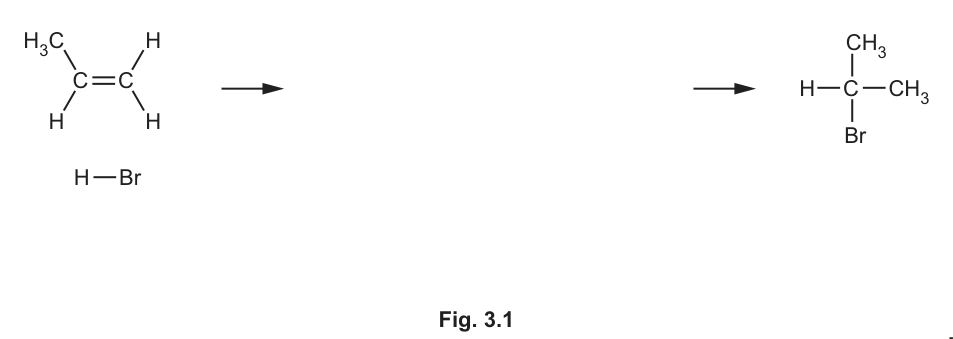
Answer
Step 1: Curly arrow from the C=C double bond to the H atom of H–Br.
Step 2: Curly arrow from the H–Br bond to the Br atom (H has , Br has ).
Intermediate: Secondary carbocation and .
Step 3: Curly arrow from a lone pair on to the of the carbocation.
Electrophilic addition mechanism: curly arrow from C=C to H of HBr, curly arrow from H-Br bond to Br (with dipole shown), secondary carbocation intermediate, curly arrow from Br⁻ lone pair to C⁺.
Background Concept
Electrophilic addition is the characteristic reaction of alkenes. The π-bond of C=C is a region of high electron density and acts as a nucleophile (electron-pair donor). The H–Br molecule is polarised () because bromine is more electronegative than hydrogen, so the H acts as the electrophile. The mechanism proceeds in two stages: (1) the π-electrons attack the electrophilic H, breaking the H–Br bond heterolytically to form a carbocation and Br⁻; (2) the Br⁻ (nucleophile) donates a lone pair to the electron-deficient carbocation carbon, forming the C–Br bond.
Understanding the Question
The question asks you to complete a given framework (Fig. 3.1) showing the mechanism for forming specifically 2-bromopropane. You must include charges, dipoles, lone pairs, and curly arrows. Four marks are available for four distinct features.
Approach
Identify the three stages: (1) attack of π-bond on H, (2) heterolytic cleavage of H–Br, (3) attack of Br⁻ on carbocation. Draw each with correct curly arrows (always from electron source to electron-poor site).
Step-by-Step Reasoning
M1 — Curly arrow from C=C to H: The double bond (π-electrons) is the electron source. The H of HBr is electron-poor () due to the polarisation of the H–Br bond. So the arrow starts at the C=C bond and points to H.
M2 — Curly arrow from H–Br bond to Br: When H accepts the electron pair from the π-bond, the H–Br bond must break. Both electrons in that bond go to Br (heterolytic fission), so the arrow starts on the H–Br bond and points to Br. The dipole ( on H, on Br) must be shown to justify why the bond breaks this way.
M3 — Correct intermediate: The carbocation must be the secondary one: (2-bromopropane precursor). The positive charge is on the central carbon. Br⁻ is shown separately with its lone pairs and negative charge.
M4 — Curly arrow from Br⁻ lone pair to C⁺: The bromide ion is the nucleophile; it donates a lone pair to the electron-deficient carbocation carbon.
Key Takeaways
- Curly arrows always show movement of electron pairs (from source to destination)
- The dipole on HBr must be shown to justify the direction of bond breaking
- The secondary carbocation is the intermediate for 2-bromopropane
- Lone pairs on Br⁻ are the electron source for the second step
Common Mistakes
- Drawing the curly arrow from H to the C=C (wrong direction — arrows go from electrons to electron-poor site)
- Omitting the dipole on HBr (required for M2)
- Drawing a primary carbocation instead of secondary
- Not showing lone pairs on Br⁻
- Drawing the arrow from the C⁺ to Br⁻ (backwards)
Things to Be Careful About
- The dipole is essential for M2 — without it, that mark is lost
- The intermediate must show the + charge clearly on the correct carbon
- Lone pairs must be visible on Br⁻ for M4 to be awarded
Explain why the major product of this reaction is 2-bromopropane rather than 1-bromopropane.
Answer
- The secondary carbocation intermediate (leading to 2-bromopropane) is more stable than the primary carbocation (leading to 1-bromopropane).
- This is because the central C⁺ has two methyl groups attached, which donate electron density by the positive inductive effect, stabilising the positive charge more effectively than the single ethyl group in the primary carbocation.
The secondary carbocation is more stable due to the positive inductive effect of two methyl groups (rather than one ethyl group), so it forms preferentially, leading to 2-bromopropane as the major product.
Background Concept
When an unsymmetrical alkene reacts with a polar molecule like HBr, two possible carbocation intermediates can form. Markovnikov's rule states that the major product is the one formed via the more stable carbocation. Carbocation stability increases with the number of alkyl groups attached to the positively charged carbon (tertiary > secondary > primary) because alkyl groups have a positive inductive effect (+I): they push electron density towards the electron-deficient carbon, dispersing the positive charge.
Understanding the Question
The question asks WHY 2-bromopropane is the major product rather than 1-bromopropane. Two marks are available: one for identifying the more stable intermediate, and one for explaining WHY it is more stable (the inductive effect of alkyl groups).
Approach
Compare the two possible carbocations: secondary (from 2-bromopropane pathway) vs primary (from 1-bromopropane pathway). Explain the stability difference using the inductive effect.
Step-by-Step Reasoning
M1 — More stable intermediate: The pathway to 2-bromopropane involves a secondary carbocation , while the pathway to 1-bromopropane involves a primary carbocation . The secondary carbocation is more stable, so it forms faster (lower activation energy for its formation), and is therefore the major intermediate.
M2 — Inductive effect explanation: The central carbon in the secondary carbocation has TWO methyl groups attached. Each methyl group exerts a positive inductive effect, pushing electron density towards the C⁺ and stabilising the charge. In the primary carbocation, only ONE ethyl group is attached to the C⁺, providing less stabilisation. Two methyl groups give greater total +I effect than one ethyl group.
Key Takeaways
- Markovnikov's rule is explained by carbocation stability
- More alkyl groups on C⁺ = more stable = major product
- The positive inductive effect is the physical basis for this stability ordering
- It is the NUMBER of alkyl groups directly attached to C⁺ that matters
Common Mistakes
- Saying 'the secondary carbocation is more stable because it has more carbon atoms' — this is vague; you must mention the inductive effect
- Saying 'tertiary is more stable than secondary' — irrelevant here since neither pathway gives a tertiary carbocation
- Confusing the inductive effect with hyperconjugation (while hyperconjugation is the real physical explanation, at AS level the inductive effect is what is expected)
- Saying '2 methyl groups are better than 1 ethyl group' without mentioning the inductive effect
Things to Be Careful About
- You must explicitly mention the inductive effect (or electron-donating effect of alkyl groups) for M2
- The comparison should be between the two relevant carbocations, not a general statement about stability
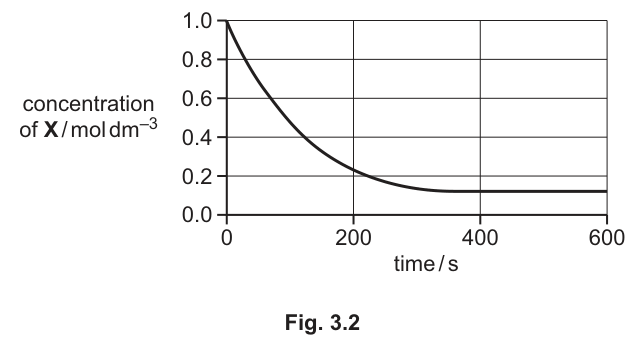
and nickel are added to alkene X. Fig. 3.2 shows how the concentration of X changes with time.
Answer
is the limiting reagent. The concentration of X does not fall to zero (it levels off at approximately 0.12 mol dm), so some X remains unreacted at the end, meaning must have been used up first.
H₂ is the limiting reagent because some X (alkene) remains at the end (concentration does not reach zero).
Background Concept
In a reaction between two reagents, the limiting reagent is the one that is completely consumed first, stopping the reaction. On a concentration-time graph, the limiting reagent's concentration falls to zero, while the excess reagent's concentration levels off at a non-zero value.
Understanding the Question
Fig. 3.2 shows the concentration of alkene X decreasing with time. The curve levels off at approximately 0.12 mol dm⁻³ and does NOT reach zero. The question asks you to identify the limiting reagent and explain your reasoning.
Approach
If X's concentration doesn't reach zero, X is in excess. Therefore H₂ must be the limiting reagent (it ran out first, preventing further reaction of X).
Step-by-Step Reasoning
The graph shows [X] starting at 1.0 mol dm⁻³ and decreasing to about 0.12 mol dm⁻³, then remaining constant. Since [X] ≠ 0 at the end, X was not fully consumed. The reaction stopped because the other reactant (H₂) was used up. Therefore H₂ is the limiting reagent.
Key Takeaways
- The reagent whose concentration does NOT reach zero is in excess
- The reaction stops when the limiting reagent is exhausted
- A plateau on a concentration-time graph indicates reaction completion
Common Mistakes
- Saying X is the limiting reagent because its concentration decreased (it decreased but didn't reach zero)
- Not providing the explanation (the mark requires both identification AND reasoning)
Things to Be Careful About
The mark scheme requires BOTH parts: naming H₂ as limiting AND stating that X remains. Either alone is insufficient.
Use Fig. 3.2 to describe how the gradient changes as the reaction proceeds. State what this shows about the rate during this reaction.
Answer
The gradient (slope) of the curve decreases with time (becomes less steep). Since the gradient represents the rate of reaction, this shows that the rate decreases as the reaction proceeds, eventually reaching zero when the gradient becomes zero (horizontal line).
The gradient decreases over time, showing that the rate of reaction decreases as the reaction proceeds.
Background Concept
On a concentration-time graph, the gradient at any point equals the instantaneous rate of reaction. A steep gradient means a fast reaction; a shallow gradient means a slow reaction. As reactants are consumed, their concentration decreases, leading to fewer successful collisions per unit time, so the rate falls.
Understanding the Question
The question asks you to describe how the gradient changes and state what this tells you about the rate. One mark is available for linking the gradient change to the rate change.
Approach
Observe that the curve starts steep and becomes progressively flatter. State that gradient = rate, so decreasing gradient means decreasing rate.
Step-by-Step Reasoning
At t = 0, the curve is steep (large negative gradient) → high initial rate. As time progresses, the curve becomes less steep → rate decreases. Eventually the curve becomes horizontal (gradient = 0) → rate = 0 (reaction has stopped, limiting reagent exhausted). The mark scheme accepts either 'as gradient decreases, rate decreases' or 'rate decreases until the reaction stops when gradient = 0'.
Key Takeaways
- Gradient of concentration-time graph = rate at that moment
- Decreasing gradient = decreasing rate
- Zero gradient = reaction has stopped
- The rate decreases because reactant concentration decreases (fewer collisions)
Common Mistakes
- Saying 'the concentration decreases' without linking it to gradient and rate
- Confusing the shape of the curve with the rate (the curve is concave up, but the key feature is that it gets less steep)
Things to Be Careful About
You must explicitly link the gradient to the rate — describing the curve shape alone without mentioning what it means for the rate will not earn the mark.
Hydrocarbon Y contains two groups. There are no other functional groups present.
Y reacts with an excess of to produce hexane, .
Table 3.1
| bond | energy/ |
|---|---|
| C−C | 350 |
| C=C | 610 |
| C≡C | 840 |
| H−H | 436 |
| C−H | 410 |
Use Table 3.1 to calculate the enthalpy change per mole of produced in this reaction.
Working
Y is a diene with two C=C bonds that hydrogenates to hexane (C₆H₁₄), so Y = C₆H₁₀.
Only bonds that change need be considered:
Bonds broken:
Bonds made:
Answer
kJ mol
-248 kJ mol⁻¹
Background Concept
Enthalpy change can be calculated from bond energies using: ΔH = Σ(bonds broken) − Σ(bonds made). Bond breaking is endothermic (energy absorbed) and bond making is exothermic (energy released). Only bonds that actually change between reactants and products need be considered — bonds that are present in both and unchanged cancel out.
Understanding the Question
Hydrocarbon Y has two C=C groups and no other functional groups. It reacts with excess H₂ to produce hexane (C₆H₁₄). We must first deduce Y's molecular formula, then calculate ΔH per mole of hexane produced using the given bond energies.
Approach
- Deduce Y's formula: hexane is C₆H₁₄. Adding 2H₂ (4 H atoms) to Y gives C₆H₁₄, so Y = C₆H₁₀ (a diene).
- Identify bonds that change: two C=C become two C-C, and two H-H become four C-H.
- Apply ΔH = bonds broken − bonds made.
Step-by-Step Reasoning
Deducing Y: C₆H₁₄ − 2H₂ = C₆H₁₀. This is a diene (two C=C bonds, consistent with the question statement).
Bonds broken (reactants side, bonds that disappear):
- 2 × C=C: 2 × 610 = 1220 kJ mol⁻¹
- 2 × H–H: 2 × 436 = 872 kJ mol⁻¹
- Total broken = 2092 kJ mol⁻¹
Bonds made (products side, new bonds formed):
- Each C=C → C-C conversion creates 1 additional C–C bond (the π-bond becomes a σ-bond to H). Two C=C → two C-C: 2 × 350 = 700 kJ mol⁻¹
- Each H adds to form a C–H bond. Four H atoms added (2 from each H₂): 4 × 410 = 1640 kJ mol⁻¹
- Total made = 2340 kJ mol⁻¹
ΔH = 2092 − 2340 = −248 kJ mol⁻¹
The negative sign confirms the reaction is exothermic, as expected for hydrogenation.
Key Takeaways
- ΔH = Σ(bonds broken) − Σ(bonds made)
- Only bonds that change need be considered (the 'shortcut' method)
- Hydrogenation of alkenes/dienes is always exothermic
- Deduce the unknown formula from the product and the known stoichiometry
Common Mistakes
- Forgetting that each C=C → C-C change also creates 2 new C-H bonds (total 4 C-H for two C=C)
- Using the full bond count for both molecules (Method 1 in the mark scheme) and making arithmetic errors
- Getting the sign wrong (bonds made − bonds broken instead of the correct order)
- Not realising Y is C₆H₁₀ (a diene with 2 C=C bonds)
Things to Be Careful About
- The question asks for ΔH per mole of C₆H₁₄ produced, so the stoichiometry must be 1:1 with hexane
- The mark scheme accepts either the full method or the shortcut; both give −248 kJ mol⁻¹
- Units must be kJ mol⁻¹
Hydrocarbon Y reacts with .
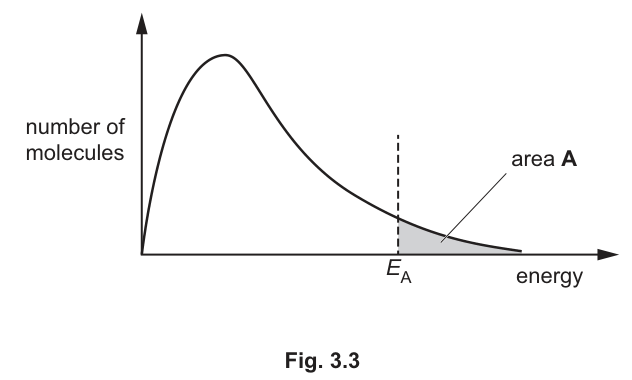
Fig. 3.3 shows the distribution of energies of at temperature .
Area A represents the number of molecules with energy greater than or equal to the activation energy, , at temperature .
Answer
A new, lower (labelled ) is marked to the LEFT of the original on the energy (x) axis. The curve shape remains unchanged (same temperature).
A lower E_A is marked to the left of the original E_A on the x-axis of the Maxwell-Boltzmann distribution.
Background Concept
A catalyst provides an alternative reaction pathway with a lower activation energy (). On a Maxwell-Boltzmann distribution curve, this is shown by moving the marker to the left on the energy axis. The curve itself does NOT change shape (because the temperature is unchanged — the distribution of molecular energies depends only on temperature). What changes is the proportion of molecules with energy ≥ the new, lower .
Understanding the Question
The question asks you to annotate the given Maxwell-Boltzmann curve (Fig. 3.3) to show the effect of adding nickel (a catalyst for hydrogenation) at the same temperature T. One mark is available.
Approach
Draw a new vertical dashed line to the LEFT of the original line on the x-axis, and label it as the catalysed .
Step-by-Step Reasoning
- The original line is already shown on Fig. 3.3.
- Adding a catalyst lowers but does NOT change the energy distribution (temperature is constant).
- So we keep the same curve and add a new marker to the left of the original.
- The area under the curve to the right of the new will be larger than area A.
Key Takeaways
- Catalyst lowers → shown by moving the marker leftward
- The MB curve shape is unchanged (same temperature)
- A larger proportion of molecules now exceed the (lower)
Common Mistakes
- Changing the shape of the curve (this would represent a temperature change, not catalysis)
- Drawing the new to the RIGHT (that would mean higher activation energy)
- Not labelling the new clearly
Things to Be Careful About
The curve must remain the same shape — only the position changes. The mark is for showing the new to the left of the original on the x-axis.
Area B (not labelled on Fig. 3.3) represents the number of molecules with energy greater than or equal to the activation energy when nickel is added at temperature .
State the difference, if any, between areas A and B. Explain the significance of your answer on the rate of hydrogenation of Y. Give your answer in terms of collisions.
Answer
- Area B is larger than area A, so the rate of hydrogenation increases.
- This is because a greater proportion of molecules now have energy ≥ the (lower) activation energy, leading to an increase in the frequency of effective (successful) collisions.
B is larger than A; rate increases due to increased frequency of effective collisions.
Background Concept
On a Maxwell-Boltzmann distribution, the area under the curve to the right of represents the fraction (or number) of molecules with sufficient energy to react. When a catalyst lowers , this area increases — meaning more molecules can react per unit time. In collision theory terms, the rate depends on the frequency of effective collisions (collisions with energy ≥ and correct orientation). More molecules exceeding the lower means more effective collisions per second, hence a faster rate.
Understanding the Question
Area A = molecules with energy ≥ original . Area B = molecules with energy ≥ catalysed (lower) . The question asks: (1) the difference between A and B, and (2) the significance for rate, expressed in terms of collisions. Two marks.
Approach
State that B > A (the lower means more molecules qualify). Then link this to collision theory: more molecules with sufficient energy → more effective collisions → faster rate.
Step-by-Step Reasoning
M1 — B larger, rate increases: Since the catalysed is lower (to the left), the area to its right (B) is necessarily larger than the area to the right of the original (A). A larger area means more molecules can react, so the rate increases.
M2 — Frequency of effective collisions: The increased area B means a greater proportion of molecules have energy ≥ . In collision theory, only collisions with energy ≥ are 'effective' (can lead to reaction). With more such molecules present, the frequency of effective collisions increases, explaining the higher rate.
Key Takeaways
- Lower → larger area under MB curve to the right → more molecules can react
- Rate increase is explained by increased frequency of effective collisions
- The total number of collisions doesn't change (same temperature, same concentration) — what changes is the proportion that are effective
Common Mistakes
- Saying 'more collisions occur' (wrong — total collision frequency is unchanged; it's the proportion that are effective that increases)
- Saying 'the catalyst provides more energy to molecules' (wrong — catalysts lower the energy requirement, they don't increase molecular energies)
- Not linking the area difference to collisions (the question specifically asks for an answer 'in terms of collisions')
Things to Be Careful About
- You must use the word 'effective' or 'successful' when describing collisions
- The explanation must be in terms of collisions as the question specifies
- Don't confuse this with the temperature effect (where the curve shape changes)
Alkene Z contains two bonds. Z reacts with an excess of hot concentrated acidified to produce only , , and .
Suggest the structure of Z.
Working
Hot concentrated acidified cleaves each C=C bond:
- → ketone
- → carboxylic acid
- →
From the products:
- (propanone) → one end was
- (propanedioic acid) → middle fragment was
- → other end was
Assembling the two C=C bonds:
Answer
(5-methylhexa-1,4-diene)
CH₂=CHCH₂CH=C(CH₃)₂ (5-methylhexa-1,4-diene)
Background Concept
Hot concentrated acidified potassium manganate(VII) is a powerful oxidising agent that cleaves C=C double bonds completely. Each carbon of the double bond is oxidised based on its substituents:
- If the carbon has two alkyl groups (R₂C=), it becomes a ketone (R₂C=O)
- If the carbon has one alkyl group and one H (RCH=), it becomes a carboxylic acid (RCOOH)
- If the carbon has two H atoms (=CH₂), it becomes CO₂ (+ H₂O)
For a diene with two C=C bonds, both are cleaved, giving up to four fragments (though some may be on the same carbon chain if the two C=C bonds are separated by a saturated chain).
Understanding the Question
Z has exactly two C=C bonds and no other functional groups. Oxidative cleavage gives ONLY propanone, propanedioic acid (HOOCCH₂COOH), CO₂, and H₂O. We must deduce Z's structure by working backwards from these fragments.
Approach
- Identify what each product tells us about the C=C carbon that produced it.
- Assign fragments to the two ends of each C=C bond.
- Assemble the complete molecule.
Step-by-Step Reasoning
Propanone (CH₃COCH₃): This is a ketone, so one carbon of a C=C had two methyl groups:
CO₂: This comes from a terminus (carbon with two H's).
HOOCCH₂COOH (propanedioic acid): This is a dicarboxylic acid. Each COOH group came from a =CH– carbon (one H, one alkyl chain). The CH₂ in the middle was already saturated. So this fragment must have been between the two C=C bonds:
Assembling: We need to connect to and to :
Written from the other end:
Verification:
- First C=C: → propanone + ✓
- Second C=C: → + CO₂ ✓
- Middle: HOOCCH₂COOH ✓
Key Takeaways
- Oxidative cleavage of alkenes is a powerful structural determination tool
- Work backwards: each product tells you the substitution pattern of the C=C carbon
- A dicarboxylic acid product means the =CH– fragment was between two C=C bonds
- The number of products tells you how many C=C bonds were cleaved
Common Mistakes
- Putting the two C=C bonds adjacent (conjugated diene) — this would not give the observed products
- Forgetting that CO₂ comes from a terminal =CH₂ group
- Not realising HOOCCH₂COOH must be the middle fragment (connected to both C=C bonds)
- Drawing a structure with the wrong number of carbons (must total 6)
Things to Be Careful About
- The question says 'only' these products, so no other fragments are possible
- Z must have exactly two C=C bonds and nothing else
- The molecular formula must be C₆H₁₀ (check: 6 carbons, 10 hydrogens for a diene)
Propanoic acid, , reacts with reducing agent Q to produce propan-1-ol, .
Answer
LiAlH (lithium tetrahydridoaluminate(III), in dry ether)
LiAlH4
Background Concept
Carboxylic acids are strongly resistant to mild reducing agents: NaBH will reduce aldehydes and ketones but NOT carboxylic acids. The stronger hydride-donor LiAlH is required, delivering four hydride equivalents per molecule, followed by an aqueous/acidic work-up that protonates the alkoxide to give the primary alcohol.
Understanding the Question
'Suggest the formula' means recall which reagent reduces to the primary alcohol propan-1-ol.
Approach
Match the transformation (carboxylic acid primary alcohol) to the only reducing agent in the AS syllabus capable of it.
Step-by-Step Reasoning
The C=O of a carboxylic acid must be fully reduced to a group. LiAlH provides (hydride) ions strong enough to reduce the acid; NaBH is not strong enough. So Q = LiAlH.
Key Takeaways
- LiAlH reduces carboxylic acids (and aldehydes/ketones/esters) to alcohols.
- NaBH reduces aldehydes/ketones only — a classic discrimination point.
Common Mistakes
- Writing NaBH — it does not reduce carboxylic acids.
- Writing H/Ni — hydrogenation reduces C=C, not the acid group under these conditions.
Things to Be Careful About
Give the formula LiAlH clearly; the mark is for the formula, so a name alone may not suffice.
Complete the equation to show the reduction of propanoic acid to propan-1-ol. Use [H] to represent one atom of hydrogen from Q.
Answer
CH3CH2COOH + 4[H] -> CH3CH2CH2OH + H2O
Background Concept
Reducing a carboxylic acid to a primary alcohol requires adding two hydrogen atoms to the carbonyl carbon and two to the oxygen of the OH group — four [H] in total. One oxygen is removed as water.
Understanding the Question
Complete the given equation skeleton using [H] for hydrogen atoms delivered by LiAlH, balancing all species.
Approach
Compare atoms on both sides: the acid has 2 oxygens, the alcohol has 1, so one O leaves as HO. Count hydrogens needed: 4 [H] supply the two new C–H/O–H hydrogens plus the two in the water.
Step-by-Step Reasoning
- : the extra H goes on carbon and the OH gains an H.
- Oxygen balance: 2 O on left, 1 in alcohol + 1 in HO on right. ✓
- Hydrogen balance: left 6 (from CHCH) + 1 (COOH) = 8; right 7 (alcohol) + 2 (HO) = 9, so 1... recount: acid H = 3+2+1 = 6; alcohol H = 3+2+2+1 = 8; water H = 2. Right total = 10, left = 6, so 4 [H] needed. ✓
Key Takeaways
Reduction of RCOOH to RCHOH is a 4[H] process with one O expelled as water.
Common Mistakes
- Using 2[H] instead of 4[H] (that would only reduce an aldehyde).
- Omitting the HO product, leaving the equation unbalanced.
Things to Be Careful About
Check the H count explicitly; the mark requires the fully balanced equation including water.
Propan-1-ol is converted to compound T in a three-step synthesis.
In step 1, is added to propan-1-ol to produce compound E.
In step 2, E reacts with a suitable reagent to produce butanenitrile.
In step 3, butanenitrile is heated with .
Answer
Substitution (the –OH group of propan-1-ol is replaced by –Cl, giving 1-chloropropane, compound E).
substitution
Background Concept
Thionyl chloride, SOCl, converts an alcohol's –OH into a chloroalkane: . The –OH is substituted by –Cl.
Understanding the Question
Name the type of reaction in step 1 where propan-1-ol becomes compound E (1-chloropropane).
Approach
Recognise that a functional group (–OH) has been replaced by another (–Cl) — the definition of substitution.
Step-by-Step Reasoning
The C–O bond is broken and a C–Cl bond formed with no change to the carbon skeleton, so the reaction is nucleophilic substitution at carbon (often described simply as 'substitution').
Key Takeaways
SOCl (and PCl/PCl) are reagents for alcohol halogenoalkane substitution.
Common Mistakes
Writing 'addition' or 'elimination' — no atoms are added across a bond, and no small molecule is eliminated from the alcohol to form a double bond.
Things to Be Careful About
'Substitution' alone earns the mark; 'nucleophilic substitution' is also accepted.
Answer
KCN (potassium cyanide) dissolved in ethanol, heated (under reflux).
KCN in ethanol, heat
Background Concept
Halogenoalkanes undergo nucleophilic substitution with cyanide ions: . The CN nucleophile lengthens the carbon chain by one, converting 1-chloropropane (C3) into butanenitrile (C4). KCN is used in ethanolic solution so the organic halogenoalkane dissolves; heating provides the activation energy.
Understanding the Question
Step 2 turns E (1-chloropropane) into butanenitrile — identify the reagent and conditions.
Approach
Chain extension by one carbon via CN substitution: KCN/ethanol/heat.
Step-by-Step Reasoning
- The nucleophile must be CN, supplied by KCN (or NaCN).
- Ethanol is the solvent because the halogenoalkane is organic and poorly soluble in water; aqueous KCN would favour substitution by OH instead.
- Heat (reflux) is needed for a reasonable rate.
Key Takeaways
KCN in ethanol + heat = chain extension by one C; KCN in aqueous ethanol vs alcoholic NaOH distinctions matter.
Common Mistakes
- Omitting 'ethanol' or 'heat' — both are required.
- Using HCN — too weak a source of CN (very weak acid, poor nucleophile supply).
Things to Be Careful About
The mark requires BOTH the reagent (KCN) AND the conditions (ethanol, heat).
Answer
CH3CH2CH2CN + NaOH + H2O -> CH3CH2CH2CO2Na + NH3
Background Concept
Nitriles are hydrolysed by aqueous acid or alkali. With hot aqueous NaOH, the CN is hydrolysed to a carboxylate salt plus ammonia: . The nitrogen leaves as NH under alkaline conditions (under acidic conditions it would be the ammonium ion).
Understanding the Question
Construct the balanced equation for butanenitrile () heated with NaOH(aq).
Approach
Write the carbon skeleton R = –, convert CN to CONa, put nitrogen out as NH, then balance with NaOH and HO.
Step-by-Step Reasoning
- Organic product: sodium butanoate, (M1).
- Balance: left has N (in CN), right needs NH — 3 H required. NaOH supplies Na and one O–H; HO supplies the remaining H and O. Count: C 4=4, H 5+1+2=8 vs 5+3=8, N 1=1, O 1+1=2 vs 2, Na 1=1. Balanced (M2).
- Alternative accepted form: .
Key Takeaways
Alkaline hydrolysis of a nitrile gives the carboxylate salt + NH; acidic hydrolysis gives the free acid + NH.
Common Mistakes
- Writing the free acid instead of the sodium salt in alkaline conditions.
- Writing NH or NHCl instead of NH under alkaline conditions.
- Forgetting HO as a reactant, leaving the equation unbalanced.
Things to Be Careful About
Butanenitrile is (4 carbons total) — do not write propanenitrile. Both marks depend on the correct organic product first, then the rest of the equation.
Answer
Hydrolysis (specifically alkaline hydrolysis).
(alkaline) hydrolysis
Background Concept
Hydrolysis is the splitting of a molecule by reaction with water; here NaOH(aq) provides the hydroxide that cleaves the CN, so it is alkaline hydrolysis.
Understanding the Question
Name the type of reaction in step 3.
Approach
Water/alkali breaks the nitrile into a carboxylate and ammonia — hydrolysis.
Step-by-Step Reasoning
The nitrile is cleaved by OH/HO into two fragments (carboxylate and NH), the defining feature of hydrolysis; the alkaline medium makes it alkaline hydrolysis.
Key Takeaways
Nitrile + hot aqueous acid or alkali = hydrolysis to carboxylic acid (or its salt).
Common Mistakes
Writing 'substitution' or 'neutralisation' — the mark requires hydrolysis.
Things to Be Careful About
'Hydrolysis' alone is sufficient; 'alkaline hydrolysis' is the most precise answer.
Compounds A, B and C belong to the alcohol homologous series. Each molecule of A, B and C contains four saturated carbon atoms.
Identify the type of hybridisation shown in the saturated carbon atoms of all alcohols.
Answer
sp hybridisation (tetrahedral arrangement, bond angles ).
sp3
Background Concept
A saturated carbon forms four sigma bonds with no multiple bonds. It uses four sp hybrid orbitals (one s + three p mixed), giving a tetrahedral geometry with bond angles of about 109.5°. sp applies to C=C carbons and sp to triple-bonded carbons.
Understanding the Question
Identify the hybridisation of the saturated carbons in alcohols A, B and C.
Approach
'Saturated' means only single bonds four bonds sp.
Step-by-Step Reasoning
Each carbon in the alcohols has four single bonds (to H, C or O), so each mixes its 2s and three 2p orbitals into four sp hybrids.
Key Takeaways
saturated C = sp; C=C = sp; CC = sp.
Common Mistakes
Writing sp by confusing alcohols with alkenes.
Things to Be Careful About
The oxygen in the alcohol is also effectively sp (two lone pairs), but the question asks about the carbon atoms.
Answer
Hydrogen, H (e.g. ).
hydrogen / H2
Background Concept
Alcohols, like water, have an O–H bond; reactive metals such as Na displace hydrogen: . The reaction is slower than with water because alcohols are weaker acids than water.
Understanding the Question
Name the gas evolved when Na(s) is added to each alcohol.
Approach
Metal + O–H compound H gas.
Step-by-Step Reasoning
Na donates an electron to the acidic O–H hydrogen, releasing H atoms that pair to form H; the sodium alkoxide (e.g. sodium butoxide) remains dissolved/suspended.
Key Takeaways
Na + alcohol sodium alkoxide + H; effervescence is observed.
Common Mistakes
Saying O or naming the alkoxide as the gas.
Things to Be Careful About
The gas is hydrogen — test with a lit splint (squeaky pop).
Answer
Na acts as a reducing agent — it donates electrons to the alcohol (reducing the alcohol / its O–H group).
Na is a reducing agent; it donates electrons to the alcohol
Background Concept
A reducing agent is the species that is itself oxidised (loses electrons) while reducing another species. Sodium, with one easily lost valence electron, is a powerful reducing agent: .
Understanding the Question
'Describe the role' — state what chemical function Na performs when reacting with alcohols.
Approach
Frame the Na + ROH reaction in redox language: Na loses electrons, the alcohol gains them.
Step-by-Step Reasoning
Na is oxidised to Na, transferring electrons to the alcohol; the alcohol (via its O–H) is reduced. Hence Na is the reducing agent (electron donor). The mark scheme accepts: 'Na reduces the alcohol', 'Na behaves as a reducing agent', or 'Na donates electrons to the alcohol'.
Key Takeaways
Reducing agent = electron donor = species oxidised itself.
Common Mistakes
Calling Na an 'oxidising agent' — it is the opposite; Na is oxidised.
- Saying Na is 'a catalyst' — it is consumed in the reaction.
Things to Be Careful About
The mark requires the redox role (reducing agent / electron donor), not merely 'it reacts vigorously'.
Table 4.1 shows the results of two tests on separate samples of A, B and C.
Table 4.1
| compound | heat under reflux with acidified | warm with alkaline |
|---|---|---|
| A | remains orange | no visible change |
| B | orange to green | no visible change |
| C | orange to green | pale yellow precipitate |
Answer
A is not oxidised by acidified (stays orange) and gives no iodoform reaction, so A is a tertiary alcohol: (CH)COH, 2-methylpropan-2-ol (tert-butanol).
(CH3)3COH (2-methylpropan-2-ol)
Background Concept
Acidified dichromate(VI) (orange) oxidises primary alcohols to aldehydes/acids and secondary alcohols to ketones, being reduced to green Cr. Tertiary alcohols have no C–H on the carbinol carbon and resist oxidation, so the reagent stays orange. The tri-iodomethane (iodoform) test with I/NaOH gives a pale yellow CHI precipitate only for alcohols containing the – group (and methyl ketones).
Understanding the Question
Use Table 4.1: A stays orange (no oxidation) and shows no visible change with I/NaOH (no iodoform). Deduce A's structure, given A is a saturated C4 alcohol.
Approach
No oxidation tertiary alcohol. Among C4 alcohols, the only tertiary one is 2-methylpropan-2-ol. Cross-check: it lacks the – group, consistent with the negative iodoform test.
Step-by-Step Reasoning
- Orange orange means dichromate is not reduced A is not oxidised tertiary alcohol.
- C4 tertiary alcohol: central C bonded to OH and three CH groups = (CH)COH.
- Negative iodoform test confirms no – group. ✓
Key Takeaways
Dichromate distinguishes 1°/2° (green) from 3° (stays orange); iodoform identifies –.
Common Mistakes
- Suggesting butan-1-ol or butan-2-ol — both would turn dichromate green.
- Confusing 'no visible change' in the iodoform test with a positive result.
Things to Be Careful About
Write the structure clearly: (CH)COH; the name 2-methylpropan-2-ol is also acceptable.
Answer
B is oxidised (orange green) but gives no iodoform precipitate, so B is a primary alcohol without the – group: butan-1-ol (or 2-methylpropan-1-ol).
butan-1-ol (or 2-methylpropan-1-ol)
Background Concept
Primary alcohols are oxidised by acidified dichromate (orange green). The iodoform test is positive only for alcohols with the – group. A primary alcohol whose OH carbon is not adjacent to a CH in the required arrangement gives a negative iodoform test.
Understanding the Question
B: oxidised by dichromate, negative iodoform. Name a possible C4 alcohol for B.
Approach
Oxidised 1° or 2°. Negative iodoform excludes butan-2-ol. Remaining C4 candidates: butan-1-ol and 2-methylpropan-1-ol.
Step-by-Step Reasoning
- Orange green: B is oxidised primary or secondary.
- No yellow precipitate with I/NaOH: B lacks – not butan-2-ol.
- So B is butan-1-ol () or 2-methylpropan-1-ol (); either name scores.
Key Takeaways
Dichromate-positive + iodoform-negative = primary alcohol without the methyl-carbinol group.
Common Mistakes
Naming butan-2-ol — it would give a positive iodoform test (pale yellow precipitate).
Things to Be Careful About
Any correct primary C4 alcohol name is accepted; butan-2-ol is reserved for C (part iii).
Answer
C is oxidised AND gives a pale yellow precipitate (iodoform), so C contains the – group: butan-2-ol, .
butan-2-ol / CH3CH2CH(OH)CH3
Background Concept
The iodoform reaction: alkaline I oxidises alcohols containing – to the methyl ketone, then cleaves it to give pale yellow CHI (tri-iodomethane) precipitate. Secondary alcohols with this motif (e.g. butan-2-ol) are both oxidised by dichromate and iodoform-positive.
Understanding the Question
C: orange green (oxidised) and pale yellow precipitate (iodoform positive). Identify C among C4 alcohols.
Approach
Both tests positive secondary alcohol with the – unit butan-2-ol.
Step-by-Step Reasoning
- Oxidised 1° or 2° alcohol.
- Iodoform positive – group present.
- C4 secondary alcohol with that group: = butan-2-ol.
Key Takeaways
The iodoform test uniquely identifies the – (or –) unit.
Common Mistakes
- Naming butan-1-ol — it is iodoform-negative despite being oxidised.
- Naming (CH)COH — tertiary, not oxidised.
Things to Be Careful About
Give either the name 'butan-2-ol' or the structure ; the mark is cao for this compound.
The structure of vitamin C is shown in Fig. 5.1.
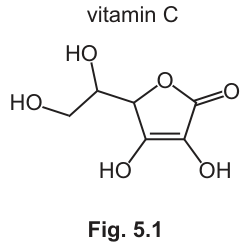
Answer
CHO
C3H4O3
Background Concept
A molecular formula shows the actual number of atoms of each element in one molecule of a compound. An empirical formula shows the simplest whole-number ratio of these atoms. To convert a molecular formula to an empirical formula, you divide all the subscripts by their greatest common divisor.
Understanding the Question
The question provides the displayed (structural) formula of vitamin C (ascorbic acid) and asks for its empirical formula. You must count every atom in the structure—including those on hydroxyl (–OH) groups and implicit hydrogens on ring carbons—and then reduce the ratio to its simplest form.
Approach
- Count the total number of carbon (C), hydrogen (H), and oxygen (O) atoms in the displayed structure.
- Write the molecular formula.
- Divide all subscripts by their highest common factor to obtain the empirical formula.
Step-by-Step Reasoning
- Count carbons: The five-membered ring contains 4 carbon atoms. The side chain (–CH(OH)–CHOH) contains 2 carbon atoms. Total C = 6.
- Count oxygens: The ring has 1 ether oxygen and 1 carbonyl oxygen (C=O). The ring has 2 enolic hydroxyl groups (–OH). The side chain has 2 hydroxyl groups. Total O = 1 + 1 + 2 + 2 = 6.
- Count hydrogens: The ring CH has 1 H. The two enolic –OH groups have 2 H. The side chain –CH(OH)– has 2 H (1 on C, 1 on O). The terminal –CHOH has 3 H (2 on C, 1 on O). Total H = 1 + 2 + 2 + 3 = 8.
- Molecular formula: CHO.
- Empirical formula: Divide all subscripts by 2 to get CHO.
Key Takeaways
Always remember to count implicit hydrogens on saturated carbons and explicit hydrogens on functional groups like –OH when deducing a formula from a displayed structure.
Common Mistakes
- Forgetting the hydrogen on the ring carbon (C4) that is not part of a double bond or hydroxyl group.
- Miscounting the hydrogens on the side chain.
- Stopping at the molecular formula (CHO) instead of simplifying to the empirical formula.
Things to Be Careful About
Ensure you simplify the ratio fully. CHO is not the empirical formula; CHO is.
The mass of vitamin C present in 150.0 g of lemon is found in an experiment.
stage 1 All the vitamin C in 150.0 g of lemon is extracted and dissolved in water to make of solution L.
stage 2 A sample of solution L is titrated with .
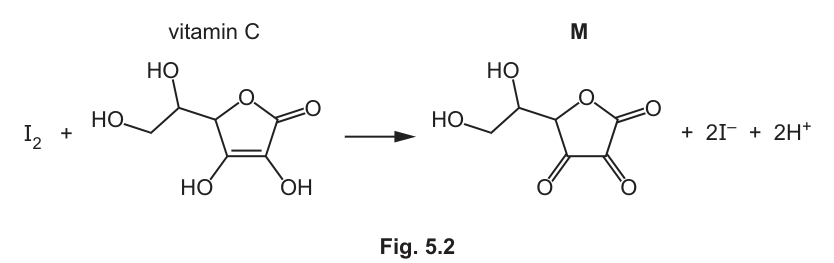
Exactly of reacts with the sample of solution L.
[: vitamin C, 176]
Working
Answer
mol
1.83e-4 mol
Background Concept
In titrations, the amount (in moles) of a solution can be calculated using the equation , where is the amount in moles, is the concentration in mol dm, and is the volume in dm. If the volume is given in cm, it must be divided by 1000 to convert to dm.
Understanding the Question
You are given the concentration of the iodine solution ( mol dm) and the volume used in the titration (36.65 cm). You need to calculate the number of moles of I that reacted.
Approach
- Convert the volume from cm to dm by dividing by 1000.
- Multiply the concentration by the volume in dm to find the moles of I.
Step-by-Step Reasoning
- Volume of I = 36.65 cm = dm = dm.
- Concentration of I = mol dm.
- Moles of I = mol.
- Rounding to 3 significant figures (consistent with the concentration), we get mol. The mark scheme accepts or .
Key Takeaways
Always check your units. Concentration is in mol dm, so volume must be in dm. A common error is forgetting to divide cm by 1000.
Common Mistakes
- Forgetting to convert cm to dm, resulting in an answer that is 1000 times too large.
- Using the wrong number of significant figures.
Things to Be Careful About
Keep full precision in intermediate calculations (e.g., use ) to avoid rounding errors in subsequent parts of the question.
Use your answer to (b)(i) to calculate the percentage by mass of vitamin C present in 150.0 g of lemon.
(If you were unable to calculate a value for the amount of in (b)(i), use the value . This is not the correct value.)
Working
From the equation in Fig 5.2, the molar ratio of vitamin C to I is 1 : 1.
Moles of vitamin C in 25.0 cm sample = mol.
Moles of vitamin C in 100.0 cm of solution L:
Mass of vitamin C in 150.0 g of lemon:
Percentage by mass of vitamin C:
Answer
0.0860 %
0.0860 %
Background Concept
To find the percentage by mass of a substance in a mixture, you need the mass of the substance and the total mass of the mixture. The mass of the substance can be found from its amount in moles and its relative formula mass (). In a titration, the stoichiometry of the reaction allows you to relate the moles of the titrant (I) to the moles of the analyte (vitamin C).
Understanding the Question
You have titrated a 25.0 cm aliquot of a 100.0 cm solution containing all the vitamin C extracted from 150.0 g of lemon. You need to find the total mass of vitamin C in the 150.0 g of lemon and then express it as a percentage.
Approach
- Use the 1:1 molar ratio from the reaction equation to find moles of vitamin C in the 25.0 cm sample.
- Scale up the moles to find the total moles of vitamin C in the 100.0 cm solution.
- Convert moles to mass using the given of vitamin C (176).
- Calculate the percentage by mass: .
Step-by-Step Reasoning
- Moles of I: From part (b)(i), moles of I = mol.
- Moles of vitamin C in 25.0 cm: The reaction is vitamin C + I → M + 2I + 2H. The ratio is 1:1, so moles of vitamin C = mol.
- Total moles of vitamin C in 100.0 cm: The 25.0 cm sample is of the total volume. Total moles = mol.
- Mass of vitamin C: Mass = moles g.
- Percentage by mass: . Rounding to 3 significant figures gives 0.0860%.
Key Takeaways
Always scale up the moles from the aliquot to the total volume before calculating the mass. Do not forget to divide by the total mass of the sample (150.0 g) to get the percentage.
Common Mistakes
- Forgetting to multiply by 4 to account for the full 100.0 cm volume.
- Dividing by the wrong mass (e.g., using 25.0 g instead of 150.0 g).
- Rounding too early in the calculation, leading to a loss of accuracy.
Things to Be Careful About
The mark scheme allows error carried forward (ecf) from part (b)(i). If you used the suggested incorrect value of mol, your mass would be g and the percentage would be . Ensure your final answer has the correct number of significant figures (3 sf is appropriate here).
The progress of the reaction of vitamin C with to produce M is monitored using infrared spectroscopy.
Table 5.1 indicates the presence of some absorptions in the infrared spectrum of vitamin C. Complete Table 5.1 to predict which of these absorptions, if any, are present in the infrared spectrum of M.
Table 5.1
| absorption/ | present in spectrum of vitamin C | present in spectrum of M |
|---|---|---|
| 1500–1680 | ✓ | |
| 2850–2950 | ✓ | |
| 3200–3650 | ✓ |
Table 5.2
| bond | functional groups containing the bond | characteristic infrared absorption range (in wavenumbers)/ |
|---|---|---|
| C–O | hydroxy, ester | 1040–1300 |
| C=C | aromatic compound, alkene | 1500–1680 |
| C=O | amide carbonyl, carboxyl ester | 1640–1690 1670–1740 1710–1750 |
| C≡N | nitrile | 2200–2250 |
| C–H | alkane | 2850–2950 |
| N–H | amine, amide | 3300–3500 |
| O–H | carboxyl hydroxy | 2500–3000 3200–3650 |
Answer
| absorption / cm | present in spectrum of vitamin C | present in spectrum of M |
|---|---|---|
| 1500–1680 | ✓ | ✗ |
| 2850–2950 | ✓ | ✓ |
| 3200–3650 | ✓ | ✓ |
Reasoning:
- 1500–1680 cm: This range corresponds to C=C stretching. Vitamin C has a C=C bond, but compound M has only C=O and C–O bonds in that region (the C=C is oxidised to C=O). Thus, this absorption is not present in M.
- 2850–2950 cm: This range corresponds to C–H stretching (alkane). Both vitamin C and M contain C–H bonds (alkane framework). Thus, this absorption is present in M.
- 3200–3650 cm: This range corresponds to O–H stretching (hydroxy). Vitamin C has hydroxyl groups. Compound M still has hydroxyl groups on the side chain (–CH(OH)–CHOH). Thus, this absorption is present in M.
1500–1680: ✗; 2850–2950: ✓; 3200–3650: ✓
Background Concept
Infrared (IR) spectroscopy identifies functional groups based on the absorption of infrared radiation, which causes bonds to vibrate. Different bond types absorb at characteristic wavenumber ranges:
- C=C (alkene): 1500–1680 cm
- C–H (alkane): 2850–2950 cm
- O–H (hydroxy): 3200–3650 cm
- C=O (carbonyl): 1640–1750 cm
- C–O (hydroxy, ester): 1040–1300 cm
Understanding the Question
You are given the structures of vitamin C and compound M (the product of oxidation by I). You must complete a table indicating which of three IR absorption ranges are present in the spectrum of M. You can use the provided Table 5.2 to match ranges to bonds and functional groups.
Approach
- Identify the bonds present in compound M by comparing its structure to vitamin C.
- Match the bonds in M to the absorption ranges in Table 5.2.
- Determine which absorptions from Table 5.1 will be present or absent in M.
Step-by-Step Reasoning
- 1500–1680 cm (C=C): Vitamin C has a C=C double bond in the ring. In compound M, this C=C bond has been oxidised to two C=O (carbonyl) groups. The C=C bond is gone. Therefore, the absorption at 1500–1680 cm is absent (✗) in M.
- 2850–2950 cm (C–H alkane): Both vitamin C and compound M contain an alkane carbon framework (–CH– and –CH– groups). The C–H bonds are unchanged. Therefore, this absorption is present (✓) in M.
- 3200–3650 cm (O–H hydroxy): Vitamin C has four hydroxyl (–OH) groups. In compound M, the two enolic –OH groups on the ring are oxidised to C=O groups, but the two hydroxyl groups on the side chain (–CH(OH)–CHOH) remain intact. Therefore, an O–H absorption is still present (✓) in M.
Key Takeaways
When comparing IR spectra of reactant and product, focus on which bonds are broken and which are formed. Bonds that remain unchanged will still show their characteristic absorptions.
Common Mistakes
- Assuming that because vitamin C is oxidised, all O–H groups disappear. Remember to check the side chain.
- Confusing the C=C absorption range (1500–1680) with the C=O absorption range (1640–1750). The C=O absorption is not listed in Table 5.1, so you only need to worry about the C=C disappearing.
Things to Be Careful About
Ensure you use the exact symbols (✓ or ✗) requested by the table. A blank or dash may be marked incorrect depending on the examiner's strictness, though the mark scheme accepts ✗, –, or blank for 'not present'.